

Writesonic is one of the most popular AI writing tools for bloggers, marketers, and SEO teams.
In this Writesonic review 2026, we test its features, pricing, SEO workflow, and real content production performance to see whether it is still worth using for modern content marketing.
Scaling content production used to mean a familiar trade-off: either spend heavily on writers and editors, or publish less often and lose momentum.
AI writing tools promised to solve that problem, but in practice many of them still produce repetitive structure, weak factual grounding, and generic copy that needs substantial cleanup before it is usable.
Writesonic has been one of the more established platforms in this category for several years, especially among SEO teams, affiliate publishers, and content marketers. The real question for 2026 is whether it still saves enough time, supports a reliable workflow, and produces strong enough drafts to justify the subscription cost.
To find out, we tested Writesonic across long-form article generation, SEO-focused workflows, and real content production scenarios to see where it helps, where it slows teams down, and where human editing is still necessary.
In this Writesonic review 2026, we break down pricing, workflow, output quality, and practical use cases to evaluate whether the platform still makes sense for bloggers, publishers, and SEO-driven content teams.
We are reader-supported. When you buy through links on our site, we may earn an affiliate commission at no extra cost to you.
⚡ Quick Verdict: Is Writesonic Worth It?
If you are just looking for a free toy to write a couple of personal Instagram captions or generate a funny greeting card, Writesonic is going to feel incredibly overwhelming and entirely overkill. There are free solutions for that.
But if you manage a portfolio of niche blogs, run a content department, launch ad campaigns, or want to figure out how to use Writesonic for SEO on a professional level, this tool remains one of the stronger options in this category. It is not just a “text chatbot”; it is a full-scale content factory that understands search intent and knows how to analyze your top competitors in Google.
There is a learning curve, especially when it comes to training its Brand Voice feature. However, the sheer amount of money you save by firing mediocre writers makes the ROI can make sense quickly for teams producing content regularly. And yes, if you are asking is Writesonic worth it for blogging,
for many blogging and SEO workflows, the answer is yes — but only if you are willing to edit the output and use the platform properly.
✅ What We Love
- ✅ Article Writer 6.0: It doesn’t just write text. It scrapes the top 10 ranking articles of your competitors on Google and builds a competitor-informed outline that can help you produce a more complete draft faster
- ✅ Chatsonic (Live Web Access): Unlike basic models, Chatsonic is hooked directly into Google Search in real-time. it is better positioned to pull fresher context than static AI models, although factual claims still need to be checked before publishing.
- ✅ Brand Voice: You can upload your past articles, and the AI will learn to mimic your unique style, humor, and sentence structure. It can reduce generic phrasing, especially when trained on your own content samples, though the output still needs editing for consistency.
- ✅ Surfer SEO Integration: Seamless connection with the industry’s best SEO optimization tool directly inside the editor window.
❌ Where It Falls Short
- ❌ Complex Credit System: Their accounting for “Premium” versus “Superior” words is incredibly confusing and requires constant budget monitoring.
- ❌ Content Cannibalization Risk: If you generate dozens of articles in one narrow niche in a single day, the AI starts repeating itself, using the same introductory phrases. Human editing is still required.
- ❌ Browser Lag: Generating massive, 3,000+ word long-reads can occasionally cause brief browser lag inside the dashboard.
🏆 OVERALL RATING: ⭐⭐⭐⭐⭐ 4.8 / 5
Best For: SEO specialists, marketing agencies, affiliate site owners, and copywriters needing to scale production without losing quality.
🏗️ What is Writesonic?
Writesonic is better understood as a structured AI content workflow platform rather than a basic chatbot.
Unlike basic chatbots, which often depend heavily on how well you prompt them, Writesonic is built around structured templates and guided workflows. If you need a landing page, blog draft, or YouTube script, the platform gives you a more directed starting point instead of forcing you to build everything from scratch.
Under the hood, Writesonic uses major language models, but the bigger difference is how those models are packaged inside its content workflow. Rather than generating text in a blank-chat format, the platform is designed to support article production, content structure, and SEO-oriented drafting in a more systematic way.
That workflow-first approach is a big part of why Writesonic remains relevant for SEO teams, publishers, and content marketers. It also makes it worth testing in a real production setting, which is exactly what this Writesonic review 2026 is about.
📈 Is Writesonic Good for SEO?
One of the biggest reasons marketers choose Writesonic is its focus on SEO-driven content creation.
The platform analyzes competing pages, generates structured outlines, and provides optimization suggestions during the writing process. This helps teams produce articles that match search intent more effectively.
While it does not guarantee rankings, Writesonic can significantly speed up the workflow for publishers who rely on organic search traffic.
🖥️ Ease of Use & The User Interface
When you log into Writesonic for the first time, the interface is a stark contrast to the minimalism of a blank ChatGPT page.
For beginners, the dashboard can feel slightly cluttered: dozens of cards featuring different tools, from “Facebook Ads” to “Quora Answers.” However, the platform’s logic becomes clear within 10 minutes. You don’t converse with a bot in a chat window (unless you are using the Chatsonic tab); you fill out structured briefs.
For example, to launch its core feature—creating an article—you simply type in your focus keyword. The system automatically suggests titles, builds a structural outline (H2, H3) based on competitor analysis, and allows you to approve the blueprint before generating anything. This removes much of the friction that usually comes with starting from an empty prompt. The workflow is designed to guide users from keyword to outline to draft with much less manual setup than a standard chatbot.
The trade-off is that the dashboard can feel busy at first, especially if you only need one or two core tools.
✍️ Writesonic Editor: How It Works
The Writesonic editor is the central workspace where most content creation happens. Unlike basic AI chat interfaces, the editor is designed to guide users through a structured workflow.
Instead of writing everything manually, users can generate outlines, expand sections, and refine paragraphs directly inside the document editor. The platform also provides suggestions for headings, formatting, and keyword usage.
For SEO-focused teams, this structured editor makes it easier to move from keyword research to a complete article draft without constantly switching tools.
⚙️ Key Features That Actually Work
Most SaaS platforms boast about having hundreds of tools (like useless poetry generators). During our testing, we ignored the vanity features and focused strictly on the tools that actually save hours of manual typing. Here is what makes Writesonic stand out from the noise.
Article Writer 6.0
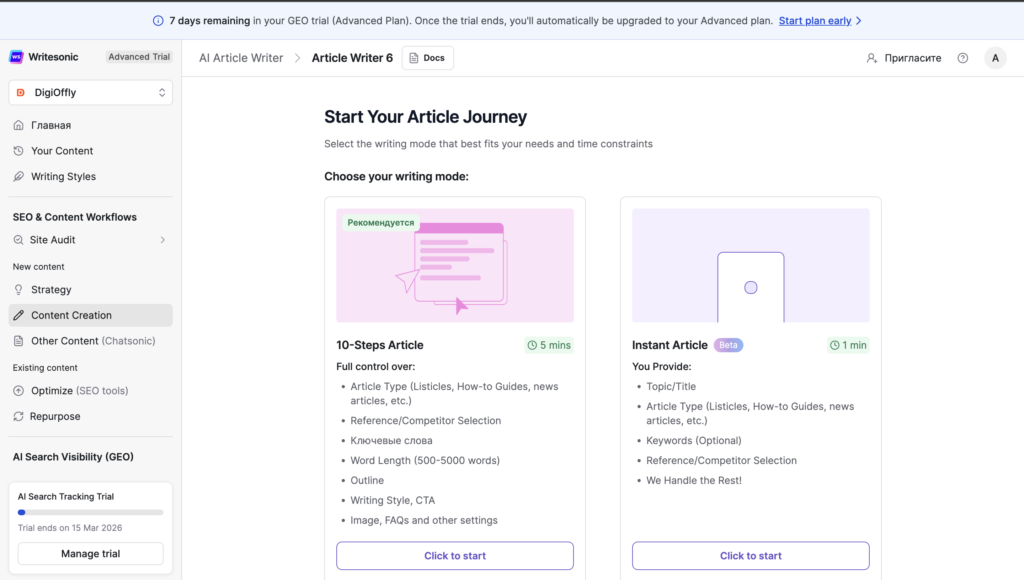
This is one of the core parts of the platform. While many AI tools are better suited to short, surface-level drafts, Article Writer 6.0 is built for longer-form content with a more structured output. It can produce extended drafts with headings, tables, and bullet points, giving users a stronger starting framework for article development.
In practice, the value is less about getting a publish-ready 2,500-word article and more about reducing the time it takes to move from topic to workable first draft. It can also help with structure and formatting that would otherwise take more manual effort to assemble.
Chatsonic (AI with Internet Access)
Imagine an intelligent assistant that isn’t locked into a database from last year. Chatsonic can analyze a fresh stock market report released an hour ago and write an analytical summary. In a direct Writesonic vs ChatGPT Plus comparison, Chatsonic frequently provides more accurate, up-to-date source links, which is critical for YMYL (Your Money or Your Life) niches.
SEO Checker & Optimizer
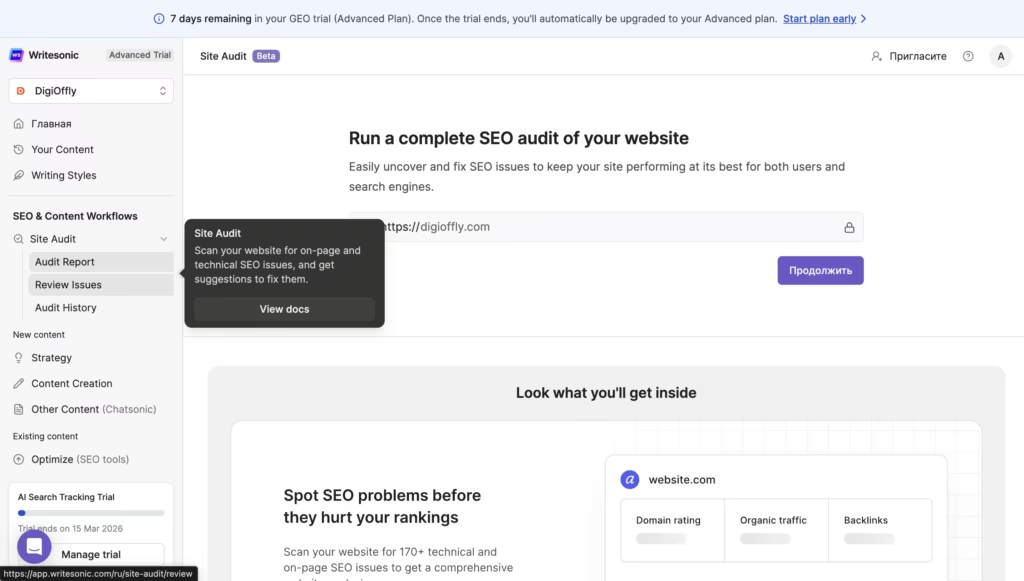
You no longer have to copy-paste generated text into third-party tools. Writesonic features a built-in optimizer that displays an SEO score from 1 to 100 directly during the generation process. It gives you additional keyword and topic coverage suggestions based on competing pages, which can help you build a more complete draft — but it should be treated as guidance, not a ranking guarantee.
🔎 Writesonic SEO Audit & Optimization Tools
Writesonic also includes basic SEO audit features designed to help improve content quality before publishing.
The platform analyzes keyword usage, structure, and topic coverage to provide suggestions for improving your article’s SEO score. While it does not fully replace professional tools like Ahrefs or Semrush, it can highlight missing topics and optimization opportunities.
For bloggers and affiliate marketers, this built-in audit workflow helps reduce the time needed to prepare an article for search engines.
🥊 Writesonic vs. Free AI Generators
You might be wondering: “Why pay for a premium subscription when ChatGPT or Claude are completely free?”
It all comes down to workflows and integrations. Free AI relies entirely on your prompting skills. If you type “write me an article about VPNs,” you will usually get a generic draft that still needs stronger structure, better factual support, and more editing before it is competitive.
To get a ranking article out of a free tool, you must:
- Manually scrape competitors.
- Build an outline.
- Ask the AI to write the intro.
- Ask it to write each section individually (to avoid context loss).
- Manually check for plagiarism.
Writesonic reduces much of this manual work inside a single workflow, although results still depend on the brief, model choice, and final editing. A paid tool gives you API access, bulk upload capabilities, and native WordPress integration, allowing you to publish dozens of articles a day directly from the dashboard.
⚠️ Performance Issues (The Reality Check)
To keep this review brutally honest: no digital text tool is flawless.
If you are expecting a magic button that spits out Pulitzer Prize-winning journalism with zero human oversight, you will be disappointed. The main issue is “fact hallucination” in highly specialized niches (like medical or complex legal topics). The AI can write absolute nonsense with extreme confidence.
The second issue is stylistic fatigue. If you use the exact same “Brand Voice” for 50 articles in a row, you will start noticing repetitive transitional phrases and metaphors. The reality check: Writesonic is a brilliant junior researcher, but you still need a human editor-in-chief to verify the final 10% before hitting publish.
💰 Pricing Plans & Real ROI
A deep dive into how the Writesonic pricing plans exUnderstanding how Writesonic pricing works takes a little time at first, especially because the value depends on how often you publish and which features you actually use.
- Free Plan: Best for testing the interface and basic workflows. It is enough to get a feel for the platform, but not enough for any serious publishing operation.
- Individual: Typically the better fit for solo users, freelancers, or anyone experimenting with AI-assisted content production on a smaller scale. It gives access to the core writing workflow and more capable models without requiring a larger team setup.
- Teams: This is likely the most practical plan for businesses that publish regularly. It adds collaboration features, Brand Voice support, and more room for a structured content workflow.
- Enterprise: Built for larger organizations that need additional control, security, account management, and more customized implementation.
The real value depends less on the headline plan price and more on how often the platform replaces manual drafting time. For teams producing content consistently, the subscription can become cost-effective fairly quickly. For occasional users, the economics are less convincing.
🛑 The Catch with Limits and Word Quality
A crucial warning in our review that marketers often hide: Writesonic pricing obscures a sneaky word-quality system.
On many tiers, you have a choice: generate text using “Premium” words (powered by faster, basic models like GPT-3.5) or “Superior” words (powered by GPT-4/Claude 3 Opus). If your plan gives you a limit of 100,000 Premium words, switching to the smarter “Superior” model will burn your balance significantly faster (e.g., 1 Superior word = 5 Premium words).
If you plan on producing deep, analytical content, you must use Superior words, so budget for a faster burn rate on your monthly limits.
🎯 Who Should Use Writesonic?
A key takeaway from this review is that Writesonic is built for teams that need a more scalable content workflow, not just occasional AI assistance.
One of the most common questions is whether AI-assisted content can still perform in Google. It can, but only when the workflow includes clear briefs, human editing, fact checking, and stronger differentiation than a raw draft alone.
For teams trying to expand content coverage, Writesonic can make it easier to build outlines, draft supporting articles, and move through topic clusters faster than a fully manual process. That does not automatically create topical authority, but it can help publishers and marketers cover relevant subjects more efficiently.
The strongest fit is SEO-focused publishers, content teams, agencies, and businesses that need more structure and speed in written content production without relying entirely on blank-page prompting.
🔄 Writesonic Alternatives
The text generation market is incredibly crowded, but only a few platforms actually compete at the SEO-productivity level. In the ongoing Writesonic vs Jasper debate, the choice often depends on your final budget and integration needs.
Jasper has historically been the king of corporate copywriting, offering incredibly deep brand voice customization. But it is significantly more expensive. If you are looking for the best Writesonic alternatives for copywriting, here is a quick breakdown of the major players:
| Feature | Writesonic | Jasper AI | Copy.ai | ChatGPT Plus |
| Best For | SEO Articles, Blogging | Corporate PR, Marketing | Short posts, Email drips | General tasks, Coding |
| Interface | Templates + Editor | Advanced Doc Editor | Kanban Boards, Templates | Conversational Chat |
| SEO Integration | Direct (Built-in + Surfer) | Via add-ons/plugins | None | None (Custom GPTs only) |
| Web Access | Yes (Chatsonic) | Yes | Yes | Yes |
| Pricing Tier | Mid-Range / Affordable | Premium | Mid-Range | Fixed ($20) |
Choose Writesonic if you want stronger SEO workflow support and structured article production.
Choose Jasper if brand voice control matters more than cost.
Choose Copy.ai if your needs are mostly short-form marketing copy.
Choose ChatGPT Plus if you want general flexibility rather than a dedicated publishing workflow.
🔬 How We Tested Writesonic
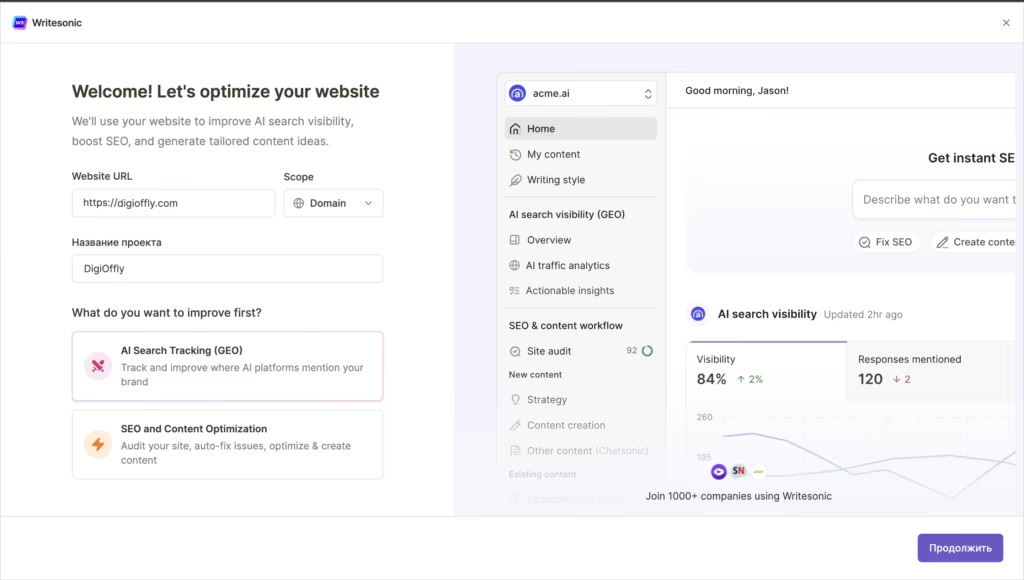
This review is not based on product copy alone. To evaluate Writesonic properly, we tested it inside a real publishing workflow rather than relying on feature pages and marketing claims.
We used the platform to generate article drafts in competitive content areas, reviewed the built-in SEO workflow, compared drafts created with and without Brand Voice guidance, and assessed how much manual editing was still required before publication.
The biggest difference was not just speed, but structure. Writesonic made it easier to move from topic idea to usable first draft, especially for longer-form content. At the same time, generic patterns became more noticeable when drafts were left too close to the default output, which made human revision and factual cleanup essential.
The conclusions throughout this review come from hands-on use focused on workflow quality, draft structure, editing load, and practical publishing value rather than marketing claims alone.
🧠Writesonic Review Summary
After testing Writesonic across multiple real content workflows, the platform proves to be one of the more structured AI writing tools available today.
Its biggest advantage is the guided publishing workflow, which helps users move from keyword research to a usable draft much faster than traditional AI chat tools.
While the output still requires human editing and fact-checking, Writesonic can significantly accelerate content production for SEO teams, bloggers, and digital agencies.
🏆 Final Verdict: Time to Upgrade Your Content Pipeline
After testing the platform across real content workflows, the conclusion is more practical than dramatic: Writesonic is a strong AI writing platform for teams that care about structure, speed, and repeatable publishing workflows.
It is not a replacement for editorial judgment, and it will not solve ranking problems on its own. But for bloggers, publishers, agencies, and SEO-focused teams, it can reduce the time it takes to move from topic idea to workable first draft, especially when the workflow is supported by clear briefs, human editing, and factual review.
Its main strength is not “one-click traffic,” but a more guided approach to article production. That includes content structure, workflow support, and a faster path from research direction to draft.
If your team publishes regularly and needs a more scalable way to produce content without relying entirely on manual drafting, Writesonic is worth considering. The best next step is to compare the available plans and test the platform against your actual workflow before making a longer-term decision.

Frequently Asked Questions
How to use Writesonic for SEO?
Start with Article Writer 6.0 and a clear primary topic. Review the suggested outline, compare it against competing pages manually, and use the built-in optimization guidance as a support layer rather than a final authority. The best results usually come when the draft is edited for accuracy, structure, and originality before publishing.
Are Writesonic texts unique and plagiarism-free?
Writesonic generates original drafts rather than copying existing paragraphs directly, but that does not guarantee every output will be completely free of common phrasing or accidental overlap. Final drafts should still be reviewed with editing and originality checks before publication.
What is the winner in a Writesonic vs ChatGPT Plus comparison?
It depends on what you need. ChatGPT Plus is stronger as a general-purpose assistant for brainstorming, coding, and flexible prompting. Writesonic is stronger when you want a more guided publishing workflow with templates, content structure, and SEO-oriented drafting support.
What are the best Writesonic alternatives for copywriting?
If you represent a large corporate brand with strict tone-of-voice guidelines and a massive budget, Jasper AI is the most powerful alternative. For short-form content (email marketing, LinkedIn posts, product descriptions), Copy.ai is excellent. For simply rewriting existing text, many still prefer QuillBot.
How do the Writesonic pricing plans work regarding word limits?
The main confusion in Writesonic pricing plans explained is the difference between “Premium” and “Superior” quality. The plans give you a word limit. Premium words are generated by faster, less intelligent models. Superior words are generated by the smartest models on the market (GPT-4), but they burn through your balance with a multiplier. One generated “smart” word might cost you 5 standard words from your limit. Always factor this into your content calendar budget.
Is Writesonic worth it for blogging in 2026?
Absolutely. If you are managing a portfolio of niche sites, asking is Writesonic worth it for blogging usually comes down to pure ROI. By acting as a scalable ai article generator, it allows a single editor to publish 10x the content without sacrificing SEO structure. It effectively replaces expensive entry-level writers, making it arguably the best ai writer for affiliate bloggers and publishers.
Can this AI article generator bypass AI detectors?
It depends entirely on your workflow. If you just click “generate” and publish the raw text, strict AI detectors (like Originality.ai) will likely flag it. However, if you actively use the Brand Voice feature, inject your own industry anecdotes, and use the Chatsonic module to cite real-time data, the final output reads much more naturally and easily passes human and algorithmic review.
Is there a free version to test the platform?
Yes, there is a permanent Free tier that gives you 10,000 words a month. It is a great way to test the dashboard interface before committing to the paid Writesonic pricing tiers. However, for serious agency production, you will need to upgrade to the Teams plan almost immediately to unlock the higher-quality GPT-4 processing and remove the strict limits.
🌐 Explore More on Digioffly
If you found this Writesonic review 2026 helpful, check out our other guides on scaling your digital marketing and creative workflows:
- Best Financial Software Deals: Learn how to automate your bookkeeping and tax reporting so you can free up more time to use your new AI tools.
- Featured Digital Deals & Top Services: Return to our homepage to explore the absolute highest-rated software discounts and exclusive B2B tech tools we’ve verified for 2026.
- Top VPN Services & Privacy Deals: Stop leaving your agency’s data exposed. Compare the fastest, most secure VPN subscriptions to protect your remote team and bypass geo-blocks.
- Notion Review 2026: Is It the Best Productivity App? — Read our brutal breakdown of how to replace Trello, Asana, and Google Docs with one centralized, enterprise-grade workspace.
- Midjourney Review 2026: The Best AI Image Generator? — Stop paying for generic stock photos. Learn how to generate photorealistic, commercial-grade brand assets to pair with your new Writesonic articles.
- Explore All AI & Tech Categories & Guides: Dive into our full library of artificial intelligence software reviews and automation strategies.
- The Ultimate B2B Growth Stack: Discover our curated list of the best software for management, SEO, and team productivity.