

Databricks Genie ZeroOps: On November 12, Databricks moved its background data operations agent into beta. Genie ZeroOps brings failed jobs, stale tables and suggested repairs into one place, but it still leaves production changes under human control. Here is what data engineering teams should know before enabling it.
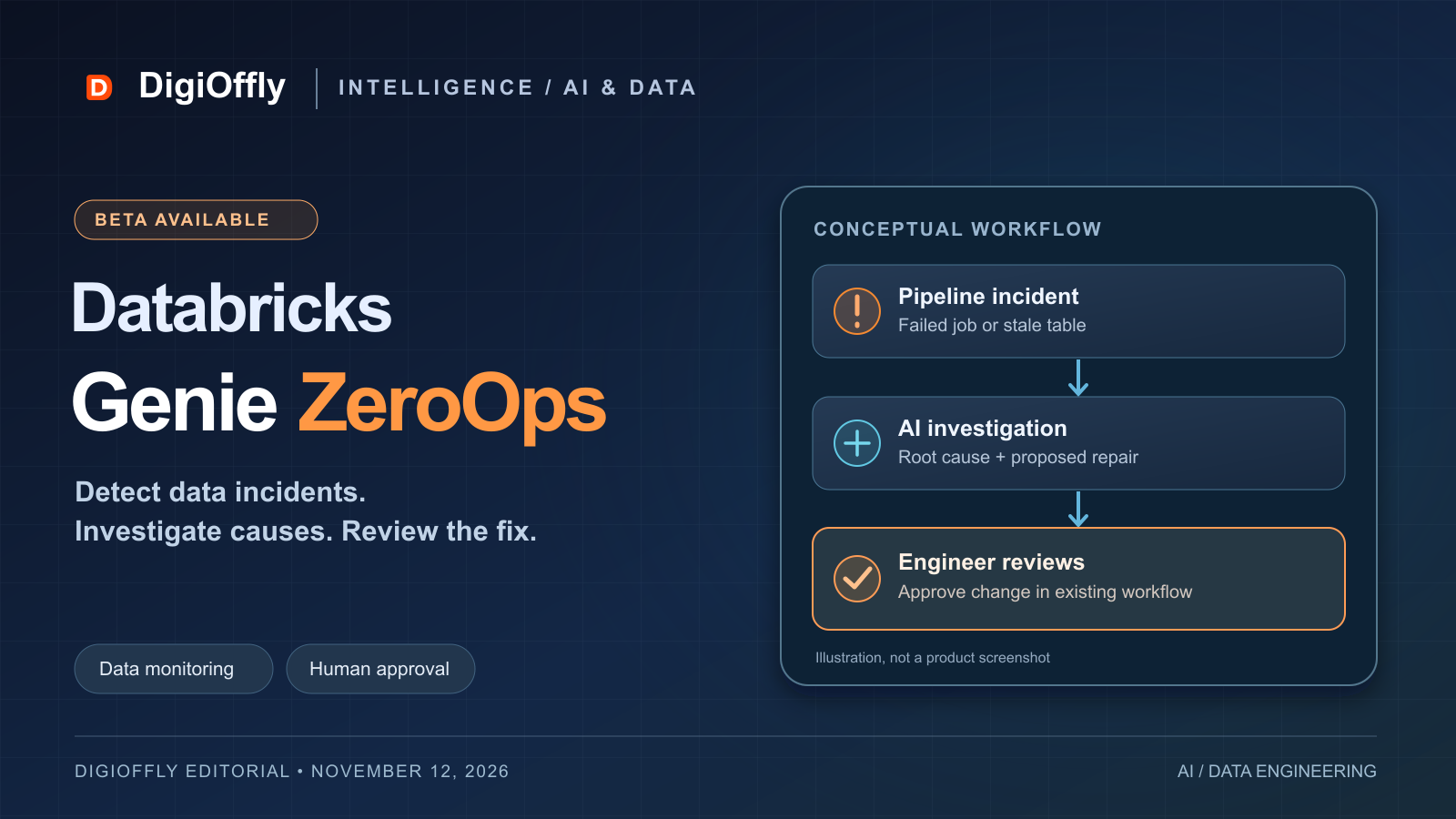
An agent that watches; an engineer who decides
The diagram separates a failing data workflow from an AI-generated diagnosis and the human approval required to turn a proposed repair into a change. It does not claim that the agent automatically fixes production.
What Happened
Databricks dated the Genie ZeroOps beta release November 12, 2026. The company introduced the concept in June, so today's milestone is availability rather than the first announcement. The current beta turns data pipeline monitoring into a background activity: selected jobs, pipelines and tables are watched for failures and data quality issues. Instead of requiring an engineer to start a chat every time a job breaks, ZeroOps gathers an incident, investigates the likely underlying problem and recommends a repair.
A successful job can still leave a stale or incomplete table behind; those are also the kinds of issues this agent is designed to surface. Databricks describes this workflow in its release notes and current setup documentation, not an independent performance benchmark.
Who Is Affected & When
Databricks workspace users with sufficient asset permissions can try the beta after a workspace administrator enables the preview. The supported permissions are OWNER, CAN MANAGE and CAN VIEW. ZeroOps runs within an individual workspace, not across an entire Databricks account, and its configuration belongs to the person who creates it. Databricks says releases are staged, so the dated beta entry is not a guarantee that every workspace has the feature today.
Check the Previews page in your own account. US teams already using Databricks Lakeflow Jobs and Lakeflow pipelines have the clearest starting point; organizations outside that environment should not treat this as a general-purpose monitoring service.
What Changes in Practice
Set up Databricks Genie ZeroOps monitoring
Open Jobs & Pipelines, select ZeroOps, and configure a limited set of assets to watch. You can describe the scope in Genie Code and revise it later. Genie ZeroOps initially analyzes issues from the preceding 24 hours, then continues looking for new problems. For an initial rollout, choose a small pipeline with a documented owner and an established incident response process. Check Databricks job permissions and table access before enabling the preview.
Include one important downstream table if its freshness matters. Starting with a manageable scope makes it easier to determine whether Databricks job monitoring saves time or merely creates more alerts.
AI root cause analysis for failed jobs
Suppose a daily ingestion job succeeds but a reporting table stops receiving rows. An ordinary success notification would not establish that the report is healthy. ZeroOps can surface data freshness issues and suggest a cause for a monitored asset. Its investigation may point to a change in code, a new schema or an upstream failure. A human still has to verify that explanation against the evidence.
Compare the proposed cause with Databricks data lineage and run history before acting. This is the practical difference between a conventional alert and AI root cause analysis: a useful diagnosis reduces the number of checks an engineer must perform, but a plausible answer is not proof. Data pipeline troubleshooting should retain the same incident ownership and verification requirements.
Git pull requests and human approval
For a job linked to a Git repository, a Databricks Git integration can give the agent context for an investigation. Read permission is required to inspect the repository; writing a proposed fix requires an appropriate Git credential. ZeroOps can prepare a change, but the user must ask for and confirm a push before it creates a new branch. The user then opens a pull request in the Git provider and follows the existing review process.
For workspace-stored code, a user can ask Genie Code to apply the proposed repair or make the edit manually. Do not confuse a suggested change with a merged patch or a successful production deployment. Keep Git pull request review, automated tests and rollback procedures in place.
Data quality monitoring costs and operational gaps
Databricks states that detecting quality issues in tables requires separately billed data quality monitoring. Check Databricks data quality monitoring charges in the context of the assets you select. The November release does not provide a standalone ZeroOps price in dollars; request account-specific Databricks pricing and check the applicable monitoring usage before committing. Data quality checks also differ from infrastructure observability.
The beta does not detect cost or performance regressions, and it does not monitor other asset classes such as apps or models. Keep your existing cost monitoring, performance monitoring and service-level alerts. A successful pilot should compare actionable incidents, time spent investigating and actual monitored-workload costs rather than promise automatic savings.
Permissions, shared insights and notification controls
Databricks says ZeroOps uses language models hosted within its security perimeter, and investigations can process repository contents or query accessible tables. Shared insight recipients can see included code excerpts, suggested repairs and sample data rows even without access to the underlying assets. That makes Databricks workspace permissions and the decision to share an insight separate governance questions. The configuration can be shared with up to 25 individual workspace users, not groups or service principals.
Notifications may go to Slack, Microsoft Teams, PagerDuty or configured webhooks; external copies fall outside Databricks retention and deletion controls. The beta is not HIPAA compliant. Review data access controls, sensitive repository content and notification destinations before turning on unattended monitoring.
| Decision area | Genie ZeroOps beta | What the team should check |
|---|---|---|
| Coverage | Jobs, pipelines and tables | Separate coverage for applications, models and infrastructure |
| Detection | Failed runs and data quality issues | Existing alert ownership and data freshness checks |
| Remediation | Suggested fix; confirmed Git branch push | Pull request review, tests and rollback |
| Cost | Table data quality monitoring billed separately | Account terms and actual monitoring consumption |
| Visibility | Individual workspace configuration; shared insights | Who may see sample rows and repository code |
| Compliance | Not HIPAA compliant | Exclude regulated workflows pending approval |
Why It Matters
The change is significant because the agent is positioned inside the data platform rather than operating as an isolated chat assistant. Databricks Genie ZeroOps may shorten the route from a failed workload to an informed repair recommendation, particularly where a team spends hours tracing dependencies. Yet the beta does not remove the need for an on-call engineer or independent monitoring.
For teams improving data pipeline observability, this is an additional diagnostic layer, not a reason to retire their data pipeline monitoring tools. A data observability platform, a ticketing system and a governed review process can still be important for the services outside Databricks. The strongest early use case is a known, repeatable failure in a pipeline whose business impact and recovery path are already understood. That gives the team an objective basis for evaluating the agent.
Our Take
We would run a controlled Databricks Genie ZeroOps pilot for production data monitoring on a non-sensitive job with known failure modes, then review the agent's explanations alongside the existing logs. Measure time to a verified diagnosis, the proportion of useful recommendations and the incremental cost of data quality monitoring. Check notification destinations and sharing permissions before inviting colleagues. Only broaden the scope when those checks produce useful evidence.
The beta label, separate monitoring charges and limits on asset coverage make a measured deployment more appropriate than a wholesale switch. DigiOffly has not enabled a private Databricks workspace or performed hands-on tests of the beta; this is a source-based news analysis, not a benchmark.
Frequently Asked Questions
Is Databricks Genie ZeroOps generally available?
No. Databricks lists the November 12, 2026 release as Beta. Workspace administrators must enable the preview, and access can vary during a staged rollout.
Can Genie ZeroOps automatically fix a production job?
It can investigate and recommend repairs. Workspace code changes require human involvement, and a Git change is pushed to a new branch only after an explicit request and confirmation. Normal review and deployment controls still apply.
Does Genie ZeroOps replace data observability tools?
No. It focuses on monitored Databricks jobs, pipelines and tables, but does not detect cost or performance regressions or monitor apps and models. Keep separate coverage for those systems.
How much does Databricks Genie ZeroOps cost?
The release entry does not publish a standalone price. Databricks explicitly says table data quality detection requires separately billed data quality monitoring. Check your account terms and usage rather than assuming that beta access makes monitoring free.
Official Sources & Dates
Announcement: 2026-11-12; effective or availability date stated by the vendor: 2026-11-12. Check official updates before purchasing or changing production settings.
- Databricks platform release notes — Genie ZeroOps beta, November 12, 2026
- Databricks — Genie ZeroOps overview, updated November 11, 2026
- Databricks — Get started with Genie ZeroOps, updated November 11, 2026
- Databricks — Introducing Genie ZeroOps, June 16, 2026 (original announcement)
Editorial note: DigiOffly verified dated primary sources. This is not a claim of hands-on testing unless independently documented. Prices and access conditions may change.