

Pricing and specifications checked November 16, 2026: U+SASE is an enterprise subscription service with a tailored quotation. LG Uplus has not published a US dollar seat price on the product page. This review examines the public documentation, launch announcement and buyer-facing materials; it does not claim a paid deployment or independent performance benchmark.
An employee opens a customer spreadsheet from home, joins a meeting from a phone and pastes a summary into an AI assistant. A conventional office firewall has little context about those actions once the employee leaves the building. A company can buy separate VPN, web filtering, SaaS visibility and data protection products, but then its security team must keep the policies, identities and incident records aligned.
That is the problem LG Uplus wants to solve with U+SASE. The Korean telecommunications company announced the commercial launch of its cloud-based network and security platform on November 16, 2026. Its proposition is a consolidated security service backed by its own network and data-center operations, developed with Korean cloud-security specialist MONITORAPP. It matters most to organizations that need consistent controls across branches, offices, remote work and cloud applications rather than another consumer VPN. Official LG Uplus launch announcement.
This LG Uplus U+SASE review explains what the product can reasonably do, where the evidence stops, how LG Uplus U+SASE pricing works, and what an American or international buyer should ask before signing. We also compare the approach with Cloudflare One, Zscaler and Prisma SASE. The official commercial pages are written primarily for Korean businesses, so an English-language buyer should establish regional availability before treating the product as a deployable option.
📊 U+SASE Review Summary
U+SASE combines network access controls and several security functions delivered through a cloud service. Its public materials describe web protection, SaaS visibility, private application access, browser isolation and controls intended to prevent sensitive information from being sent to generative AI services. LG Uplus also describes a continuously staffed monitoring operation. Those capabilities address different parts of the same access journey: who is connecting, what resource they want, what traffic is allowed, and what data can leave the organization.
The most important distinction in this U+SASE review is between a feature list and an independently verified deployment. Product documents show which functions the vendor offers; they cannot prove the latency of a connection from New York, the detection rate of a data policy, or the amount of time an administrator will save. We have reviewed the public pages and commercial structure, not logged into a customer tenant. We do not award a numerical performance rating without that evidence.
The service belongs on a short list when a Korean organization is replacing several disconnected controls or wants a managed security operation. For a US-only business, the starting question is different: can LG Uplus contract with the company, provide support in the required language, and serve its users and workloads from acceptable network locations? If those conditions are not satisfied, an impressive local infrastructure story will not overcome an unsuitable deployment.
⚡ Quick Verdict: Is U+SASE Worth It in 2026?
U+SASE is worth evaluating for organizations that want to reduce the operational friction of multiple network security products, especially where the Korean service footprint and managed support match their requirements. Its value proposition is not that one console magically eliminates every risk. The potential value is a more consistent policy model, less duplication of maintenance and a clearer route for incident escalation.
We would not recommend an immediate full replacement of an existing security estate. A pilot should prove that the intended access policies behave correctly on real company devices, that critical applications still work, and that alerts can be investigated. If the business cannot obtain a clear service agreement, an itemized quote or a practical migration plan, those are reasons to postpone procurement rather than accept a vague promise of lower costs.
U+SASE is not a consumer privacy subscription. A home user looking for a different streaming location or a simple encrypted tunnel will not get the same experience as a personal VPN. Nor is the product a replacement for identity administration, endpoint management, backup recovery or application security. Those systems remain part of a defensible security architecture even when traffic inspection and remote access are consolidated.
The editorial verdict is a qualified enterprise shortlist, not a definitive best-in-class rating. If the buyer operates mostly in Korea and requires managed security support, the service merits a conversation. If users span the US, Europe and Asia, the pilot must include those regions. If the organization has a strict regulatory obligation, the signed contract and evidence of the relevant controls should outrank all marketing claims.
👍 What We Love
- ✅ Managed security operation described by LG Uplus
- ✅ Internet, SaaS and private-access controls in one offering
- ✅ Documented AI data protection capability
- ✅ A phased migration model for enterprise buyers
👎 Where It Falls Short
- ❌ No fixed public US dollar price
- ❌ US availability and support need confirmation
- ❌ Private admin console and performance not independently tested
- ❌ Gateway allowance and certifications need contract verification
🏆 EDITORIAL VERDICT: QUALIFIED SHORTLIST
Best For: Enterprises evaluating managed network security, private application access and AI data protection.
🧠 What Is U+SASE and How Does It Work?
Secure access service edge, or SASE, describes an architecture that brings network connectivity and security enforcement together in cloud-delivered services. The phrase is not a certification that guarantees every product includes every networking and security function. Some purchases focus on security service edge, or SSE, which emphasizes access and security controls; others also include a wider branch networking architecture. A buyer should map the actual order form to the functions the organization needs.
U+SASE is LG Uplus’s offering in that space. The vendor’s launch material explains that its platform applies security to business traffic across office, branch, data-center, cloud and remote-working environments. In practice, the relevant question is whether the proposed traffic path covers the right resources and user populations. Coverage gaps remain possible if routing or device coverage is incomplete.
LG Uplus highlights its own infrastructure and continuously staffed security monitoring as differentiators. LG’s public product documentation describes separate domestic main and disaster-recovery centers. For Korean buyers, local operational knowledge and an established relationship with a network provider may simplify discussions about service ownership. International buyers should request an actual traffic-flow diagram, the processing locations and a list of support escalation contacts. A domestic design cannot by itself establish global service coverage. LG Uplus infrastructure documentation.
🖥️ Ease of Use & The User Interface
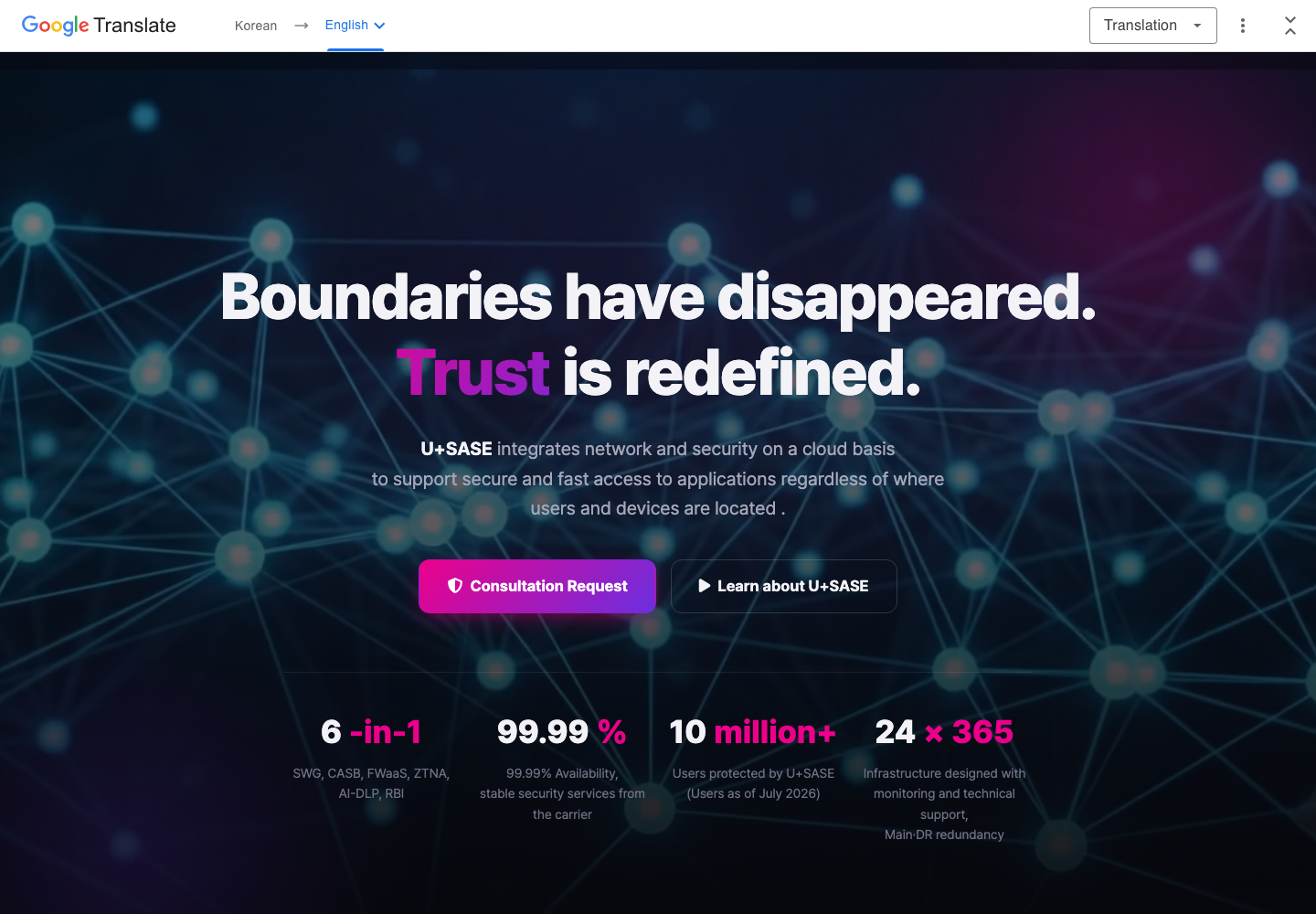
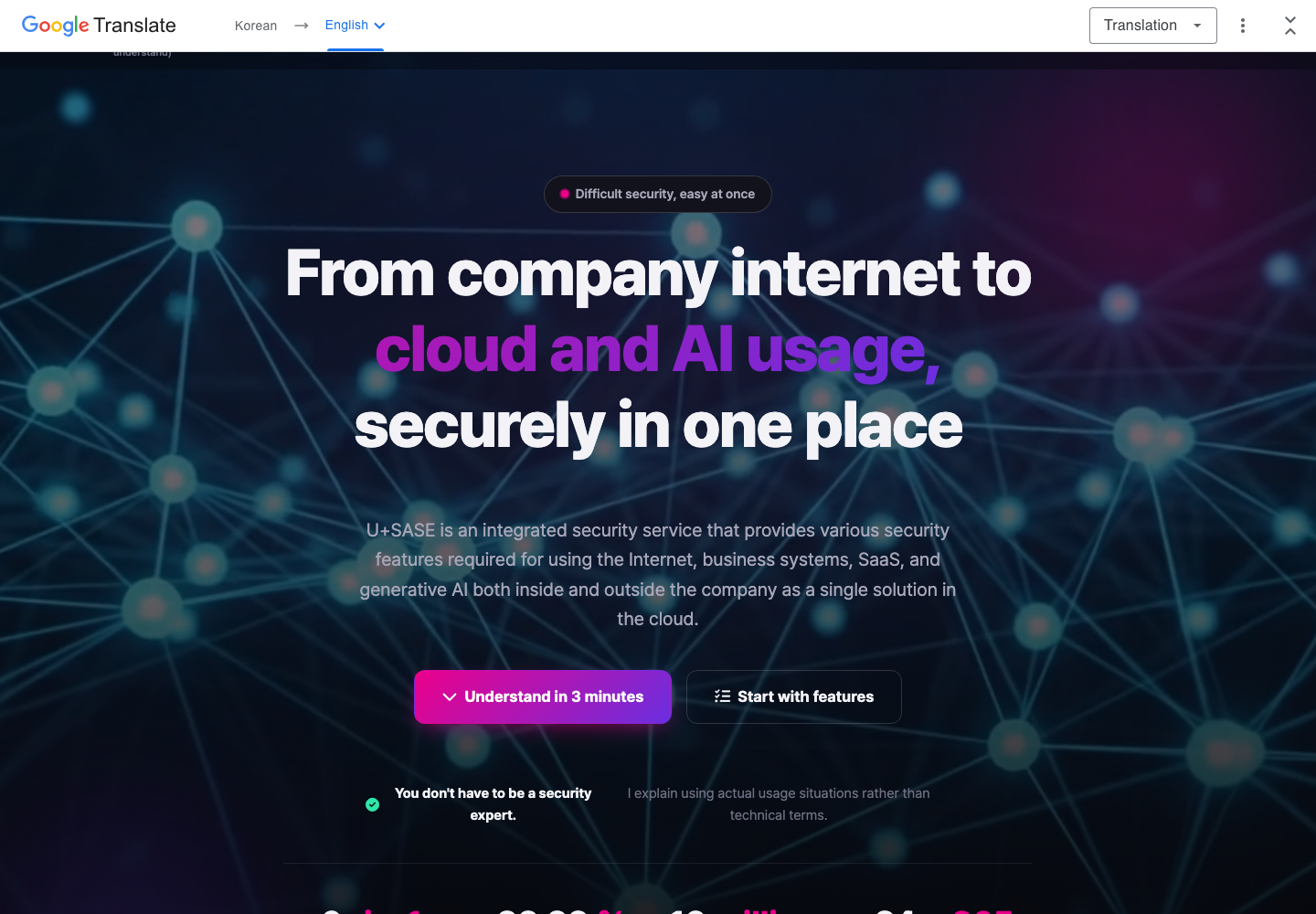
Our U+SASE review is based on genuine public website captures and the vendor’s published service information, not a simulated admin console. The public pages introduce the service in business-oriented language, with separate explanations of the security functions and commercial options. A prospect can request consultation rather than choosing a credit-card plan. That makes sense for a service whose configuration depends on the organization’s identity, network, application and security requirements.
The harder question with U+SASE is administration after deployment. A polished product page tells us little about day-to-day configuration. Before accepting a proposal, ask the provider to demonstrate the policy editor, how changes are reviewed, where administrators see audit logs, and how exceptions expire. Ask who can create a policy, who approves it, and whether the system preserves a history that investigators can use. If a managed service is included, establish exactly which actions the internal team can perform and which require a ticket.
Accessibility and language are particularly important for international teams. The public documentation we inspected is predominantly Korean. Do not infer that the full tenant interface or support desk is available in English from an English acronym or a translated brochure. Request an English-language walkthrough, sample incident ticket and example configuration documentation if those are operational requirements. A global security program needs predictable handovers across time zones.
🧭 How to Use U+SASE: Enterprise Deployment Guide
1. Inventory users, applications and traffic
Before requesting U+SASE pricing, list the applications and user groups in scope. Separate public web browsing, cloud software, private applications and connections between sites. Record the operating systems, device ownership, identity provider and existing security policies. For sensitive applications, document the authorized users, protocol requirements and business owner. A small but accurate inventory is more useful than a large spreadsheet with no clear owner.
2. Obtain an architecture and itemized quotation
Ask LG Uplus to propose the exact combination of U+SASE functions, the locations where traffic will be processed, any required gateways, and the integration work. The proposal should identify the service term, user count, optional features, support arrangements and any limitations. Ask how the design changes if the workforce doubles or a new branch opens. A useful quotation includes assumptions.
Do not let the architecture discussion become a feature-count competition. For each required capability, specify what should happen in a representative scenario. For example, a contractor should access one application from a compliant device, while the rest of the internal network remains unavailable. An employee should be able to use an approved AI assistant with test data but be blocked from sending a synthetic sensitive record if the selected policy supports that control.
3. Configure a limited pilot with rollback
For a phased SASE implementation, choose a limited group of users, such as a department with representative applications and a mix of office and remote connections. Define the expected permitted and denied actions before enabling controls. Test sign-in, policy changes, device health, application compatibility, help-desk escalation and access recovery. Do not intentionally expose real credentials or customer data to prove that a security feature works. Use synthetic records and a test environment agreed with the vendor.
U+SASE documentation describes a phased transition approach. That is preferable to removing a working firewall or VPN before the new route has been validated. Keep the existing recovery path available during the pilot, but ensure the test is meaningful: if all traffic silently bypasses the new policy, a successful connection does not demonstrate protection. The migration plan should state how administrators will verify which traffic is inspected.
4. Review the operating model before scaling
When the pilot ends, compare the results against the agreed success criteria. Track application connection success, policy accuracy, support response, help-desk incidents, and changes to administrative workload. Measure performance from the actual locations in the scope of the contract. Review what information is logged and who has access to it. Resolve any blocking issue before extending the service to more users.
🛠️ Key U+SASE Features That Actually Matter
🌐 Secure web gateway (SWG)
The official product materials describe an SWG intended to restrict access to malicious or undesirable web destinations and enforce web access policy. For an enterprise, the useful part is consistency: staff working outside the office should not automatically escape the company’s chosen internet policy. A real evaluation should examine blocked and permitted destinations, policy exceptions and the visibility available for troubleshooting. Official U+SASE product documentation.
A buyer should ask about the handling of encrypted traffic, privacy exclusions and exceptions for applications that cannot tolerate inspection. Ask whether the organization can apply different policies to different groups and whether it can identify the policy responsible for a block. A carefully configured system should not force staff to choose between completing their work and following the security policy.
🔥 Cloud firewall as a service (FWaaS)
The cloud firewall capability is designed to control network and application traffic according to policy. That can be useful when a company needs to apply a consistent outbound security policy across several locations instead of administering separate rules independently. It does not automatically replace every on-premises or inbound firewall. The proper scope depends on the network topology and the exact service package.
For a U+SASE pilot, create a harmless test of permitted and prohibited traffic. Verify the policy in both an office and a remote environment. Ask how exceptions are documented and how administrators discover an unexpected denial. Consider whether traffic that never reaches the cloud service remains governed by the existing controls. A successful firewall rule test is evidence about that specific route, not the entire estate.
🛡️ Zero trust network access (ZTNA)
Zero trust network access is one of the most consequential features because it changes the question from whether a user can join the corporate network to whether a user should access a particular resource. LG describes user and device authentication for application access, including device posture and network context in its launch material. Effective zero trust access control must also support revocation. The launch materials describe an LG-developed access-path mechanism; this review does not infer security efficacy from it. LG Uplus launch and access verification.
For a U+SASE ZTNA assessment, compare zero trust network access solutions and establish which private application protocols are supported and how access is revoked when a worker leaves. Test a valid user with the wrong device, a disabled identity, a user outside the authorized group and a correctly authorized user. These are simple scenarios, but they reveal the difference between an attractive policy description and a practical least-privilege configuration.
Some legacy applications rely on broad network connectivity, unusual authentication flows or hard-coded addresses. They may need additional work to fit an application-specific access design. Document those exceptions instead of assuming every old VPN use case will migrate unchanged. Keep a fallback for critical systems while validating an alternative route.
☁️ Cloud access security broker (CASB)
A CASB can help administrators see and control which cloud applications employees use. LG’s documentation describes visibility into SaaS use and policy-based access control, including discovery of unapproved software. The value depends on coverage: which activities are visible, whether inspection occurs in the traffic path, and how identity is represented.
The buyer should avoid conflating discovery with complete protection. Knowing a user visited a SaaS application does not establish that every file stored in that application is classified or that its sharing permissions are safe. Ask whether the desired control is inline, API-based, or both; request the supported application list and confirm which actions are covered. U+SASE should be compared with alternatives on these actual requirements rather than acronym coverage.
🧩 Remote browser isolation (RBI)
Browser isolation separates the execution of risky web content from a user’s local environment. LG documents RBI as a product capability and describes a commercial configuration that extends internet protection with isolation. It can be valuable for users who must research unfamiliar websites as part of their work. It is not a guarantee that every malicious action will be stopped.
Evaluate the user experience before making browser isolation a broad policy. Some workflows require file downloads, forms, multimedia or clipboard actions. Test which activities are allowed, whether the isolation experience is usable, and what happens when a legitimate workflow is incompatible. Ask the provider which data can move between the isolated environment and the endpoint. A narrowly scoped pilot can identify where isolation adds value without unnecessarily disrupting regular browsing.
🤖 Generative AI data protection
U+SASE includes an AI-related security capability that is particularly relevant to organizations experimenting with chatbots, copilots and document summarization. LG’s product documentation describes checks on prompts and uploaded documents, with policies intended to reduce sensitive-data exposure. AI data loss prevention and AI prompt security should be evaluated with controlled tests. A practical use case is reducing accidental disclosure when employees paste business information into external AI services. LG Uplus feature descriptions.
These generative AI security risks need specific tests. The existence of a GenAI Security package does not prove that it supports every AI application, every file format or every way information can leave a device. Ask for the supported applications, browser and endpoint coverage, configurable detection rules, and whether a policy can warn, block or record an event. Use fictional test records, not actual personal or company data, when evaluating a detection policy.
A successful demonstration should also include negative cases. An ordinary product description should not be blocked just because it contains a number; a synthetic sensitive record should trigger the expected action. Check what information the security provider logs, how long it retains it, and whether the prompt itself is stored. A policy that protects one data flow while creating a new sensitive log repository introduces a different risk.
💰 U+SASE Pricing Plans & Real Cost of Ownership
LG Uplus U+SASE pricing is consultative. The official product page lists commercial configurations rather than fixed public dollar prices. The dedicated product materials describe a subscription based on the number of users and selected functions, with annual terms as the usual starting point and possible longer-term discounts. Actual pricing, taxes, commitment and service availability need a written quotation. We have not converted a Korean contract into a fictional US price. Official buyer guide and commercial information.
| Configuration | Documented scope | Price |
| SIA | SWG, FWaaS and CASB | Custom quote |
| SRA | Private application access via ZTNA | Custom quote |
| RBI | SIA plus remote browser isolation | Custom quote |
| GenAI Security | Prompt and AI data protection controls | Custom quote |
One useful way to compare U+SASE pricing is to request separate quotes for the minimum functional scope and the broader target design. That makes the incremental cost of AI data protection, isolation or private application access easier to understand. A bundle can be convenient, but it can also obscure what a business is paying for if several functions are not required. Ask whether user counts are named, active, concurrent or measured in another way.
The provider promotes a commercial approach in which increases in traffic do not result in an additional egress charge under the described subscription. Treat that statement as a vendor policy claim and confirm exactly which traffic and deployment it covers. It does not establish that every possible network circuit, migration, gateway or support service is included. Separate circuit costs and existing contracts can remain part of total expenditure.
There is an important documentation detail worth raising in procurement. The main LG product page describes up to five hardware gateways at no additional charge, while the simplified buyer guide describes up to two. These are conflicting published statements, not guaranteed entitlements. Verify the actual order form. Request the allowance for your actual order, including software gateways, redundant sites, replacement hardware and any charges beyond the included amount. This is exactly why a written commercial specification matters more than a promotional comparison. LG product page. Dedicated buyer guide.
The U+SASE cost calculation should include existing contracts, implementation, training, migration overlap, support and any infrastructure needed for connectivity. Consider the following illustrative model: a company has several annual security subscriptions and an internal team spending time reconciling policies. If a consolidated service reduces those contracts or administrative hours, those savings can be compared against the new subscription and the cost of moving. This is a calculation framework, not a claim that a particular company will save money.
👾 Security, Reliability & Real-World Limits
No security vendor should receive credit for eliminating risk on the basis of a feature list. U+SASE has a plausible architecture for centralizing security functions, but our review has no independent measured detection rates or application latency results. LG’s description of continuous monitoring and redundant infrastructure is a useful starting point; contractual availability commitments, exclusions and remediation terms must be checked separately.
A company with a distributed workforce should measure the user experience in the locations that matter. Track application connection failures and latency against the existing service under comparable network conditions. Test scheduled maintenance, loss of a connectivity path and the restoration of access. A strong service-level agreement is useful only if the contract defines the measured service, calculation period, exclusions and remedy.
Data handling deserves its own review. Establish where traffic is processed, where event data is stored, who may access it, what retention is configurable, and how data is removed after contract termination. Confirm the relationship between the network service, security monitoring and any partners delivering components. If an organization handles regulated data, obtain current certificates and appropriate contractual terms rather than assuming that a domestic service or zero-trust architecture satisfies a particular obligation.
The dedicated buyer guide lists CSAP (IaaS/SaaS) certification as in progress, targeting the first half of 2027. That target is not an issued certificate. Do not list certifications as completed without current documentary proof and confirmation that their scope covers the purchased service. Similarly, LG’s announced collaborations and future plans for integrating further security capabilities should not be treated as features that a buyer can already order. Certification information.
🎯 Who Should Use U+SASE?
The strongest documented U+SASE fit is an organization with Korean operations that needs coordinated network access and security management. Companies with several branches and a mixture of office and remote work may want to evaluate whether a common policy and managed monitoring model reduces their operational complexity. A business with limited security staff may also value a clear division of responsibility with a service provider.
Schools, public organizations and businesses handling sensitive information are plausible use cases, but they must evaluate their own procurement and regulatory requirements. LG’s announcement states that its web filtering function was used by roughly 400 schools before the formal launch. That is evidence of the vendor’s reported deployments of one capability, not proof that every school used every U+SASE module or that any particular institution achieved a measured security improvement.
For an American company, we would approach U+SASE as a candidate requiring further qualification. A business with a Korean subsidiary might have a different service requirement from a company with no local presence. Confirm sales eligibility, local points of presence, service support language, regional processing and the contract’s governing terms. If the vendor cannot offer a suitable arrangement, focus on solutions with a documented delivery model for your region.
Small organizations looking only for basic secure remote access should compare a narrower product or package. Buying a broad suite can create administration work that a small team cannot absorb. Conversely, a large enterprise with complex branch routing, multiple identity providers or sophisticated compliance requirements should test whether the available integrations and policies are sufficiently granular. The right fit for zero trust access is a consequence of architecture and support, not simply company size.
⚖️ U+SASE Alternatives: Cloudflare One, Zscaler and Prisma SASE
The U+SASE alternatives below are enterprise security approaches, not consumer VPN equivalents. We compare the public product descriptions and the questions a buyer should validate. There is no common independent performance dataset for these products in this review, and the comparison is not a ranking by security efficacy.
| Platform | Documented focus | What to verify |
| LG Uplus U+SASE | Managed enterprise security; Korea-oriented service | Regional eligibility, contract, exact modules |
| Cloudflare One | Workspace and network security | SASE packaging, support and network scope |
| Zscaler | Identity-aware internet and private access | Bundle, application coverage, delivery model |
| Prisma SASE | Enterprise security and branch networking | Licensing, integration and migration scope |
Cloudflare One is a useful comparison for a team that wants an integrated network and security platform with an established public-facing technical documentation ecosystem. Cloudflare’s pricing page distinguishes workspace security from the broader One SASE offering and directs buyers to discuss SASE packaging with its sales team. A free proof of concept is advertised, but that does not establish the cost of a full enterprise deployment. Compare the exact seat, network, support and data protection requirements. Cloudflare official plans.
Zscaler describes its Zero Trust Exchange as an identity- and context-aware platform for secure access. Its Internet Access and Private Access products provide distinct controls for external resources and private applications. A company already considering separate internet and private-access policies should include Zscaler in a procurement comparison. For zero trust remote access, the useful test is whether the proposed bundle covers the same users and applications with a practical migration and support model, rather than whether both products use the phrase zero trust. Zscaler official FAQ.
Prisma SASE from Palo Alto Networks combines security and networking capabilities in a wider enterprise portfolio. It is particularly relevant to buyers examining branch modernization or a security estate that already uses the vendor’s tools. A buyer should verify what the proposed package includes, how management integrates with existing products and what additional configuration is required. Vendor performance claims are not interchangeable with a measured result from your own offices. Prisma SASE official product page.
🧪 How We Evaluated U+SASE
DigiOffly reviewed the November 16, 2026 launch announcement, the official LG Uplus product description and the dedicated product materials. The screenshots in this article are captures of genuine public vendor webpages, not images of an authenticated tenant. We compared documented capabilities and commercial structure with primary vendor pages for the three alternatives. We checked the differences between published descriptions and marked unresolved commercial or technical questions rather than filling them in from assumptions.
No paid customer account, private console or live corporate network was available. Accordingly, this U+SASE review makes no hands-on claims about the administrator experience, throughput, detection accuracy, support response times or independently measured uptime. We recommend a pilot for those questions. A clear research-based review can still help a buyer prepare a short list, but it must not masquerade as a production test.
| Pilot area | Acceptance evidence |
| Identity and access | Authorized test user succeeds; unauthorized user denied |
| Web and SaaS | Agreed test policies apply across locations |
| AI data protection | Synthetic sensitive record handled as agreed; normal content permitted |
| Reliability | Measured application latency and recovery behavior |
| Operations | Documented logs, escalation, change approval and rollback |
🏆 Final Verdict: Is U+SASE the Right Enterprise Security Platform?
U+SASE is a credible candidate for Korean organizations that want a managed, cloud-delivered security service coordinated with enterprise connectivity. Its documented combination of internet protection, application access and AI data safeguards is relevant to the way modern employees work. The commercial structure also makes an itemized comparison with existing tools possible once the buyer obtains a real quote.
The most significant limitations are the absence of a public fixed price, the need to confirm regional delivery and the lack of independent deployment measurements in this review. Those are not proof that the service is unsuitable; they are the questions that prevent us from making an unconditional recommendation. A buyer with clear operational needs, a suitable service footprint and an agreed pilot can make a better decision than one relying on an attractive marketing comparison.
Our conclusion for this U+SASE review is to shortlist the platform where its managed service and local infrastructure make sense, then validate the specific policies and cost with a written proposal. For US and global buyers, qualify availability before investing time in a full migration design. Keep Cloudflare One, Zscaler and Prisma SASE in the comparison if those products align with your requirements.
Sources and editorial transparency
Product and launch information checked November 16, 2026. The primary sources are LG Uplus’s product page, its launch announcement and the dedicated U+SASE site. Commercial and certification claims are treated as vendor statements that need confirmation in the contract. Competitor comparisons use their official product and pricing pages. We currently link directly to providers without affiliate commissions from these links.
Frequently Asked Questions
What is LG Uplus U+SASE?
U+SASE is a cloud-based enterprise network and security service from LG Uplus. Its documented capabilities include web filtering, cloud firewall, SaaS visibility, private application access, browser isolation and AI data protection. The purchased configuration determines what is available.
How much does U+SASE cost?
There is no fixed public US dollar price. U+SASE pricing depends on user count, selected features and deployment conditions. Request a written quote that includes the contract term, gateways, support, taxes and implementation.
Is U+SASE available in the United States?
The public product materials primarily address Korean businesses. We have not verified a US sales agreement or US service footprint. Ask LG Uplus about eligibility, support, processing locations and service commitments before buying.
What is the difference between U+SASE and a VPN?
A conventional VPN provides network connectivity, whereas the U+SASE ZTNA capability is intended to enforce access to specific applications using identity and device context. Some legacy workflows may still require other connectivity.
Does U+SASE protect generative AI prompts?
The vendor describes controls for detecting sensitive information in AI prompts and uploaded documents. Verify supported AI applications, policy actions, file types and logging in a controlled pilot.
What is included in U+SASE SIA?
The product page describes SIA as combining secure web gateway, cloud firewall and cloud access security broker capabilities. Confirm the actual order form and whether optional controls are included.
Do I need an LG Uplus internet connection?
The dedicated product information says the service can be applied independently of LG Uplus circuits. Confirm technical eligibility and any separate network charges for your environment.
Does U+SASE support remote browser isolation?
Yes, the vendor lists RBI as a capability and describes a configuration with browser isolation. Confirm supported browser workflows, downloads, clipboard policies and licensing.
Can U+SASE replace all existing firewalls?
Not necessarily. A phased deployment can retain existing controls for traffic or workloads that are outside the new service scope. Validate network paths and rollback before removing any working protection.
How does U+SASE compare with Cloudflare One or Zscaler?
All are enterprise security options, but packaging, regional availability, networking and operating models differ. Compare equivalent requirements, written quotes and real pilot results rather than feature counts.
Has DigiOffly tested the private U+SASE dashboard?
No. This review uses current primary-source documentation, public website screenshots and an evidence-based buyer checklist. We have not measured production performance, detection accuracy or private administrator usability.
EXPLORE NEXT ON DIGIOFFLY
🔍 Explore More on DigiOffly
Use our security research and software tools to build a shortlist for your organization.
Explore security options
- Security & Privacy — Explore related software and security guides.
- LG Uplus U+SASE launch news — Read the verified November 16, 2026 announcement.
Compare your shortlist
- Software Compare — Evaluate alternatives already in our catalog.
- Software Finder — Identify tools for your requirements.
- Software Directory — Explore the broader catalog.
Plan your rollout
- Software Cost Calculator — Model the cost of tools with verified prices.
- Workflow Library — Plan secure operational workflows.
- Software News — Follow verified product developments.