

OpenRouter MiniMax warning — November 21, 2026. Customers using OpenRouter have shared a warning that requests routed to MiniMax models may have been read by a third party. Unique test links inserted into some prompts were reportedly opened 40–130 hours after the requests. OpenRouter says it removed the Zero Data Retention (ZDR) label from the affected MiniMax-model endpoints during its investigation. This is a serious AI prompt security concern, not proof of a platform-wide OpenRouter hack.
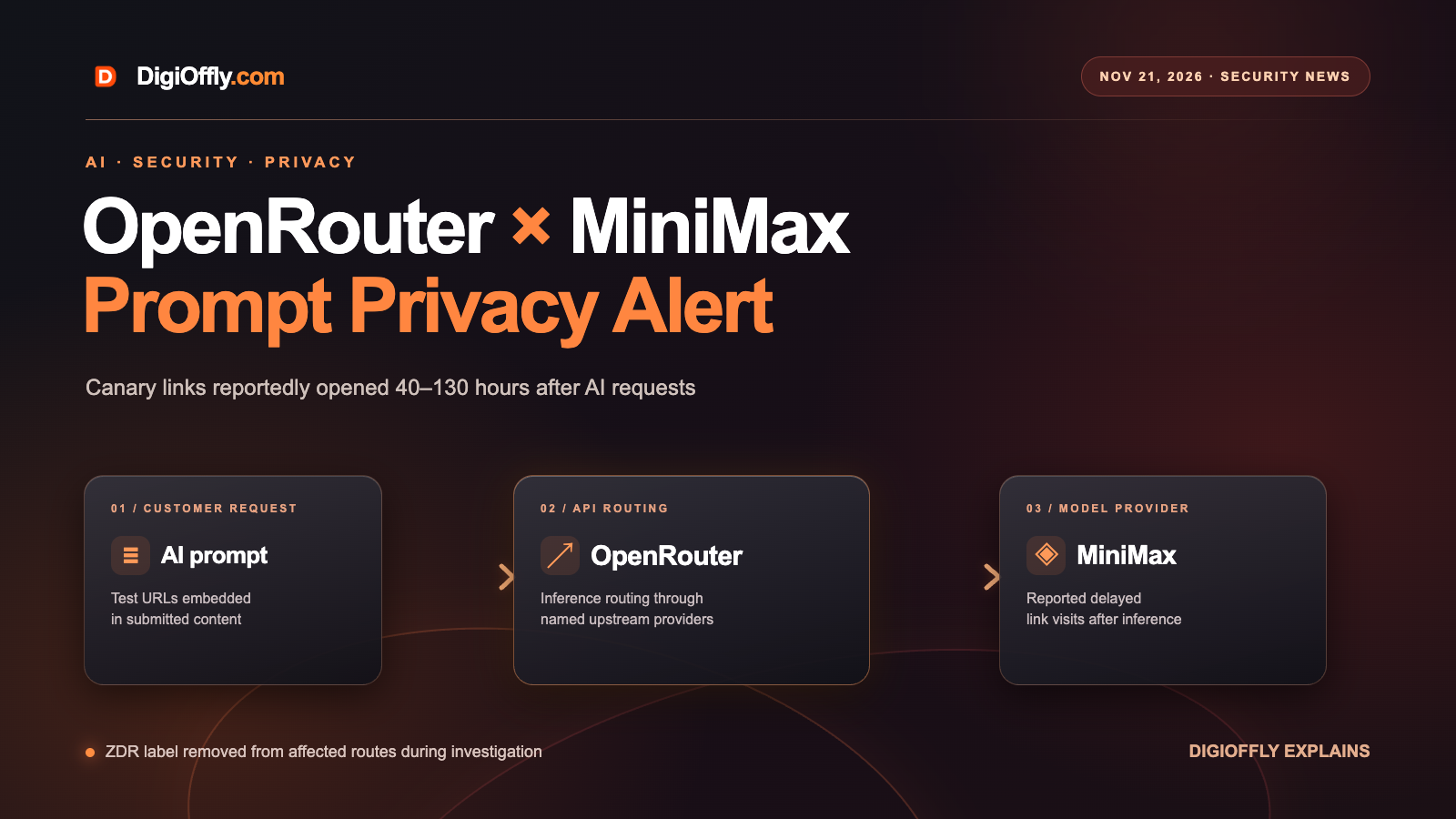
What canary links revealed
The OpenRouter notice describes link visits many hours after MiniMax inference requests. This illustration shows the concept, not a verified network trace of a customer’s prompt.
What Happened
On November 21, a recipient shared an OpenRouter customer email titled “Requests you sent to MiniMax models may have been read.” It described a researcher’s tests from July through October 2026. The researcher added unique URLs to prompts sent to MiniMax models, then monitored whether someone opened those links. A delayed visit is significant: it suggests that material from an inference request was available after the original session, because the planted URL acted as a deliberately trackable canary.
The email reported link visits 40 to 130 hours after prompts were submitted. According to the notice, those visits occurred whether MiniMax served the requests directly or another provider forwarded traffic to MiniMax. It also states that, with one exception, similar tests on different models at the same forwarding providers did not generate comparable visits.
The distinction matters: seeing a canary URL accessed later establishes a signal of subsequent visibility, but it does not identify who accessed it, whether a human or automated system did so, or which organization retained the prompt. The publicly shared email does not prove that OpenRouter’s own systems were breached. Read the November 21 copy of the notice and a dated account of its contents.
Who Is Affected & When
The notice names four paths relevant to the MiniMax tests: direct MiniMax inference and three forwarding providers—AtlasCloud, Novita and StreamLake. The circulated notice describes AtlasCloud, Novita and StreamLake as forwarding routes to MiniMax; they are also reported to have confirmed that routing to OpenRouter. This makes OpenRouter provider routing part of any exposure assessment, not just a question of which model name appeared on the invoice.
One person’s notification listed 321 MiniMax requests from his account between June 6 and October 22. That number describes his account; it is not the total number of affected customers or requests. Organizations evaluating MiniMax data privacy should instead search their own activity and any preserved account notices for the relevant historical period.
According to the reported email, MiniMax told StreamLake that content moderation was enabled on its endpoints before October 22 and that it subsequently enabled ZDR. OpenRouter said it had requested a direct explanation from MiniMax but had not received one at the time of the warning. No public incident-wide victim count, technical root-cause report or definitive access attribution was included in the copy available on November 21.
What Changes in Practice
The visible OpenRouter action was a privacy-label change: the platform removed the ZDR designation from the affected MiniMax endpoints during investigation. OpenRouter’s official Zero Data Retention documentation (updated October 27, 2026) defines a qualifying inference endpoint as one that does not persist prompts and responses after processing. It also explains why “no training” is not equivalent to ZDR; a provider may avoid model training while still retaining data for another stated purpose.
For OpenRouter data retention, the specific endpoint matters. A model may be available through more than one provider, and customer-side routing controls must be checked against the current endpoint policy. ZDR does not guarantee regional processing, erase a company’s own application logs or prevent connected tools from receiving information. Reviewing the OpenRouter privacy policy and account controls remains important even when a particular endpoint is labelled ZDR.
| Issue | What is established | What remains unknown |
|---|---|---|
| Canary-link access | Reported visits 40–130 hours after requests | Who opened the links and the precise mechanism |
| Provider paths | MiniMax, AtlasCloud, Novita and StreamLake named | Whether every customer route had the same behavior |
| ZDR status | OpenRouter says affected designations were removed | Long-term policy and root-cause resolution |
| Incident scope | A recipient shared an account-specific history | Confirmed total of exposed prompts or customers |
For a software team, the first action is to locate MiniMax requests made through OpenRouter and determine whether prompts or outputs included passwords, API tokens, confidential source code or customer records. If a real credential was exposed in an affected prompt, revoke and rotate that credential. Changing the OpenRouter account key alone does not revoke a database password copied into an unrelated request.
Next, verify the current provider settings, including whether to require ZDR-eligible routing, and reduce unnecessary secrets in prompt payloads. A MiniMax data retention review should ask who processed the request, what was logged, how long data was kept and which party is responsible for incident notices. These questions are more actionable than assuming every route is equally risky.
Why It Matters
The customer notice arrives two days after Dragos published research on November 19 into AI supply chain security. Its Chief Research Officer, HD Moore, described sending nearly two million prompts containing canary URLs and decoy credentials through AI services over several months. The study reported evidence of compromises at three AI providers, resellers accessing marketplace prompts through logging, and questionable handling of privacy restrictions.
That study gives context to broader AI data privacy and AI model security risks, but it must not be conflated with the OpenRouter MiniMax warning. Dragos did not name the laboratory in one of its key examples, and the circulated OpenRouter email does not identify its researcher. A shared timeline does not prove the same experiment, the same provider, or the same incident. The original Dragos report was published November 19—not November 21.
For LLM data privacy, the practical concern is the supply chain. A coding assistant or workflow agent may send internal documents, instructions or secrets through more intermediaries than the user realizes. An LLM data security program therefore needs data minimization, provider selection, logs of routing decisions, and policies for secret rotation. The OpenRouter data privacy warning illustrates why these safeguards should be explicit rather than assumed.
Our Take
DigiOffly’s assessment is that users should take the OpenRouter MiniMax disclosure seriously without treating it as a confirmed breach of every request. The evidence described in the customer email supports caution about delayed access to test content on the named routes. A public technical explanation of the access path and the overall incident scope would be needed before drawing firmer conclusions.
Organizations can act now: review MiniMax API activity, inspect sensitive prompt contents, revoke any genuinely exposed secrets, check OpenRouter provider selection and monitor official statements. If strict retention and data residency are required, verify both controls independently. Prompts are data assets, not disposable chat text; what happens at every upstream step deserves the same scrutiny applied to other business processors.
FAQ
Did OpenRouter confirm a hack on November 21?
No. The shared notice warns that third parties may have read MiniMax requests. It does not prove that OpenRouter’s own systems were hacked or identify the visitor.
What happened to the Zero Data Retention label?
OpenRouter said it removed the ZDR label from affected MiniMax-model endpoints while investigating delayed access to unique URLs planted in prompts.
Are all MiniMax requests exposed?
That has not been established. The notice names particular routes and an example account history, but does not publish a global count of affected users or requests.
Is the Dragos study the same incident?
There is no verified direct link. Dragos published broader research on November 19; the MiniMax notice circulated on November 21 without identifying the researcher.
Official Sources & Dates
November 19, 2026: Dragos published its wider AI inference data security research. November 21, 2026: the OpenRouter customer warning about MiniMax became public. DigiOffly distinguishes those dates, and does not present the older study as today’s new product announcement.
- Recipient’s public copy of the OpenRouter email — November 21
- OpenRouter’s official ZDR policy explanation
- Dragos original report — November 19
- Independent reporting on the November 21 customer notice
Editorial note: This report is based on a publicly shared customer notice, OpenRouter’s official ZDR documentation and Dragos’s distinct technical research. DigiOffly has not accessed private OpenRouter logs or independently established an attacker identity.