

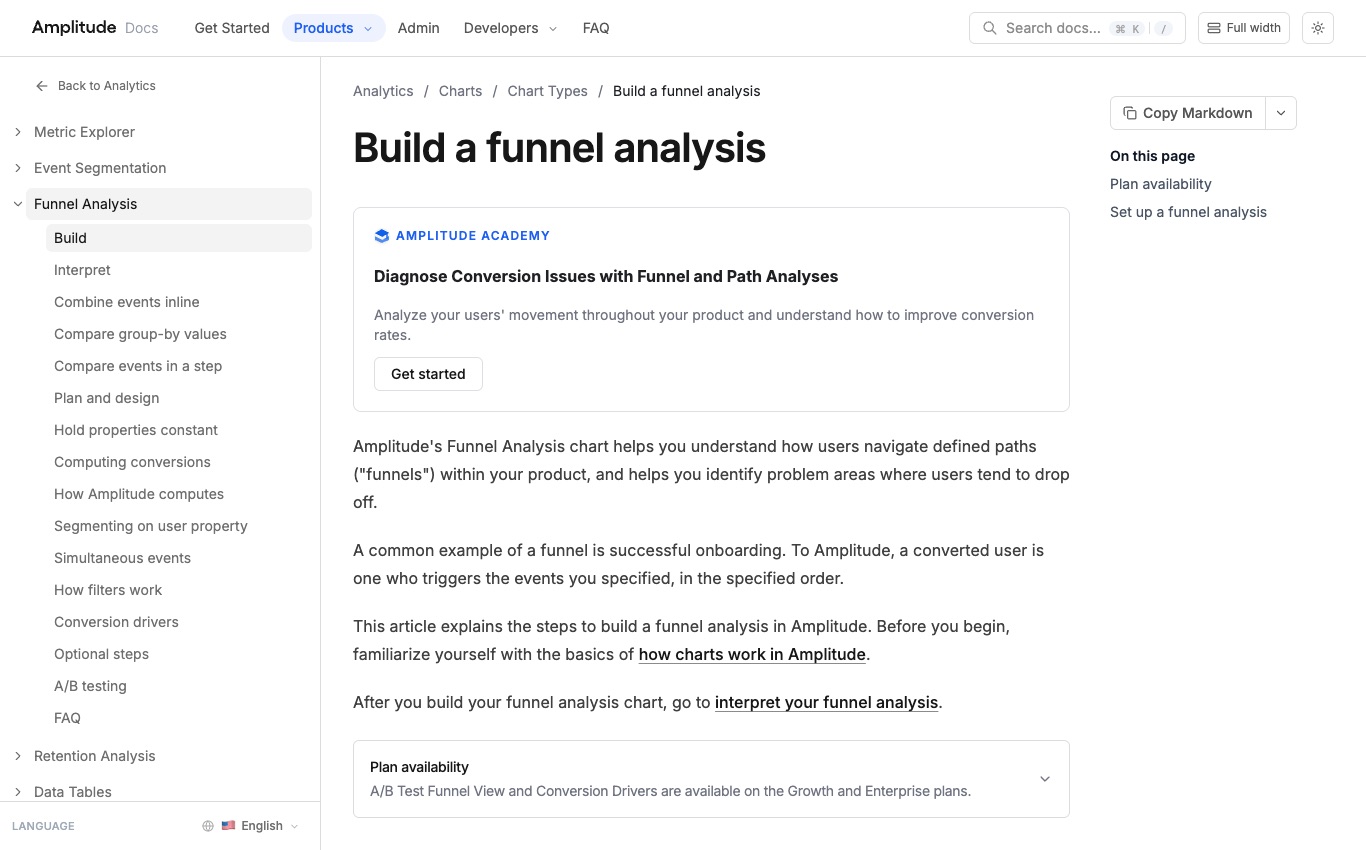
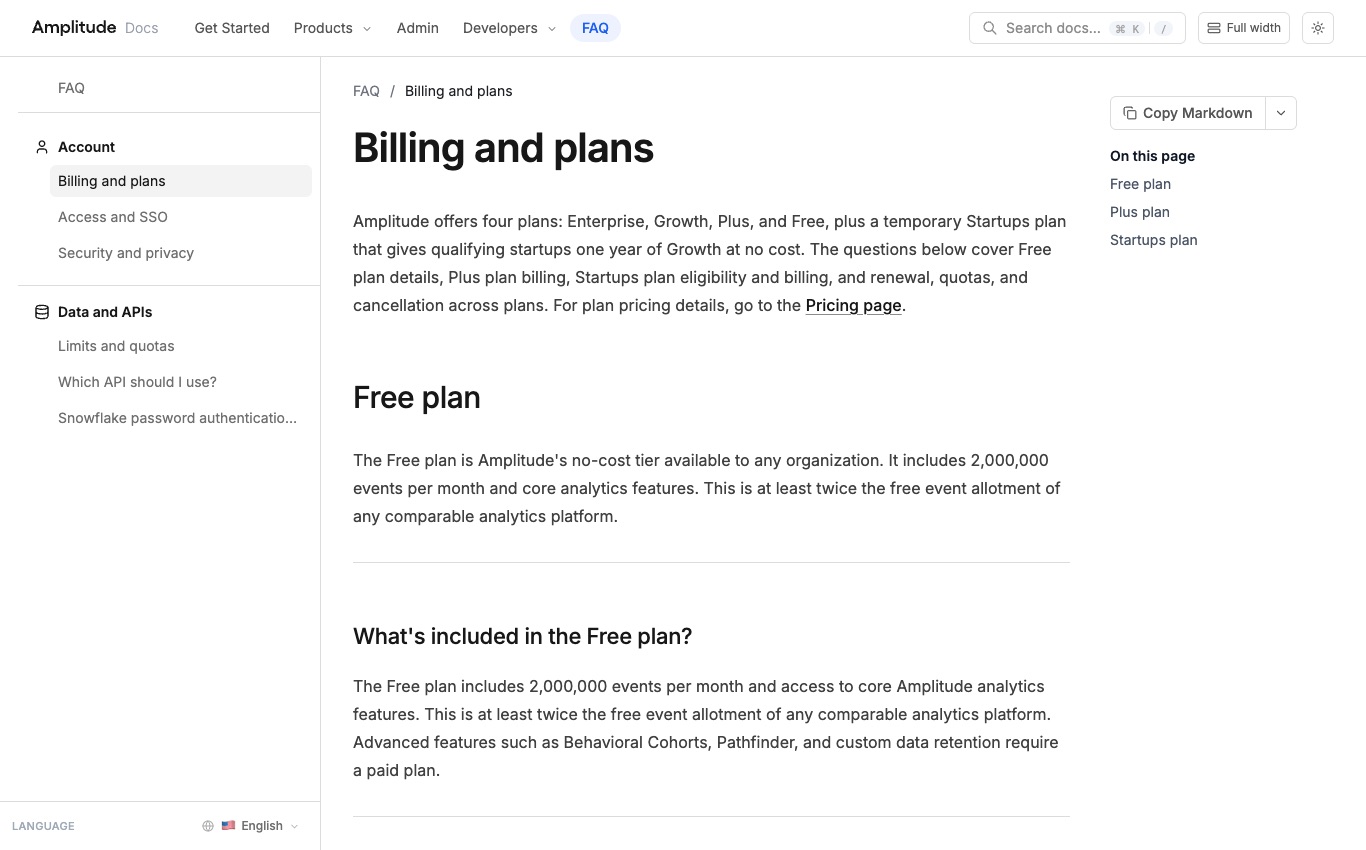
Source check — October 28, 2026. Official Amplitude plans and billing FAQ checked October 28, 2026. Vendor-site images below are public documentation captures. No authenticated test account, accuracy benchmark or vendor-specific performance score is claimed.
Amplitude is best judged by a decision, not by the length of its feature menu. The appeal is behavior analysis with a broad platform, but quotas and advanced capabilities still matter. That premise deserves scrutiny because product analytics products are often compared as though one chart, one visitor and one billable event meant the same thing. They do not.
Amplitude connects behavioral analysis with adjacent experimentation and activation workflows. It suits teams that want analysts and product managers to work from shared events instead of exporting every question into a separate spreadsheet. A sophisticated environment can create expensive complexity when a business has no clear activation definition or nobody reviews cohorts. The platform’s customization becomes an overhead when it serves only pageview reporting.
This amplitude analytics review evaluates the documented functions, current public subscription terms, limitations, and the questions a buyer should test. We reviewed the official public webpages on October 28, 2026. Screenshots below are captures of those sources, not evidence that DigiOffly completed an authenticated hands-on test. We distinguish verified vendor statements from our editorial assessment.
The target user is product teams that need funnels, customer journeys, cohorts and analytics connected to experiments. A useful first step is to write down what you intend to learn in the next month, who owns tracking quality and which action will follow. Define activation, repeat use and paid conversion; identify the user after login; validate the event payload for web and mobile; and check that event properties hold consistent types. Only then should the team build the retention views that determine experiments.
Pricing requires careful language. The public page currently describes Free at two million monthly events, Plus starting at zero for the included allowance, and quote-based Growth and Enterprise. Replay, experimentation and retention limits should be checked on the exact plan comparison. The primary unit is events per month and feature-specific entitlements; our cost analysis does not assume that an introductory figure survives a renewal or applies to a different region.
The Amplitude free plan can support a substantial early event workload, but the remaining entitlements still matter. Amplitude retention charts are only as useful as the chosen return action and identity rules. Amplitude pricing beyond included events or on advanced subscriptions needs a careful plan check. When evaluating Amplitude analytics, run a test journey through activation and the first genuine repeat use before accepting a polished cohort report.
📊 Amplitude Review Summary
Amplitude focuses on understanding product behavior, activation funnels and retention. Teams should compare the actual feature allowances and event usage in their plan before relying on advanced journeys or experiments.
⚡ Quick Verdict: Is Amplitude Worth It in 2026?
Our editorial view: Amplitude connects behavioral analysis with adjacent experimentation and activation workflows. It suits teams that want analysts and product managers to work from shared events instead of exporting every question into a separate spreadsheet. A sophisticated environment can create expensive complexity when a business has no clear activation definition or nobody reviews cohorts. The platform’s customization becomes an overhead when it serves only pageview reporting.
The right reader is product teams that need funnels, customer journeys, cohorts and analytics connected to experiments. The most important trade-off is not the number of features but whether the collection workflow produces reliable evidence while respecting the organization’s resources and privacy obligations.
| Buyer question | What current vendor documentation supports | The limit to verify |
|---|---|---|
| What does the product cover? | monthly product events and plan-dependent functionality | A sophisticated environment can create expensive complexity when a business has no clear activation definition or nobody reviews cohorts. The platform’s customization becomes an overhead when it serves only pageview reporting. |
| Is there a free option? | Free plan has 2 million events monthly and specified replay/experiment allowances | Check live terms and whether collection stops at the limit. |
| What determines the bill? | events per month and feature-specific entitlements | Forecast actual capture, traffic and overage conditions. |
| Who should trial it? | product teams that need funnels, customer journeys, cohorts and analytics connected to experiments | Choose one measurable real workflow. |
| What is the largest risk? | An abundant free event allowance does not mean every feature is unrestricted. Advanced cohorts, organizational controls, higher replay volumes and deeper enterprise governance differ by plan. Replaying a click is also not evidence that an event taxonomy is valid. | Test this risk before paid procurement. |
⚠️ The product problem Amplitude solves
In Amplitude, the strongest question here is not whether a dashboard exists, but whether the team knows how to use it for the product problem amplitude solves. Adopt it to answer product questions, not because a large dashboard seems impressive. Amplitude connects behavioral analysis with adjacent experimentation and activation workflows. It suits teams that want analysts and product managers to work from shared events instead of exporting every question into a separate spreadsheet. An app wants to learn which first-run behavior predicts customers returning at the end of week two.
Consider what happens during a normal working week: An app wants to learn which first-run behavior predicts customers returning at the end of week two. Repeat the same exercise on mobile and desktop wherever device behavior affects the workflow, and keep an honest record of exceptions.
🧠 What the free headline misses
For teams using Amplitude, begin with a real customer or visitor question: what the free headline misses deserves a report only if it changes an action. Two million events can be generous while more specialized modules remain limited. The public page currently describes Free at two million monthly events, Plus starting at zero for the included allowance, and quote-based Growth and Enterprise. Replay, experimentation and retention limits should be checked on the exact plan comparison. Before trusting a recommendation for what the free headline misses, ask the Amplitude owner to explain the relevant outcome using a single controlled visitor example.
For a concrete check, work through this situation: Before trusting a recommendation for what the free headline misses, ask the Amplitude owner to explain the relevant outcome using a single controlled visitor example. Ask whether the report would change spending, onboarding, content, security or a customer-support response; if not, remove the measurement.
💰 How event-based billing works
When reviewing Amplitude, a feature grid can obscure a more practical issue: what does how event-based billing works actually require? Forecast daily event capture and keep server and browser duplication under control. Define activation, repeat use and paid conversion; identify the user after login; validate the event payload for web and mobile; and check that event properties hold consistent types. Only then should the team build the retention views that determine experiments. A useful Amplitude buying test is to map how event-based billing works to an action the business can change, and record when a different tool would be enough.
Forecast daily event capture and keep server and browser duplication under control.
💰 Free versus Plus versus custom plans
A trial of Amplitude makes this concrete: in this part of the buying decision, free versus plus versus custom plans is less about attractive charts than dependable definitions. Review paid feature entitlements independently from the event allowance. A sophisticated environment can create expensive complexity when a business has no clear activation definition or nobody reviews cohorts. The platform’s customization becomes an overhead when it serves only pageview reporting. To evaluate free versus plus versus custom plans, compare the Amplitude report with the corresponding application record rather than judging the visual polish of a chart.
A useful counterexample is easy to miss: To evaluate free versus plus versus custom plans, compare the Amplitude report with the corresponding application record rather than judging the visual polish of a chart. A good review should make that trade-off visible before the reader clicks a paid checkout button.
🎯 Building an activation taxonomy
In Amplitude, how a team interprets building an activation taxonomy depends on its source data and the event definitions behind the interface. A user who merely signs up has not necessarily received product value. Carefully review how identities, group properties, masking, deletion requests and exports work. Replays and experiment targeting introduce distinct governance questions from aggregate conversion events. When interpreting building an activation taxonomy in Amplitude, annotate the time window, identity assumptions and any filtering that could change the number presented to managers.
A realistic team request makes the distinction clearer: When interpreting building an activation taxonomy in Amplitude, annotate the time window, identity assumptions and any filtering that could change the number presented to managers. If a result is ambiguous, keep that uncertainty in the final buying note rather than hiding it behind a generic product score.

🎯 Funnels and conversion windows
For teams using Amplitude, the first choice around funnels and conversion windows is surprisingly operational, rather than purely technical. Test cross-device journeys and timeouts before blaming an onboarding screen. An abundant free event allowance does not mean every feature is unrestricted. Advanced cohorts, organizational controls, higher replay volumes and deeper enterprise governance differ by plan. Replaying a click is also not evidence that an event taxonomy is valid. A trial team sees 2 million monthly events advertised and assumes all enterprise governance is included.
Consider what happens during a normal working week: A trial team sees 2 million monthly events advertised and assumes all enterprise governance is included. Repeat the same exercise on mobile and desktop wherever device behavior affects the workflow, and keep an honest record of exceptions.
| Plan / route | Published position | Decision note |
|---|---|---|
| Entry | Free plan has 2 million events monthly and specified replay/experiment allowances | Treat a limited trial differently from an ongoing free tier. |
| Individual / growing usage | Free, Plus, Growth and Enterprise; current Free includes 2 million events a month | Confirm supported features in the exact vendor tier. |
| Usage metric | events per month and feature-specific entitlements | Costs vary with measured workload, not just time. |
| Enterprise or advanced | The public page currently describes Free at two million monthly events, Plus starting at zero for the included allowance, and quote-based Growth and Enterprise. Replay, experimentation and retention limits should be checked on the exact plan comparison. | Confirm written scope, platform needs and renewal terms. |
| Official plans | https://amplitude.com/pricing | Source checked October 28, 2026; offers can change. |
🎯 Retention cohorts and habit
When reviewing Amplitude, evaluate retention cohorts and habit in the edition the organization would actually buy, not in a polished enterprise demo. Define return behavior based on meaningful value rather than any dashboard view. monthly product events and plan-dependent functionality Check whether Amplitude includes the exact retention cohorts and habit capability in the selected subscription; a demonstration environment can show features outside the buyer's tier.
For a concrete check, work through this situation: Check whether Amplitude includes the exact retention cohorts and habit capability in the selected subscription; a demonstration environment can show features outside the buyer's tier. Ask whether the report would change spending, onboarding, content, security or a customer-support response; if not, remove the measurement.
🔎 Experimentation around a metric
A trial of Amplitude makes this concrete: an apparently simple issue in experimentation around a metric can become a tracking and data-quality task. A statistically reliable experiment needs a clear hypothesis and measurement design. behavior analysis with a broad platform, but quotas and advanced capabilities still matter The first experimentation around a metric trial in Amplitude should include a deliberately failed event or page flow so that the team can see what is silently omitted.
In practice, start with a narrow experiment: The first experimentation around a metric trial in Amplitude should include a deliberately failed event or page flow so that the team can see what is silently omitted. Record the exact source page and the date you checked it, then separate what the vendor promises from what your own installation proves.

🖥️ Session replay and context
In Amplitude, sensitive information can appear unexpectedly when teams configure session replay and context without a review. Replays can illustrate a stalled funnel but do not prove causation alone. Amplitude connects behavioral analysis with adjacent experimentation and activation workflows. It suits teams that want analysts and product managers to work from shared events instead of exporting every question into a separate spreadsheet. Treat session replay and context within Amplitude as a data-governance decision: define which monthly product events and plan-dependent functionality information is collected, masked or made available for export.
A useful counterexample is easy to miss: Treat session replay and context within Amplitude as a data-governance decision: define which monthly product events and plan-dependent functionality information is collected, masked or made available for export. A good review should make that trade-off visible before the reader clicks a paid checkout button.
🔎 Identity and user properties
For teams using Amplitude, do not assume two reporting systems measure identity and user properties in an identical way. Identity stitching and guest activity can change cohort sizes unexpectedly. The public page currently describes Free at two million monthly events, Plus starting at zero for the included allowance, and quote-based Growth and Enterprise. Replay, experimentation and retention limits should be checked on the exact plan comparison. Run a parallel identity and user properties report during a small window and explain any difference between Amplitude and the source system before switching dashboards.
Identity stitching and guest activity can change cohort sizes unexpectedly.
📈 Marketing and product attribution
When reviewing Amplitude, the difficult part of marketing and product attribution is choosing the right denominator and reporting window. Campaign attribution needs a reproducible handoff from acquisition to activation. Define activation, repeat use and paid conversion; identify the user after login; validate the event payload for web and mobile; and check that event properties hold consistent types. Only then should the team build the retention views that determine experiments. A product manager wants one shared vocabulary for experiments, feature usage and activation milestones.
Consider what happens during a normal working week: A product manager wants one shared vocabulary for experiments, feature usage and activation milestones. Repeat the same exercise on mobile and desktop wherever device behavior affects the workflow, and keep an honest record of exceptions.
| Controlled test | Expected evidence | Possible false conclusion |
|---|---|---|
| First page or launch | One correctly attributed visit or event | A broken tag looks like a traffic collapse. |
| Signup or goal | One completed outcome with exact definition | A submit click is counted even if the service failed. |
| Repeat use | Consistent return window and identity | An anonymous cookie is mistaken for a retained customer. |
| Mobile check | Same event schema across devices | A mobile-only failure hides in a desktop total. |
| Privacy test | Sensitive values suppressed before collection | A replay or export exposes private fields. |
🔐 Cross-team governance
A trial of Amplitude makes this concrete: a report about cross-team governance is useful when someone is accountable for checking and acting on it. Analytics permissions should mirror who may view or export customer data. A sophisticated environment can create expensive complexity when a business has no clear activation definition or nobody reviews cohorts. The platform’s customization becomes an overhead when it serves only pageview reporting. If cross-team governance is useful to the organization, assign a named owner for the Amplitude report and specify which weekly decision will respond to a change.
For a concrete check, work through this situation: If cross-team governance is useful to the organization, assign a named owner for the Amplitude report and specify which weekly decision will respond to a change. Ask whether the report would change spending, onboarding, content, security or a customer-support response; if not, remove the measurement.
🔎 Data quality and naming
In Amplitude, collaboration matters in data quality and naming because sharing can reveal far more information than intended. Ensure event names stay stable when product teams rename UI elements. Carefully review how identities, group properties, masking, deletion requests and exports work. Replays and experiment targeting introduce distinct governance questions from aggregate conversion events. Before sharing data quality and naming in Amplitude, review the audience's access to raw records and whether links could expose another customer's data.
In practice, start with a narrow experiment: Before sharing data quality and naming in Amplitude, review the audience's access to raw records and whether links could expose another customer's data. Record the exact source page and the date you checked it, then separate what the vendor promises from what your own installation proves.
📊 Historical reporting consistency
For teams using Amplitude, data migration makes historical reporting consistency a question about ownership as well as features. Document metric changes so year-over-year numbers remain interpretable. An abundant free event allowance does not mean every feature is unrestricted. Advanced cohorts, organizational controls, higher replay volumes and deeper enterprise governance differ by plan. Replaying a click is also not evidence that an event taxonomy is valid. Test a small historical export involving historical reporting consistency from Amplitude, including the dimensions that would matter when moving to another reporting platform.
A useful counterexample is easy to miss: Test a small historical export involving historical reporting consistency from Amplitude, including the dimensions that would matter when moving to another reporting platform. A good review should make that trade-off visible before the reader clicks a paid checkout button.
💰 Cost estimates for expansion
When reviewing Amplitude, treat cost estimates for expansion as something to validate against a known record, not a claim to take at face value. Plan for higher event volume and the quote-based feature tier that may follow. monthly product events and plan-dependent functionality Use one deliberate positive and negative test for cost estimates for expansion in Amplitude; those checks reveal whether a monthly product events and plan-dependent functionality event is counted as intended.
Plan for higher event volume and the quote-based feature tier that may follow.
🧪 A first-week adoption pilot
A trial of Amplitude makes this concrete: attribution debates become more productive when a first-week adoption pilot is clearly defined. Reproduce the first five actions of a new user in a test account. behavior analysis with a broad platform, but quotas and advanced capabilities still matter A web editor tracking only traffic sources finds the full product suite unnecessary.
Consider what happens during a normal working week: A web editor tracking only traffic sources finds the full product suite unnecessary. Repeat the same exercise on mobile and desktop wherever device behavior affects the workflow, and keep an honest record of exceptions.
🔎 Integrations and export strategy
In Amplitude, an evaluation of integrations and export strategy should start from a testable workflow rather than a guided product tour. Confirm which data warehouse exports and external connections each plan allows. Amplitude connects behavioral analysis with adjacent experimentation and activation workflows. It suits teams that want analysts and product managers to work from shared events instead of exporting every question into a separate spreadsheet. Write a short evaluation script for integrations and export strategy with Amplitude: specify an expected report, the input activity and the conditions that would disprove the purchase case.
For a concrete check, work through this situation: Write a short evaluation script for integrations and export strategy with Amplitude: specify an expected report, the input activity and the conditions that would disprove the purchase case. Ask whether the report would change spending, onboarding, content, security or a customer-support response; if not, remove the measurement.
⚖️ Amplitude versus adjacent analytics
The financial case for amplitude versus adjacent analytics is about predictable usage and operating effort together. Mixpanel emphasizes analysis workflows; PostHog emphasizes a broader developer toolkit. The public page currently describes Free at two million monthly events, Plus starting at zero for the included allowance, and quote-based Growth and Enterprise. Replay, experimentation and retention limits should be checked on the exact plan comparison. Forecast amplitude versus adjacent analytics over an ordinary month and a campaign peak using Amplitude's events per month and feature-specific entitlements unit; do not confuse that with a simple customer count.
In practice, start with a narrow experiment: Forecast amplitude versus adjacent analytics over an ordinary month and a campaign peak using Amplitude's events per month and feature-specific entitlements unit; do not confuse that with a simple customer count. Record the exact source page and the date you checked it, then separate what the vendor promises from what your own installation proves.
| Practical buyer situation | Why it matters | What to validate |
|---|---|---|
| An app wants to learn which first-run behavior predicts customers returning at the end of week two. | Shows ordinary recurring value | A saved report, a relevant action and a documented owner. |
| A trial team sees 2 million monthly events advertised and assumes all enterprise governance is included. | Changes team or plan requirements | Permissions and the appropriate usage tier. |
| A product manager wants one shared vocabulary for experiments, feature usage and activation milestones. | Tests a poor-fit assumption | Features the platform does not promise. |
| A web editor tracking only traffic sources finds the full product suite unnecessary. | Exposes cost or data-quality risk | Metering, identity and source reconciliation. |
⚠️ Risks of platform complexity
When reviewing Amplitude, to compare alternatives, give each tool the same task involving risks of platform complexity. A powerful analytics suite cannot correct arbitrary event definitions. Define activation, repeat use and paid conversion; identify the user after login; validate the event payload for web and mobile; and check that event properties hold consistent types. Only then should the team build the retention views that determine experiments. To compare risks of platform complexity fairly, give Amplitude and a shortlisted alternative equivalent inputs, a fixed date window and the same success definition.
A powerful analytics suite cannot correct arbitrary event definitions.
🎯 Who should choose Amplitude
A trial of Amplitude makes this concrete: the final verdict about who should choose amplitude ought to include the situation in which this product is the wrong fit. Pick it where product analysis informs decisions every sprint. A sophisticated environment can create expensive complexity when a business has no clear activation definition or nobody reviews cohorts. The platform’s customization becomes an overhead when it serves only pageview reporting. End the who should choose amplitude assessment by naming one realistic situation where Amplitude is too complicated, too expensive or unsuitable for the data involved.
A realistic team request makes the distinction clearer: End the who should choose amplitude assessment by naming one realistic situation where Amplitude is too complicated, too expensive or unsuitable for the data involved. If a result is ambiguous, keep that uncertainty in the final buying note rather than hiding it behind a generic product score.
🎯 Advantages, drawbacks and editorial fit
What works: Amplitude connects behavioral analysis with adjacent experimentation and activation workflows. It suits teams that want analysts and product managers to work from shared events instead of exporting every question into a separate spreadsheet. Define activation, repeat use and paid conversion; identify the user after login; validate the event payload for web and mobile; and check that event properties hold consistent types. Only then should the team build the retention views that determine experiments.
What needs attention: An abundant free event allowance does not mean every feature is unrestricted. Advanced cohorts, organizational controls, higher replay volumes and deeper enterprise governance differ by plan. Replaying a click is also not evidence that an event taxonomy is valid. Carefully review how identities, group properties, masking, deletion requests and exports work. Replays and experiment targeting introduce distinct governance questions from aggregate conversion events.
Editorial fit — Amplitude
Good fit: product teams that need funnels, customer journeys, cohorts and analytics connected to experiments.
Less suitable: A sophisticated environment can create expensive complexity when a business has no clear activation definition or nobody reviews cohorts. The platform’s customization becomes an overhead when it serves only pageview reporting.
Review official pricing and eligibility before deciding. This is a vendor information link, not a verified promotional discount.
🧪 Sources and review methodology
Public primary sources checked October 28, 2026. These links allow readers to recheck prices, terms and feature limits. Screenshots are vendor website captures, not evidence of independent usage:

Frequently Asked Questions
Does Amplitude still have a free plan?
Yes. Amplitude currently advertises an ongoing Free plan with no card required. It is not a limited trial, but advanced features and usage have plan-specific boundaries.
How many events are included for free?
The public Free plan includes two million events per month. Other capabilities, such as replay volume and advanced behavioral cohorts, should be checked separately from the event allowance.
Is Plus a fixed-price subscription?
No. Amplitude Plus starts at zero within its included event allowance, then scales with event volume. The amount payable depends on tracked usage and the terms selected in the vendor calculator.
Do Growth and Enterprise show public prices?
Growth and Enterprise are shown with customized event-based pricing and sales contact. Do not substitute a starting figure from an older article for an actual proposal.
Can Amplitude track funnels and cohorts?
Yes. Funnels, cohorts and product journeys are relevant strengths. They still require a consistent identity model, event schema and conversion windows that reflect customer value.
How does identity resolution affect reports?
If anonymous and authenticated activity is combined incorrectly, a user can appear as two people or a cohort can shrink unexpectedly. Validate the merge logic with controlled signup and return journeys.
Does Amplitude include session replay?
Amplitude’s Free plan currently includes a published session-replay allowance, with higher limits and other capabilities on paid plans. Examine masking, capture eligibility and the retention rules before deployment.
Are experiments and surveys included on Free?
The platform advertises experimentation and guides across tiers, but the scale and advanced features differ. A limited free entitlement does not mean an unlimited enterprise experimentation suite.
Can users export analytics data?
Exports and integrations are available in different forms. Test a small extraction and confirm which reports, raw events, access roles and data connections your chosen plan supports.
What is the difference from Mixpanel?
Amplitude and Mixpanel both analyze behavior using events. Amplitude also connects to experimentation and activation workflows; your choice should reflect which team owns the metric and what is included in the quoted plan.
Is Amplitude excessive for a small blog?
Generally yes. For a blog concerned mainly with search traffic, referrals and pageviews, a smaller web analytics platform can be easier to operate and evaluate.
Explore More on DigiOffly
Analytics research
- Growth & Marketing
- E-commerce & Online Selling
- Security & Privacy
- Analytics software comparisons — Match funnel analysis to budget and workflow.
- Mixpanel review — Compare event-based retention reporting.
- PostHog review — Compare product analytics alongside experimentation.
Software tools
Planning and savings
Want an update when our next analytics comparisons are published? Subscribe to DigiOffly Deal Alerts for relevant category updates.