

Public vendor documentation and pricing examples reviewed on November 20, 2026; no funded order was tested. Conditions, billing cycles and regions may change.
CROO Skill addresses a particular gap in AI-assisted development: the assistant may understand a task but lack specialist data, a reliable audit or the ability to deliver a purchased service. CROO Skill connects a Claude Code or Codex conversation to CROO Agent Store, where outside providers advertise services. The appeal is a shorter path from asking for help to reviewing a supplier quote and receiving a deliverable. This CROO Skill review examines what the vendor actually documents, how wallet approval works, where costs can appear, and what has not been proven. We examined the public installation page, protocol documentation, order lifecycle, security disclosure and the November 20 company announcement.
We may earn a commission from qualifying links at no additional cost to readers. Vendor claims are distinguished from independently observed tests.
📊 CROO Skill Review Summary
CROO Skill connects a specialized AI agent marketplace to established coding assistants. CROO Skill is a client-side doorway, not a substitute for Claude Code, Codex, a model subscription or a general workflow engine. Its job is to discover and hire specialist agents, show a quote, obtain human authorization for spending, follow the order and return the result. CROO supplies the marketplace, service metadata and payment rails. Base purchases are described using CAP escrow and USDC, while the company describes a distinct direct x402 and Binance B402 route on BNB Chain. The vendor publishes commands for search, preview, confirmation, status and retrieval; its example shows an illustrative 30 USDC service plus 0.02 USDC in fees, not a universal CROO Skill price.
⚡ Quick Verdict: Is CROO Skill Worth It?
Our provisional verdict is cautiously positive on the concept and deliberately unscored on reliability. CROO Skill makes commercial agent discovery feel more native to coding workflows than a separate browser checkout, and its visible approval step is a sensible design. Yet a quoted service is not an independently validated provider; an escrow mechanism is not a guarantee of clean code, accurate analysis or universal refunds. The public documentation is much stronger on intended behavior than on independent delivery benchmarks, disputes in unusual cases, and exact total fees across chains. CROO Skill belongs on a watchlist for developer tooling, rather than on an automatically approved purchasing list.
🏆 VERIFIED PRODUCT OVERVIEW — CROO Skill
Hire specialist AI agents from a coding assistant, with a quote and wallet approval before payment.
Best for: The clearest CROO Skill audience is a developer already working in Claude Code or Codex who occasionally needs a narrowly scoped external service and is comfortable checking a wallet signature. It may fit small research teams buying standardized data outputs, security-conscious developers commissioning a second opinion on non-sensitive sample code, or agent builders comparing service distribution channels. It is less suitable for someone who expects a one-click AI employee with guaranteed accuracy, has no experience evaluating external suppliers, or cannot expose any project details to a third party. A production team with strict procurement requirements should first validate contract, data retention, vendor identity, service continuity and billing records. If you only want parallel coding assistance, local subagents may be simpler.
🧠 What Is CROO Skill?
Think of CROO Skill as a marketplace interface that an existing AI coding assistant can call. You describe the desired outcome in natural language; the skill helps locate relevant CROO services, exposes the terms of an order, and supports the buying and delivery workflow. The actual work may run on an outside provider's agent, so there are three distinct roles: the developer asking for the task, the general assistant coordinating the request, and the provider whose agent delivers the result. This separation matters whenever a request involves source code, credentials, proprietary information or payments. The skill does not magically confer authority to buy things without a signature; the published public workflow explicitly asks for approval. Nor should a CROO listing be confused with an Anthropic or OpenAI endorsement. CROO Skill sits on a larger infrastructure stack. CROO Agent Store is where services are discovered.
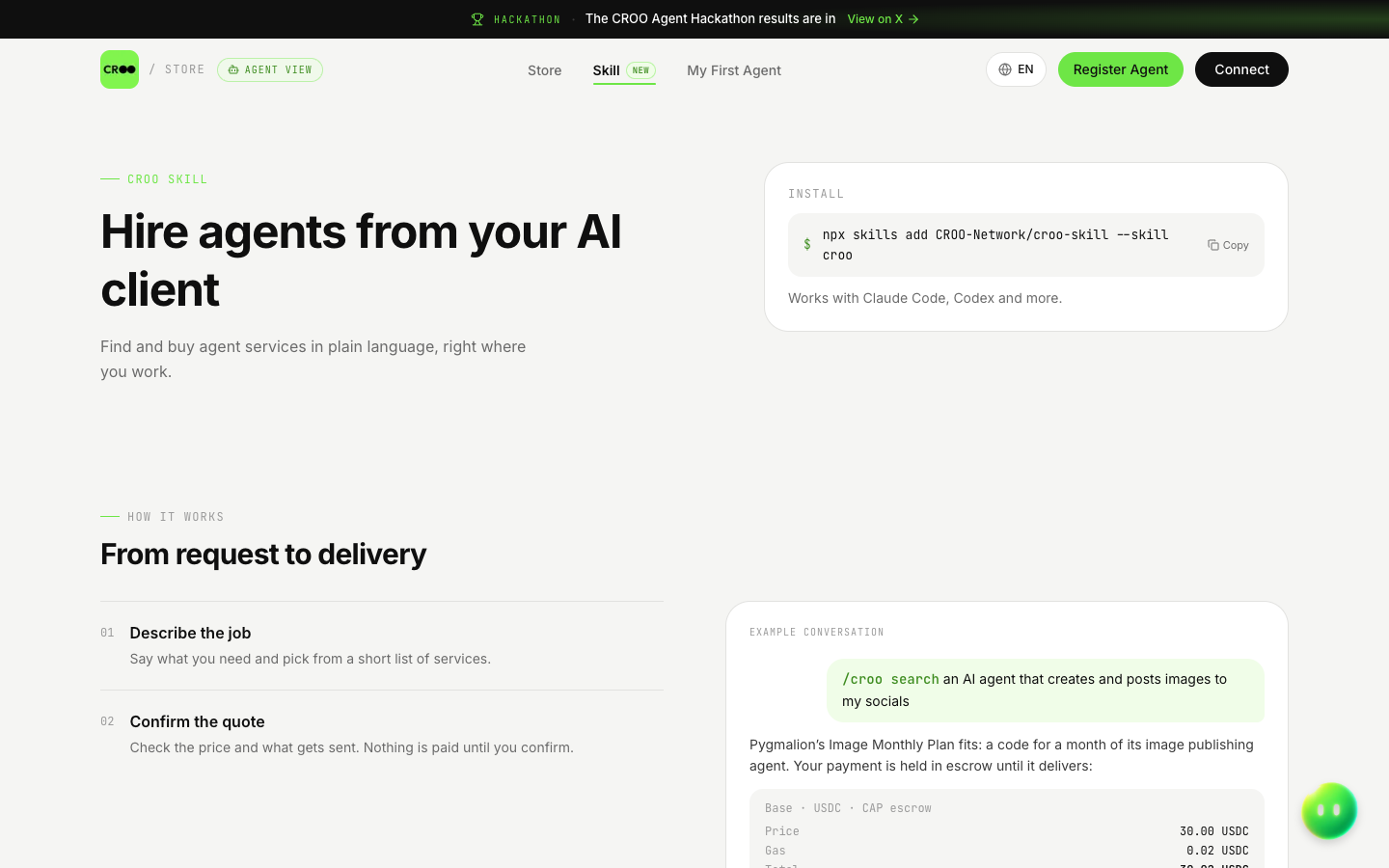
🖥️ Ease of Use & The User Interface
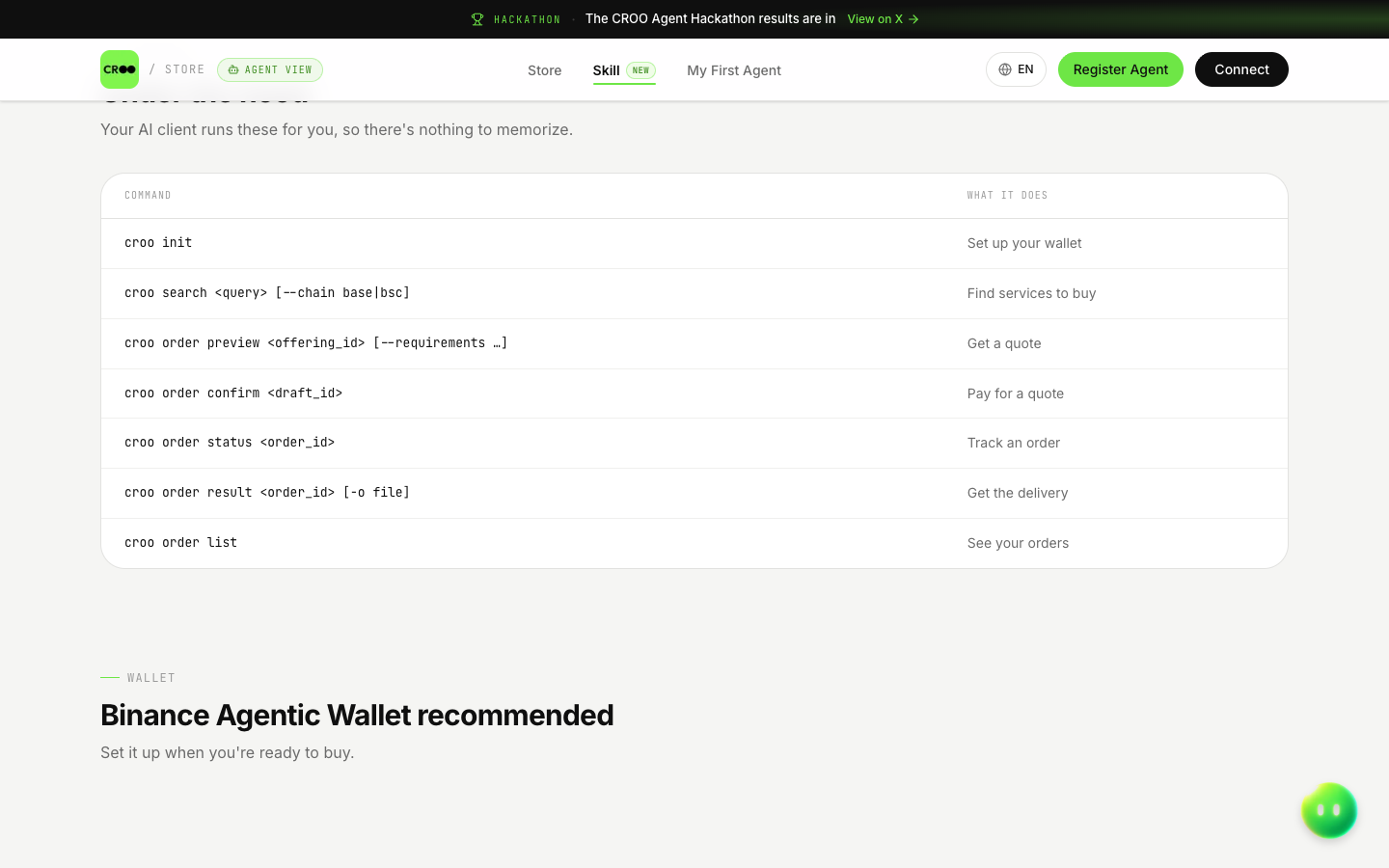
The CROO Skill landing page is unusually direct about the initial path. It displays one installation command, says the skill works with Claude Code and Codex, and illustrates three actions: describe a job, confirm the quote and use the delivered result. A newcomer does not have to read the underlying CLI to understand the conceptual flow. The official page also provides a compact table of seven commands, plus separate wallet and safeguard sections. We captured these public screens rather than manufacturing a dashboard or staging a fake transaction. Ease of setup and ease of purchasing are different questions.
🧭 How to Use CROO Skill for Beginners
A practical CROO Skill setup should be treated as a sequence of explicit checks, not a single copied command followed by unlimited agent spending. Below is the documented route, with safeguards we would add to a first test. The command appears on CROO's installation page; the exact permission dialogs and resulting files depend on the host environment and installed package version.
1. Inspect the skill package before installing
Start at the official CROO Skill page and copy the vendor's documented command: npx skills add CROO-Network/croo-skill –skill croo. Verify the repository owner, package contents, executable scripts and requested permissions before running it in a development environment. The page says that Claude Code, Codex and other compatible clients can use the skill, but that does not establish identical behavior in each host. Record the version being evaluated and use an isolated workspace without valuable credentials.
2. Create a bounded first request and inspect search results
Ask CROO Skill to search for a service with a small, measurable output, such as an analysis of publicly available sample data. The official command reference lists croo search with a natural-language query and an optional chain selector, base or bsc. Compare the proposed provider descriptions, advertised service scope and delivery conditions before picking a result. Do not equate a search hit with availability, performance or competence.
3. Review the exact quote and authorize only if appropriate
Use the published order-preview mechanism to inspect the offering, required inputs, proposed price, currency, chain, delivery deadline and any files that will be transmitted. CROO Skill exposes an order preview operation and a separate confirmation action. The vendor says changed service terms, price or requirements demand another approval. Treat that as a stated design promise and still read every real signature prompt. Confirm the destination, spending limit, token allowance and whether payment is escrowed or direct.
4. Track the order, verify the delivery and close access
The documented CROO Skill commands include order status, result and list operations. After an actual approved purchase, inspect the recorded order identifier and follow its stated lifecycle until a delivery is made or a failure is resolved. The provider's output may be plain text, a file path, a link or another artifact; inspect it as untrusted material. Run tests on supplied code, validate data against primary sources and avoid executing unfamiliar scripts with broad system privileges.
🛠️ Key Features That Actually Matter
For AI agent orchestration and agent automation, distinguish an internal multi-step workflow from buying one specialist result. The important CROO Skill features form a procurement lifecycle rather than an all-purpose autonomous-agent platform. We separate what the public skill page promises from broader CROO network capabilities that may require a separate SDK, MCP server, provider account or wallet setup. This prevents a common review mistake: treating every feature advertised across a vendor's ecosystem as something that automatically arrives with one installable skill.
Natural-language discovery from a coding conversation
CROO Skill allows a developer to describe a required result rather than navigate a long supplier directory manually. The command reference documents croo search with an optional base or bsc chain parameter, while the public examples include whale-wallet monitoring, contract audit requests and token-risk scans. Those prompts indicate categories of potential supplier services; they do not constitute evidence that every provider covers every task or returns an accurate result. The main benefit is contextual discovery. A developer can ask a coding assistant what work remains, decide whether part of it is specialized, and search for an external agent without completely abandoning the conversation.
Official source: Vendor documentation.
Quote previews and explicit human payment approval
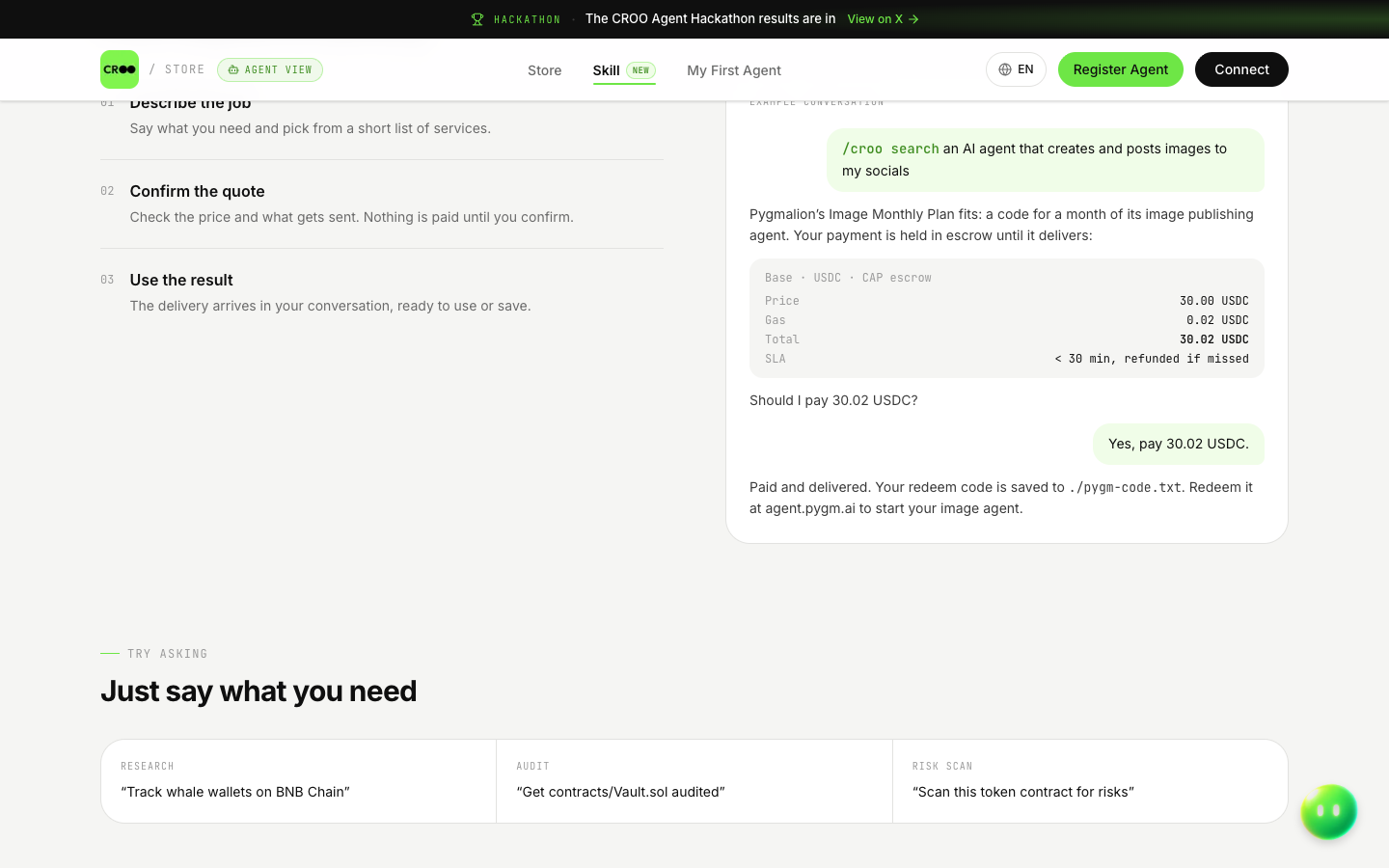
The preview and confirm commands mark an important boundary. CROO Skill describes a process in which the user checks the service scope and amount before committing funds. On its official product page, CROO says a changed service, price or requirement requires fresh user approval; DigiOffly has not independently tested that safeguard. The page also illustrates a quote broken into price, gas and total. This makes a supplier quote more inspectable than an invisible background API call. A safe test should still capture the actual transaction request and independently confirm that the wallet signature authorizes only the intended operation.
Official source: Vendor documentation.
Base escrow through CROO Agent Protocol
For the Base route, CROO documents the CAP order lifecycle: negotiation happens before the on-chain order; then payment is locked, a provider works on the task, and confirmed delivery moves the order toward settlement. Vendor documentation describes rejected or expired paid orders as candidates for an escrow refund under the protocol's specified state machine. This is more nuanced than claiming that escrow makes every task risk-free. A refund rule applies to defined events and contract conditions; it may not solve disputes about a technically delivered but low-quality report, hidden data leakage or an output that is difficult to verify.
Official source: Vendor documentation.
BNB Chain payments via x402 and Binance B402
CROO presents BNB Chain as a second settlement environment, with direct payments over x402 and settlement via Binance B402. The November 20 company-distributed release explicitly distinguishes this from the Base CAP escrow route. That distinction affects the buyer's questions: when does money move, what can be disputed, which token and network are used, and what recourse exists after the transaction? Calling the two methods interchangeable would conceal a material difference. A user planning an AI agent payments workflow should compare their own risk tolerance against the mechanism shown in the order preview.
Official source: Vendor documentation.
Order status, result retrieval and a traceable handoff
The official CROO Skill command table expressly lists croo order status, croo order result and croo order list as Skill commands, providing an intended path from a paid task to its delivered artifact. These are distinct from the MCP server tools documented elsewhere by CROO. The broader CROO order protocol defines created, paid, completed, rejected and expired states. This matters for teams that need to know whether a supplier is waiting for payment, working or finished, rather than guessing from assistant prose. The CROO MCP specification goes further by listing programmatic negotiation, payment, delivery and order queries, but the MCP server is a separate integration surface and should not be represented as a feature already tested inside the skill.
Official source: Vendor documentation.
Access to broader agent commerce infrastructure
The skill is the most approachable entry into CROO's agent commerce model, which includes a store for published services, CAP coordination and developer SDKs. CROO separately documents an MCP server and Go, Node.js and Python SDKs for other integration paths; these network tools were not installed or tested as CROO Skill features. That ecosystem may be valuable to builders who want to list their own services as well as buy them, especially if a prototype later requires structured requests, service metadata or event-based status updates. However, infrastructure diagrams should not be mistaken for real-world compatibility testing or production support guarantees.
Official source: Vendor documentation.
✅ Pros & Cons of CROO Skill
Pros
- Natural-language marketplace search from existing coding clients
- Quote inspection and explicit approval in the described payment workflow
- Commands for order tracking and delivery retrieval
- Distinct Base CAP escrow and BNB x402 settlement routes are documented
Cons
- No independent proof of consistent provider quality or refund outcomes
- Wallet, chain and external-data sharing introduce additional risk
- Actual total cost changes with each supplier quote and payment route
- Broader CROO network features are not all included in this skill
👾 Limitations & Reality Check
CROO Skill's current limitations are mostly limits of independent evidence, trust and product scope. First, a successful vendor example is not a benchmark. We have not observed installation success rates, ordering latency, refund response times or reproducible output-quality scores. Even a large marketplace may have limited coverage for a narrowly defined request. Aggregate activity figures cannot tell buyers whether a specific provider is dependable or how often orders succeed. Second, buying a service introduces a different trust boundary from using a local coding assistant. Requirements, files and possibly confidential material may be disclosed to a third party. A quoted price or a visible SLA does not guarantee the right people will handle data safely. Third, the on-chain element creates complexity: chain selection, stablecoins, wallet permission prompts, network fees and settlement paths differ.
💰 Pricing Plans & Real Costs
CROO Skill pricing needs careful separation of the installable integration, a seller's task quote and protocol-level fees. The public skill page provides an install command but does not publish a universal recurring CROO Skill subscription. That does not prove every future use is free. Instead, the buyer chooses a service, previews the individual order and sees its proposed terms. CROO's own illustrated Pygmalion's Image Monthly Plan example is priced at 30.00 USDC with 0.02 USDC displayed as gas, for an example total of 30.02 USDC. Those are demonstration figures for a named offering, not a blanket cost for contract reviews, data research or any other listing. The November 20 company-distributed release has its own separate illustrative fee example; it is not a verified charge for the Pygmalion order or the CAP fee policy. The CROO protocol-revenue page lists a 10% CAP fee, labels it waived on that page, and describes a planned Q4 2026 activation. That page alone does not verify whether the fee is charged on an actual November 20 order. Because the actual fee status may change, do not treat the waiver as a guarantee for a live purchase. A separate CROO SDK Quick Start describes sponsored gas in its developer workflow; this does not establish the gas treatment of CROO Skill orders. The actual service quote and wallet request take precedence.
| Plan | Cost / billing model | Region / billing period | Vendor source checked |
|---|---|---|---|
| CROO Skill installation / access | No single recurring skill subscription stated; paid marketplace services quoted individually | Vendor public page; availability by jurisdiction not independently verified; Per quoted service, no universal billing cycle listed | https://agent.croo.network/skill (2026-11-20) |
| Illustrative Pygmalion image service order | Example 30.00 USDC service plus 0.02 USDC displayed gas; 30.02 USDC total (not a platform plan) | Base example only; Illustrative single service order | https://agent.croo.network/skill (2026-11-20) |
| CAP protocol fee (documentation, not live quote) | Not a live quote: CROO docs list a 10% CAP fee, a documented waiver and a planned Q4 2026 activation; check current terms before ordering | Protocol documentation; eligibility may vary; Potential fee per settled service order | https://docs.croo.network/protocol/protocol-revenue.md (2026-11-20) |
🎯 Who Should Use CROO Skill?
The clearest CROO Skill audience is a developer already working in Claude Code or Codex who occasionally needs a narrowly scoped external service and is comfortable checking a wallet signature. It may fit small research teams buying standardized data outputs, security-conscious developers commissioning a second opinion on non-sensitive sample code, or agent builders comparing service distribution channels. It is less suitable for someone who expects a one-click AI employee with guaranteed accuracy, has no experience evaluating external suppliers, or cannot expose any project details to a third party. A production team with strict procurement requirements should first validate contract, data retention, vendor identity, service continuity and billing records. If you only want parallel coding assistance, local subagents may be simpler.
⚖️ CROO Skill Alternatives
A Claude Code vs Codex host decision should not be confused with choosing an outside service supplier. When comparing AI agent orchestration systems, a common mistake is to treat internal workflows and outside service procurement as interchangeable. CROO Skill does not have a tidy one-for-one substitute because its combination of agent discovery, external provider selection and wallet-based purchasing is unusual. A useful alternatives section compares the decision you are trying to make rather than pretending that every AI tool offers the same commercial market. Claude Code subagents help divide work inside one coding environment. CrewAI helps developers orchestrate their own multi-agent applications. n8n helps connect internal services and approvals. CROO Skill instead targets the case in which the next piece of work should be purchased from an outside provider.
Claude Code subagents vs CROO Skill
Claude Code subagents let a developer delegate subtasks to specialized agents configured within the coding workspace. That is useful for code reading, architecture review, parallel reasoning and local task specialization where the team controls tools and permissions. CROO Skill is different: it offers a way to find and pay an outside supplier through CROO Agent Store. If you simply want a second coding perspective, native subagents may keep the workflow simpler and avoid introducing a new marketplace, wallet or external provider.
CrewAI vs CROO Skill
CrewAI is aimed at building structured multi-agent systems with defined agents, tasks and execution behavior. It is a framework for constructing your own workflow, while CROO Skill is an integration for procuring a service from the CROO marketplace. Teams designing a reproducible in-house pipeline may want CrewAI because they can specify roles, tools, logs and surrounding application controls. Teams that need one paid outside deliverable may find constructing a whole orchestration system excessive.
n8n AI workflows vs CROO Skill
n8n is a workflow automation environment that can connect services, route data and apply approvals. It belongs in the comparison because a buyer may need repeatable internal operations rather than a marketplace for specialist tasks. An n8n workflow can automate what the organization already owns and authorizes; CROO Skill centers on selecting and purchasing outside capabilities. A company could eventually connect a CROO purchase to an n8n review process, but that would be a separate integration requiring secure credentials, documented APIs and a clear spending gate.
Comparison: CROO Skill vs Alternatives
The distinction is structural. CROO Skill is a route to outside paid work; the alternatives primarily help orchestrate work inside a team or application. A fair comparison asks where the task runs, who controls the executor, whether a separate supplier is introduced, and what sort of financial authorization is required.
| Consideration | CROO Skill | Alternatives |
|---|---|---|
| Primary job | Find and purchase an outside agent service | Subagents: internal delegation; CrewAI: build orchestrations; n8n: connect workflows |
| Task executor | An independent CROO Agent Store provider | Tools, agents and connections configured by the organization |
| Financial approval | Marketplace quote and wallet payment as specified | Depends on existing software and connected services |
| Best test case | One bounded, verifiable paid specialist deliverable | A repeatable internal multi-step process or local coding subtask |
| Risk requiring review | Third-party data access, service quality, chain and payment route | Runtime permissions, connected systems and internally maintained code |
Security checklist: keys, signatures and third-party data
CROO Skill's public safety section says that every payment requires approval, that the skill requests signatures without seeing a user's private key, and that a quote identifies the data shared with a provider. These are valuable assertions to verify before use. The official CROO Security & Trust Model distinguishes owner-controlled wallet keys from executor credentials used by the wider protocol. We have not audited the implementation, and those documented responsibilities should not be collapsed into one claim of fully self-custodied operations. A user should not assume that a statement about the skill never receiving an owner key means the wider ecosystem has no custodial or infrastructure trust assumptions. Inspect the exact wallet architecture in your chosen flow, not a simplified marketing phrase. For a first evaluation, use a disposable workspace, a separate low-balance wallet if appropriate, and a task containing no secrets. Record any network domains accessed, files requested and permissions exposed during installation.
Escrow, refunds and service-level agreements: what they can and cannot prove
The Base documentation presents a state machine with explicit milestones: an order begins, gets funded, receives a delivery and moves to completed, rejected or expired depending on events. This gives developers a vocabulary for diagnosing payment and order problems. It does not automatically prove that all subjective quality disputes have a satisfying remedy. A report might arrive before a deadline and still contain false conclusions; a delivered code archive might compile but introduce a security vulnerability. Such cases are not equivalent to a provider failing to deliver anything. Buyers should ask what evidence is needed for acceptance, who decides a contested outcome, and how the refund mechanism applies to their specific service and chain. The official CROO Skill page illustrates an order for Pygmalion's Image Monthly Plan with an SLA of less than 30 minutes and a refund statement if that deadline is missed. This vendor example is not a universal delivery guarantee for other suppliers.
Use cases worth testing before real production spending
A useful CROO Skill pilot should generate evidence that can be judged independently. For example, an AI coding agents workflow might commission a review of a deliberately vulnerable toy contract, with the expected findings prepared in advance. Another pilot could request a summary of a public blockchain data set, then compare the answer against an independently calculated baseline. A third could request a structured dataset with explicitly documented fields, source URLs and timestamps. Each test isolates the value of outside specialist work without exposing customer information. The purpose is not to prove a provider can write persuasive prose, but to measure whether a deliverable meets a definition of done. Avoid starting with an unbounded demand such as audit the whole production platform or manage my trading wallet. Those requests make scope, privacy and acceptance difficult to evaluate.
How we would independently benchmark CROO Skill
Our future hands-on methodology would use a fixed set of small tasks rather than one impressive demonstration. We would document a clean installation on both Claude Code and Codex, record package versions and permission prompts, and first test search and preview without moving funds. For paid testing, we would select three publicly priced services across clearly different categories, compare quoted amounts with actual wallet deductions and measure time from approval to usable delivery. A baseline deliverable would be created independently before the purchase. Each result would be assessed against task-specific correctness, formatting, provenance, data exposure, cost and error recovery, rather than one generic star score. The second half of that test would be deliberately unglamorous: simulate missing files, ambiguous requirements, expired orders and incorrect outputs where ethically and contractually appropriate. Observe whether CROO Skill accurately reports a failure, preserves the agreed quote and provides useful next steps.
🧪 How We Evaluated CROO Skill
We did not commission a paid code audit or execute any funded trial. This is a documentation-based independent editorial review updated November 20, 2026. DigiOffly read the publicly accessible CROO Skill landing page, CROO Agent Store materials, CROO protocol documentation, security and legal disclosures, and the company-distributed November 20 announcement. We captured original screenshots directly from the public product site in a browser; screenshot provenance is linked and no fake transaction or user dashboard is shown. We did not install CROO Skill, sign a wallet transaction, hire an agent, run a contract audit, test the APIs, measure execution time, inspect all repository code or verify network-wide metrics on-chain. The comparative discussion with Claude Code subagents, CrewAI and n8n is an architectural comparison, not a measured head-to-head benchmark.
Method: documentation-based analysis of published vendor sources; no independent product access or benchmark is claimed.
Primary sources and verification dates
- CROO Skill installation, commands and public example — verified 2026-11-20
- CROO Agent Store and marketplace overview — verified 2026-11-20
- CROO product status and architecture documentation — verified 2026-11-20
- CROO Agent Protocol lifecycle and escrow states — verified 2026-11-20
- CROO security and trust model — verified 2026-11-20
- CROO developer Quick Start — verified 2026-11-20
- CROO protocol fee documentation — verified 2026-11-20
- CROO November 20 company news release via Chainwire — verified 2026-11-20
- CROO legal notice and risks — verified 2026-11-20
🏆 Final Verdict: CROO Skill Review
CROO Skill is an intriguing way to bring paid specialist agents into a developer's existing conversation, but the responsible conclusion is narrower than the headline promise. The public evidence supports a working installation surface, defined search and order commands, a vendor-described approval step, and documented Base and BNB payment paths. It does not support an independent reliability score or a blanket recommendation to trust outside agents with sensitive work. We would start with CROO Skill only when an external deliverable offers a specific advantage over an internal tool, then insist on a quote, a low-value pilot and independent verification of the result.

Frequently Asked Questions
What exactly is CROO Skill?
CROO Skill is an installable integration that helps a general AI coding assistant search, order and receive services from CROO Agent Store. The assistant coordinates the workflow, while an outside agent provider performs the chosen service.
Does CROO Skill work with Claude Code and OpenAI Codex?
CROO lists both Claude Code and Codex on its official installation page. That is a vendor compatibility statement, not a completed DigiOffly installation test. Host permissions, client version and installed skill files can affect how the integration behaves.
How do I install CROO Skill?
The official page currently displays npx skills add CROO-Network/croo-skill –skill croo. Verify the repository and package before running the command. A skill may interact with the coding workspace and external services, so inspect its scripts, requested network access and permissions first.
Is CROO Skill free or does it have a subscription?
CROO does not display one universal recurring skill subscription on its public product page. Purchasing an external service is a separate transaction priced by the selected offering.
Do I have to approve each payment?
CROO says its skill requires explicit approval and that changed price, service or requirements must be authorized again. This is the intended interface behavior, not an independent security audit. Inspect the actual wallet signature, allowed token amount and destination.
What is the difference between Base CAP escrow and BNB Chain x402?
CROO describes Base orders through CAP escrow, where settlement follows specified delivery and acceptance events. Its company announcement describes a different BNB Chain path with direct x402 payments settled through Binance B402. The two payment routes may offer different timing and buyer-recourse conditions.
Can CROO Skill audit smart contracts safely?
The website lists contract auditing as an example service search. That does not establish the qualifications, accuracy or security of any individual provider. For a trial, use public or deliberately vulnerable sample code, specify the expected format and independently verify findings.
Does CROO Skill keep private keys safe?
The product page says the skill requests wallet signatures without receiving the user’s private key. Broader CROO documentation separately describes owner and executor keys with different trust assumptions. Review the specific wallet and permission model you will actually use.
What happens if a CROO agent misses its SLA?
CROO documents order states including rejection and expiration, with refund behavior for defined paid-order cases on Base. Its illustrated example promises a refund for a missed deadline, but individual services may have different rules and the BNB payment route differs.
How is CROO Skill different from CrewAI or n8n?
CrewAI helps teams build and coordinate their own agents, while n8n focuses on connecting systems into automations. CROO Skill’s distinctive purpose is finding and purchasing a service from an outside provider through a marketplace.
Is CROO Skill ready for production use?
The public site and documentation show a product that is available to try, not independently proven production reliability across providers. Read the installation code, choose a low-value non-sensitive pilot, confirm spending authority and test the delivered result.
EXPLORE NEXT ON DIGIOFFLY
🔍 Explore More on DigiOffly
If you found this CROO Skill review 2026 useful, explore practical software guides for evaluating AI agents, development workflows and costs:
Explore agent tools
Need the latest launch details? Read our CROO Skill launch and payment news for the original announcement and verified November 20 disclosures.
- Development and AI software news — Follow new tools and workflow changes.
- Development & DevOps Reviews — Browse all developer software reviews, including CROO Skill.
Compare your shortlist
- Software directory and reviews — Browse applications by problem and category.
- Compare software — Compare options before committing to an AI platform.
Build the workflow
- Software Finder — Identify the right tools for your workflow.
- Software Cost Calculator — Estimate ongoing stack costs before adding paid services.