

Sources checked October 29, 2026. This Greenhouse review draws on the official Core, Plus and Pro pricing pages, product descriptions and help materials. Screenshots illustrate published vendor pages rather than a live employer account. We have not independently conducted an interview panel or measured hiring results inside Greenhouse.
Greenhouse is strongest when an organization wants more discipline in hiring decisions. It gives recruiting teams a framework for job approvals, interview plans, scorecards and candidate histories. That can be valuable when applicants meet several interviewers and the panel needs to explain its choice. It also requires managers to agree on useful criteria and record their judgments before the debrief. Software cannot supply that discipline on its own.
A recruiting system does not fix a vague interview process merely by placing it on a screen. If panel members assess different things, or complete their notes after they have decided, a neat scorecard says little. Similarly, a dashboard becomes misleading if every department calls the same hiring stage something different. This review looks at those operational boundaries and at what Greenhouse’s Core, Plus and Pro contracts actually include, without inventing a live hiring trial.
Consider an engineering candidate interviewed by four people. If every interviewer receives a generic invitation and writes impressions after the decision, a new ATS has changed little. Greenhouse’s structured interview kits can support a better process, provided the panel understands the attributes and records assessments independently. Ask the hiring team to show the same method for a sales role without forcing both roles into an identical rubric.
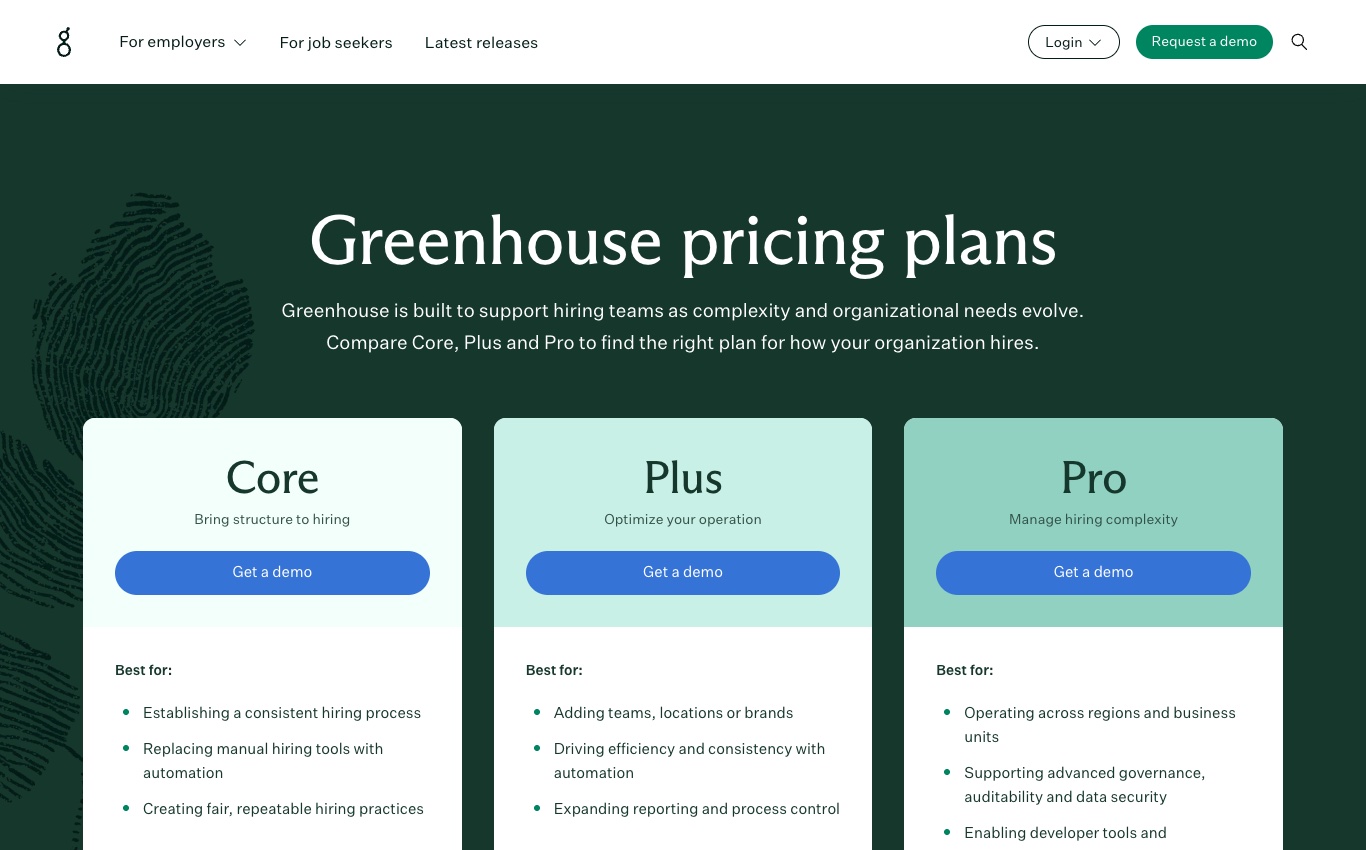
Pricing snapshot: Greenhouse offers Core, Plus and Pro plans by tailored quotation rather than a public per-employee price. Core covers structured hiring; Plus adds automation and advanced analytics; Pro extends governance, security and enterprise controls. We do not infer an entire enterprise subscription from a publicly advertised starting rate or substitute a competitor blog for a vendor quote. Obtain current contractual terms before making a purchase.
We may earn a commission when readers purchase through certain links. That never changes which product limitations, missing regional services or contract questions we document here.
📊 Greenhouse Review Summary
Greenhouse tends to make more sense when the company hires often enough to justify a structured process. A recruiting-operations lead can maintain role definitions, approvals and reporting while hiring managers concentrate on interviews. It is less obvious for an employer that makes a handful of hires annually. The question is whether the organization will actually use the additional controls, not whether the vendor offers them.
Interview kits and reporting make up much of the case for Greenhouse. Their effectiveness depends on consistent stage definitions and independent feedback, however, and some more advanced reporting and restricted-data controls sit in higher plans. A useful quote needs to distinguish the Core workflow from Plus and Pro capabilities. It should also specify how accepted candidates reach the company’s HRIS without dropping important data.
⚡ Quick Verdict: Is Greenhouse Worth It in 2026?
Editorial assessment: Greenhouse is a strong shortlist candidate for a recruiting team that owns its interview process and trains managers to follow it. The product asks more of administrators than a lightweight applicant tracker, and pricing comes through a tailored quote. Against Workable, the relevant distinction is how much the employer values repeatable hiring governance compared with a more straightforward sourcing-and-ATS setup. Avoid comparing a Greenhouse enterprise configuration with Workable’s smallest published price bracket.

🧠 Greenhouse ATS and structured hiring
Greenhouse Core vs Plus vs Pro is principally a decision about how much hiring structure and administration the team can maintain. Core supports structured hiring; higher tiers add items such as sourcing automation, advanced reporting filters and restricted file access. Greenhouse ATS pricing is quote-based, so ask for an itemized package rather than assuming features observed during the demo will be present in the final subscription.
Greenhouse should be judged on the decisions its interview structure supports. Define the skills for one role, distribute them among interviewers and have every assessor complete a scorecard before the panel meets. The result should be clearer evidence, not a more complicated ritual. A candidate’s response can be misread when the rubric contains vague traits; training interviewers is therefore part of the product cost. Ask the hiring manager to explain why a particular criterion matters for the job before enabling automated suggestions.
A candidate profile is not an employee record. Greenhouse begins with sourcing, job approvals, interview decisions and offers; Greenhouse Onboarding or an external HRIS may handle the next handoff. Map that boundary before procurement, especially if HR already owns identity, payroll and contract documents. An integration logo cannot tell you which records synchronize or what happens after a failed transfer.
🛠️ Why structured hiring changes the conversation
A well-run interview panel should not need to reconstruct its reasoning after the offer has been sent. Greenhouse emphasizes job-related attributes and interview kits so each interviewer knows what evidence to collect. The difficult part is agreeing on useful criteria: ‘culture fit’ is too vague to support a defensible decision, while a clear requirement to explain a technical trade-off can be discussed against actual answers.
For a demonstration, have two assessors interview the same fictional candidate separately and save their notes before the panel meets. Their ratings need not agree, but both should point to specific evidence rather than a general impression.
🔎 Requisitions and job approvals
Recruiting often starts with an argument over whether a vacancy is authorized. Greenhouse can route job approvals before a position goes live, keeping a departmental request separate from permission to recruit. That matters when a manager wants to replace a departing employee but finance has approved only a different salary range or location.
Run a mock approval with HR, finance and a department lead, then change the requisition’s compensation band. Check whether approval must be repeated and whether the recruiter can see which version was authorized. A record of who approved the opening is more useful than a frictionless publishing button.
⚖️ Core tier for repeatable interviews
Greenhouse Core should be considered as the baseline for creating a repeatable hiring process, not as a stripped-down version of every enterprise feature. The published Core description covers structured interviews, sourcing-related tools and core recruiting workflows, but advanced controls belong to other tiers. Teams with a few well-defined vacancies may not need the same reporting or administration as a large recruiting organization.
Ask the vendor to use a Core-only demonstration account for a vacancy approval, interview kit and final hiring decision. Anything available only in Plus or Pro should be called out at the moment it appears, not discovered after a contract is signed.
📈 Plus automation, reporting and fraud filters
The reason to consider Greenhouse Plus should be visible in the team’s backlog. If recruiters spend hours filtering reports or sending repeat follow-ups, its additional automation, text communication and reporting tools may matter. The plan also advertises fraud- and spam-related features. But a detection flag is not a candidate verdict, and hiring teams should know what triggers a review by a real person. Get the vendor to itemize Plus entitlements against the Core quote before judging the upgrade.
🔐 Pro controls for complex hiring
A confidential leadership vacancy makes Greenhouse Pro’s restrictions more tangible than a list of security controls. The recruitment team may need to hide applications from ordinary hiring managers while retaining an audit record for people authorized to review them. Pro offers options including restricted files, timeouts, audit logs and developer testing facilities. The buyer’s IT owner should decide which of these capabilities actually resolves a policy requirement; a sandbox or extra audit report has little value without someone responsible for using it.
🧭 What a real implementation pilot should include
Forget the generic six-employee HR demo: Greenhouse should be tested with two very different hiring panels. One team interviews a senior engineer, the other recruits hourly operations staff. Give each an approved requisition, job-specific interview criteria and a fictional candidate who reschedules. The important evidence is whether every assessor can find the right instructions, whether approval changes are visible and whether the funnel report distinguishes the two processes. A perfect-looking applicant card tells you little about that.
Recruiting operations should own the Greenhouse evaluation, with an actual hiring manager leading one part of it. The manager must enter a scorecard before seeing everyone else’s opinion; otherwise a structured interview tool becomes a more expensive shared notebook. Involve IT for the Pro security options, and someone responsible for privacy when old candidate data is imported. If the organization cannot name who will maintain rubrics after launch, it has not finished its implementation plan.
🎯 Who actually benefits from this system
Greenhouse is a specialist recruiting platform rather than a general people database. Its most ambitious promise is consistency across many hiring decisions: approvals, interview evidence, candidate communications and the reports that reveal bottlenecks. An employer with sporadic hiring might prefer a simpler ATS. A larger organization could justify the more deliberate structure, but only if managers agree to use it. The strongest pilot is one that exposes when someone skips the process and shows whether an administrator can correct the gap.
Recruiters may appreciate configurable stages. The finance approver wants to know which requisition has an authorized budget; the hiring manager wants a short interview plan; the privacy lead wants candidate data to expire appropriately. Each cares about different pieces of Greenhouse. Put those people in the demonstration and ask them to complete their tasks separately. A feature that requires the recruiting administrator to intervene every time should be counted as ongoing work, not as a finished automation.
💰 Greenhouse pricing, modules and total cost
Greenhouse interview scorecards become useful when evaluators record evidence against the same job-related criteria. Structured interview kits, independent panel notes and candidate experience tools must work together: an accurate decision process means little if the candidate receives the wrong schedule. The recruiter should also demonstrate applicant data retention controls before importing historic applications into the platform.
| Budget element | Questions for the vendor | Buyer evidence |
|---|---|---|
| Base HR license | No verified fixed public dollar figure should be substituted for a Greenhouse quote. Ask separately about recruitin | Signed quote and exact plan tier |
| Recruiting and ATS | Are jobs, screening, onboarding and extra recruiters included? | Current module entitlements |
| Payroll and benefits | Which countries, employment types and extra services are covered? | Written geographic scope |
| Implementation | What migration, onboarding and training services are charged? | Statement of work |
| Renewal and cancellation | What changes as employees grow or leave? | Contract and notice period |
💡 Interview kits and independent scorecards
Greenhouse interview kits address a problem that often appears only after a candidate has spoken to several people. One interviewer measures technical depth, another asks about collaboration and a third repeats both sets of questions. A good kit assigns clear areas of evidence to each person so the debrief is about the candidate’s answers, not whose memory sounds most confident.
There is a trap in structured interviews: filling out the rubric after the panel has already agreed on the verdict. In that sequence a scorecard only makes consensus look official. The process works better when reviewers note observations before the group discussion. Interviewer training should cover what good evidence looks like and what to do when a question proves irrelevant to the role.
Give two managers the same fictional candidate and keep their scorecards separate until both are complete. Then compare the reasons they recorded, not just the numerical ratings. If an administrator can overwrite an assessment without a trace, the company should ask what controls or tier features support accountability. An interview workflow should be auditable enough to explain a decision later.
📋 Scheduling and candidate communications
An interview invitation is a small promise to a candidate. The correct interviewer will attend, the meeting link will work and the time will match the recipient’s location. Greenhouse supports interview coordination and candidate communication, yet the employer still needs someone to own changes that fall outside the happy path. A calendar connection does not prevent a panellist from cancelling five minutes before the meeting.
Consider a three-person panel spanning two time zones. One interviewer declines, the candidate asks to move the call and an accessibility request arrives with the reply. What should be visible to the recruiter, and what message will the candidate receive? Those are concrete questions for a product demonstration. The decisive measure is not the number of calendar integrations; it is whether nobody has to guess which invitation is current.
🎯 Talent discovery and sourcing CRM
A person in a recruiting database may be an active applicant, an old finalist or a prospect who has never applied. Treating those records identically makes outreach easier for the recruiter and potentially confusing for everyone else. Greenhouse’s sourcing and CRM functions can support longer-term relationships, but the organization needs a reason to retain each contact and a clear process for withdrawing consent where applicable.
A historical candidate who applied for one position should not automatically be enrolled in campaigns for every new vacancy. Recruiters also need to understand where an exported prospect record goes when another tool sends the messages. Ask the vendor to demonstrate an opt-out that remains effective after a job closes and an old contact is found again. It is a mundane test, and precisely the sort of detail that can undermine a polished CRM rollout.

🧩 Real Talent matching and fraud defense
Greenhouse describes talent matching plus more advanced fraud and spam defenses in its current plans. Fraud controls can be particularly relevant when online applications surge.
Matching is an aid to reviewing applications, not an objective measure of potential. Errors can exclude legitimate applicants; disclosure and appeal paths should be considered.
Submit fictional edge cases and have a human recruiter inspect the match explanation before any candidate is rejected.
💰 Calculate the real first-year bill
The first-year Greenhouse expense depends on which processes must become repeatable. If managers only need basic interviewing, a Core proposal may be enough. A company purchasing Plus for analytics should identify the reports it cannot create today; Pro should have a clear security owner asking for logs, restricted files or a sandbox. There is also internal work to budget: deciding stage definitions, rewriting interview rubrics and training managers. None of those costs appears as a reliable public subscription number, so the quote must make the assumptions explicit.
Ask Greenhouse to present the quote alongside the actual implementation diagram. Which HRIS receives accepted hires? Who builds the integration? How will historical candidates be screened for retention rules before import? And, crucially, does the demonstrated workflow rely on a Plus or Pro entitlement that is not in the proposed tier? A procurement document that only names a subscription level cannot settle those questions. Record the scope, renewal commitments and training services before comparing it with Workable.
🔐 Employee records and data governance
Recruiting records are personal data gathered before someone becomes an employee. Greenhouse may hold rejected candidates, interview feedback, contact information and sourcing history long after a vacancy closes. Give hiring managers only the access they need for assigned roles, then document who can export candidate files or alter a scorecard. Migration is not automatically a reason to carry every old application forward; data that should have been deleted from the previous ATS should not quietly reappear in the new one.
🛠️ AI Notetaker and interview governance
An interviewer can misremember a candidate’s answer; an automated transcript can mishear it. Greenhouse’s AI Notetaker may reduce administrative work, but a hiring decision should not depend on an unattributed summary that nobody checked. Before adopting recorded interviews, the employer needs to settle candidate notice, retention of recordings, who can correct errors and whether the transcript is visible to the entire panel. The most useful demonstration would show how a disputed note is traced back to what was actually said.
🔎 Analytics and job-level conversion
Greenhouse offers reporting on hiring performance and advanced filters higher up the tiers. Recruiters can study drop-off by stage rather than a single average time-to-fill number.
Interview formats, hiring freezes and seniority create misleading comparisons. Business intelligence connectors need defined fields, refresh frequency and export ownership.
Calculate stage conversion for two fictional role families, then reproduce the headline result from underlying candidate records.
⚖️ Candidate experience and MyGreenhouse
Candidate-facing features and MyGreenhouse can support clearer application steps, contact details and an experience more consistent with employer branding.
The recruiting journey involves email, scheduling, accessibility and feedback; a well-designed candidate portal cannot compensate for a company that never responds to applicants.
Submit a mock application from mobile, withdraw it and follow the notifications a candidate receives through that process.
🔐 Sensitive employee data and the permission matrix
A candidate may speak to four interviewers and one recruiting coordinator before a decision is made. Each person has a legitimate reason to view some notes, but not every document or past application. Greenhouse’s restrictions become particularly important when interview feedback contains sensitive comments or candidates apply for confidential vacancies. Test a manager assigned to one job who tries to open records for another; then check who can export that material and whether the appropriate tier logs the action.
🧭 Implementation and workflow design
📈 Greenhouse Onboarding and Welcome
Greenhouse offers onboarding experiences and document-oriented workflows connected to its recruiting environment. This helps the hiring-to-first-day transition stay visible.
Greenhouse Onboarding or Welcome is not identical to a full HRIS. Confirm subscription scope and whether a worker’s details actually synchronize with the existing people database.
Move an accepted candidate to a fictional new-hire record, introduce a different start date and inspect the tasks assigned to IT and HR.

🔐 Integration ecosystem and HRIS handoff
A Greenhouse integration listing tells a buyer where a connection may be possible, not what information passes through it. Consider a successful applicant with an amended start date and a signed offer. The HRIS needs the correct person, role and date, without receiving two records or an outdated salary field. Ask which system owns corrections after an offer is accepted and whether failed synchronization is visible to recruiters. The detail matters more than the size of the integration marketplace.
💡 Data retention, DEI and permission boundaries
Recruiters handle candidate backgrounds, protected information and confidential feedback. Greenhouse promotes structured evaluation and enterprise permission controls.
Fair hiring policies depend on local law and employer process. Granular access, retention periods and deletion rights must be mapped before importing historical candidate data.
Sign in as two hypothetical managers with different job permissions and verify that neither can export restricted files for an unrelated vacancy.
📋 Implementation across business units
A multi-office company needs consistent role definitions without forcing every department into an identical interview style. Greenhouse’s configurable process can accommodate governance when owned centrally.
Too many custom stages make reports incomparable; too few hide genuine differences between engineering, sales and hourly recruiting. Assign an owner for the shared vocabulary.
Create two job families with one consistent core rubric and distinct specialist criteria, then compare their resulting reports.
🛠️ Migrating without breaking payroll and approvals
Moving into Greenhouse is not mainly a task of transferring contact names. Historical stage definitions, source attribution and recruiting consent determine whether subsequent reports make sense. Import a small group of fictional candidates across two jobs, including one prospect who opted out of outreach. Compare the reconstructed pipeline with the previous ATS and decide which historical notes should not travel. It is better to omit stale records intentionally than to import everything and have to explain a privacy mistake later.
| Workflow | Owner | Pilot result to document |
|---|---|---|
| Hire to employee record | Recruiter + HR | Candidate history mapped; HR status verified |
| Permission change | HR + IT | Only approved roles retain access |
| Payroll data transfer | HR + payroll | Sample totals reconcile with the source |
| Leave approval | Employee + manager | Balances, notifications and exports agree |
| Offboarding | HR + IT + payroll | Revocation and final checks have evidence |
⚖️ Alternatives and real-world fit
For teams comparing Greenhouse vs Workable, examine hiring approval workflows, interview scheduling software and talent sourcing CRM features under equivalent contract terms. Larger organizations might prioritize Greenhouse Pro audit logs and restricted candidate files, while lean hiring teams may place more value on transparent price brackets and built-in sourcing. Greenhouse onboarding integrations should be assessed separately from a complete employee HRIS.
🎯 Greenhouse against Workable
Workable’s public entry pricing and sourcing emphasis may appeal to smaller recruiting teams. Greenhouse takes a different route: formal interviews, approvals and reporting are central to the product’s case. A large organization can value that structure, particularly where many managers interview candidates. A small one may find it more process than it needs. Compare realistic recruiting workloads before comparing plan names.
An unquoted Greenhouse package and a Workable rate for the smallest employee bracket are not comparable prices. The implementation scope, interview tools and integrations need to be the same. The distinction is particularly important when the Greenhouse proposal includes advanced governance that Workable buyers have not requested, or when an ATS-plus-HR bundle contains features unrelated to recruiting.
The most revealing side-by-side demonstration has a requisition delayed by a finance approval, a candidate interview moved across time zones and a manager who forgets their scorecard. Watch how each platform handles the exception and which person must intervene. Then request the prices for exactly those capabilities. Product comparisons become useful when the workflow, not the sales narrative, stays constant.
🧩 When a Greenhouse purchase earns its cost
Greenhouse belongs high on the list when inconsistent interviewing is costly. Hiring managers who use defined scorecards and stage approvals can produce a clearer record of decisions. The benefit is less obvious when people refuse to adopt those habits. Technology can provide the framework; managers still have to ask the questions, document the evidence and learn from hiring outcomes.
A company hiring only a few people annually could spend more time maintaining stages and interview templates than it saves. That is not a failure of Greenhouse; it is a mismatch between the software and the organization’s process maturity. Conversely, a recruiting operations team trying to standardize work across departments may value the very controls that feel burdensome elsewhere.
For procurement, the decisive Greenhouse questions are concrete. Which tier includes the restricted-file controls? Who owns interview rubric updates? Can the chosen reporting filters explain a hiring bottleneck? And what happens to candidate history when an HRIS receives the successful hire? The answers can justify a quotation more persuasively than any claimed feature count.
⚖️ Greenhouse vs Workable: buyer comparison
The case for Greenhouse is unusually dependent on the employer’s interviewing habits. Shared scorecards can produce better-documented discussions, but they do nothing when managers complete them after agreeing on the answer. The more advanced analytics or governance tools could be valuable; they also make the quote and administration more complicated. A company should prefer the simplest configuration that its interviewers will genuinely follow over the most elaborate workflow available in the demonstration.
🏆 Final verdict and buyer checklist
I would put Greenhouse ahead of a lighter ATS when hiring is frequent enough for interview consistency to become an operating problem. A useful trial includes a delayed requisition approval, two panels with different rubrics and a report that explains where candidates drop out. If the company cannot staff and maintain those rules, even the Core tier may be an unnecessary burden. Greenhouse vs Workable should be judged on that process requirement, not on which vendor counts more integrations.
| Decision | What favors Greenhouse | What should make you hesitate |
|---|---|---|
| Core HR | structured interview kits and shared scorecards | quotation-only pricing with plan-dependent advanced features |
| Hiring and talent | extensive integration ecosystem and candidate experience workflows | administrative complexity and manager training requirements |
| Regional payroll | Greenhouse is recruiting software, not a legal employer or a universal international payroll processor; geographic and HRIS integration support must be checked separately | Country-specific limits and quote uncertainty |
| Overall suitability | Mid-market and enterprise recruiting teams seeking consistent interviews, governed approvals and detailed hiring analytics | Unproven workflows or incomplete scope |
🎯 Pros, cons and editorial fit
Editorial fit — Greenhouse
Advantages: structured interview kits and shared scorecards; configurable hiring approvals and reporting; extensive integration ecosystem and candidate experience workflows.
Trade-offs: quotation-only pricing with plan-dependent advanced features; administrative complexity and manager training requirements; a standalone ATS does not replace a full international HRIS or payroll service.
Best next step: Request a scoped quote and a realistic workflow demonstration. A product screenshot cannot prove implementation quality or support performance.
🧪 Sources and review methodology
This review relies on publicly accessible Greenhouse pricing, recruiting and onboarding materials reviewed on October 29, 2026. Screenshots were taken from official public pages. No private employer account, live interview session or real candidate migration was tested for this article. The evaluation exercises are proposed buyer checks rather than claims about independently measured hiring outcomes.
Custom quotes, product tiers and feature entitlements can change. We have not substituted an invented dollar price for a Greenhouse subscription or assumed that enterprise audit controls are available in a basic plan. A buyer should confirm the purchased tier and the handling of candidate records with the vendor and their own legal and security teams.

Frequently Asked Questions
What is Greenhouse best suited for?
Greenhouse suits a recruiting organization where many managers interview candidates and need a consistent way to assess evidence. Its structured scorecards, approvals and reporting become more valuable as the number of openings and business units increases.
How much does Greenhouse cost in 2026?
Greenhouse sells Core, Plus and Pro through custom quotations. Core contains structured hiring essentials; Plus expands sourcing automation, texting and reporting; Pro adds controls such as audit logs and sandbox features. There is no dependable public dollar price.
Does Greenhouse have a free plan or free trial?
Greenhouse invites buyers to request a demonstration, but we did not verify a broadly available, fully featured self-service free plan. Ask what an evaluation environment includes and whether its advanced features match the contract you intend to sign.
Can Greenhouse handle recruiting and applicant tracking?
Greenhouse is itself an applicant tracking and recruiting platform. It supports requisitions, candidate tracking, interview kits, approvals, scheduling and reporting. The important distinction is how deeply a team uses structured evaluation rather than whether it has a generic ATS label.
Can Greenhouse process international payroll?
No. Greenhouse Recruiting should not be mistaken for employer-of-record services or a cross-border payroll engine. It can send accepted-hire information to compatible HR systems, but a separate legal employer and payroll arrangement is still required.
How does Greenhouse support onboarding and offboarding?
Greenhouse Welcome and Greenhouse Onboarding build on the recruiting workflow with new-hire communication and task management. Document signatures, HRIS integrations and the scope of those onboarding products should appear explicitly in the vendor proposal.
How do Greenhouse permissions and security work?
Access control depends on plan and configuration. Core includes SSO while Pro offers additional enterprise options such as audit logs and configurable restricted files. Buyers should demonstrate permissions using several fictional recruiters and hiring managers.
Is Greenhouse suitable for a small business?
For an organization making only a handful of hires each year, Greenhouse may demand more administrative attention than the team can justify. Its stronger case involves repeatable hiring, trained interview panels and a defined recruiting-operations owner.
How difficult is it to move to Greenhouse?
Reconcile candidate stage history, source attribution, consent and interview notes before the import. The new recruiting dashboard is not a clean migration if imported applications lose their original source or outdated permissions remain attached.
What are the main alternatives to Greenhouse?
Workable offers a more directly published price ladder and ATS-plus-HR positioning. Ashby, Lever and other specialist recruiting systems are also reasonable comparisons. Request the same structured interview, analytics and approval workflow from every shortlisted provider.
How did DigiOffly evaluate Greenhouse?
We reviewed Greenhouse’s official pricing, platform, interviewing and onboarding documentation available October 29, 2026. Public screenshots support the feature descriptions; they do not represent a logged-in recruiting deployment or independent hiring-outcome measurement.
EXPLORE NEXT ON DIGIOFFLY
🔍 Explore More on DigiOffly
Comparing Greenhouse with other recruiting platforms? Explore HR reviews, shortlist tools and cost-planning guides before deciding which hiring workflows matter most.
Explore related software
- HR & Recruiting section — Compare hiring, payroll, employee management and global workforce software.
- Workable — Compare job distribution, ATS workflows and recruiting costs.
- Personio — Consider HRIS and the transition from candidate to employee.
Compare your shortlist
- Software Directory — Browse the growing library of independent software reviews.
- Compare Software — Evaluate competing products by capabilities and priorities.
- AI Software Finder — Narrow your options using your actual workflow requirements.
Plan costs and updates
- Software Cost Calculator — Model licenses and recurring costs for your software stack.
- Best Value Advisor — Explore practical software choices for common buying needs.
- Deal Alerts — Follow relevant offers and software category updates.
Want updates when additional HR and recruiting reviews are published? Subscribe to DigiOffly Deal Alerts for relevant category updates.