

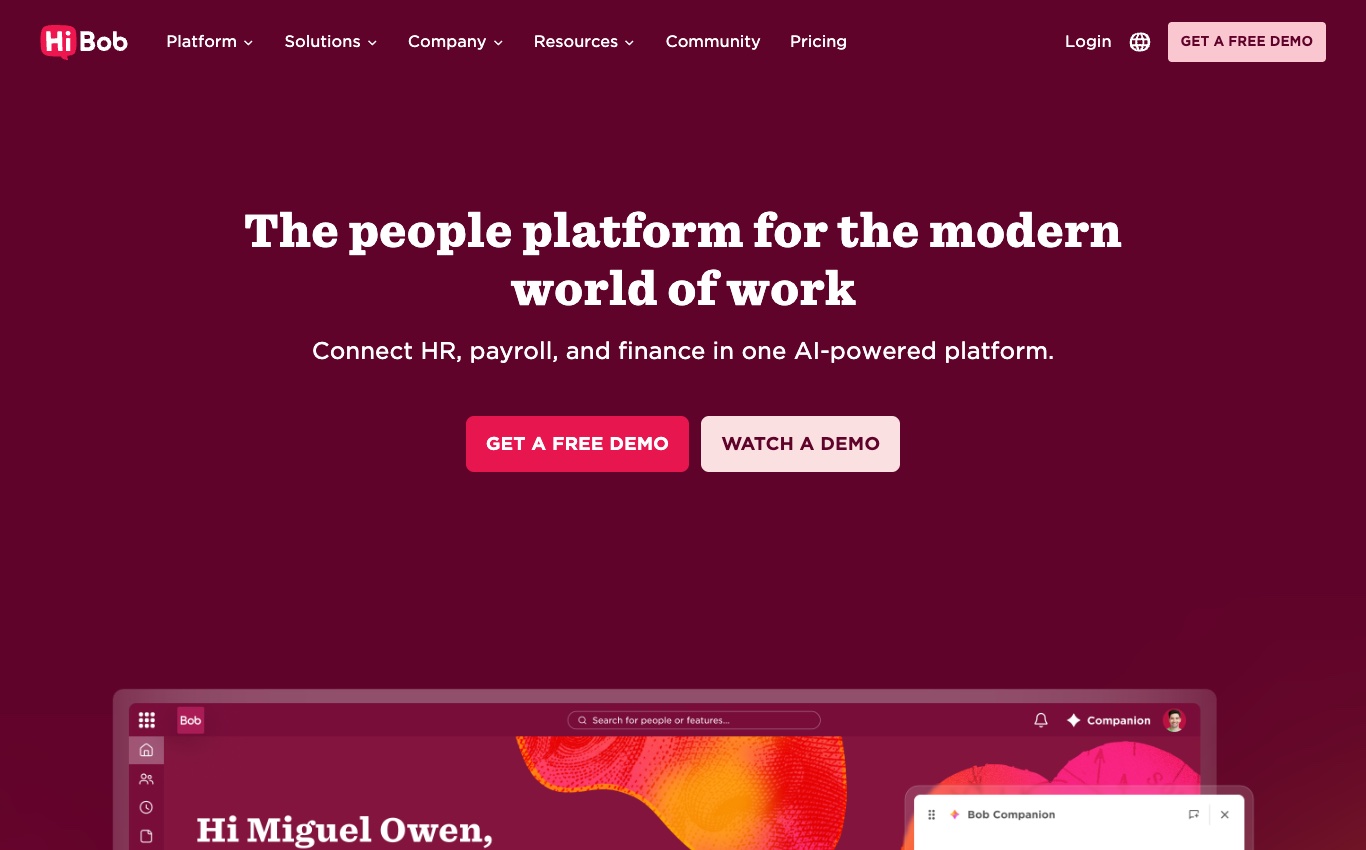
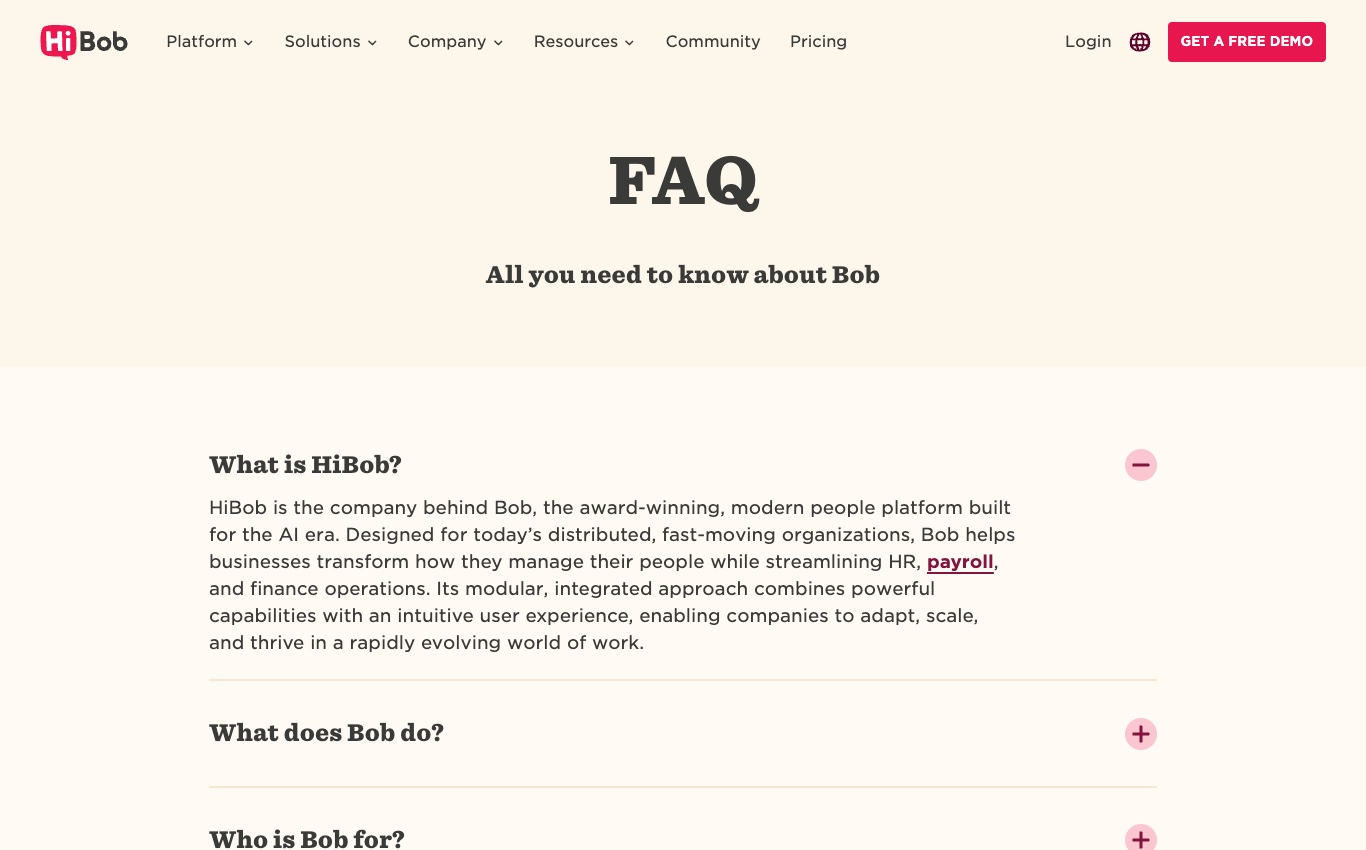
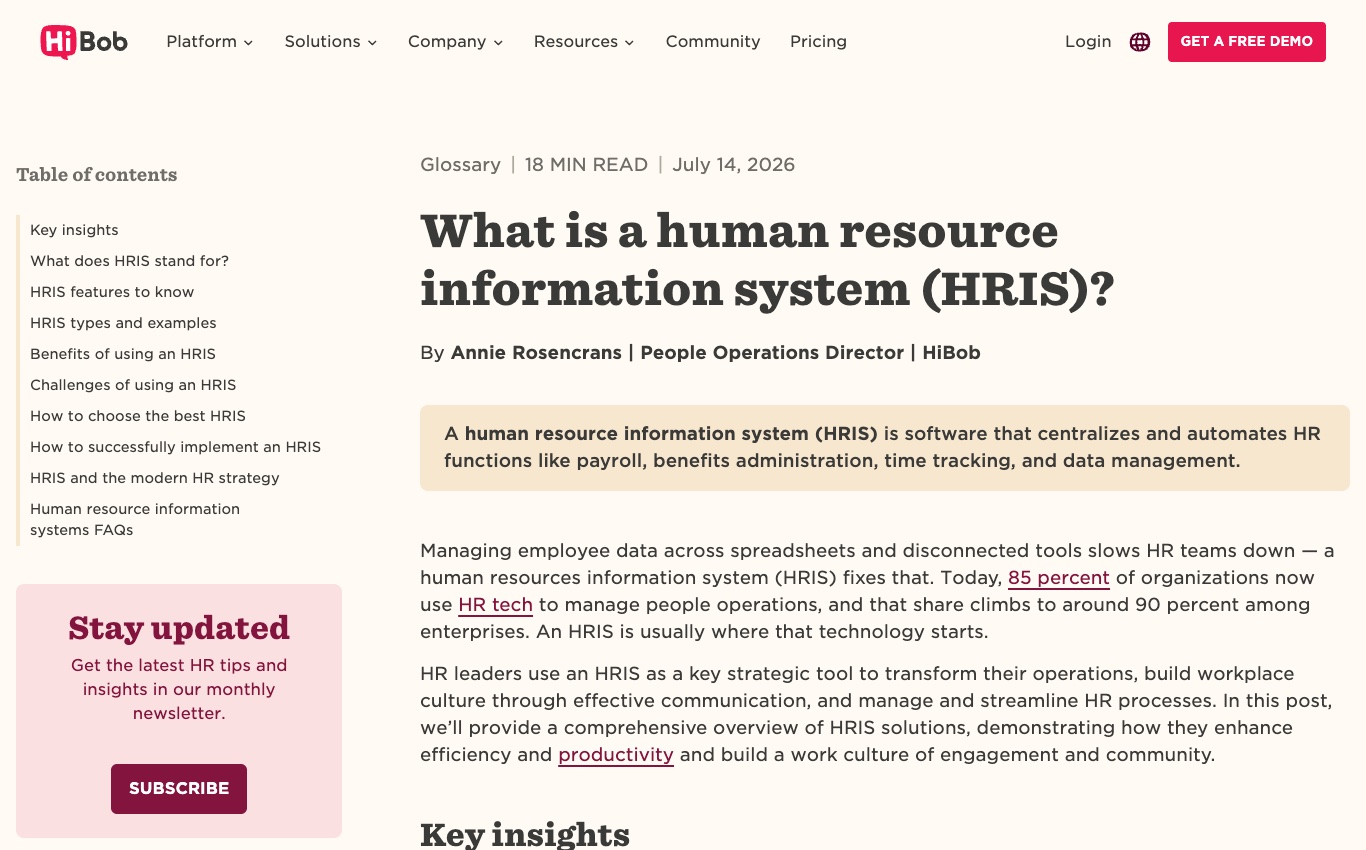
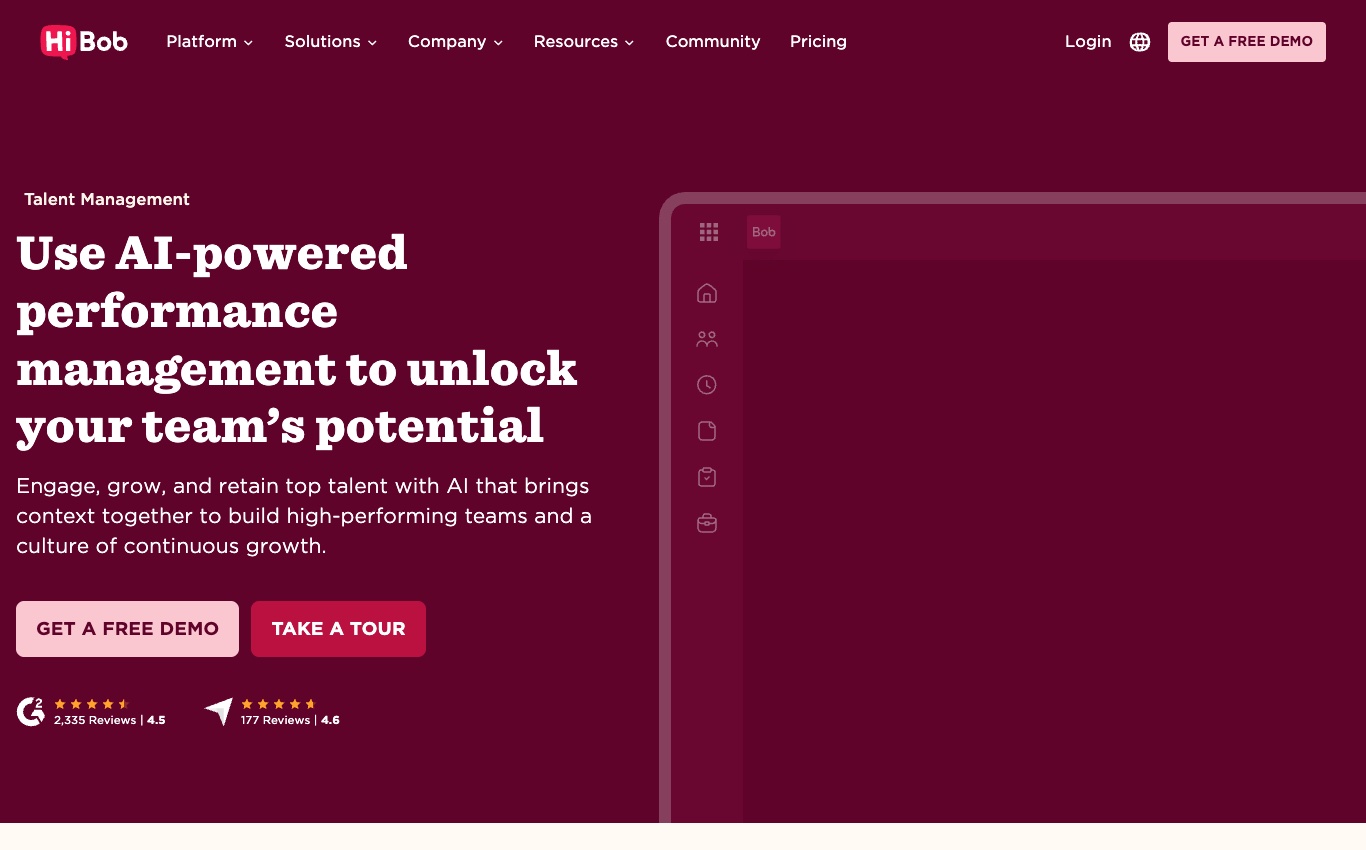
Research notes, October 29, 2026. This HiBob review examines the public Bob platform, pricing FAQ and product information. The screenshots come from official web pages and do not depict private employee records. The analysis identifies questions for a prospective buyer; it is not a report of an authenticated payroll or HR rollout.
One employee can appear under different managers, legal entities or employment statuses in different HR spreadsheets. HiBob’s Bob platform is intended to bring those records together, then use them in leave, performance, compensation and workforce-planning processes. That is more ambitious than providing an employee directory. It also means a company must settle data ownership and permissions before the dashboards become dependable. A broken manager history will not become accurate merely because it is displayed in a modern interface.
The revealing HiBob questions arise when a person moves teams. Does a previous manager’s review remain in the employee’s history? Which manager can now approve leave? What happens when the legal employing entity, rather than just the department, changes? These details can affect salary handoffs and confidential access. Bob may support the underlying workflows, but an employer has to configure them for its actual policies and local payroll arrangements.
Take the transfer of an employee from a UK entity to another local employer. Their job may stay similar, yet documents, leave rules and payroll responsibilities can change. A credible HiBob HRIS demonstration should preserve the historical record while applying the correct future policy. Run that scenario before discussing engagement dashboards or optional analytics. The result tells more about implementation work than a polished walkthrough of Bob’s homepage.
Pricing snapshot: HiBob publishes tailored quotes rather than a fixed public subscription rate. Its pricing FAQ says Core HR is included in subscriptions, and cost depends primarily on employees, selected modules and implementation or support. We do not infer an entire enterprise subscription from a publicly advertised starting rate or substitute a competitor blog for a vendor quote. Obtain current contractual terms before making a purchase.
We may earn a commission when readers purchase through certain links. That never changes which product limitations, missing regional services or contract questions we document here.
📊 HiBob Review Summary
Bob sits between a basic HR record system and a larger people-operations platform. A growing employer may benefit from connecting reporting lines, performance history, compensation planning and employee self-service. A smaller business with stable records and straightforward leave rules may prefer fewer modules and less configuration. The deciding factor is not interface design; it is whether HR and managers can maintain a reliable account of who works where and under which rules.
HiBob’s broader modules are appealing, but each brings practical work. Compensation planning needs approval boundaries; performance reviews need a policy for old feedback; workforce analytics depends on consistent employee classifications. The subscription is tailored rather than publicly fixed, so these features must appear in the written proposal if they are part of the buying case. Payroll integration should be evaluated country by country rather than inferred from a product menu.
⚡ Quick Verdict: Is HiBob Worth It in 2026?
Editorial assessment: HiBob is worth a serious look when the employer has several teams or legal entities and can appoint an owner for its people data. A credible pilot would follow one fictional employee through a manager change, a review and a payroll-related update. Compare Personio where European HR administration dominates; compare BambooHR for more straightforward HR requirements. A company seeking only an employee directory should not assume it needs Bob’s full modular scope.
🧠 HiBob and the core HR workflow
Bob Core HR pricing is a starting point, not the cost of every people-management feature. HiBob compensation planning, HiBob workforce planning and payroll integrations can belong to different operational owners, even when they rely on the same employee record. An employer should compare an itemized modular HR platform quote with the process it actually wants to improve, including implementation assistance and the expense of training managers.
Bob becomes more interesting when somebody changes manager, role or legal employer. An employee can keep the same job title while moving to a different payroll entity, or change team without changing their contract. HR needs a clear effective date and a record of which details are historical. Managers should see the information needed to run their teams without inheriting every old confidential document. If the transfer cannot be demonstrated with fictional staff records, expanding into more modules will not solve the underlying data problem.
HiBob’s employee lifecycle begins with reliable identity, location, manager and employment-status fields. The promise of connected people analytics depends on those basic records being maintained correctly. Separate an approved salary proposal from the payroll action it triggers; likewise, separate performance comments from documents a line manager may legally view. Bob Core HR is a starting point, not a guarantee that every specialized feature is bundled.
🛠️ Bob Core HR as the starting point
When people records live in different spreadsheets, a routine reorganization can generate three versions of the truth. Bob Core HR is intended to provide a common record of employee identity, reporting line, team and legal entity. The practical value is visible when those fields change over time: the new manager should see the current organization, while HR still needs to understand the previous arrangement.
Import two fictional employees, transfer one to another department and inspect the effective date in the organizational history. If the same person appears twice or the original manager retains unexpected access, the foundation needs correcting before optional talent modules are introduced.
🔎 Organizational structure and permissions
An organization chart is useful only if the permissions behind it are trustworthy. In HiBob, a manager may need a team member’s contact details and leave approval requests but not their confidential pay history. A transfer can make that boundary harder: the new manager needs enough background to run the team without receiving every earlier document.
The clearest test uses two fictional departments. Assign a worker to one, move them to the other, and compare what the former and current managers can open. Repeat the exercise after revoking an administrator role. A secure workflow should not rely on someone remembering to hide individual files manually.
⚖️ Employee experience and self-service
HiBob describes employee-facing functions alongside HR administration. That makes sense when workers need to update their details, find policies or submit routine requests without sending emails to HR. Adoption is less certain for employees who rarely use a computer at work or whose preferred language differs from the head office’s.
Give a fictional frontline employee access with only the permissions they would normally receive. Ask them to update a contact detail, locate a policy and submit a leave request using their phone. Watch where they become confused. Ease of use should be judged from that perspective, not only from an administrator’s polished demo.
📈 New hire and role-change workflows
Onboarding is a series of coordination problems: documents, role permissions, equipment, manager introductions and milestones. HiBob supports configurable flows around the employee lifecycle.
An attractive workflow can still fail when a legal entity changes after an offer or when someone joins from a different country. HR and IT must agree on effective dates.
Onboard two synthetic hires, one transferring between locations, and confirm tasks and documentation follow the correct rules.
🔐 Time off and local leave policies
Leave balances look simple until an employee works part time, changes country or switches contracts halfway through the year. Bob can hold time-off rules alongside the person record, but HR must still interpret the policy and check its lawful treatment locally. An incorrect carryover can flow into payroll or an exit calculation months later. Before migrating historical balances, reconcile at least one midyear transfer against the original approved leave records and identify who owns any correction.
🧭 What a real implementation pilot should include
A useful Bob pilot begins with an employee who changes manager and legal entity during the year. That person has already taken leave, received a performance review and been considered for a salary adjustment. HR should be able to reconstruct the earlier record without giving the new manager unrestricted access to it. Use fictional names and amounts, change the effective date once and inspect what appears in the organization chart and payroll export. A simple onboarding checklist would miss most of these difficulties.
HiBob needs more than an enthusiastic HR administrator during evaluation. Bring a department manager who normally approves leave, a finance colleague who reconciles salary changes and a person responsible for staff permissions. Have them complete a transfer independently and record which decisions still require manual coordination. If one manager makes an employee confidential file visible to another team, the project needs data-governance work before additional talent modules are discussed.
🎯 Who actually benefits from this system
Bob is not an applicant tracking system with a few HR extras. The system’s centre of gravity is the employee record and the decisions made around it: manager changes, policies, performance and compensation. Those parts become interesting once a business has multiple teams or countries with different obligations. An employer that needs only an absence calendar may gain little from the wider platform. A scaling company could benefit substantially, provided someone is willing to maintain the underlying data and permissions.
Ask a new manager to open Bob and carry out the tasks they will actually own. Can they confirm a team member’s reporting line, approve a legitimate leave request and find the current performance cycle? Then move an employee into another department and see what changes. HR may find the workflow obvious; a manager who rarely visits the platform may not. That difference is the real adoption risk, and it should be visible before the implementation contract is signed.
💰 HiBob pricing, modules and total cost
HiBob performance management can be valuable when a change of manager should not erase performance review history. A cross-entity employee transfer raises a different problem: the new manager may need basic HR information but not confidential documents from the previous employer. Demonstrate salary change approvals and manager access controls using fictional employee records before enabling sensitive real-world data flows.
| Budget element | Questions for the vendor | Buyer evidence |
|---|---|---|
| Base HR license | Ask for a written per-employee calculation, Core HR inclusion, relevant modules, integrations, country coverage, mi | Signed quote and exact plan tier |
| Recruiting and ATS | Are jobs, screening, onboarding and extra recruiters included? | Current module entitlements |
| Payroll and benefits | Which countries, employment types and extra services are covered? | Written geographic scope |
| Implementation | What migration, onboarding and training services are charged? | Statement of work |
| Renewal and cancellation | What changes as employees grow or leave? | Contract and notice period |
💡 Time and attendance connection
Attendance data matters most when it moves into another process. A part-time employee corrects a missed clock-in; their manager approves it; payroll needs the accurate hours. Bob’s position alongside people records can help, provided the systems involved agree on which version is authoritative. That is a more useful test than counting the number of time-management menu items.
Local rules complicate even an ordinary timesheet. Breaks, overtime premiums and shift allowances may depend on a worker’s location or contract. An HR platform should make that information available to the responsible people, but it cannot decide legal wage treatment for every country by itself. Payroll operations should document the handoff instead of assuming the HR report is a final payslip.
Use a synthetic record where one clock-in is missing and the employee changes schedule halfway through the pay period. Have the manager correct the source and review the resulting export. The question to ask is simple: what exactly reaches payroll, and how can a discrepancy be corrected before anyone is paid? The audit trail matters more than how quickly a timesheet looks complete.
📋 Talent and performance cycles
A performance review becomes difficult when the employee changes manager halfway through the year. The first manager knows the earlier work; the second must make a fair assessment without automatically inheriting confidential notes they have no reason to read. HiBob connects performance processes to employee records, which may make this history easier to manage. It does not decide which feedback should remain private, or whether goals from the former team still apply.
The employer should settle those rules before a review cycle begins. Take one fictional employee with an unfinished assessment, move them to a new reporting line and trace who can now edit, read and approve each part of the review. A nice-looking goals dashboard is secondary if two managers can overwrite one another’s decisions or the employee cannot find the final outcome.
🎯 Compensation planning and sensitive access
A proposed pay rise is not payroll instruction. There is usually a manager’s recommendation, a budget decision, an HR check and an effective date before any figure should reach the payroll provider. HiBob places compensation planning within its broader people-management offering, but the distinction between proposed and authorized changes must be maintained deliberately. This is especially important when the employee’s legal employer or pay currency has changed.
An approval workflow should also respect who can see salary data. A manager might have permission to propose a change for a team member without being able to download every pay record in the department. Use a fictional request that exceeds the manager’s authority; follow its rejection or amendment through to the final export. The result ought to be explainable to finance without opening unrestricted access to confidential files.
🧩 Workforce planning and headcount controls
A vacancy is not always an extra employee. Replacing someone on leave, backfilling a resignation and adding a genuinely new role affect workforce forecasts differently. HiBob’s planning tools can connect those decisions with people data, but only if finance and HR agree what counts as an approved position. Contractors can further distort a simplistic headcount total. A useful board report ought to distinguish present employees, funded vacancies and proposed roles rather than roll them into one confident-looking number.
💰 Calculate the real first-year bill
A Bob estimate should include more than a subscription figure. Think about the time needed to reconcile employee records across legal entities, agree on reporting lines and translate existing leave rules into software. Then add the modules a team actually needs: compensation, performance, analytics or workforce planning. A quote that only mentions Core HR may be accurate yet irrelevant to the proposed project. Finance should ask for today’s employee count, a credible growth case and the costs of support or configuration beyond the opening period.
Before signing with HiBob, ask which system holds the definitive payroll-ready salary amount in every country. A compensation proposal inside Bob might need approval before another system processes it. The integration map should show who corrects a failed export and whether historical changes remain auditable. The vendor proposal should also specify implementation ownership, employee thresholds, selected modules and cancellation terms. Without those details the organization cannot work out its operational cost.
🔐 Employee records and data governance
Compensation and performance history make the permissions design unusually important in Bob. A department manager may recommend a salary change without needing access to another employee’s prior leave or disciplinary file. After a reorganization, the new manager should not automatically inherit every earlier review. Test an approval with fictional records and identify which country-specific payroll system receives the resulting data. A successful transfer is one that preserves confidentiality, records who approved the change and can be corrected if the export fails.
🛠️ People analytics and report ownership
A turnover chart for a department of three people can expose an individual even when names are hidden. HiBob people analytics can bring workforce figures together, but the manager viewing those figures does not automatically need access to every salary, appraisal or exit reason behind them. Review group-size thresholds and export permissions before creating self-service dashboards. Nor should a correlation between engagement scores and departures be described as proof of why people left.
🔎 Global teams and legal entities
Bob is marketed to companies with international teams that want consistent employee lifecycle processes and manager visibility across locations.
Local leave rules, documents and payroll obligations do not become uniform because a platform has one employee directory. The quote should identify supported countries and dependencies.
Move a fictional employee from one legal entity to another and audit employment history, manager access and leave policy changes.
⚖️ Payroll connectors and boundaries
HiBob includes payroll in its product story and describes ways to connect people information with pay processes. Timely HR changes can reduce manual correction work.
A payroll integration may transfer inputs without carrying out tax filing or wages. Availability depends on the country, selected services and integration model.
Take an approved salary change, map it to a local payroll provider and reconcile the exported amount against the expected value.
🔐 Sensitive employee data and the permission matrix
Employee data rights are not a theoretical settings exercise in Bob. After a reorganization, one manager may need access to future goals but not earlier confidential evaluations. A finance specialist could require salary figures while having no reason to read a worker’s leave explanation. Test both roles with fictional records and repeat the test after changing the reporting line. A correctly protected file is more persuasive evidence than a colorful org chart.
🧭 Implementation and workflow design
📈 Culture and employee engagement
Engagement and employee experience tools can give managers better visibility into participation, feedback and organizational changes.
An engagement survey can damage trust if employees believe private answers will be attributed to them. Response thresholds and manager access must be transparent.
Create a tiny synthetic survey group and check whether individual responses or identifiers are exposed to a department manager.
🔐 Manager training and daily adoption
The manager who approves leave twice a month is a better test of Bob’s usability than the HR administrator who configured it. A new reporting line, a disputed absence balance and a pending review all need someone to make a decision, not just open a dashboard. Training should explain what the manager may change and when to send the issue back to HR. If every exception still requires an administrator to repair the record, the rollout has shifted work rather than reduced it.
💡 HiBob module and implementation pricing
Bob does not publish a reliable universal dollar figure. Employee count, Core HR, optional modules and support or implementation services form the actual cost.
A low initial per-employee quote can omit compensation, analytics or workforce planning features motivating the project. Regional requirements may change pricing.
Obtain itemized quotes for present headcount and a plausible growth scenario, listing every included module and implementation fee.
📋 Migration and employee record reconciliation
A migration to Bob should start by mapping stable employee identifiers, previous managers, legal entities, contracts and historical changes, not simply importing the latest spreadsheet.
Duplicate records or missing effective dates can disrupt reviews and payroll integrations months later. A rollback export needs a clear owner.
Import a sample including an employee returning to the company and verify past records remain connected without duplicate profiles.
🛠️ Migrating without breaking payroll and approvals
A HiBob migration should preserve effective dates, not merely the last row of each employee spreadsheet. Imagine a rehired worker with an old employment record, a manager who moved divisions and an employee whose leave entitlement changed midyear. If those records are flattened, future reports can appear correct while historical calculations become wrong. Import those three synthetic cases first. Compare their managers, legal entities, balances and pay attributes with the original sources before bringing over a broader workforce.
| Workflow | Owner | Pilot result to document |
|---|---|---|
| Hire to employee record | Recruiter + HR | Candidate history mapped; HR status verified |
| Permission change | HR + IT | Only approved roles retain access |
| Payroll data transfer | HR + payroll | Sample totals reconcile with the source |
| Leave approval | Employee + manager | Balances, notifications and exports agree |
| Offboarding | HR + IT + payroll | Revocation and final checks have evidence |
⚖️ Alternatives and real-world fit
HiBob people analytics and employee engagement features can identify changes in a growing organization, but reporting depends on the underlying records and appropriate access. HiBob onboarding workflows should show how local leave rules and legal-entity information are assigned. In a HiBob vs Personio comparison, ask each provider to show the same cross-country employee move, the resulting permissions and the payroll handoff.
🎯 HiBob compared with Personio and BambooHR
Personio is often shortlisted for European HR administration and local process coverage, while BambooHR has a straightforward core-HR appeal. HiBob takes a broader people-operations position, connecting employee records with planning, talent and engagement. These are different emphases rather than a single ladder from cheapest to most capable. The company’s legal entities and manager workflows should determine which one fits.
A manager who wants a simpler absence calendar may have little use for a larger modular system. An employer managing reorganizations across countries might need the advanced approval, reporting and compensation workflows that justify HiBob. But payroll law still matters independently: a broad HR suite should never be assumed to file taxes or disburse wages correctly in each jurisdiction.
Give the vendors a fictional employee who moves from one legal entity to another while carrying historical performance feedback and accrued leave. Ask each system to show what stays visible to the old and new managers, which effective date applies and what reaches payroll. Keep the licensed modules explicit. This one scenario reveals more than a list of generic HRIS capabilities.
🧩 Which organization should choose Bob
Bob’s strongest buying case is an organization with growing data complexity and managers willing to use a shared system. Its value is not merely a complete employee directory; it is the ability to keep decisions and historical context consistent as people move. That requires an internal owner for policies, permissions and integrations. Without one, a rich platform can simply reproduce the inconsistency that existed in spreadsheets.
Some teams may reasonably conclude that the implementation effort exceeds the problem they are trying to solve. There is no advantage in purchasing compensation analytics if the immediate need is tracking ten employees’ leave. Yet for a growing employer with several legal entities, fragmented information can become more expensive and riskier than careful configuration. The decision belongs to that employer’s context.
An effective HiBob pilot should answer three questions: will a manager use it without repeated HR assistance, can a transfer preserve correct historical access and can an approved compensation change reach the correct payroll recipient? Those are operational outcomes that justify a shortlist. An unverified promise about employee engagement or productivity should not stand in for them.
⚖️ HiBob vs Personio: people operations fit
HiBob appeals to organizations trying to turn inconsistent people records into more reliable decisions. Its strength is the connection between HR data, workflows and manager-facing tools. Its weakness is equally clear: that connection demands configuration, careful permissions and a quote that does not hide the important modules. No public screenshot can establish that a particular employer’s payroll interfaces or local policies will work. A buyer should insist on a cross-entity transfer demonstration instead of an overall numerical product rating.
🏆 Final verdict and buyer checklist
I would shortlist Bob for a growing employer that has named owners for people data and wants managers to participate in HR workflows. A manager transfer, a performance review from an earlier team and a compensation proposal are three revealing tests. If they work only after an administrator manually corrects everything, the implementation plan is incomplete. If the employer just needs basic records for one stable office, it should consider a simpler HRIS before taking on more modules.
| Decision | What favors HiBob | What should make you hesitate |
|---|---|---|
| Core HR | connected Core HR records and configurable workflows | custom quotations with a potentially broad set of paid modules |
| Hiring and talent | multi-department people analytics and workforce planning options | implementation and process configuration demand internal ownership |
| Regional payroll | Bob supports global people operations, but legal payroll processing depends on the selected payroll module or local partners and relevant country rules | Country-specific limits and quote uncertainty |
| Overall suitability | Growing mid-market employers managing multiple departments or countries and seeking more structured people operations | Unproven workflows or incomplete scope |
🎯 Pros, cons and editorial fit
Editorial fit — HiBob
Advantages: connected Core HR records and configurable workflows; talent, compensation and performance features alongside employee lifecycle data; multi-department people analytics and workforce planning options.
Trade-offs: custom quotations with a potentially broad set of paid modules; implementation and process configuration demand internal ownership; regional payroll and country-specific policy requirements.
Best next step: Request a scoped quote and a realistic workflow demonstration. A product screenshot cannot prove implementation quality or support performance.
🧪 Sources and review methodology
The HiBob analysis uses official Bob product descriptions and the public pricing explanation available on October 29, 2026. Screenshots document publicly accessible pages, not a private employee account. We did not administer a live payroll cycle, transfer a real employee or operate a performance review inside Bob. The proposed exercises are examples of how a buyer might validate its own requirements.
Bob’s commercial offer and country coverage need confirmation in writing, especially where optional people-management modules and local payroll integrations are involved. The article does not award a performance or compliance result based on a vendor page. Before using personal records, the employer should establish permission rules, migration responsibilities and the local legal basis for any processing.

Frequently Asked Questions
What is HiBob best suited for?
HiBob is best considered when an employer has more people processes than a basic employee directory can handle. It brings Core HR data together with talent, compensation, performance and workforce planning modules for growing organizations.
How much does HiBob cost in 2026?
HiBob provides tailored quotes rather than a universal list price. Core HR is the common foundation, but headcount, paid modules, regional requirements, integrations and implementation services determine the financial commitment.
Does HiBob have a free plan or free trial?
HiBob offers a sales-led demonstration and quote request. We did not find a verified permanent free Bob HRIS subscription. Buyers should ask for a controlled evaluation using fictional employee records before authorizing any sensitive data import.
Can HiBob handle recruiting and applicant tracking?
Bob is a people-operations platform, not chiefly a specialist applicant tracking system like Workable or Greenhouse. A company needing advanced candidate sourcing should confirm the recruiting products or integrations available in its intended configuration.
Can HiBob process international payroll?
HiBob discusses payroll in its suite and partner ecosystem, yet local payroll calculation and legal filings are separate questions. The payroll arrangement for each country should be shown on the contract and demonstrated with a sample approved salary change.
How does HiBob support onboarding and offboarding?
HiBob can organize employee records, approvals, documents, onboarding and changes in role or manager. The difficult test is not the first new hire, but a worker transferring between legal entities with an existing performance and leave history.
How do HiBob permissions and security work?
HR, managers and payroll staff should not receive identical access to the employee file. Test compensation proposals, historical performance reviews and sensitive documents after a manager change; ask how exports and revoked permissions are logged.
Is HiBob suitable for a small business?
HiBob can work for a smaller fast-growing employer prepared to standardize its HR practices, but a company wanting only a leave calendar may not need the full modular platform. Quote scope and internal ownership matter more than raw headcount.
How difficult is it to move to HiBob?
Map employee IDs, legal entities, manager history, pay attributes and leave balances before importing into Bob. Include a rehired employee and a cross-entity transfer in the trial batch to catch duplicates and incorrect effective dates.
What are the main alternatives to HiBob?
Personio is a useful comparison for European HR administration, BambooHR for straightforward employee management, and Rippling for HR-to-IT automation. A good shortlist tests the same employee transfer, report and approval with known module boundaries.
How did DigiOffly evaluate HiBob?
This HiBob review covers published Bob product information and the official custom-pricing explanation as of October 29, 2026. We used public-page screenshots, not a private employee workspace, and have not validated a real payroll or performance-review cycle.
EXPLORE NEXT ON DIGIOFFLY
🔍 Explore More on DigiOffly
Evaluating HiBob for your people operations? Review HR alternatives, employee-workflow software and planning tools to assess the broader cost of your HR stack.
Explore related software
- HR & Recruiting section — Compare hiring, payroll, employee management and global workforce software.
- Rippling — Compare HR records with payroll and IT account workflows.
- Personio — Explore European HR operations, reporting and approvals.
Compare your shortlist
- Software Directory — Browse the growing library of independent software reviews.
- Compare Software — Evaluate competing products by capabilities and priorities.
- AI Software Finder — Narrow your options using your actual workflow requirements.
Plan costs and updates
- Software Cost Calculator — Model licenses and recurring costs for your software stack.
- Best Value Advisor — Explore practical software choices for common buying needs.
- Deal Alerts — Follow relevant offers and software category updates.
Want updates when additional HR and recruiting reviews are published? Subscribe to DigiOffly Deal Alerts for relevant category updates.