

The NXP Robotics Platform received its formal launch announcement on November 9, 2026, combining reference hardware, AI-oriented processors and an open Robotics SDK for drones. Its company-issued release presents an integrated development foundation built around NXP’s Neural Axis Architecture. The significant news is the formal company launch and availability statement—not the first appearance of the technology: NXP showed the drone platform on November 5, while the SDK listing had an October revision. We explain what teams can actually obtain, which tools are supported and what remains unproven.
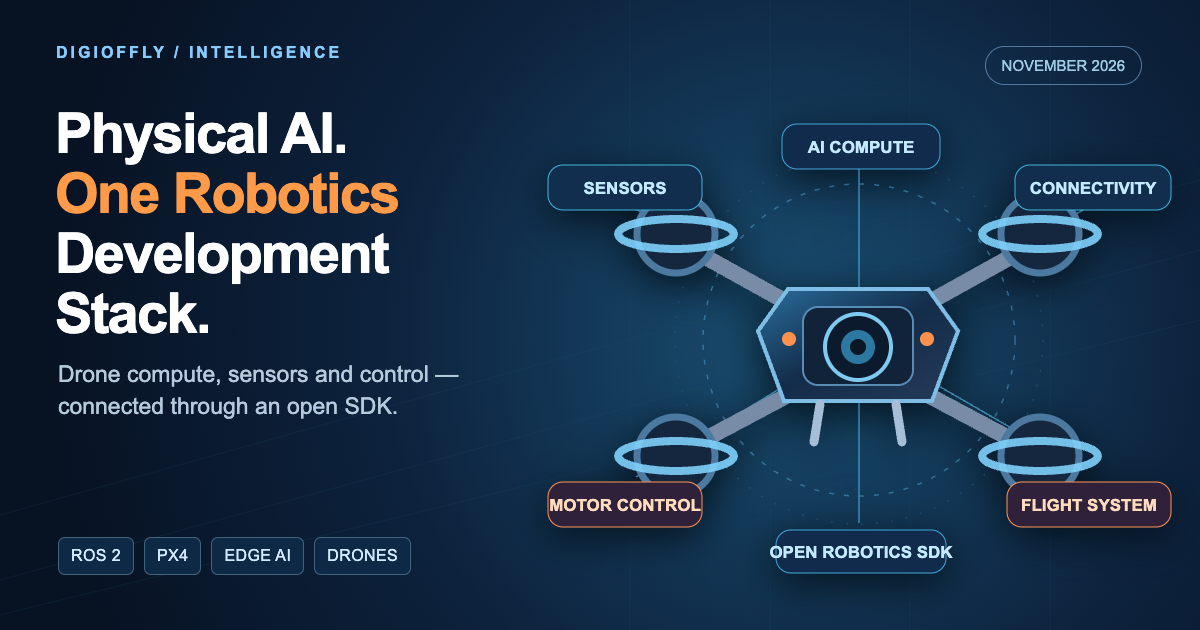
A software stack for real-world autonomous systems
Open frameworks, reference boards and specialized processors make prototyping more repeatable. Production-grade autonomy, safety and performance still depend on developers’ own validation.
What Happened
NXP’s November 9 announcement describes a common architecture for sensing, real-time control, AI processing and communications. The NXP Robotics Platform is designed around a Neural Axis Architecture that links these functions rather than forcing teams to invent every interface between boards. The first reference designs focus on drones, although NXP says future development will also target service robots and autonomous mobile robots.
The company’s launch material emphasizes a faster path from a board selection to initial flight testing. It claims its prototype-ready design can achieve initial drone functionality within approximately 30 minutes. This is a manufacturer-reported starting point, not an independent performance benchmark or a promise that a fully tested commercial drone can be created in half an hour. Developers still need to supply a suitable assembly, follow safety procedures and validate behavior under the intended operating conditions.
There is an important chronology. The company formally announced the NXP unified robotics platform on November 9, but its official prototype video was dated November 5. The NXP Robotics SDK product listing also has an October 2 revision. Calling this a newly invented SDK or previously unseen prototype would be misleading. What is new today is the company’s formal launch announcement, product positioning and availability communication.
Who Is Affected & When
NXP says additional enablement for service robots, autonomous mobile robots and other autonomous systems is targeted for the second half of 2027. That is a roadmap, not a guarantee. Teams planning a purchase should check current board availability, lead times, regional support and technical documentation directly with NXP.
For U.S. engineering teams, the most useful action may be a limited prototype rather than a large procurement decision. Download the official SDK, verify its Linux and Docker prerequisites, identify which board revision is available, and document the time needed to reach a repeatable test. Compare those observations with an existing ROS 2 or PX4 workflow before committing to a specific architecture.
What Changes in Practice
Inside the NXP Robotics SDK
The NXP Robotics SDK is an open, modular development stack that combines application examples, device integration and established open-source frameworks. The official feature list includes ROS 2 Jazzy, PX4 autopilot, CogniPilot Cerebri, Zephyr RTOS, NuttX and AM32 motor-controller firmware. Its edge AI tooling references the NXP eIQ Toolkit and Ara SDK. For robotics developers, these names matter because they cover several tasks that are typically configured separately: high-level robot coordination, flight management, real-time firmware and AI inference.
Communications are equally important. The Robotics SDK documentation identifies Zenoh, rmw_zenoh with zenoh-pico, MAVLink, uORB, DShot, RPMsg and 100BASE-T1 Ethernet among supported technologies. The NXP Robotics SDK can make it easier to move data from sensor networks to processors and flight-control subsystems. It does not mean every framework and network combination is interchangeable, or that a developer can simply replace a board without adjusting drivers and system configurations.
The published host environment requires Linux with Docker, the west meta-tool, Arm GNU toolchain, CMake and Ninja. NXP also lists deployment tools for programming its supported hardware and notes that prebuilt artifacts require a Nexus user token. Teams evaluating an NXP Robotics SDK installation should therefore verify host compatibility, account access, repository permissions and firmware versions before scheduling a proof of concept.
NXP Drone Reference Designs: Hardware Comparison
The company’s November release maps four distinct responsibilities to reference designs. The table reflects NXP’s published specifications, not testing by DigiOffly.
| System function | Reference design | Processor |
|---|---|---|
| Autonomy compute and flight control | NavQ95 | i.MX 95 applications processor |
| Flight management | Tropic VMU / FMU | i.MX RT1064 crossover MCU |
| Intelligent sensor networking | 100BASE-T1 Sensor Node | MCX N947 microcontroller |
| Motor control | AM32-compliant ESC | MCX A13 microcontroller |
The distinction between these boards is practical. Autonomous decision-making needs substantial computing power; low-level motors need predictable timing; and sensor traffic has different reliability constraints. The NXP modular drone platform aims to provide reference designs for each role with a shared SDK that brings them together. Selecting one of these boards does not eliminate the need to verify the others, and a flight-control reference design is not itself a certified aviation product.
Developers should also note the preproduction designation on NXP’s official NavQ95 page. The page explicitly says its information and specifications are subject to change. Other linked hardware designs are likewise described as preproduction. That status matters for commercial sourcing, replacement parts, validation and long-term maintenance. It would be premature to treat the announced boards as an established retail hardware product line.
NXP Robotics Platform vs. a DIY Robotics Stack
A team can already combine ROS 2, PX4 and embedded firmware without adopting the full NXP robotics platform. The difference NXP proposes is a supported set of reference boards, documented interfaces and shared build tools, potentially reducing the work required to join hardware from several domains. This may be valuable for teams already using NXP processors, especially when a project needs autonomous navigation, onboard sensing and predictable real-time motor control.
NXP’s physical AI robotics platform is therefore most relevant to embedded developers and industrial robotics teams. It is not directly comparable with a general-purpose AI chatbot or a no-code business workflow app. Buyers looking for ordinary software subscriptions should evaluate a different class of product, while robotics engineers should test a reference design before accepting performance or cost claims.
Security and Functional Safety: What Still Needs Testing?
NXP describes security, safety enablement and deterministic real-time control as components of its Neural Axis Architecture. Those are important goals for systems that move through the physical world. A compromised communications channel, an unstable motor controller or a flawed autonomy decision may create real-world consequences that do not exist in a normal web application.
That is also why vendor descriptions should not be confused with independent proof. NXP’s security and safety design features do not mean an assembled drone automatically meets every regulatory or industry requirement. Teams still need threat modeling, trusted firmware updates, access controls, failure handling, hardware-in-the-loop testing, incident logging and evidence appropriate to their deployment environment.
Why It Matters
The broader trend is that edge AI, control systems and connectivity are becoming parts of a single development problem. Training or running a model is only one component of an autonomous robot. A real project also needs to move sensor data, keep timing predictable, respond to failures and maintain a safe physical system. The NXP Robotics Platform tries to make those dependencies easier to manage through common reference designs and software tooling.
Our Take
This is a noteworthy engineering launch rather than a mass-market AI software announcement. The NXP Robotics Platform gives teams a coherent way to explore physical AI and drone development. Its strongest selling point is the integration between AI compute, sensor networking, flight software and motor control, not an unverified claim that robotics development has become effortless.
For teams already exploring NXP silicon, the NXP Robotics SDK is worth a controlled trial. For buyers seeking ready-made SaaS automation, it is unlikely to be the right software category. DigiOffly has not tested the hardware, flown a drone using the platform or independently reproduced the advertised 30-minute setup. We also distinguish the November 9 formal release from the November 5 preview to avoid treating an earlier demonstration as a brand-new invention.
NXP Robotics Platform FAQ
What is the NXP Robotics Platform?
It is an integrated robotics development ecosystem built around NXP’s Neural Axis Architecture, reference hardware and an open Robotics SDK. The company formally announced the platform on November 9, 2026, after earlier prototype demonstrations.
Does the NXP Robotics SDK support ROS 2 and PX4?
Yes. NXP’s official SDK documentation lists ROS 2 Jazzy and PX4 autopilot, alongside CogniPilot, Zephyr, NuttX, AM32 and additional tooling. Check compatibility for your exact board and firmware revision.
Can a drone really be ready in 30 minutes?
NXP says its reference designs can reach initial drone functionality in approximately 30 minutes. This is a vendor claim, not independent evidence that a production-ready drone can be assembled, tested and certified within that time.
Are the NavQ95 and related boards production-ready?
The official NavQ95 product page identifies the board as preproduction and warns that specifications may change. Teams should confirm hardware availability, support and lifecycle before planning commercial use.
Official Sources & Dates
The formal announcement is dated November 9, 2026. NXP’s prototype demonstration is dated November 5, and its Robotics SDK listing identifies an October 2 revision. The comparison, dates and hardware status are taken from these vendor materials; claims of speed, security and performance have not been independently tested.
- NXP-issued GlobeNewswire announcement — November 9, 2026
- NXP official Robotics SDK software documentation
- NXP video demonstrating prototype drones — November 5, 2026
- NXP NavQ95 reference board — preproduction notice
Editorial disclosure: This DigiOffly Intelligence report is based on NXP’s dated announcements and technical documentation. DigiOffly has not conducted a hands-on test of the platform and does not independently certify its performance, safety, security, cost or availability. No affiliate links are used.