

Imagine a small customer-support team receiving the same kind of request in three places: a form, a shared inbox and a CRM note. The business wants one ticket, a consistent priority, and a notification only when a person needs to intervene. Connecting those systems is not especially glamorous. It is also where many automation projects either save their first hour or quietly start creating duplicate work.
Activepieces approaches that problem with visual flows, an expanding library of app integrations, built-in tables, AI agents and the option to run its core software on your own infrastructure. It is tempting to reduce the choice to “a cheaper Zapier,” but that description misses the important questions. Who maintains the integrations? What happens when a trigger fires twice? Can a teammate understand why the result was wrong? And how many credits, external API calls and hours of attention does the business actually spend?
This Activepieces review evaluates the product as an automation system rather than a collection of flashy demos. It explains the current credit-based plans, the distinction between cloud and self-hosted editions, practical workflows for growing teams, the trade-offs around AI agents and MCP, and when Make, Zapier or n8n deserves a place on the same shortlist.
Pricing reference — October 14, 2026: On the official Activepieces pricing page, the monthly-billing view lists Free at $0, Plus at $20/month, Team at $200/month and Ultimate by custom quotation, in USD. It lists included credit allowances of 1,000, 10,000 and 50,000 respectively, and $0.007 per excess credit on Plus and Team. The vendor page presently contains inconsistent wording about the Free allowance and whether its reset happens daily or monthly; the displayed plan grid says 1,000 per month while adjacent FAQ wording refers to refreshing “tomorrow.” Verify the exact allowance and reset cycle in the authenticated checkout or with Activepieces before relying on a free-tier production schedule. Annual prepayment may change the displayed monthly equivalent; it is not the same purchase commitment as paying month to month.
Editorial note: Alex Wright prepared this DigiOffly assessment through independent research of product documentation. We have not purchased a paid Activepieces subscription, run the software under a production load, independently verified uptime, commissioned a security audit or measured end-to-end delivery speed. Workflow examples and cost scenarios are illustrative, not claims of firsthand testing. Product claims are referenced to the vendor’s primary sources, and plan details can change after the inspection date.
📊 Activepieces at a Glance: The Decision in One Minute
Best for: operations teams and technical-minded no-code builders who want visual automation, several connected business apps, API flexibility, AI-assisted workflows and a credible self-hosting path. More cautious fit: organizations with strict incident-response requirements but no workflow owner; buyers who expect every advanced administrative control in the free Community Edition; and teams that want AI outcomes without reviewing generated actions.
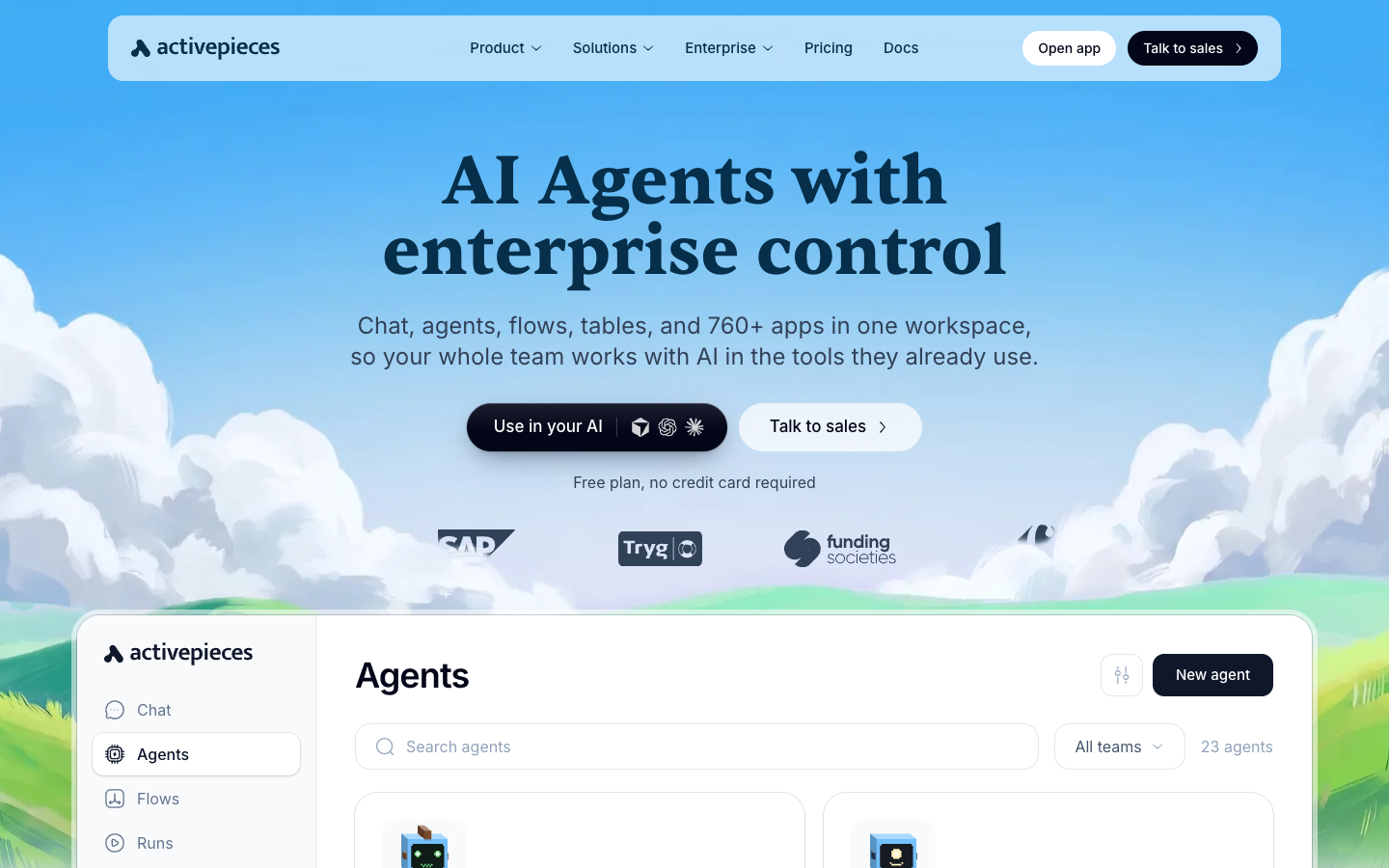
A flow starts with an event or schedule, then executes configured steps. A piece is an integration that provides triggers or actions for an application. Tables can store structured operational records, while agents can choose tools and actions when a situation cannot be fully expressed as a fixed path. That is already a more interesting architecture than a simplistic “when X, do Y” recipe. It also creates more surfaces to configure and supervise.
The official getting-started documentation describes flows, agents and tables as connected building blocks and advertises more than 760 application integrations at the time inspected. Treat that count as a changing catalog figure, not proof that your exact trigger, API scope or version is supported. A connector name on a marketplace page says less than the individual actions it exposes.
A distinctive buying detail is the way the current pricing page describes one credit for a normal flow run regardless of its number of steps, with additional AI-related charges. That means a twenty-step data-cleaning run may have a different platform billing profile from twenty independent events. It does not mean heavy processing is free of execution limits, third-party charges or operational risk. A single run can still time out, fail or write an unwanted record.
Our provisional verdict: Activepieces merits evaluation when you need cross-application processes that a business operator can inspect, especially if deployment choice or AI orchestration is important. It is less compelling when the process is already handled reliably by one app’s native automation, or when a team cannot commit to monitoring the resulting system. The purpose of automation is fewer unattended errors, not simply fewer manual clicks.
⚡ Quick Verdict: Is Activepieces Worth Using in 2026?
There are two reasons to consider Activepieces. First, its visual approach keeps the shape of a process accessible to people who are not building a full custom integration service. Second, the underlying open-source core creates a route toward local deployment and extensibility that ordinary hosted-only workflow subscriptions do not provide. Whether those advantages matter depends on the organization rather than on the number of available pieces.
Consider the mundane case of a new customer. An incoming form needs email normalization, a CRM lookup, creation of a customer record if one does not exist, and a notification to the appropriate owner. That flow has several business rules and an opportunity for duplicate records. In Activepieces you can describe them as visible steps, branch when data is missing, and use an HTTP call if the supported CRM piece lacks an action. This is a meaningful improvement over copying between tabs, but only if the branch conditions are defined carefully.
Now consider a person asking an AI agent to decide whether a new support ticket should be escalated. The agent’s flexibility can be useful: two tickets containing different signals may require different actions. Yet the organization must define permitted tools, review the decisions, manage credentials and provide an exit path when the agent is uncertain. Agentic automation should be introduced after—not instead of—simple business rules and an audit trail.
The strongest objection is that even a simple workflow is now a small piece of infrastructure. Somebody must know who owns it, where failures surface, whether events are retried, how credentials rotate and how a rollback would work. Hosted service relieves server administration, but it does not take responsibility for the correctness of your business rules. Self-hosting adds the server work back into the equation.
For a genuinely low-risk first project, choose a process whose mistakes can be reversed: label an incoming message, copy a non-sensitive row into a tracking table, or create a draft that a person approves. Learn the actual sequence of events and the account’s credit consumption. Avoid beginning with irreversible payments, bulk deletion, mass messaging or unrestricted access to customer information.
🧩 What Activepieces Actually Includes
The platform’s language is useful if you understand the pieces. Flows represent deterministic processes: the same rules run whenever the trigger conditions are met, subject to external changes and errors. Pieces encapsulate application capabilities, including authentication and operation-specific fields. Tables store records that flows and agents can access. Agents are intended for flexible decisions or tasks that cannot be conveniently hard-coded. The MCP server exposes selected Activepieces capabilities to compatible AI clients.
That combination changes the shape of an automation project. A team can keep an internal table of requests, let a scheduled flow fetch updates, use an agent to classify unstructured text, and route uncertain cases to a human. The pieces can cooperate, but they still need a shared record identifier and rules defining which system is authoritative. Without those rules, automation simply distributes inconsistent information faster.
There are two separate notions of being “no code.” You may not need to write a program to assemble ordinary app actions, but you still need to reason about data types, authentication, errors and side effects. When an app is missing a particular endpoint in its piece, the official pricing FAQ points to HTTP and webhook tools as alternatives. Those are powerful escape hatches; they also require reading API documentation and occasionally understanding pagination, rate limits and request bodies.
An integration catalog is therefore a discovery tool, not a coverage guarantee. Before adopting the platform, make a short matrix of the exact source events and destination actions you require. Include awkward cases such as updating an existing record, filtering by a custom property, downloading an attachment and handling revoked credentials. The missing action that occurs only once a week can matter more than a thousand connectors you will never use.
🧭 Who Should Choose Activepieces—and Who Should Probably Not
A small operations team is a sensible candidate when it has enough recurring activity to justify a workflow owner but not enough integration work to maintain custom microservices. Examples include CRM hygiene, service-ticket classification, employee onboarding checklists, inventory notifications and finance-document routing that stops before an actual payment instruction. These are repetitive processes with clear owners and measurable outcomes.
An agency can benefit from building repeatable client processes, yet client separation is not a detail to assume. Projects, credentials, access scopes and audit history have commercial and technical implications. The current Team plan introduces governance and organizational features that a one-person Free account should not be treated as offering. If the workflow runs on behalf of outside customers, examine licensing and commercial terms as well as pricing.
A developer may choose Activepieces because an existing API can be wrapped in a piece and integrated with a visual process. That can reduce repeated plumbing work. It is particularly appealing when a technical owner wants non-engineers to understand the business logic, although code review and deployment practices remain important for any custom components.
On the other hand, a company with no one willing to be responsible for a failed workflow should begin with a simpler system. Native CRM automations, scheduled exports or a small number of well-documented hosted integrations might have lower total ownership cost. If the process is high-stakes or tightly regulated, the security and procurement review comes first; a product page describing encryption or self-hosting is only the start of diligence.
A useful screening exercise asks five questions: which event starts the flow; what uniquely identifies the business object; what step changes an external system; how will the owner discover a failure; and what should happen after a duplicate event? If any answer is vague, that is a process-design problem. No plan upgrade will fix it.
🔄 How the Visual Workflow Builder Changes Daily Work
Think about a familiar spreadsheet-to-CRM process. At the beginning, a form submission sends contact details to a sheet. A naive automation creates a new CRM record each time a row changes. Before long, edits or repeated webhooks produce several entries for the same person. The visual workflow can expose a necessary check: normalize the email, look for an existing customer ID, update when found, create only when absent, and capture the final record ID.
The benefit is not that the editor magically understands deduplication. It is that the branching and mapping decisions can be written down and inspected by the person responsible. A customer-success colleague can point to the “missing owner” branch and say what should happen. A developer can add a specific API request without replacing the whole system. The tool becomes a shared representation of business rules.
The drawback appears at scale. Branches multiply. Inputs arrive in different shapes. Older steps depend on field names that vendors quietly change. The person who designed the flow may leave. A diagram with sixty steps can be as opaque as a badly documented script. Name actions for what they do, split distinct outcomes into understandable processes, and write the failure behavior next to the business requirement.
Publishing a flow should therefore be treated like a release. Use representative but non-sensitive sample records, confirm credentials and permissions, check one successful path and at least two failure paths, and record the owner and rollback procedure. For a customer-facing flow, decide whether changed trigger behavior could send duplicated emails or alter already processed orders before switching it on.
🤝 Strengths and Trade-offs in Practice
👍 What We Love
- ✅ Visible workflows: Make app-to-app business logic inspectable and easier to maintain.
- ✅ MIT-licensed core: Self-host covered code, subject to the distinction between core and commercial features.
- ✅ Run-based credits: Ordinary flow runs are billed differently from per-step task models.
- ✅ Agents, tables and MCP: Combine structured processes with guarded AI assistance.
👎 Where It Falls Short
- ❌ Operational ownership: Self-hosted deployments still need secure configuration, updates and backups.
- ❌ Credits need scrutiny: Model steps, agent actions and quota resets complicate budgets.
- ❌ Commercial feature limits: Core MIT licensing does not unlock every enterprise capability.
- ❌ Failure handling: Unexpected retries and source events demand reconciliation and alerting.

Activepieces — Editorial Buying Snapshot
Good fit: cross-app operations, visual flows and supervised AI workflows. Reconsider: production without an owner, unreviewed agent actions or unbudgeted AI credit use.
Documentation-based analysis. No paid hands-on test or numerical product rating is claimed.
What we love: The mix of visual flow construction and custom API possibilities leaves room to handle real, imperfect business data. The current pricing structure focuses ordinary automation charges on runs rather than making every extra internal step an automatic paid task. Tables, agents and MCP can share a workflow context rather than being unrelated subscriptions. The MIT-licensed core and self-hosting options give technically capable teams meaningful deployment choices.
Where it falls short: Flexible execution models require more design discipline, not less. Credit language changes over time and the vendor’s current Free-plan reset wording is inconsistent enough to require confirmation. AI actions can add charges and independent model-provider costs. Advanced governance, security controls and production reliability still depend on the selected edition, deployment architecture and administrator competence.
Our assessment is deliberately conditional. These are strengths and limitations inferred from documented capabilities and buying terms, not a star rating derived from unperformed testing.
💰 Activepieces Pricing in 2026: Free, Plus, Team and Ultimate
| Plan | Monthly-billing reference, October 2026 | Included credits and key distinctions |
|---|---|---|
| Free | $0; reset wording requires direct confirmation | 1,000 stated in the monthly grid; up to 5 users; unlimited configured flows |
| Plus | $20 per month; $0.007 per excess credit | 10,000 credits per month; up to 5 users; bring-your-own AI keys |
| Team | $200 per month; $0.007 per excess credit | 50,000 credits per month; 25 included users; projects, SSO, roles |
| Ultimate | Custom quote | Negotiated credits, advanced security, permissions and operational features |
| Self-hosted core | MIT-licensed core; infrastructure not included | Commercial editions and advanced controls require license/terms confirmation |
The first thing to discard is the old Activepieces comparison that says every cloud account gets ten active flows free and then pays five dollars per additional active flow. That was an earlier pricing model. The vendor’s public pricing page, checked on October 14, 2026, now describes Free, Plus, Team and Ultimate using credits and a separate set of AI-related allowances. Treat screenshots and articles that still display the old per-flow scheme as historical, not as today’s contract.
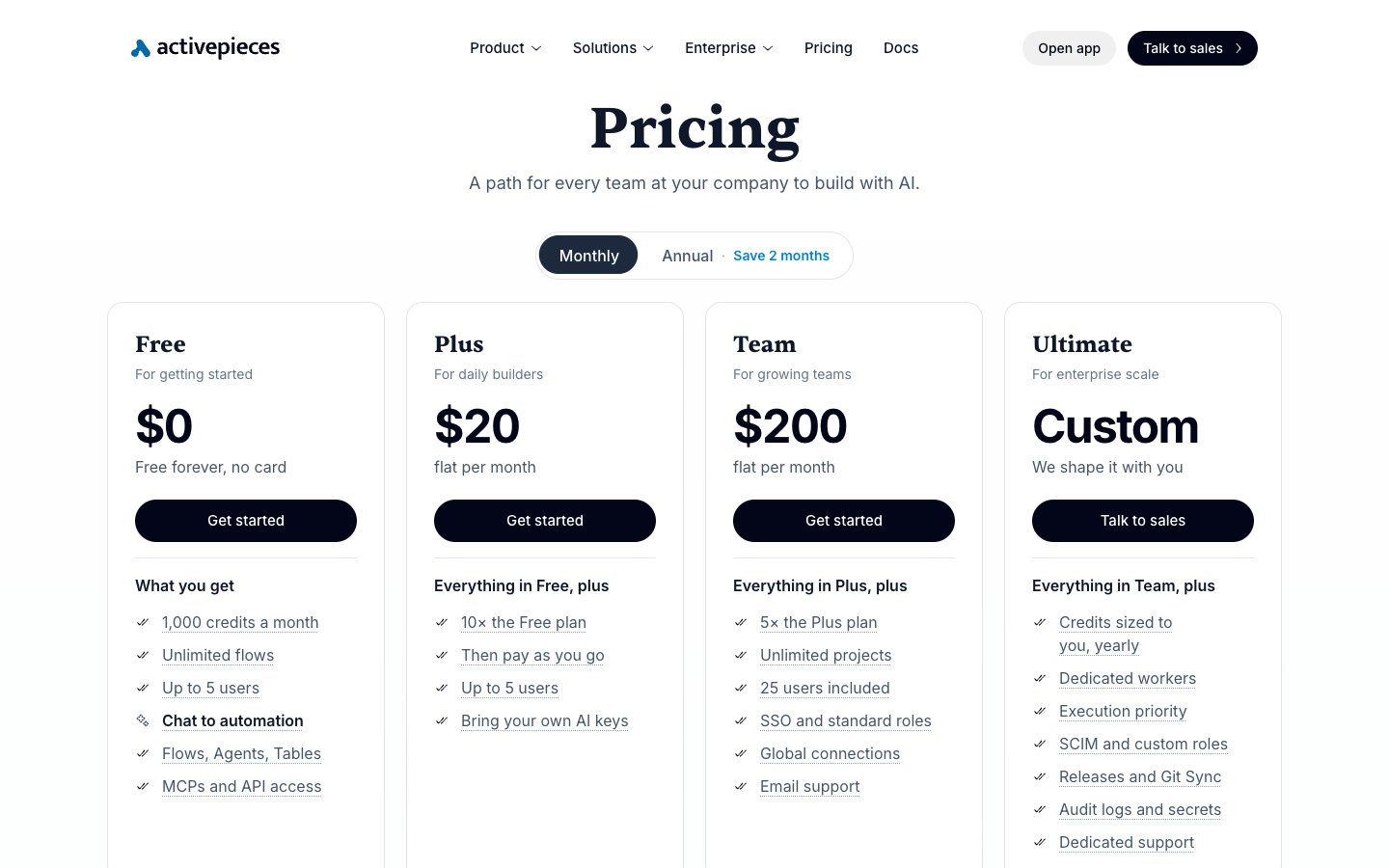
For the monthly selection, the public figures are Free $0, Plus $20 per month, Team $200 per month and Ultimate custom pricing. The pricing table lists 1,000 included credits for Free, 10,000 for Plus and 50,000 for Team. All three advertise unlimited flows, but an unlimited number of configurations is not an unlimited number of successful executions. Free is listed for up to five users; Plus also allows up to five, and Team includes twenty-five. The enterprise-level Ultimate offer is negotiated.
An annual billing selector advertises savings, and another indexed vendor version has shown lower monthly equivalents when prepaid annually. Do not turn that into a claim that a $16/month equivalent can be purchased as a cancellable $16 monthly subscription. The article uses $20 and $200 as the verified monthly-billing references. For a purchasing decision, toggle the desired term, read the checkout total and confirm taxes, currency, number of included users and any renewal conditions.
The Free-plan allowance merits a specific warning. The same currently accessible official pricing page displays 1,000 credits a month in its main table, Daily in the reset-frequency row, and wording about credits refreshing “tomorrow” in the FAQ; a search-indexed page revision also mentions 100 credits a day. Those statements do not settle into one reliable enforceable daily and monthly cap. We would not schedule business-critical work around any one of them without a confirmed answer from Activepieces or the account billing screen. This is a research finding, not an attempt to improve the numbers.
For Plus and Team, the public grid says extra usage is charged at $0.007 per credit after the included allocation. At that published overage rate, 2,000 extra credits would add $14 before any relevant taxes, optional support or external service fees. That is arithmetic based on an illustrative workload, not an invoice. Whether particular attempts, retries, agent actions or AI steps consume more than the basic run unit must be verified from the currently applicable usage rules and your own account history.
🧮 Credits, Runs and AI Actions: What the Bill Really Measures
The vendor’s pricing FAQ makes an important distinction. A normal flow run is described as one credit regardless of how many steps it contains. AI usage is not identical: the published examples specify two credits for a fast-model step, ten for a smart-model step and twenty for a frontier-model step, plus one credit for an agentic action. Those examples are plan guidance, not a promise that every future model or tool will use the same schedule. It is sensible to inspect the live usage display after executing a representative flow.
Imagine that a small internal process receives 120 legitimate webhook events per working day and runs twenty working days per month. That is 2,400 intended runs before duplicates, retries, tests or AI-related additions. At one ordinary credit each, the base platform usage would be 2,400 credits. Under the Plus reference allowance of 10,000, this illustrative base case has headroom. But a busy process with several extra agentic actions or higher-cost hosted AI calls can change the picture markedly.
Now suppose those 2,400 runs each perform one AI step using the vendor’s illustrative ten-credit smart-model class. That would add up to 24,000 step credits if the documented ten-credit rate applies to that configuration and is charged in addition to the base run. The scenario illustrates why “one credit per run” does not equal “every AI workflow costs one credit.” It is not a forecast of actual cost, and the precise composition of charges must be confirmed from the current meter.
The official FAQ says paying customers may bring their own AI provider keys. This can change the platform-side calculation for an AI step, while transferring model charges to another vendor. One consolidated bill can become two bills; it does not make model inference free. For a team comparing hosted models with bring-your-own-key arrangements, account for token consumption, prompt retries, output size, tool calls, provider rate limits and internal data-policy requirements.
Keep separate worksheets for Activepieces subscription and overages, external AI/API bills, connected software licenses and operations labor. If you already maintain vendor contracts, counting them again would overstate the incremental cost. If a solution requires a new CRM seat only for the automation account, ignoring that seat would understate it. The right metric is the cost of producing a reliable business outcome, not the attractiveness of a single pricing row.
📅 Free Plan: What You Can Learn Without Committing
A genuine free starting point has a practical purpose: you can examine the builder, authenticate a few non-sensitive integrations, create a simple flow and study the execution history. The vendor currently advertises no card requirement for Free and lists unlimited flows, agents, tables, MCP and API access in the plan presentation. Eligibility and availability of particular features can still depend on hosting mode or edition, so verify the actual product UI.
There is a sharp distinction between a free prototype and an unattended service. Suppose a deadline reminder runs only a few times per day. An allowance ambiguity might be manageable during testing. Suppose the same account is responsible for routing every incoming order to a fulfillment team. If new runs stop at quota exhaustion, the cost of missed or delayed work could dwarf the subscription. The vendor’s FAQ explicitly says Free runs past quota may not execute until credits refresh.
For the first pilot, record the number of credits consumed by one clean event, by an error event, and by a manual test. Repeat after adding a branch or AI action. Then look at the actual account’s reset information. This is more useful than quoting the maximum number of flows you can create, because unused flows are not the operational constraint.
Free is valuable when you are learning the product’s mental model. It is a poor basis for an assured service-level claim. For anything time-sensitive, establish budget alerts, an accountable owner, and an independent record of events received so you can recover work if downstream execution pauses.
🧾 Plus vs Team: When Higher Plans Are Justified
Plus is the plausible first paid choice for a small group that needs regular automation without much organizational separation. Its public monthly figure is $20, included credits are 10,000, and the vendor positions it for everyday builders. The pricing page lists bring-your-own-AI-key capability, which can matter if your team already has approved model-provider accounts.
Team is a different purchasing proposition. Its reference is $200/month with 50,000 included credits and twenty-five users. Beyond volume, the page identifies additional governance and coordination: unlimited projects, SSO, standard roles, global connections and email support. The value is not just the ratio of credits to dollars. If several departments depend on shared connections, a role mistake or undocumented change can be costly; team features may protect against those operational problems.
However, not every governance feature belongs to Team. The comparison grid reserves custom roles, SCIM, audit logs, secrets integration, dedicated execution arrangements and release-related capabilities for more advanced or negotiated offerings. Businesses should inspect the exact entitlement list rather than treating SSO as shorthand for every security control they require.
When comparing the two tiers, calculate three numbers: realistic base run credits, AI/agent credits and maximum expected spike. Then consider whether five user seats and limited project separation are enough. A team with light usage but strict permission boundaries may need a higher plan for governance reasons. A small team with many runs but no advanced administrative requirements may find Plus plus metered overages more economical—if its actual workload and contract terms permit it.
🖥️ Cloud vs Self-Hosted Activepieces: Not the Same Cost Equation
Activepieces’ license documentation states that the core is MIT licensed, while enterprise and cloud-edition features are distributed under commercial terms. Those distinctions matter. A permissive core license grants meaningful freedom to inspect, modify and deploy the covered code, but it does not automatically provide access to every feature shown in a managed cloud demonstration.
The Hobbyist Installation guide provides a straightforward single-container Docker route with embedded storage. The documentation is unusually clear about its intended audience: personal projects on one machine. It warns that this setup is not scalable, cannot be upgraded to Enterprise on the same embedded architecture and may require starting over when moving to a production-grade configuration. Calling a single-container hobbyist setup “enterprise-ready self-hosting” would be a serious misreading.
For a multi-user, production-minded environment, assess the documented deployment architecture using PostgreSQL, Redis, persistent storage, correctly configured frontend and webhook URLs, HTTPS, backups, monitoring and patch procedures. The platform does not replace those engineering controls merely because its interface is visual. A webhook must be reachable; an integration may need external network access; a worker that stops processing can interrupt the business without changing a single flow definition.
Self-hosting also changes accountability. You choose where the data is stored and who operates the network, but you become responsible for access, infrastructure alerts, recovery time and software updates. For a consultant or freelancer, that responsibility has a real opportunity cost. Four hours spent restoring a server is four hours not spent delivering client work. The license fee line can say zero while the true ownership cost remains substantial.
A cautious migration plan starts with a non-critical flow, exported configuration where supported, a record of credentials that must be reauthorized, and a tested restoration. Decide what should happen if the server cannot receive a webhook for several hours. Do upstream systems retry? Is there a source-of-truth event log? How will you reconcile missing messages? Those questions matter more than the convenience of installing the first Docker container.
🏗️ The Real Operating Cost of Self-Hosting
There is no defensible universal monthly self-hosting price. A tiny internal service may require little hardware; a busy environment with concurrent jobs, large payloads and several teams can need larger worker capacity, database resources, storage, observability and specialist support. Cloud-region pricing, redundancy and compliance requirements also change the bill.
To estimate responsibly, separate fixed and variable requirements. Fixed commitments include a host or cluster, database, queue service, domain and TLS management, backup storage, monitoring, administration time and routine updates. Variable requirements include concurrency, data transfer, logs, imported files, AI calls, queue growth and recovery work after failed integrations. Even if one component uses a free tier, its availability and support guarantees may not suit production use.
The official limits reference reports a cloud flow timeout of ten minutes and a cloud per-step file-size limit of ten megabytes at the time researched. The same document explains that many self-hosted defaults can be adjusted through environment variables. “Configurable” does not mean “unlimited” or “guaranteed fast”; longer-running work consumes resources and may need a different workflow design.
The vendor’s guide also distinguishes pause/wait time from active execution time for timeout accounting. That may make approval workflows feasible without keeping a worker continuously busy, but it is still essential to confirm persistence and resume behavior for your version and installation. Always test the exact long-running path you need, including a restart between the pause and the continuation.
Our buying recommendation is to compare two honest totals: a paid cloud plan including realistic overages, and a self-hosted solution including operations labor and recovery requirements. If no one is willing to own the second set of responsibilities, the cheapest-looking server is unlikely to be the cheapest operating choice.
🧠 AI Agents, Tables and MCP: Where Automation Becomes Less Predictable
Activepieces describes an agent as a worker you brief in plain language and give tools to use. Unlike a conventional flow, which executes predefined instructions, an agent can decide which supported action seems appropriate as a situation develops. The official agents documentation describes agents that work with pieces, project resources and structured outputs. This flexibility can remove brittle keyword rules from messy requests; it can also make results harder to reproduce.
Consider two customer messages that use different wording to describe an address problem. A deterministic filter looking for the phrase “incorrect address” may miss one. An agent may classify both as address corrections. That sounds useful until it mistakenly applies a new delivery address to the wrong order. The appropriate design is to let the agent suggest a category and draft a response, then require a deterministic customer-ID check and human approval before changing shipment data.
Tables are a practical companion in that design. A row can record a case identifier, source message, assigned colleague, agent recommendation, current disposition and timestamp. The structured record makes it possible to compare what was received with what was decided. But the table must not become a second uncontrolled customer database. Decide which fields may be duplicated, how long records are retained, and which system remains authoritative.
MCP, the Model Context Protocol, makes the AI connection more interesting. Activepieces documents a built-in MCP server that compatible AI clients can use to interact with flows and tables. A separate MCP integration can expose an Activepieces flow as a callable tool or return a reply to a calling client. These are not invitations to give every assistant unrestricted access to every business application.
For an agent-accessible tool, define the allowable side effect explicitly. A tool named “find customer status” should not silently have permission to delete a customer. Use limited-scope accounts, project separation, identity confirmation and reviewable action records where available. The fact that a model can construct a valid API call does not make every call appropriate, authorized or factually correct.
There is also a reverse workflow: a deterministic Activepieces step can call an external MCP tool using the MCP Client piece. That is useful when a known procedure needs an action from a specialized service. A deterministic call avoids relying on an agent to choose the tool, although the integration’s authentication, error handling and returned data still require validation.
The right introduction sequence is narrow. Start with a read-only agent answering questions from approved material. Observe ambiguous cases. Then allow low-risk drafts. Only after the business has a clear approval process should the agent write to external systems. Track each increase in autonomy as an explicit operational change, not as a convenient new checkbox.
📨 Practical Example: Customer Support Intake Without Duplicate Tickets
Suppose a shop receives a web form, a direct support email and a chat inquiry from the same customer within ten minutes. The outcome sought is one identifiable case rather than three separate records. This is an illustrative workflow plan, not a claim that DigiOffly has deployed the integration or verified a particular app connector.
First, every source sends its event into a standardized intake step. Store the original event ID, timestamp, channel and customer reference. Normalize basic fields while keeping a copy of the unmodified input. An email address can help correlate cases, but it is not a universal identifier; shared mailboxes and changed addresses are common.
Second, search the system that owns the support ticket. The key question is whether a matching open case already exists under an agreed business rule. If it does, append an internal note. If not, create a case and store the result’s ticket ID. Where APIs allow it, use an idempotency key so an identical repeated request cannot accidentally create the same ticket twice.
Third, a fixed rule can tag urgent categories such as charge disputes. An AI step may propose an additional category when text is ambiguous, but the decision should remain reversible. Messages claiming a legal deadline or a payment fraud should follow a documented escalation path instead of trusting model confidence as a substitute for review.
Fourth, notify the owner only after receiving confirmation of the ticket update. Sending an alert before the ticket exists can leave a colleague chasing a nonexistent record. Include the case ID in the notification so an operator can investigate without reconstructing the entire message path.
Finally, reconcile outcomes daily. Count source events, distinct case IDs, successful writes, failed writes and manual escalations. If the source received 100 events and the flow shows 99 successes, the discrepancy deserves attention even if every dashboard looks green. This is where automation becomes a managed process rather than an attractive diagram.
📈 Practical Example: Lead Routing Across Sales and Marketing
A second illustration begins with an inbound lead from a campaign landing page. The sales team wants the right representative assigned, while marketing wants campaign attribution preserved. A flow can normalize a domain, check existing CRM ownership, branch on geography or organization size, and alert the responsible person. Each piece is simple. The difficult part is deciding which rule wins when two signals conflict.
Do not send every lead into an AI model merely because agents are available. When territory is a documented country list, a deterministic lookup is easier to audit. Use AI only for fields that genuinely require interpretation—perhaps classifying an unstructured company description—and store the model’s recommendation separately from the authoritative territory rule.
Duplicate submissions are predictable. Advertising platforms retry, users refresh forms, and a CRM integration may acknowledge an update slowly enough that the upstream automation times out. Before any create operation, perform a lookup and consider whether the destination API supports upsert or an idempotent key. If it does not, use an intermediate record that marks processing state and prevent overlapping workers from creating the same lead.
Track outcomes that matter to the business: percentage of leads assigned correctly, number of duplicates, time from submission to ownership, and manually corrected assignments. The number of flows built is not a meaningful success metric. A single dependable route is more useful than twelve fragile ones.
Because the flow may handle personal data, determine retention periods and access privileges before enabling log-heavy debugging. A contact email that appears in a step output may be copied into execution history, analytics or support screenshots. Choose the smallest set of fields needed for diagnosis and use anonymized examples for training.
🧾 Practical Example: Document Approval Without Giving AI Payment Authority
Imagine a finance team receiving supplier invoices that require classification and approval. It may be reasonable to use a flow to record attachment metadata, extract proposed fields, identify a project owner and create an approval request. It is not reasonable to let an unreviewed extraction automatically trigger an irreversible bank transfer.
The workflow should separate document handling from payment authorization. Capture the source document reference; require a unique invoice number in combination with the supplier identity; check known duplicates; and flag discrepancies in amount, currency or purchase-order reference. An AI extractor may propose values, but confidence from a model does not constitute evidence that a tax ID or bank account is correct.
A human reviewer can approve the structured record. Another authorized system can then execute any permitted financial process under its own controls. Keeping this boundary visible allows an operations team to benefit from automation without transferring final responsibility to a probabilistic model.
This scenario also tests file limits. The official limits page currently lists 10 MB per step file on Cloud and other run/log constraints. Larger scanned files or multiple attachments may require external storage and a link-based design. A workflow that passes a handful of tiny PDFs in development may behave differently when production uploads include high-resolution scans.
🛡️ Security, Credentials, Privacy and Compliance
The vendor’s security practices document describes encrypted credentials, masking of sensitive connection material, SSO and role-based administration as platform capabilities. The relevant question for a buyer is which of those capabilities is available on your plan and deployment. An enterprise feature documented in the knowledge base is not automatically present in a free hosted account.
The pricing FAQ says its cloud data region is Frankfurt, with other arrangements available on request, and that the company’s SOC 2 program is still in progress. Do not translate “program in progress” into “SOC 2 certified.” Teams with procurement controls should request the current DPA, subprocessors, penetration-test summary and applicable security commitments from the vendor. Independent regulatory, legal or contractual compliance cannot be inferred from an FAQ.
A workflow can expose personal information even when credentials are encrypted. Step inputs, execution history, generated messages, debug exports and notification channels all move data. Limit sensitive inputs, use test records when troubleshooting, inspect who can view runs and decide when old execution data must be removed. The vendor’s current Cloud limits document specifies a 30-day execution-data retention reference, but organizations must confirm their configuration and any different commercial commitments.
Self-hosting offers an opportunity to keep processing in an environment you control. It also means you must verify encryption at rest for your databases, secret handling, ingress protection, network isolation, backups and administrator access. A self-hosted application with public management endpoints and unrecoverable backups is not a privacy improvement simply because its source code is available.
Governance should extend to AI agents. An agent with broad write access creates more opportunities for accidental external changes. Use separate credentials for staging and production, restrict the applications exposed to an agent, and keep irreversible functions outside the model’s direct authority. Test how your business recovers if a model recommends an action that the user would never have approved.
🛠️ Reliability: Retries, Timeouts, Webhooks and Recovery
Automation failures are not rare edge cases. Providers change API fields; a token expires; a service is temporarily unavailable; a webhook arrives more than once; an output is larger than expected. The platform’s own run history can help diagnose those failures, but history is useful only if somebody looks at it. Document an owner, an alert threshold and a recovery window for every consequential workflow.
Distinguish a transport retry from a business retry. An HTTP timeout does not always mean the destination system made no change. Repeating “create invoice” after a timeout could create a duplicate. Where supported, use stable event identifiers, an idempotency key or a status lookup before resending a side-effecting operation. Label each action by whether repetition is safe.
Activepieces’ published execution limits include a ten-minute Cloud flow run timeout, a thirty-second synchronous webhook response timeout, a five-megabyte Cloud webhook payload cap and a ten-megabyte Cloud step-file limit. These references are material for long-running tasks and document processing. They are not generic promises of unlimited execution or throughput; self-hosted limits may be configured differently.
An approval process may pause longer than a regular action. The same documentation describes a thirty-day paused-flow lifetime reference and explains that paused time does not consume active execution time. That is operationally useful, but a business should still test what happens when the approval arrives after the limit, when the approver is absent or when the system is redeployed while the flow is paused.
Recoverability needs two records: what the input system believes it delivered and what the workflow believes it completed. If you can reconcile those independently, an outage is a problem with a bounded repair procedure. Without reconciliation, a green dashboard may conceal work that never reached the trigger. For critical paths, maintain a source-side queue or replay capability when the source supports it.
⚖️ Activepieces vs Zapier, Make and n8n
A meaningful comparison starts with the same workflow. Take one qualified lead, look up a CRM record, update the record if it exists, and notify an account owner. Measure the destination actions and business requirements first. Then model how each platform charges and what somebody must maintain. A platform with a lower advertised monthly fee can cost more once its workflow unit, model calls, governance requirements or maintenance work are included.
| Decision factor | Activepieces | Make | Zapier |
|---|---|---|---|
| Best fit | Visual workflows, teams and extensible automation | Complex visual scenarios and routing | Large SaaS integration ecosystem |
| Core building block | Flows and reusable pieces | Scenarios and modules | Zaps and actions |
| Deployment model | Managed platform plus self-hosted options | Managed cloud | Managed cloud |
| Plan consideration | Credit and user allowances | Credits and scenario scheduling | Tasks and feature-level restrictions |
Zapier emphasizes a wide hosted integration ecosystem and familiar task-based workflows. For someone who needs a conventional managed automation between common apps, it may be faster to operate. Yet the task model is not the same as Activepieces’ current run-credit explanation. A multi-step process can have different consumption depending on the platform’s accounting rules and plan features.
Make offers visual scenarios, routers and transformations useful for complex application-to-application paths. Its credit model also differs from Activepieces. When benchmarking an example, count the operations and branch behavior realistically rather than assuming one completed business process equals one Make credit. If someone in your organization already understands Make well, the cost of retraining and rebuilding matters.
n8n appeals to developers and technical operations teams through programmable nodes, self-hosting and execution-oriented billing on its cloud plans. Activepieces’ MIT-licensed core is a meaningful distinction from n8n’s fair-code approach, but neither license description tells you which product is easier to maintain. Compare permitted commercial uses, production topology, error recovery, version management and the actual connectors required.
Activepieces belongs on a shortlist when an organization wants a visual flow builder, documentable internal processes, optional self-hosting and a route to AI agents or MCP. Zapier may win for straightforward managed app automations; Make may win when its visual routing and operator familiarity fit; n8n may be better for a technically intensive, code-friendly automation estate. None of those recommendations should be interpreted as a measured speed or uptime ranking.
The most defensible pilot runs the same business outcome in each shortlisted tool. Use synthetic records, record implementation effort, test duplicate events and one failure, and model the real monthly workload. Include the administrative features needed by your team. The result will be specific to your process, which is exactly why it is more useful than a universal “best automation software” claim.
✅ A Sensible Evaluation Checklist Before Paying
Write a one-page automation brief. It should identify the initiating system, source event ID, expected output, data owner, acceptable delay, destination permissions, expected volume and failure owner. The exercise often exposes a simpler native integration or a business decision that has not yet been made.
Then inspect your top three required pieces, not the total number in the catalog. Confirm the exact trigger and action, field compatibility, OAuth scope, pagination, attachment handling and rate limit behavior. If you need the HTTP piece for a missing action, budget for the technical work and add a documentation reference for whoever inherits the flow.
Build a pilot that covers the ordinary happy path, a duplicate event, a missing field, an expired credential and a temporary destination failure. Do not use a real production customer as your test case. Check whether failed runs are discoverable, whether retries are safe, and whether a non-developer colleague can understand the sequence.
Price the pilot twice: with only deterministic steps, then with the AI steps you genuinely need. Record the credit meter rather than trusting an estimate built from a marketing slogan. Add provider subscriptions and an annualized estimate for maintenance labor. Compare billing periods on equal terms; a prepaid annual deal can look cheaper per month while demanding a larger upfront commitment.
Lastly, establish ownership. A named person should know when to disable the flow, how to prevent duplicates, which credentials need rotation, how to restore missing records and how to contact the vendor or hosting provider. If the planned workflow changes customer accounts, payments or sensitive data, seek specialist review before enabling automatic writes.
🧪 How DigiOffly Evaluated Activepieces—and What We Did Not Test
For this review we used primary vendor documentation, including the pricing grid and FAQ, licensing terms, installation guidance, execution limits, security practices, agents and MCP. These sources were inspected on October 14, 2026.
We separated directly documented product behavior from illustrative workflow design. The credit calculations use the vendor’s posted examples and expressly state assumptions. A scenario about lead routing or invoice processing is a proposed design, not a transcript of an executed customer workflow. We have not independently authenticated every connector, purchased a paid account or benchmarked the product under load.
Two limitations deserve particular emphasis. First, the official Free-plan material is internally inconsistent about when exhausted credits become available, so that question remains open until confirmed in a customer account or directly by the vendor. Second, feature descriptions across cloud and self-hosted editions must be checked against the purchased entitlement; having source code does not create the right to use commercial-only modules.
We do not assign invented scores for reliability, support quality or actual user satisfaction. A third-party AI detector is not a credible way to certify whether a review is original or written by a person. Editorial originality must instead be assessed through source attribution, exact-text similarity checks, substantive accuracy, varied argumentation and a clear account of what research was and was not performed.
🏁 Final Verdict: Who Should Try Activepieces?
Activepieces is worth putting through a pilot if your problem is a series of manual transfers across several business applications and you want the resulting logic to remain visible. Its pieces, tables, agents, MCP options and self-hosted core make it a flexible foundation for a carefully operated automation program. The current credit-oriented cloud pricing deserves a close look, especially where ordinary runs contain several deterministic steps.
It should not be bought solely because the marketing page says “unlimited flows.” You still need to understand credit consumption, plan limits, AI charges and operational failure. Nor should the open-source license be used as a shortcut around proper infrastructure management. A dependable workflow depends on its owner and recovery process at least as much as its editor.
Our preference is to prototype one reversible, measurable process. If the result is accurate, diagnosable and reasonably priced, expand one workflow at a time. If the process is exceptionally simple, compare the application’s native automation before buying another platform. If the team demands formal governance, obtain an entitlement-level quote rather than hoping those controls arrive with the lowest tier.
For further context, use our Automation & No-Code category guide, Software Finder and Software Cost Calculator. The goal is a system that your colleagues trust, not a complicated diagram nobody is willing to maintain.
Frequently Asked Questions About Activepieces
Is Activepieces free in 2026?
The vendor currently advertises a no-card Free cloud plan with 1,000 credits in its main monthly pricing grid and a self-hosted MIT-licensed core. However, the official page gives inconsistent wording about the timing of Free credit resets. For a production use case, check the account’s actual usage panel or confirm the free limit directly with the vendor.
How much does Activepieces Plus cost?
The official monthly billing selector lists Plus at $20 per month in USD with 10,000 included credits and metered usage above the allowance. Annual prepayment may have a different monthly equivalent; check checkout terms, taxes and region before budgeting. Any connected paid apps and external AI-provider charges are additional.
What counts as a credit in Activepieces?
The current FAQ states that an ordinary flow run costs one credit regardless of the number of steps. AI model steps and agentic actions can consume additional credits using the published model classes or action rates. Retries and particular configured steps should be checked against the live meter for your implementation.
How many Activepieces flows can I create?
The public pricing grid describes unlimited flows on Free, Plus and Team. This refers to the number of flow configurations, not unlimited execution credits or guaranteed processing capacity. Actual billing, concurrency, timeouts and administrative features depend on the plan and hosting environment.
Is Activepieces really open source?
The vendor describes its core software as MIT licensed, while enterprise and cloud-edition features use commercial licensing. Check which source-code packages and capabilities your use case requires before assuming an enterprise feature is included in a free installation. The official license document is the primary reference.
Can I self-host Activepieces with Docker?
Yes. The documentation includes a single-container Docker hobbyist installation and separate production-grade hosting guidance. The single-container option uses embedded storage and is expressly described as non-scalable and unsuitable for a direct Enterprise upgrade. Production teams should plan databases, queues, backups and operational monitoring.
Is Activepieces better than Zapier, Make or n8n?
That depends on the same tested business outcome. Activepieces emphasizes visual flows, an MIT-licensed core and AI/MCP options; Zapier emphasizes managed app automations; Make offers detailed visual routing; and n8n serves complex programmable workflows with a self-hosting option. Their billing units are different and should not be equated.
Does Activepieces include AI agents and MCP?
The product documents AI agents, tables and MCP capabilities. Exact feature access, governance and cost vary by plan or edition. An agent that can call external tools needs limited permissions and an approval boundary for consequential actions. AI model calls may also create additional credit or provider charges.
Can Activepieces handle confidential customer data?
The vendor documents credential encryption, masking and security controls, but a safe deployment depends on configuration, purchased entitlements, data access, retention and the connected services. Its pricing FAQ says the SOC 2 program is in progress rather than already certified. Seek a DPA and security evidence for regulated use.
What happens if an Activepieces flow fails?
Diagnose the failed run and determine whether an external side effect already occurred before retrying. Use stable event identifiers, reconciliation and a documented owner so repeated events cannot create duplicate records. The official Cloud limits also constrain execution time, file size and webhook response time.
Should a small business choose Activepieces Cloud or self-hosted?
Cloud reduces server and upgrade work but adds subscription and usage charges. Self-hosting provides deployment control for the covered code but requires infrastructure, monitoring, security and restoration capacity. Compare the full cost, including staff time, and test one reversible workflow before expanding.
🔍 More Software Research on DigiOffly
For the broader landscape, consult our Automation & No-Code Software guide, Make Review, Zapier Review and n8n Review. We recommend comparing identical business outputs rather than turning different vendors’ credits, tasks, operations and executions into one fictitious unit.
The Software Directory, Compare Software and Software Finder can help organize product features and alternatives. For total spend, Software Cost Calculator is a starting point, not a substitute for real credit-usage history, self-hosting labor or separate AI invoices.
Our research methodology explains what public documentation can establish and what requires firsthand product testing. Activepieces’ official pricing page is the source of truth for a current quote; if the site’s Free reset wording remains inconsistent, request clarification rather than selecting whichever figure is most convenient.
EXPLORE NEXT ON DIGIOFFLY
Explore More After This Activepieces Review
Use the DigiOffly research tools to compare automation platforms, clarify billing units and build a shortlist before deploying your next workflow.
Explore automation choices
- Browse the software directory — Find comparable products and published review pages.
- Match tools to your workflow — Narrow your options by functional needs before optimizing the bill.
Calculate your full costs
- Run a side-by-side comparison — Review feature differences that a monthly total cannot show.
- Check free plans and current offer references — Explore catalog-listed trials and pricing sources without assuming an unverified discount.
Go beyond this review
- Review ready-made software stacks — Avoid overlapping subscriptions across your team.
- Explore editorial software shortlists — See alternative categories worth considering before checkout.
- Understand our pricing research method — Learn where estimates end and vendor confirmation begins.