

Research updated 19 October 2026. Pricing, product conditions and screenshots were checked against Mercury’s public website. We did not open an account or send live payments. Official plan details can change, and neither eligibility nor a referral reward is guaranteed.
Editorial note: this review is based on public documentation, the live pricing matrix and an evaluation of real business scenarios, not access to a private Mercury dashboard. Vendor terms take precedence over our examples.
A free business account sounds simple until an overseas supplier sends an invoice in euros, a contractor needs to be paid tonight, and your bookkeeper cannot identify last Tuesday’s card purchase. That is the moment when the headline monthly fee stops being the only useful number.
Mercury business banking has become familiar to U.S. startups by bringing checking and savings access, cards, payments, invoicing and accounting connections inside one online interface. The proposition is attractive: skip much of the bank-branch paperwork, keep everyday transfers inexpensive and give founders a more coherent view of their money. But some claims need an asterisk. Mercury is a financial technology company, not a bank; its eligibility rules rule out some international founders; and its paid plans are about financial operations, not simply opening an account.
This Mercury review for 2026 examines what the product actually does, where the costs accumulate and which businesses should look elsewhere. The verdict is less exciting than a promotional bonus banner, and considerably more useful: Mercury is compelling for an eligible U.S.-registered business with mostly U.S.-dollar transactions, but its fit deteriorates if you need cash deposits, predictable access for a restricted jurisdiction, or extensive multi-currency spending.
📊 Mercury Review Summary
Mercury business banking tackles a specific problem: getting accounts, cards, bill payments and bookkeeping feeds into one online workflow. That can be valuable for an eligible U.S.-registered company that mainly earns and spends U.S. dollars; it is not an all-purpose bank for every founder.
What stands out
- Standard banking: no mandatory monthly fee.
- USD payments: ACH and standard wires have no Mercury-side fee.
- Accounting: direct connections to Xero, QuickBooks Online and NetSuite.
Where to be careful
- Eligibility: U.S. registration and residence checks still apply.
- Currency: foreign-currency wires and card transactions have fees.
- Continuity: no walk-in branch or guarantee against account reviews.
Best fit: A U.S.-registered startup, online agency or growing small business that wants digital banking and practical finance workflows under one login.
Most persuasive advantages: No mandatory monthly fee for standard business checking and savings; no account minimum; free ACH and standard domestic and USD international wires from Mercury’s side; multiple ways to organize spend; and connections to QuickBooks Online, Xero and NetSuite.
Biggest limitations: A Mercury business account does not come with branch access; eligibility depends on company formation, business activity, residence and verification; foreign-currency transfers and transactions carry fees; and paid workflow subscriptions may be needed when the team outgrows basic invoicing or accounting automation.
Editorial verdict: Consider Mercury a finance-operations platform with banking services provided by partner banks. Do not mistake its attractive dashboard for a guarantee of account approval, immediate access to funds or zero-cost foreign exchange.
⚡ Quick Verdict: Is Mercury Worth It in 2026?
Yes — for an eligible online-first U.S. business that handles most payments in USD. If your business depends on cash deposits, unsupported jurisdictions or frequent foreign-currency spending, choose based on those constraints first. Mercury pricing is attractive at the free tier; Plus and Pro are optional operational upgrades, not prerequisites for ordinary banking.
🏆 Editorial assessment: strong value for mainstream USD workflows; conditional recommendation for international founders. We have not assigned a numerical hands-on score because an account was not opened or transaction-tested.
🧠 What Is Mercury, and Is Mercury a Real Bank?
To evaluate Mercury FDIC insurance coverage, distinguish eligible partner-bank deposits and sweep arrangements from nondeposit investments. Review how the actual program is structured rather than treating a marketing limit as unconditional.
People searching for a Mercury bank review are usually looking for the safety and cost of a business account. The key distinction is that Mercury provides the software interface while regulated partner banks provide the underlying deposit accounts.
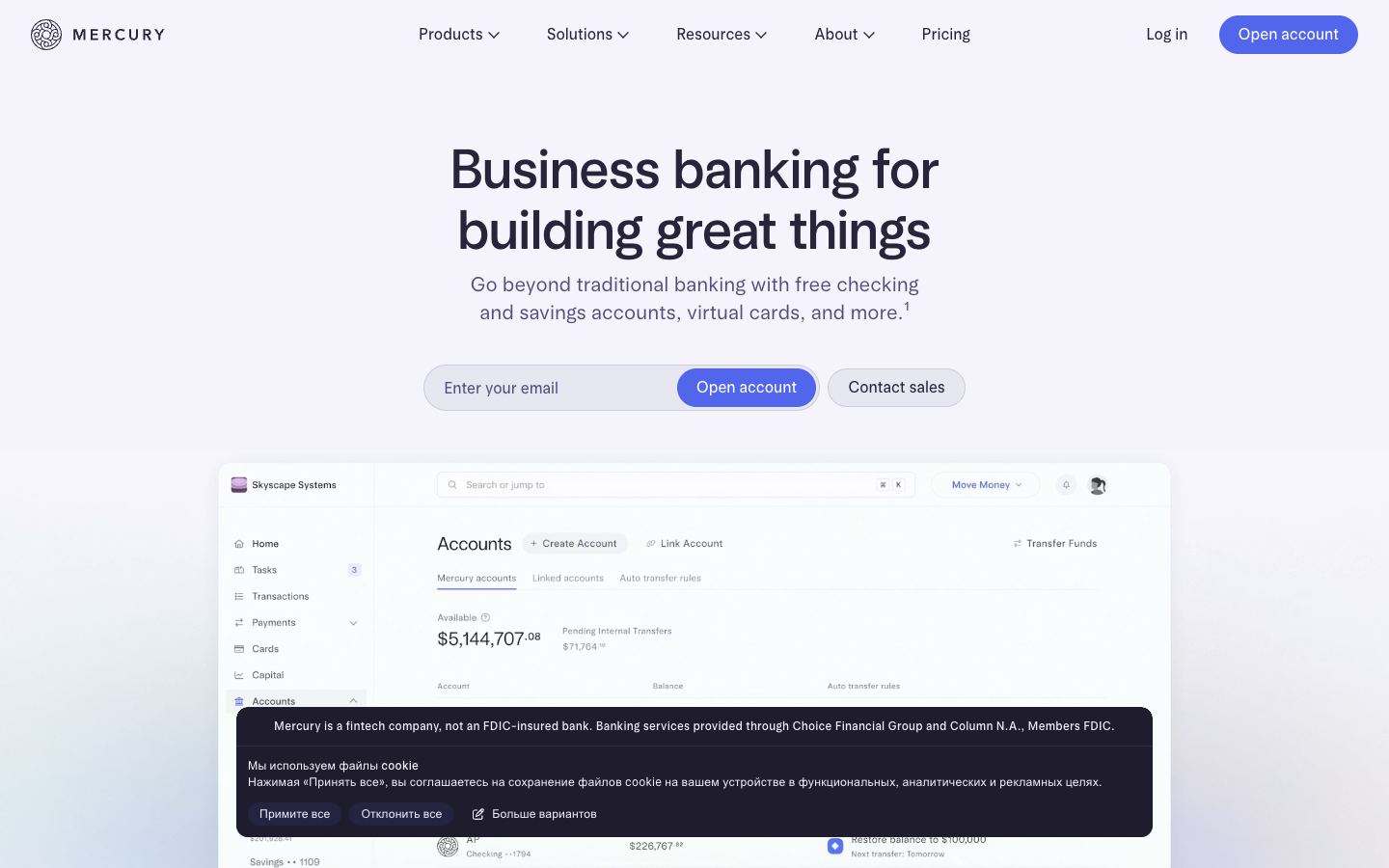
Mercury business banking provides an online place to manage checking and savings, pay vendors, issue cards, process expenses, send invoices and work with accounting data. The accounts are accessible through a modern online platform, but the legal structure matters. Mercury states that it is a fintech company, not an FDIC-insured bank. Banking services are provided by Choice Financial Group and Column N.A., Members FDIC.
That distinction isn’t a reason to dismiss the platform; it is a reason to understand where your funds sit. Mercury says eligible checking and savings deposits may receive up to $5 million in FDIC coverage through its partner banks and sweep networks. This is not a promise that every dollar in every Mercury product receives identical protection. Applicable pass-through insurance conditions must be satisfied, and Mercury Treasury investments are structurally different from bank deposits.
If you are choosing where to keep payroll money, read the official FDIC explanation before relying on a banner. It explains the bank partnerships, sweep networks and the distinction between deposits and Treasury.
The difference between banking convenience and banking resilience
Online onboarding and instant card creation solve a real problem: founders should not need to visit a physical branch to review a vendor payment. They do not solve every failure mode. A returned wire, a flagged transaction or an account review can still create serious operational friction, particularly for a remote founder with no local branch to visit.
For a business with employees and regular supplier payments, the practical answer may be to maintain an independent backup account at another institution, document the support route and avoid placing every critical payment on a single platform. That advice isn’t unique to Mercury. It follows from the cost of a payroll interruption being much larger than a modest difference in account fees.
Who can open a Mercury business account in 2026?
A Mercury business account for non-US residents can be possible when the business is U.S.-registered and the founder lives in a supported location. This does not override the company-address, industry or identity rules.
Mercury business account eligibility begins with the company, not with a glossy founder story. According to its published requirements, the applicant must generally be formed and registered in the United States or a U.S. territory, have existing or planned U.S. operations, and provide a qualifying principal-business address. The address may be international, and a residential location can be acceptable, but a registered-agent-only address, P.O. box or commercial mail drop does not meet the normal physical-address requirement.
Non-U.S. citizens and non-U.S. residents can apply for eligible U.S. companies. That does not mean every foreign founder can be approved. A Mercury business account is subject to restrictions that consider residence, business location and activity, and may request additional verification or decline an application. U.S. company registration by itself does not guarantee acceptance.
Prepare an official company name and formation documents, an IRS-issued EIN document, a business description, source-of-funds details and government identification for the responsible person and relevant owners. Mercury requests beneficial-owner information for individuals holding at least 25% of the company, including ownership through holding entities. The exact document checklist can vary with the structure and the review.
One nuance is especially important to international founders: The residence restrictions for a Mercury business account should be checked before paying for U.S. company formation solely to obtain an account. Citizenship and current residence are not always treated the same; Mercury’s help center distinguishes them. Read both its eligibility requirements and prohibited jurisdictions, and seek confirmation from Mercury when your circumstances are borderline.
An eligibility checklist before applying
The Mercury business account opening requirements matter before you pay for formation services: gather the EIN evidence, real operating address and ownership documents first.
- Is the business actually U.S.-formed, and does it have a credible U.S. business purpose or planned operation?
- Can you document where the company operates rather than supplying only an agent’s mailing address?
- Can every reportable owner provide accurate identification, residential-address information and ownership details?
- Is your industry supported, and do you understand additional review requirements?
- Do founders, controllers or operational activities fall into a listed restricted country or region?
These questions are not bureaucratic trivia. A company can have genuine revenue and still be ineligible because of residence restrictions or the nature of its business. Submitting inaccurate details to move the application along is not a workaround.
🛠️ Mercury Features: Payments, Cards and Accounting
Imagine a five-person U.S. software agency. Its monthly pattern is ordinary: clients pay invoices, two contractors work abroad, subscriptions renew on different dates, the founder reviews card purchases and the accountant reconciles expenses. Without a shared workflow, these tasks span a bank portal, spreadsheets, PDFs and email approvals.
The appeal of Mercury business banking is in reducing that fragmentation. A founder can open separate accounts for operating cash or reserves, use physical and virtual company cards, set spending permissions, pay bills and connect transaction records to accounting software. A business that mostly operates in USD may get more practical value from those connected processes than from a high-yield headline.
There are three areas worth examining before you commit.
1. Payments, cards and spending controls
The Mercury foreign transaction fee is especially relevant for founders who spend on non-USD cards while traveling: that card charge is different from the fee for converting an outgoing wire.
Mercury advertises free ACH, domestic wires and standard international wires in USD. The issuer or intermediary receiving a transfer may charge separately. For a non-USD international wire, Mercury’s published currency conversion fee is 1%. It also lists a 3% currency exchange fee for non-USD card transactions on its business cards. Those percentages describe different events: wiring foreign currency is not the same as buying in foreign currency with a card.
Businesses can use virtual or physical cards and spend limits. Those controls matter when a contractor needs access to a design subscription but should not have access to payroll funds. A lockable card and a transaction owner create a better audit trail than sharing the founder’s card details.
The caveat is that approval rules and automated categorization do not automatically become reliable bookkeeping. Someone still needs to define policies, match unusual transactions to invoices and review anomalies. A convenient payments interface does not remove the need for separation of duties.
2. Invoicing and bill payments
A free Mercury business account lets eligible users create, send and track invoices. Recurring invoicing and ACH-debit collection sit among the advanced features associated with paid plans, with transaction-level pricing differences between Plus and Pro. If a client pays an invoice by card through a connected Stripe account, Stripe processing fees still apply. Mercury does not turn card acquiring into a cost-free activity.
On the bill-payment side, uploading an invoice can reduce retyping. The product describes automated extraction, an invoice inbox and approvals. That is useful for a team processing many vendor bills, but the actual value depends on whether accounting classifications, approvers and recipient details remain accurate after automation.
A finance lead should pilot the complete workflow with a few low-risk vendors before switching all payables. Check who can create a beneficiary, who can approve a payment, and who receives an alert if a bill is duplicated.
3. Accounting integrations
The Mercury Xero integration can streamline bank feeds, but it does not decide your chart of accounts or resolve every reconciliation exception for the accountant.
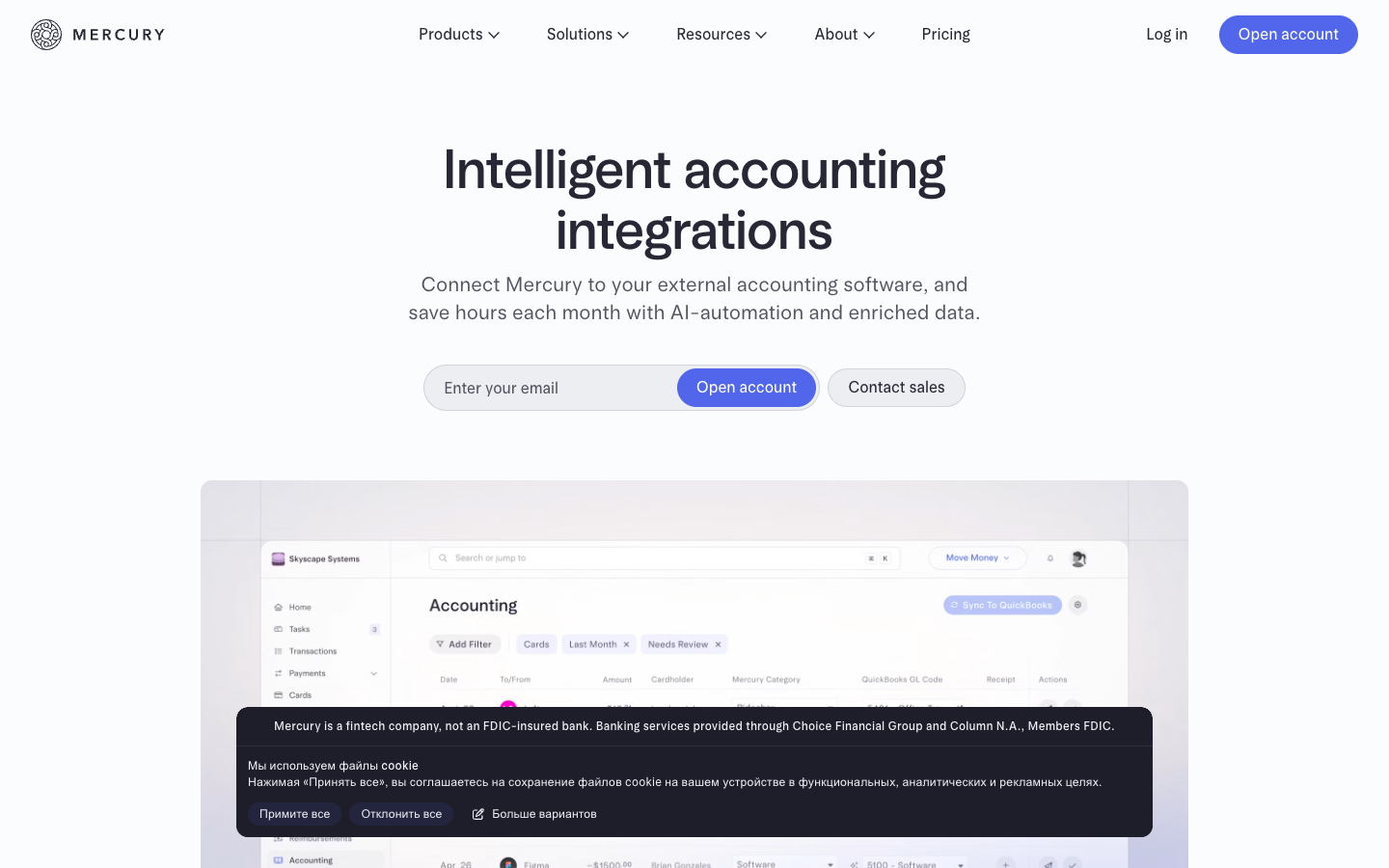
Mercury business banking connects with QuickBooks Online, Xero and NetSuite. Bank-feed synchronization and some category enrichment are available on the free tier. More advanced NetSuite automation appears in the paid-plan feature comparison.
That difference matters. Importing deposits and card movements into accounting software is not the same thing as replacing an accountant or automatically closing a set of books. You still need a chart of accounts, reconciliation rules, a review process and a plan for exceptions.
Mercury business banking can make transaction data easier to collect and distribute. Xero or QuickBooks then remains the system in which accounting policies and financial statements are maintained. The most sensible comparison is often Mercury plus Xero, not Mercury versus Xero as though both products perform identical jobs.
💰 Mercury Pricing 2026: Free, Plus and Pro
When comparing Mercury Plus vs Pro pricing, price the extra accounting and relationship features against a specific workload; a higher monthly tier will not make a business automatically eligible.
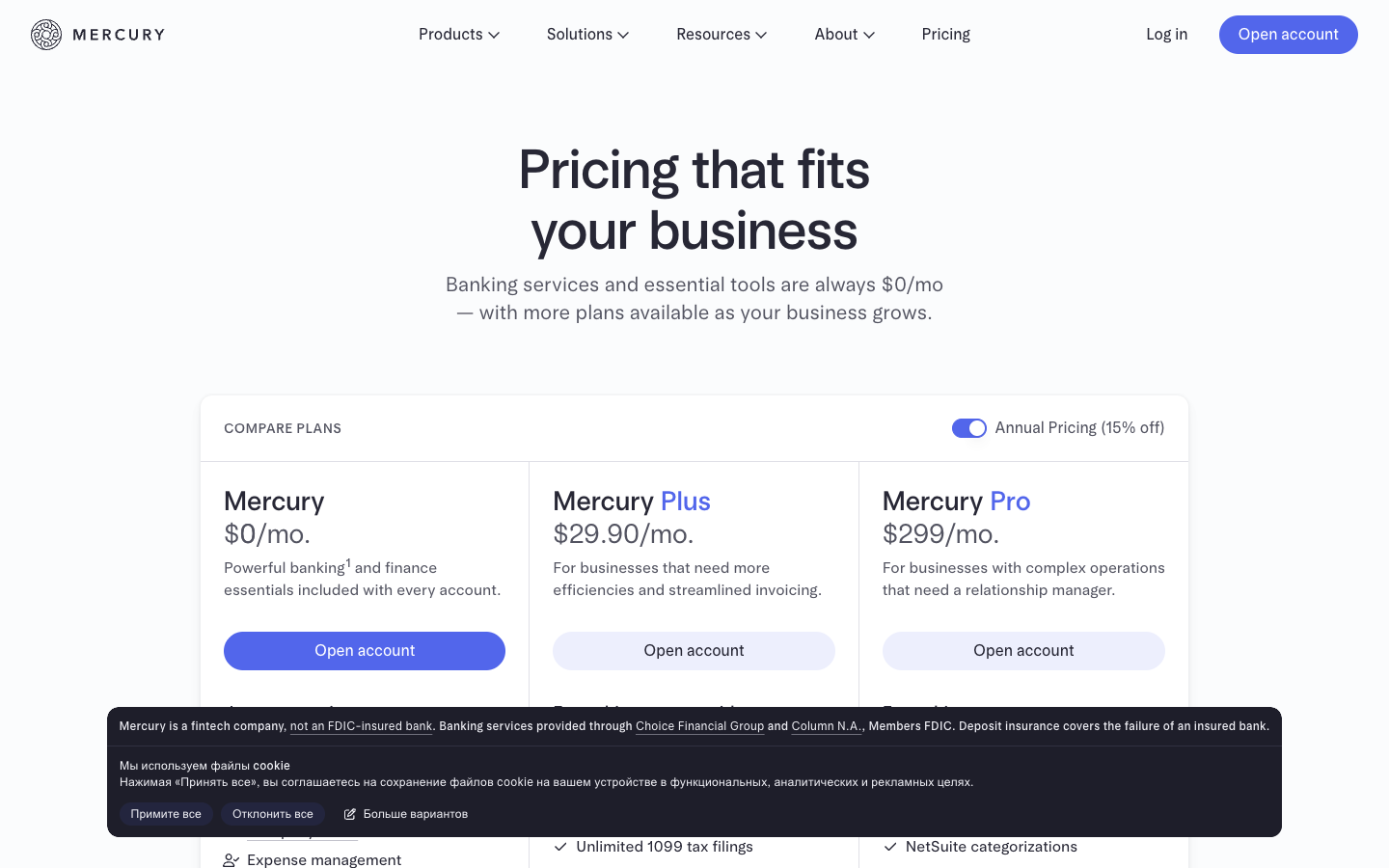
The official Mercury pricing page currently distinguishes the free Mercury business tier, Mercury Plus and Mercury Pro. The free banking relationship does not require a paid subscription to make routine payments. Plus and Pro sell incremental finance-workflow capabilities and service arrangements; neither should be confused with a higher FDIC-insured deposit balance.
There is an important presentation detail on the vendor site. A selector shows annual pricing with a discount, alongside standard prices discussed elsewhere in Mercury’s FAQ. Plus is displayed at $29.90/month with annual pricing selected, while Mercury discusses $35/month as the starting paid subscription price in its explanatory text. Pro is displayed at $299/month in the observed annual-pricing view. Whether an annual commitment is billed monthly or upfront, the exact invoice terms and effective dates should be checked at checkout. Displaying $29.90 or $299 without the billing context is less useful than it first appears.
The Mercury pricing page also advertises temporary feature-price waivers, such as a waiver displayed through December 31, 2026, for an eligible feature. That statement is not a license to treat all Plus services as permanently free. A business should compare the normal recurring plan expense against the cost of the administrative tasks it expects the upgrade to eliminate.
Mercury plan comparison — official public pricing checked 19 October 2026
| Plan | Published price context | Where it fits | Limits worth noticing |
|---|---|---|---|
| Mercury business | $0/month, no required paid banking subscription | Startups needing USD banking and everyday payments | Non-USD exchange, card FX and some premium workflows still cost money |
| Mercury Plus | $29.90/month in the observed annual-pricing selection; standard starting rate described as $35/month | Teams needing recurring invoices, expanded workflows and priority support | ACH-debit invoice collection has a published $1 transaction charge; confirm annual terms |
| Mercury Pro | $299/month in the observed annual-pricing selection | More complex operations needing a dedicated relationship manager or deeper NetSuite features | A significant fixed cost; specific benefits and billing should be independently confirmed |
This is a buyer’s comparison, not a promise of approval or a fixed custom quote. Mercury’s website updates promotional and annual-pricing presentations; always use the live plan matrix as the final authority.
The fees that matter more than the subscription
Questions about Mercury international wire transfer fees need two answers: whether the wire is sent in USD, and whether a currency conversion or an intermediary-bank charge applies.
To evaluate Mercury pricing beyond the monthly plan, look at the payments your company actually makes. Consider a U.S.-registered agency that pays most domestic vendors by ACH and one overseas contractor in local currency. The domestic transfer may cost $0 on Mercury’s side, while the foreign-currency wire carries the published 1% exchange fee.
Here is a simple illustrative fee scenario, not an actual transfer quote. Suppose a payment exchanges the equivalent of $8,000 into a supported local currency. A 1% conversion fee works out to approximately $80. That illustration excludes any other provider or intermediary charges and any movement in the exchange rate itself. If the company sends ten such payments per month, understanding the cumulative currency costs becomes more important than comparing $0 and $35 subscription headlines.
Card purchases have their own economics: the listed non-USD transaction fee is 3%, rather than the 1% wire conversion fee. A founder traveling internationally and routinely charging hotels and software in foreign currencies should compare the total card cost with a more specialized international-spend product.
Published fee reference
| Activity | Mercury’s stated charge or caveat | Practical question |
|---|---|---|
| Domestic ACH payment | $0 on Mercury’s side | Do both institutions support the intended payment timing? |
| Standard domestic USD wire | $0 on Mercury’s side | Are any counterparties or intermediary charges relevant? |
| Standard international USD wire | $0 on Mercury’s side; optional premium-processing charges may exist | What does the recipient actually receive after intermediaries? |
| International wire converted to non-USD | 1% currency conversion fee | How much local currency will be delivered at the displayed exchange rate? |
| Non-USD card purchase | 3% published foreign-currency transaction fee | Does the team’s purchasing pattern justify a different card? |
| Basic business account | $0 required monthly banking fee | Will your team also need advanced invoicing or NetSuite automation? |
| Eligible Treasury access | Separate investment product with eligibility conditions | Is an investment vehicle appropriate for cash the business must spend soon? |
The table deliberately separates guaranteed vendor-listed charges from the questions that still require a live quote. It is safer than estimating every business’s total cost from one fee figure.
What about Mercury Treasury and the advertised yield?
The Mercury Treasury minimum balance requirement is only one part of qualification. The vendor also lists supported locations and business-entity types; some single-member LLCs are currently excluded from Treasury access.
Mercury Treasury is not simply a higher-interest version of the checking account. Mercury offers access to Treasury through Mercury Advisory, an investment adviser, for qualifying users with sufficient balances. Its pricing documentation states a $250,000 Mercury account balance eligibility threshold at the time of this review. Yield is variable and depends on the actual investment product and market conditions.
The word Treasury can sound like a guarantee. Read the disclosure instead: Treasury investments are not bank deposits and are not FDIC-insured. SIPC protections associated with a brokerage account concern the failure of a member brokerage and have different limits and purposes. They do not protect investors against the normal rise and fall of the value of securities.
If the money is earmarked for taxes or next week’s payroll, consider liquidity, settlement times and the possibility of short-term investment risk before chasing a quoted annualized yield. A balance threshold or attractive headline does not make an investment equivalent to cash at a bank.
For businesses that need insured deposits rather than investment exposure, compare the available checking and savings arrangements, understand the sweep program, and verify the applicable limits and terms for your legal entity.
The $250 Mercury bonus: is it really available to everyone?
The Mercury $250 referral bonus requirements are not met merely by clicking a public pricing link. The account must be new and opened through a qualifying referral, with the specified deposit condition satisfied.
The Finance category card on DigiOffly refers to a potential $250 bonus. Mercury does run a published referral program, but the bonus is not a universal signup gift. Its official referral terms state that eligible new business customers must use a qualifying referral link and deposit and maintain a balance of at least $10,000 for a full business day within their first 90 days. Other terms, eligibility checks and restrictions apply.
That is a meaningful difference from clicking any public pricing URL. A plain product link or a page saying “View Pricing” does not by itself establish that the visitor has been referred, will be accepted or will receive cash. If the exact referral URL and its eligibility have not been verified, the responsible description is potential referral reward subject to official terms, not get $250 for signing up.
The same caution applies to temporary credits, partner discounts and promises connected to paid plans. A worthwhile banking account should remain worthwhile even if the incentive never arrives.
⚖️ Mercury vs Xero, Ramp and Wise Business
Business finance software is an awkward comparison category because many products solve different layers of the problem. One handles bank accounts, another is the accounting ledger, another focuses on corporate cards, and another specializes in currency conversion. Ranking them as interchangeable alternatives would mislead readers.
Mercury versus related products
| Tool | Primary job | Where it may beat Mercury | Where Mercury may be more convenient |
|---|---|---|---|
| Mercury | U.S. business banking plus finance workflows | N/A — baseline for comparison | Consolidates banking, bill pay, cards and integrations |
| Xero | Accounting software and financial reporting | Stronger dedicated ledger, reconciliation and accountant workflow | Mercury provides payment rails and business accounts rather than only books |
| QuickBooks Online | Small-business bookkeeping, reporting and accounting | Deeper accounting workflows for many U.S. business types | Mercury helps originate and control underlying bank transactions |
| Ramp | Corporate spend controls and expense management | Businesses with complex card policy and employee spending needs may prefer a specialist | Mercury integrates spending with the bank account and payment operations |
| Wise Business | International money movement and multi-currency workflows | Businesses paying or collecting in several currencies may prefer its specialized currency tools | Mercury offers a broader integrated U.S. startup banking workflow |
The useful decision is not necessarily to replace one product with another. A company might legitimately use Mercury business banking, Xero for accounting and a dedicated cross-border provider for recurring foreign-currency invoices. The key is to avoid paying twice for a feature you never use, while keeping a reliable audit trail when funds move between systems.
Mercury vs Xero: bank feed or bookkeeping system?
Xero is not a substitute for holding a checking-account balance, just as Mercury’s transaction categorization does not eliminate a general ledger. Mercury’s accounting integration lets bank-feed information flow into Xero; the accounting platform then takes on the bookkeeping tasks. The integration is especially useful for owners who want their accountant to receive structured data instead of monthly CSV dumps.
If you are already happy with your traditional bank, buying Xero may be the correct next decision. If your accounting process is sound but vendor payments and approvals are fragmented, Mercury may solve a different bottleneck.
Mercury vs Ramp: where does the spending workflow belong?
Ramp is particularly relevant when you need departmental limits, employee expenses and corporate-card governance at scale. A Mercury business account includes access to cards, expense policies, receipt collection and accounting connections, but the detail of approvals and exception handling should be tested against your actual organization chart.
Ask who can edit a spending limit and whether the change is logged. Consider how the team collects missing receipts, offboards an employee and handles a disputed purchase. A single well-enforced control may save more than an additional analytics chart.
Mercury vs Wise Business: international payments change the equation
A fair comparison of Mercury vs Wise Business fees starts with the same amount and payment corridor, plus any card spend and conversion that your company actually expects.
For a business that invoices in dollars and pays almost everyone in dollars, Mercury pricing is easy to like. For a company that receives pounds, pays designers in euros and buys inventory in a third currency, the answer may be different.
Before making a decision, compare the final delivered amount for the same amount, same source currency, same destination currency and same transfer time. Compare FX margins and explicit fees, not a marketing label. Wise Business and Mercury have different account eligibility and product structures, so their cost comparison is only meaningful for a specific payment scenario. This is also a situation where holding a backup rail is a sensible operational precaution.
✅ Mercury Pros and Cons
Pros
- A genuine $0 entry-level business-banking tier.
- Free standard USD wires and domestic ACH on Mercury’s side.
- Accounts, cards, bill payments and reporting in one workflow.
- Connections to popular bookkeeping systems.
Cons
- U.S. entity eligibility and residence restrictions.
- 1% conversion on non-USD wires and 3% on non-USD card spend.
- No cash deposit network or branch-counter support.
- Treasury is an investment product, not FDIC-covered cash.
Strengths and weaknesses after examining the published product
There is a reason Mercury business banking comes up so often in discussions about new U.S. companies. Its feature list addresses mundane operational annoyances: moving money without a branch visit, managing cards without forwarding PDFs, and seeing transaction data before the accountant asks for it.
The strongest aspects of the published offer are straightforward. Standard banking is free to maintain; several common USD payment methods have no Mercury-side transfer charge; the product includes finance tools that smaller companies would otherwise assemble from separate subscriptions; and the accounting integrations cover three important platforms.
The weak points deserve equal weight. It is not a walk-in bank or a universal account for businesses worldwide. A founder can be perfectly legitimate yet fail eligibility. Foreign-currency costs matter. Free banking and paid workflow subscriptions can be easy to conflate. And a good-looking dashboard does not tell you how a complex fraud review, returned international wire or account closure will unfold.
Independent customer discussions reinforce this tension. Public reviews include praise for the interface and onboarding alongside complaints about delayed or restricted accounts, service escalation and difficulty recovering funds after closures. Such reports are individual allegations and experiences, not verified findings about every customer. They still highlight the questions a prospective customer should ask before relying on a Mercury business account as their only financial relationship.
How to evaluate Mercury without risking your business operations
A careful rollout beats an excited migration. This is the procedure we would recommend to an eligible business comparing Mercury business banking with its current provider:
- Confirm eligibility first. Check the U.S. company requirement, owner and controller residence restrictions, business address and excluded activities before you collect documents or spend money on company formation.
- Map your payment flows. Count monthly domestic ACH transfers, international USD payments, non-USD supplier wires, card transactions and invoices. This reveals whether “free banking” actually captures most of your use.
- Price the messy scenarios. Obtain a live quote for a representative foreign-currency payment and inspect any card FX fees, premium processing options and counterparties’ costs.
- Test separation of duties. Decide who can add a recipient, approve a bill, create a new card, raise its limit and export data. Avoid a setup in which one person controls every step without review.
- Pilot the accounting connection. Import a small number of transactions into Xero, QuickBooks or NetSuite and verify categorization, reimbursement handling and reconciliation.
- Retain business continuity. Keep an alternative account or payment route until the primary account has a dependable track record for your real transactions and your team knows how to resolve an exception.
No article can replace those real-world checks. This review evaluates the disclosed product and potential workflow fit, not the customer-specific terms you will receive after underwriting.
🎯 Who Should Use Mercury?
A Mercury business account is worth shortlisting if you operate an eligible U.S. LLC or corporation, work online, receive or pay predominantly in USD, want a modern card-and-payments interface and need an exportable record for an accountant. A startup with clear ownership, ordinary domestic payments and basic invoicing may find the free plan sufficient.
Compare alternatives carefully if you depend on frequent foreign-currency transactions, need to deposit physical cash, want in-person branch help or have a complex regulated business model. You should also hesitate if your founder or financial controller’s location is restricted, even when the company itself is registered in the United States.
Do not buy a Plus or Pro subscription by default. Start by recording which specific paid functions would eliminate a current administrative task. Recurring invoicing, enhanced accounting automation and higher-touch service can have real value, but only if your volume and control requirements justify the recurring charge.
🧪 Mercury Review Methodology: Research and Limitations
For this Mercury review, we checked the public pricing matrix, its business banking descriptions, its accounting integrations and its official eligibility and referral terms. We also compared published requirements against the needs of a small agency paying domestic suppliers and international contractors. Our three screenshots show public website pages captured on 19 October 2026.
We did not open a Mercury account, conduct transfers, verify support response times, or test the restricted customer dashboard. Therefore speed, reliability, onboarding approval and specific FX quotes are not independently benchmarked. User reports on forums can help identify risks, but individual disputes cannot establish a failure rate for all customers. We publish uncertainty rather than invent account activity.
🏆 Final Verdict: Is Mercury Business Banking Worth It?
The clearest advantage of Mercury business banking is the combination of everyday USD payments and connected financial workflows. For the right U.S.-registered business, that can remove small but costly frictions from bill payment, card management, invoicing and transaction reconciliation.
The conditions are equally clear. Mercury is a fintech rather than a bank, the eligibility criteria matter, international-currency expenses are not free, and the referral bonus requires a genuine qualifying referral and an eligible deposit. Those points don’t negate the product. They explain who should choose it and how to budget for it.
Our conclusion: Mercury is a strong candidate for an eligible online-first U.S. business with mostly USD operations, provided it maintains appropriate backup financial access and verifies the live terms. Businesses built around multi-currency flows, cash handling or restricted international residence should start with their operational constraints rather than the signup headline.
For the exact current terms, review Mercury’s official pricing, its eligibility checklist and its deposit-insurance explanation. Compare the full cost, not just the subscription price.
Mercury Review: Frequently Asked Questions
Is Mercury a bank?
No. Mercury is a fintech platform, not an FDIC-insured bank. Banking services are provided by partner banks, Choice Financial Group and Column N.A., Members FDIC.
Is Mercury business banking really free?
Standard business checking and savings have no required monthly subscription, balance minimum or Mercury-side charge for many USD transfers. Some FX, card and advanced workflow fees still apply.
Can non-U.S. residents open Mercury accounts?
Some can, if they own an eligible U.S.-registered business with qualifying operations and documentation. Residence, jurisdiction and industry restrictions still apply; approval is never guaranteed.
What documents are required to open Mercury?
Typically a company formation document, EIN evidence, business and funding information, identification for controllers and relevant beneficial owners, and acceptable physical-address details.
How much does Mercury charge for international transfers?
Mercury lists standard international USD wires as free on its side. It lists a 1% conversion fee for international wires sent in non-USD currencies; intermediaries and optional processing can add costs.
Does Mercury integrate with QuickBooks and Xero?
Yes. Mercury lists direct accounting integrations for QuickBooks Online, Xero and NetSuite. Available enrichment and automation capabilities differ by plan.
What does Mercury Plus cost?
Mercury displays $29.90 per month in its annual-pricing view, and describes paid plan access from $35 per month elsewhere. Confirm billing cadence, commitment and checkout terms.
Are Mercury deposits FDIC-insured?
Eligible checking and savings deposits may receive up to $5 million in FDIC coverage through partner banks and sweep networks, subject to applicable conditions. Mercury Treasury investments are different and are not FDIC-insured.
How do I qualify for the Mercury $250 referral bonus?
Mercury says eligible new business customers need a qualifying referral link and must deposit and maintain at least $10,000 for a full business day within the first 90 days, subject to other terms.
Is Mercury better than Wise Business or Xero?
They serve different needs: Mercury centers on U.S. business banking and finance workflows, Xero is dedicated accounting software, and Wise Business specializes in international money movements. Compare a real use case.
EXPLORE NEXT ON DIGIOFFLY
What to explore after Mercury
Keep researching the full money workflow, not just the price of one banking account.
Finance comparisons
- Explore our Finance software hub — Review banking, accounting, payroll and expense platforms.
- Browse the full software directory — See the wider catalog and existing reviews.
- Brex review — Compare card programs and business account eligibility.
- Ramp review — Review spend controls and finance approvals.
Compare total ownership costs
- Estimate recurring software costs — Separate monthly fees from annual commitments and transaction charges.
- Compare software side by side — Check capabilities and the unknowns before subscribing.
Keep researching
- Find software for your workflow — Shortlist tools by concrete business needs.
- Read our research methodology — See how public vendor documentation is interpreted.