

Reviewed October 19, 2026. This Brex review examines the actual 2026 software plans, corporate charge cards, expense management, banking-related services and the implications of Capital One’s acquisition. Our assessment is based on official pricing, help-center documents and public product examples. We have not applied for credit, opened a Brex account, processed an invoice or obtained access to a customer dashboard. Screenshots shown below come from Brex’s public materials, not from hands-on testing in an authenticated account.
A growing software business now has thirty employees across sales, engineering and customer success. The product team pays for cloud infrastructure, recruiters buy job ads, staff travel to customer meetings, and the accounting team receives receipts in several formats. A card statement describes what employees purchased, but not necessarily why a purchase was permitted or which client or department should bear its cost. By the time the finance manager notices an unwanted renewal, the payment may already have cleared.
Brex expense management aims to put spend limits, corporate cards, receipt collection, approvals and accounting synchronization into a single workflow. Its software can help teams issue different budgets, review exceptions and attach evidence to transactions before the month-end close. Brex expense management also connects to bill payments, employee reimbursements, travel booking and a separate business account. Buying all of those functions is not the same as buying a conventional business credit card.
A current Brex review also needs to address ownership. Brex became part of Capital One on April 7, 2026, when the announced acquisition closed. The products and public help center remain available, but purchasers should read the current legal entities, issuing-bank disclosures and contract terms rather than relying on older independent-startup descriptions. The acquisition itself is neither proof that the product improved nor evidence of a decline in service.
📊 Brex Review Summary 2026
What Brex does well
Essentials offers usable spend controls, card workflows, expense automation and accounting integrations at no software subscription charge.
Where to be careful
Card approval depends on underwriting, monthly or daily balance settlement, cash redemption can be less valuable and FX markups apply.
Best for: Eligible growth-stage businesses and established companies wanting corporate cards with controls, managed employee spending, accounting integrations and the option to add multi-entity finance workflows.
Plans: Essentials starts at $0 per user per month. Premium is advertised at $12 per user per month. Enterprise has custom pricing. Card underwriting and account eligibility are separate from selecting a software package.
What stands out: Physical and virtual cards with configurable spend limits; software workflows for receipts and approvals; access to bill payments, reimbursements, travel booking and business accounts; expanded policies and multi-entity controls in paid tiers.
Watch-outs: Brex cards generally require the balance to be paid in full on the applicable daily or monthly schedule. International conversions can include a markup of up to 3%. Rewards are not uniformly valued at one cent in cash. Premium bills for active users, and Enterprise contracts can include committed seats and overage terms.
Quick opinion: Strong shortlist candidate if the business needs coordinated cards, expenses and spending policies. Less appropriate when the primary objective is to carry a revolving card balance or when the company’s formation, funding or operating profile does not meet underwriting requirements.
⚡ Quick Verdict: Is Brex Worth It in 2026?
The appeal of Brex is operational: define what an employee may spend, then collect receipts and accounting details with fewer disconnected systems. Finance teams should look beyond the marketing claims in a corporate card review and follow how an actual purchase moves through approval, card authorization, evidence collection, ledger entry and reconciliation. That sequence is more important than a list of AI features.
Essentials is unusually capable for a free software plan. The Brex pricing table lists basic corporate cards, AI-powered rules, accounting connections, bill pay, employee reimbursements, local-currency wires and travel booking. Premium adds policies that vary by department and transaction type, advanced approval routing, live budgets, and additional international and ERP functionality. Enterprise is designed for organizations requiring broader global coverage, customized rollout and more centralized administrative controls.
Brex pricing matters, but businesses should not calculate value solely by subtracting $12 from their monthly software budget. There can be FX costs, rewards redemption trade-offs and contract terms governing which users are billable. A free software plan also does not guarantee the applicant will be approved for a card or business account.
Our Brex review recommends testing one spending policy with representative transactions and comparing the time spent on exceptions before a broader rollout. Get a written statement of eligibility and costs. For finance teams that already close the books efficiently, buying additional automation may yield less than expected.
🧠 What Is Brex and How Does the Corporate Card Work?
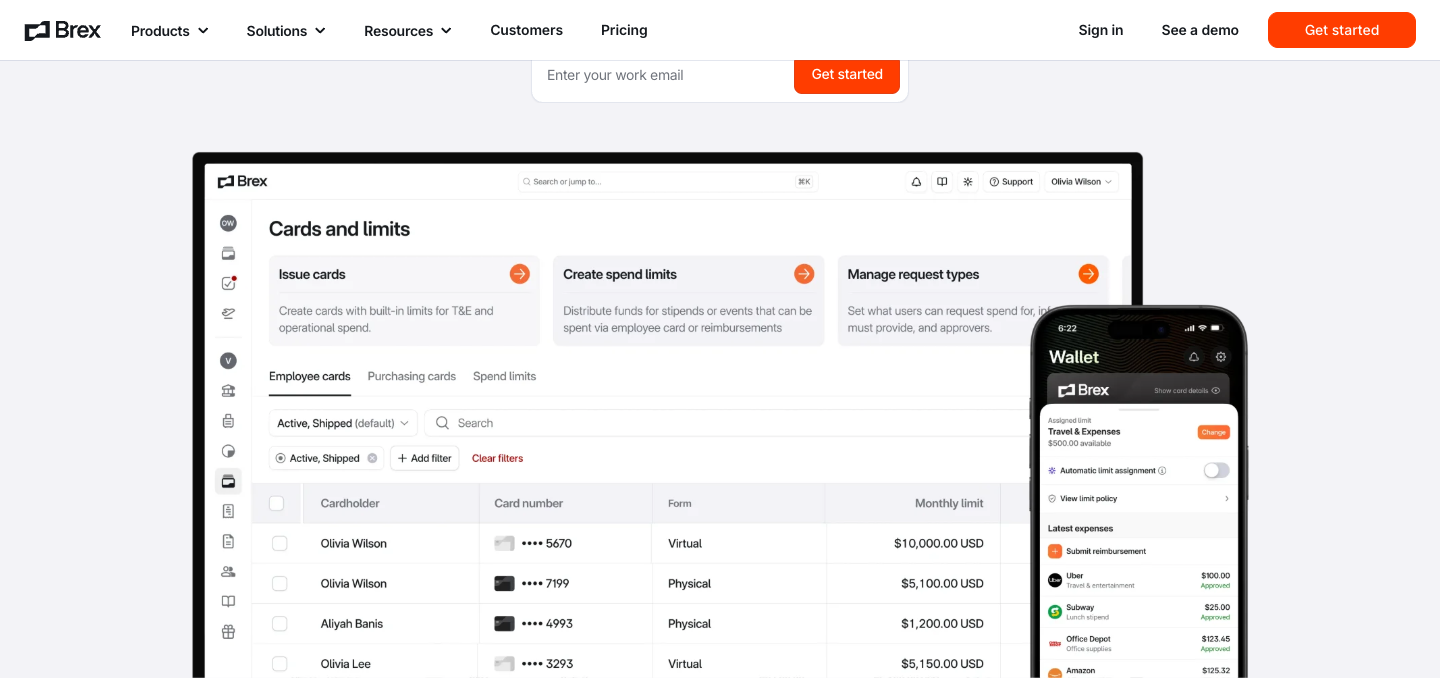
The Brex corporate card program combines Mastercard-based charge cards with software that manages spending and related bookkeeping evidence. Eligible employees can receive a physical card and virtual cards attached to approved spending limits. Administrators assign budgets by purpose, group, department or company policy, while finance staff review card transactions and any required receipts. Brex also provides tools for payable invoices, travel, reimbursements and a separate business account.
Brex calls its program a corporate card, but it is not a normal revolving credit card. Its current help center states that accounts may pay daily or monthly; the business must settle the statement in full. Limits can be underwritten using linked account balances, cash flow, financial performance or assets held through eligible Brex products. The limit may change as the company’s circumstances change. Unlike a conventional business credit card, a company cannot assume it may finance a purchase by paying only the minimum.
An agency paying annually for SaaS has two separate decisions: whether the cost is authorized and whether sufficient liquidity exists when the charge-card payment is due. The software can help enforce the former. It does not solve the latter. That distinction should be discussed with treasury and accounting staff before transferring a large volume of purchasing.
Brex company eligibility and application requirements
Brex asks for business incorporation details, the entity’s address, ownership information, tax identification details and financial information as appropriate to the products requested. It may require access to eligible corporate banking data or historical statements for underwriting. A business’s location, legal form, operational activity and financial strength can affect the decision.
Brex corporate card eligibility depends on the business rather than a universal $25,000 minimum bank balance. That figure belongs to Ramp’s publicly documented eligibility guidance, not an all-purpose rule for Brex. Brex’s own credit-limit explanation describes both cash-based and revenue-based underwriting with different supported payment schedules. Ask what Brex actually needs for the legal entity and product being considered.
Approval for the software is not automatically approval for an issuing-bank financial product. A company may be able to create an account and explore parts of the dashboard while certain cards or payment services await identity and financial checks. Never treat a marketing signup form as a committed credit offer.
Daily payment cards versus monthly payment cards
Understanding Brex daily vs monthly payments helps companies plan their cash needs. Brex says a monthly statement limit may depend on connected cash, cash flows and business performance. Daily cards rely more directly on funds in the company’s Brex business account and settle charges each day. The right arrangement depends on underwriting and your company’s eligibility.
Consider a company that books $40,000 in annual software renewals early in the quarter. Its finance officer should establish whether its payment schedule is daily or monthly, which bank account funds automatic payments and whether card limits may change during the period. A $40,000 spending limit does not itself promise that an invoice for $40,000 will remain affordable when it settles.
The card program terms describe the issuer relationship and payment obligations. Brex’s documentation also names different issuing banks for eligible cards. Read the agreement for the card actually offered, rather than assuming all products have the same issuer, settlement currency or available features.
Physical cards, virtual cards and budget ownership
A virtual Brex corporate card can help businesses pay suppliers without sharing a general-purpose company card. Finance can create a dedicated purchase limit for software, travel or one approved supplier. If an employee changes roles, access and budgets can be reviewed without recalling every transaction made on a shared physical card.
A well-managed rollout of Brex virtual cards for employees includes clear card owners, spending-limit reviews and a process for exceptions. When a vendor unexpectedly places a temporary hold, an administrator may need to raise a limit temporarily. When an annual subscription ends, the business should cancel the service through the vendor; freezing a card alone may not terminate the contract.
🛠️ Brex Expense Management Features
Brex receipt automation for small business teams
Brex advertises the ability to apply rules and request missing documents during the expense workflow. The system can collect receipts, identify transactions that require review and assign employees to policy contexts. That can reduce the bookkeeping team’s time spent manually matching every card transaction to an email receipt.
Test automated receipt matching with real-world edge cases. Have employees submit a hotel folio with a deposit, a restaurant bill with a tip, and a partly refunded online order. Then check what evidence is retained, whether the final settled amount agrees with the receipt, and how the system flags unresolved discrepancies.
Automated categorization remains a suggestion until a qualified reviewer accepts the accounting treatment. A paid annual license may be a prepaid expense rather than an immediate operating cost; a staff reimbursement may need different tax or payroll classification. Finance should verify the general ledger in its accounting software instead of assuming the expense dashboard constitutes the books.
Spending policies and dynamic review chains
Basic Brex expense management controls can specify card limits or eligible types of spend. Premium adds customizable expense policies, review chains and rule-based approval exceptions. In a growing company, this can reduce confusion about who approves contractor charges or purchases that span multiple departments.
A good Brex spend management policy setup begins with written decision rights. Which employee may authorize $500 of software renewals? Who approves an unusual international transfer? What happens if a manager is away? Brex expense management can route a request, but it cannot decide how the company should allocate responsibility.
The platform’s AI-powered review features can highlight suspicious patterns. That is useful as a second set of eyes, not as legal proof that a purchase was unauthorized. An incorrect merchant category or an unusual but legitimate purchase can trigger a false alert. Define a path to explain, override and log those exceptions.
Employee reimbursements and international operations
Not every employee expense is placed on a corporate card. A worker may buy train tickets with a personal payment method or pay a business expense while traveling in another country. Brex supports domestic reimbursements and selected global reimbursement workflows, although the available countries, funding options and plan restrictions vary.
When checking Brex employee reimbursement fees, distinguish an explicit transaction fee from a foreign-exchange margin embedded in the exchange rate. Brex says it does not charge a foreign transaction fee on eligible global reimbursements, but cross-currency payment conversions use a Brex- or partner-selected rate that includes a markup. The actual amount and availability depend on the route.
A company with international employees should verify local banking details, approval schedules, settlement currencies and documentation. It should not assume the software can pay a reimbursement in any country simply because Brex cards are widely accepted.
Travel booking and card rewards
Brex pricing includes travel booking on Essentials, while higher tiers expand policy options and group travel controls. This creates a link between authorization, booking, card payment and later expense review. It can be convenient when employees travel often, but the company should compare hotel availability, ticket restrictions, change support and service fees with its current travel provider.
Reward points require a separate valuation. The Brex Rewards terms, revised July 15, 2026, allow the company to change eligibility and multipliers. Brex’s own redemption help gives examples of 1 cent per point for eligible travel and 0.6 cent per point for a cash or statement credit, depending on redemption type and customer agreement. These are not interchangeable outcomes.
The actual Brex points redemption value depends on how the company intends to use its points. A business that rarely books travel may place more value on cash, but the conversion can be materially lower. On 100,000 points, a one-cent travel redemption is worth $1,000, while a 0.6-cent statement credit is $600. These are arithmetic illustrations, not a prediction of how many points the business will earn.
Bill pay and vendor workflows
Brex allows eligible customers to collect invoice data, route approvals and schedule payments. This is an accounts-payable workflow, not the same as the corporate card spending limit. The finance team should verify the supplier’s legal identity and bank destination before paying an invoice, particularly after a vendor sends new account details.
To compare Brex bill pay vs expense management, consider a software purchase on an employee card alongside an invoice paid through accounts payable. Cards generate an expense and a statement liability. Invoices may create accounts-payable balances before any money moves. A sound accounting integration should preserve those differences.
Brex’s help center describes ACH, checks, domestic wires and some international payments through its business account. Brex says it does not add Brex-issued transaction fees for many standard transfer methods, but intermediary banks and recipients may charge fees, and non-USD transfers can use a provider-determined exchange rate. A complete procurement budget must include those third-party and conversion costs.
Brex business account and treasury distinctions
The Brex business account combines eligible deposit-account functions with optional treasury products. Its current help pages identify a checking product provided through Column N.A., Member FDIC, while money-market investment opportunities are offered through a different affiliated securities entity. Those products have different risk, coverage and liquidity characteristics.
It is important not to call every balance in the Brex interface FDIC-insured cash. Bank deposits and money-market investments do not carry the same protections. Read the customer agreement, account disclosures and treasury prospectus before transferring operating reserves.
For businesses using both the business account and charge cards, daily settlement can be a convenient operational design. But payments, card liabilities and transfers should still be reconciled in an independent accounting system. A single dashboard does not remove the need for separate control over cash and credit.
Brex accounting integrations with ERP software
Brex’s Essentials plan includes accounting integrations and an API. Premium expands integrations and workflow customization for larger finance teams. Common accounting stacks include QuickBooks, Xero and more sophisticated ERP platforms, depending on the plan and supported connector.
The Brex QuickBooks integration should be tested for duplicate entries, expense account mapping, card liability handling, reimbursements and month-end settlement. A payment from a linked operating bank account to a Brex card statement should not be recorded as a second operating expense if its individual card transactions are already posted.
For businesses using NetSuite or another ERP, ask where custom entity dimensions and approval history are preserved. An integration that merely exports totals may not preserve the level of detail needed to explain why a particular department spent above budget.
The operational goal should be faster reconciliation with fewer unresolved exceptions. It is not realistic to assume that turning on an integration produces audited financial statements or automatically makes a company’s accounting policy compliant.
💰 Brex Pricing 2026: Essentials, Premium and Enterprise
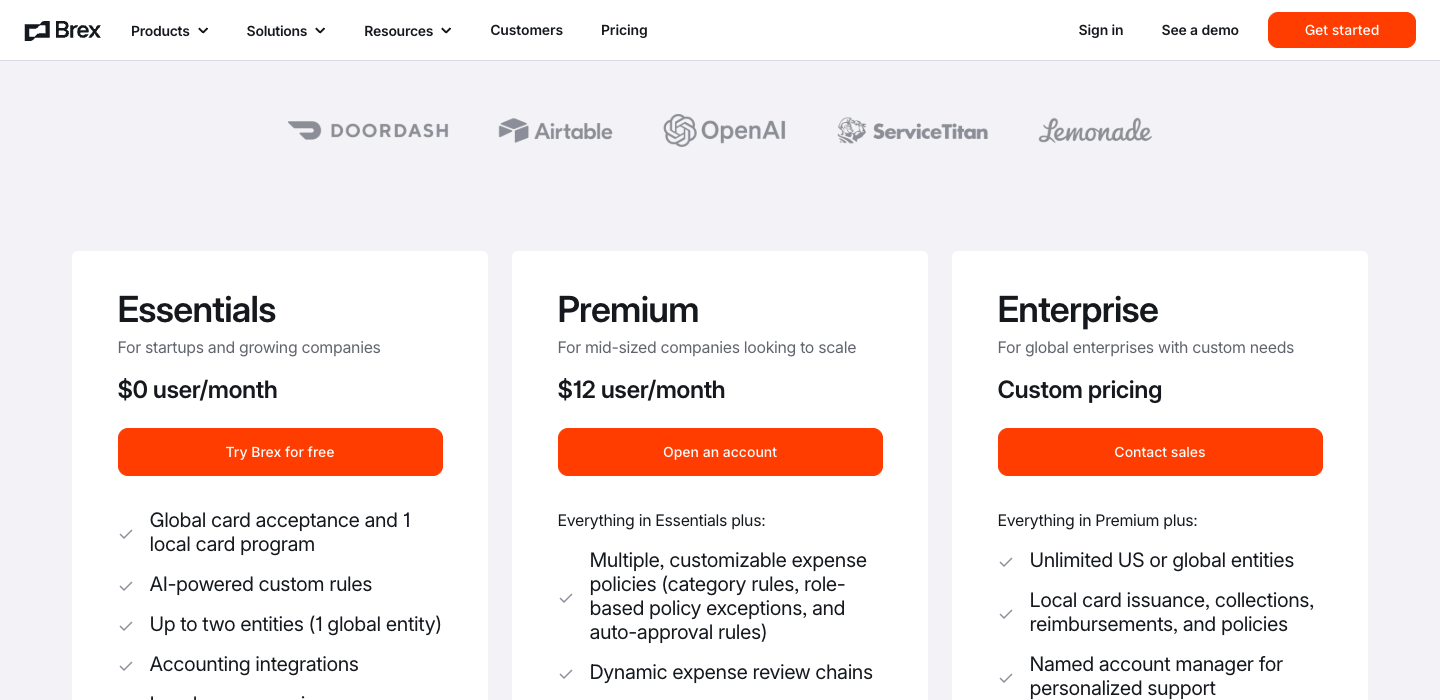
On the current official Brex pricing page, the software comparison is straightforward: Essentials starts at $0 per user per month, Premium is $12 per user per month, and Enterprise is quoted by sales. The basic Brex pricing tier is free, but financial products have separate approval rules and some transactions or investments still generate costs.
| Plan | Advertised software fee | Included highlights | What to verify before choosing |
|---|---|---|---|
| Essentials | $0 per user/month | Corporate cards, basic policies, expenses, reimbursements, bill pay, accounting integrations and travel booking | Card eligibility, bank product approval and country support |
| Premium | $12 per user/month | More granular policies, approval chains, live budgets, multi-entity workflows and advanced integration options | Which active users are billed, taxes and any negotiated commitment |
| Enterprise | Custom quote | Unlimited eligible entities, region-specific card issuing, advanced administration, implementation and support options | Seat minimums, supported jurisdictions, extra modules and annual obligations |
Brex corporate card buyers should also note the separate Smart Card offer with custom pricing. That should not be confused with the automatically included Essentials cards. Procurement-specific features may require a separate product agreement. A company should obtain a quote for the precise configuration rather than assume every item in a product menu comes free.
Brex Premium pricing example
At the published rate, ten active paid users would cost $120 per month and thirty users $360. Fifty paid users would be $600 per month. If every seat were billed for a full year at that list rate, the respective totals would be $1,440, $4,320 and $7,200 before taxes and other negotiated terms.
| Number of Premium users | Monthly list cost | Twelve-month list equivalent | Excludes |
|---|---|---|---|
| 10 | $120 | $1,440 | Transaction conversion costs, taxes, separately contracted services |
| 30 | $360 | $4,320 | Transaction conversion costs, taxes, separately contracted services |
| 50 | $600 | $7,200 | Transaction conversion costs, taxes, separately contracted services |
The Brex Premium cost per user calculation should count people who actually qualify as active billable users, not only employees who hold physical cards. Brex’s Premium Upgrade Terms describe self-serve charges at $12 per active user each month and note that taxes may apply. Different enterprise or negotiated contracts may use committed seat counts and overage rules.
For example, a finance team might upgrade twenty people to Premium but have sixty total employees who occasionally submit reimbursement requests. Whether those roles count as paid users should be established from the current account’s subscription terms rather than guessed from the number of physical cards. The monthly invoice is the right source of truth.
Paid software versus the cost of payment rails
The subscription price alone does not tell the whole story about costs. There are several categories of cost that deserve separate treatment: the software subscription, cross-currency exchange-rate margins, third-party intermediary bank charges, rewards redemption economics and any negotiated modules.
Brex says standard domestic card transactions ordinarily have no additional Brex-issued transaction fees. For card purchases requiring a foreign-currency conversion, however, Brex can apply a markup of up to 3% over its relevant wholesale rate. On $20,000 of foreign-currency spending, a full 3% margin would equal $600. A particular company’s actual margin may differ and must be checked in the agreement and statement.
The main business account may offer free standard ACH, check and wire initiation from Brex’s side. The recipient’s bank or intermediary can still charge a fee, and a local-currency wire uses an exchange rate selected by Brex. For international spending, the relevant costs depend on whether the business made a card purchase, an international wire or an employee reimbursement.
Do not treat a no-monthly-fee account as evidence that all global transfers settle at a mid-market exchange rate. FX markups are costs even when they are embedded in the conversion rate instead of shown as a separate line item.
Can Brex rewards offset Premium fees?
They might, but it depends on the eligible spending mix and how points are redeemed. If the company earns points on purchases and redeems them for travel at an available one-cent redemption rate, their value may differ from a cash redemption at 0.6 cents. Merchant type, card-payment cadence and the customer agreement can change multipliers.
A finance manager considering Brex rewards points vs cash back should calculate actual earned points from historical eligible purchases, then apply the redemption value the company will really use. Do not extrapolate the best travel multiplier across software, payroll, international transactions or every procurement payment.
Separate the expense-management subscription decision from the card-rewards decision. A business can benefit from controls even if rewards are modest. Conversely, a rewards program is less attractive if it encourages unnecessary purchases or complicates the way employees and managers approve spending.
Capital One ownership: what changed in 2026?
Capital One announced the completed acquisition on April 7, 2026. The public announcement described Brex as providing cards, expense automation and payments. This is now part of the corporate ownership context for every up-to-date comparison.
That does not establish a new $12 price guarantee, a change to card underwriting or automatic migration of every account to a Capital One consumer product. Brex continues to publish its own commercial pricing and platform agreements. We did not find a basis to claim that all previously signed Brex contracts changed on the acquisition date.
Any discussion of the Capital One acquisition should separate the confirmed ownership change from speculation about fees or future integrations. Existing customers should review notices and ask support about any transition terms that apply to their specific legal entity. Prospective customers should read the current contract rather than rely solely on older Brex reviews published before April 2026.
⚖️ Brex vs Ramp, Mercury and Airwallex
A practical Brex vs Ramp comparison begins by defining the business problem. Brex and Ramp combine corporate cards with spend-control software. Mercury focuses primarily on eligible US business banking and related payments. Airwallex is a common option to investigate for multi-currency financial operations. Accounting platforms like QuickBooks and Xero remain separate from each provider’s card or cash-management software.
| Provider | Primary role | Where it may fit | Main qualification |
|---|---|---|---|
| Brex | Corporate charge cards, expense and spend management, travel, business account | Growth-oriented business seeking coordinated cards and approvals | Pay-in-full terms, underwriting, FX costs and correct Premium user count |
| Ramp | Corporate charge cards and spend controls | US company seeking structured receipt, vendor and card policies | Platform fee on Plus, card eligibility and FX conversion |
| Mercury | Business banking and payments | Eligible US business seeking deposit and payment capabilities | Banking partner, credit products and entity eligibility |
| Airwallex | Global accounts, transfers and cards | Company that regularly holds and settles multiple currencies | Supported country, account type and conversion rates |
| QuickBooks Online | Accounting ledger and reports | Accountant or owner maintaining financial books | Subscription tier, manual close and bank reconciliation |
Brex vs Ramp: two free starting plans
The Brex vs Ramp corporate card decision is not settled by their free software tiers. Both advertise useful expense capabilities without a per-user license charge, but their eligibility requirements, user roles, reward systems, global functions and payments can differ. Ramp’s Plus price is $15 per user monthly plus a platform fee; Brex Premium’s published self-serve price is $12 per active user monthly.
Compare total cost rather than just $12 versus $15. Ramp’s additional platform fee makes a simple per-seat comparison incomplete. Brex can have costs tied to FX or negotiated commitments. A business that needs detailed entity-based rules should also compare which required policy exists in each provider’s free versus paid plan.
The deciding factor in Brex vs Ramp is often operational rather than a headline price. Draft the same spend policy in both systems: a $1,500 software budget, a regional travel allowance, two layers of exception approval and a QuickBooks export. Check which steps need a paid tier, what happens when a manager is absent, and how an improperly classified transaction can be corrected.
Brex and Mercury serve different needs
Mercury may suit companies primarily seeking US checking and payment infrastructure. Brex can offer a business account too, but its value proposition includes cards, spending limits and expense workflows. A company might use Mercury as its operating bank while funding a Brex charge card from an external linked account.
If doing so, document bank-to-card payments, liability reconciliation and which account holds operational cash. Do not assume all products have the same coverage or legal banking institution. The finance manager should identify where deposits sit and which statements constitute the accounting evidence.
Brex versus Airwallex for global teams
Airwallex emphasizes international accounts, cards and currency workflows. Brex offers globally accepted cards and expanded local issuing and entity functions in higher plans, but the company must verify exact supported jurisdictions and product combinations.
For a company with employees in five countries, the checklist is practical: Which local legal entities can receive a card? Can the local payroll currency be used? Can staff reimbursements settle directly into local bank accounts? What is the conversion margin? A worldwide card acceptance claim does not automatically answer any of these questions.
✅ Brex Pros and Cons
Pros
Free entry software, physical and virtual charge cards, linked receipts, approval policies and travel and reimbursement tools.
Cons
Financial product underwriting, payment-in-full rules, FX markup, rewards redemption trade-offs and paid user or contract fees.
Pros: The Essentials package offers substantive financial operations tools without a software subscription. Basic corporate cards, expenses, accounting sync and travel appear in its public pricing. Premium provides better governance for more complicated budgets. Having spend controls close to the underlying card transactions can simplify exception review and reduce the number of disconnected systems.
Cons: Not all businesses qualify for Brex financial products. Card limits may vary with cash or financial results. Daily or monthly card settlements require payment in full. International conversion margins can be material, reward redemption rates are not universal, and paid user counts or negotiated contractual obligations may increase total cost. Treasury products have financial risks and disclosures different from ordinary insured bank deposits.
If your company routinely needs to borrow across payment cycles, pay-in-full corporate cards may not solve that need. Likewise, if you only require a business checking account, a full expense-management platform may create needless administrative complexity.
🎯 Who Should Use Brex?
Good match: An eligible growth-stage company issuing cards to employees, approving purchases across teams, and needing accounting evidence before the month-end close. Free Essentials provides a practical starting point without requiring a Premium upgrade solely to issue basic cards.
Premium candidate: An organization with several approval layers, complex expense rules, live budgets or additional entities. The important test is whether the governance functionality eliminates enough manual work to justify $12 per active user every month.
Enterprise candidate: A company operating across multiple legal entities or countries that needs local card issuance, centralized access administration and guided implementation. Sales must confirm product coverage by country and any minimum commitment before the numbers are final.
Weaker fit: A sole operator with simple expenses, an international company without the necessary supported structure, or a company expecting to revolve card balances. Choose the provider based on its eligibility and the business’s financial operations, not on a leaderboard of rewards multipliers.
🧪 How We Reviewed Brex
We checked the current official pricing, Brex card requirements and underwriting, card program agreement, Premium upgrade terms, FX and service costs, and rewards conditions. Capital One’s official April 2026 acquisition announcement was used to verify the ownership timeline. The illustrative workflow and examples are our own analysis of how the services might be used, not reports of customer testing.
We did not register a Brex account, obtain a card approval, issue an expense policy inside a live tenant or move customer funds. We therefore do not claim measurable time savings, guaranteed approval, real-life support response times or card-limit outcomes. The illustrations are official website captures with sample data, not authorized views of actual customer finances.
Whenever a published headline might sound absolute, we distinguish it from the underlying contract: “no fees” may exclude currency margins; “free” may refer to software rather than credit approval; and “global” depends on the account and legal entity. Those distinctions are essential to comparing regulated financial products fairly.
🏆 Final Verdict: Is Brex Worth the Cost in 2026?
Brex makes sense as a shortlisted finance operations platform when the company needs cards, receipts, approvals and accounting evidence to work together. Essentials is a real free entry point for eligible businesses, while Premium provides more elaborate workflows at a publicly posted $12 per user per month. Enterprise offers a custom approach when geography, entities and controls are considerably more complicated.
Its charge-card model imposes a real cash obligation: the company must pay its statement in full on the appropriate schedule. International card conversion may include an up-to-3% markup, and rewards should be valued based on how the company can actually redeem points. Capital One ownership is a material 2026 update, but it is not itself a reason to invent changes in eligibility or pricing.
The best next step is a controlled pilot: obtain confirmation of underwriting requirements, replicate your company’s approval policy, test representative employee expenses, and reconcile a statement into your accounting ledger. Compare that experience and the full cost against Ramp or another provider before transferring all team spending. A clear, documented workflow will matter long after the initial signup offer is forgotten.
Brex Review 2026: Frequently Asked Questions
Is Brex free in 2026?
Brex Essentials software is listed at $0 per user monthly for qualifying users. Approval for a corporate card or business account remains subject to separate eligibility and underwriting.
What does Brex Premium cost?
Brex lists Premium at $12 per active user per month on its main pricing page. Enterprise is custom priced. Taxes, overages or special contract terms may apply.
Who can qualify for the Brex corporate card?
Brex considers business incorporation, owners, financial strength and connected banking or revenue data. There is no single guaranteed public cash balance or approval rule for every product.
Can I carry a balance on Brex cards?
No. Brex business cards are pay-in-full charge cards. Depending on approved card type and account, the payment schedule can be daily or monthly.
What changed after Capital One bought Brex?
Capital One completed the Brex acquisition on April 7, 2026. Brex continues to publish its pricing and card terms. Do not assume all customer agreements or products automatically changed.
Does Brex charge foreign transaction fees?
Brex can add a foreign exchange rate markup of up to 3% on card purchases converted into another settlement currency. International wires and reimbursements have different FX terms.
Can Brex integrate with QuickBooks?
Brex advertises accounting integrations including common small business and ERP systems. Test duplicate card transactions, chart-of-accounts mapping and settlement reconciliation.
How much are Brex reward points worth?
Brex cites a common one-cent-per-point redemption for eligible travel and 0.6 cent for cash or statement credit; actual rates and eligibility depend on the redemption and contract.
Does Brex offer employee reimbursements?
Brex offers employee reimbursement workflows, including eligible global reimbursements. Country access and currency conversion are subject to product and plan conditions.
How does Brex compare with Ramp?
Both provide company cards, approvals and expense software. Brex Essentials and Ramp Free start at no software charge; Brex Premium is $12 per user while Ramp Plus is $15 per user plus a platform fee.
EXPLORE NEXT ON DIGIOFFLY
What to explore after Brex
Compare corporate cards, business accounts and accounting software on approval conditions and the costs that matter.
Finance comparisons
- Explore our Finance software hub — Review banking, accounting, payroll and expense platforms.
- Browse the full software directory — See the wider catalog and existing reviews.
- Ramp review — Compare expense policies and virtual cards.
- Mercury review — Explore business banking requirements.
Compare total ownership costs
- Estimate recurring software costs — Separate monthly fees from annual commitments and transaction charges.
- Compare software side by side — Check capabilities and the unknowns before subscribing.
Keep researching
- Find software for your workflow — Shortlist tools by concrete business needs.
- Read our research methodology — See how public vendor documentation is interpreted.