

Editorial research checked: November 14, 2026. US list prices are shown in USD before taxes; plan allowances and local checkout terms may change.
Choosing Semrush used to start with a simple question: Pro or Guru? In 2026, that is only half the decision. An SEO specialist can still buy traditional keyword research, site audits and rank tracking. But a company trying to understand why ChatGPT or Google AI answers mention competitors now faces a different question: should it pay separately for AI visibility, or choose the combined Semrush One subscription? The plans address different monitoring needs, and picking the wrong bundle can add hundreds of dollars to a yearly budget.
This Semrush review 2026 examines what the current SEO Toolkit does, how Semrush One combines SEO and AI-search intelligence, and where AI Visibility fits. We compare plan ceilings and first-year spending, then use concrete publisher and agency scenarios to show when a rival may offer better value.
How this review was researched: We checked Semrush’s current subscription documentation and captured four official-source screenshots. We did not buy another paid seat or run an authenticated client audit for this article. The three test scenarios are practical exercises readers can reproduce, not results we claim to have measured.
📊 Semrush Review Summary: What You Should Know
| Buying question | November 2026 finding |
|---|---|
| Product | Semrush — SEO, competitor research, rank tracking, AI visibility and marketing toolkits |
| Best starting use case | Understand which queries to target, monitor key pages and discover technical site issues |
| SEO Classic Pro | $139.95 per month, published US monthly list price |
| SEO Classic Guru | $249.95 per month, published US monthly list price |
| SEO Classic Business | $499.95 per month, published US monthly list price |
| Semrush One Starter | $199.95/month FAQ starting reference for monthly billing; $165.17/month equivalent for annual prepayment (about $1,982.04). Verify the exact checkout amount and billing cycle. |
| Semrush One Pro+ | $299/month rounded marketing reference for monthly billing; $248.17/month equivalent for annual prepayment (about $2,978.04). Verify the exact checkout amount and billing cycle. |
| Semrush One Advanced | Custom quote on the current SEO + AI Search page; earlier public prices are not a current quote |
| AI Visibility separately | Help Center: $99/month; pricing page also displays $99/month per domain billed annually; verify the actual billing term |
| Free usage | Permanent Free account: one demo project, 10 reports per day; limited tools, not the full paid suite |
| Our buying stance | Pro for focused SEO; Semrush One for sustained SEO plus AI visibility; higher plans for proven scale |
A table of features does not tell you whether a tool fits your workflow. The rest of this Semrush review walks through the tasks each subscription supports, what still needs human verification, and how to decide when one plan has become too small.
🎯 Who Should Use Semrush — and Who Might Not Need It?
Solo publishers and early-stage sites. Even a small publisher can use its competitor and technical reports to identify missing topic coverage or a broken group of important URLs. Its ongoing monitoring has value when a site publishes regularly. If a site has just twenty articles, free Search Console may answer the key questions without another $139.95 charge. Ask which editorial or technical decision you would make differently with the paid report in hand.
Content teams. Keyword and competitor data help an editor separate a search-driven topic from a subject with little demonstrated audience interest. A useful workflow starts with a real audience question and ends with a brief that includes intent, necessary evidence and a differentiated angle. A site full of interchangeable articles for minor keyword variants gives visitors little reason to return.
Freelance SEO consultants. Consultants benefit from position tracking, recurring audits and repeatable reports when they manage several domains. Pro’s five monitored projects may be enough for a specialist with a small client roster. A consultant responsible for twelve client sites should compare Guru’s fifteen-project limit before committing to a reporting schedule.
Marketing teams facing AI search. If customers increasingly discover brands through ChatGPT, Gemini or Perplexity, AI Visibility can help describe which prompts produce citations and mentions. Use those observations to decide which buyer questions deserve closer investigation; revenue impact still needs separate evidence. An organization should combine AI mention trends with Analytics and Search Console data before claiming a campaign worked.
Larger agencies. Historical competitor research, more monitored websites, higher keyword quotas, API access and permission controls can make a more expensive tier reasonable. The useful comparison is the next month’s workload under each plan, not the number of tools shown in the product navigation.
Who can probably wait? A local professional who wants one basic website crawl and occasional search analytics might first use free GSC, Google Analytics and one-off technical tests. A developer debugging application errors needs a monitoring tool such as Sentry, not an enterprise SEO subscription. Those use cases call for different tools.
💰 Semrush Pricing 2026: SEO Classic vs Semrush One
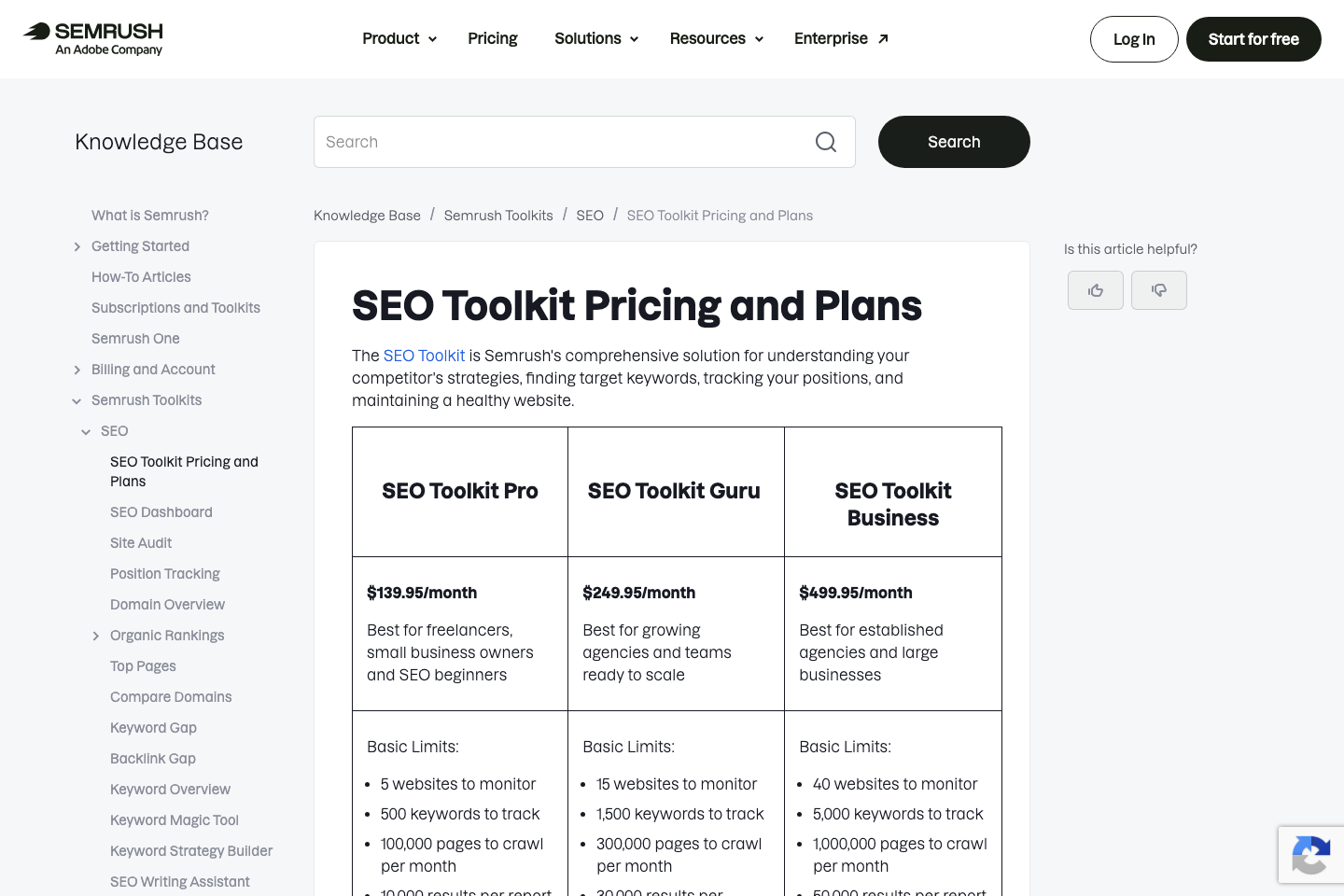
The main purchase choice is SEO Classic, the standalone SEO Toolkit, versus Semrush One, a bundle that adds AI-search monitoring. For a Semrush One vs SEO Classic comparison, ask whether AI prompt reports are needed every week or only occasionally. The current SEO + AI Search page lists SEO, Starter, Pro+ and Advanced; SEO Classic help still documents Pro, Guru and Business. Starter and Pro+ retain published limits, while Advanced now requires a sales quote. Older Semrush One pages may show a different offer.
Specialist toolkits also cover AI Visibility, Traffic & Market, Local, Content, Social and Advertising. Paying for SEO Classic does not automatically mean every additional toolkit is included. Some add-ons have their own subscription terms, seat charges or credit allowances.
| Plan | US monthly reference | Core project / keyword limit | When it fits |
|---|---|---|---|
| SEO Classic Pro | $139.95/mo | 5 monitored websites; 500 tracked keywords | Focused SEO research and auditing |
| SEO Classic Guru | $249.95/mo | 15 websites; 1,500 keywords | Growing teams, history and content analysis |
| SEO Classic Business | $499.95/mo | 40 websites; 5,000 keywords | Larger agencies and extended limits |
| Semrush One Starter | $199.95 FAQ starting monthly-billing reference; verify checkout | 5 sites; 500 keywords; 50 AI prompts tracked | One site or small portfolio needing SEO and AI visibility |
| Semrush One Pro+ | $299 rounded monthly-billing reference; verify exact checkout | 15 sites; 1,500 keywords; 100 AI prompts | Multi-market research and higher volume |
| Semrush One Advanced | Custom quote | 40+ sites; 5,000+ keywords; unlimited daily prompts advertised; contract controls actual limits | Broad agency operations and expanded API access |
Sources: Semrush SEO Toolkit pricing and limits, Semrush One plans, and SEO + AI Search pricing. The current marketing page displays $199 and $299 for Starter and Pro+, and Custom for Advanced. The FAQ lists Semrush One from $199.95/month; the older Semrush One page still shows an Advanced $549 monthly reference and 200 prompts. That $549 amount is obsolete as a reference for a new Advanced purchase: the current sales-quote offer supersedes it. These are different official presentations, not a guarantee of current checkout pricing. Use the current quote for Advanced; confirm exact cents, tax, region, promotion and term for every offer.
🧰 Semrush SEO Toolkit Pro vs Guru vs Business
Pro includes keyword research, competitor analysis, Position Tracking, backlink data and Site Audit. The current official help page describes five websites, 500 keywords and 100,000 crawled pages per month. The distinction between tracked keywords and keyword research requests matters: a large report of suggested terms does not mean you have room to monitor them all daily.
Guru increases the published allowances to 15 sites, 1,500 tracked keywords and 300,000 pages crawled per month. It also adds historical research, multi-location or device targeting and content-related tools, according to the plan matrix. That makes it more useful for teams comparing several markets or presenting progress over longer periods.
Business raises limits to 40 websites, 5,000 keywords and 1 million pages crawled per month and includes additional API access and Share of Voice capabilities. These numbers are ceilings, not evidence that a campaign will produce traffic. If your agency has 12 clients but tracks only 25 keywords for each, Guru may cover the monitoring need better than a far more expensive plan.
🤖 Semrush One Starter vs Pro+ vs Advanced
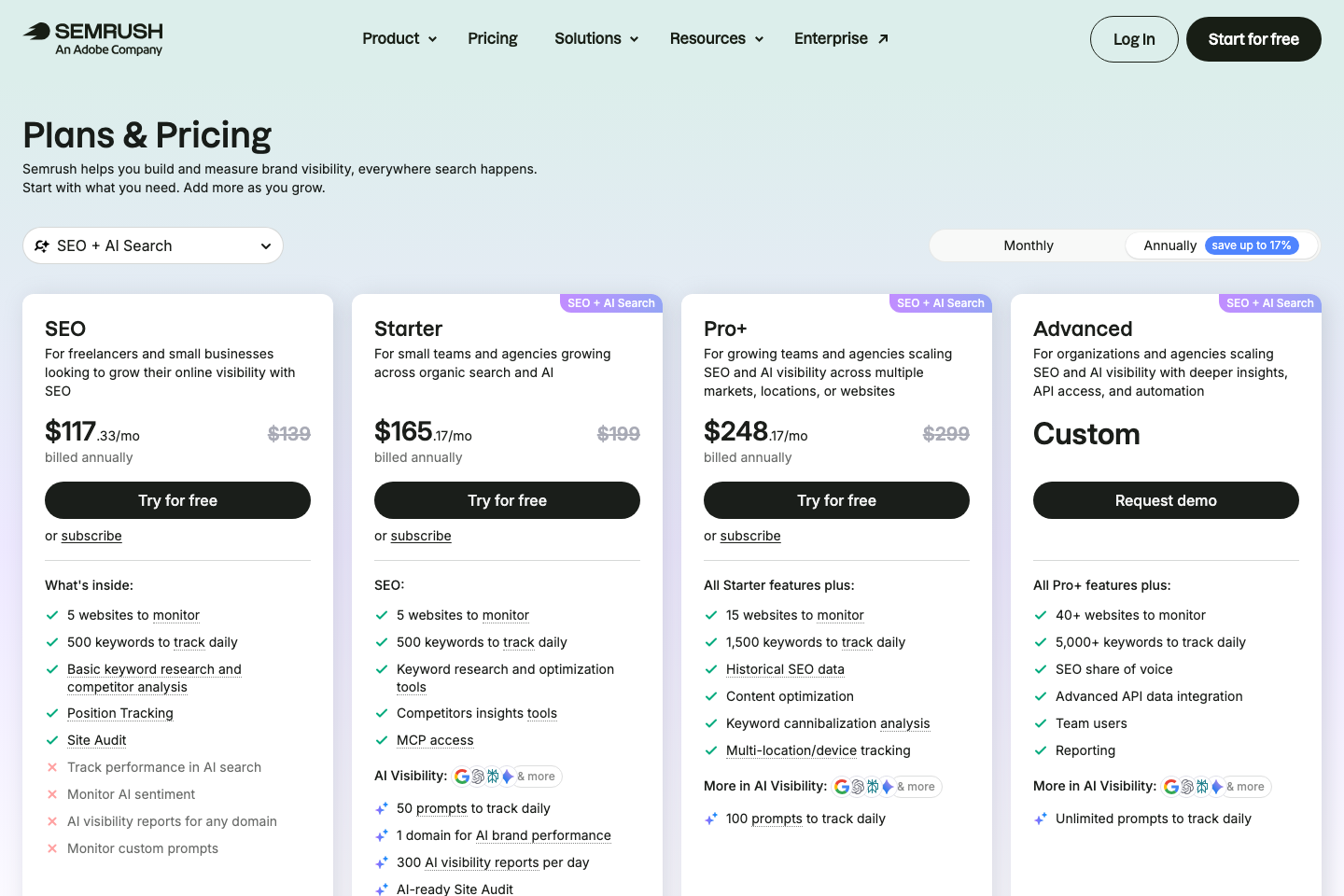
The combined subscription brings traditional SEO tools and AI Visibility into one purchase. Starter combines up to five websites and 500 daily tracked keywords with 50 tracked AI prompts and AI-focused reports. Pro+ expands that to 15 websites, 1,500 keywords and 100 prompts, while unlocking historical data and more detailed multi-location analysis.
The current Advanced offer advertises 40+ monitored sites, 5,000+ tracked keywords, unlimited daily prompts, team users, reporting and advanced API integration. The detailed comparison shows 40 sites and 5,000 keywords; these are published reference capacities, not a fixed contract for every buyer. The older Semrush One page lists 200 prompts. Confirm the quoted limits, seats and API package rather than assuming either the older cap or unlimited access to every feature.
The bundle is not automatically the cheapest choice when an organization already owns some of its components. Some businesses already pay for SEO Classic and need only occasional AI checks. Others rely on daily brand-prompt monitoring and would rather keep those reports in one subscription. Compare the precise entitlements, including domain quotas and daily refresh frequency, rather than summing every headline benefit indiscriminately.
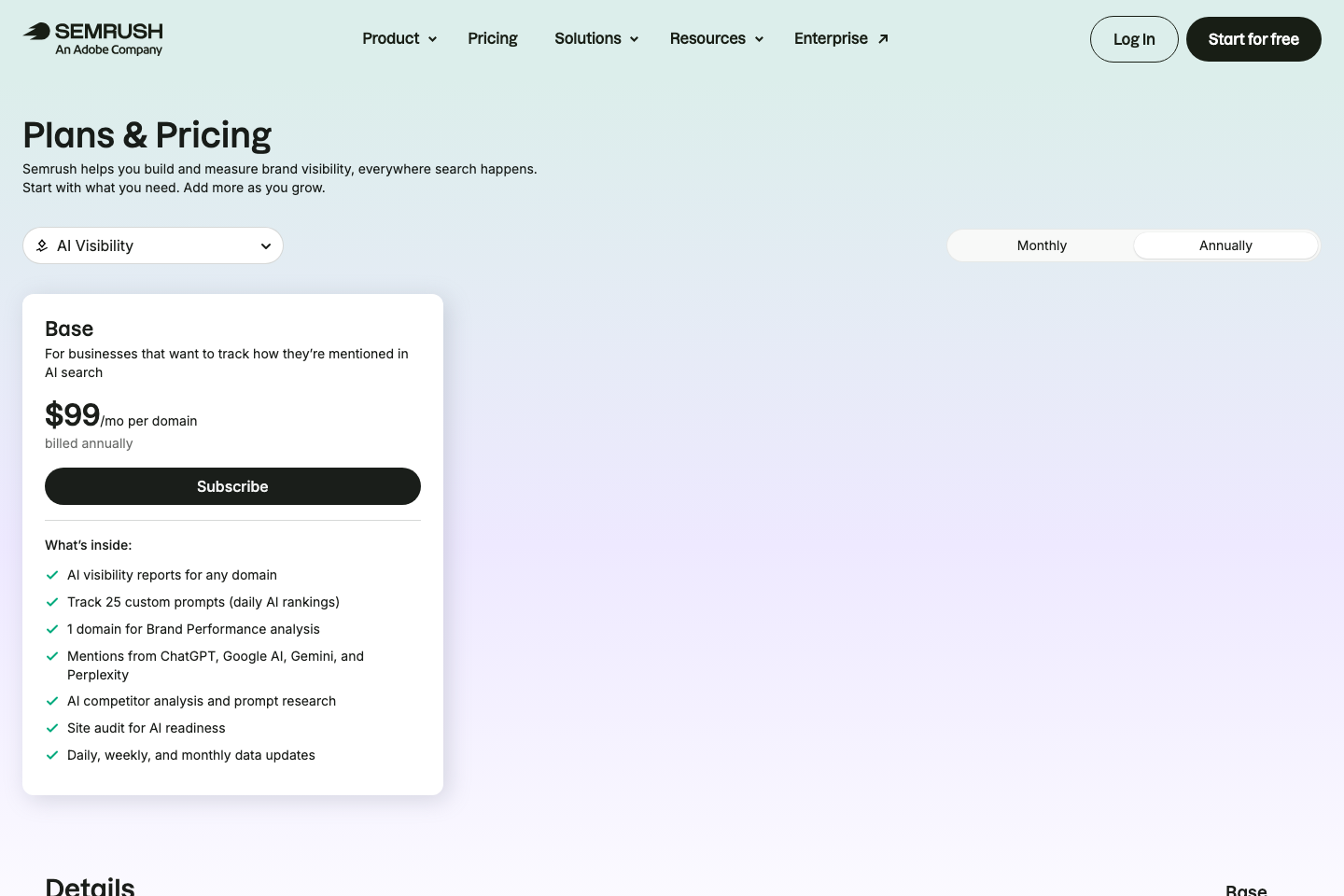
👁️ AI Visibility Toolkit: $99 add-on or Semrush One?
The AI Visibility Toolkit help article lists $99 per month, while the pricing page also presents $99 per month per domain billed annually. Confirm the applicable payment cadence. It covers AI mentions and citations, prompt research and tracking. The standalone offering has its own quantities, including an officially documented base allowance of 25 custom prompts. Starter includes 50 prompts, twice the standalone Base quota; the billing models are not directly interchangeable.
A publisher using SEO Classic Pro and considering standalone AI Visibility might compare the two published reference prices: $139.95 + $99 = $238.95 per month equivalent. Semrush One Starter’s $199.95 monthly list price is lower than that illustrative sum, but billing periods and eligibility differ. The help article lists $99/month, but the pricing page also displays an annual-billed reference; $238.95 is an illustrative monthly-equivalent sum, not a verified checkout offer. The standalone toolkit has no free trial according to its help article. Extra Brand Performance domains cost $99/month each and 50 more tracked prompts cost $60/month; neither grants a new user license.
Ask three questions before switching: Does the AI toolkit cover the same domain and prompt slots? Are all SEO Classic Pro reports preserved? And will an existing subscription receive a prorated charge or annual renewal change? The help center also explains how an AI Visibility add-on can share the renewal cycle of an existing annual subscription.
🧮 First-Year Budget: Exact Cash vs Monthly Equivalent
Advertising an annual plan as ‘$165.17 per month’ can obscure the first payment: about $1,982.04 upfront, calculated from the displayed rounded equivalent. In reality, a buyer may have to commit to a full year. A fair Semrush pricing 2026 comparison distinguishes amounts charged every month from full-year upfront cash.
| Scenario, US list prices | First-year cash cost | Monthly equivalent | Contract caveat |
|---|---|---|---|
| SEO Classic Pro for 12 monthly payments | $1,679.40 | $139.95 | Assumes unchanged monthly pricing |
| SEO Classic Guru for 12 monthly payments | $2,999.40 | $249.95 | 15-site limit still applies |
| Semrush One Starter 12 payments at FAQ starting reference | $2,399.40 | $199.95 | Illustrative starting reference; check account price and term |
| Semrush One Starter billed annually | $1,982.04 upfront | $165.17 | Annual term; amount from advertised equivalent |
| Semrush One Pro+ 12 payments at rounded marketing reference | About $3,588 | $299 (rounded) | Upgrade only when limits justify it |
| Semrush One Pro+ billed annually | $2,978.04 upfront | $248.17 | Annual term; check actual invoice rounding |
| Semrush One Advanced (new quote) | Quote required | Quote required | Confirm term, API units, seats and actual limits with sales |
Arithmetic based on listed prices, before tax, discount, rounding differences or extra users. Multiply the advertised annual-billed monthly equivalent by 12 for a planning estimate; actual checkout cash can differ by cents. An annual payment cannot be replaced by twelve small installments just because marketing displays a monthly equivalent.
For a small publisher, the $60 monthly difference between SEO Classic Pro and Semrush One Starter is meaningful. Over 12 months that difference is $720 if both were paid monthly at list prices. A person who checks AI mentions once every quarter may prefer to start with SEO Classic, or keep GSC as the baseline and use periodic free AI checks.
A team already paying for other research software should also consider the subscription stack. Ahrefs and this platform both provide keyword datasets, competitor insights and backlinks. Duplicating those costs can make sense for agencies that compare datasets, but not automatically for a one-person site. Do not cancel either system before checking which reports your team actually uses.
🔎 Semrush Keyword Research: A Better Brief, Not Just More Terms
Keyword Overview, Keyword Magic Tool and competitive research are the platform’s most familiar tools. A search analyst can enter a topic, inspect reported volume and intent, compare related terms, and see which competing pages appear in results. That is valuable because editorial planning involves choices: which query expresses a question the product can genuinely answer, and which one merely shares a popular word?
The tool’s estimates are models of search demand, not exact measurements of what your own website will receive. Search volume, cost-per-click and difficulty can vary by country, device, data source and update cadence. For a new website, chasing the highest-volume query may place an article against established brands that are difficult to displace. A smaller, more precise term that matches user intent might lead to a stronger page.
📚 Semrush Keyword Magic Tool: from a phrase to a useful cluster
A password-manager publisher might start with the broad term “password manager”. The more useful briefs distinguish family sharing, passkeys, offline access and business administration—separate reasons people buy the software. A useful Keyword Magic Tool evaluation groups phrases by the buying decision they represent.
Export a small sample of terms with the country, search volume, commercial intent and difficulty estimate. Then inspect the actual search results for at least ten of them. Merge terms that would be answered on the same page and separate terms requiring a distinct buyer decision. The result is a content map, not a quota of near-duplicate articles.
For Semrush long-tail keyword research, include phrases such as “best password manager for family sharing” or “password manager with passkey support” as examples of intent, not promises of verified monthly search volumes. The keyword tool can supply estimated numbers for the selected country in the user’s own account.
🧭 Keyword Gap and competitor analysis
Competitor research becomes more useful when a rival ranks for a topic that your site could legitimately cover. Keyword Gap reports help expose that intersection. But a missing topic is not automatically an opportunity: your business may not serve the same audience, and a competitor’s page may satisfy a different intent.
For a Semrush competitor keyword analysis, compare three websites serving roughly the same market rather than benchmarking a new blog against huge marketplaces. Compare their strongest pages, identify content types they cover better, and mark which gaps are relevant to your products. The output should be a short list of defensible priorities, with estimated effort and original sources.
The interface also estimates keyword difficulty and other metrics. Treat them as decision signals, not precise forecasts of ranking. A single low difficulty score should not override a poor site architecture, thin article or a search results page dominated by a format your content cannot provide.
📍 Position Tracking and actual search performance
Position Tracking reports where selected keywords rank in a defined market and device context. It differs from Google Search Console: Semrush monitors the chosen keyword set under its own sampling methodology, while GSC reflects impressions, clicks and average positions that Google observed for your own property.
That distinction matters when a report says visibility improved. A tracked term moving from position 12 to position 6 is useful, but the business may have earned few additional clicks. A page with more GSC impressions could also have become less relevant if the queries changed. Review ranking movements together with page-level clicks and conversions.
A Semrush Position Tracking review needs a stable baseline: use one location, one device category and the same 25 buyer-relevant terms for several weeks. Record the baseline. Compare the following weeks against Search Console instead of adding and removing keywords to make the line chart look better. Use annotations for technical changes and major content updates.
🛠️ Semrush Site Audit, Backlinks and On-Page SEO
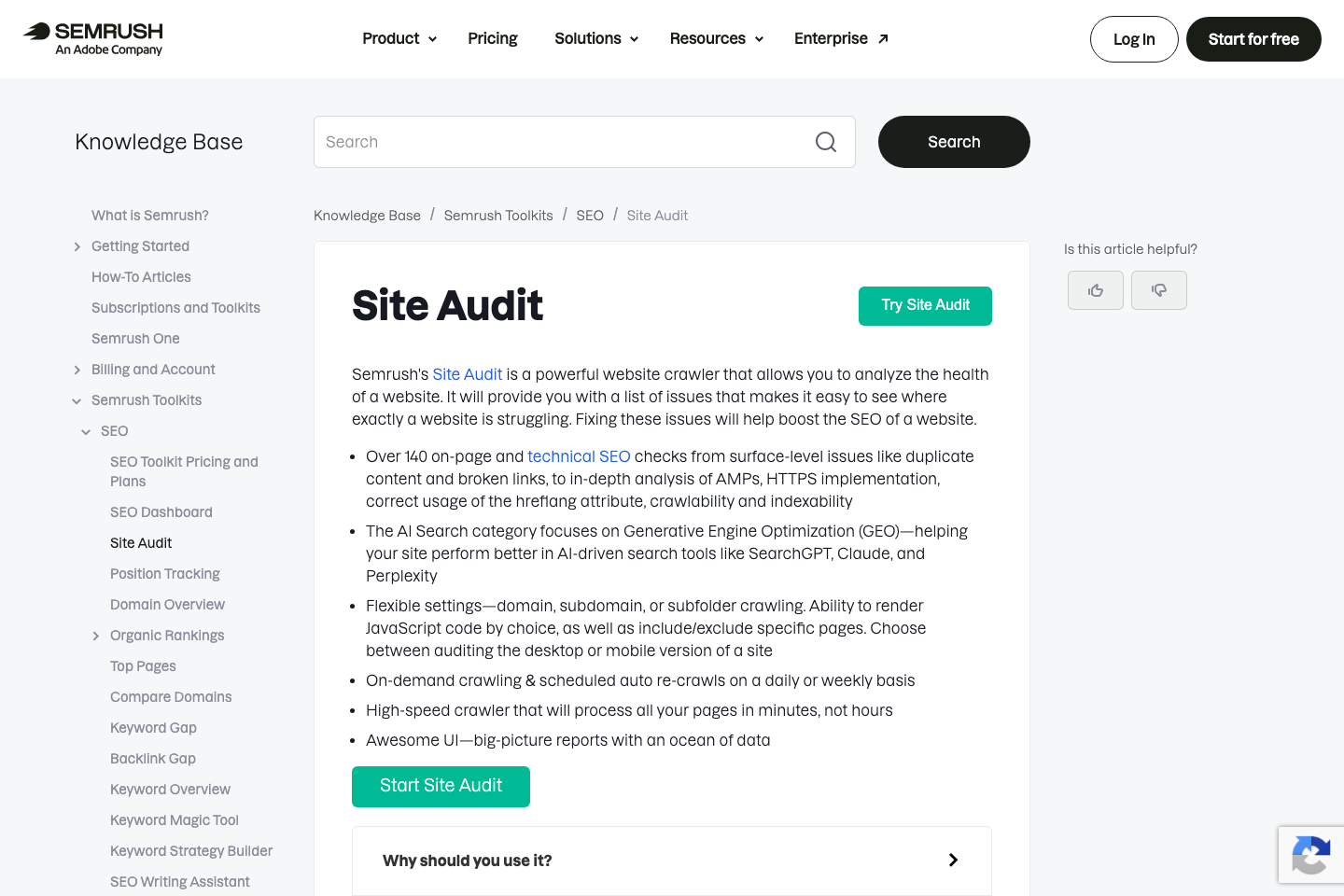
Site Audit is where an SEO platform can quickly reveal concrete engineering work. Broken internal links, indexability conflicts, redirect chains, duplicate metadata and crawl problems are plausible reasons a site underperforms. The software should help you prioritize fixes; it should not make changes to production without review.
A useful Semrush Site Audit tool review starts with the crawl scope. If a website has 400 public pages but the crawler has permission to inspect only 100, the health score is not a complete statement about the site. Conversely, thousands of filtered URLs can make an error count look frightening without corresponding business impact.
🩺 Technical SEO audit: severity before volume
Start by reading the project’s crawl settings: user agent, URL scope, limits and exclusion rules. Next compare the discovered URLs with the XML sitemap and Search Console indexing report. Then classify issues into three groups: blockers for important pages, maintenance issues and intentional differences (for example, noindex on a private account page).
A report that identifies three important product pages excluded from indexing is actionable. A generic count of 142 warnings does not tell the team what to fix first. That report can become an engineering ticket with a reproduction method. The user can fix it and rerun the audit to test whether the condition changed.
Some technical checks rely on a crawler’s view, not Google’s final indexing decisions. A crawler can highlight possible indexability problems, but Google’s actual indexing decision must be checked separately. A site owner should cross-check errors with GSC and with the page’s actual response headers or HTML before changing robots rules.
🔗 Backlink Analytics vs Backlink Audit
Backlink Analytics provides information about links pointing to domains and pages. A competitor with many links may be worth studying, but linking domains alone do not establish trust or explain rankings. The source page’s subject, editorial context and intent matter more than blindly pursuing a numeric target.
For Semrush backlink analysis, export a competitor’s most relevant referring pages, then inspect several for legitimate editorial context. Inspect a handful manually. Ask whether those links are references from genuine research, media coverage, partnerships or irrelevant directories. Then identify a legitimate reason your own work could attract links, such as original comparison data.
Backlink Audit and toxic-link metrics should be handled carefully. A vendor-generated “toxic” label is not direct evidence that Google penalized your site. Avoid deleting useful links or disavowing domains solely because one automated score looked alarming. Investigate actual manual actions, spam patterns and professional guidance first.
📝 On-Page SEO Checker and content tools
On-Page SEO Checker can suggest technical and editorial opportunities: improve a title, address missing subtopics, update internal links or compare a page against competing results. Its recommendations still require editorial judgment. A page stuffed with keyword variants to achieve a plugin score is unlikely to be more helpful.
Some writing and content features live in Guru, Semrush One higher tiers or the separately priced Content Toolkit. The Semrush Content Toolkit pricing page currently states $60/month with a seven-day trial, including a set of supported AI article workflows. This is not the same as obtaining unrestricted AI writing inside the cheapest SEO Toolkit tier.
A responsible content process uses research to identify a real question, gathers first-party screenshots or tested facts, drafts a direct answer, and reviews both source support and readability. A keyword-density threshold cannot replace those steps. For commercial software content, date-specific pricing and transparent testing claims matter especially.
👁️ Semrush AI Visibility Toolkit and GEO Tracking
The newer AI-search products address a different source of uncertainty: a company may rank in Google but rarely be mentioned in answers returned by ChatGPT, Gemini or Perplexity. Semrush AI Visibility attempts to show where a brand appears, what prompts trigger an answer and how competitors are represented. That information can guide research, but it is not an absolute measurement of every user’s AI experience.
AI answer content can vary with prompt wording, personalization, retrieval results, geography, session context and time. The useful analysis follows a stable sample of prompts over time and notes when the product changes its sampling.
📈 AI visibility score, brand mentions and share of voice
An AI Visibility dashboard may report how frequently a brand is cited or mentioned under monitored prompts and compare that performance against competitors. Those metrics should be defined before they appear in a monthly client report. Does “mention” mean a brand name in the answer, a linked domain, or both? Is the dataset global or restricted to chosen prompts?
For a repeatable Semrush AI visibility tracking study, monitor the same twenty buyer questions against three competitors, then inspect the context behind every major movement. Record the tools or models covered, prompt language and target market. Review changes weekly, then inspect the actual answers behind significant movement. If the prompts change, label the new baseline instead of interpreting the jump as a sudden marketing victory.
The official Semrush AI Visibility page identifies services including ChatGPT, Google AI, Gemini and Perplexity. This is a vendor description of coverage. We have not independently measured how closely its monitored outputs match responses that end users receive.
💬 Prompt Tracking and competitive AI gaps
Prompt Tracking is useful when its daily quotas support a stable set of customer questions. A company may discover that competitors are mentioned on queries about product compatibility or switching costs, even though its own website contains relevant documentation. The next step is not automatically “write 30 optimized AI pages.”
First inspect the citations. Do the models repeatedly link to a comparison article, documentation page or forum thread? Does the missing information already exist on your site but remain difficult for a crawler to locate? Improving a clear product FAQ or documenting a missing integration may address the underlying user need more effectively than publishing a generic “best” list.
In a Semrush prompt tracking review, record both the citation URL and the statement made about the brand. A brand name mentioned as an example of a poor fit should not count as an unqualified marketing success. Qualitative context can reverse the meaning of a favorable-looking aggregate metric.
📊 SEO and AI visibility reporting together
The reporting dashboard should place AI citations next to rankings and Search Console clicks. For example, a page might be cited by an AI answer to a buyer’s question but earn few direct Google clicks. That observation helps an analyst decide what to investigate; it does not prove the AI citation led to a purchase.
An October 12, 2026 Semrush tutorial outlines how to combine AI Visibility, Search Console and spreadsheets in a dashboard. It documents the vendor’s method, not results independently recreated for this DigiOffly article. Add GA4 conversions where available, but keep correlation and verified sales attribution separate.
⚖️ Semrush vs Ahrefs vs SE Ranking: Practical Buying Comparison
All three cover core SEO research, but their project limits and reporting workflows make different subscription stacks sensible. Neither vendor can reveal a competitor’s actual sales from its modeled traffic estimate. Compare the same domains, dates, locations and data definitions.
| Platform | Strong candidate task | Purchase question | Main pitfall to check |
|---|---|---|---|
| Semrush | Unified SEO competitor research, audits and optional AI prompt tracking | SEO Classic alone or Semrush One bundle? | Unused toolkit allowances and separate add-ons |
| Ahrefs | Research on organic pages, backlinks and content opportunities | Does its credit model and seat pricing fit usage? | Treating estimated traffic as actual analytics |
| SE Ranking | Tracked SEO projects, keyword monitoring and client reports | Does its plan include enough keywords and sites? | Feature differences across subscriptions |
| Google Search Console | First-party Google performance data for your verified property | Free, but only for owned websites | Cannot directly benchmark competitor accounts |
| Google Analytics 4 | User events and engagement after visits | Free core tooling with implementation work | Not an external keyword research service |
Semrush vs Ahrefs for backlinks and keywords
Start with one competitor page that ranks for a relevant query and has earned real editorial links. Pull its backlink and keyword data from both services on the same day. Compare how the tools define organic visibility and referring domains. It is entirely possible for both datasets to be internally useful while giving different numerical estimates.
For a small publisher, the best value may be the tool whose export becomes an actionable editorial plan. For a large outreach team, the backlink interface and link-index coverage might dominate the choice. Do not make claims about a winner based on pricing alone if you haven’t tested coverage on relevant domains.
Semrush vs SE Ranking for agency workflows
SE Ranking may appeal to teams prioritizing structured project monitoring and client reports at a different price point. The larger suite offers broader competitor and market intelligence, with added quotas and costs. The most informative evaluation uses the same ten keywords, two domains and one reporting cycle.
Include manual setup time and clarity for a non-technical client. A less expensive dashboard that cannot explain what changed will not necessarily save an agency money. Conversely, paying for a very large market intelligence suite to produce one weekly rank chart can be wasteful.
You can also consult the published SE Ranking review and use DigiOffly’s software comparison tool to structure your shortlist. The goal is to avoid paying for two suites when they solve exactly the same recurring task.
🧪 How We Would Test Semrush: Three Reproducible Workflows
Test 1: A technical audit with a known issue
Create a test site or use a staging version of a website you control. Add a few deliberate problems: one broken internal link, a redirect chain, a misleading canonical URL and an orphaned page absent from internal navigation. Let Semrush crawl the allowed pages. Record how many problems it found, how it prioritized them, and whether the interface gave a reproducible fix.
Repeat the crawl after correcting the issues. If the dashboard score improves but an important error remains, report the disagreement rather than claiming that an SEO Health number proves the site is healthy. A strong tool helps the site owner find and fix verifiable problems.
Test 2: A keyword strategy a writer can execute
Take a topic relevant to your business and generate 30 candidate queries in Semrush. Select ten with different intents, check the live search results, and ask an editor to propose distinct page outlines. The evaluation measures relevance and missing evidence, not sheer output volume.
Try to reproduce the same shortlist using a free source such as GSC and the visible search results. If the paid tool provides no decisions that you could not reach with an existing workflow, its cost is harder to justify. If it uncovers a relevant competitor question your team missed, document that gain.
Test 3: AI mentions vs actual acquisition
For Semrush One or AI Visibility, choose ten recurring prompts around a brand and two competitors. Capture the output for an initial week. At the same time, log GSC clicks, branded search trends and conversions in the site’s analytics. Review whether the observed AI citations involve meaningful recommendations or incidental mentions.
The experiment should result in two clearly labeled columns: “AI answer observations” and “website outcomes.” This prevents a report from confusing estimated share of voice with sales growth. A rise in citations may be encouraging without yet being commercially attributable.
| Test | Metric to record | What would justify payment? | Warning sign |
|---|---|---|---|
| Site Audit | Important issues found and reproducibly fixed | Saves engineer time on real blockers | A cosmetic health score becomes the objective |
| Keyword research | Distinct buyer questions mapped to usable pages | Better content priorities than current process | Hundreds of exported terms with no editorial decision |
| Position Tracking | Stable tracked terms plus GSC comparison | Useful weekly monitoring across the target market | Ranking changes presented as guaranteed revenue |
| AI Visibility | Verified mention context, citations and prompt coverage | Identifies material gaps across recurring queries | One-off AI answer treated as representative |
| Reporting | Minutes of cleanup and errors in client deliverables | Produces accurate reports colleagues can use | Automated tables require rebuilding each week |
🔐 Permissions, Data Accuracy and Team Governance
An SEO tool can reveal sensitive business information without touching private customer records. Connected Google Analytics and Search Console accounts may expose acquisition and conversion data. Agencies may manage competitive research alongside confidential client domains or reports. Review which colleagues can access each project and whether the subscription includes extra-seat charges.
Published additional-user references are $45/month on Pro or Starter, $80 on Guru or Pro+, and $100 on Business or older Advanced offers, according to Semrush user-management documentation. A separate $99/user AI Visibility access charge may apply when another person needs those features within Semrush One. This makes Semrush One additional user pricing particularly important for teams with several full-access analysts. A new Advanced contract may bundle team users differently; confirm the quote. For two Starter users with AI access, the illustrative monthly-billing reference is $199.95 (Starter base) + $45 (second SEO seat) + $99 (second user’s AI access) = $343.95. Separately, for SEO Classic Pro with two SEO-only users, $139.95 + $45 = $184.95/month; for SEO Classic Guru with two SEO-only users, $249.95 + $80 = $329.95/month. These examples use different subscriptions and do not include taxes or extra domains. These are published-reference calculations, not actual invoices. For an agency with five users, verify roles and the full seat-and-toolkit invoice before quoting a client.
MCP (Model Context Protocol) lets compatible AI tools retrieve supported Semrush data through a standardized connection. The Semrush MCP documentation, updated November 13, 2026, lists 50,000 included API units at no extra MCP charge for SEO Classic Pro and Guru and Semrush One Starter and Pro+, refreshed on the subscription renewal date. SEO Classic Business and One Advanced require a purchased API-unit package for MCP. There is no separate MCP usage fee; requests consume the shared API units. MCP access on lower tiers does not imply unrestricted direct API access.
Semrush API pricing and limits: the Standard API help article states that SEO Business enables purchase of API units and a key; the initial balance remains zero until a package is bought. Packages are 2 million, 5 million, 10 million or 20 million units. Unused units expire at renewal rather than rolling over. Trends API is a separate Traffic & Market data subscription. The current API documentation explains endpoint-specific costs. A sample domain organic keyword report costs 10 units per live row or 50 per historical row: 100 rows would consume 1,000 or 5,000 units respectively. This is illustrative direct-API arithmetic, not a claim that every MCP request has that rate. Limit fields and rows, log actual usage, and review outputs before including them in client reports.
For a small business, it is sensible to connect accounts using the least privileges necessary, document how credentials are rotated, and revoke access when an agency engagement ends. Do not include client Search Console exports in screenshots or public reports unless permission has been granted.
✅ Semrush Pros and Cons
Why Semrush is worth shortlisting
- Broad SEO research workflows covering keywords, competitors, site health and position tracking.
- Clear published project and keyword allowances make capacity planning possible.
- Guru and higher tiers expand history, location targeting and advanced reporting.
- Semrush One combines search and AI visibility monitoring in a unified purchase.
- Standalone toolkits allow teams to choose relevant specialist capabilities.
- Reporting integrations can connect third-party search observations with first-party GSC and GA4 data.
- Official documentation explains several practical limits, not just product marketing claims.
Trade-offs to evaluate carefully
- A $139.95 entry-level monthly price is substantial for a hobby project.
- The overlap between SEO Classic, Semrush One and additional toolkits complicates cost comparisons.
- Annual-billed monthly equivalents should not be mistaken for monthly payments.
- Extra seats, specialist toolkits and API requirements can increase total expenditure.
- Estimated SEO traffic and AI mention scores are not verified customer conversion data.
- Some content marketing features and advanced research require higher subscriptions.
- A vendor suggestion engine can still reward high-volume, low-value busywork if the team lacks an editorial decision process.
🏆 Is Semrush Worth It in 2026?
If a website publishes regularly and has enough pages to justify systematic audits, keyword research and rank monitoring, Semrush SEO Classic Pro deserves a trial. It may save substantial manual investigation time, especially when the owner compares its findings against Search Console instead of treating a score as the final objective.
For teams already tracking AI citations and brand appearances, Semrush One Starter is the more relevant baseline. Its published 50-prompt capacity could be enough for a focused brand study. Pro+ or Advanced should be justified by measured limits — more domains, locations, historical research or prompt volume — not by a desire to own the most expensive plan.
Start with one piece of work your team actually repeats: a crawl, a keyword map or an AI-prompt report. Give someone ownership, define what a correct deliverable looks like and record the minutes saved after review. Keep Semrush only if the workflow becomes more accurate, faster or valuable enough to cover its full cost.
Editorial verdict: Semrush is a serious research and monitoring platform, but it isn’t a substitute for publishing useful content, correcting technical problems or earning trust. Its value depends on whether its data changes a decision your organization actually makes.
📚 Official Sources and Fact-Checking Notes
These are source pages used in preparation of this Semrush review, originally researched in October and updated November 14, 2026. Pricing and product functions are vendor claims; the buying calculations and evaluation protocols above are DigiOffly editorial analysis. We have not independently confirmed the performance benefits promised in vendor case studies.
- Semrush: SEO Toolkit pricing and plan limits — Pro/Guru/Business US monthly pricing, monitored projects, tracked keywords and monthly crawls.
- Semrush: SEO Classic plan pricing — current plan descriptions and annual-billing presentation.
- Semrush: Semrush One pricing and feature comparison — Starter, Pro+, Advanced, daily AI prompt capacity and annual equivalents.
- Semrush: SEO + AI Search plans — current combined plan information and updated naming.
- Semrush: AI Visibility Toolkit pricing — standalone Base, per-domain pricing and AI prompt coverage.
- Semrush: AI Visibility Toolkit documentation — published features, prompt limits and annual-billing add-on behavior.
- Semrush: How does Site Audit work? — crawler behavior and technical SEO auditing.
- Semrush: Content Toolkit pricing — additional content subscription and trial details.
- Semrush Blog: Building an AI visibility dashboard, October 12, 2026 — vendor tutorial integrating AI mention observations with Google Search Console.
- Semrush: Subscription plans and toolkits — product toolkit separation and subscription models.
All prices are illustrative US reference amounts rechecked November 14, 2026, not live checkout quotations. October screenshots are historical; the current tables take precedence. DigiOffly does not advise purchasing or canceling subscriptions solely from this page; verify renewal, seat and contract terms in your account.

Semrush Frequently Asked Questions
Is Semrush worth it for a small website in 2026?
Semrush can be useful for regular keyword research, rank tracking and audits. A small site with occasional analysis should first compare its expected workflow against free Search Console and Analytics before paying monthly.
How much does Semrush SEO Classic Pro cost?
Semrush lists SEO Toolkit Pro at $139.95 per month in its official US plan documentation. Check your region, offer and checkout terms before purchasing.
What is the difference between Semrush SEO Pro and Guru?
The published limits rise from five monitored sites and 500 tracked keywords on Pro to 15 sites and 1,500 keywords on Guru. Guru also adds historical data and more advanced content and multi-target tracking features.
What is Semrush One?
Semrush One bundles traditional SEO and AI visibility. Starter and Pro+ have published site, keyword and prompt quotas; the current Advanced plan is custom-priced, with contract-specific limits.
How much is Semrush One Starter?
The official FAQ lists Semrush One from $199.95/month; the current marketing page shows $199 rounded and $165.17/month equivalent billed annually for Starter. Annual billing is prepaid; confirm exact checkout and renewal.
What does the Semrush AI Visibility Toolkit track?
The toolkit monitors AI mentions, citations and prompts involving brands and competitors. Results are observations from selected platforms and prompt samples, not a guarantee of sales or universal AI search coverage.
Is AI Visibility included in the cheapest SEO Toolkit plan?
No. SEO Classic and the standalone AI Visibility Toolkit are separate offerings. Semrush One combines them, while standalone AI Visibility has its own pricing and quotas.
How many projects and keywords can Semrush Pro track?
The current official SEO Toolkit reference lists five monitored websites, 500 daily tracked keywords and up to 100,000 crawled pages each month for Pro.
Is Semrush better than Ahrefs?
They overlap in keyword, backlink and competitive research. Compare their data coverage, workflow usability, limits and price on the same representative domains instead of assuming a universal winner.
Does Semrush Site Audit guarantee Google will index a page?
No. Site Audit flags crawl and technical issues but cannot decide how Google indexes a URL. Confirm indexability and actual Google performance in Search Console.
Can Semrush subscriptions be canceled at any time?
Semrush documentation says subscriptions can generally be upgraded, downgraded or canceled unless custom signed terms apply. Refunds, trial deadlines, annual commitments and account-specific billing should be checked before payment.
EXPLORE NEXT ON DIGIOFFLY
Compare Semrush Against Your Real Software Budget
Research competitor tools, evaluate SEO subscriptions and estimate costs before choosing a plan.
Research and compare growth tools
- SE Ranking Review — compare rank tracking and reports.
- Growth Software Offers — explore other SEO and marketing tools.
- Compare Software — compare multiple products side by side.
- Ahrefs Review — Compare backlink, keyword research and rank-tracking limits.
- Screaming Frog — Crawl checks for technical SEO and redirects
- Ahrefs vs Semrush — Compare SEO pricing, rank tracking, AI visibility and API/MCP quotas.
Choose a lean software stack
- AI Software Finder — identify tools for real business tasks.
- Best Value Advisor — evaluate subscriptions for value.
- Software Cost Calculator — model your first-year cash costs.
Read more before you subscribe
- AI & Tech Reviews — understand AI tool alternatives.
- Software Directory — browse relevant software categories.
- Software Deals Hub — check actual eligible offers.