

Imagine a client reporting a four-place drop for a priority keyword. Before calling it an SEO loss, you need to know where the ranking was checked, whether organic clicks changed, and whether somebody edited the landing page. A position report is a starting clue, not a diagnosis.
SE Ranking brings rank checks, competitor research, site crawls, and reporting into one workspace. Its newer plans also track aspects of visibility in AI-generated answers. But does your team actually need those features every week? At $129 per month for Core on monthly billing, the decision deserves a workload calculation, not an impulse purchase after a polished demo.
In this SE Ranking review, we focus on the numbers that can change a buying decision: Core versus Growth limits, the extra cost of agency reporting, the 14-day trial, and the line between included AI tracking and paid extras. We also explain when Semrush or Ahrefs might be a better fit.
Editorial method: Alex Wright personally tested SE Ranking before publication. His first-hand experience informed our assessment of the platform’s usability and how its SEO tools fit into everyday work. We also checked published pricing, plan limits, and product documentation. The interface illustrations reproduced here come from SE Ranking’s help center, not our test account; vendor-listed allowances are not presented as independently measured results.
Pricing checked 10 October 2026: The US-dollar monthly list price is $129 for Core or $279 for Growth. Annual billing advertises 20% savings, giving effective monthly equivalents of $103.20 and $223.20, respectively. Final currency, taxes, add-ons, and regional offers may differ. See official plan details.
📊 SE Ranking Review Summary
The short version: We would put SE Ranking on the shortlist for a small SEO agency or an in-house marketer juggling several sites. Core lists ten projects, 2,000 daily tracked keywords, and 250,000 audit pages per month. Those are useful allowances if you will actually use them; for a single small blog, they may simply be capacity you are paying for and never touching.
There is a less attractive side to the pricing. Core is $129 monthly or $103.20 as an annual-billing equivalent, and the client-facing Agency Pack is separate. If white-label reports are the reason you are shopping, calculate that add-on before deciding the platform is a bargain.
One caution runs through our SE Ranking review: a live rank check is not the same thing as estimated competitor traffic. Both are useful, but they answer different questions. We would not put either on a client report without labeling the source and explaining the assumptions.
⚡ Quick Verdict: Is SE Ranking Worth It in 2026?
Worth trialing, not buying blind. SE Ranking offers a coherent set of tools for recurring SEO work: monitoring a campaign, checking competitors, finding technical problems, and producing reports. None of those features fixes a page by itself. The value depends on whether your team turns findings into decisions.
If one person manages eight client sites, Core looks practical on paper. If three specialists need their own manager access and you monitor a larger keyword portfolio, Growth’s extra seats and capacity may be worth exploring. If you are a freelancer with one niche site, first ask whether Search Console and a smaller paid tool already cover the job.
During the free trial, choose one site and write down the three things you want to learn before opening a dashboard. For example: which landing pages lost non-brand clicks, whether important keywords moved consistently in your target city, and whether the crawl reveals anything worth fixing this week. If you cannot answer those questions faster by day 10, the full subscription is probably premature.
🧭 What SE Ranking Actually Does
Imagine a Monday routine. The rank tracker flags a drop on a high-value query. Search Console shows whether real clicks changed. A competitor report suggests a new page is ranking above yours. The audit checks for a broken canonical or inaccessible URL. That chain of evidence is much more helpful than any one metric in isolation.
Beyond traditional search rankings, the platform now monitors parts of generative-answer visibility. This is a useful extension, but the product names matter: SE Ranking plans contain certain AI prompt allowances, while the AI Search add-on and SE Visible offer other capabilities. Do not assume the main plan grants unlimited access to all three.
An audit might flag hundreds of items, but the work queue should start with pages that matter and problems that affect crawling, indexing, or visitors. If a broken canonical keeps a valuable page out of search, fix that before polishing a harmless batch of similar titles.
A practical SEO investigation: what would we check first?
For a sudden keyword drop, start by comparing the same search engine, location, and device. Check Search Console for a matching change in impressions and clicks. Then inspect the page’s status, canonical, internal links, and any recent edits. Only after those checks would we look for a competitor’s newly ranking page or a larger search-result reshuffle. A rank tracker makes the investigation repeatable; it does not replace the investigation.
👍 What We Love
- ✅ All-in-one foundation: Keyword tracking, technical SEO audits, backlinks, competitors, and content planning are available from one workspace.
- ✅ Useful Core capacity: Current plans advertise 10 projects, 2,000 tracked keywords, and 250,000 monthly crawl pages on Core.
- ✅ Daily rank monitoring: Follow movements by configured search engine, device, and geography rather than a single national average.
- ✅ Trial without card: The official 14-day trial lets you explore real workflows before committing.
👎 Where It Falls Short
- ❌ Higher entry price: The current $129 monthly Core plan is a serious expense for a solo hobby blog.
- ❌ Extra fees: Agency white labeling and some advanced AI or automation capacity can be paid add-ons.
- ❌ Modeled competitor data: Search-volume, traffic, and authority metrics are estimates, not your competitors’ private analytics.
- ❌ Learning curve: A broad suite demands setup, disciplined projects, and interpretation; it does not perform the SEO fixes for you.
🏆 EDITORIAL VERDICT: SEO PLATFORM FOR GROWING TEAMS
Best For: Agencies and in-house SEO teams managing rank tracking, technical audits, keyword research, and client reporting.
🧠 SE Ranking Review: How the Platform Works
The logical starting point is the project setup. Define the main domain, locations, search engines, and target queries. Then connect Google Search Console and Google Analytics 4 if available, and run a website audit. The result should be a baseline, not a victory score.
Next, inspect competitors for the same audience. A multinational software brand may be a poor benchmark for a local service website. Research the pages and queries that actually compete with your business, then decide whether the answer is content, links, technical repair, or a better offer.
Finally, build a reporting cadence. Weekly position changes are helpful for operational decisions; monthly reports are usually better for trend interpretation and client communication. Search results fluctuate. A single green arrow on a dashboard is not proof that last week’s optimization caused a gain.
🛠️ How to Get Started With SE Ranking
1. Use the 14-day free trial
The official SE Ranking free trial is advertised as 14 days with no credit card required. Before registering, write down the exact questions you need the product to answer: Which pages lost visibility? Which competitor owns the keywords you need? Which technical problems block indexing?
2. Set up one representative website project
Begin with one site instead of importing every client at once. Choose a consistent market, search engine, and device. Rank reports can differ from your own browser because a live SERP varies by location, device, personalization, and the moment of the search.
3. Connect Search Console and GA4
Use Google’s first-party measurements for clicks, impressions, and conversions. SE Ranking adds other perspectives, such as estimated competitor traffic and tracked positions, but it cannot replace actual conversion data from your business.
4. Audit and prioritize the first fixes
Run Website Audit and separate technical blockers from cosmetic warnings. Fix inaccessible pages, wrong canonical rules, serious redirects, and missing internal links before treating every metadata suggestion as equally urgent.
5. Build a reporting routine
Track a small set of meaningful keyword groups, review your main competitors, and note work completed. If a ranking improved, inspect whether the SERP and organic clicks support the change. You want decisions that can be explained, not a dashboard full of unexplained percentages.
📈 SE Ranking Rank Tracker: Daily Keyword Positions
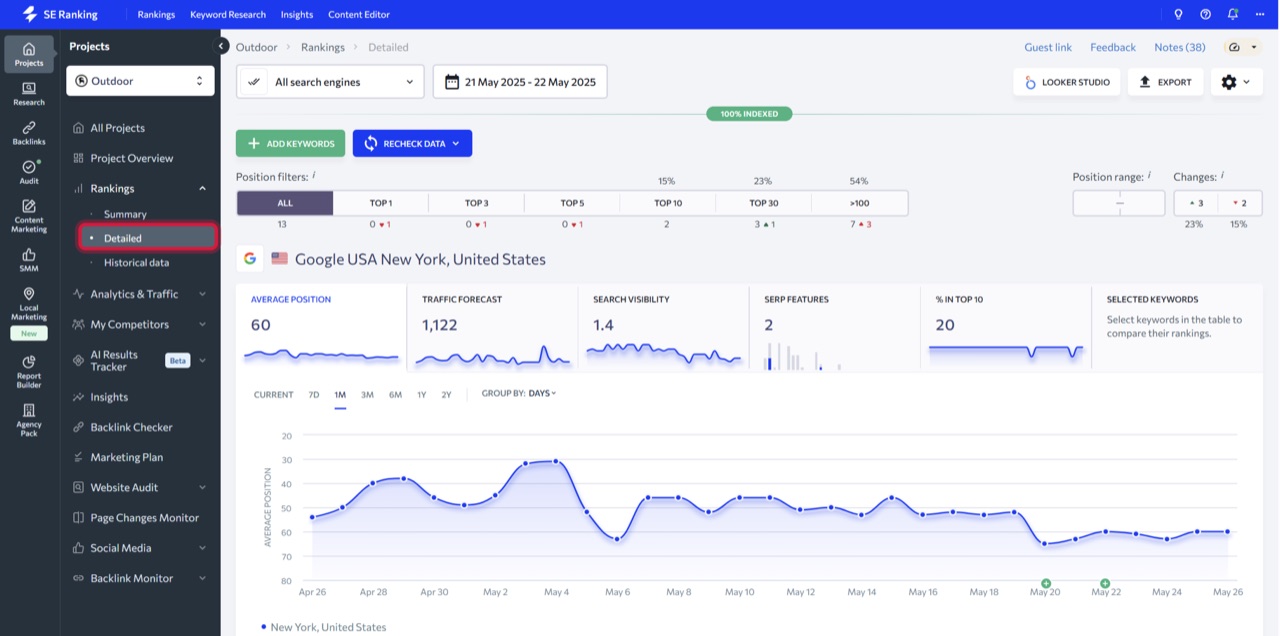
The SE Ranking rank tracker gives you a repeatable view of selected queries by engine, device, and location. For a business serving one city, those settings matter as much as the rank number. A result checked in downtown Bucharest is not necessarily comparable with the result your colleague sees in a different country.
Core advertises 2,000 daily tracked keywords, with 5,000 on Growth. Before you import a long keyword list, ask how your chosen engines, devices, and locations count toward the subscription. A campaign with separate desktop/mobile and local/national reporting can quickly become larger than the raw number of phrases suggests.
Local results are particularly sensitive to geography. A dental clinic competing in one neighborhood does not necessarily need an entire country in its weekly report. Set the city or area you care about and keep it consistent. Otherwise a perfectly valid rank-tracking report may seem to conflict with a live browser search.
🔎 Keyword Research & Competitor Analysis
Keyword Research: Intent Matters More Than a Giant List
The SE Ranking keyword research tool estimates volume, keyword difficulty, and related searches. That makes it useful for turning a broad theme into a shortlist of pages you could realistically produce. But a high search-volume number is not a strategy. Start with what the searcher wants and which page on your site could satisfy it better than the current results.
Take an imaginary niche SaaS business. “Project management software” looks attractive on paper, but the search results are dominated by established platforms. “Project management for restoration contractors” is narrower and could be much closer to the buyer’s problem. We would use the database to locate such opportunities, then inspect intent and business fit manually.
A practical SE Ranking review question is whether you can export and group useful long-tail terms without wasting time on irrelevant variations. Test that on your own niche during the trial. Vendor database coverage is not identical across every country or language.
Competitive Research: Spot the Gap, Then Verify It
Competitive Research estimates which queries and pages drive traffic to other domains. Use it to identify topics or customer questions you have ignored. Then inspect the actual ranking page. Is it a guide, comparison, category, or transactional page? Your own content should answer the same intent with greater clarity or genuinely different evidence.
Treat the competitor traffic chart as a hypothesis to investigate. SE Ranking can estimate traffic from search results and its keyword database; it cannot open another company’s Google Analytics account. If you brief a client, describe the competitor numbers as estimates and check the ranking pages for real evidence of what is working.
🧰 Website Audit: Finding Issues You Can Actually Fix
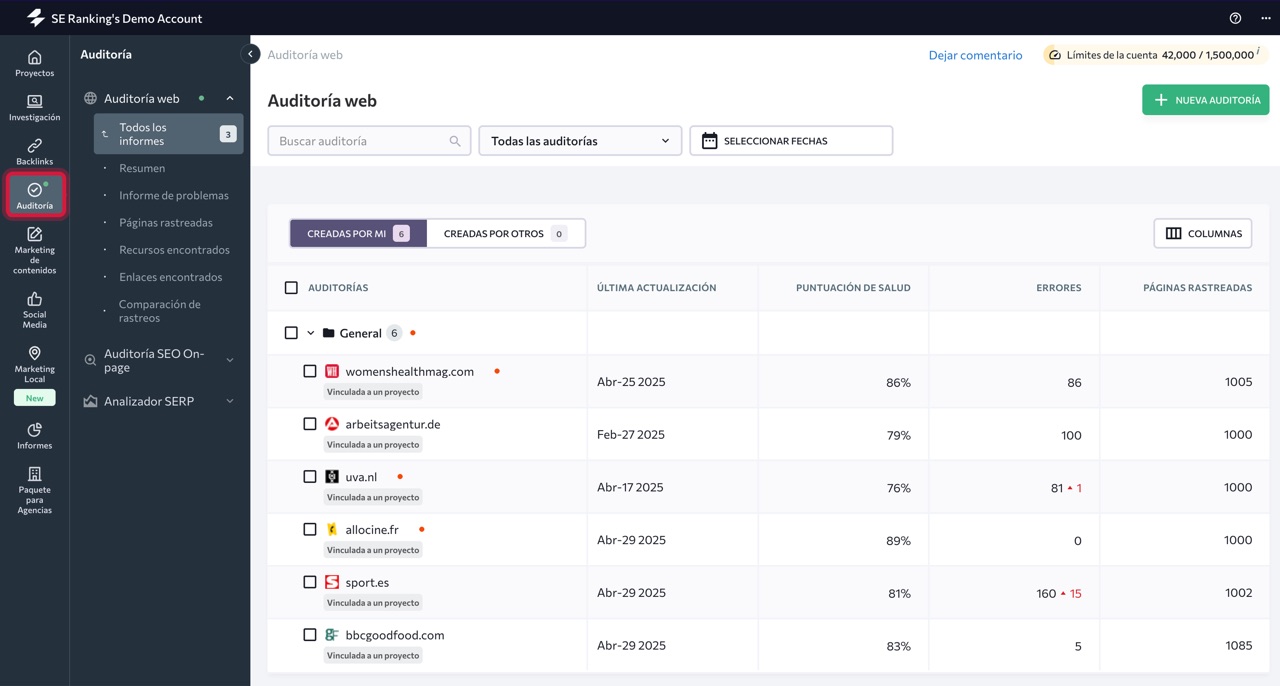
The SE Ranking website audit checks indexing signals, HTTP responses, redirects, metadata, technical configuration, and internal links. That is valuable for narrowing down technical problems, provided you treat the findings as leads to investigate rather than tasks that must all be closed.
The current Core allowance is up to 250,000 pages audited per month; Growth advertises up to 2 million. Those are account-level capacities, not a promise that every individual site needs that much scanning. Growth also increases the per-project crawl maximum.
Suppose a crawl returns 30 broken internal links and 200 similar title tags. The broken links are usually straightforward to investigate. The titles might reflect intentional page templates. That is why we would prioritize by business impact and crawl context, not simply work down the list of warnings.
If an audit stalls, the issue may be infrastructure rather than a bug in the product. The vendor documents situations in which a firewall or rate limiter blocks its crawler. Work with your host to allow legitimate crawling safely instead of disabling security indiscriminately.
🔗 SE Ranking Backlink Checker: Research & Link Gaps
The SE Ranking backlink checker lets you examine referring domains, anchors, and link-profile changes; monitoring helps surface links that appeared or disappeared. It is helpful for PR reviews and competitor research, but it cannot tell you that every link is desirable or that a lost backlink caused a ranking drop.
Do not confuse a third-party authority score with Google’s internal ranking calculation. Nor is every “toxic” link proof of a penalty. Examine the page, context, referring domain, and link history before requesting removals or creating a disavow file.
For competitor opportunities, the Backlink Gap view is a starting point. A rival may earn a link because it published original research or runs a genuinely useful resource. Look at why the link exists before copying the tactic. An original data study, a partnership, and a general directory listing call for very different responses.
✍️ Content Editor and On-Page SEO
SE Ranking’s Content Editor can assemble briefs from competitive search results, suggest relevant topics and keywords, and score drafts against on-page recommendations. That can help an editor spot missing context before publication. It cannot establish whether a writer has real experience or whether the article offers an original conclusion.
A content score is not Google’s ranking score. Over-optimizing for a plugin can leave you with repetitive headings and unnatural phrases. Use the brief as a checklist: search intent covered, evidence sourced, structure clear, and obvious questions answered.
The On-Page SEO Checker examines individual URLs, allowing you to look at a specific page against a specific target query rather than a whole-site average. This is a sensible complement to Site Audit when you want to work on an important product, service, or comparison page.
🤖 SE Ranking AI Search & GEO: What Is Included?
This is where 2026 SE Ranking pricing becomes more nuanced. Its Core and Growth plan tables now advertise daily AI prompt tracking — 100 on Core and 250 on Growth — alongside search rank tracking. They also define limits on the number of domains for GEO research.
What counts as one AI Search check?
The AI Search add-on uses a separate accounting unit: one prompt checked on one AI platform is one check. Tracking the same prompt across five engines therefore consumes five checks, according to the vendor’s AI Search documentation. That distinction is easy to miss if you compare “100 daily prompts” with an add-on sold in monthly checks. They are different allowances, so confirm the exact product before buying.
SE Ranking also markets SE Visible for brand-level AI visibility; its AI Search add-on documentation says the add-on includes access to SE Visible. Check the current package and limits rather than assuming that every Core or Growth subscription includes the same SE Visible access. The broader reports can cover brand mentions, sources, citations, and share of voice across systems such as ChatGPT, AI Overviews, and Perplexity. Do not assume that a reference to “AI” in the basic plan includes every dashboard, engine, or history feature.
The important workflow question is whether AI appearances correlate with your business goals. A brand mention without a helpful citation or qualified visitors is not automatically more valuable than a strong traditional search landing page. When testing GEO features, identify which prompts actually represent potential customers.
Also separate the terms SEO, GEO, and AEO. They overlap, but no single number captures search ranking, answer-engine visibility, and sales outcomes. Use these tools as different lenses on the same customer journey rather than proof that one platform can guarantee AI recommendations.
📊 SE Ranking for Agencies: Reporting & Integrations
SE Ranking integrates with Google Search Console, Google Analytics 4, and reporting products including Looker Studio. Project reporting can combine tracked positions, audits, and backlink trends for repeatable check-ins. An agency may care as much about access control and exports as it does about another keyword metric.
The Agency Pack is an important pricing footnote. SE Ranking lists white labeling, client-facing tools, report scheduling, and a lead-generation widget as a separately paid add-on. The vendor currently advertises a starting price of $69 per month equivalent, billed annually. Do not quote a base-plan subscription as if it automatically includes white-label delivery.
API and MCP access also require reading the usage allowances. Core advertises 25,000 API credits and Growth 100,000; high-volume external automation may require extra credits or a separate API arrangement. Included access is not the same as unlimited data exports.
💰 SE Ranking Core vs Growth: 2026 Pricing & Limits
The current SE Ranking pricing page shows Core, Growth, and Enterprise. Articles that still present Essential, Pro, or Business as the only current plans may be describing legacy subscriptions. Here is what the vendor advertised on 10 October 2026; confirm currency and checkout details for your location.
| Plan | US monthly / annual equivalent | Published core limits | Who it suits |
|---|---|---|---|
| Core | $129 monthly / $103.20 per month when billed annually | 10 projects; 1 manager; 2,000 rank keywords + 100 AI prompts daily; 250k audit pages/month; 25k API credits | A single SEO manager overseeing a portfolio |
| Growth | $279 monthly / $223.20 per month when billed annually | 30 projects; 3 managers; 5,000 rank keywords + 250 AI prompts daily; 2M audit pages/month; 100k API credits | Agencies and growing in-house SEO departments |
| Enterprise | Custom quote | Negotiated project, user, integration, and data limits | Larger teams with complex governance and capacity needs |
Important billing distinction: $103.20 is not a one-month purchase option for Core. It is the monthly equivalent of an annual subscription. If prices remain at the published rate, the base annual Core commitment is $1,238.40 before taxes and extras, compared with $129 paid for a single month on monthly billing.
Growth works out to $2,678.40 for twelve months at the listed annual rate, before taxes. Those are arithmetic illustrations rather than guaranteed renewal quotes. The actual contract, introductory offers, and exchange rate should always be checked at purchase.
⚠️ SE Ranking Add-On Costs You Should Budget
The subscription headline is only one line in the budget. The Agency Pack, additional tracked keywords, and specialized AI Search can change what you pay. If you require branded client reports, for example, Core alone may not deliver the complete experience you expected.
An illustration using the published US pricing: Core’s annual equivalent is $103.20 per month, and Agency Pack starts at $69 per month equivalent with annual billing. Together that is at least $172.20 per month equivalent before taxes and other extras. Do not confuse that with an offer to pay $172.20 for a single month.
Your own cost depends on how many websites you manage, how many managers need access, which markets you monitor, and how often you produce reports. Calculate the complete stack before buying. Review SE Ranking’s live plan and add-on comparison.
⚖️ SE Ranking vs Semrush vs Ahrefs: Pricing & SEO Workflows
Semrush, Ahrefs, and SE Ranking all address overlapping SEO work. We would not award an overall winner from a feature checklist. The practical comparison is whether you can complete the same research and reporting tasks, within your project and user limits, at an acceptable total cost.
| Buying criterion | SE Ranking | Semrush | Ahrefs |
|---|---|---|---|
| Primary appeal | Integrated daily rank tracking, site audits, competitors, reporting, and GEO options | Broad digital-marketing workflow with SEO and paid-market research | SEO-focused research and link analysis workflows |
| What to verify | How tracked keywords, projects, agency tools, and AI prompts count | Which toolkits and user seats are included in the quoted plan | Update cadence, project allowances, crawling credits, and API access |
| Agency concern | White-label work may need the paid Agency Pack | Reporting/export and collaborator permissions vary by package | Team access, reports, and tracked update limits vary by plan |
| Who should trial first | Teams needing daily tracking and coordinated SEO delivery | Teams combining many marketing channels | Teams prioritizing deep competitor and link investigation |
SE Ranking may look cheaper or more generous for a given campaign, but only a like-for-like comparison of projects, tracked queries, locations, users, crawl allowances, and add-ons is fair. A rank-tracking quota and an API-credit quota are different units; do not compare the numbers directly.
Switching has a cost too. If your team already knows another suite, migrating projects and rebuilding reports may erase several months of subscription savings. Trial the new workflow before canceling the old one, and avoid paying indefinitely for two dashboards that answer the same questions.
🎯 Who Should Buy SE Ranking — and Who Should Skip It?
Small SEO agencies: Core can suit a single manager with several client projects, while Growth offers more projects and team seats. Agencies that must deliver branded portals should price the Agency Pack before promising that feature to a customer.
In-house marketers: A company managing multiple brands, regions, or sites may benefit from combining technical findings, positions, competitor opportunities, and executive reporting. Assign one owner to interpret the numbers; automation alone will not prioritize the work.
Consultants and freelancers: The trial is useful for assessing whether the suite replaces a collection of paid tools. But a consultant with only a few small accounts may find $129 monthly excessive, especially if they already use Search Console and another crawler. For focused keyword discovery, SERP research and simpler rank monitoring, compare our Mangools review before committing to the wider suite.
Who should probably skip it: A blogger checking a dozen keywords, a business with no capacity to fix technical issues, or a team expecting guaranteed backlinks or ranking improvements. Start with free first-party tools and a clear SEO action plan.
🔐 Data Reliability, Privacy & Practical Limitations
SE Ranking’s competitor traffic and keyword difficulty scores are third-party estimates; the vendor’s databases are substantial, but they are not identical to the private reporting that websites see in GA4 or Search Console. Keep your own business outcomes anchored in first-party data.
For access and privacy, review user permissions, project separation, vendor terms, and the integrations you connect. Client data can be commercially sensitive. If you rely on API exports or third-party automations, establish who can access those records and how credentials are stored.
An SEO platform is also limited by what Google exposes. Rankings can vary between checks and user locations. The vendor’s help center recommends comparing a tracked position against the same search engine, location, device, and live result context instead of assuming your personal browser is the benchmark.
🧪 How Alex Wright Tested and Researched SE Ranking
Alex Wright personally evaluated SE Ranking before this review was published, with particular attention to how its features fit an SEO practitioner’s routine. We separately verified the pricing table, free-trial conditions, Agency Pack and API details, and documentation for Rank Tracker and Website Audit on 10 October 2026. Vendor help-center illustrations are identified as such; they are not screenshots from our hands-on session.
What our testing does and does not establish: Alex’s hands-on assessment informs the practical workflow discussion, but this article does not claim a controlled measurement of regional rank accuracy, backlink index completeness, website crawl duration, or a head-to-head benchmark against Semrush and Ahrefs. Those figures would require comparable test datasets. Our evaluation distinguishes real product use from vendor-published specifications and unmeasured performance claims.
Primary sources: pricing and included limits; feature overview; platform overview; Website Audit documentation; rank-tracker help; and Agency Pack terms.
🏆 Final Verdict: Is SE Ranking Worth the Money in 2026?
SE Ranking looks like a sensible working suite, not a shortcut to better rankings. Core offers meaningful capacity for an individual managing several campaigns; Growth gives larger teams more room. The best reason to subscribe is that the dashboards help your team find and fix problems sooner.
The cost can be deceptive if you compare an annual-billing equivalent with a competitor’s month-to-month plan, or discover after checkout that your agency requires a paid add-on. Work out the full yearly commitment — and what your current tools already do — before committing.
Our recommendation is to trial one site, a realistic group of keywords, one crawl, one competitor research task, and one report you could actually send to a client. Keep notes on which insights changed your work. If all you gain is another dashboard to check, skip the upgrade.

Frequently Asked Questions
Is SE Ranking worth it in 2026?
SE Ranking can be worthwhile for teams that need ongoing rank tracking, technical audits, competitor research, and reporting together. Its current Core subscription is a substantial recurring cost, so start with the 14-day trial and confirm you use enough of the suite to justify it.
How much does SE Ranking cost in 2026?
The vendor lists Core at $129 monthly or $103.20 per month equivalent with annual billing; Growth at $279 monthly or $223.20 annual equivalent; Enterprise is custom-priced. Regional currency, taxes, and add-ons may change the final amount.
Is there a free SE Ranking plan or free trial?
SE Ranking offers a 14-day free trial without requiring a credit card on the official signup page. That is not the same as a permanent free plan. Confirm what happens at the end of the trial before subscribing.
What is included in SE Ranking Core?
The current Core plan advertises 10 projects, one manager seat, up to 2,000 keywords and 100 AI prompts tracked daily, 250,000 site audit pages monthly, plus 25,000 API credits. Exact usage rules and add-ons are shown on the official plan table.
What is the difference between SE Ranking Core and Growth?
Growth raises core capacity to 30 projects, three manager seats, 5,000 keywords and 250 AI prompts daily, up to 2 million audit pages per month, and 100,000 API credits. It also adds collaboration and monitoring features. Compare against your workload rather than selecting a tier from price alone.
Does SE Ranking include AI search visibility tracking?
Core and Growth include defined daily AI prompt-tracking limits. The paid AI Search add-on extends those limits and, according to its current documentation, includes access to SE Visible. Check the separate check-based allowances, supported platforms, and current subscription terms before buying.
Is SE Ranking better than Semrush or Ahrefs?
That depends on your priority. SE Ranking emphasizes coordinated tracking, audits, SEO and GEO workflows, and reporting. Semrush covers a broad marketing stack; Ahrefs is widely used for search and link research. Match the same project, keyword, seat, and usage limits and trial the workflow; we have not run a controlled accuracy benchmark.
Is SE Ranking good for small agencies?
It can be. Core supports a portfolio managed by one person; Growth adds capacity and seats. But white-label features are sold through an additional Agency Pack, so agencies should quote the full combined subscription when budgeting client delivery.
🔍 Keep Going: From SEO Findings to Finished Work
SE Ranking can show which keywords moved, which pages need attention, and where competitors are gaining ground. The next step is turning those findings into something useful. Here are related DigiOffly reviews grouped by the job they help you finish—not simply by software category.
Detailed head-to-head: Read our SE Ranking vs Mangools comparison for side-by-side prices, tracking limits, technical audits and a practical buying verdict.
1. Turn keyword research into useful content
- Jasper AI review — Consider an AI writing workflow for marketing teams once your keyword research and page intent are clear.
- Writesonic review — Compare another option for drafting articles and refining content briefs; check every factual claim before publishing.
- Copy.ai review — Explore marketing copy and workflow tools for repurposing approved research into campaign materials.
2. Assign the fixes and prepare the deliverables
- ClickUp review — Track audit fixes, assign owners, and keep a record of what changed on each important page.
- Notion review — Organize keyword maps, editorial briefs, SOPs, and client notes in one reference workspace.
- Canva review — Prepare clear diagrams, page visuals, and presentation assets to support the content you publish.
3. Compare tools before adding another subscription
- Growth & Marketing Software Comparisons — Browse other tools for marketing operations and growth workflows.
- AI & Tech Software Reviews — Compare AI, productivity, and content tools without confusing them with the SEO platform itself.
- Surfer SEO review — Compare a dedicated Content Editor and AI visibility tracker with SE Ranking’s wider rank-tracking and audit toolkit.
Want to know how Alex Wright combines practical testing with source checks? Read our software review methodology to see how we separate first-hand observations, current vendor documentation, and claims that need controlled benchmarks.