

Mangools — 2026 pricing and specifications: Pricing and plan terms checked against the vendor's public site on 10 October 2026. Figures are in US dollars where shown, and plans, limits, availability, taxes, billing periods and regional terms can change. Always verify on the official checkout page. Check the vendor’s latest plan terms.
You can lose half a morning comparing keyword difficulty scores without learning whether anyone will buy from the page you plan to write. Mangools is interesting because it makes that first research pass less intimidating. It combines KWFinder, SERPChecker, SERPWatcher, LinkMiner and SiteProfiler in a lightweight suite. The trade-off is that allowances, rank-update frequency and research depth are not the same as enterprise SEO monitoring.
In this Mangools review, Alex Wright examines where Mangools fits into a real team workflow, what published plan limits mean in practice, and when an alternative is the smarter purchase. This is a source-led editorial evaluation, not a claim that DigiOffly conducted a controlled live-account benchmark.
📊 Mangools Review Summary
| Question | DigiOffly editorial finding |
|---|---|
| Best fit | Keyword Research & SEO teams; suitability discussed below |
| Main buying criterion | Budget one representative keyword research & seo workflow before upgrading |
| Current official plans | Basic; Premium; Agency |
| Biggest caution | Check Basic limits, subscription terms and integration requirements |
⚡ Quick Verdict: Should You Buy Mangools?
Choose Mangools when the team values straightforward keyword discovery and occasional SERP analysis over complex audit workflows. Do not mistake a simple interface for unlimited data: a freelancer preparing many client campaigns will notice per-day request limits.
👍 What We Love
- ✅ Clear Keyword Discovery: KWFinder helps shortlist relevant queries without a heavy enterprise interface.
- ✅ SERP Context: SERPChecker gives a closer look at competing pages before committing to a topic.
- ✅ Practical Rank Monitoring: SERPWatcher keeps an agreed keyword group visible between content updates.
- ✅ Useful Adjacent Tools: LinkMiner and SiteProfiler support competitor and backlink reconnaissance.
👎 Where It Falls Short
- ❌ Plan Limits Matter: Search allowances and tracked-keyword quotas can constrain larger client workloads.
- ❌ Not an Enterprise Audit Suite: Do not assume full technical crawling or expansive client reporting are built in.
- ❌ Metrics Need Interpretation: Difficulty scores, backlink figures, and AI mentions cannot prove conversions or revenue.
🏆 EDITORIAL VERDICT: STRONG FOR KEYWORD RESEARCH

Best For: Solo SEO consultants, local businesses, niche content teams and small agencies with focused research needs.
🧠 What Is Mangools — and What Does It Actually Solve?
Mangools combines several compact SEO research interfaces in a single subscription. Users move between keyword discovery, result inspection, tracking, link research and domain overviews instead of working in a larger integrated audit environment. This is useful for small budgets but requires discipline about daily requests and the rank-tracking cadence. Local search conditions can shift the apparent attractiveness of a keyword, so regional SERP verification should remain a manual step.
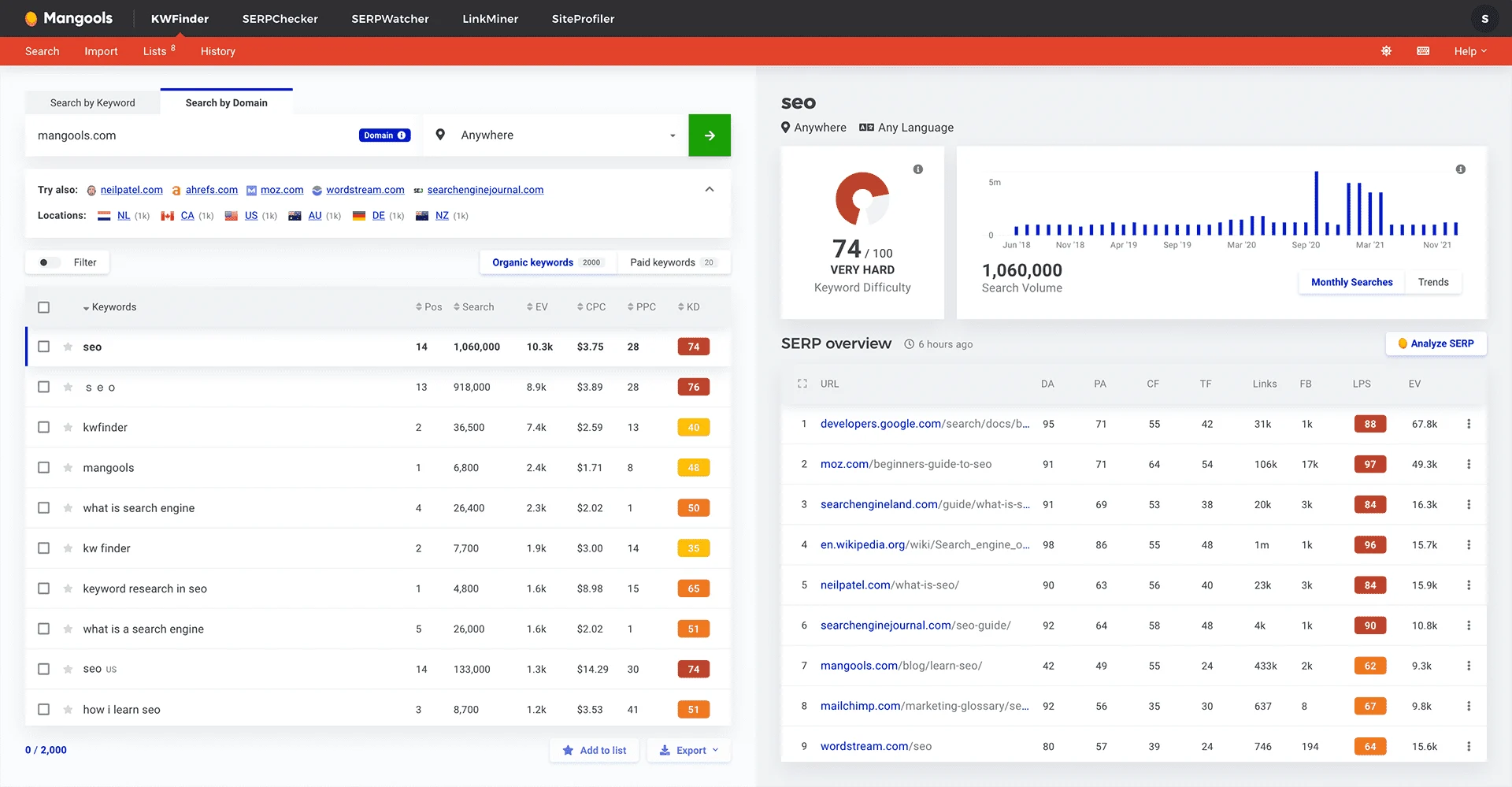
Official Mangools product interface from mangools.com. Vendor-provided screenshot, not an independently recorded DigiOffly account test.
🛠️ Mangools Features: The Details Behind the Headline
KWFinder for practical keyword discovery
Search by topic or domain to identify candidate queries, then annotate each with intended landing-page type and business value. A difficulty metric is a starting filter, not a substitute for opening live results and checking intent. Repeat this process separately for regional markets.
SERPChecker and SERPWatcher
Use SERPChecker to inspect competing results and SERPWatcher to observe a chosen keyword set. The current Mangools site describes weekly rank updates on Basic and Premium, with daily updates reserved for Agency; that difference may matter far more than the subscription price.
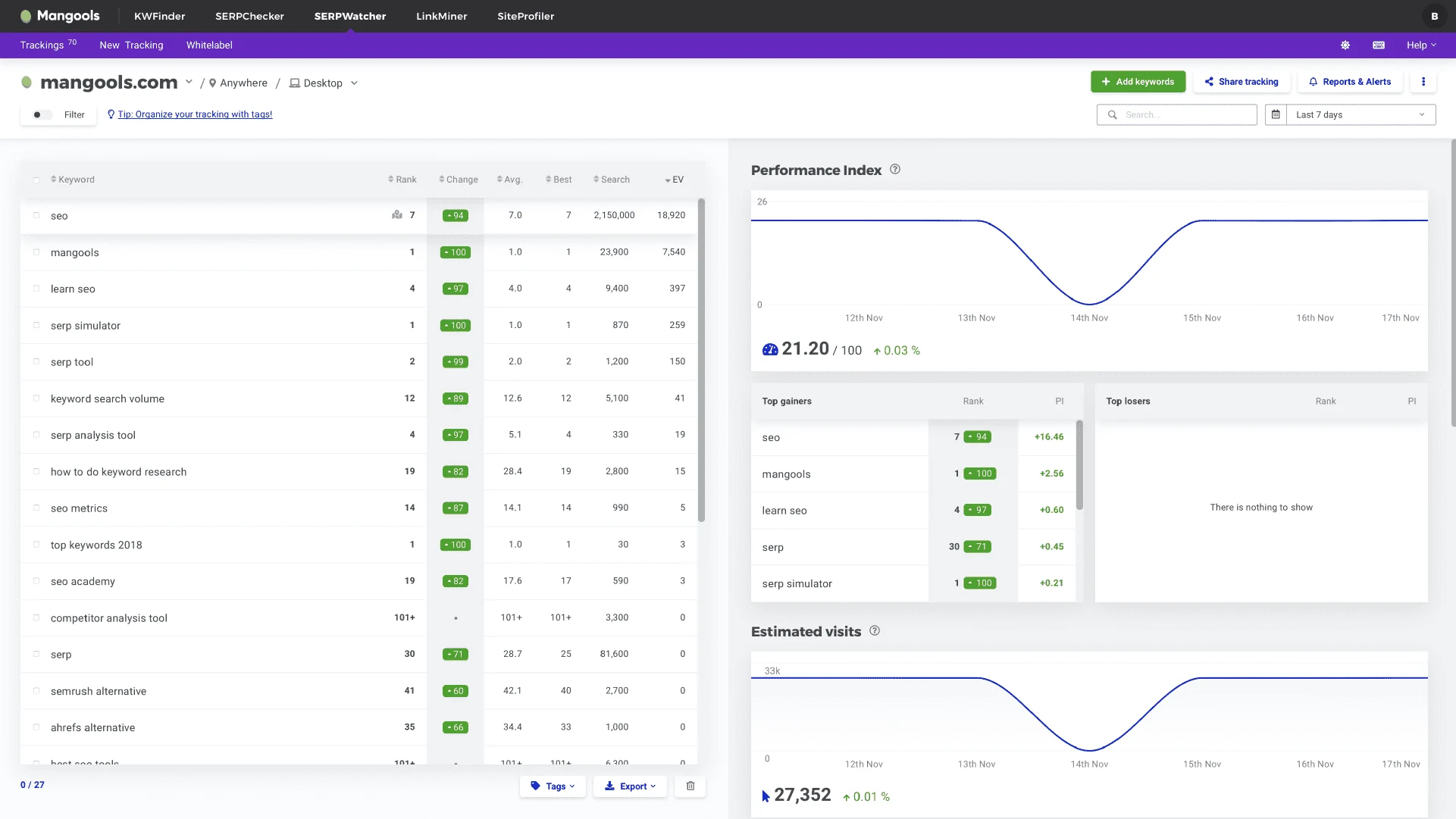
Official Mangools product interface from mangools.com. Vendor-provided screenshot, not an independently recorded DigiOffly account test.
LinkMiner and SiteProfiler
Backlink and site-profile views help with competitive reconnaissance. They do not prove a backlink is editorially desirable or safe to pursue. Use source quality, topical context and relevance when deciding whether a competitor's link opportunity is actually valuable.
AI Search Watcher in the bundle
Mangools now advertises AI Search Watcher with monitored prompts in its plans. Treat AI prompt appearances as a separate discovery channel, not a substitute for organic click reporting. Check which LLMs and monitoring frequencies your actual package includes.
🧭 How to Evaluate Mangools Before Paying
- Select five high-intent queries from one real service category.
- Compare keyword suggestions to the actual Google results in the target country.
- Track a small portfolio and record whether weekly updates are sufficient.
- Check how often the team exhausts daily searches before upgrading.
🔎 Mangools vs. Full-Service SEO Platforms
Mangools is designed for focused research, not for replacing every SEO task. KWFinder and SERPChecker are useful when a small team needs to make a defensible content choice quickly.
SE Ranking can be a better option when frequent technical audits, client reporting and wider project monitoring drive the workflow. Mangools may be simpler when the team primarily researches keywords, SERPs and rankings.
Use one real website and one consistent market when comparing software. Count research and tracking limits, the need for exports and the human work required to turn estimates into a useful page.
💰 Mangools Pricing in 2026: What You Really Pay
| Plan | Advertised starting price / term | Published fit or allowance |
|---|---|---|
| Basic | $37.70/month equivalent on annual billing | 100 keyword requests per 24 hours; 200 tracked keywords |
| Premium | $52.70/month equivalent on annual billing | 500 keyword requests per 24 hours; 700 tracked keywords |
| Agency | $97.70/month equivalent on annual billing | 1,200 keyword requests per 24 hours; 1,500 tracked keywords |
🔬 The Procurement Question Most Teams Miss
For location-based businesses, the research project needs a geographic boundary before it needs a keyword score. A London agency checking US search results might build a convincing but irrelevant list. Capture the target country, preferred device and service area alongside each export. Also investigate update cadence on a real Monday-to-Friday reporting cycle: weekly tracking is fine for broad trend reviews, but inadequate for a team promising clients a daily position report. The right subscription depends on that reporting commitment. One useful procurement exercise is to assign each search request to a client and discover which accounts consume the quota.
⚠️ Hidden Costs and Practical Limits
The site publishes resource quotas that vary by subscription. A team with many client domains must count keyword checks, simultaneous users and daily update needs rather than comparing one monthly headline. Unlimited domains for rank tracking does not imply unlimited tracked keywords.
Put one month's typical campaign work into a spreadsheet before buying: how many queries will you inspect each day, how many keywords need tracking, and how many people must log in? Test those numbers against published plan limits, then reserve time to verify search intent manually.
🧮 A Realistic Buying Scenario
Imagine a specialist building a resource page for bookkeeping firms in three regions. KWFinder can surface local variations and suggest keyword themes. SERPChecker then forces the useful question: do the current winners answer a different intent? A keyword with modest volume but high relevance may beat a larger phrase whose first page is full of job listings instead of buying guides.
🎯 Who Should Use Mangools?
Best for solo consultants, niche-site editors and small SEO teams that need accessible keyword research. Less suitable for agencies requiring broad technical crawling, deep automation or daily rank updates on lower tiers.
⚖️ Mangools Alternatives and Trade-offs
See SE Ranking for a more integrated auditing and reporting environment. Our Growth tools directory explains adjacent software categories; Notion can hold a vetted keyword map.
🔐 Reliability, Privacy and Verification
🧪 How Alex Wright Researched This Mangools Review
Alex Wright’s DigiOffly editorial assessment uses the official vendor pricing and product information, published feature descriptions and the workflow and cost considerations set out above. We distinguish those public facts from our own recommendations. We did not have a controlled end-to-end customer-account benchmark for this draft; any future hands-on findings must be added and labelled separately.
🧭 The Real Buying Decision and Workflow
Choose Search Intent Before a Difficulty Score
A surprising number of SEO subscriptions begin with the wrong question: Which tool has the nicest keyword dashboard? The useful question is which search problem the team has not solved. Imagine a freelance consultant preparing landing pages for a heating-repair business in three Romanian cities. Search Console shows impressions, but the site owner cannot tell whether potential customers are searching for emergency repairs, parts or DIY instructions. KWFinder can help split those audiences into candidate queries before anyone writes another page. Compare a few phrases at the correct location, open their actual results and note whether a service page, guide or map listing appears. Only then would I use keyword difficulty to prioritize. A high-volume term that attracts students researching a trade may be worse than a modestly searched emergency-service phrase. Mangools makes research approachable; it does not know the client’s margin or whether a technician will pick up the phone. Those judgments belong in the brief, not in a colored metric.
Test Mangools With Six Clients and Real Tracking Limits
Give Mangools one small but awkward assignment before considering a year of billing. A local agency handles six clients, each with about 80 phrases worth following. That is 480 keyword targets before location and device variations; this is a planning scenario, not a DigiOffly account benchmark. Ask the researcher to identify twenty promising new keywords for one client, check ten difficult SERPs and place the agreed terms into a rank-monitoring list. Record how long each handoff takes and which results still require opening Google Search Console. The plan cap matters: Basic advertises 200 tracked keywords and Premium 700. If the agency needs to track mobile and desktop or multiple cities separately, the list will consume additional capacity. Weekly updates on the two smaller plans also affect how quickly a ranking problem can be investigated. A pilot that ignores those details may appear cheap and become a reporting headache a month later. Try a representative slice of the workload, not a polished example chosen by the vendor.
From KWFinder Research to an Approved Content Brief
Keyword tools do not decide which page gets built. A researcher may find a question with appealing volume, an account lead may see poor commercial fit, and the client may reject the topic because it duplicates an existing service page. That disagreement is healthy when it happens before production. I would have the researcher attach the KWFinder result, current SERP examples, location and an intended search intent to one shared brief. The account lead records the commercial reason to pursue or reject it. A writer receives the approved angle, not an unfiltered spreadsheet of terms. After publication, the person responsible for Search Console checks impressions and clicks; SERPWatcher supplies rank movement, not proof of conversions. For a small team this can be a simple Notion table rather than another automated stack. Mangools should make the research phase faster. It should not become a place where decisions disappear because only the person who ran the keyword lookup understands the numbers.
🔬 Feature-by-Feature Evaluation Without Guesswork
KWFinder Keyword Research: Finding Real Opportunities
KWFinder is probably the first Mangools screen most buyers should evaluate. Enter a service phrase, select the country or city that actually matters and examine the suggestions. The trap is to choose the greenest-looking difficulty score without reading the search results. For example, a broad search for ‘boiler service’ can mix local technicians, product manuals and companies that sell equipment. A lower-volume variation mentioning a city or urgent repair may be commercially clearer. Save a shortlist with the intended landing-page format beside each term. Then check Search Console to see whether an existing page already earns impressions for similar language. If so, improving that page may be cheaper than publishing a competing one. KWFinder’s monthly volume and difficulty estimates are useful directional data, not measurements of what any particular site will earn. A good Mangools review should explain that distinction because it can save a small business far more than choosing between two similarly priced plans.
SERPChecker vs SERPWatcher: Analysis and Rank Tracking
SERPChecker and SERPWatcher solve related but different problems. SERPChecker is the closer inspection: who occupies the results page now, what kinds of pages are showing, and does a smaller site have a believable route into that competition? SERPWatcher is the calendar: did a chosen phrase move after the page went live? Mixing the two creates bad reports. Suppose an agency updates a service page on Tuesday and checks rankings on Friday. If it uses Mangools Basic or Premium, the published schedule is weekly, so Friday’s displayed position might not reflect the change yet. Agency currently advertises daily updates. Before committing to a plan, list how quickly clients genuinely expect ranking information and whether the company needs daily investigation or simply monthly progress reviews. Also record search engine, location and device next to the position. ‘Moved from 9 to 6’ has little meaning when the two reports refer to different markets.
LinkMiner and SiteProfiler: What Backlink Metrics Miss
LinkMiner can show backlinks found for another website; SiteProfiler gives a compact view of a domain. Neither turns competitor links into endorsements of a new campaign. I would open a handful of referring pages, not just sort by a proprietary strength number. Is the page an industry association that cited a useful guide? A supplier’s customer directory? A promotional link on a generic coupon domain? Those are very different opportunities. For the repair-business example, a genuine mention by a local building-trades organization may be more helpful than fifty unrelated directories. Also check the age and context of a link before suggesting the client pursue a similar mention. Data coverage varies among third-party link indexes, and absence from Mangools does not prove absence from the web. If backlink research is only an occasional task, its place in the bundle may be useful; if the team runs exhaustive link audits every week, compare the depth and exports with a specialist platform before upgrading.
AI Search Watcher: Prompts Are Not Organic Traffic
The AI Search Watcher addition makes the Mangools bundle more interesting in 2026, but its numbers belong on a separate page of the report. Mangools advertises monitoring of prompts and appearances in AI-generated answers. That is not the same unit as a keyword’s position in Google’s traditional results, and it certainly is not an organic click. A brand might appear in an answer this morning and disappear after a wording change tomorrow. Select a stable group of prompts, note the model and country if offered, and record dated examples rather than promising a permanent visibility score. Compare those observations with search demand, actual mentions and leads reported by the business. If a plan includes 500 monitored prompts, the next question is what counts as a check and which models receive it, not whether ‘500’ is a large enough marketing number. I would treat AI Search Watcher as exploratory research until a business can connect the observations to an outcome.
💵 Plan Economics and Subscription Boundaries
Mangools Basic Pricing: Low Entry Cost, Real Limits
Mangools Basic currently advertises $37.70 per month as an annual-billing equivalent, or $452.40 charged for the year; the month-to-month price shown for US visitors is $61. The real constraint is not the headline price. Basic includes 100 keyword research requests per 24 hours and 200 tracked keyword slots, with weekly ranking updates. That is plenty for one consultant preparing a handful of carefully planned articles. It is not necessarily 200 distinct phrases when the consultant wants to monitor different devices and towns separately. A solo operator could spend more time cleaning the keyword list than the subscription saves if every client insists on numerous local variations. Before buying, count the exact keyword/location/device combinations and the expected research days. A permanent free account is useful for getting oriented, but do not assume its quotas support ongoing client reporting. Prices, billing currencies and access details can change by region, so verify the current Mangools pricing table yourself.
Mangools Premium Pricing: More Research, Still Weekly Ranks
Premium makes sense when research volume or teamwork, rather than the promise of better rankings, becomes the bottleneck. The vendor lists $52.70 per month equivalent when paid annually ($632.40 for a year), compared with $81 on monthly billing for US pricing. It expands daily keyword research requests to 500 and tracked keywords to 700. Mangools also describes up to three additional seats. Notice what does not improve: SERPWatcher rank updates remain weekly. A marketing agency could need Premium because several people share research duties, yet still be unhappy if its service agreement demands a fresh position every day. This is why I would write out the actual reason for upgrading: more researchers working at once, more tracked location variants, or a larger volume of keyword lookups. If the need is daily ranks, Premium alone does not fix it. Compare the annual invoice with how many months the client will reliably pay for reporting before committing.
Mangools Agency Pricing: When Daily Rank Tracking Matters
Agency is where the SERPWatcher refresh schedule changes. Mangools currently lists 1,500 tracked keyword slots, 1,200 keyword requests per day and daily rank updates on that plan. The US annual-billing equivalent is $97.70 per month ($1,172.40 a year), compared with a $141 monthly rate. That may sound surprisingly close to a dedicated rank tracker, but the bundle still includes KWFinder and the other Mangools tools. The right test is whether the team actively uses them. An agency with weekly client review calls may find daily rank data unnecessary; a team diagnosing site changes day by day might need it. Look closely at the number of tracked keyword variants after accounting for location and device, not simply the number of spreadsheet rows. Agency permits additional teammates too, but confirm the terms before rolling it out across departments. A larger package does not automatically buy broader keyword accuracy, and a smooth price-per-slot calculation does not account for research quality.
The Hidden Cost of a Bad Keyword Brief
Most small teams do not lose money because a keyword lookup took twenty seconds too long. They lose it when a topic is approved without checking the SERP, or when two writers publish pages aimed at the same query. Mangools reduces the effort of finding candidate terms; someone still has to decide which existing page should own the intent. Imagine an agency preparing ten new articles for an accounting client. The first researcher groups keywords in KWFinder, but the content editor notices that four suggested pages overlap. That correction should happen before briefs are assigned. Establish a simple workflow: research, SERP inspection, Search Console check, approval, production and outcome review. Keep the keyword map outside the tool in a place the writer can access. Budget for the hours spent on that work, not merely the subscription. A cheaper plan used consistently can outperform an expensive one whose charts are never tied to publishing decisions.
🔐 Risk, Data Quality, and Evidence
Client Research, Seats and Data Responsibility
Keyword lists may look harmless next to customer databases, yet agency research often contains client strategy. A shared project can reveal target locations, upcoming launches, competitors under investigation and pages a company plans to build. Before giving every freelancer access to a Mangools subscription, determine which collaborators need a seat and whether they should also receive exports and client files. The vendor currently places additional-seat allowances on higher plans; that does not replace an internal confidentiality policy. Keep approved keyword briefs and decisions in the client’s controlled workspace, not solely in a personal tool login. If a contractor leaves, the agency should be able to continue a campaign without losing the context for why terms were chosen. For analytics, prefer the company’s own Search Console and GA4 accounts as sources for actual impressions, clicks and conversions. Mangools numbers remain useful research estimates. The distinction matters when clients ask whether a traffic projection became a measurable result.
Test One Misleading Keyword Before You Subscribe
A strong Mangools trial should contain one deliberately misleading keyword. Try a phrase that looks easy in KWFinder but whose first ten results answer a question completely different from the service the client sells. Give a junior researcher the keyword list, the target city and a proposed landing-page angle. Can they catch the mismatch in SERPChecker before recommending a new page? Now change the city. Does the intent or result composition change enough to invalidate the earlier recommendation? Repeat the exercise with a phrase that already sends clicks to an existing client page according to Search Console. Building a second page could cause unnecessary competition between the client’s own URLs. There is no need to purchase extra reporting software to run this check. What matters is that the workflow flags uncertainty instead of converting an estimated difficulty number into an unquestioned content brief. If the team passes the test, the suite may be improving judgment rather than merely speeding up collection.
⚖️ Alternatives and Buyer Scenarios
Mangools vs SE Ranking vs Surfer SEO
Comparing Mangools, SE Ranking and Surfer SEO as though they are three interchangeable keyword databases misses the reason most people subscribe. Mangools is a compact research workflow: find phrases, inspect results, watch positions and investigate some links. SE Ranking is a broader option when website audits, client reporting and recurring project management become central. Surfer SEO puts more emphasis on content editing and on-page recommendations after a topic has been chosen. A solo blogger preparing two service articles a month may value Mangools’ simpler interface. An agency running weekly technical audits across multiple domains might prefer the breadth of SE Ranking. A publishing team already comfortable with keyword research could consider Surfer for editorial execution instead. Run the same business scenario through each product and compare outputs the team can act on. Do not assign a universal winner or claim any one vendor guarantees a ranking improvement. The buying decision is about the work left undone by the current process.
How Agencies Should Share Keyword Research
The first Mangools rollout question for an agency is not ‘How many people can sign in?’ It is ‘How will we keep keyword maps from contradicting one another?’ Imagine an account manager promises a customer new landing pages for five locations. One SEO specialist researches desktop terms, another mobile, and a writer receives an export without either location field. The resulting brief can be misleading even if every keyword number was transcribed correctly. Agree on a naming convention for client, market, device, topic cluster and target URL. Share the working brief through the agency’s normal project system. Then set one person to approve searches before they become assignments. Premium and Agency have additional-seat allowances, but a seat does not resolve ownership or reporting cadence. Start the rollout with two clients and one reusable template, not every historical keyword at once. A tool with five interfaces is much easier to adopt when the team already knows what each interface contributes.
A Practical 30-Day Mangools Evaluation
Week one should answer a simple question: do Mangools suggestions help us select more appropriate topics than our current method? Prepare a shortlist, open the live SERPs and compare a handful of terms against Search Console data. Week two tests the handoff to a writer and the quality of the resulting brief, not the writer’s speed alone. In week three, set up SERPWatcher and explain the plan’s update frequency to whoever receives the report. Do not promise that a ranking change will be measurable every day on a weekly-update tier. Week four is for costs and exceptions: count keyword requests, tracked device/location combinations, exports the client actually uses and any work still done elsewhere. Review the results with the people who will pay for and operate the subscription. Thirty days cannot establish that a keyword strategy has increased long-term revenue, but it can reveal whether this specific research workflow deserves a larger role in the business.
When Mangools Is Worth Renewing
Mangools earns a place on the shortlist when the main pain is choosing search topics thoughtfully without spending half a day inside a complicated SEO platform. Its most useful path is KWFinder to SERPChecker to an approved content brief, with SERPWatcher used later to observe positions in a consistent market. I would be more cautious if the business requires daily rank reporting on a low-cost tier, automated technical audits or detailed access controls. Those needs can push it toward Agency or a different product entirely. Before paying annually, test three things: whether the keyword suggestions match the intended buyer, whether the SERP inspection changes your initial decision, and whether the ranking slots cover the locations and devices you promise to monitor. Keep Search Console as the evidence for actual organic clicks. The subscription is justified if it helps the team reject bad page ideas early and produce better-informed briefs. It is not justified simply because the difficulty gauges make a research spreadsheet look more scientific. That is the buying decision behind this Mangools review.
📖 A Closer Look at Mangools: Five Buyer Questions
KWFinder and the trap of treating difficulty as demand
A keyword difficulty score is a compact description of a competitive landscape, not a forecast of commercial return. Consider a specialist maintenance contractor in Bucharest. One phrase may have substantial monthly search volume but attract students reading about the profession. Another may generate fewer searches and bring property managers looking for an urgent quotation. The second query may be more valuable even if it scores as relatively difficult. Mangools can help discover both candidates, but the analyst must inspect intent and decide what page type serves each audience. Export the terms with a note on why each deserves a page. A practical KWFinder worksheet should include geography, device, search intent, the existing destination URL, estimated effort, evidence of a real buyer problem and the next action. Avoid creating one article for every near-identical keyword: several variations may belong on the same comprehensive page. Open the actual results for priority terms and check whether Google favors directories, maps, product pages or how-to guides. If your site offers a service but results overwhelmingly favor definitions, target a different query or change the content concept. The main cost Mangools helps reduce is research friction; it cannot turn the wrong intent into a lead just by supplying a keyword suggestion.
SERPChecker: examine the page, not just a competitor metric
SERPChecker invites researchers to compare metrics associated with ranking pages. That is useful orientation, but a high-authority domain does not tell the whole story of why a result appears. A local business listing may dominate because it matches geography, while a large publisher may win a broad informational query through depth and freshness. When using Mangools, identify the type of result first. Look for titles, structured features, maps, forum discussions and the balance between informational and commercial pages. Then open a sample of the actual URLs and ask whether they satisfy a buying question better than your proposed page. For an agency, store a short SERP snapshot alongside a keyword export. Search layouts change; two analysts comparing results from different countries can reach contradictory conclusions without either being careless. Record whether ads crowd the organic results and whether a featured snippet answers most of the question before a click occurs. The point is not to reconstruct a competitor's text. Instead, decide where your own expert evidence, pricing clarity or original comparison would genuinely add value. A tool can accelerate collecting observations, but replicating a successful page outline without an independent argument produces derivative content.
SERPWatcher and the meaning of ranking cadence
Position changes are emotionally persuasive because they provide a simple number. Yet the significance of a movement depends on search term, location, device and update schedule. The current Mangools plan information distinguishes more frequent monitoring on higher tiers from weekly tracking on smaller packages. This should be written into any client-facing reporting commitment. If a consultant promises daily alerts, buying a plan with weekly updates will create disappointment even when the underlying dataset is accurate. A team that reports only once a month may have no reason to pay for daily coverage. Before adopting SERPWatcher, establish how many keywords actually matter to decisions. Thousands of vanity phrases can hide ten that generate relevant customers. Mark the business-critical group and note the exact search market for each one. When positions change, corroborate with impressions and clicks from Search Console, check whether landing pages changed, and note search-feature alterations. A rank report is evidence of where a query appeared under defined conditions; it is not evidence that a buyer saw the page or completed a transaction. The best practice is to connect rankings to concrete URLs and reader outcomes.
LinkMiner and SiteProfiler: useful leads, not endorsement badges
Backlink investigation can reveal the kinds of websites that mention a competing business and what content earns citations in a sector. But the existence of a link does not prove it should be copied. A university resources page, an industry association, a thin coupon directory and a private network can appear side by side in a tool export. Their editorial and reputational value differ dramatically. Review the source page, context, anchor text and whether a real reader might reasonably follow the link. Reject link opportunities built on deception, hacked pages or irrelevant placements. A second question is whether the research creates a legitimate asset worth referencing. If competitor links frequently point to statistics, a company might publish transparent original research. If they point to useful calculators, a service business could build one that genuinely works. Mangools can aid reconnaissance; it cannot produce the underlying contribution. For small SEO teams, this distinction protects time. Instead of collecting the largest possible list of referring domains, prioritize a small set of editorially plausible relationships and document why they fit. Do not promise ranking gains from any individual link or confuse profile metrics with Google's ranking calculations.
When Mangools is a sensible alternative to a large platform
Mangools' appeal is that an independent practitioner can move quickly between practical research tasks without designing a complex reporting environment. That simplicity becomes a limitation when clients expect cross-site audit queues, permission structures, heavy API automation or intricate reporting. Count how many users need the account, how many queries are researched during a typical week and how often tracking must refresh. Split the count by client to see whether one very active account consumes most of the allowance. This is more revealing than comparing monthly headline prices. Take the illustrative portfolio of six customers with eighty important terms each. That is 480 tracked keywords before any new campaign is planned. It may fit one package but leave little space for additional monitored searches. If the consultant regularly researches hundreds of variations each day, daily lookup limits can become the dominant cost driver. Compare Mangools with a broader platform such as SE Ranking and with a manual Search Console process. An all-in-one suite may be justified for technical audits and automated client deliverables; Mangools may win for focused research and clear interfaces. The right choice is the smallest reliable system that meets the actual reporting agreement.
AI Search Watcher belongs on a separate evidence sheet
Mangools now advertises monitoring of visibility in AI-generated search responses. Buyers should resist folding this into the same reporting column as tracked keyword positions. Generated answers can vary by model, location, prompt wording and date. A brand appearing in one response may not receive a click, and one apparent disappearance may not signal lost search demand. If the team is considering this feature, define the exact prompts and languages to track before looking at the report. Treat results as directional observations and save the relevant citations or context when the platform provides them. For a small consultant, AI-search monitoring is worthwhile when it reveals a genuine information gap that a client can address: outdated product details, unclear company descriptions or missing public documentation. It should not become an excuse to produce dozens of nearly identical articles solely for prompts. Check how many monitored prompts the Mangools tier allows, how frequently results refresh, and whether the data can be exported. Keep Search Console clicks and ordinary rank tracking in their own reports. The question for a client is whether the insights lead to better documentation and more qualified customer understanding. A dashboard count of mentions, taken in isolation, should not be sold as proof of business growth.
🏆 Final Verdict: Is Mangools Worth It in 2026?
A consultant who mainly chooses queries and reviews competitor pages will find Mangools easier to justify than an elaborate platform. The decision changes when clients demand daily monitoring, technical crawls or heavier agency reporting. Price the deliverables before choosing the tier, especially if requests are shared across several customers.

Frequently Asked Questions
What tools are included in Mangools?
KWFinder, SERPChecker, SERPWatcher, LinkMiner and SiteProfiler form the core research bundle; the vendor also advertises AI Search Watcher.
Does Mangools track rankings every day?
The current bundle information shows weekly updates on Basic and Premium and daily updates on Agency. Confirm your specific plan at checkout.
Is Mangools free?
The vendor offers limited free SEO tools, but the main suite uses paid plans with usage quotas.
How is Mangools different from Surfer SEO?
Mangools emphasizes keyword and SERP research, while Surfer is centered on drafting and optimizing content against search topics.
Which Mangools plan suits an agency?
Count active tracked keywords, daily search requests and team seats. Agency is designed for heavier use but still has published limits.
🔍 What to Do After Keyword Research
A research export is not a content plan. Choose the next step according to the problem you still have: understanding competing pages, keeping the work organized, or turning an approved topic into useful content. These Digioffly reviews cover those specific tasks.
Detailed head-to-head: Read our SE Ranking vs Mangools comparison for side-by-side prices, tracking limits, technical audits and a practical buying verdict.
1. Validate the opportunity and compare SEO platforms
- SE Ranking review — Compare site audits, reporting and rank monitoring with the narrower KWFinder/SERPChecker workflow.
- Surfer SEO review — Explore how a dedicated content editor differs from Mangools keyword discovery and SERP analysis.
- Growth & Marketing Software — Browse adjacent tools when a broader workflow matters more than a single research feature.
2. Move approved keywords into a project
- ClickUp review — Assign each approved target page and its research brief to an editor with a real deadline.
- Notion review — Save selected keywords together with location, intent, the live SERP examples and a target URL.
- Canva review — Create charts, explanatory visuals and presentation assets for the chosen page.
3. Turn search intent into a credible page
- Writesonic review — Review drafting assistance once the search intent is settled; independently verify facts and claims.
- Jasper AI review — Compare another content workflow once the audience, intent and evidence are settled.
For our standards on sources, firsthand testing and vendor claims, see how DigiOffly reviews software.