

Last checked October 23, 2026 · US reference prices in USD, before taxes. Account limits, billing currency and promotions may vary.
Ahrefs gives marketers an unusually detailed view of what competitors publish, which pages collect backlinks, and how search demand is distributed across topics. It can also become an expensive subscription if the team mistakes estimated traffic for real visitors or pays for a large tier just to run one weekly ranking report.
The buying decision has changed in 2026. Ahrefs now starts with a genuinely useful free account for verified websites, adds a $29 Starter tier, and offers higher-end SEO research with its Lite, Standard, and Advanced subscriptions. On top of that, Ahrefs Brand Radar tracks brand visibility in AI answers. The different credit systems, prompt allowances, and billing schedules deserve more attention than a quick feature checklist.
This Ahrefs review 2026 examines the current plans, practical SEO workflows, the difference between Brand Radar and regular Rank Tracker, and how Ahrefs compares with Semrush and SE Ranking. We’ll calculate twelve-month subscription costs, discuss the free-account limits, and offer tests that an editor or agency can reproduce.
Our evidence standard: This is a documentation-led review, built from official Ahrefs product pages and help-center articles captured in October 2026. We have not purchased a new Ahrefs account or run a controlled paid subscription benchmark for this article. The screenshots show official public material, not imaginary results from an account we claim to have tested. Product claims are attributed; suggested workflows are proposed tests, not measurements.
📊 Ahrefs Review Summary
| Question | Editorial finding, October 2026 |
|---|---|
| Software | Ahrefs — SEO research, backlink analysis, content research, rank tracking, technical audits and AI visibility |
| Free entry | Ahrefs Free: verified-site reports, Site Audit, Web Analytics and limited Site Explorer data |
| Starter | $29 monthly, 200 monthly usage credits, 50 tracked keywords and one unverified project |
| Lite | $129 monthly, 1,000 credits per user, five unverified projects and 750 tracked keywords |
| Standard | $249 monthly, fair-use unlimited report credits, twenty unverified projects and 2,000 tracked keywords |
| Advanced | $449 monthly, larger data limits and 5,000 tracked keywords |
| Enterprise | From $1,499 per month with annual commitment; additional terms quoted by sales |
| AI visibility | Brand Radar paid AI index access from $199/month, custom prompt packages from $50/month |
| Rank tracking cadence | Weekly by default on subscription plans, not continuous real-time ranking |
| Most important caveat | Forecasted organic traffic and Keyword Difficulty are estimates; check first-party performance separately |
A site with no editorial calendar rarely needs the same license as an agency managing forty client websites. The sections below tie specific Ahrefs features to workflows rather than assuming that more expensive always means better.
🎯 Who Is Ahrefs Really For?
Solo publishers. A small software-review publisher can use Ahrefs Free to understand their own backlinks, spot technical issues and inspect pages that attract organic visibility. If they need to look inside competing domains, Starter may be worth $29 per month for short research projects. Its 200 credits are the real purchasing constraint: careless report browsing can exhaust them long before the month ends.
SEO freelancers. Lite gives a freelancer more reporting capacity, tracked keywords and export options. It is better suited to recurring tasks than Starter, but it still has a defined credit ceiling. Someone who researches different client sites throughout the day should compare Standard before committing to Lite for a full year.
Content strategists. Keywords Explorer, competitor research and Content Explorer help prioritize topics. The valuable result is a relevant editorial map with unique, evidence-backed pages. A long spreadsheet of vaguely related phrases is not an editorial strategy; it becomes useful only when someone groups phrases by the actual question a visitor needs answered.
Link-building specialists. Ahrefs is particularly useful for backlink discovery, finding broken links and understanding which pages attract references. A backlink database can reveal an opportunity, but a count of referring domains cannot tell whether a particular partnership is credible, ethically appropriate or likely to earn traffic.
Agencies and larger teams. Standard, Advanced and Enterprise offer increasingly deep datasets, stronger exports and higher project allowances. Team pricing needs special attention: Ahrefs lists one included user on several plans, while additional users can cost $40, $60 or $80 per month depending on tier. These amounts can change the budget significantly.
Teams tracking AI answers. Brand Radar can show recurring brand mentions or citations in AI interfaces, but visibility is not the same as attributable revenue. A marketer who only needs monthly keyword research should not automatically buy an additional $199 AI index.
Who should wait? A new website with only a handful of pages should start with Search Console, analytics and the free verified-site tools. SEO software is worthwhile when it changes specific publishing, technical or competitive decisions—ideally decisions someone is actually ready to act on.
💰 Ahrefs Pricing 2026: Free, Starter, Lite, Standard, Advanced
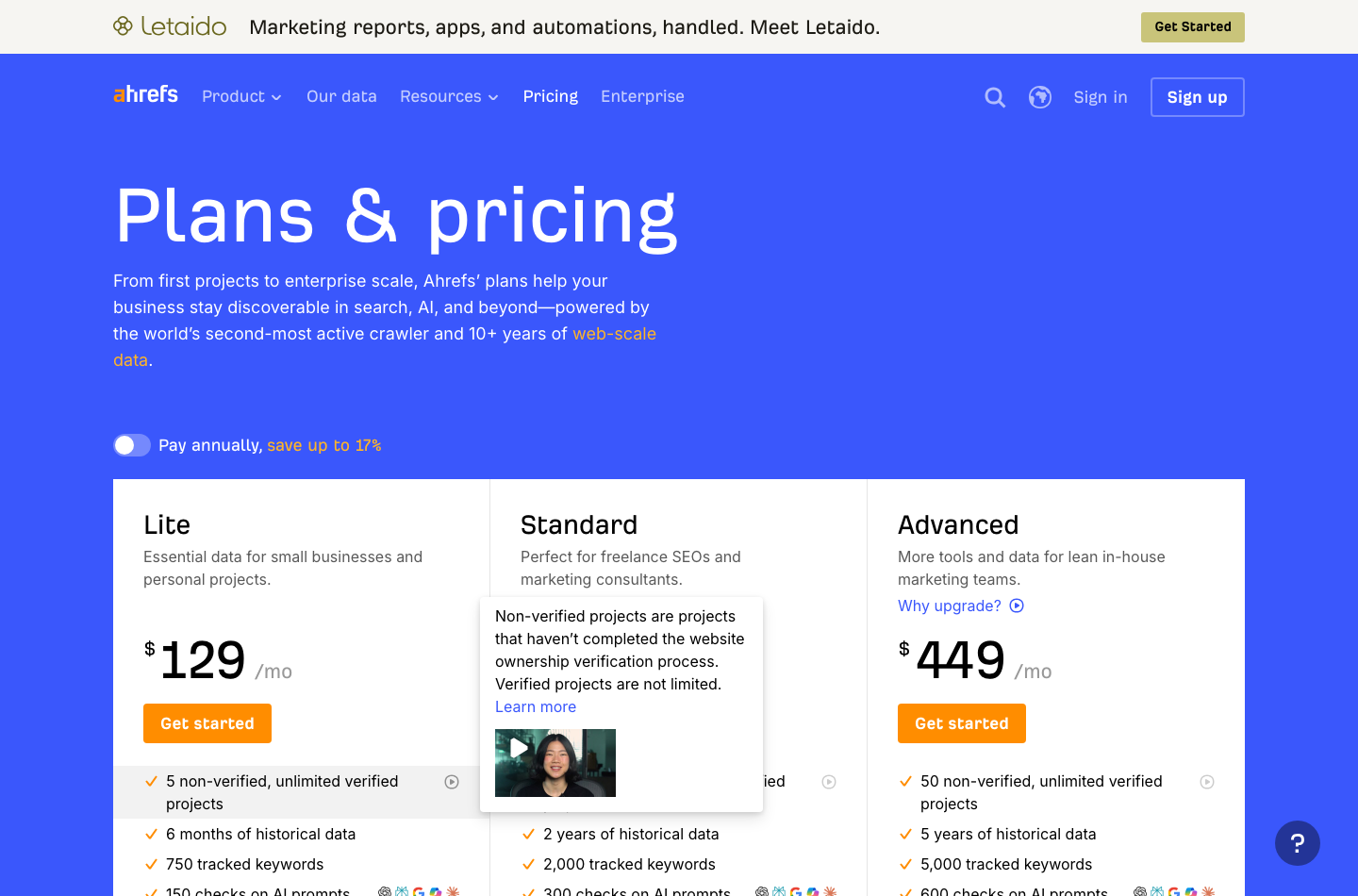
The main Ahrefs pricing 2026 ladder runs from a free account to Starter, Lite, Standard, Advanced and Enterprise. Compared with older pricing guides, the most meaningful change is the difference between credit-based lower plans and fair-use report access in Standard and above. Higher plans also expand historical records, keyword tracking, crawl capacity and Brand Radar prompt monitoring.
| Plan | Monthly US reference | Typical reason to buy | Major limit to check |
|---|---|---|---|
| Ahrefs Free | $0 | Audit and research your own verified website | No regular competitor-analysis credits; verified-site scope |
| Starter | $29 | Occasional competitor and keyword discovery | 200 credits/month, 50 keywords tracked, limited exports |
| Lite | $129 | Recurring solo SEO research | 1,000 report credits/user, 750 tracked keywords |
| Standard | $249 | Frequent agency or professional analysis | Higher project limits; fair-use rather than hard report credits |
| Advanced | $449 | Larger markets, datasets and reporting | 5,000 tracked keywords; limits on exports and crawls still apply |
| Enterprise | From $1,499; annual commitment | Corporate teams, governance and custom capacity | Sales agreement, minimum commitment and per-seat terms |
Reference: Ahrefs official pricing, Starter limits, and account-specific plan guidance. Verify currency, tax, renewal price and checkout before buying.
🆓 Ahrefs Free vs Starter: an important distinction
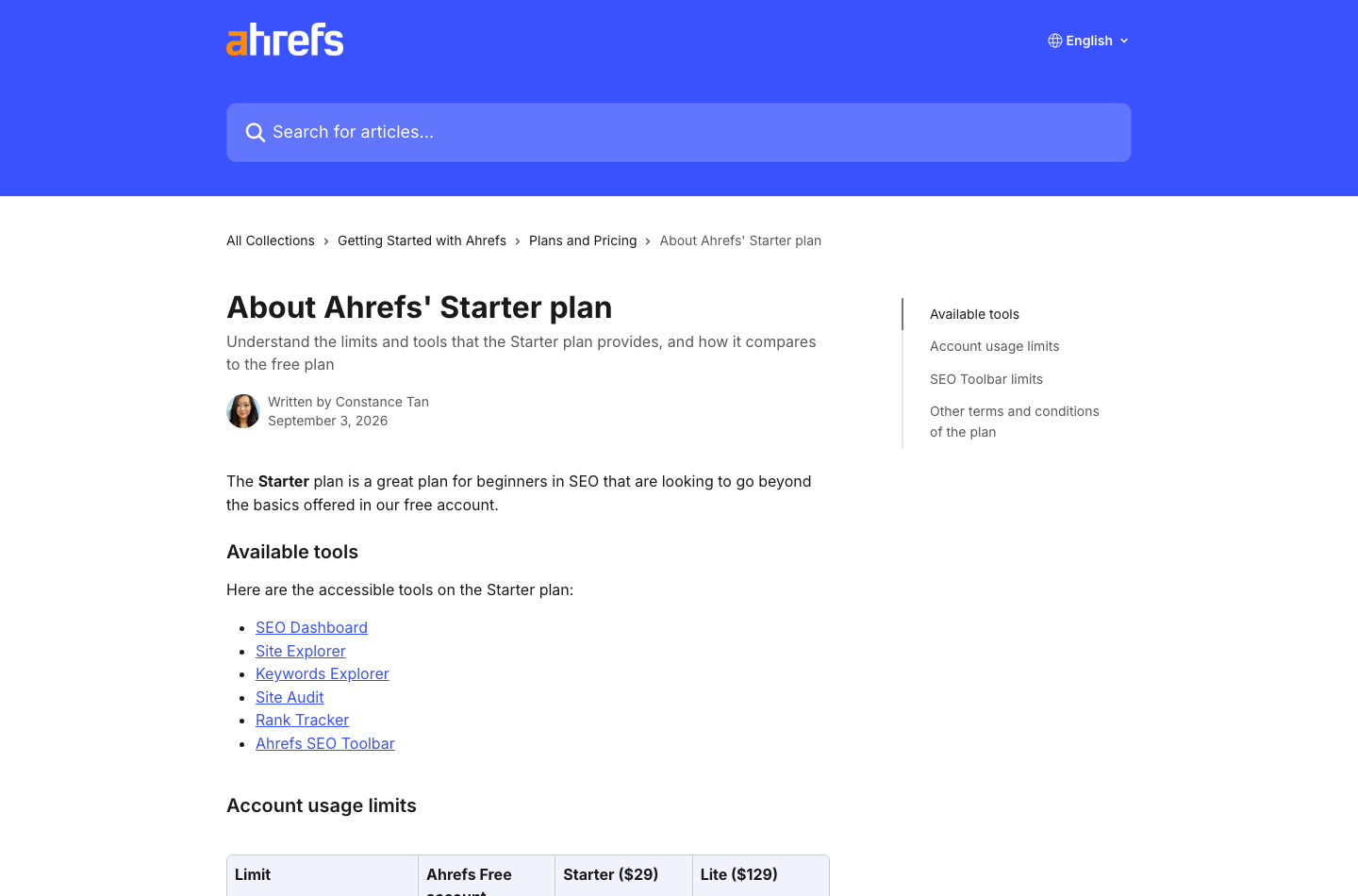
The renamed Ahrefs Free tier succeeded Ahrefs Webmaster Tools. It is designed primarily for analysis of websites whose ownership you can prove. Current official documentation lists access to Site Explorer reports for verified sites, a Site Audit crawler with 5,000 monthly crawl credits per verified project, Web Analytics up to one million events per project, and limited content and toolbar tools. You may see as many as 1,000 backlink or keyword rows at once in relevant free reports.
Starter removes some of the ownership restriction. You gain up to 200 monthly report credits to investigate other domains, one unverified project, Keywords Explorer, and the ability to follow 50 keywords in Rank Tracker. The account can maintain several keyword lists but has restricted export options and no additional users. The current help center says Starter renews monthly only.
This makes an Ahrefs Free vs Starter comparison more useful than a blanket claim that one is “better.” If your immediate problem is an indexing error on your own website, Ahrefs Free may be enough. If you need to inspect a competitor’s top pages or keyword opportunities, Starter supplies data that the free owner-only workflow lacks.
💳 Ahrefs Starter credits explained
Not every click in the application costs a credit, but many report-loading and filtering actions in research tools do. Ahrefs describes its Starter plan as 200 monthly credits, and buying more credits is not available on that plan. If you casually open twenty competitors, apply multiple filters and keep changing report settings, it is possible to consume meaningful capacity before finishing a single client brief.
A practical Ahrefs Starter credits review uses a fixed task. Write down five competitors, the exact metrics needed, and a limit on report variations before logging in. Produce one small brief with keywords and backlink examples. Note how many of the 200 credits were consumed and whether the missing data would require a larger subscription.
Don’t assume credits measure all product usage. Site Audit crawl credits, tracked ranking keywords and AI prompt checks have separate allowances. Treat them as distinct budgets rather than adding them together.
📈 Ahrefs Lite vs Standard: why frequent researchers pay more
Lite costs $129 per month and provides five unverified projects, six months of historical research, 750 tracked keywords and 100,000 monthly crawl credits. The pricing page currently lists 1,000 monthly credits per user for report usage. It also includes five daily AI prompts to track through Brand Radar’s custom monitoring.
Standard costs $249 per month and increases unverified projects to 20, historical data to two years, keyword tracking to 2,000 terms and monthly crawling to 500,000 credits. Current Standard and higher tiers use a fair-use unlimited credit model, which is attractive to someone who repeatedly opens and filters competitor reports throughout the day.
A $120 monthly difference sounds steep until a freelancer repeatedly hits Lite’s reporting limits and has to manually ration queries. The opposite is also true: an SEO consultant with three stable clients and predictable reports may get no extra commercial value from Standard. Record how often you actually reach limits before upgrading.
🏢 Advanced and Enterprise for complex teams
Advanced costs $449 monthly and extends the published ceilings to 50 unverified projects, up to five years of historical data, 5,000 tracked keywords and 1.5 million monthly crawl credits. It also supports more exports and larger API allocations than lower plans, according to the plan table.
Enterprise starts at $1,499 monthly with an annual commitment and offers corporate features such as SSO, audit logs and higher limits that depend on the agreement. This is a procurement exercise, not a credit-card upgrade for a single blog. Request the proposed seat count, support responsibilities, security controls, cancellation clauses and data-usage rights in writing.
For the Ahrefs Lite vs Standard comparison, team size also changes the result: additional users are listed at $40 each on Lite, $60 on Standard and $80 on Advanced, subject to per-plan seat ceilings. A three-person agency cannot budget only for the headline plan price.
🧮 Ahrefs Cost Calculator: What You Pay in Year One
Sticker price, billing cadence and optional seats are three different numbers. A marketing team can compare two plans correctly only if it uses the same time horizon and spells out whether a figure represents twelve monthly invoices or an annual commitment.
The Ahrefs annual pricing comparison is not as simple as multiplying the annual-plan marketing rate by twelve. The official site advertises annual savings of up to 17%, and eligible annual plans are marketed with roughly two months of savings compared with paying month by month. The exact checkout commitment still needs to be checked by plan and location. Starter is monthly-only; Enterprise requires a yearly agreement.
| Illustrative subscription scenario | First-year cash | Effective monthly spend | Critical condition |
|---|---|---|---|
| One Starter account for 12 months | $348 | $29 | Monthly renewal only; no extra users |
| One Lite user paying monthly for 12 months | $1,548 | $129 | Usage credits and other limits remain |
| One Standard user paying monthly for 12 months | $2,988 | $249 | Fair-use report access, not unlimited all quotas |
| One Advanced user paying monthly for 12 months | $5,388 | $449 | Check need for 5,000 tracked keywords |
| One Enterprise baseline at $1,499/month for 12 months | $17,988 | $1,499 | Annual commitment; sales quotation may vary |
| One Lite user plus one $40 additional seat monthly for 12 months | $2,028 | $169 | Requires eligible seat configuration |
| Standard plus one $60 additional seat monthly for 12 months | $3,708 | $309 | Confirm seat and contract conditions |
All amounts above are arithmetic based on published US monthly reference pricing, not a verified prepaid annual checkout or a personal quote. Taxes, promotional offers, add-ons and variable use are excluded. Use the DigiOffly Cost Calculator for your team-size assumptions.
What about two months free on annual billing? An illustrative annual Lite amount at ten months of the current monthly price would be $1,290, versus $1,548 for twelve monthly invoices. That is a $258 modeled saving, not a guarantee of the current annual invoice. It also trades flexibility for a prepaid year. Repeat the comparison for Standard or Advanced only after you have confirmed the checkout rate.
A freelancer who uses Ahrefs for a one-month competitive research project may be better served by Starter or Lite monthly than by an annual subscription. Conversely, an agency producing client reports every week may save more working time with Standard than the nominal $120 monthly price difference suggests. Record actual report usage and editorial decisions before extending the commitment.
Ahrefs team pricing: avoid buying by headline rate
Different users may need different kinds of access. One analyst may require competitor research, while a project manager only needs a shared PDF. Do not automatically buy each person a paid editor seat. Map the specific exports, dashboards and write privileges first, then count how many seats genuinely need tool access.
The extra-user price is particularly important for Ahrefs agency pricing 2026: Lite is listed at $40 per additional user with a cap of two extra seats, Standard at $60 with up to five extra seats, and Advanced at $80 with up to ten extra seats. Verify current availability and any billing changes at checkout.
🔎 Site Explorer: See Which Competitor Pages Actually Matter
Site Explorer is central to an Ahrefs SEO review because it combines estimated search visibility with backlink and content information. You can inspect top-performing pages, keywords, referring domains and how a competitor’s visibility changes over time. None of those external estimates is the competitor’s actual Google Analytics report. Use them to form hypotheses, not to certify its revenue.
For Ahrefs Site Explorer competitor analysis, choose a similar-size publishing website rather than a giant marketplace. Compare its ten most relevant pages with yours. Look for a topic that genuinely matters to your readers but lacks a satisfactory answer in your existing articles. Open the pages, inspect their evidence and decide whether you could publish something more helpful.
A sensible candidate might be an updated pricing comparison with hidden annual cash commitments, not another generic list of “top productivity tools.” The research feature has done its job when it produces a better editorial brief. An export with 5,000 rows and no editorial decision is mostly overhead.
Organic traffic estimation vs first-party analytics
Ahrefs estimates organic traffic from ranking positions, search volumes and modeled clickthrough assumptions. Search Console reports Google’s observations for your own verified property. The figures can diverge for several valid reasons: they measure different things, use different periods, and include different query coverage.
If an Ahrefs traffic estimate rises while Search Console clicks are flat, inspect which estimated pages or terms moved. Maybe the model updated its volume assumptions; perhaps a few keywords gained visibility without driving many visits. Don’t report the estimate as a real traffic increase unless first-party data supports it.
A careful Ahrefs organic traffic estimate accuracy exercise logs five monthly snapshots alongside GSC clicks and impressions. Record geographic filtering and the data ranges. The objective is not to force the numbers to match; it is to understand which strategic decisions remain useful despite imperfect estimates.
Backlinks and referring domains
A page with 700 referring domains is not automatically better than one with 70. The editorial context of each reference matters: an authentic research citation, a relevant customer tutorial and an automated directory entry contribute different value. Ahrefs surfaces link candidates, but an editor needs to inspect the referring page before interpreting the signal.
The Ahrefs backlink checker review should go beyond counting links. Select a competitor’s five strongest relevant referring pages, open them and ask what the publisher actually cited: a proprietary dataset, an explanatory tutorial, a comparison chart or brand popularity. Plan content that deserves a reference without asking another site to misrepresent its recommendation.
Ahrefs also shows broken links and link-intersection opportunities in eligible plans. Treat the output as a prospecting list, not permission to send a template message to every contact. Relevant outreach should explain the source material that makes a link editorially useful.
🔑 Keywords Explorer: Search Demand, Not a Content Factory
Keywords Explorer helps an SEO analyst discover related terms, estimated search volumes, traffic potential and Keyword Difficulty. It can also mislead inexperienced teams: a keyword with high search volume may be unsuitable for the website, and a low KD score does not guarantee that a new site will rank.
Ahrefs explains that its KD metric is based largely on referring domains pointing to pages already ranking in the top ten. On-page relevance and the strength of your particular website are not built into that single number. The company’s own education materials warn that rankings cannot be predicted from KD alone.
Long-tail keywords and realistic editorial intent
A practical Ahrefs long-tail keyword research session should start from a real buyer dilemma rather than a broad software label. Suppose a team is searching for email-marketing software. Some queries concern automation, others data portability, GDPR compliance or costs for 50,000 subscribers. Different product decisions deserve distinct evidence and sometimes distinct articles.
Export a shortlist of candidate terms with the selected country, estimate date and commercial intent. Examine live search results for ten phrases. Merge synonymous terms whose intent can be fully answered in one helpful page; keep separate those that require materially different comparisons. There is no reason to produce 18 pages if one well-researched guide answers all 18 variations.
For a Keywords Explorer review, count how often a suggested cluster led to a meaningful content decision. Measure whether the editorial team could establish original sources and screenshots, not how many phrases it managed to cram into paragraphs. A reader should never notice a keyword strategy when reading the final article.
Keyword Difficulty and Traffic Potential
Ahrefs provides more than a simple search-volume number. Traffic Potential is intended to estimate the total search visits that a page ranking highly for the topic could receive across related queries. That can be more useful than analyzing a single phrase, but it remains a model. It does not account perfectly for your website’s authority, content quality, competition or click patterns.
A useful Ahrefs Keyword Difficulty explained workflow evaluates a topic on three axes: strength of actual search results, relevance of the content you can publish, and strength of your site’s existing coverage. Even a modest-volume term may be valuable if it represents a high-intent product decision.
Content Gap and competitor keyword overlap
Competitor keywords are useful when they reveal something important that your site has overlooked. A Ahrefs Content Gap tutorial could compare three peer publications and surface queries they all cover while your site does not. Before briefing a writer, ask whether the missing topic fits your site’s purpose. Not every competitor strategy should be copied.
The best results from Content Gap are small and specific. A software publisher might discover that readers need a plain-language explanation of annual billing commitments. That is more useful than automatically generating hundreds of articles to match every keyword a large review website happens to rank for.
🧪 Site Audit: Find Fixable Technical Problems
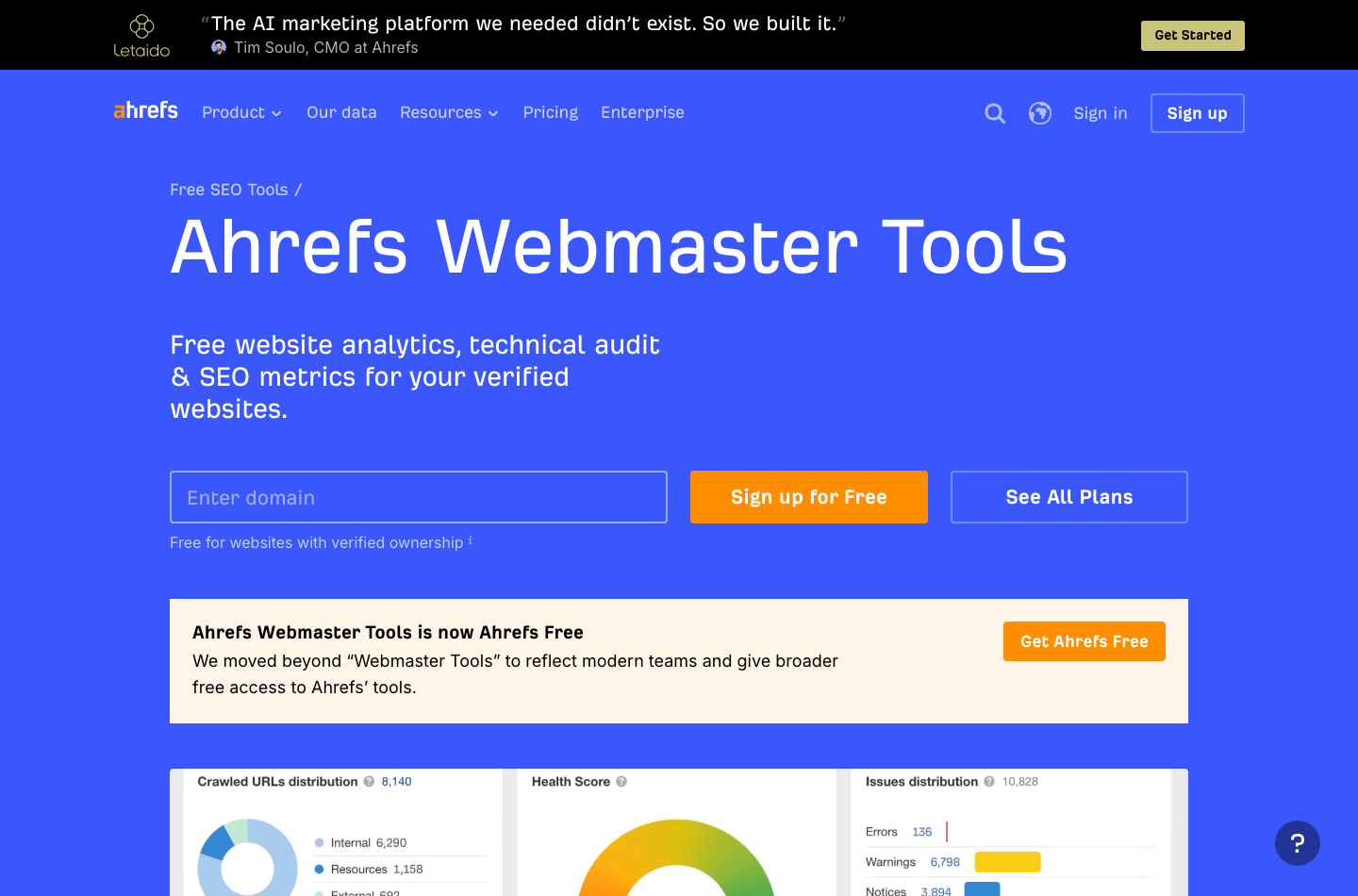
Site Audit crawls selected websites and highlights technical problems such as broken internal links, orphaned pages, redirect issues, missing metadata and indexability conflicts. On verified websites, Ahrefs Free currently includes 5,000 monthly crawl credits per project. Paid plans expand the allowances, but the scope of a particular crawl still matters.
In an Ahrefs Site Audit review, the first step is checking what the crawler could actually access. A site could report an excellent health score while excluding its most important product pages from the crawl. It could also produce a scary list of warnings about URLs intentionally excluded from Google. Review the exclusions and canonical rules before treating the counts as actionable.
A reproducible technical SEO test
Use a staging site you control and deliberately introduce three test issues: a broken internal link from a published guide, a multi-step redirect and a page whose canonical points to the wrong URL. Run the crawler, document whether the exact issues appear, fix them, then repeat the crawl.
The result should be evidence in the form of URLs, response codes and changes—not an abstract “SEO health improved” claim. If Ahrefs misses one of the issues or flags an intended noindex as a serious error, document the limitation. Never make a blanket indexing change based on a single crawler warning without comparing Google’s Search Console report.
When Project Boost matters
Ahrefs offers optional Project Boost products on its pricing page for projects needing increased crawling frequency, additional automation or expanded monitoring. They are charged on top of the base subscription and can meaningfully alter the monthly cost. A small publisher should test whether a normal scheduled crawl is enough before paying for always-on auditing.
In a Ahrefs Site Audit crawl limits comparison, calculate the number of HTML pages a project really needs to inspect and how often each should be revisited. A 60-page site does not normally need an enterprise crawl budget. A content marketplace with rapidly changing product URLs may be a different case.
📍 Rank Tracker: Useful Movements, Weekly by Default
Rank Tracker monitors the positions of a defined set of keywords across selected markets and devices. The number of tracked terms increases from 50 on Starter to 750 on Lite, 2,000 on Standard and 5,000 on Advanced. Ahrefs’ September 2026 help documentation states that default keyword updates occur weekly on subscription plans.
This matters for teams evaluating an Ahrefs Rank Tracker update frequency claim. Weekly observations can support a recurring client report, but they are not a tick-by-tick measurement of Google’s results. Ranking positions fluctuate by location, device, query and personalization. A screenshot captured in one place at noon is not definitive evidence of the position every customer sees.
Set the tracking country and device consistently, then choose 30 queries tied to actual buying decisions. Review the same set for several weeks. If you repeatedly add or remove keywords, the aggregate visibility line may change simply because your sample changed. Pair the trend with Google Search Console’s clicks and impressions, and annotate significant website updates.
A strong Ahrefs Rank Tracker vs Search Console workflow explains disagreement rather than hiding it. One reports positions within an explicit tracked keyword basket, while the other summarizes Google’s actual observed impressions for the owned property. Treat both as different measurements that can tell a richer story together.
🤖 Ahrefs Brand Radar: The AI Visibility Add-On
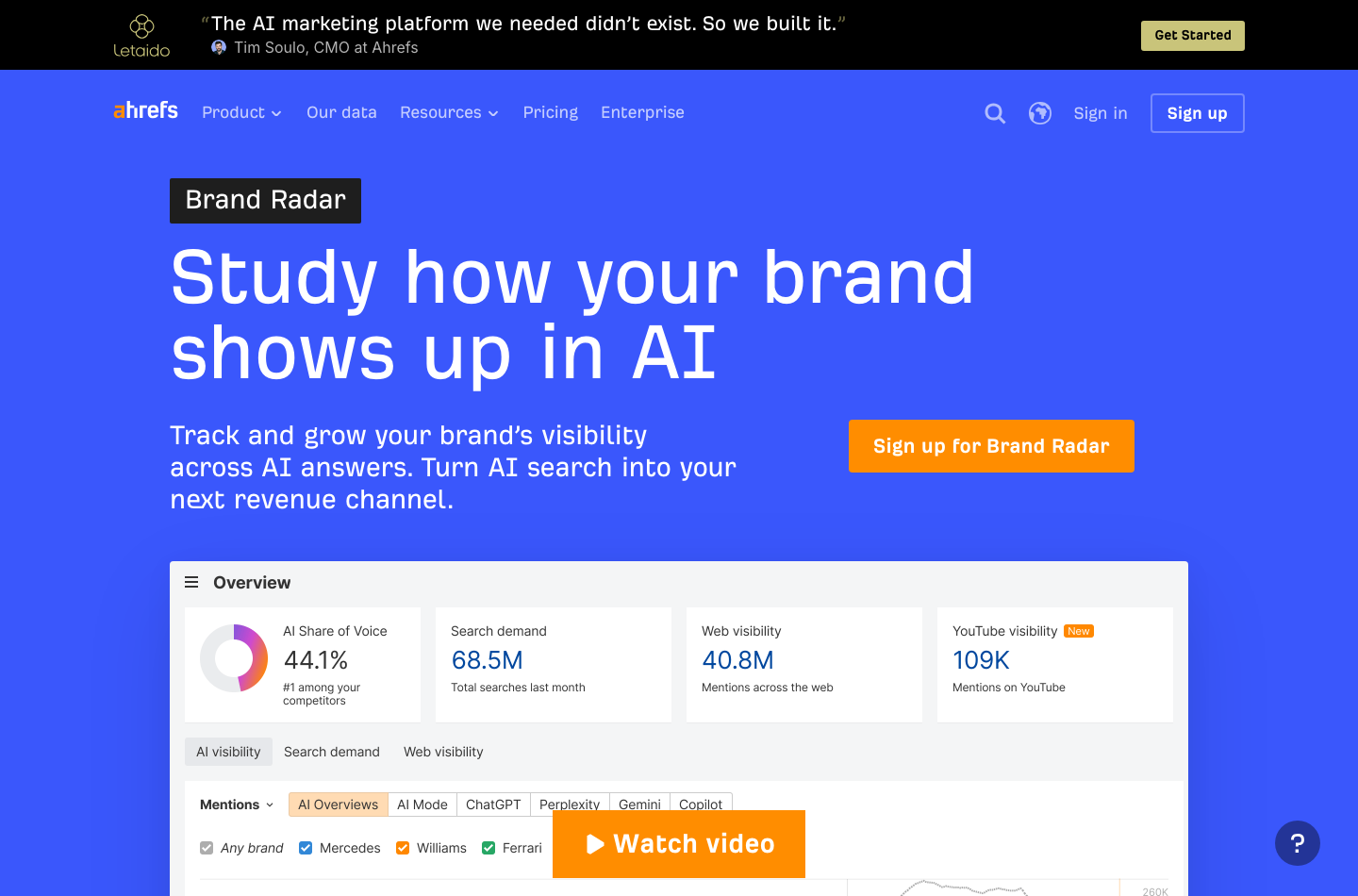
Brand Radar is the newest reason a company might reconsider its Ahrefs subscription. It describes where brands appear in monitored AI answers, the prompts that produce those mentions and competitors that show up alongside the brand. The vendor currently advertises a separately paid AI Visibility Index starting at $199 per month and custom prompt packages starting at $50.
A crucial distinction: Ahrefs Lite and higher plans already include a small number of custom tracked AI prompts—five on Lite, ten on Standard and twenty on Advanced—without automatically unlocking the full paid AI Visibility index. These allowances let teams watch a few explicitly chosen questions; a larger index is for broader discovery and competitive analysis.
Ahrefs Brand Radar pricing and prompt quotas
| Brand Radar product | Public price reference | Allowance or scope | Decision caveat |
|---|---|---|---|
| Custom prompts in Lite | Included in $129 Lite plan | 5 daily prompts / ~150 checks monthly on one platform | Limited to the specified prompt/platform setup |
| Custom prompts in Standard | Included in $249 Standard plan | 10 daily prompts / ~300 monthly checks | More monitoring capacity, still bounded |
| Custom prompts in Advanced | Included in $449 Advanced plan | 20 daily prompts / ~600 monthly checks | Check supported platforms and reporting |
| Custom prompt Basic add-on | $50/month | 2,500 checks; $0.020 extra per check | Actual platform/location combinations consume checks |
| Custom prompt Growth add-on | $100/month | 7,000 checks; $0.015 extra per check | Watch overage spending on scheduled monitoring |
| AI Visibility Index | From $199/month per index | Research existing AI-answer datasets | Broader access separate from basic prompt tracking |
Source: Ahrefs Brand Radar, Brand Radar usage explanation. Prompt-check rules and prices can evolve; validate exact platforms and billing scope for your account.
An Ahrefs Brand Radar review should measure the usefulness of its observed answers, not just the total number of mentions. If a brand is mentioned as a product to avoid, the count may look like visibility while the context is commercially negative. A defensible report opens the underlying response, checks the wording, and records whether a citation supports the statement.
AI visibility does not equal sales attribution
AI-generated answers can vary with phrasing, platform, market and time. An identical customer question may produce different citations in ChatGPT, Gemini, Perplexity or Google AI Mode. Vendor sampling is useful for spotting recurring patterns, but one observed answer cannot prove how the entire customer population saw a brand.
For Ahrefs AI visibility tracking for brands, write a fixed list of twenty buyer questions, record the platform and region, and monitor them over the same time window. Inspect when a competitor receives a favorable mention and whether the linked source explains it. If the sample changes, mark a new baseline instead of announcing a sudden success.
Compare the findings with GSC branded-search trends and analytics conversions. If AI citations increase without a change in clicks or qualified leads, the appropriate conclusion is that visibility moved, not that the campaign generated a specific dollar amount.
Brand Radar vs Semrush AI Visibility
The two vendors approach a similar category: monitoring where brands and competitors appear in AI search. But the subscription economics differ. Ahrefs includes a small custom-prompt quota in Lite and above, while broader Brand Radar indexes cost extra. Semrush One bundles traditional SEO with AI Visibility in its Starter, Pro+ and Advanced subscriptions.
For a fair Ahrefs Brand Radar vs Semrush AI Visibility test, use the same twenty prompts, market and platforms. Compare which AI responses are available for manual verification, how historical context is presented, whether the reports export cleanly, and how much the full monthly license stack costs. Do not assume two scores with the same name come from identical source populations.
⚖️ Ahrefs vs Semrush vs SE Ranking: Which Is Better?
The best SEO suite depends on how a team works. A publisher mainly auditing its own pages may benefit from Ahrefs Free. An established agency comparing competitor backlink profiles and assembling content briefs may justify Ahrefs Standard or Semrush. Another agency might prioritize SE Ranking’s workflow or reporting packages. The names alone do not establish a universal ranking.
| Product | Strongest evaluation case | Where to look before subscribing | Risk to avoid |
|---|---|---|---|
| Ahrefs | Backlink, keyword and competitor-page investigations | Credits, exports, verified vs unverified projects | Confusing estimated traffic with actual user sessions |
| Semrush | Broad competitive SEO and bundled AI visibility | SEO Classic vs Semrush One and add-on seats | Paying for tools no one uses |
| SE Ranking | Project-based rank tracking, audits and client workflows | Keyword quotas, location setup and reporting terms | Assuming the entry tier contains every agency feature |
| Google Search Console | First-party Google performance on owned properties | Query, page and country segmentation | Mistaking average position for a universal ranking |
| Google Analytics 4 | Website engagement, events and conversion analysis | Implementation quality and event definitions | Treating analytics as a backlink research product |
Read DigiOffly’s Semrush Review 2026 and SE Ranking Review for the individual software comparisons. These articles give context for a shortlist; they do not claim to reproduce identical paid-account benchmarks across vendors.
Ahrefs vs Semrush for competitive research
For Ahrefs vs Semrush pricing 2026, start with a realistic team and repeat the same task. Choose one organic competitor, identify its five most valuable editorial topics and inspect ten referring pages supporting them. Ask both tools for the source URLs, dates, keyword assumptions and export format.
Then calculate what is actually needed: perhaps one monthly Ahrefs Lite seat at $129, or a Semrush SEO Classic Pro seat at $139.95. The cheaper monthly label does not necessarily mean the cheaper completed task if reporting limitations or add-ons force another subscription. Conversely, a few extra data columns do not automatically justify a larger suite.
Ahrefs vs SE Ranking for routine SEO reporting
A business that mainly needs recurring rank reports may not require the deepest backlink dataset. A clear agency report with stable tracked keywords, working exports and accurate first-party context can be more valuable than a database no one has time to inspect.
Use an Ahrefs vs SE Ranking comparison that measures report preparation time across two real projects. Check whether the exported deliverable is understandable without opening the SEO interface and whether the user can revise notes for clients. The final report’s usability is often where the purchasing decision becomes obvious.
🧪 Three Hands-On Tests You Can Reproduce
These are proposed evaluation protocols. They are not claims that DigiOffly performed paid account testing or obtained results from Ahrefs. Use your own authorized accounts and non-sensitive information.
Test 1: Find a source-backed content gap
Choose three websites writing for the same audience. In Site Explorer and Keywords Explorer, identify ten topics where your site has a weak or missing article. Open the top-ranked pages and note whether their content relies on original evidence, dated product testing, an authoritative source or simple summaries.
For each topic, write one sentence describing the unique evidence your team can contribute. If none of the topics could produce something better than what already exists, the keyword database did not justify ten new articles. Estimate the credits consumed and time required.
Test 2: Audit real technical issues
Use a staging website you can edit. Insert a broken link, a redirected URL with an unnecessary intermediate hop and an incorrect canonical. Run Site Audit within the authorized crawl scope, then check whether the tool identifies each exact issue.
Fix the problems and repeat the audit. Record false positives, issues the crawler missed and whether the interface supplied enough information for an engineer to reproduce the errors. This protocol evaluates practical work saved, not a headline Site Health score.
Test 3: Track a narrow set of AI questions
Define ten recurring public buyer questions relevant to a product and two competitors. Use the Brand Radar prompts available on your plan, or a clearly budgeted add-on. Compare the resulting answer snapshots over a fixed period and inspect citations manually.
Record prompt/check usage, mentions with positive or negative context, and what marketing decision the observations suggest. Compare first-party conversions separately; don’t attribute sales to the AI answers without evidence.
✅ Ahrefs Pros and Cons
What we like about the proposition
- A useful free account for websites you can verify, with Site Audit and limited Site Explorer access.
- Low-price Starter access for occasional competitive research and keyword investigation.
- Strong relationships between backlink discovery, competitor pages, keyword research and content opportunities.
- Clear published ceilings for projects, exports, tracked keywords and crawl allowances.
- Standard and higher plans support fair-use unlimited report credits on current subscriptions.
- Brand Radar can connect conventional SEO work with selected AI-answer research.
- Published API and MCP capabilities support more sophisticated integrations in eligible plans.
What buyers should inspect first
- Starter’s 200 report credits can be exhausted quickly by unfocused research.
- Lite remains credit-based even though higher plans have fair-use report access.
- Weekly Rank Tracker updates may be insufficient for specialized daily reporting workflows.
- AI Visibility Index and high-volume prompt checks can add substantial monthly cost.
- Team seats, crawl boosts and data exports can change the true subscription budget.
- Modeled competitor traffic and Keyword Difficulty are not guarantees of clicks or rankings.
- Free accounts mainly serve your own verified sites, not unlimited competitor research.
🏆 Ahrefs Verdict: Who Should Upgrade?
If you manage a small website, start with Ahrefs Free. Verify ownership, audit key pages and see whether the reports produce worthwhile action items. For a short burst of competitor investigation, Starter at $29/month is a reasonable test, provided you treat its 200 credits as a planning constraint.
For regular SEO work, Lite at $129/month is a more substantial toolkit. Standard at $249/month becomes appealing when a team needs frequent filtering, more tracked keywords, broader exports or multiple client domains. Advanced and Enterprise are operational purchases requiring a real project and seat forecast.
Ahrefs Brand Radar offers a route into AI-answer visibility, but the Index and extra prompt monitoring should be evaluated as distinct spending decisions. The clearest evidence of value is a repeatable process: a specific question, the original data backing the answer, a documented action and an outcome checked later in first-party analytics.
Our bottom line: Ahrefs can help a team find better SEO decisions, but buying the tool does not substitute for publishing reliable research or fixing website problems. The appropriate tier is the one that helps complete those tasks accurately at a sustainable full-year cost.
📚 Official Sources and Editorial Notes
The following resources support this article’s October 2026 subscription facts. They are official provider descriptions, not independent performance benchmarks. No payment or product access was exchanged for a favorable conclusion.
- Ahrefs Plans and Pricing — $29 Starter; $129 Lite; $249 Standard; $449 Advanced; Enterprise from $1,499 and seat/project details.
- Ahrefs Starter Plan Limits — September 2026 — credit budgets, projects, keyword tracking, exports and monthly billing.
- What Can I Use for Free? — September 2026 — verified-site reports, 5,000 crawl credits, Web Analytics and free-account capabilities.
- Ahrefs Webmaster Tools Now Ahrefs Free — product migration and verified-site features.
- Ahrefs Subscription Comparison — Lite through Enterprise and fair-use plans.
- Rank Tracker Update Frequency — weekly default rank monitoring.
- Ahrefs Brand Radar — tracked AI prompts, add-on indexes and custom-prompt packages.
- Brand Radar Help Center — scope of AI answer research and prompt checks.
- How Ahrefs Calculates Keyword Difficulty — the methodology and its important ranking limitations.
- Ahrefs Plan and Legacy Credit Guidance — credit-based Lite versus fair-use Standard and higher accounts.
Pricing is editorial information, not a quote or promise of available inventory. Check the vendor’s current checkout, cancellation and renewal policy before making a purchase.

Ahrefs Frequently Asked Questions
Is Ahrefs free to use in 2026?
Yes. Ahrefs Free provides verified-website Site Explorer reports, Site Audit, Web Analytics and limited other tools. Competitor analysis requires a paid tier.
How much does Ahrefs Starter cost?
The official US reference is $29 monthly. Starter provides 200 monthly report credits and 50 tracked keywords, and the provider says this tier renews monthly only.
What is the difference between Ahrefs Lite and Standard?
Lite is $129 monthly with 1,000 report credits, five unverified projects and 750 tracked terms. Standard is $249 monthly with fair-use report access, 20 unverified projects and 2,000 tracked keywords.
How many keywords can Ahrefs track?
Starter currently supports 50 Rank Tracker terms, Lite 750, Standard 2,000 and Advanced 5,000. Account-specific limits and verification settings can change.
Does Ahrefs update tracked rankings daily?
The default Rank Tracker keyword-update frequency is weekly according to September 2026 help documentation. Verify scheduling details in your current account.
What is Ahrefs Brand Radar?
Brand Radar tracks brand mentions and source citations in sampled AI responses. Lite and higher plans include some custom tracked prompts, while broader AI indexes and larger prompt packages cost extra.
How much is the Ahrefs Brand Radar AI Visibility Index?
The official Brand Radar pricing page lists index access starting at $199 monthly and optional custom-prompt packages starting at $50 monthly. Product scope and platform coverage depend on the package.
What can you do with Ahrefs Free Webmaster Tools?
For an owned verified site, you can inspect limited Site Explorer reports, run Site Audit with 5,000 monthly crawl credits per project and use Web Analytics and other free features.
Is Ahrefs better than Semrush for SEO?
Both offer keyword, backlink and competitive research. Compare the same projects and full costs; Ahrefs specializes in source-backed SEO research while Semrush bundles additional toolkits and AI monitoring options.
Are Ahrefs traffic numbers accurate visitor totals?
No. Competitor organic-traffic numbers are modeled estimates. Compare owned-site results with Google Search Console and analytics before claiming actual visitors or conversions.
Does Ahrefs Starter offer a yearly subscription?
The current Ahrefs Starter Help Center states that Starter renews monthly only. Other eligible Ahrefs plans may offer annual billing discounts; verify the precise checkout and renewal terms.
EXPLORE NEXT ON DIGIOFFLY
Compare Ahrefs With Other SEO Research Tools
Compare SEO suites and estimate complete subscription costs before you purchase.
Compare SEO platforms
- Semrush Review — compare SEO Classic and Semrush One.
- SE Ranking Review — review rank tracking and agency reporting.
- Growth & Marketing — browse other SEO and marketing tools.
- Screaming Frog — Crawl checks for technical SEO and redirects
Plan your subscription budget
- Software Cost Calculator — estimate full-year charges and extra seats.
- Best Value Advisor — identify an appropriate subscription level.
- Software Comparison — compare available tools in one place.
Explore AI and software choices
- AI & Tech Reviews — research assistants and AI software.
- AI Software Finder — match a tool to a specific task.
- Software Directory — discover related products and categories.