

 VS

Mercury handles USD business banking. Wise Business focuses on currency balances and international payments. Compare both with your actual invoices, recipient amounts and payment controls.
By Alex Wright, DigiOffly · Pricing and product details reviewed 12 November 2026 · Source-led editorial comparison. No claim of live payment testing.
Quick answer: In Mercury vs Wise Business for international payments, start with Mercury if your US company needs a USD operating account for domestic bills, cards and cash controls. Wise Business deserves a closer look when a client pays you in euros and you need those euros for a supplier invoice. If your company collects USD revenue and pays a recurring EUR contractor, compare the cost of a Mercury wire with moving USD into Wise and paying the contractor there. Use both only if the extra account solves a measurable problem and your team can reconcile it. Compare what reaches the recipient, not just the headline fee.
Research disclosure: This comparison uses official public documentation and hypothetical payment examples. We have not opened accounts with either provider for this article, performed a live USD-to-EUR transfer or verified personalized in-app quotes. Rates, receiving methods, availability and fees depend on the company, banking partner, corridor and date. Figures below are illustrative unless explicitly identified as a published fee. Recheck both providers before moving money. This article is not legal, tax or financial advice.
At a glance: Mercury vs Wise Business
| Decision factor | Mercury | Wise Business | What matters to a buyer |
|---|---|---|---|
| Main role | USD business banking and financial operations for eligible US companies | Multi-currency business money movement and currency balances | Which job is currently slowing your finance team? |
| Hold EUR, GBP or other non-USD balances | No — Mercury accounts are USD-only | Yes, in supported currencies | Avoiding unnecessary conversion on foreign receipts |
| Receive a EUR payment | Supported incoming wires can be converted to USD before credit | Eligible customers can receive EUR in available account details and retain EUR | Does the business need to spend that EUR later? |
| Send EUR from USD | Supported international wires; published 1% FX exchange fee | Conversion and transfer fee varies by route and payment method | Compare final recipient EUR after all charges |
| Send USD internationally | Published $0 sending fee on SHA; optional $15 OUR for eligible USD wires | Route-dependent quote; payment and receiving fees can apply | Recipient/intermediary charges and delivery certainty |
| US domestic banking | Banking services through partner banks, USD account features and domestic rails | Business account details and transfers, not a substitute for all banking needs | Payroll, cash controls, financing and audit needs |
| Recurring international operations | Supported, but non-USD recurring payments use the rate on processing date | Multi-currency balances; scheduling options vary by account | Reconciliation, approvals and treasury processes |
| Getting started | US entity, business activity, beneficial owner and jurisdiction checks | Business type and jurisdiction checks, verification and regional feature eligibility | Eligibility must precede a cost comparison |
Verdict in one sentence: Mercury is usually the more natural primary USD operations account; Wise Business is usually the more natural specialist foreign-currency layer. The best choice depends on the invoices, currencies and permitted payment routes you actually use.
What are you really comparing?
“Mercury vs Wise Business” sounds like a head-to-head contest between identical business bank accounts. That framing can produce an expensive answer. The providers overlap in payment services, but solve different parts of a financial workflow.
Mercury describes itself as a financial technology company, not a bank. Banking services are provided through Choice Financial Group and Column N.A., Members FDIC. For an eligible US company, Mercury combines checking and savings features with corporate cards, bill payment, spending controls and accounting integrations. Its core proposition is not a portfolio of currency wallets: Mercury only holds USD account balances. An incoming supported non-USD wire is converted into USD before the balance is credited. The precise incoming conversion treatment depends on the underlying banking partner and intermediaries.
Wise Business centers on international money movement. Once approved for the relevant features, a company can use currency balances and account details, receive customer payments, convert at a disclosed rate with a separate fee and pay suppliers internationally. Wise Business is not necessarily a full substitute for a US operating bank. A startup may still need a conventional business account for payroll, cash reserves, specific lending products or its accountant’s preferred controls.
That distinction changes the question to: Where does the company receive money, which currency must it keep, and which currency must leave the business? These three decisions should come before deciding which product has the most attractive homepage.
The three-part payment test: receive, hold, send
- Receive. Does the payer send USD, EUR or another currency? Does your provider give the payer suitable local account details, or must the payer send a SWIFT wire? Which receiving fees and intermediary deductions can occur?
- Hold. Must you retain foreign currency to pay a future invoice, or would immediate conversion to USD be acceptable? If you convert twice, quantify that round trip.
- Send. Will the recipient be paid in USD or local currency? Is your invoice fixed in the recipient’s currency, and who covers intermediary-bank costs?
A provider that looks cheaper on the third step may be more expensive across all three. For example, a company that receives EUR today and pays EUR next week may avoid an unnecessary EUR-to-USD-to-EUR round trip if it can keep those EUR funds available in a supported Wise balance. This is an operational illustration, not a guaranteed saving: receiving charges, holding restrictions and transfer paths still need checking.
Mercury international payments: strengths, FX fees and limits
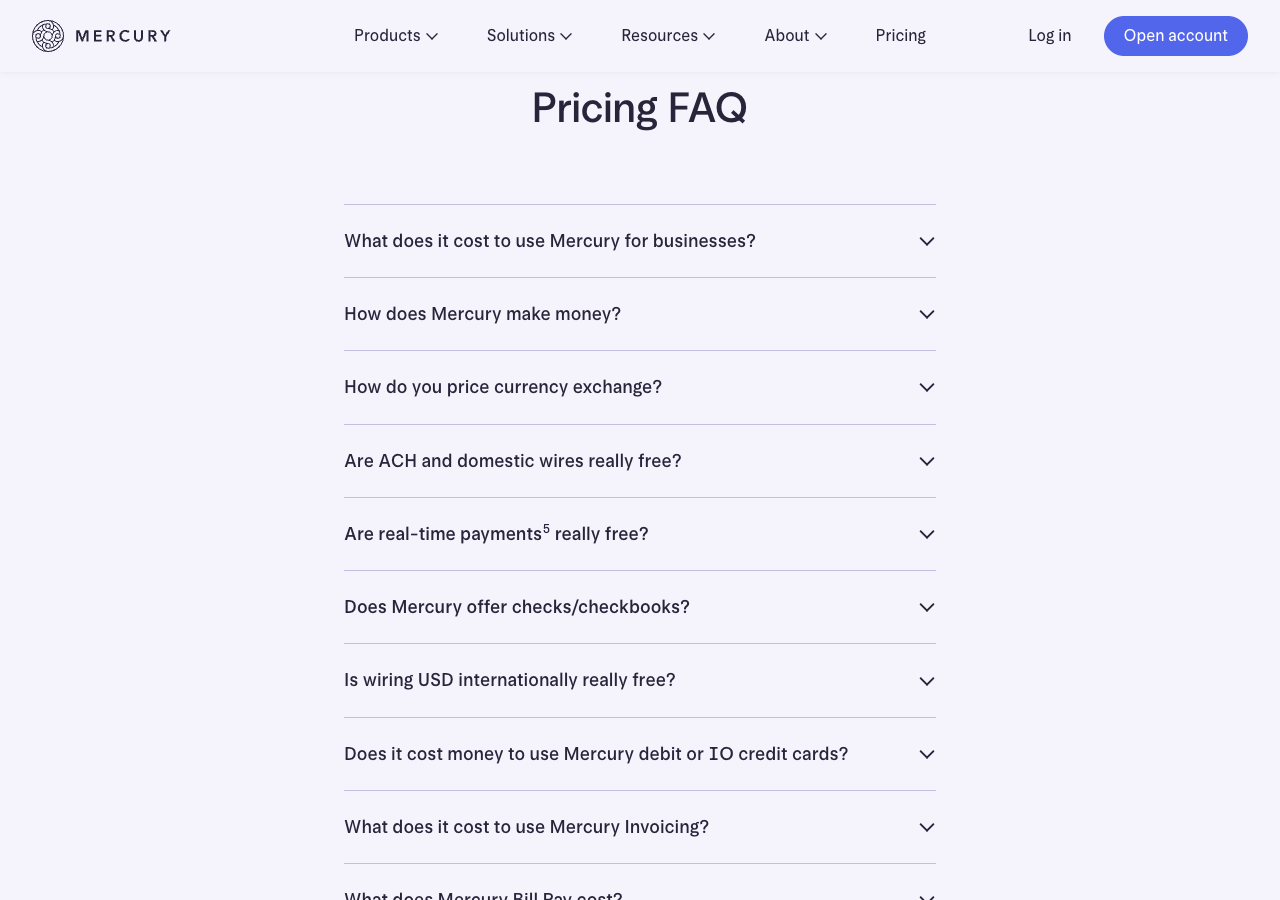
Mercury’s USD checking features address a specific operational need. A US startup approved for an account can use it to collect domestic US revenue, pay vendors, operate company cards and manage who can approve payments. Public pricing lists no required monthly fee for standard business banking, free ACH and free outgoing domestic and USD international wires. Premium workflow subscriptions and exceptions are separate from this basic cost model.
For outgoing non-USD international wires, the Mercury FX fee is central to the cost comparison. Mercury publishes a 1% currency exchange fee when converting USD to a supported foreign currency. Mercury says it supports more than 40 outgoing currencies and uses the current mid-market rate on business days; on weekends and holidays, it may use the most recent available rate. Payment limits and supported destinations are not universal, and the quote should be checked before confirmation. A recurring FX wire uses the rate when the payment processes, rather than a rate locked weeks earlier.
For incoming non-USD wires, Mercury can accept supported currencies through its banking partners but automatically converts the proceeds to USD. Its help documentation distinguishes conversion by Column N.A. at the mid-market rate from Choice Financial Group routes that use intermediaries and may have additional exchange-rate markup. It would be wrong to say every incoming foreign-currency payment has the same effective cost. It would also be wrong to say Mercury lets the business keep EUR simply because it can receive EUR wires.
Mercury international wire fees: what “free” does and does not mean
Mercury offers USD international wires using standard SWIFT charge instructions: SHA (charges shared between parties) or, for qualifying transfers, OUR (sender pays covered charges). These are charge-allocation instructions, not separate Mercury products. With SHA, Mercury does not charge the sender its outgoing wire fee, but intermediary banks can deduct amounts from the transfer, leaving the recipient less than the nominal invoice. Mercury publishes a $15 OUR option designed to cover intermediary charges on an eligible USD wire. Its help center notes that the receiving bank may still impose its own incoming fee. As a result, OUR raises the likelihood of a full receipt but should not be portrayed as a guarantee against every possible charge.
Suppose a US company owes a designer exactly $1,000 in USD. Under SHA, the business may initiate a $1,000 transfer at no Mercury sending fee, while the designer receives less if intermediaries deduct costs. Under OUR, the business may pay $15 more upfront so covered intermediary fees are borne by the sender. You must still confirm how the recipient’s bank treats incoming wires. A lower sending fee does not necessarily make the net payment more predictable.
Who should shortlist Mercury?
Mercury belongs on the shortlist when you need a USD operating account for an eligible US company; most suppliers invoice in USD; your finance workflow values domestic payments, cards and banking controls; international transfers are occasional or predictable; and the actual recipient amounts remain acceptable after quotes and possible intermediary deductions.
It is a weaker match if retaining EUR, GBP and other non-USD balances is essential to your treasury process. It is not available to every founder or every entity: US company formation, meaningful current or planned US operations, physical-address and beneficial-ownership verification, prohibited industries and residence/operating-country restrictions all matter. US incorporation alone does not guarantee approval.
Wise Business fees and multi-currency operations

Wise Business is worth evaluating where foreign-currency receipts and payments are central to the job rather than incidental. Supported account details can let eligible customers receive certain local payments; supported balances allow a business to retain currencies instead of converting immediately; and outgoing transfers disclose conversion, rate and fees before confirmation. Eligibility and exact capabilities are tied to business registration, location, currency and verification status.
For a US business, Wise’s published pricing page listed a $31 one-time fee to unlock receiving account details, variable sending and conversion fees from 0.23%, and free holding of supported currencies when checked for this draft. “From 0.23%” is a minimum advertised starting point, not a firm USD-to-EUR quote, and not proof that Wise beats Mercury on every corridor. Payment method, route, amount and market conditions affect the quote.
Wise Business receiving fees depend on the payment method, not just the currency. The US pricing page distinguishes local incoming payments from SWIFT or wire receipts. It publishes free domestic/non-SWIFT receiving in listed currencies, a $6.11 receiving fee for USD wire/SWIFT, and a €2.39 fee for receiving EUR SWIFT. A EUR local transfer, EUR SWIFT transfer and USD wire are not interchangeable. The payer’s bank or correspondent banks may add charges outside Wise’s receiving fee; local and SWIFT instructions should be checked separately.
Wise also advertises volume discounts for eligible transfers once an account’s qualifying monthly international transfer volume reaches $25,000 or equivalent. Discounts depend on the qualifying volume, currency and transfer details.
When Wise Business makes operational sense
Imagine a US agency billing an EU client in EUR, then paying an EU contractor in EUR. If both payments use eligible Wise details and the business can hold that currency, the agency may be able to receive and spend EUR without converting the same funds into USD in between. That can simplify cash-flow planning and reduce unnecessary FX events. The advantage disappears or changes when the client insists on SWIFT, your business cannot obtain the necessary details, your recipient is in an unsupported corridor, or you must convert into USD for payroll and taxes immediately.
Wise Business also needs financial controls. A finance lead should establish who may add recipients, who may approve transfers, who reconciles the account and how balances are presented in the general ledger. The existence of multi-currency balances does not eliminate accounting complexity; in some businesses, it makes foreign-exchange revaluation and month-end controls more important.
Costs: a fair Mercury vs Wise comparison
The incorrect comparison is “Mercury costs 1%; Wise costs 0.23%; therefore Wise wins.” The 1% Mercury figure applies to its outgoing non-USD wire FX exchange fee. The 0.23% Wise figure is the published starting rate for certain transfers or conversions. They are not guaranteed prices for identical transactions, and the cheapest sender fee can still result in a smaller net amount received.
Here is a clean starting example for a company paying a euro-denominated invoice from a USD balance. Assume the USD amount subject to the Mercury 1% fee is exactly the amount shown. This is only the arithmetic fee component; it is not an execution quote and does not determine EUR delivered.
| Illustrative converted USD principal | Mercury’s published 1% FX fee component | Wise Business fee | Final EUR received |
|---|---|---|---|
| $5,000 | $50 | Obtain current USD→EUR quote | Unknown without same-time quotes |
| $10,000 | $100 | Obtain current USD→EUR quote | Unknown without same-time quotes |
| $25,000 | $250 | Obtain current USD→EUR quote and check discount eligibility | Unknown without same-time quotes |
The example intentionally does not invent a market FX rate, a Wise fee or a received amount. Your actual all-in payment may include provider charges, banking rails, intermediary deductions or receiver-side charges. Confirm which party funds each of them.
The recipient-amount worksheet
Use the following five rows for each provider, quoting the same transaction at the same time:
| Line | Mercury quote | Wise Business quote |
|---|---|---|
| 1. Sender currency and maximum sender debit | USD / [exact amount] | USD / [exact amount] |
| 2. Destination and recipient currency | [country and EUR, GBP etc.] | Same destination and currency |
| 3. Quoted conversion rate and provider fee | [rate + disclosed fee] | [rate + disclosed fee] |
| 4. Other known intermediary / receiving costs | [SHA/OUR, local bank] | [payment rail and bank costs] |
| 5. Net recipient amount and estimated arrival | [quote / range] | [quote / range] |
If the invoice demands that a supplier receive exactly €9,000, compare how many USD must leave your company to deliver €9,000, not what € amount a fixed $10,000 debit might generate. This reverses the question and can reveal shortfalls that headline fees conceal. Include a small buffer only when your contractual obligations and provider quote terms justify it; do not silently overpay.
Double conversion: the overlooked cost
A US software company receives €20,000 in a supported incoming wire, needs to pay a €12,000 supplier invoice next week and will keep $-denominated books. On Mercury, the EUR receipt cannot remain as EUR: the supported incoming flow converts to USD. A subsequent EUR payout from Mercury requires another currency exchange. Actual costs depend on the receiving partner, incoming conversion route and the published outgoing FX fee. On eligible Wise Business details, the company may retain sufficient EUR for the later payment and only convert a separate amount into USD when needed.
This is a workflow comparison, not evidence of realized savings. It is possible that a particular receiving or outgoing route has fees that reverse the apparent advantage. Ask both providers for a statement of what is received, what is converted, what is retained and what leaves the business.
Three realistic scenarios: international payments for US startups
Scenario 1: How to pay international contractors from a US startup
A Delaware startup collects US revenue in USD. Twice a year it pays a European designer. Assume the company uses Mercury for routine operations and the contractor can provide EUR or USD receiving details.
Start by asking the contractor which currency the invoice legally requires and whether the receiving bank deducts charges. If the invoice is in USD, an eligible Mercury USD international wire may be operationally simpler; SHA versus OUR matters. If the invoice is in EUR, request a non-USD Mercury wire quote and a Wise USD-to-EUR quote for the exact recipient amount. Include any setup and approval overhead you would incur to add another platform for only two payments. Best provisional fit: Mercury may be sufficient; Wise deserves a quote if the cross-border cost is material.
Scenario 2: A SaaS company earns EUR and pays EUR vendors monthly
A US-based SaaS company invoices European clients and pays EU-based contractors every month. A large share of its operating payments stays in EUR. The business wants clearer currency-based cash planning and fewer involuntary conversions.
Can Mercury receive EUR payments? Yes, a supported incoming EUR wire can reach Mercury, but Mercury converts the funds to USD before credit. Wise Business may allow supported EUR receipts, retained EUR balances and EUR payments. Verify the customer’s payment rail and the company’s access to EUR account details; inspect local versus SWIFT charges. Use consistent invoice references and accounting entries for each incoming and outgoing payment. Best provisional fit: Wise as a foreign-currency layer, potentially alongside Mercury as the main USD operating account.
Scenario 3: A US agency pays a USD invoice abroad and must deliver the full amount
An international contractor issues a $4,000 invoice payable in USD to a foreign bank. The contract treats short payment as unpaid balance. The agency is comparing two charge instructions for a Mercury USD wire (SHA and OUR) with a Wise transfer quote.
Under Mercury’s published USD wire terms checked on November 12, 2026, a SHA instruction has no Mercury sending fee; intermediaries can deduct charges. The OUR instruction adds a published $15 fee for covered intermediary costs, but the receiving bank may still levy its own charge. Wise requires an actual USD transfer quote for the recipient bank and route. Best provisional fit: the provider and wire route that best document the recipient’s expected net USD after all known charges. Price is secondary to contractual certainty if a shortfall triggers penalties.
Eligibility, regulation and account safety
An international founder should not treat “US LLC” as automatic approval for Mercury. Mercury requires a US-formed and registered business with existing or planned US operations, acceptable company and owner addresses, business documentation, owner identity details and compliance review. The company also publishes country and industry restrictions that can change. A non-US citizen can potentially qualify, but residency and business activities still affect the decision.
Wise Business for a US LLC is not automatic approval: Wise Business supports different legal structures and jurisdictions, but not every business type, country or activity. Feature availability and verification requirements may change based on where the entity is registered, who controls it and what currencies it uses. Confirm the business product is available and suitable; do not extrapolate from a personal Wise account or a screenshot from another region.
Neither provider should be described as offering identical bank-deposit protections. Mercury provides banking services through named partner banks and describes applicable FDIC-insured arrangements. Wise operates under a different legal and safeguarding framework that depends on jurisdiction. Review each provider’s current disclosures and your company’s required deposit protections. If the account holds substantial operating reserves, understand exactly where money is held, what protections apply and which services are not bank deposits.
A practical finance-control checklist
Before sending material sums, document the business owner, approved bank or payment provider, invoice number, recipient legal name, destination account identifiers, payment purpose and currency. Require independent verification for a new or changed vendor bank account, especially when an email requests urgent changes. Separate approval from execution where possible. Confirm your accounting platform imports or records the transaction, rate, processing fee and any bank deductions. Reconcile the final recipient proof rather than treating an initiation receipt as settlement evidence.
For recurring payments, record whether the payment is scheduled in USD or foreign currency, whether a new quote applies each time and what happens on holidays. Test a low-risk transfer first where permitted. If a return occurs, reconcile the return amount, any FX difference, fee and open invoice rather than assuming the original transfer was never attempted.
How to use Mercury and Wise Business together without duplicate payments
A hybrid stack can make sense when you genuinely need two distinct workflows:
| Job | Provisional provider role | Finance control |
|---|---|---|
| USD operating cash, domestic vendors and payroll-related flows | Mercury | Approvals, category tagging, reconciliation |
| Foreign-currency customer receipts where supported | Wise Business | Correct local instructions, payer reference, FX policy |
| Foreign-currency suppliers and contractors | Wise Business or a quoted Mercury wire | Recipient-amount comparison and bank confirmation |
| USD and FX bookkeeping | Existing accounting system (for example Xero or QuickBooks) | Consistent ledger treatment and monthly reconciliation |
The failure mode is not just paying twice. A team can accidentally pay the same invoice twice when two dashboards each list an unpaid vendor. It can also leave cash in a balance no one monitors, overlook a currency exposure or lose sight of who may approve a payment. A written funding and reconciliation rule is therefore worth more than adding another application for its own sake.
Before adding a second provider, look at a representative set of invoices and transfers. For an established business, the last three months may be enough; a new company can start with its expected payment schedule. Identify the recurring FX problem and choose the fewest accounts needed to solve it.
What would change our recommendation?
We would change a Mercury-first recommendation if most client receipts arrive in foreign currency, if expenses must be settled in the same currency, if the company is ineligible for Mercury or if quote-by-quote comparison finds materially better delivered values elsewhere. We would change a Wise-first recommendation if domestic USD banking, US operating controls or integration with the company’s existing finance processes overwhelmingly drive requirements, or if its necessary currency/account details are not available to the business.
Neither product is automatically best for a company with complex entity structures, unusually high payment volumes, regulated activities or institutional treasury requirements. Such cases may need a specialist provider, a bank relationship or a customized finance architecture. Consider Airwallex as another research option for selected international collections, payments and expense workflows rather than treating this as a two-vendor universe.
Final verdict: Mercury vs Wise Business for US startups
Choose Mercury if you mainly operate in USD, qualify for its US business account and want a convenient primary place to manage routine banking and company payments. Its published 1% conversion fee for supported non-USD outgoing wires is straightforward to understand, but it must be assessed alongside any downstream costs and the inability to hold foreign currency.
Choose Wise Business if your operating model requires holding, receiving or spending supported foreign currencies, and the business qualifies for the relevant account details and routes. Its fees should be quoted for the actual transaction; a minimum advertised rate does not prove it is universally cheaper.
For international payments for US startups, choose both only if the split removes a specific expense or workflow bottleneck and your team can reconcile and control two systems.
Before switching, run the recipient-amount worksheet for your three most common transfer types. Verify account eligibility, expected net receipt, banking protection, provider permissions and accounting integration. Select the workflow you can consistently operate, not simply the biggest marketing promise.

Frequently Asked Questions
1. Is Mercury better than Wise Business for a US startup?
Mercury is a suitable starting point for an eligible US startup whose main operating currency is USD. Wise Business can fit better when multi-currency receipts, holding and cross-border payments are central. Compare both against the startup’s actual invoices and operational requirements.
2. Can Mercury hold euros or British pounds?
No. Mercury states that its accounts hold USD only. Supported incoming non-USD wires are converted to USD before being credited. Receiving a EUR payment is not the same as maintaining a EUR balance.
3. Can a US LLC open Mercury if the founder lives outside the US?
Potentially. Mercury considers US-registered companies with non-US founders, but it requires current or planned US operations, owner identification, acceptable addresses and compliance with its country and industry restrictions. Founders should check the current eligibility policy for their residence and operating jurisdictions. Incorporating a US LLC does not guarantee an account.
4. Can a US company receive EUR payments through Wise Business?
For an eligible business and supported details, Wise may provide a way to receive EUR. Local transfers and SWIFT receipts can carry different charges. Check the actual details granted to your business before invoicing clients.
5. What is the Mercury international wire fee for USD-to-EUR?
Mercury publishes a 1% currency exchange fee for outgoing international wires converted from USD into a supported non-USD currency. On a hypothetical $10,000 amount subject to that fee, the fee component is $100. The recipient’s EUR amount still requires an actual quote.
6. Is a Mercury USD international wire completely free?
No. The advertised zero sending fee for SHA does not guarantee that the recipient receives the full invoice amount. A paid OUR instruction can cover specified intermediary charges, but the recipient’s bank may still charge. If the invoice requires an exact net amount, compare the two charge instructions described above.
7. Is Wise Business always cheaper than Mercury for FX?
No. Wise publishes variable fees starting from a minimum percentage, not a guaranteed rate for every corridor and amount. Compare identical sender debits and final recipient amounts at the same time, including any third-party charges.
8. What are Wise Business receiving fees?
It depends on method and currency. Wise’s US business pricing lists free receipt for certain local/non-SWIFT transfers, but fixed charges for examples such as USD wire/SWIFT and EUR SWIFT receipts. Eligibility and fees can change; check current receiving instructions.
9. Can I use Mercury and Wise Business together?
Yes, if both providers approve your company and the setup fits your needs. A common arrangement is a USD operating account plus a dedicated foreign-currency payment layer. Set clear internal transfer, approval and reconciliation procedures to avoid duplicate payments.
10. Which is better for paying international contractors?
That depends on the contract currency, recipient bank, fee allocation, jurisdiction and frequency. For occasional USD invoices, Mercury may be sufficient. For ongoing EUR or GBP payouts or currency-funded invoices, Wise deserves a direct quote. Do not assume the recipient can accept every advertised currency.
11. Are Mercury and Wise Business both banks with the same protections?
No. Mercury is a fintech company whose banking services are provided by partner banks; Wise Business operates under jurisdiction-specific legal and safeguarding structures. Review the current terms and protection disclosures for each account or feature, rather than assuming the same deposit insurance applies to both.
How DigiOffly researched this comparison
As of November 12, 2026, we checked publicly accessible official product documentation, US-facing pricing and help-center policies. We compared three distinct money flows (receipt, currency holding and payout), analyzed published fee structures and developed hypothetical examples designed to reveal the difference between sender fees and recipient outcomes. We did not make a live payment, obtain personalized quotes, access a private dashboard or independently verify transfer settlement time. Our findings are documentation-based, not hands-on banking tests. The page should be refreshed when vendor terms, country eligibility or pricing change.
Primary official sources
- Mercury business banking and eligibility
- Mercury business pricing
- Mercury account eligibility
- Mercury receiving non-USD payments
- Mercury sending international non-USD payments
- Mercury recipient wire fees
- Wise Business US pricing
- Wise Business incoming payments
- Wise Business sending transfers
- Wise Business eligibility
What to read next
Choose the tool after mapping the actual money flow, then compare the rest of your finance stack.
Explore the two products in depth
- Mercury review — USD banking, payments and eligibility.
- Wise Business review — Fees, currency balances and alternatives.
Turn the research into a practical workflow
- Best Financial Software Stack for US Startups — See how Mercury and Wise fit a full US startup finance stack with accounting, payroll and spending controls.
- Airwallex review — Global accounts, FX and payment acceptance.
- Financial software overview — Explore accounting and finance operations.
Compare related software before subscribing
- Software Finder — Find software for the whole finance workflow.
- Interactive Compare — Evaluate related software.