

Reviewed October 19, 2026. This Deel review evaluates published pricing, international employment services, contractor payments, payroll workflows, legal responsibilities and the alternatives available to a growing company. Our research uses official vendor documentation and independent articles. We did not create a Deel customer account, engage Deel as a legal employer, process a real salary or access private employee records. Vendor images in this article show public marketing examples, not a hands-on test in an authenticated business account.
A software company in the United States has found three people it wants to hire. One lives in France, another in Brazil, and the third works independently from Poland. The founder wants everyone to start next month. HR needs legally appropriate agreements, payroll needs correct local taxes and employee benefits, and accounting needs to understand how much each arrangement will cost after fees, mandatory contributions and currency conversions.
The administrative challenge is not simply transferring money internationally. An employee must generally be hired by an eligible legal employer and paid under the rules of the country where work occurs. A truly independent contractor needs a valid service relationship rather than an employment arrangement disguised as freelance work. Managing these distinctions without a local specialist can quickly consume more time than the technical onboarding itself.
Deel provides several ways to handle those tasks: Employer of Record (EOR) for foreign employees where the buyer has no local employing entity; self-managed international contractors; Contractor of Record for a managed contractor relationship; Global Payroll where the buyer already has an entity; and a US professional employer organization service. These are different products with different responsibilities, not features automatically included in one cheap payroll subscription.
A useful purchasing decision starts by choosing the correct legal arrangement for each worker. Only then should the company compare headline pricing, statutory employer costs, deposits, support and the work its internal finance and HR teams will continue doing.
📊 Deel Review Summary 2026
What Deel does well
Multiple international hiring models, localized payroll workflows, contractor administration and unified reporting.
Where to be careful
Employer-side statutory costs, deposits, FX and employment-contract scope are additional to headline service fees.
Main use case: Hiring and paying international employees and contractors, including Employer of Record arrangements when the company does not own an eligible local entity.
Published entry prices: Contractor management is $49 per contractor monthly; Contractor of Record is $325 per contractor monthly; Employer of Record starts at $599 per employee monthly; US PEO starts at $125 per employee monthly. A talent-sourcing product starts at $14 per worker monthly. Global Payroll for existing entities requires a quote on Deel’s current general pricing page.
What looks useful: Localized onboarding, employment and service agreements, approvals, consolidated worker records, multi-currency payments, payroll calculations and access to specialist employment support.
What needs attention: Service fees sit on top of employee salaries, statutory employer contributions and benefits. Some country contracts may involve employment-security deposits. Currency conversion and local payment charges can affect the delivered payout. Worker type, country and contract terms determine what protections or responsibilities apply.
Editorial recommendation: Deel belongs on the shortlist for companies with several cross-border hiring models, provided they request written country-specific total costs and clarify who employs each worker. It is less compelling for a company with a single domestic payroll and no foreseeable international hiring.
⚡ Quick Verdict: Is Deel Worth It in 2026?
Deel’s value comes from bundling country-specific employment infrastructure with one operational system. When an engineering business needs to employ someone in a market where it has no legal entity, an EOR can be significantly faster to evaluate than forming, capitalizing and maintaining a new subsidiary purely for one hire. That convenience carries a meaningful recurring service fee.
Deel pricing is not one interchangeable per-person license. The $49 contractor plan mainly organizes agreements, invoices and cross-border payouts while the customer remains responsible for choosing an appropriate independent-contractor relationship. The $599 EOR plan involves a formal employing entity and additional legal and payroll responsibilities. Comparing those numbers without considering classification can lead to a false saving.
For a business assessing Deel pricing across several countries, the same platform may simplify approvals and consolidated reporting across employees and contractors. However, it cannot remove every employment risk or decide what a local authority would conclude about a worker’s day-to-day relationship. The customer still directs the work, provides correct information and meets funding deadlines.
A Deel employer of record quote should include not just monthly service fees but expected salary, employer-side taxes and social insurance, benefits, required severance provisions, deposits, support response times and exit costs. If the company needs forty employees in one country for several years, eventually establishing its own entity may cost less; that analysis depends on local advice, worker mix and administrative overhead.
Our assessment is favorable toward Deel as a solution to a genuine multi-country employment problem, rather than as a default purchase for anyone who simply wants to pay someone abroad.
🧠 What Is Deel and How Does Employer of Record Work?
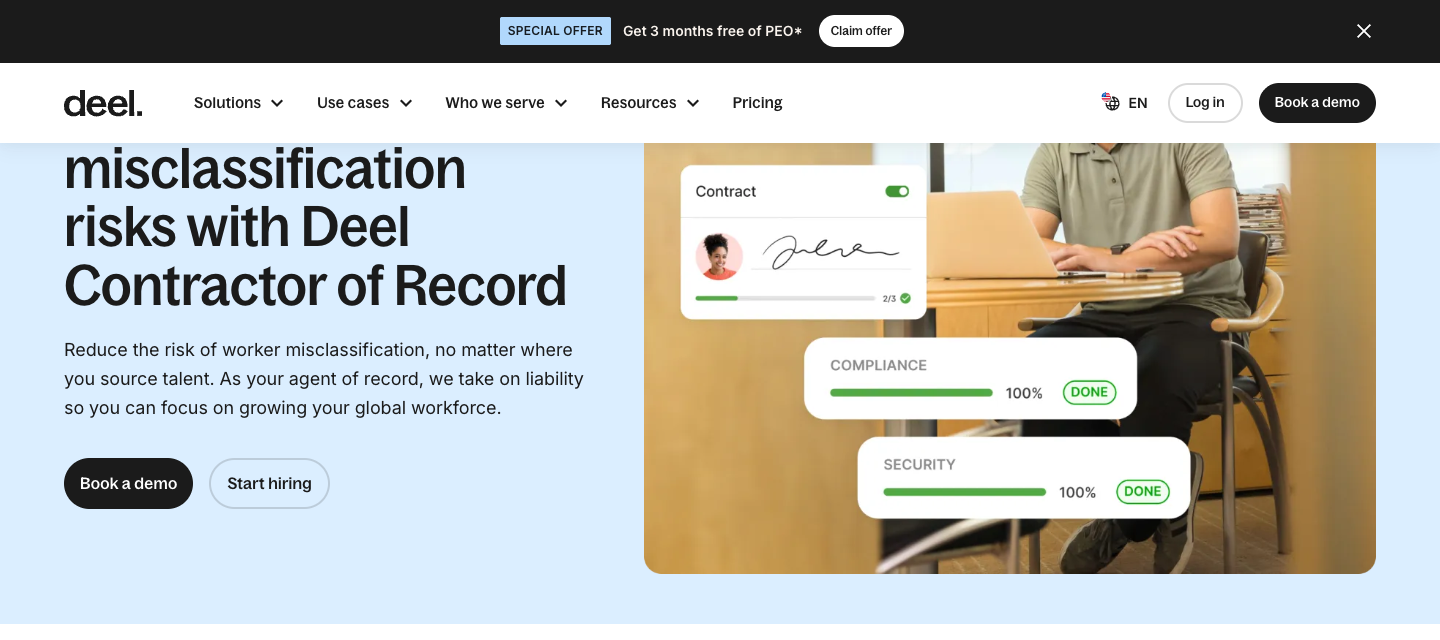
An Employer of Record is a third-party legal employer that hires an employee on behalf of a client in a jurisdiction where the client generally has no employing entity. The EOR entity signs an employment agreement, administers local payroll and statutory contributions, and supports mandatory benefits or filings within its contractual scope. The client manages the person’s everyday work and business priorities.
The distinction matters in a Deel employer of record arrangement. If the employee takes parental leave, receives notice of dismissal or earns overtime under local law, the legal employer and client must follow the agreed process. Neither a software dashboard nor a single contract template guarantees that every difficult employment issue is resolved without consultation.
Businesses looking at Deel employer of record services often want to hire quickly without setting up a foreign subsidiary. Deel advertises EOR employment across 130-plus countries on the current pricing page. Other Deel marketing pages reference broader payroll coverage, which includes services where the buyer already owns entities. Those numbers should not be treated as an identical list of supported EOR countries.
A worked example: hiring an employee in France
Suppose the US company offers an annual salary of €70,000 to a French product designer. A Deel employer of record engagement can provide a locally structured employment agreement, run gross-to-net payroll, handle employer filings and coordinate legally mandated items. But the budget is not €70,000 plus twelve times the $599 EOR service fee.
The company also needs to account for employer social contributions, benefits, paid leave obligations and any local requirements affecting total compensation. Exchange rates between the funding currency and payroll currency can move as well. The actual amount depends on country, role, compensation components and the employment agreement.
Before confirming Deel pricing, the company should request a country-specific employer-cost estimate, review it against local legal advice if the arrangement is material, and budget for changes such as annual salary adjustments and permitted reimbursements. Deel provides an employment cost calculator API for the employment-cost workflow; the interface’s results are estimates, not a substitute for binding payroll instructions.
EOR service fee versus the full employment cost
The official $599 monthly entry figure is the recurring EOR service fee, not the gross salary or the complete employer budget. Ten EOR employees at the same advertised service rate represent $5,990 a month in service charges, or $71,880 annually, before salaries, employer contributions, benefits, funding costs or additional contract obligations. Individual country pricing and negotiated agreements can change the calculation.
It is useful to evaluate that recurring amount against entity setup and annual administration. A small team distributed across five jurisdictions may favor a managed EOR; a large permanent engineering group in one jurisdiction may justify direct entity ownership. There is no universal headcount threshold that makes one approach always cheaper.
Deel EOR security deposit and termination reserve
Country-specific EOR arrangements may require an advance or refundable deposit to cover payroll and potential liabilities. There is no safely universal deposit amount that applies to every Deel employment contract. Ask whether the contract requires a cash reserve, its currency, the conditions for returning it and what happens if an employee’s final salary or severance has not yet been reconciled.
The buyer should record any refundable deposit separately from the monthly service fee and plan for the liquidity impact. A refundable amount can still tie up operating cash for months. When comparing providers, require the same assumptions and country-specific terms rather than treating one vendor’s quoted monthly fee as its total cash commitment.
🛠️ Deel Global Hiring and Payroll Features
Independent contractor agreements and payments
Deel contractor management supports service contracts, onboarding documents, invoicing and payouts through supported channels. The customer nevertheless remains responsible for confirming that the worker qualifies as independent under applicable law. Deel’s platform may provide localized templates and compliance guidance, but a template does not alter the working relationship by itself.
The published Deel contractor management cost starts at $49 per contractor per month. A team with eight independent contractors would pay $392 monthly in platform fees at that rate, excluding compensation and any transaction or conversion fees. Those fees may be reasonable when consolidated invoicing and documentation replace scattered spreadsheets, but small teams should compare their existing payment workflow.
Under Deel contractor management, each agreement should specify who owns the work product, payment milestones, intellectual property rights, confidentiality, the applicable law and the practical degree of worker independence. Ensure that invoice approval and payment funding schedules line up with those contract terms.
Deel Contractor of Record fees and responsibilities
Deel’s Contractor of Record product currently starts at $325 per contractor monthly. Its official product page describes Deel as managing classification and accepting specified liability associated with the relationship, subject to its agreement. The provider does not make local employment laws disappear, and broad marketing language should not be read as unlimited indemnification for every conceivable dispute.
The official Contractor of Record product page also describes a deposit equal to one month’s contractor compensation plus a Deel fee for each covered contract. This makes the cash needed at onboarding materially different from the $325 subscription charge alone.
For companies with long-term contractors who work under strict supervision, a classification review matters more than the price differential between the $49 and $325 products. A relationship that should legally be employment cannot reliably be made independent by changing its invoice description.
Deel worker misclassification risks
Employment status depends on actual control, economic dependence and jurisdiction-specific tests. A worker who follows the company’s employee schedule, reports to a manager and performs its core business under ongoing direction may be more likely to be considered an employee than a genuinely independent vendor serving several clients.
The June 2026 Deel classification guidance warns that misclassification can create tax, benefits and penalty exposure. We treat this as a reason to obtain local advice where facts are unclear, not a claim that Deel has a universal test guaranteed to satisfy every government.
Document any classification review and revisit it when the relationship changes. A freelance designer who starts as an occasional contractor may eventually become a full-time team member with employee-like duties. Classification should follow the actual arrangement.
Paying contractors in different currencies
Deel describes contractor payouts in 120-plus currencies through a range of available banking and local payment methods. That breadth is useful to a company working with people across several time zones. Still, the customer should confirm the exact currency, country, withdrawal rail and payment cutoff before promising an employee or contractor that money will arrive on a specific day.
When evaluating Deel international contractor payments, the accounting question is how the invoiced obligation, employer funding and contractor receipt are converted into the correct recorded values. If a contractor invoices in euros but the customer funds from dollars, a currency conversion can create an exchange difference. Fees or a provider rate margin may change the actual amount delivered.
A practical pilot involves an ordinary bank transfer, an invoice paid after its due date, a payout that needs to be recalled and a contractor who changes bank details. Verify who approves destination changes, who handles failed payouts and how the company receives evidence of settlement. Do not assume every advertised withdrawal method is available in every country.
Global Payroll for companies with their own entities

Deel Global Payroll is different from EOR. It is intended for a company that already operates an eligible local employing entity but wants to coordinate local payroll with common reporting, controls and approvals. Legal employer responsibility generally remains with the customer’s entity, while Deel provides contracted payroll administration and technology services.
According to its global payroll use case, the product unifies payroll inputs, gross-to-net results, approvals and reporting across countries. Deel also describes both self-service and managed models. Which model is appropriate depends on whether the client can maintain local expertise and review each country’s compliance requirements.
For Deel global payroll pricing, a salesperson’s quote is needed: the current main public pricing page does not list one unconditional rate for every global payroll deployment. Some third-party guides reproduce an older $29-per-worker starting figure, but we would not describe that as a currently guaranteed official price without a corresponding published offer. Request pricing per entity, worker, implementation and supported payroll frequency.
The complexity can come from variable compensation, local leave rules, benefit deductions, tax filing deadlines and how foreign currency payroll funding is settled. Good reporting needs correct source data from the HR system. The payroll provider cannot reliably calculate a bonus that the client forgot to submit before the cutoff.
Implementing Global Payroll across several countries
A company implementing payroll across three countries should appoint a payroll owner for each local entity, map job records and tax identifiers, import historical year-to-date balances, and run a parallel cycle before replacing the previous provider. The cutover period should include contingency arrangements if a bank or authority rejects a payment file.
A Deel global payroll implementation should be scoped by country rather than promised as an instant switch everywhere. Confirm who translates historic employee records, validates tax settings, reconciles the first payroll journal and handles reporting corrections. The time needed for validation may be more important than the software screen count.
Deel’s publicly documented API supports submitting bonuses, deductions, shifts and worker information, and retrieving gross-to-net reports. The documentation explains an integration capability; it does not prove every payroll country has identical API coverage, certification requirements or error resolution times. A technical team should test the particular endpoints and permissions it plans to use.
Tax filing, benefits and local compliance
EOR employment brings mandatory employer obligations. The scope may include national insurance contributions, pension arrangements, paid leave entitlements and required local filings. Some countries also require specific contract clauses, termination processes or works-council consultation in certain situations.
To understand Deel employer taxes by country, request a cost statement showing the salary, applicable employer contributions, statutory benefit costs and any service fees. A standard percentage applied indiscriminately to every country can produce a misleading budget. Compensation changes, employee status and local legislation can alter totals after onboarding.
A US startup hiring in Germany and Brazil should not expect the same pay schedule, tax basis or employment termination process in both places. HR should coordinate with qualified local advisers when issuing a complex offer or considering an involuntary dismissal.
US PEO versus international EOR
Deel’s current pricing page lists US PEO from $125 per employee monthly. Professional Employer Organization services are structured around co-employment for companies with a US legal employing entity. By contrast, international EOR service is intended to employ someone through the provider’s local entity when the customer lacks one.
It would be incorrect to recommend a $125 PEO arrangement as a substitute for a $599 EOR employment relationship abroad. Legal structure and location determine which solution can apply. The buyer should also confirm whether benefits administration, insurance and payroll functionality are included in the quoted base price or billed separately.
Hiring, HR records and workforce operations
The main pricing table also advertises a talent-finding service from $14 per worker monthly. That is a different product from EOR or payroll. It can support job postings, candidate evaluation and onboarding workflows, but using it does not automatically create a local employment relationship or pay the successful candidate.
Deel offers additional HR and workforce functions through several product lines. Before committing, a buyer should map its existing ATS, HRIS, identity management and finance systems and identify which records need to flow between them. Avoid buying duplicate HR software only because it appears alongside payroll in the same platform.
💰 Deel Pricing 2026: EOR, Contractors, Payroll and PEO
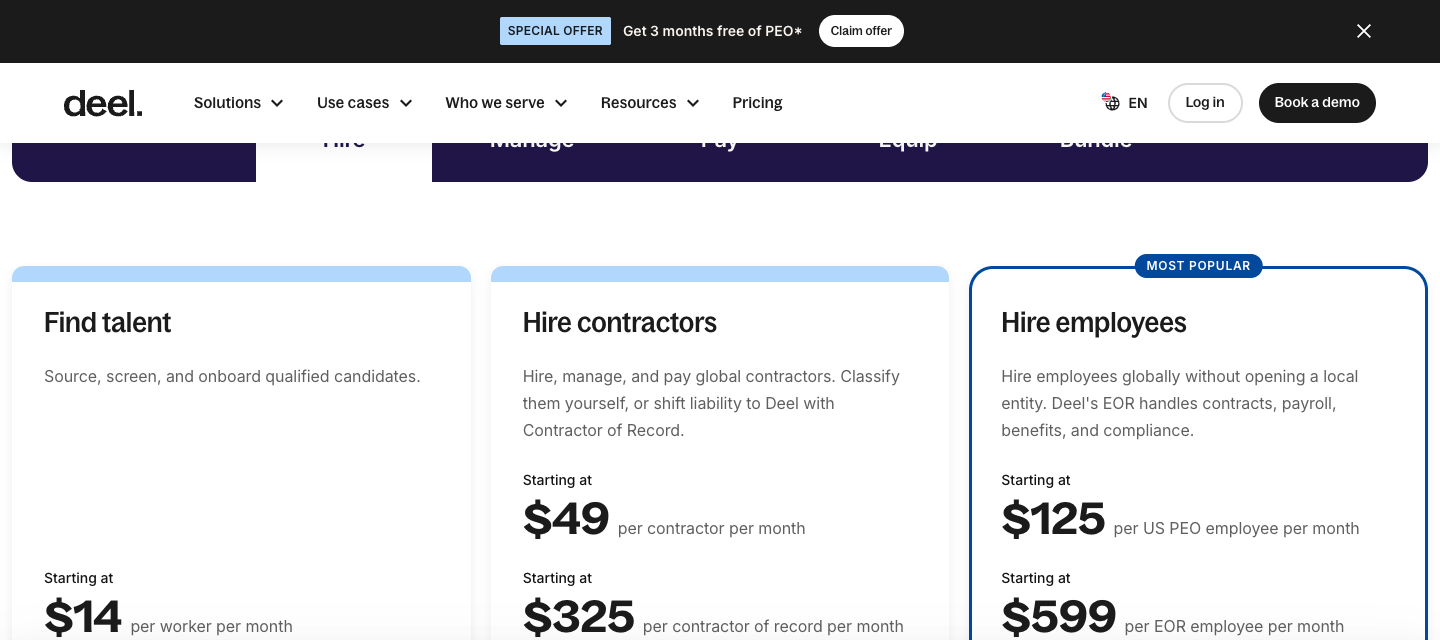
The current Deel pricing page separates hiring models. These entry prices should be read as service fees or software fees, not as worker compensation or all-inclusive employer budgets.
| Deel service | Published starting price | Main purpose | What is outside the headline |
|---|---|---|---|
| Contractor management | $49 per contractor/month | Agreements, invoices and payments for independent providers | Contractor compensation, applicable payout/FX costs, classification responsibility |
| Contractor of Record | $325 per contractor/month | Managed contractor relationship and contracted classification liability | Contractor pay, one-month compensation deposit plus Deel fee, specific contract limits |
| Employer of Record | $599 per employee/month | Legally employ an overseas employee through an EOR entity | Salary, statutory employer taxes, benefits, deposits and variable country costs |
| US PEO | $125 per employee/month | Co-employment and HR support for US workforce | Wages, benefits or other items identified in the final agreement |
| Talent sourcing | $14 per worker/month | Recruiting and candidate workflow | EOR, payroll and recruiting services beyond the subscribed scope |
| Global Payroll | Request a quote | Payroll administration through the buyer’s own entities | Local payroll funding, entity-specific implementation and contract variables |
The real cost of one international EOR employee
Imagine a company hires an employee for the equivalent of $60,000 annually. The service fee at the published EOR entry rate is $7,188 per year. Those figures imply $67,188 before employer taxes, social contributions, benefits, deposits, currency conversion and other additional items. They do not establish the complete cost of employment.
A Deel employer of record hiring budget should separate recurring compensation from refundable reserves, one-off onboarding expenses and conditional future costs. The employer may also need to fund severance or legally mandated end-of-employment items, depending on the jurisdiction and contract.
To understand Deel EOR pricing per employee, ask the vendor to show a full country-by-country financial schedule with currency assumptions and an estimate of required funding. Treat every unsupported universal percentage as a starting hypothesis, not a reliable cost forecast.
Realistic subscription comparisons for different teams
A team using Deel contractor management for twelve self-classified contractors would face $588 a month in management fees at the public $49 rate. Twelve EOR employees at the $599 entry service rate represent $7,188 per month before compensation and local employment costs. The difference reflects radically different responsibilities, so it cannot be interpreted as an EOR markup on an otherwise identical service.
| Team scenario | Monthly service component | Annualized service component | Not included |
|---|---|---|---|
| 3 contractors at $49 | $147 | $1,764 | Contractor invoices, conversion, bank fees |
| 10 contractors at $49 | $490 | $5,880 | Contractor invoices, conversion, bank fees |
| 3 EOR employees at $599 | $1,797 | $21,564 | Wages, local employer costs and deposits |
| 10 EOR employees at $599 | $5,990 | $71,880 | Wages, local employer costs and deposits |
| 5 Contractor of Record at $325 | $1,625 | $19,500 | Contractor invoices and required reserve |
These Deel pricing calculations use public starting rates, not binding quotes. A quote may include country-specific pricing, committed volumes or product combinations. Never combine employee headcount with contractor headcount in a single price-per-seat calculation without specifying the subscribed service for each worker.
Security deposits, exchange rates and other fees
The most important question about Deel pricing is not simply whether a service costs $49 or $599. It is what cash leaves the business before the employee or contractor receives funds. Funding requirements can include the underlying payroll amount, an advance reserve, taxes and the provider’s service fee.
Some international payments use exchange rates that may include a markup. Deel’s main public pricing table does not provide one binding foreign-exchange margin for every currency and funding method. Request a sample invoice for each planned currency and identify whether the amount paid to the worker is guaranteed in the contract currency.
| Cost category | Why it matters | What to request in writing |
|---|---|---|
| Monthly Deel service fee | Recurring license or managed-employment charge | Itemized rate by worker type and country |
| Salary or contractor invoice | Primary amount owed to the worker | Payment currency, cutoff and net/gross terms |
| Employer taxes and benefits | Legal employment obligations beyond salary | Country-specific statutory estimate |
| Deposit or payroll reserve | Cash tied up before or during employment | Amount, holder, permitted offsets and release timing |
| Currency conversion | Potential mismatch between funding and payout | Exchange rate rule and any margin |
| Termination and transition | Costs at the end of an arrangement | Notice, unused leave, final pay and record export provisions |
A prudent finance team also asks how unexpected legal changes, retroactive payroll corrections and refunds are handled. If a mandatory benefit rate increases in the middle of a subscription, a flat platform price does not guarantee employment costs remain fixed.
⚖️ Deel vs Remote, Papaya Global, Rippling and Local Payroll Providers
A Deel vs Remote decision changes with the underlying legal arrangement. Deel and Remote are commonly shortlisted for Employer of Record service and contractor operations. Papaya Global focuses on worldwide workforce payments and payroll services. Rippling emphasizes the connection between HR, IT and payroll. A local payroll bureau can be more suitable for a company that operates within one country and already owns the employing entity.
| Provider | Main relevant capability | Good fit | Check before committing |
|---|---|---|---|
| Deel | EOR, contractor management, Contractor of Record, Global Payroll, US PEO | Company operating across several worker models and countries | Worker type, service fee, local costs, deposits and actual supported country |
| Remote | Global EOR, contractors and payroll capabilities | Buyer wanting a country-specific EOR proposal or simpler workforce model | Direct-entity versus partner model, support, deposit and final quote |
| Papaya Global | Managed payroll and global workforce payments | Organizations coordinating existing international payroll operations | Implementation, entity support, funding workflows and contracts |
| Rippling | HR, payroll, device access and IT workflows | Employer seeking workforce administration and software provisioning together | Availability of required country payroll, local legal entity and extra modules |
| Local specialist | Direct accounting, payroll and employment support | Company employing staff in one jurisdiction through its own entity | Local expertise, statutory filings, reliability and exit terms |
Deel and Remote: compare the same offer
An honest Deel vs Remote EOR comparison should test the same hiring scenario: a full-time employee in the same country, identical salary and benefits, the same contract length and the same anticipated termination conditions. Without those shared assumptions, service fees alone say little about the actual employer cost.
A meaningful Deel vs Remote comparison requires written employment-cost proposals from both providers. They should identify the legal employer, hiring lead time, payroll funding schedule, standard benefits, statutory leave, security deposits, data export and which support staff handle a dispute. A provider with a cheaper listed fee may require a higher reserve or provide less of the work you expected.
Customer service quality matters when a worker does not receive a correct payslip or a local authority requests documents. Ask about escalation paths and which legal specialists are available before deciding based on an attractive demo.
Deel versus Papaya Global for payroll
Papaya may be attractive when the buyer’s primary need is consolidating payroll across entities and reconciling international funding rather than employing a handful of staff in countries where it has no entity. Deel has both EOR and Global Payroll options, so the comparison should first establish who is legally employing the workers.
Test whether each provider can reproduce historical year-to-date data, report local gross-to-net amounts and export payroll accounting journals with useful entity or department dimensions. A payroll provider offering a consolidated dashboard but no reliable correction process will still require substantial manual work.
Deel versus Rippling for HR and IT
Rippling’s strengths can include identity and device administration coordinated with employee events. That may matter to a distributed engineering company requiring prompt onboarding and access revocation. Deel also offers workforce operations tools and integrations, but the buyer should compare the exact subscribed modules rather than assume identical features.
If an employee leaves, the company must both complete lawful payroll termination and withdraw access to devices, code repositories and vendor accounts. Those are linked workflows, but the local employment and IT obligations are still separate. Define ownership for both.
✅ Deel Pros and Cons
Pros
Flexible hiring models for employees and contractors, localized onboarding, payroll infrastructure and multi-currency payouts.
Cons
Total worker costs exceed subscription fees; deposits, entity obligations, currency conversion and country-specific exits require review.
Strengths: Broad choice of worker models; a recognizable public starting price for contractor management, Contractor of Record, EOR and US PEO; localized onboarding and managed country expertise; multi-currency payouts and unified workforce records; options for companies that do or do not own foreign employing entities.
Weaknesses: EOR is costly when viewed over multiple years and employees. The initial service fee is not the entire employment budget. Some country arrangements involve deposits, and the currency conversion terms can vary. A company with many workers in one jurisdiction may have better economics through its own entity. Workflow complexity increases when multiple products or country exceptions are combined.
The quality of a global employment provider is most visible when something goes wrong: a delayed payment, a change in tax status, a parental leave question or an employee termination. Product screenshots do not establish how these situations will be handled. Buyers should request written response commitments, understand liability allocation and identify the person authorized to resolve a payroll problem.
🎯 Who Should Use Deel?
Strong candidate: A US or European software company hiring several employees across jurisdictions where it has no employing entity, while also maintaining an international contractor workforce. The mixed product catalog could reduce fragmentation if the contracts and country requirements align.
Contractor-only buyer: A company paying independent designers, developers or consultants internationally that needs agreements, invoices and records in one place. The $49 product can be evaluated before moving into an EOR or Contractor of Record relationship. Classification still requires attention.
Global payroll candidate: An established multinational with employing entities that wants to coordinate local payroll reporting. Request managed versus self-service operating models and a detailed implementation proposal; do not use the EOR rate as a proxy for payroll outsourcing.
Potentially poor fit: A one-country business with a reliable domestic payroll service, a team of only one or two independent contractors using uncomplicated domestic transfers, or a large permanent operation in one market where direct entity ownership is already economical.
🧪 How We Reviewed Deel
We checked the Deel published pricing, Employer of Record cost API documentation, Contractor of Record product terms, worker classification guidance, global payroll documentation and payroll API overview.
These sources confirm service categories and several public price points. They do not let us independently determine a particular worker’s employment status, a country-specific employer tax total, every deposit amount or a binding FX spread. Where prices are quote-only, this article says so instead of repeating unsupported third-party claims as guaranteed rates.
We also examined public reviews and comparisons for the questions buyers repeatedly raise about onboarding, worker classification, the legal employing entity, account support and the full cash cost. Third-party estimates are not substitutes for a provider quote or local legal and payroll advice.
The images are official Deel public website captures and illustrative product materials, not authenticated views of an actual client’s employee records. We did not run a salary calculation, test a withdrawal or verify claimed payroll-time savings independently. Do not use this editorial article as personalized legal or tax advice.
🏆 Final Verdict: Is Deel Worth the Cost in 2026?
Our Deel review finds the platform worth considering when cross-border hiring creates a genuine legal and administrative problem. The appeal is access to multiple employment models and a centralized system for onboarding, payments and reporting. A company hiring in three different countries might reasonably value that coordination more than a small difference in software license fees.
The published $49 contractor and $599 EOR figures describe different services, not competing ways to pay the same worker. The right arrangement depends on local employment law and the actual relationship. The $325 Contractor of Record product uses a managed classification model, but its deposit and liability terms require attention. For Global Payroll, the buyer should obtain an individualized quote rather than rely on an outdated third-party entry figure.
We would compare Deel with Remote for EOR employment, and with payroll specialists when the company already has foreign entities. Ask each bidder for the same salary, country, benefit assumptions and written responsibility matrix. Include all employer taxes, benefits, funding deposits, currency conversion and termination provisions.
If those details fit your legal structure and cash flow, Deel may offer worthwhile operational value. If the company mainly needs a simple local payroll run, the breadth of features is unlikely to justify buying a global employment platform.
Deel Review 2026: Frequently Asked Questions
How much does Deel cost in 2026?
Deel lists contractor management at $49 monthly, Contractor of Record at $325 monthly and Employer of Record at $599 per employee monthly. US PEO starts at $125. Global Payroll requires a quote on the main pricing page.
What is Deel Employer of Record?
An EOR employs an international worker through the provider local legal entity when the hiring business generally has no employing entity in that country, and administers specified local payroll and employment obligations.
Is the $599 EOR price all-inclusive?
No. The recurring service fee is separate from gross salary, employer taxes, mandatory benefits, deposits where required and applicable foreign exchange or contract costs.
What is the difference between Deel Contractor and Contractor of Record?
The $49 management plan helps businesses handle self-classified contractors. The $325 Contractor of Record plan adds a managed classification arrangement and contracted liability allocation, with a required contractor-pay deposit on the public product page.
How much is Deel Global Payroll?
The current main pricing page does not give one universal public price. Request an entity- and country-specific proposal, including implementation, managed support and payroll funding arrangements.
Does Deel let me hire without creating a local entity?
The Employer of Record model can hire through a qualifying local EOR entity in supported jurisdictions. Contractors and Global Payroll have different legal arrangements and responsibilities.
Is Deel Contractor of Record legally risk-free?
No. The provider describes assuming certain classification responsibilities and liability under contract, but actual worker facts, local labor law and the agreement still matter.
Does Deel charge currency conversion fees?
Currency conversion and payout costs depend on funding currency, payout method and the agreement. Request an itemized exchange rate and margin for each planned currency.
Does Deel include employer taxes and health benefits?
Employment obligations depend on country. Employer-side taxes and statutory benefits can be administered by the provider but remain costs beyond the advertised monthly platform fee.
How does Deel compare with Remote?
Both offer global employment services. Compare the same country and salary scenario, supported local employing entity, full fees, deposit terms, benefits, data export, support and termination provisions.
EXPLORE NEXT ON DIGIOFFLY
What to explore after Deel
Compare payroll, contractor management and finance software based on legal structure and total recurring cost.
Finance comparisons
- Explore our Finance software hub — Review banking, accounting, payroll and expense platforms.
- Browse the full software directory — See the wider catalog and existing reviews.
- Remote review — Compare global EOR fees and contractor options.
- Gusto review — Review domestic payroll alongside international hiring.
Compare total ownership costs
- Estimate recurring software costs — Separate monthly fees from annual commitments and transaction charges.
- Compare software side by side — Check capabilities and the unknowns before subscribing.
Keep researching
- Find software for your workflow — Shortlist tools by concrete business needs.
- Read our research methodology — See how public vendor documentation is interpreted.