

Vendor information reviewed 2 November 2026. Plan details and known add-on charges are explained in the pricing section, with a direct link to the source. Current vendor pricing.
Editorial disclosure: This is a software and pricing research draft based on the linked vendor documentation, not a claim of a completed personal product benchmark or trading outcome. We do not provide investment, financial or tax advice.
FX Replay is organized around historical decision practice rather than live brokerage execution. The important question is whether a trader can rehearse a written setup across enough unfamiliar dates without seeing future price information. A clean playback interface is useful, but the method of selecting sessions and recording invalid setups determines whether the resulting exercise teaches anything.
We can assess the published plan limits and explain a reproducible research protocol, but that is not equivalent to independently executing hundreds of replay trades. Any reported profits from an illustrative scenario would need disclosed dates, costs, risk assumptions and a fixed rule version. The material here therefore treats the simulator as a practice instrument rather than a verified source of trading returns.
📊 FX Replay Review Summary
Best-fit use: Backtesting & Trading Journals. Pricing model: free entry tier and optional paid plans. Check the full pricing breakdown below.
Beginner may be enough to learn the replay controls, while a user planning a larger sample could need the extra sessions, history and resolution of a paid tier. The value of seconds-level data depends entirely on the time horizon of the strategy. Someone trading daily closes should not upgrade solely because a higher plan shows more granular price movements.
⚡ Quick Verdict: Is FX Replay Worth It?
The practical distinction for FX Replay is between session-based historical practice and structured trade review and what a user can validate from the selected plan. The decisive caveat is historical simulations do not execute live brokerage orders. Compare that with TraderSync before making an annual commitment.
The relevant comparison is often between FX Replay as a practice workspace, TradingView's more general chart playback and a separate journal for real orders. A good selection follows the actual task: reconstructing hypothetical decisions, analyzing charts or reconciling executions. Combining these activities into a single win-rate figure would blur distinctions that matter to risk and performance analysis.
🧠 What Is FX Replay?
FX Replay is a platform in the Backtesting & Trading Journals software category. Its relevant published capabilities include session-based historical practice and structured trade review; trading journal, checklists and recorded trade review; multi-chart and custom-timeframe options depending on plan; higher tiers offer more sessions, deeper data and retention. This makes it part of the broader trading-software stack, but it should not be confused with a guarantee of successful trades, a regulated investment recommendation or a substitute for evaluating market-data licensing.
A suitable FX Replay buyer has a defined task: practice twenty previously unseen setups under one entry and exit policy. A person needing multi-chart and custom-timeframe options depending on plan may face a different licensing decision from someone who only reads weekly research. Name the instrument, expected export and budget before choosing a subscription tier. This avoids comparing products with different purposes as though their feature lists were directly interchangeable.
🖥️ Interface, Data and Day-to-Day Workflow
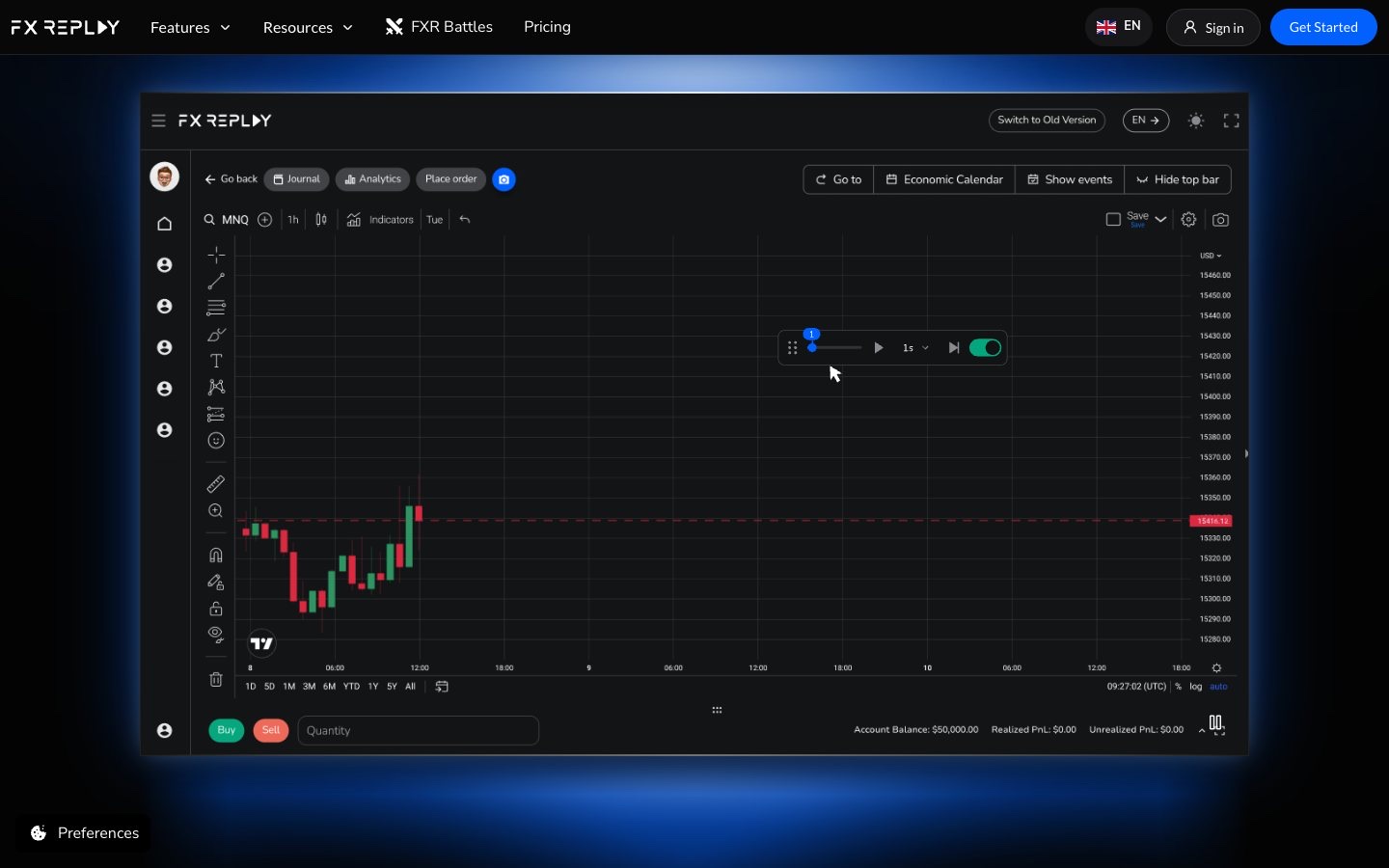
Follow the FX Replay workflow from the input to the reported result. Start with check historical candle clocks against the chosen timezone; then record whether the output makes use of session-based historical practice and structured trade review. If the data comes from another exchange, wallet or account, note that dependency explicitly. A screenshot can help explain the screen but does not independently verify the accuracy of every value it contains.
For FX Replay, start with a constrained project: practice twenty previously unseen setups under one entry and exit policy. Then check historical candle clocks against the chosen timezone. Treat that as a repeatable acceptance test, not as a trading system. If the result depends on a feed, exchange or report format that is absent from your plan, do not infer that the paid tier will fix it without verifying the entitlement.
🧭 How to Evaluate FX Replay Before Subscribing
1. Replay twenty historical setups with consistent entry and exit rules
Evaluation note: Before starting this check, record the chosen instrument and session zone. Inspect whether saved settings remain consistent when the platform is reopened. Any mismatch should be described with an exact timestamp rather than dismissed as user error.
2. Validate chart timestamps and time-zone handling
Evaluation note: Run this check against a defined sample and record the limits of the account tier. If the feature is unavailable, note the subscription level rather than treating it as a software malfunction.
3. Check whether replay includes sufficient historical sessions for selected markets
Evaluation note: Keep a dated copy of the source input and the result. When external exchange or wallet data is involved, document that dependency so the same exercise can be attempted again.
4. Record commissions, spread and missed fills separately
Evaluation note: Compare the output with a second method or a manually checked subset. Explain any disagreement before using the result in a recommendation; a successful screenshot alone does not establish data accuracy.
🛠️ Key Features and Real-World Fit
✓ Historical replay sessions for strategy rehearsal
session-based historical practice and structured trade review: the practical question for FX Replay is whether a user can practice twenty previously unseen setups under one entry and exit policy. Compare the documented output with TraderSync where appropriate, and check historical simulations do not execute live brokerage orders before treating the feature as a subscription benefit.
✓ Trading journal, checklists and recorded trade review
Trading journal, checklists and recorded trade review: the practical question for FX Replay is whether a user can check historical candle clocks against the chosen timezone. Compare the documented output with TradingView where appropriate, and check data coverage varies by instrument, feed and subscription before treating the feature as a subscription benefit.
✓ Multi-chart and custom-timeframe options depending on plan
Multi-chart and custom-timeframe options depending on plan: the practical question for FX Replay is whether a user can check whether replay includes sufficient historical sessions for selected markets. Compare the documented output with Forex Tester where appropriate, and check historical hindsight and order fills can make results appear optimistic before treating the feature as a subscription benefit.
✓ Higher tiers offer more sessions, deeper data and retention
Higher tiers offer more sessions, deeper data and retention: the practical question for FX Replay is whether a user can record commissions, spread and missed fills separately. Compare the documented output with TraderSync where appropriate, and check historical simulations do not execute live brokerage orders before treating the feature as a subscription benefit.
⚠️ Limitations and Accuracy Risks
- Historical simulations do not execute live brokerage orders
- Data coverage varies by instrument, feed and subscription
- Historical hindsight and order fills can make results appear optimistic
For FX Replay, the warning about data coverage varies by instrument, feed and subscription deserves a concrete example before publication. Check check whether replay includes sufficient historical sessions for selected markets. If this fails, identify whether the cause is a missing plan entitlement, incompatible input or out-of-date documentation. Do not substitute a generalized claim that all platforms are unreliable, because the specific limitation is what helps a buyer.
💰 FX Replay Pricing and Total Ownership Cost
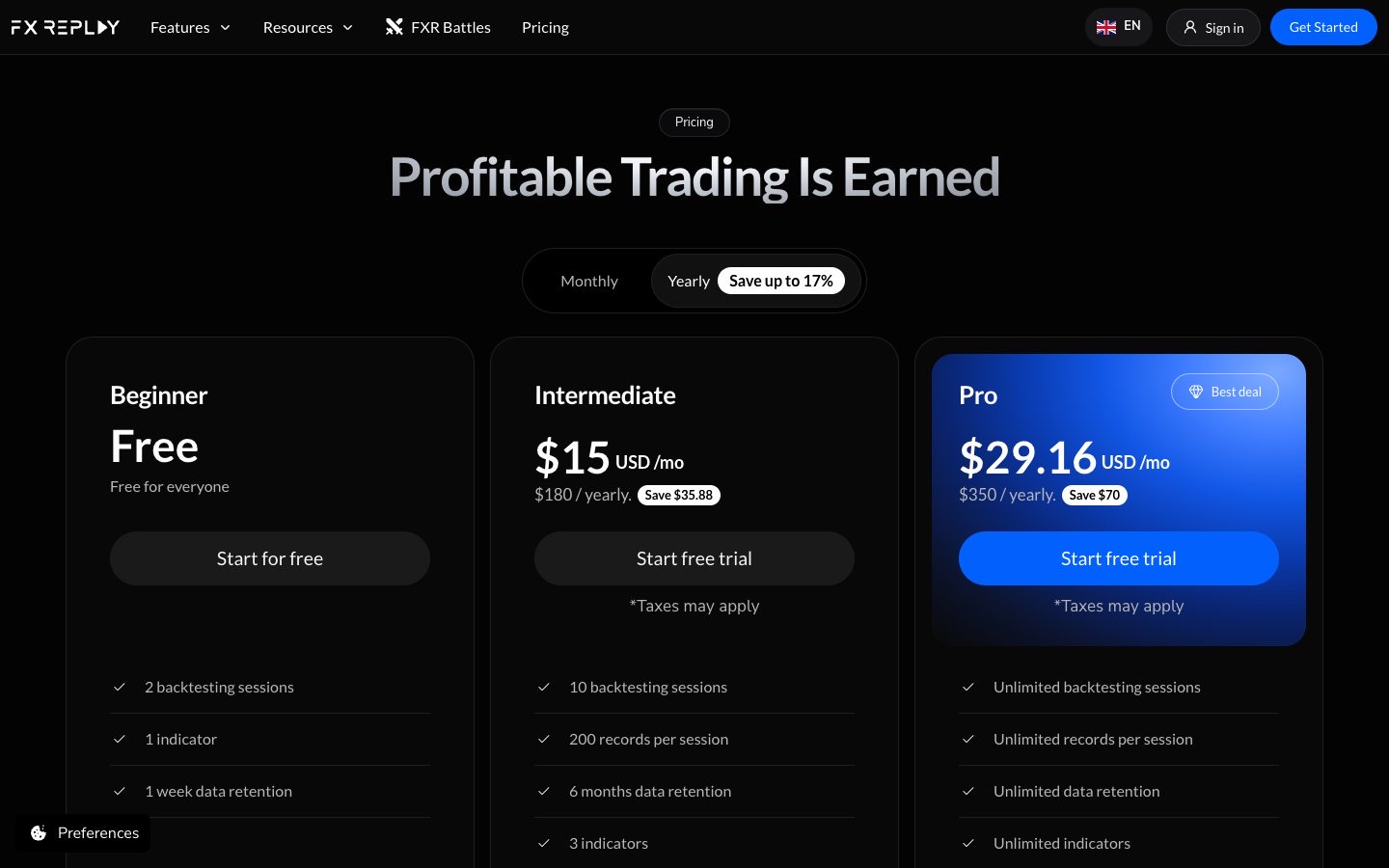
FX Replay lists Beginner free with two backtesting sessions and one-week retention; Intermediate costs $17.99/month or $180/year; Pro costs $35/month or $350/year, with broader limits and seconds-level data. Taxes can apply.
Build the FX Replay budget from the vendor’s current plan page, the required feature session-based historical practice and structured trade review and any data or report limits connected to historical simulations do not execute live brokerage orders. Compare the actual monthly checkout against the yearly amount paid up front. Where an API or third-party licence is required, treat that as a separate cost rather than an included benefit. Set a calendar reminder for renewal, but do not assume a discounted first year will repeat.
| Cost question | What to verify | Why it matters |
| Billing cycle | Monthly and annual checkout totals | Effective monthly rates can require a year of commitment |
| Data access | Asset coverage, exchange entitlements and history | A missing feed may invalidate your workflow |
| Usage caps | Charts, alerts, exports, API calls or transaction counts | Limits can interrupt an otherwise useful test |
| Commercial rights | Personal, team or commercial data usage | A personal plan may not permit publishing or redistribution |
| Cancellation | Trial conversion and renewal date | Avoid paying for an unused tool |
🎯 Who Should Use FX Replay?
The strongest potential fit is someone actively working on backtesting & trading journals, with enough regular use to justify the subscription. That person should be able to identify a specific recurring problem, choose a success metric and confirm access to the correct data and export format.
FX Replay is less attractive when a buyer does not regularly use trading journal, checklists and recorded trade review or cannot explain the information needed from practice twenty previously unseen setups under one entry and exit policy. The interface may be extensive without producing a useful record. In that situation, a free chart, a spreadsheet or a narrower competing product can be sufficient. The useful comparison is actual work completed against total annual cost, not the number of dashboards.
⚖️ FX Replay Alternatives and Comparisons
| Platform | Primary decision dimension | What to check |
| FX Replay | Backtesting & Trading Journals | Vendor plan features, data coverage and total cost |
| TraderSync | Different approach to the same task | Workflow and data comparability |
| TradingView | Specialised research or journal tools | Integration and output needs |
| Forex Tester | Complementary tool or workflow | Whether it replaces or supplements the stack |
Compare FX Replay against TraderSync with the same instrument, historical window and output requirement. A second candidate such as TradingView may solve only one part of the process. If the job is check historical candle clocks against the chosen timezone, record which product completes it with fewer undocumented assumptions. Comparing a journal to a screener simply because both concern markets does not establish that one is superior.
🔎 FX Replay in Practice: Detailed Research Notes
A realistic research session
An FX Replay trial should be treated like a small research study. Choose one pair, one session window and a short list of written entry rules before loading historical data. Restart the session on a date you have not studied, then hide subsequent bars and make decisions as information arrives. Include the setups you decline, not only the hypothetical trades you take. If the strategy depends on a five-minute reversal after a higher-timeframe liquidity event, record whether the relevant one-hour and daily structure was available at the replay point. The value of the software comes from consistency of practice, not from producing a smooth simulated equity curve.
Which features change the work?
FX Replay’s core workflow is historical playback, session management and record keeping. Beginner offers a small number of sessions, whereas the paid tiers expand charts, indicator capacity, history and retention. The session archive is important: a short practice burst can be useful, but serious evaluation requires enough diverse market periods to avoid learning one week’s price path by memory. A multi-chart view can help align context with execution, provided the chart clocks and candles are synchronized. The user should be able to explain the result of each test in terms of entry, invalidation, risk and the market condition at the time.
Market data, definitions and timing
The quality of any replay depends on historical price coverage, resolution and session timestamps. FX Replay describes standard market data on Intermediate and expanded data including seconds-level intervals on Pro. Verify actual supported instruments and selected historical dates rather than inferring that every currency pair has the same history. A strategy relying on news spikes may need finer granularity than one using daily closes. If a simulated stop is crossed inside a candle, the platform’s fill model could matter more than the visual accuracy of the chart. Spread, commissions, swaps and slippage should be recorded separately whenever the simulator does not model them in the same way as a broker.
The subscription decision
The official FX Replay pricing page lists a free Beginner plan with two backtesting sessions and one-week data retention. Intermediate is $17.99 on monthly billing or $180 for a year; Pro is $35 monthly or $350 annually. These annual commitments translate into lower effective monthly costs but should not be compared with a truly cancellable monthly plan as if they were identical. A new learner may only need the free session allowance to understand replay controls. Someone testing a rule across dozens of market days may run into session or retention limits quickly. Check renewal terms and regional taxes before upgrading.
How it compares with alternatives
TradingView’s Bar Replay can be convenient for a charting user who occasionally reviews historical bars. FX Replay targets a more deliberate practice experience with repeatable simulation sessions and trade logs. Forex Tester may be relevant for a dedicated historical testing setup, while TraderSync addresses the analysis of recorded trades and offers its own replay capabilities on higher tiers. The correct choice depends on whether the primary work is drawing and analyzing charts, repeating historical decisions, or reconciling actual brokerage results. Running twenty defined test cases tells you more than comparing the products’ marketing screenshots.
Where an attractive dashboard can mislead
The chief risk is hindsight disguised as discipline. If you know a particular month contained a strong trend, you may unconsciously favor entries that fit that memory. Select dates without previewing the chart and keep a log of skipped opportunities. Do not quietly shift a stop after the simulated trade loses. Use the same risk unit and cost assumptions across sessions. A profitable simulation with a handful of trades has little statistical weight, and it cannot prove that equivalent orders would be filled under real liquidity conditions. Treat the results as practice evidence, not a performance promise.
🔍 Related FX Replay Questions Worth Checking
Start with FX Replay Beginner limits: the number of available sessions and data retention may be sufficient to learn the interface but not to study several market regimes. The FX Replay Intermediate vs Pro decision becomes more concrete when you know whether finer replay resolution or extra sessions are essential. This is forex backtesting software for practicing defined rules, not a guarantee of future fills.
A proper FX Replay futures data review would check contract coverage, timestamps and how historical rolls are represented. The FX Replay bar replay process should hide future candles and force decisions at the simulated moment. That matters much more than the size of a positive hypothetical balance at the end of a practice session.
An FX Replay historical trading simulator should allow you to record entries you reject, not only trades you choose. The value of the FX Replay trade journal comes from a consistent link between rules, timestamps, position sizing and the market context. Without those records it is too easy to mistake hindsight for a repeatable setup.
Compare FX Replay pricing yearly with the monthly terms for your expected testing horizon. The usefulness of FX Replay seconds data depends on whether the rule being examined requires intrabar granularity; a daily strategy and a rapid reversal strategy have different needs. An FX Replay Pro upgrade is justified only by an identified limit of the cheaper plan.
For FX Replay forex testing, document the chosen broker assumptions, spread, commission and session zone. An FX Replay TradingView comparison should distinguish a dedicated simulation workflow from a general charting platform with replay features. A user assessing FX Replay free access can start by checking whether the entry-level sessions support a meaningful first exercise.
🔬 FX Replay — Practical Product Analysis
Designing sessions that do not reward hindsight
A useful FX Replay exercise begins with a rule, a random or previously unseen historical date, and a clearly defined session. Hide future bars and decide whether to act only when the specified information exists. A setup based on a liquidity sweep, displacement and retest should record which confirmation was present at each candle close. If the final confirmation never arrives, mark the opportunity as canceled rather than inventing an entry in hindsight. This practice is more instructive than scrolling to a known winning trade and reconstructing an attractive explanation. Keep unsuccessful and skipped cases alongside winning simulations to avoid a selectively positive record.
Risk needs to be the same across sessions to make results comparable. Record a predetermined stop rule, position-sizing method, spread assumption and reason for invalidation. A simulated stop touching a historical level does not tell you the exact price at which a broker would fill in a live market. Particularly around major economic releases, spreads and available liquidity may differ sharply from the replay model. The software can help a trader rehearse decisions and build a consistent record, but even a long run of profitable replays cannot guarantee that live execution will match the historical result.
Time resolution and the paid plan
FX Replay offers a free Beginner plan with limited sessions and retention, while Intermediate and Pro provide broader historical practice capabilities. The previously verified reference prices were $17.99 per month for Intermediate and $35 for Pro, with annual billing options. A strategy using daily or hourly closes has different data requirements from a system that acts seconds after a news event. Buyers should verify the history, supported pairs, session allowances and granular timestamps on the chosen plan. An upgrade is worthwhile if those particular limitations prevent a meaningful test; paying for a more detailed feed is unnecessary if the method never uses that level of precision.
A multi-chart replay is useful only when the chart clocks agree. For example, the daily bar of an FX pair can close at different times depending on the data provider's session conventions. If a plan depends on previous-day highs or lows, inconsistent daily candles can create apparent changes in the rule. The same problem becomes more complex in futures when a continuous contract is built from rolling expirations. Each practice log should identify the symbol, source, selected interval and timezone so an analyst can understand any discrepancy with a brokerage chart.
Replay compared with a trade journal
FX Replay and TradingView's Bar Replay overlap on visual historical practice, but FX Replay is oriented toward structured sessions and review notes. TraderSync, in contrast, is primarily valuable for reconciling actual trading records, even though it offers separate replay capabilities. A beginner may only need a small number of free sessions to learn the controls, whereas someone studying dozens of different market regimes will run into retention and history limits. Decide whether the objective is rehearsing hypothetical choices or analyzing real orders: they are different datasets, and neither function substitutes for the other.
A disciplined benchmark could cover a set of twenty unfamiliar sessions across trend, range and volatile periods. Note the missed fills, canceled setups and costs rather than reporting only a final profit figure. Do not adjust the rule after each losing date and then combine all sessions as if they came from one unchanged model. The useful product outcome is an auditable decision journal with timestamps and reasons for actions. Any claimed edge requires independent testing beyond the replay interface.
Further decision considerations
One useful research protocol is to select dates from at least two market regimes before starting: quiet sessions with small ranges and volatile sessions with unusually wide moves. Use the same entry and invalidation rules for both samples. Record whether the simulator's price feed includes sufficient history for the intended pair, and note if your trade would have crossed a spread or price gap the playback does not resolve. This is more credible than searching backward until a few attractive winners appear. It also helps distinguish a strategy that relies on a particular market environment from one that is actually applied consistently across varied conditions.
One More Practical Research Consideration
Session clocks deserve an explicit note when a trader studies a London or New York opening. Daylight saving changes can shift the relation between local time, UTC and a broker's chart candles, and not every historical data provider handles weekend boundaries identically. A setup recorded as occurring at a particular clock hour may therefore require conversion before comparison with another platform. The session record should state the time zone and selected calendar date, including any DST transition. This prevents an apparent strategy failure from actually being a mismatch in bar alignment and makes later reviews possible without relying on memory.
🧪 How DigiOffly Evaluates This Software
- Replay twenty historical setups with consistent entry and exit rules
- Validate chart timestamps and time-zone handling
- Check whether replay includes sufficient historical sessions for selected markets
- Record commissions, spread and missed fills separately
For FX Replay, our proposed test log includes the plan used, the date, the evidence for check whether replay includes sufficient historical sessions for selected markets, and any constraint from historical hindsight and order fills can make results appear optimistic. These are proposed checks; our current documentation does not establish the results of an independent benchmark. A legitimate revision should link the screenshot, the source record and a clear description of what was and was not verified.
🏆 Final Verdict: FX Replay Software Review
FX Replay deserves consideration when its specific features address a documented research or workflow requirement. The main decision remains practical: can you reproduce the result with the data and access included in the plan, and is the recurring cost lower than the time and errors the software can reasonably prevent? FX Replay addresses a narrow, important workflow: practicing the exact same rule set across historical sessions. It should be evaluated by session availability, data granularity and journal export, not profitability claims. A discipline-focused reviewer should record starting balance, risk policy, commissions and expected slippage outside the playback environment where necessary.

Frequently Asked Questions
What does FX Replay do?
FX Replay is designed around backtesting & trading journals. Its primary use depends on the features and data you activate.
Is FX Replay free?
FX Replay has a free entry option or limited free access. Check which functions are included before relying on it for an ongoing workflow; paid features and data may require a subscription.
How much does FX Replay cost in 2026?
The paid Intermediate and Pro tiers are listed at $17.99 and $35 a month respectively, with separate annual totals. Check the pricing source linked above for the current region, billing cycle and conditions.
Is FX Replay suitable for beginners?
A beginner can start with one narrow workflow, but should verify terminology, plan restrictions and whether a free alternative meets the need.
Does FX Replay guarantee profitable trading?
No. Research, charting, journals and backtests cannot guarantee financial outcomes; hypothetical results have important limitations.
What market data does FX Replay include?
Coverage and history are product- and tier-specific. Check the exact instrument, venue, time interval, licence and data-refresh terms.
Can I use FX Replay for crypto, forex or stocks?
Check the official supported markets and feature matrix. Product support may differ from the availability of paid real-time exchange feeds.
Can I export my research from FX Replay?
Review the export, API, CSV and reporting entitlements of the chosen plan. Data licences may limit redistribution.
What are the biggest limitations of FX Replay?
Historical simulations do not execute live brokerage orders; Data coverage varies by instrument, feed and subscription; Historical hindsight and order fills can make results appear optimistic.
What are alternatives to FX Replay?
Start with TraderSync, TradingView, Forex Tester and compare a consistent task, current pricing and market coverage.
What should I verify before paying for FX Replay?
Confirm data entitlements, annual versus monthly billing, taxes, usage caps, cancellation and the outputs you actually need.
EXPLORE NEXT ON DIGIOFFLY
🔍 Explore More on DigiOffly
After the FX Replay review: Historical practice and journal analytics answer different questions. These guides help compare a replay subscription, manage software costs and record testing limitations.
Compare the right tools
- Software Finder — Choose between structured replay, ordinary charting and journal software.
- Compare Software — Compare plan limits and subscription terms for your particular workflow.
- Software directory — Explore published guides for related research and record-keeping workflows.
Plan your software budget
- Software Cost Calculator — Calculate practice-session and data-resolution costs over a year.
- Software Stacks — Keep simulation, charting and journal subscriptions separate where useful.
- Verified software deals — Review available free access and renewal terms before upgrading.
Read related guides
- Tools & Resources — Explore practical software tools for planning and comparison.
- Security & Privacy — Protect accounts, exports and the records used in your practice logs.
- Editorial Standards — See why hypothetical replay statistics are not live performance evidence.
- Trading & Market Analysis — Browse other trading research applications
- TraderSync review — Distinguish practice sessions from imported trade journals
- TradingView review — Compare more general chart replay and drawing tools