

OpenAI Daybreak: At Cyber at the Frontier on November 12, 2026, OpenAI showcased Daybreak Red Team and Daybreak Defense Factory, with dedicated product pages for both. One product tests web applications and checks whether fixes work; the other turns security findings into proposed code changes for engineers to review. Here is what security teams should know before requesting access.
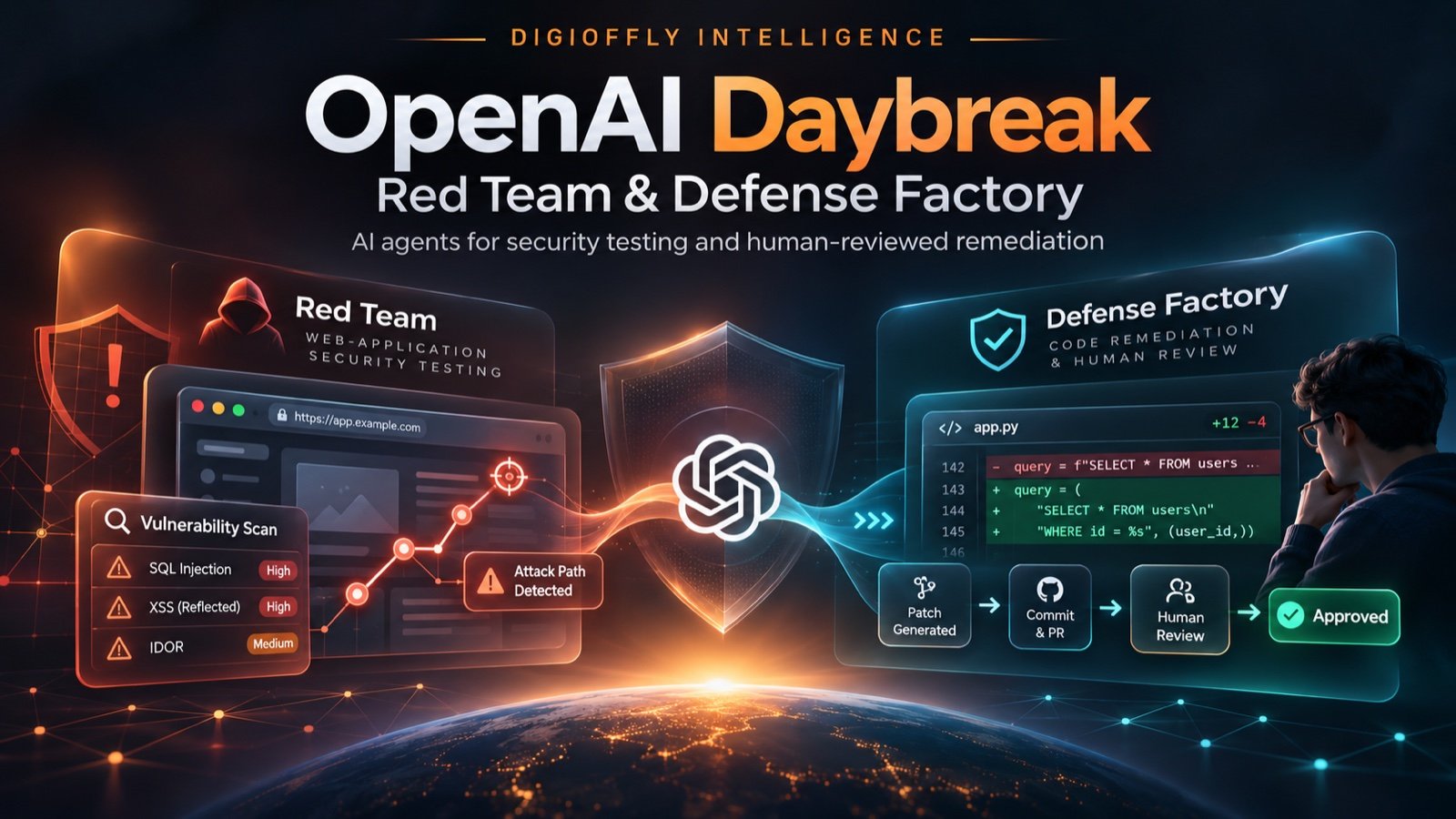
From security finding to a reviewed patch
Red Team investigates authorized web applications and validates findings. Defense Factory prepares code changes for engineering review. The illustration separates evidence, remediation, and the human decision.
What Happened
OpenAI used its November 12 presentation to show how cybersecurity agents can fit into a company's daily security operations. Daybreak Red Team and Daybreak Defense Factory now have dedicated product pages. They address different stages of the same problem: determining whether a vulnerability can actually be exploited, and preparing a repair that engineers can evaluate and deploy through their normal process. This is not the initial launch of OpenAI Daybreak, nor is it another release of GPT-6 Cyber.
The November 5 GPT-6 Cyber announcement describes the specialized model and its approval requirements. Defense Factory also predates this keynote: OpenAI described a research preview for connected repositories in its August 21 developer article. November 12 is a product-announcement milestone, not the first public mention of the workflow or a general-availability launch. The latest event puts those capabilities into named tools with specific workflows. A model API, a penetration testing product and a remediation workflow are not interchangeable.
Who Is Affected & When
OpenAI identifies Daybreak Red Team as early access and invites organizations to register interest. Its Defense Factory page invites teams to connect repositories and security findings. Neither page lists a public price or a general-availability date. Security leaders should confirm product eligibility, commercial terms and deployment requirements directly with OpenAI before committing a budget. OpenAI Daybreak offers Blue access for approved defensive work—such as vulnerability triage and patch validation.
Red access requires separate approval for advanced, authorized testing, including red teaming and controlled security research. Both retain applicable safeguards; approval is not automatic. GPT-6 Cyber requires specific model approval as well. These tiers should not be confused with automatic entitlement to the new Red Team product. Its early-access process remains relevant.
What Changes in Practice
Daybreak Red Team: AI penetration testing for web apps
A conventional vulnerability scanner may report that a component is outdated or that a request looks suspicious. The security team still needs to decide whether the finding is real and whether it matters to the application. Daybreak Red Team is designed to give coordinated agents source code and application context so they can investigate potential attack paths and validate findings. OpenAI says the service can examine reports from code scanners, bug bounty programs and vulnerability disclosures.
After developers prepare a repair, the agents can test whether the reported issue is still exploitable. That makes it relevant not only to a scheduled web application penetration test, but also to repeated verification after an application changes. The important boundary is scope: OpenAI describes isolated environments, Guardian review, and controls over which applications and endpoints agents can reach. Organizations should document their permitted assets and testing windows before a pilot.
An AI penetration testing tool is not permission to test an unrelated third-party service. When comparing security testing tools, ask how they gather evidence and distinguish confirmed issues from alerts. AI security testing should be evaluated against known findings, not a raw count of reports.
Daybreak Defense Factory: AI vulnerability remediation
Daybreak Defense Factory focuses on the other side of the security backlog. A team may already have hundreds of findings from scanners or researchers, with too few engineering hours to investigate each one. The product takes those findings, examines the relevant code and prepares patches for review. Engineers can work with Codex to inspect evidence and refine a proposed fix while agents continue other work. OpenAI also describes scheduled checks and scanning new commits.
That could help a team move from occasional security audits toward continuous vulnerability management. However, a proposed code patch is not a production deployment. Engineers still review and test changes before merging them. Existing CI/CD security checks, ownership rules and rollback procedures remain important. Teams comparing vulnerability remediation tools should measure the review burden as well as speed. Automated vulnerability management and AI security automation are most useful when existing ownership, testing and approval controls remain intact.
How the tools fit together
Consider a team that receives a bug bounty report about its own web application. An authorized security engineer could use Red Team to investigate the reported issue in a defined environment. A confirmed finding could then go into Defense Factory, where an agent prepares a patch and provides context for the engineering reviewer. After the repair is tested and merged, the team could repeat the authorized check to establish whether the problem was resolved.
That example is a proposed workflow, not a DigiOffly product test or a promise of seamless integration in every deployment. The value of AI security agents depends on the quality of the evidence, the availability of reproducible test environments and the speed at which the team can review suggested changes.
OpenAI Daybreak pilot and patch verification
For a pilot, record the source of each finding, independently confirm the evidence, review and test the proposed code change, and repeat the authorized check after the repair. A successful vulnerability validation does not establish that a patch is safe to merge. Use existing security review and patch validation procedures to evaluate the result. If an AI vulnerability scanner is already in place, use the same authorized test cases to compare evidence quality.
Record the date of each vulnerability disclosure and the evidence used to close it.
| Decision area | Daybreak Red Team | Daybreak Defense Factory |
|---|---|---|
| Primary job | Test web apps and validate vulnerabilities | Investigate findings and prepare patches |
| Inputs | Application context, source code and reported issues | Repositories and security findings |
| Output | Evidence of a vulnerability or whether a fix holds | Proposed code changes for engineer review |
| Controls | Scoped endpoints, isolated environments and Guardian review | Engineering review and tests before merge |
| Availability | Early access; register interest | Contact OpenAI for product access and terms |
Why It Matters
The official product descriptions suggest a shift toward packaged workflows that connect security research and software engineering. DigiOffly has not independently tested whether these products reduce the time spent on those handoffs. That is potentially more useful to a security leader than a benchmark alone. A vulnerability that is discovered but never repaired still represents risk; a patch that is merged without verification can introduce new problems. Existing security tools are not automatically obsolete.
Static analysis, dependency scanning, endpoint monitoring and human penetration testing can provide coverage and independent evidence that an agent workflow does not replace. Daybreak Defense Factory is designed to work with existing findings, which suggests that integration and evidence quality may matter as much as the model itself.
Our Take
For a US software company evaluating OpenAI Daybreak, we would start with a single non-sensitive repository and an application the organization owns. Pick a small set of previously resolved issues to assess whether the agents reproduce known findings and prepare useful patches. Track verified findings, false positives, review time and the proportion of patches that pass existing tests. Establish a clear owner for every approval.
Do not assume that early access includes unlimited usage or that a vendor case study predicts your own results. Ask about access, data handling, retention, audit logs and commercial terms. OpenAI's published material explains the intended workflows; DigiOffly has not tested these private products or independently measured their performance. Until a team can demonstrate improvement in its own environment, we would treat them as additions to an existing security program, not replacements for it.
Frequently Asked Questions
What is OpenAI Daybreak Red Team?
It is an early-access product for authorized web application security testing, vulnerability validation and verification of fixes using coordinated AI agents.
What does Daybreak Defense Factory do?
It investigates security findings in code and develops proposed patches. Engineers review and test the changes before merging them.
How much does OpenAI Daybreak cost?
The November 12 product pages do not disclose standalone prices for Red Team or Defense Factory. Ask OpenAI for product-specific terms; model API rates are not necessarily product subscription prices.
Is Daybreak Red Team the same as GPT-6 Cyber?
No. Red Team is a product for authorized application testing, while GPT-6 Cyber is a specialized model with separate approval requirements. The products and models have distinct access conditions.
Official Sources & Dates
Announcement: 2026-11-12. Red Team is in early access; a general-availability date and standalone product prices were not disclosed on the product pages checked November 13. Check official updates before purchasing or changing production settings.
- OpenAI — Cyber at the Frontier event and announcements
- OpenAI — Daybreak Red Team product page
- OpenAI — Daybreak Defense Factory product page
- OpenAI Help Center — Daybreak access overview
- OpenAI — Introducing GPT-6 Cyber, November 5, 2026
- OpenAI Developers — Scaling cyber defenders with Daybreak, August 21, 2026
Editorial note: DigiOffly verified dated primary sources. This is not a claim of hands-on testing unless independently documented. Prices and access conditions may change.