

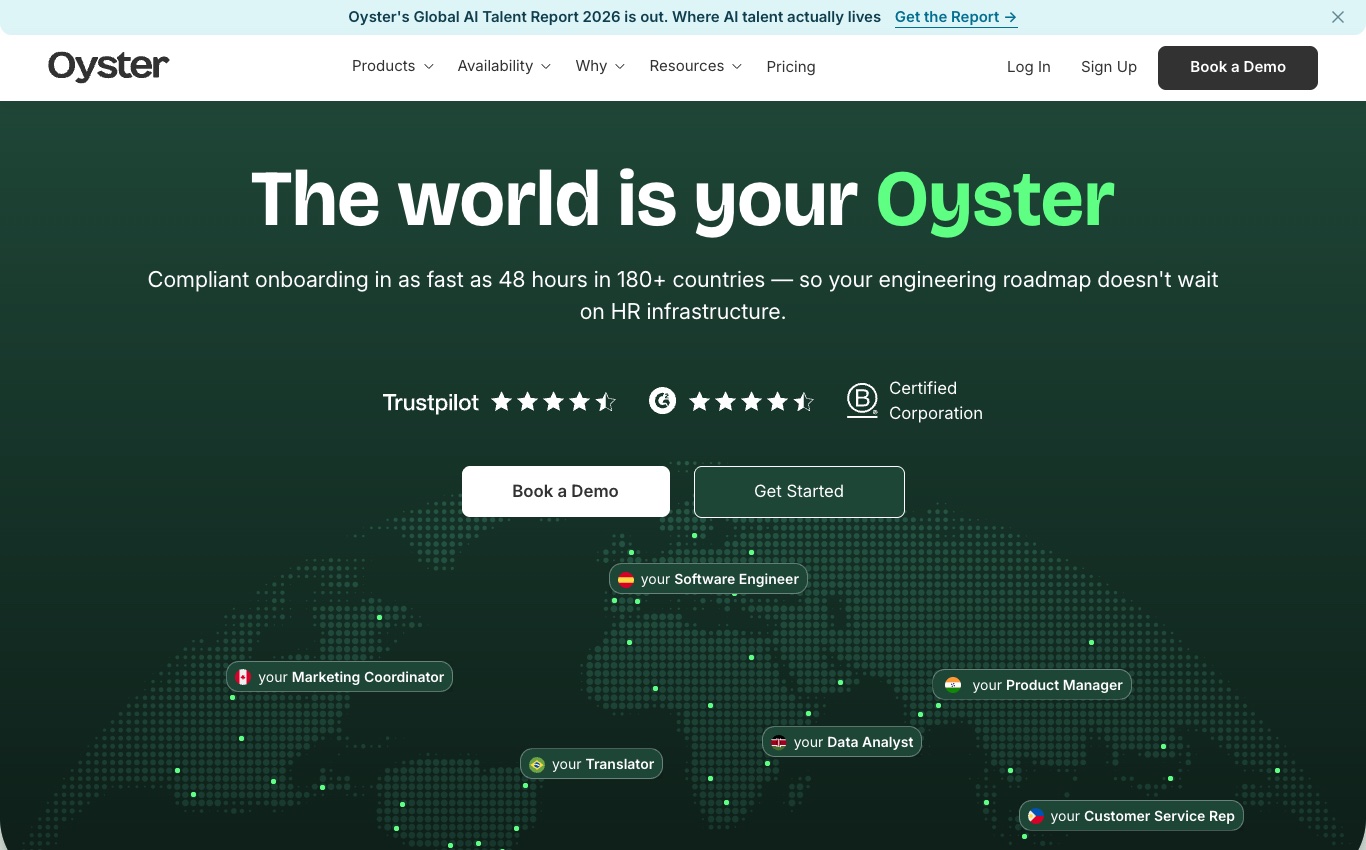
Public-source review, October 29, 2026. We examined Oyster’s current company and pricing pages and available documentation for employer-of-record, contractor and global-payroll services. The images show public vendor pages. We have not hired a worker, executed an international payment or obtained jurisdiction-specific legal advice through Oyster.
Once a company decides to hire someone abroad, it needs to establish who can legally employ and pay that person. Oyster offers different services for different answers: an employer-of-record arrangement when the client lacks an employing entity, contractor administration for legitimate independent contractors, and payroll coordination for companies with entities already in place. These are not interchangeable subscriptions. The legal relationship must be clear before price or onboarding speed becomes the main consideration.
A cross-border offer may look straightforward to a hiring manager, but finance needs a budget for statutory charges and the legal team needs to know who signs the employment contract. If an employee changes location or an independent contractor works like a full-time employee, the initial setup may no longer be appropriate. This review separates Oyster’s documented services from the country-specific confirmations a buyer still needs, without claiming to have hired a worker through the platform.
Before deciding on Oyster employer of record, pick one proposed country and identify the worker’s status. Is the person a genuine contractor? Does the company already have a payroll entity? Who will sign the employment agreement, and who can amend it if the start date changes? That short exercise often reveals which Oyster service is actually relevant before anyone compares subscription amounts.
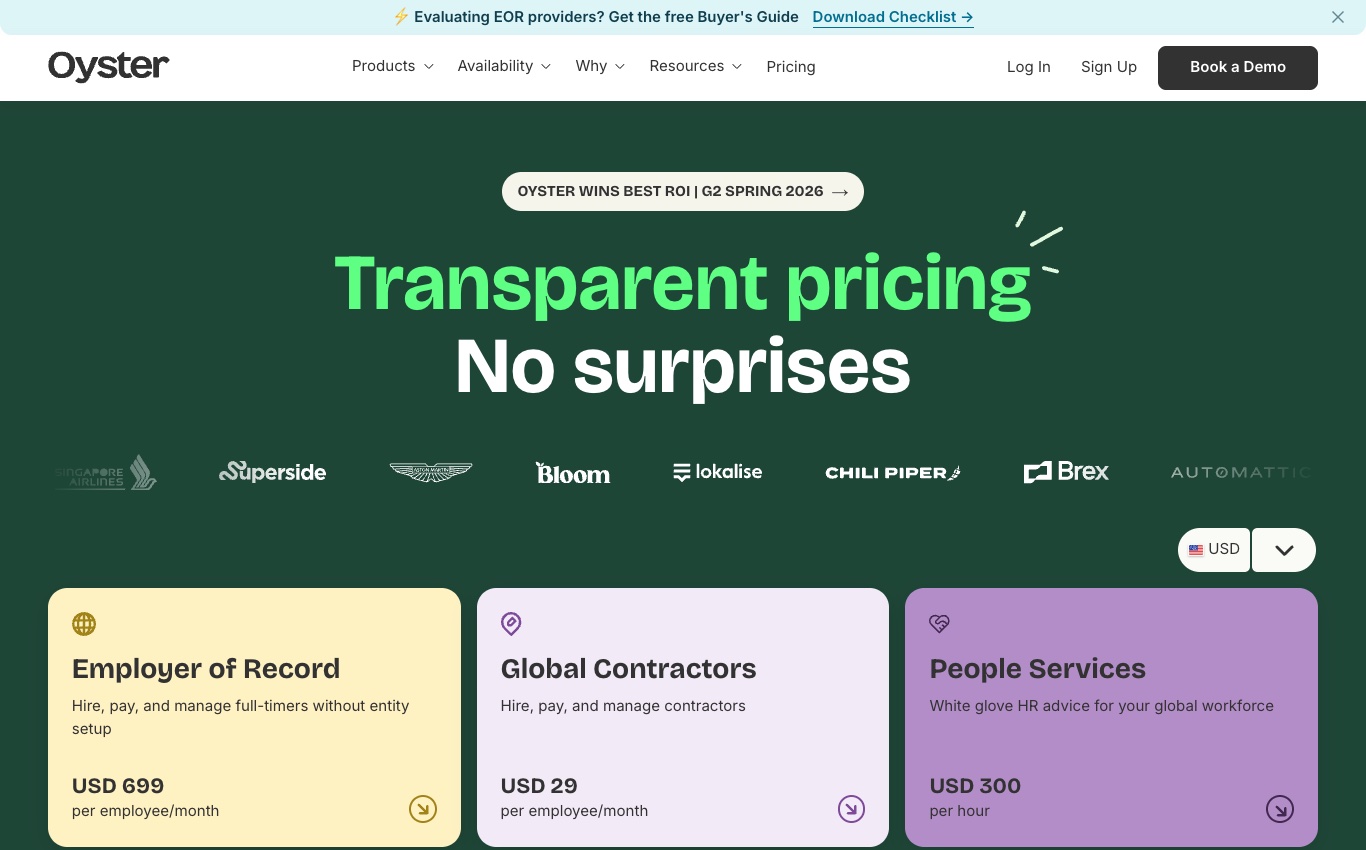
Pricing snapshot: Oyster’s official site lists Employer of Record at $699 per employee/month and Global Contractors at $29 per contractor/month. Global Payroll has separate per-entity and per-team-member fees: its help center lists $290 per entity/month plus $29 per team member/month, with a $500 implementation charge per entity in USD billing. We do not infer an entire enterprise subscription from a publicly advertised starting rate or substitute a competitor blog for a vendor quote. Obtain current contractual terms before making a purchase.
We may earn a commission when readers purchase through certain links. That never changes which product limitations, missing regional services or contract questions we document here.
📊 Oyster Review Summary
Oyster’s central use case is employment across borders, not applicant tracking or ordinary staff records. It can be practical for a small overseas team when opening a local company would be premature. For an employer that already operates legally in a country, entity payroll might be the more relevant service; for a domestic-only workforce, neither may be necessary. The first question is the worker’s employment status, not the number of countries displayed in a coverage map.
The EOR fee is separate from wages, statutory contributions and benefits. Contractor management involves a lower advertised service price but also classification risk; Global Payroll has another charging structure. None of those figures can serve as a universal cost per international worker. A useful quote must name the proposed country, type of worker and any deposits, payment or termination costs that would actually apply.
⚡ Quick Verdict: Is Oyster Worth It in 2026?
Editorial assessment: Oyster belongs on the shortlist when a company has a defined international hiring plan and no simple local employment route. Bring HR, finance and a qualified legal adviser into the decision before promising a start date. Oyster versus Deel only becomes a fair comparison when both quote the same country, employment status, compensation and benefits. Avoid treating a quick online onboarding flow as evidence that every legal obligation has already been settled.
🧠 Oyster and the core HR workflow
Oyster employer of record pricing should be budgeted separately from the worker’s gross pay and statutory employer contributions. Compare global payroll pricing for an existing legal entity with Oyster international contractor management only after classification is resolved. A quoted employer of record service fee does not automatically include the same benefits, deposits or country-specific statutory costs in every jurisdiction.
Choosing Oyster begins with the worker’s legal status. Is the person truly an independent contractor, employed by an existing local entity, or eligible for an employer-of-record arrangement? Those decisions determine which product the company needs and who will issue contracts, withhold taxes and administer benefits. A software subscription does not make an incorrect worker classification lawful. Before a manager promises a start date, HR should obtain country-specific confirmation of the legal employer and the proposed employment terms.
The employee lifecycle looks different when the employer of record and the day-to-day manager are separate organizations. Oyster may issue the employment contract, administer local pay and benefits, or facilitate contractor payments, depending on the product chosen. Before going live, specify who handles work authorization, pay disputes, final salary and sensitive documents. That operational chain is more important than a quick onboarding animation.
🛠️ What the employer of record actually does
An employer of record is more than a route to send salary abroad. In a typical EOR arrangement, the provider’s local entity employs the worker while the client directs the daily work. Contracts, statutory benefits and legal obligations therefore involve a party that the worker’s manager may never meet. Oyster offers this model to companies entering markets where they do not already have their own employing entity.
Take one hypothetical hire and write down the legal employer, supervisor, payroll operator and contact for grievances. Ask who can amend salary or approve termination under local law. If those responsibilities remain vague, a fast onboarding workflow will not fix the underlying risk.
🔎 Country coverage is a checklist, not a map
A wide country list is not a guarantee that every proposed hire is possible. Oyster’s international coverage needs to be narrowed to a specific country, employment status, legal entity and start date. Availability can depend on the worker’s citizenship, location and immigration position, as well as the job’s contractual terms.
Ask for written confirmation for a fictional candidate in one target country, including who signs the contract and which mandatory benefits apply. Do not promise a start date from a marketing coverage map. The answer should come from the service team handling that country, not from the number of flags displayed on the website.
⚖️ Employer of record versus legal entity
A company hiring its first two overseas employees may reasonably decide that establishing a subsidiary is premature. An EOR arrangement can offer a practical employment route, but the calculation changes as the team grows. At greater scale, the cost of a local entity and payroll provider may compare differently with per-worker EOR service fees. Tax and permanent-establishment questions also remain for specialist advisers.
Compare two realistic plans: a small one-year experiment and a larger multiyear operation. Include setup costs, statutory obligations and what happens if workers must transfer between legal employers later. A monthly platform fee alone cannot settle that choice.
📈 EOR monthly fees and total employment cost
Oyster’s current published EOR headline is $699 per employee each month. That is a service fee, not a complete wage-and-benefits budget for the worker.
Statutory contributions, leave, benefits, currency conversion, deposits and country-specific fees can change the amount the company must fund.
Build a budget with salary, statutory costs, EOR service, optional benefits, deposits and exit assumptions for one country.
🔐 Contractors and misclassification risk
The Global Contractors plan starts at $29 per contractor/month, offering an administrative route for managing international independent contractors.
A contractor label does not override local employment law. Control over work, exclusivity and working patterns may create employment risk that software alone cannot resolve.
Ask the classification team to assess a fictional full-time exclusive contractor before choosing a contractor subscription.
🧭 What a real implementation pilot should include
An Oyster pilot should follow one proposed international hire from the initial request to a draft contract and payroll budget. Pick a specific country and a hypothetical employee; add a separate contractor to expose the classification decision. Who is the legal employer, which benefits are mandatory, who approves changes and how does termination work? The process is less like a software demo and more like checking a service relationship. Use fictional details and involve local counsel before making any commitment to a real worker.
Finance and the hiring manager should attend the Oyster evaluation with HR and legal counsel. They will ask different questions. Finance cares about statutory costs, deposits and currency funding; the manager wants a start date; the legal reviewer wants to know what the local employer can actually sign. A tidy onboarding timeline does not settle those matters. Have each party review the same hypothetical hire and write down the unresolved obligations. Those gaps should go into the commercial proposal.
🎯 Who actually benefits from this system
Oyster is a poor comparison for a conventional HRIS unless international employment is the problem being solved. An employer of record can engage workers where the client has no local employing entity; contractor management and entity payroll involve different relationships. A domestic business with a sound payroll process may not need any of these services. An organization entering one or two new countries could find them valuable, but only after deciding whether the proposed people are employees or genuine contractors.
The useful test here is not whether an administrator can create a worker profile. It is whether the client’s HR and finance teams understand what happens after they click through the interface. Who handles a late document? Who explains a short payslip? Who has authority to amend an employment contract? For Oyster, local operating rules and the responsibilities of the legal employer matter as much as the platform’s screens. The buyer should know the names of the service contacts before a worker starts.
💰 Pricing, modules and total cost
Contractor misclassification risk becomes important when a person is effectively managed like a full-time employee, regardless of which contractor payment tool is selected. The legal employer responsibilities for an EOR arrangement are different: local contracts, statutory benefits and the employee termination process may require the provider’s approval. Ask who will coordinate payroll cutoff dates, work authorization and the final payslip.
| Budget element | Questions for the vendor | Buyer evidence |
|---|---|---|
| Base HR license | Do not confuse EOR, contractor management and Global Payroll. These are different services; country coverage, benef | Signed quote and exact plan tier |
| Recruiting and ATS | Are jobs, screening, onboarding and extra recruiters included? | Current module entitlements |
| Payroll and benefits | Which countries, employment types and extra services are covered? | Written geographic scope |
| Implementation | What migration, onboarding and training services are charged? | Statement of work |
| Renewal and cancellation | What changes as employees grow or leave? | Contract and notice period |
💡 Contractor onboarding and agreements
Contractor onboarding may look simpler than employing someone abroad. A service agreement is signed, invoices arrive and the person is paid. Yet classification remains a separate legal issue: the same person might be treated as an employee if the business controls hours, exclusivity and how work is done. The paperwork must match reality, and a platform cannot settle the distinction merely by labeling the worker a contractor.
The practical questions start before the first payment. Where does the worker reside? Who owns intellectual property created under the contract? What currency and invoicing terms have been agreed? Who verifies a new bank account? Oyster can support the administrative workflow, but a company should still document who checks identity and how exceptions are escalated when details change unexpectedly.
Imagine a fictional designer engaged for one project who requests a new bank account just before an invoice is due. The manager approves the work, finance verifies the payment instruction and the contract owner checks whether the scope is still consistent with independent contracting. The useful result is a clear chain of responsibilities, not an automatically generated invoice.
📋 Global Payroll is not an EOR subscription
Global Payroll and Employer of Record begin from different legal positions. A company using entity payroll already has an employer in the country; it wants the pay calculation, reports and funding process coordinated. In an EOR arrangement, a local provider entity is typically the legal employer and has responsibilities around contracts and statutory benefits. Oyster sells services for both situations, but they cannot sensibly share one price assumption.
For a subsidiary with ten staff members, the official Global Payroll fee schedule provides a more relevant baseline than the $699-per-worker EOR headline. The company still needs to confirm implementation charges, the treatment of one-off payments and who actually executes the transfer to workers. It is possible to approve a correct payroll report and still fail to fund salaries on time. Procurement should distinguish the two stages.
🎯 Payroll approvals and pay-cycle controls
Payroll deadlines expose the weaknesses in international coordination. A bonus arrives late, an employee changes bank account and a manager approves leave after the local cut-off. None of those events is unusual, but the remedy can differ by country and by the specific Oyster service contracted. HR, finance and the provider need a shared view of which cycle will contain the correction and who is authorized to release it.
Pay calculation and payment confirmation are not the same record. A finance lead should be able to locate the approved input, its gross-to-net result and the final funding or payment status separately. When a change must wait until the next cycle, the employee needs a clear explanation. That operational chain is more useful to evaluate than an overview claiming that multiple countries appear on one payroll dashboard.
🧩 Local employment contracts and policy changes
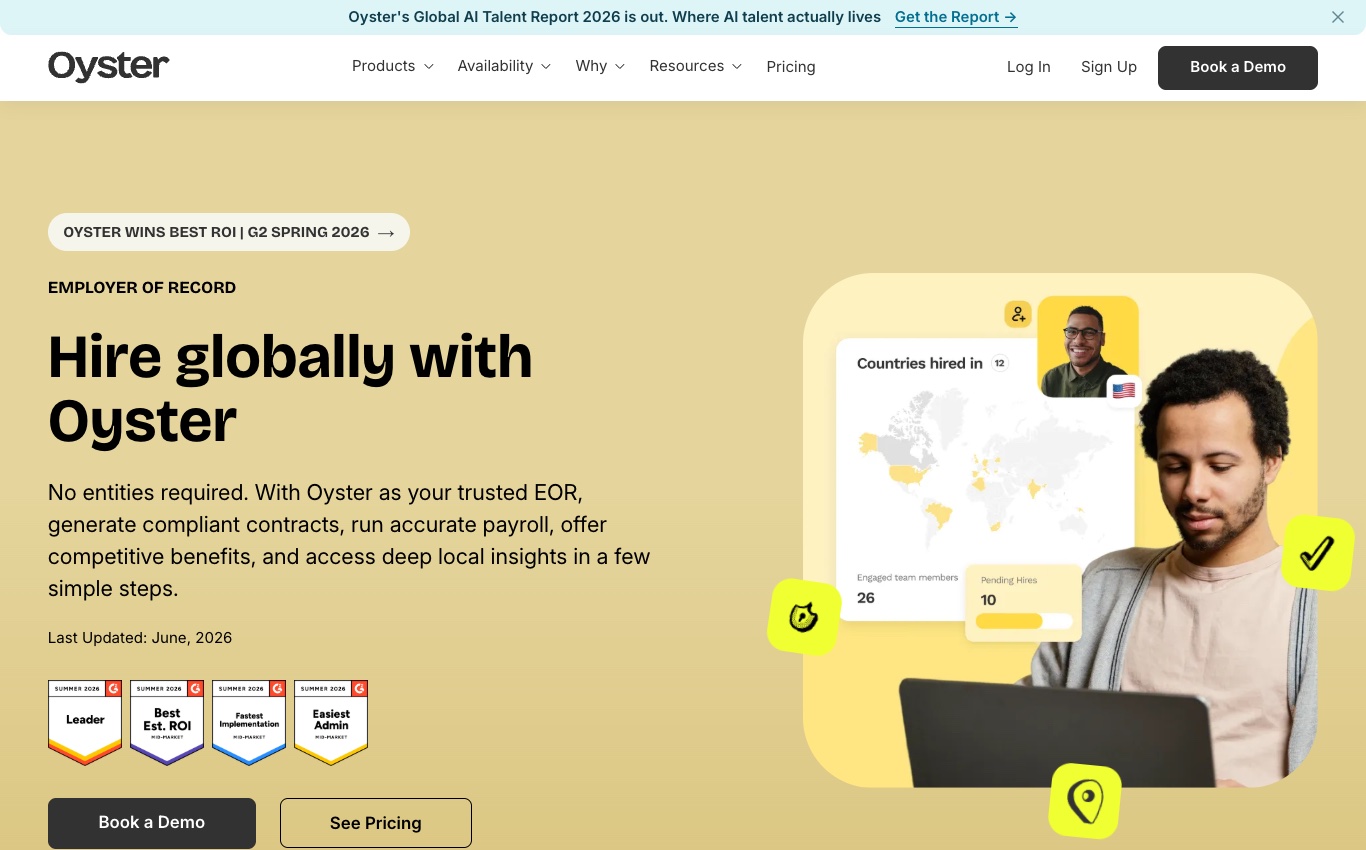
An EOR arrangement should include compliant employment paperwork and a clear method for changes in salary, work location or working time.
A manager promising a promotion directly can create a mismatch if the legal employer has not amended the contract. The employee should know who issues official documents.
Model a worker’s promotion with a future effective date and identify the client approval, employer signature and updated payroll instruction.
💰 Calculate the real first-year bill
The $699 EOR service fee is not an employment budget. Start with gross pay, mandatory employer contributions, benefits and any deposit or local charge, then add the provider fee and exchange-rate exposure. For a contractor, classification and invoice payment rules matter more than the lower starting subscription. Entity payroll has its own implementation and recurring charges. Oyster’s products solve related problems, but a finance team should never combine their prices as if every international worker used the same arrangement.
Before an Oyster agreement is signed, ask for a country-by-country outline of legal employer responsibility. Can the provider issue the intended contract? What documents must the proposed hire supply? Who approves an increase in salary or a change of workplace, and what notice rules apply when the relationship ends? Then obtain an itemized quote covering the first payroll cycle, any setup or deposits and currency settlement. A global coverage claim alone cannot answer those questions.
🔐 Employee records and data governance
Cross-border employment requires an answer to difficult handoffs, not just a completed onboarding form. Oyster may receive identity documents, bank details and local tax records that the client’s hiring manager should never download. After a disputed leave balance or termination, an employee needs to know who can correct the official record and who signs the final document. Map the client’s responsibilities against the legal employer’s obligations before launch, including access revocation and how long information remains available after departure.
🛠️ Benefits and statutory leave
For an EOR hire, the benefits question is not which optional perk looks attractive. It is what the legal employer must provide in that specific country, how paid leave is accrued and what happens to unused days at departure. Oyster can coordinate local administration, but the client needs a written benefit schedule before presenting an offer. A generic worldwide summary is not enough to budget statutory contributions, sick leave or employer liabilities for one actual proposed position.
🔎 Equity, bonuses and expenses
International teams often have commissions, expenses and equity questions that cross legal entities. Oyster’s payroll services include certain expense-management functions.
A global employment service should not be assumed to administer every equity plan or local tax treatment. One-time bonuses may affect statutory calculations.
Propose a fictional performance bonus and reimbursement, then obtain a country-specific explanation of calculation and processing.
⚖️ Cross-border payments and currency risk
A salary might be agreed in one currency, funded by the client in another and paid into a bank account in a third. Each conversion and banking deadline introduces a potential discrepancy. Oyster’s international payment services should be discussed with those flows visible on one example rather than as a promise of effortless global payroll. Finance needs to know who chooses the conversion rate, who pays intermediary fees and how a failed transfer is explained to the worker.
🔐 Sensitive employee data and the permission matrix
Oyster may hold passports, bank information and tax details that a line manager does not need to download. The client, its finance team and the legal employer have different reasons to process those records. During a demonstration, create a fictional worker and identify which party can view the bank account, amend the employment contract and correct the payroll input. The question of who retains a copy after departure is just as important as who can open it during onboarding.
🧭 Implementation and workflow design
📈 Immigration and right to work
A legal employer cannot hire someone who lacks permission to work in the relevant country merely because an online form accepts the application. For an Oyster EOR engagement, immigration status, workplace location and proposed duties may determine what is possible. Assistance with visas may also fall outside the ordinary employment service. The responsible team should secure a country-specific answer before the hiring manager promises a start date, especially where the worker is relocating rather than already resident.
🔐 Privacy and employee sensitive data
An international employment workflow may contain passports, tax numbers, contracts, bank details and medical or leave information. Access must be carefully limited across the client and EOR.
Employee privacy obligations cross borders, and the legal controller or processor roles may differ by service. Shared drives and emailed identity documents are poor substitutes for defined controls.
Have the client manager, EOR specialist and finance administrator explain what each can download, edit and retain after employment ends.
💡 Onboarding time and real-world exceptions
An EOR sales process can make hiring abroad look instantaneous. In practice, country checks, identification, contract negotiation and payroll cutoff dates all influence the first legal start date.
Promising a candidate a date before written EOR confirmation can create contractual and immigration problems. The team needs a realistic escalation contact.
Choose a target start date near payroll cutoff, add a delayed document and ask who updates the employee and the hiring manager.
📋 Offboarding, final pay and employee handover
Ending an EOR engagement involves more parties than removing a user from software. The client’s manager may want an immediate departure, but the local employer still has to consider notice, consultation, unused leave and final-pay obligations. Oyster’s offboarding process should state who communicates with the employee, who signs legally required documents and when access to personal records ends. A termination button is not evidence that the employment relationship has lawfully concluded.
🛠️ Migrating without breaking payroll and approvals
Moving an international worker to Oyster is not merely importing their profile. Existing seniority, accrued leave, benefits and immigration status may be tied to a current legal employer. Some arrangements cannot be transferred automatically or without employee consent. Draw the employment relationship first: who employs the person today, who will do so after the change and what local notices are required. Only then map payroll identifiers and documents. A spreadsheet can support that transfer but cannot determine its legality.
| Workflow | Owner | Pilot result to document |
|---|---|---|
| Hire to employee record | Recruiter + HR | Candidate history mapped; HR status verified |
| Permission change | HR + IT | Only approved roles retain access |
| Payroll data transfer | HR + payroll | Sample totals reconcile with the source |
| Leave approval | Employee + manager | Balances, notifications and exports agree |
| Offboarding | HR + IT + payroll | Revocation and final checks have evidence |
⚖️ Alternatives and real-world fit
Oyster vs Deel comparisons need the same country, working arrangement, salary and employment start date. A cross-border payment may have currency conversion costs, while global payroll implementation fees can apply to entity-based payroll services. The buying checklist should name the actual country and legal entity, not rely on a broad international hiring map or a single monthly price.
🎯 Oyster compared with Deel and Rippling
Deel and Rippling are natural comparison candidates, though their products and local employment arrangements should be inspected individually. An EOR service is not comparable to a bare HRIS subscription just because both store workers’ details. Oyster’s value must be assessed against the legal arrangement and the actual country in question. A cheaper interface can become an expensive mistake if it does not support the employment model required.
The employer should not pay for global employment complexity it does not have. A company with an established subsidiary and a compliant local provider may only need payroll coordination. Another entering its first foreign country may find EOR a simpler initial route. Contractor management adds classification obligations that cannot be priced away by a small monthly fee. These distinctions are the foundation of a responsible vendor comparison.
Compare one hypothetical employee and one genuine independent contractor in the same target country. Request the relevant contracts, required benefits, statutory charges, payments, deposits and termination assumptions from each vendor. This is more work than putting headline subscription rates in a table, but it is the only comparison likely to survive scrutiny by legal and finance.
🧩 Who should buy Oyster and who should not
Oyster is useful when an employer has a real cross-border hiring challenge and a clear reason not to incorporate locally yet. A small overseas team is an obvious case. A domestic-only business is not. The commercial question should be framed around the number of workers, their countries and employment statuses, rather than how appealing a worldwide map looks during the demonstration.
A permanent international operation may eventually outgrow an EOR arrangement and justify its own legal entity. Switching can involve employee consent, seniority, benefits and local obligations, so the exit path belongs in the initial contract discussion. The provider fee is only part of the long-term picture. That is why a modest early hiring plan and a large three-year workforce plan may lead to different choices.
Before selecting Oyster, have legal counsel identify the employment model, finance build a complete country-specific budget and HR describe the onboarding and offboarding chain. Only then compare the services and their fees. The practical outcome is a lawful, funded and understandable working relationship. A low administrative charge, by itself, does not establish any of those conditions.
⚖️ Oyster vs Deel: international employment fit
Oyster’s strongest case is allowing a business to engage and support workers in countries where building a local entity is premature. Its trade-offs are not cosmetic interface issues. Employer-of-record fees sit on top of real employment expenses, contractor classification can be disputed and local requirements shape both hiring and offboarding. A buyer should compare one genuine country scenario in depth rather than award points for an impressive international coverage map.
🏆 Final verdict and buyer checklist
The purchase decision is straightforward only after the employment model is clear. If the company needs two employees abroad and has no local entity, compare an EOR arrangement with the cost and feasibility of incorporating. If it has an existing subsidiary, compare Global Payroll with local providers. If it wants to engage a freelancer, address classification before the contractor plan price. Oyster belongs on the shortlist when the legal structure and total funding requirements are understood, not when a subscription looks low.
| Decision | What favors Oyster | What should make you hesitate |
|---|---|---|
| Core HR | employer-of-record hiring without opening a local entity | EOR fees sit on top of employment costs and statutory obligations |
| Hiring and talent | separate global payroll tools for organizations with established entities | contractor versus employee classification is a genuine legal question |
| Regional payroll | Oyster supports international engagement across multiple jurisdictions, but precise EOR availability, statutory benefits, immigration options and country-specific employer obligations must be confirmed before a worker signs | Country-specific limits and quote uncertainty |
| Overall suitability | Companies hiring internationally without establishing a legal entity in every new employment jurisdiction | Unproven workflows or incomplete scope |
🎯 Pros, cons and editorial fit
Editorial fit — Oyster
Advantages: employer-of-record hiring without opening a local entity; international contractor administration and payment workflows; separate global payroll tools for organizations with established entities.
Trade-offs: EOR fees sit on top of employment costs and statutory obligations; contractor versus employee classification is a genuine legal question; different countries, payroll products and onboarding details require separate confirmation.
Best next step: Request a scoped quote and a realistic workflow demonstration. A product screenshot cannot prove implementation quality or support performance.
🧪 Sources and review methodology
This article draws from Oyster’s public EOR, contractor and payroll information checked on October 29, 2026. The screenshots are of public pages. We did not employ a person through Oyster, issue a payslip or validate a particular country’s employment-law compliance. Examples in the article describe steps a prospective buyer should confirm with the provider and qualified local advisers.
International employment rules vary by country, worker status and contracting arrangement, as do any deposits, benefits and processing charges. An advertised service price cannot establish lawful classification or employment eligibility. The legal employer, funding requirements and termination obligations must be reviewed for the actual hire. No vendor marketing page replaces those written country-specific confirmations.

Frequently Asked Questions
What is Oyster best suited for?
Oyster is designed for a company hiring people abroad without establishing an employing entity in each destination. Its central use cases are employer of record, international contractor administration and global payroll for existing entities.
How much does Oyster cost in 2026?
Oyster lists EOR at $699 per employee per month and contractor management from $29 per contractor per month. Global Payroll has a separate fee model, including $290 per entity plus $29 per worker monthly and a $500 setup charge in USD billing.
Does Oyster have a free plan or free trial?
Oyster provides demonstrations and pricing information for its services, but an ongoing free EOR or international payroll plan was not verified. A quote must include the specific countries, work types, statutory contributions and contractual terms.
Can Oyster handle recruiting and applicant tracking?
Oyster is not primarily an applicant tracking system. It can help employ an accepted candidate or engage a contractor, but sourcing, interviews and applicant evaluation usually take place in a separate recruiting tool.
Can Oyster process international payroll?
Yes, but the employment model changes the answer. EOR places the worker with a local legal employer, while Global Payroll generally serves an organization that already operates an employing entity. They should not be treated as one interchangeable subscription.
How does Oyster support onboarding and offboarding?
Oyster can organize employment contracts, identity documents, benefits and onboarding across jurisdictions. Offboarding is more sensitive: local notice requirements, consultation duties, statutory leave and final pay can restrict the client’s preferred exit date.
How do Oyster permissions and security work?
A global employment record may contain passports, tax numbers and banking details. Restrict client managers to what they need, identify which party is the data controller or processor, and verify how access is revoked after termination.
Is Oyster suitable for a small business?
Oyster can be useful for a small business hiring its first worker in a new country. It may be unnecessary for a business employing everyone domestically; a larger established foreign operation could also compare the economics of its own entity.
How difficult is it to move to Oyster?
Before moving workers, identify who is the current legal employer, how accrued leave and seniority transfer, and whether an EOR arrangement is lawful locally. Never use a software import as a substitute for employee consent or jurisdiction-specific legal review.
What are the main alternatives to Oyster?
Deel and Remote are relevant EOR comparisons; Rippling also offers global workforce products. Compare the same country, employee salary, statutory costs, contractor risk and termination assumptions rather than only monthly platform fees.
How did DigiOffly evaluate Oyster?
We used official Oyster pricing, company pages and public global-payroll documentation available October 29, 2026. Screenshots depict vendor websites, not private employment records. We did not initiate employment contracts, cross-border payments or country-specific legal advice.
EXPLORE NEXT ON DIGIOFFLY
🔍 Explore More on DigiOffly
Planning international hiring with Oyster? Explore HR alternatives, cross-functional software and budgeting tools to plan the services your team needs alongside global employment.
Explore related software
- HR & Recruiting section — Compare hiring, payroll, employee management and global workforce software.
- Rippling — Compare global employment options and employee administration.
- HiBob — Review the HRIS processes that may surround international hiring.
Compare your shortlist
- Software Directory — Browse the growing library of independent software reviews.
- Compare Software — Evaluate competing products by capabilities and priorities.
- AI Software Finder — Narrow your options using your actual workflow requirements.
Plan costs and updates
- Software Cost Calculator — Model licenses and recurring costs for your software stack.
- Best Value Advisor — Explore practical software choices for common buying needs.
- Deal Alerts — Follow relevant offers and software category updates.
Want updates when additional HR and recruiting reviews are published? Subscribe to DigiOffly Deal Alerts for relevant category updates.