

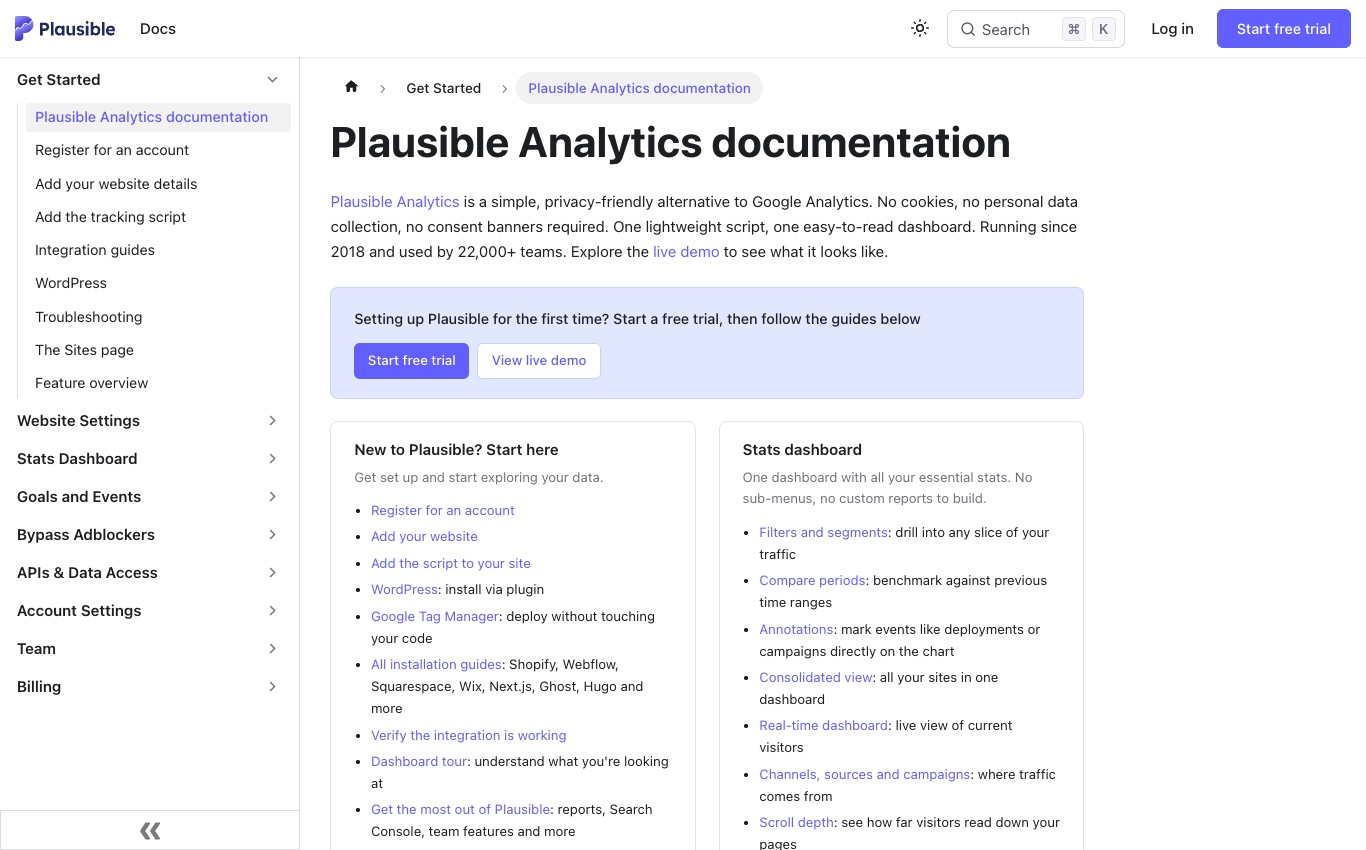
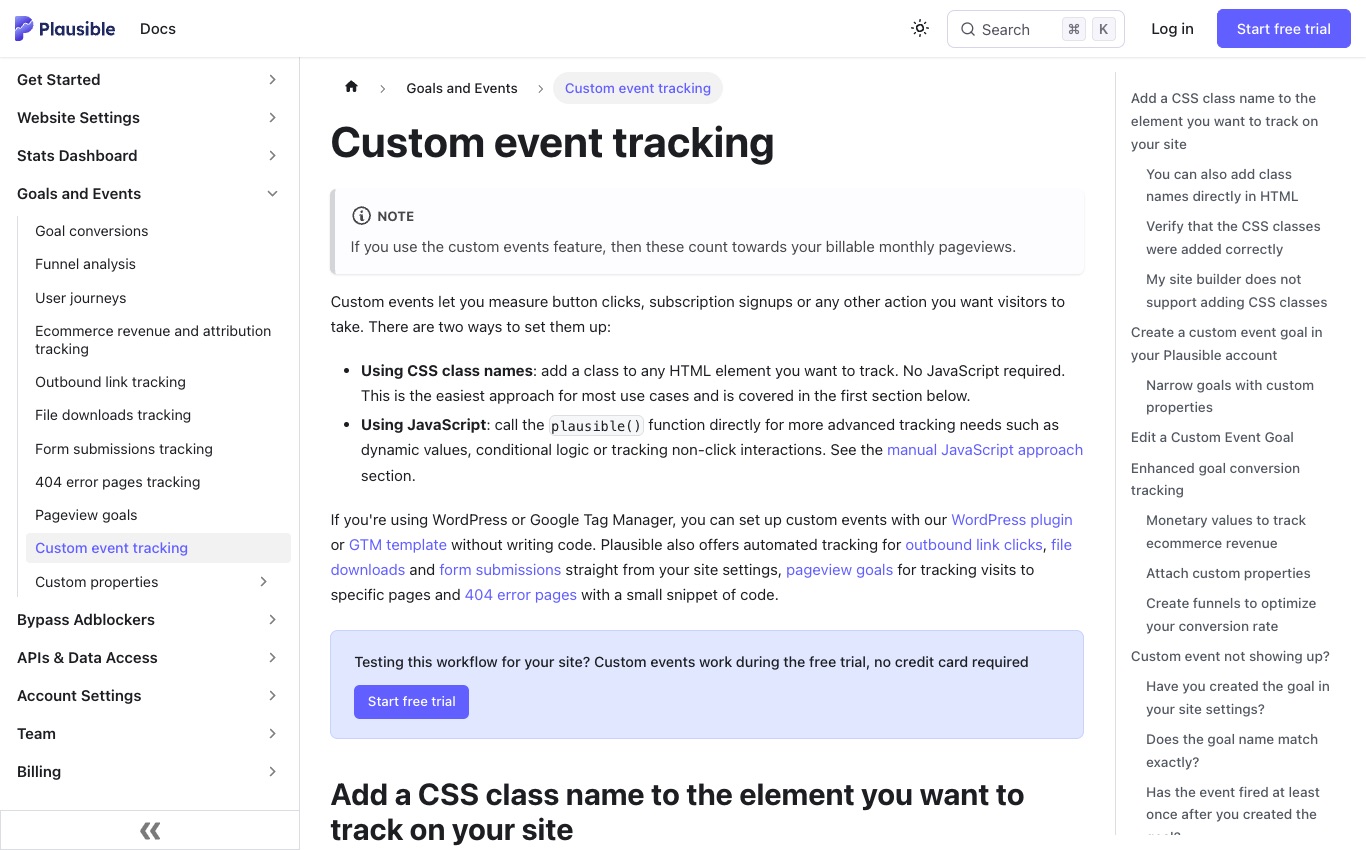
Source check — October 28, 2026. Official Plausible public pricing, subscription and goals documentation checked October 28, 2026. Vendor-site images below are public documentation captures. No authenticated test account, accuracy benchmark or vendor-specific performance score is claimed.
Plausible Analytics is best judged by a decision, not by the length of its feature menu. The appeal is a focused traffic report for owners who do not want their website dashboard to become a second job. That premise deserves scrutiny because web analytics products are often compared as though one chart, one visitor and one billable event meant the same thing. They do not.
Its primary benefit is clarity. Referrals, entry pages, goals and campaign links can answer an editorial question quickly, without requiring an analyst to build a multi-step event exploration. The simplicity is also a ceiling. Advanced identity stitching, detailed product cohorts and warehouse-style behavioral exploration are not the reason to buy Plausible. A SaaS app investigating activation may need a second product analytics tool.
This plausible analytics review evaluates the documented functions, current public subscription terms, limitations, and the questions a buyer should test. We reviewed the official public webpages on October 28, 2026. Screenshots below are captures of those sources, not evidence that DigiOffly completed an authenticated hands-on test. We distinguish verified vendor statements from our editorial assessment.
The target user is independent publishers, consultants, agencies managing modest traffic and content-led businesses. A useful first step is to write down what you intend to learn in the next month, who owns tracking quality and which action will follow. A publisher can start with a tracking script and one conversion goal such as a completed newsletter signup. Verify data appears on the correct domain, that campaign UTMs are preserved, and that an event represents an actual completed outcome rather than every click on the submit button.
Pricing requires careful language. Starter covers one site; Growth adds sites, collaborators and sharing; Business adds richer marketing workflows such as funnels, custom properties and API access. Plan entitlements and site caps should be read from current checkout rather than assumed from older comparison posts. The primary unit is pageviews and custom events; our cost analysis does not assume that an introductory figure survives a renewal or applies to a different region.
Plausible pricing is easiest to judge after counting both website traffic and tracked actions. Plausible custom events belong in that calculation: a signup, download or outbound link can create usage beyond ordinary pageviews. When comparing Plausible alternatives, ask whether the real need is a clean publisher dashboard, stricter deployment ownership or product-level retention analysis. Those requirements do not lead to the same provider, even if the feature pages appear similar.
📊 Plausible Analytics Review Summary
Plausible Analytics focuses on referrals, page performance and conversion goals for website teams that value a compact dashboard. Its simplicity and privacy-oriented approach can be useful, but custom events count toward the subscription volume and complex product cohorts require a different tool.
⚡ Quick Verdict: Is Plausible Analytics Worth It in 2026?
Our editorial view: Its primary benefit is clarity. Referrals, entry pages, goals and campaign links can answer an editorial question quickly, without requiring an analyst to build a multi-step event exploration. The simplicity is also a ceiling. Advanced identity stitching, detailed product cohorts and warehouse-style behavioral exploration are not the reason to buy Plausible. A SaaS app investigating activation may need a second product analytics tool.
The right reader is independent publishers, consultants, agencies managing modest traffic and content-led businesses. The most important trade-off is not the number of features but whether the collection workflow produces reliable evidence while respecting the organization’s resources and privacy obligations.
| Buyer question | What current vendor documentation supports | The limit to verify |
|---|---|---|
| What does the product cover? | pageviews plus tracked custom events across sites | The simplicity is also a ceiling. Advanced identity stitching, detailed product cohorts and warehouse-style behavioral exploration are not the reason to buy Plausible. A SaaS app investigating activation may need a second product analytics tool. |
| Is there a free option? | 30-day trial, not a permanent cloud free tier | Check live terms and whether collection stops at the limit. |
| What determines the bill? | pageviews and custom events | Forecast actual capture, traffic and overage conditions. |
| Who should trial it? | independent publishers, consultants, agencies managing modest traffic and content-led businesses | Choose one measurable real workflow. |
| What is the largest risk? | The plain-looking dashboard hides a real usage calculation: each tracked custom event counts toward the same subscription volume as a pageview. A lead form or download click can increase the billable events total even when the visitor count stays flat. | Test this risk before paid procurement. |
📊 What the dashboard is really for
In Plausible Analytics, the strongest question here is not whether a dashboard exists, but whether the team knows how to use it for what the dashboard is really for. Begin with one content question and ask whether the dashboard answers it in under a minute. Its primary benefit is clarity. Referrals, entry pages, goals and campaign links can answer an editorial question quickly, without requiring an analyst to build a multi-step event exploration. A solo writer wants to see whether organic search brings readers to a specific guide, not watch a complex marketing attribution model.
Consider what happens during a normal working week: A solo writer wants to see whether organic search brings readers to a specific guide, not watch a complex marketing attribution model. Repeat the same exercise on mobile and desktop wherever device behavior affects the workflow, and keep an honest record of exceptions.
🔎 The buying decision in one sentence
For teams using Plausible Analytics, begin with a real customer or visitor question: the buying decision in one sentence deserves a report only if it changes an action. The product is a better fit for aggregate site outcomes than for reconstructing an individual app-user journey. Starter covers one site; Growth adds sites, collaborators and sharing; Business adds richer marketing workflows such as funnels, custom properties and API access. Plan entitlements and site caps should be read from current checkout rather than assumed from older comparison posts. Before trusting a recommendation for the buying decision in one sentence, ask the Plausible Analytics owner to explain the relevant outcome using a single controlled visitor example.
📈 Traffic sources and acquisition decisions
A feature grid can obscure a more practical issue: what does traffic sources and acquisition decisions actually require? Campaign links and referrer classification need consistent naming or reports will fragment. A publisher can start with a tracking script and one conversion goal such as a completed newsletter signup. Verify data appears on the correct domain, that campaign UTMs are preserved, and that an event represents an actual completed outcome rather than every click on the submit button. A useful Plausible Analytics buying test is to map traffic sources and acquisition decisions to an action the business can change, and record when a different tool would be enough.
Campaign links and referrer classification need consistent naming or reports will fragment.
🎯 Goals without an analytics engineering team
A trial of Plausible Analytics makes this concrete: in this part of the buying decision, goals without an analytics engineering team is less about attractive charts than dependable definitions. Distinguish a genuinely completed conversion from a UI click that could fail server-side. The simplicity is also a ceiling. Advanced identity stitching, detailed product cohorts and warehouse-style behavioral exploration are not the reason to buy Plausible. A SaaS app investigating activation may need a second product analytics tool. To evaluate goals without an analytics engineering team, compare the Plausible Analytics report with the corresponding application record rather than judging the visual polish of a chart.
💰 Events and hidden usage growth
In Plausible Analytics, how a team interprets events and hidden usage growth depends on its source data and the event definitions behind the interface. Outbound clicks and file downloads can multiply the monthly event count, depending on enabled measurement. Plausible positions itself as privacy-friendly and cookie-light. The operator still needs to validate the full tag stack, server requests, notices, any proxy configuration and relevant laws. Privacy is a deployment question, not a one-line feature checkbox. When interpreting events and hidden usage growth in Plausible Analytics, annotate the time window, identity assumptions and any filtering that could change the number presented to managers.

💰 Plans and exact subscription boundaries
The first choice around plans and exact subscription boundaries is surprisingly operational, rather than purely technical. Use the official table for current pageview bands; the sticker price is not a universal flat fee. The plain-looking dashboard hides a real usage calculation: each tracked custom event counts toward the same subscription volume as a pageview. A lead form or download click can increase the billable events total even when the visitor count stays flat. An agency manages a few sites but needs separated collaborators and shared dashboards.
Consider what happens during a normal working week: An agency manages a few sites but needs separated collaborators and shared dashboards. Repeat the same exercise on mobile and desktop wherever device behavior affects the workflow, and keep an honest record of exceptions.
| Plan / route | Published position | Decision note |
|---|---|---|
| Entry | 30-day trial, not a permanent cloud free tier | Treat a limited trial differently from an ongoing free tier. |
| Individual / growing usage | Starter, Growth, Business and negotiated Enterprise subscriptions; 30-day no-card trial, no perpetual managed-cloud free plan | Confirm supported features in the exact vendor tier. |
| Usage metric | pageviews and custom events | Costs vary with measured workload, not just time. |
| Enterprise or advanced | Starter covers one site; Growth adds sites, collaborators and sharing; Business adds richer marketing workflows such as funnels, custom properties and API access. Plan entitlements and site caps should be read from current checkout rather than assumed from older comparison posts. | Confirm written scope, platform needs and renewal terms. |
| Official plans | https://plausible.io/ | Source checked October 28, 2026; offers can change. |
⚖️ Starter versus Growth versus Business
When reviewing Plausible Analytics, evaluate starter versus growth versus business in the edition the organization would actually buy, not in a polished enterprise demo. A second website or an extra teammate may force a different plan even when pageviews remain low. pageviews plus tracked custom events across sites Check whether Plausible Analytics includes the exact starter versus growth versus business capability in the selected subscription; a demonstration environment can show features outside the buyer's tier.
🧭 A practical installation sequence
A trial of Plausible Analytics makes this concrete: an apparently simple issue in a practical installation sequence can become a tracking and data-quality task. Place the tag once, exclude test traffic where supported, and check both desktop and mobile visits. a focused traffic report for owners who do not want their website dashboard to become a second job The first a practical installation sequence trial in Plausible Analytics should include a deliberately failed event or page flow so that the team can see what is silently omitted.
In practice, start with a narrow experiment: The first a practical installation sequence trial in Plausible Analytics should include a deliberately failed event or page flow so that the team can see what is silently omitted. Record the exact source page and the date you checked it, then separate what the vendor promises from what your own installation proves.
🔐 Consent, privacy and data stewardship
Sensitive information can appear unexpectedly when teams configure consent, privacy and data stewardship without a review. The lack of a cookie banner in a vendor example does not excuse reviewing local law or every other tracker. Its primary benefit is clarity. Referrals, entry pages, goals and campaign links can answer an editorial question quickly, without requiring an analyst to build a multi-step event exploration. Treat consent, privacy and data stewardship within Plausible Analytics as a data-governance decision: define which pageviews plus tracked custom events across sites information is collected, masked or made available for export.
A useful counterexample is easy to miss: Treat consent, privacy and data stewardship within Plausible Analytics as a data-governance decision: define which pageviews plus tracked custom events across sites information is collected, masked or made available for export. A good review should make that trade-off visible before the reader clicks a paid checkout button.
📈 Where referrer data can mislead
For teams using Plausible Analytics, do not assume two reporting systems measure where referrer data can mislead in an identical way. Direct traffic can contain visits without a usable referrer; not every attribution gap is the platform’s fault. Starter covers one site; Growth adds sites, collaborators and sharing; Business adds richer marketing workflows such as funnels, custom properties and API access. Plan entitlements and site caps should be read from current checkout rather than assumed from older comparison posts. Run a parallel where referrer data can mislead report during a small window and explain any difference between Plausible Analytics and the source system before switching dashboards.
Direct traffic can contain visits without a usable referrer; not every attribution gap is the platform’s fault.
⚠️ Cross-domain checkout pitfalls
When reviewing Plausible Analytics, the difficult part of cross-domain checkout pitfalls is choosing the right denominator and reporting window. Checkout on another hostname needs separate validation of conversion goals and referral exclusions. A publisher can start with a tracking script and one conversion goal such as a completed newsletter signup. Verify data appears on the correct domain, that campaign UTMs are preserved, and that an event represents an actual completed outcome rather than every click on the submit button. A small SaaS app wants user-level activation, cohorts and feature paths; Plausible alone is too narrow for that question.
| Controlled test | Expected evidence | Possible false conclusion |
|---|---|---|
| First page or launch | One correctly attributed visit or event | A broken tag looks like a traffic collapse. |
| Signup or goal | One completed outcome with exact definition | A submit click is counted even if the service failed. |
| Repeat use | Consistent return window and identity | An anonymous cookie is mistaken for a retained customer. |
| Mobile check | Same event schema across devices | A mobile-only failure hides in a desktop total. |
| Privacy test | Sensitive values suppressed before collection | A replay or export exposes private fields. |
🔎 Agency roles and access rights
A report about agency roles and access rights is useful when someone is accountable for checking and acting on it. Shared links and embedded reports should not expose internal data to unintended readers. The simplicity is also a ceiling. Advanced identity stitching, detailed product cohorts and warehouse-style behavioral exploration are not the reason to buy Plausible. A SaaS app investigating activation may need a second product analytics tool. If agency roles and access rights is useful to the organization, assign a named owner for the Plausible Analytics report and specify which weekly decision will respond to a change.
For a concrete check, work through this situation: If agency roles and access rights is useful to the organization, assign a named owner for the Plausible Analytics report and specify which weekly decision will respond to a change. Ask whether the report would change spending, onboarding, content, security or a customer-support response; if not, remove the measurement.
📊 Reporting routines that stay lightweight
In Plausible Analytics, collaboration matters in reporting routines that stay lightweight because sharing can reveal far more information than intended. A weekly ten-minute review is often more useful than hundreds of unused dashboard widgets. Plausible positions itself as privacy-friendly and cookie-light. The operator still needs to validate the full tag stack, server requests, notices, any proxy configuration and relevant laws. Privacy is a deployment question, not a one-line feature checkbox. Before sharing reporting routines that stay lightweight in Plausible Analytics, review the audience's access to raw records and whether links could expose another customer's data.

⚖️ How to compare historical traffic
For teams using Plausible Analytics, data migration makes how to compare historical traffic a question about ownership as well as features. An import is a reporting bridge, not a guarantee that old and new metric definitions match exactly. The plain-looking dashboard hides a real usage calculation: each tracked custom event counts toward the same subscription volume as a pageview. A lead form or download click can increase the billable events total even when the visitor count stays flat. Test a small historical export involving how to compare historical traffic from Plausible Analytics, including the dimensions that would matter when moving to another reporting platform.
A useful counterexample is easy to miss: Test a small historical export involving how to compare historical traffic from Plausible Analytics, including the dimensions that would matter when moving to another reporting platform. A good review should make that trade-off visible before the reader clicks a paid checkout button.
🧠 What Plausible cannot tell a product team
Treat what plausible cannot tell a product team as something to validate against a known record, not a claim to take at face value. Retention cohorts, user paths across sessions and complex feature adoption are outside a traffic-first remit. pageviews plus tracked custom events across sites Use one deliberate positive and negative test for what plausible cannot tell a product team in Plausible Analytics; those checks reveal whether a pageviews plus tracked custom events across sites event is counted as intended.
Retention cohorts, user paths across sessions and complex feature adoption are outside a traffic-first remit.
🔎 Importing or switching from GA4
A trial of Plausible Analytics makes this concrete: attribution debates become more productive when importing or switching from ga4 is clearly defined. Use parallel measurement for a while and explain bot filtering, time zone and consent discrepancies. a focused traffic report for owners who do not want their website dashboard to become a second job A publisher tracks outbound affiliate clicks and discovers those events count in the same usage bucket as pageviews.
Consider what happens during a normal working week: A publisher tracks outbound affiliate clicks and discovers those events count in the same usage bucket as pageviews. Repeat the same exercise on mobile and desktop wherever device behavior affects the workflow, and keep an honest record of exceptions.
🧠 A publisher trial: what to inspect
In Plausible Analytics, an evaluation of a publisher trial: what to inspect should start from a testable workflow rather than a guided product tour. Test one newsletter signup, one outbound link and one deliberately failed form submission. Its primary benefit is clarity. Referrals, entry pages, goals and campaign links can answer an editorial question quickly, without requiring an analyst to build a multi-step event exploration. Write a short evaluation script for a publisher trial: what to inspect with Plausible Analytics: specify an expected report, the input activity and the conditions that would disprove the purchase case.
For a concrete check, work through this situation: Write a short evaluation script for a publisher trial: what to inspect with Plausible Analytics: specify an expected report, the input activity and the conditions that would disprove the purchase case. Ask whether the report would change spending, onboarding, content, security or a customer-support response; if not, remove the measurement.
💰 Cost scenarios before renewal
The financial case for cost scenarios before renewal is about predictable usage and operating effort together. Model a quiet month, a viral month and a campaign with high custom-event volume. Starter covers one site; Growth adds sites, collaborators and sharing; Business adds richer marketing workflows such as funnels, custom properties and API access. Plan entitlements and site caps should be read from current checkout rather than assumed from older comparison posts. Forecast cost scenarios before renewal over an ordinary month and a campaign peak using Plausible Analytics's pageviews and custom events unit; do not confuse that with a simple customer count.
In practice, start with a narrow experiment: Forecast cost scenarios before renewal over an ordinary month and a campaign peak using Plausible Analytics's pageviews and custom events unit; do not confuse that with a simple customer count. Record the exact source page and the date you checked it, then separate what the vendor promises from what your own installation proves.
| Practical buyer situation | Why it matters | What to validate |
|---|---|---|
| A solo writer wants to see whether organic search brings readers to a specific guide, not watch a complex marketing attribution model. | Shows ordinary recurring value | A saved report, a relevant action and a documented owner. |
| An agency manages a few sites but needs separated collaborators and shared dashboards. | Changes team or plan requirements | Permissions and the appropriate usage tier. |
| A small SaaS app wants user-level activation, cohorts and feature paths; Plausible alone is too narrow for that question. | Tests a poor-fit assumption | Features the platform does not promise. |
| A publisher tracks outbound affiliate clicks and discovers those events count in the same usage bucket as pageviews. | Exposes cost or data-quality risk | Metering, identity and source reconciliation. |
⚖️ Alternatives in context
When reviewing Plausible Analytics, to compare alternatives, give each tool the same task involving alternatives in context. Fathom has a similarly simple purpose; Matomo offers heavier ownership and customization. A publisher can start with a tracking script and one conversion goal such as a completed newsletter signup. Verify data appears on the correct domain, that campaign UTMs are preserved, and that an event represents an actual completed outcome rather than every click on the submit button. To compare alternatives in context fairly, give Plausible Analytics and a shortlisted alternative equivalent inputs, a fixed date window and the same success definition.
Fathom has a similarly simple purpose; Matomo offers heavier ownership and customization.
🏆 Final fit: when to pass
A trial of Plausible Analytics makes this concrete: the final verdict about final fit: when to pass ought to include the situation in which this product is the wrong fit. Skip Plausible if the job requires deep app telemetry or custom warehouse queries. The simplicity is also a ceiling. Advanced identity stitching, detailed product cohorts and warehouse-style behavioral exploration are not the reason to buy Plausible. A SaaS app investigating activation may need a second product analytics tool. End the final fit: when to pass assessment by naming one realistic situation where Plausible Analytics is too complicated, too expensive or unsuitable for the data involved.
🎯 Advantages, drawbacks and editorial fit
What works: Its primary benefit is clarity. Referrals, entry pages, goals and campaign links can answer an editorial question quickly, without requiring an analyst to build a multi-step event exploration. A publisher can start with a tracking script and one conversion goal such as a completed newsletter signup. Verify data appears on the correct domain, that campaign UTMs are preserved, and that an event represents an actual completed outcome rather than every click on the submit button.
What needs attention: The plain-looking dashboard hides a real usage calculation: each tracked custom event counts toward the same subscription volume as a pageview. A lead form or download click can increase the billable events total even when the visitor count stays flat. Plausible positions itself as privacy-friendly and cookie-light. The operator still needs to validate the full tag stack, server requests, notices, any proxy configuration and relevant laws. Privacy is a deployment question, not a one-line feature checkbox.
Editorial fit — Plausible Analytics
Good fit: independent publishers, consultants, agencies managing modest traffic and content-led businesses.
Less suitable: The simplicity is also a ceiling. Advanced identity stitching, detailed product cohorts and warehouse-style behavioral exploration are not the reason to buy Plausible. A SaaS app investigating activation may need a second product analytics tool.
Review official pricing and eligibility before deciding. This is a vendor information link, not a verified promotional discount.
🧪 Sources and review methodology
Public primary sources checked October 28, 2026. These links allow readers to recheck prices, terms and feature limits. Screenshots are vendor website captures, not evidence of independent usage:

Frequently Asked Questions
Is Plausible Analytics free forever?
No permanent free managed-cloud plan is advertised. Plausible offers a 30-day trial without a credit card. Its self-hosted Community Edition is a separate deployment option, with your own hosting and maintenance obligations.
How much does Plausible cost for a small site?
Plausible currently lists Starter, Growth and Business plans, plus Enterprise arrangements. The lowest published Starter figure is $9/month at the entry traffic tier, but billing cadence, event volume, collaborators and site limits change the comparison.
Do custom events count toward Plausible billing?
Yes. Plausible states that custom events count toward usage just like pageviews. Outbound-link clicks, form submissions and downloads can increase the billable total even if the number of visitors does not rise.
Can Plausible replace Google Analytics 4?
It can replace many traffic, campaign and goal reports from GA4. It is not a one-to-one replacement for advanced advertising attribution, audience activation or complex individual product journeys. Run both systems during a defined validation period.
Does Plausible support conversion goals?
Yes. Goals and custom events are core to the intended workflow. Set a successful business outcome, verify the trigger fires once and compare it with the real signup or order record before using a conversion rate.
Can agencies manage more than one website?
Growth and Business accommodate more websites and team collaboration than Starter. Shared links, dashboards, seat limits and advanced reports depend on the plan; review the current vendor comparison before paying.
What happens if traffic exceeds the plan?
The vendor describes a grace process rather than immediately charging for one unexpectedly busy month. Repeated usage above a tier may require an upgrade and could restrict dashboards. Review the current overage policy and count custom events too.
Can Plausible track sales funnels?
Business is positioned for more advanced marketing workflows, including funnels and richer event properties. Starter should not be assumed to offer every feature depicted in a product demonstration.
Does Plausible require cookie consent?
Plausible markets privacy-friendly analytics, but whether consent is required depends on applicable law, implementation and other scripts on the site. Verify the full tag and data-processing setup rather than relying only on marketing copy.
Can I export historical analytics data?
Plausible documents data access and migration options, including a Google Analytics import path. Test the particular history and export format you require; a successful import does not guarantee identical definitions to GA4.
Who should choose Fathom or Matomo instead?
Fathom serves a similar need for concise website reporting with a different pricing and trial structure. Matomo may be preferable for teams requiring self-hosted governance or deeper customization. Use a real reporting task to compare them.
Explore More on DigiOffly
Analytics research
- Growth & Marketing
- E-commerce & Online Selling
- Security & Privacy
- Analytics software comparisons — Browse all eight analytics reviews by workflow.
- Fathom Analytics review — Compare a second privacy-focused hosted dashboard.
- Matomo review — Evaluate data ownership and self-hosting instead.
Software tools
Planning and savings
Want an update when our next analytics comparisons are published? Subscribe to DigiOffly Deal Alerts for relevant category updates.