

Pricing and specifications checked 2026-11-21 against vendor primary sources. Conditions, billing cycles and regions may change.
Many wallet failures begin before an asset actually moves. A user opens a familiar-looking application, sees a transaction request and agrees to something that does not match the action described on the website. Rabby Wallet addresses this moment with a more informative signing interface. Our Rabby Wallet review examines how its transaction previews, permission warnings and multi-network portfolio views fit into a self-custody routine, and where those protections stop. It also compares the software with MetaMask and specialized permission tools. This is a documentation-led evaluation, not a security certification or a record of transactions performed with customer funds.
DigiOffly currently uses direct non-affiliate product links. Vendor claims are distinguished from independently observed tests. No investment or trading advice is provided.
📊 Rabby Wallet Review Summary
Rabby is a wallet interface for Ethereum and EVM-compatible networks. It can present an address portfolio across integrated networks, support interactions with decentralized applications and help people understand the expected outcome of a request before signing. The vendor documents token approval management, swap and bridge aggregation, and connections to several classes of hardware wallets.
The software is available without a recurring installation subscription in the sources we checked. Integrated swaps and bridges have separate usage fees and variable network costs. This makes the purchase decision less about choosing a monthly plan than about matching the wallet to the networks, signing devices and applications you actually use. The browser extension and mobile app deserve separate compatibility checks; support for a device on one does not imply support on the other.
⚡ Quick Verdict: Is Rabby Wallet Worth It?
Rabby Wallet is a reasonable candidate for people who already use EVM applications and regularly encounter transaction requests they need to interpret. A newcomer can also benefit from the previews, provided that the newcomer learns what a signing request, contract allowance and network fee mean first. It is not a universal cryptocurrency wallet: native Bitcoin, Solana and Tron transactions fall outside its documented EVM scope.
For someone who mostly stores assets without interacting with applications, an additional active signing interface might add complexity without meaningful benefit. For someone who frequently changes networks and manages permissions, Rabby brings several otherwise separate decisions into the same workflow. A hardware device may be an appropriate separate signing layer, but neither a hardware device nor a preview eliminates the need to understand the authorization.
🏆 VERIFIED PRODUCT OVERVIEW — Rabby Wallet
A self-custody EVM wallet with transaction previews, risk alerts and authorization management
Best for: Ethereum and EVM network users who need readable transaction details and supported hardware wallet access
🧠 What Is Rabby Wallet?
Rabby Wallet is self-custodial software. Funds and contract state live on their respective networks; the interface reads that information and helps authorized users request changes. Depending on the arrangement, signing may be performed using locally managed credentials or a connected compatible signing device. The interface is not a bank account with a conventional password-reset service.
It is worth separating the address from the application. A public address identifies a set of records on a network; the software displays and interprets those records. Changing wallet software does not automatically cancel contract permissions, close positions or remove a prior authorization. A person can often view an existing address using another interface without moving the underlying assets. The relevant question is whether the new interface supports the existing signing method and the chains involved.
Rabby's vendor documentation describes native integrations with many EVM networks. The official support pages currently use different counts, so we avoid treating either number as a precise inventory. The documented integrated-chains list inside the application is a better place to confirm a specific network. Custom EVM networks are possible, but the documentation distinguishes their more limited functionality from deeply integrated networks.
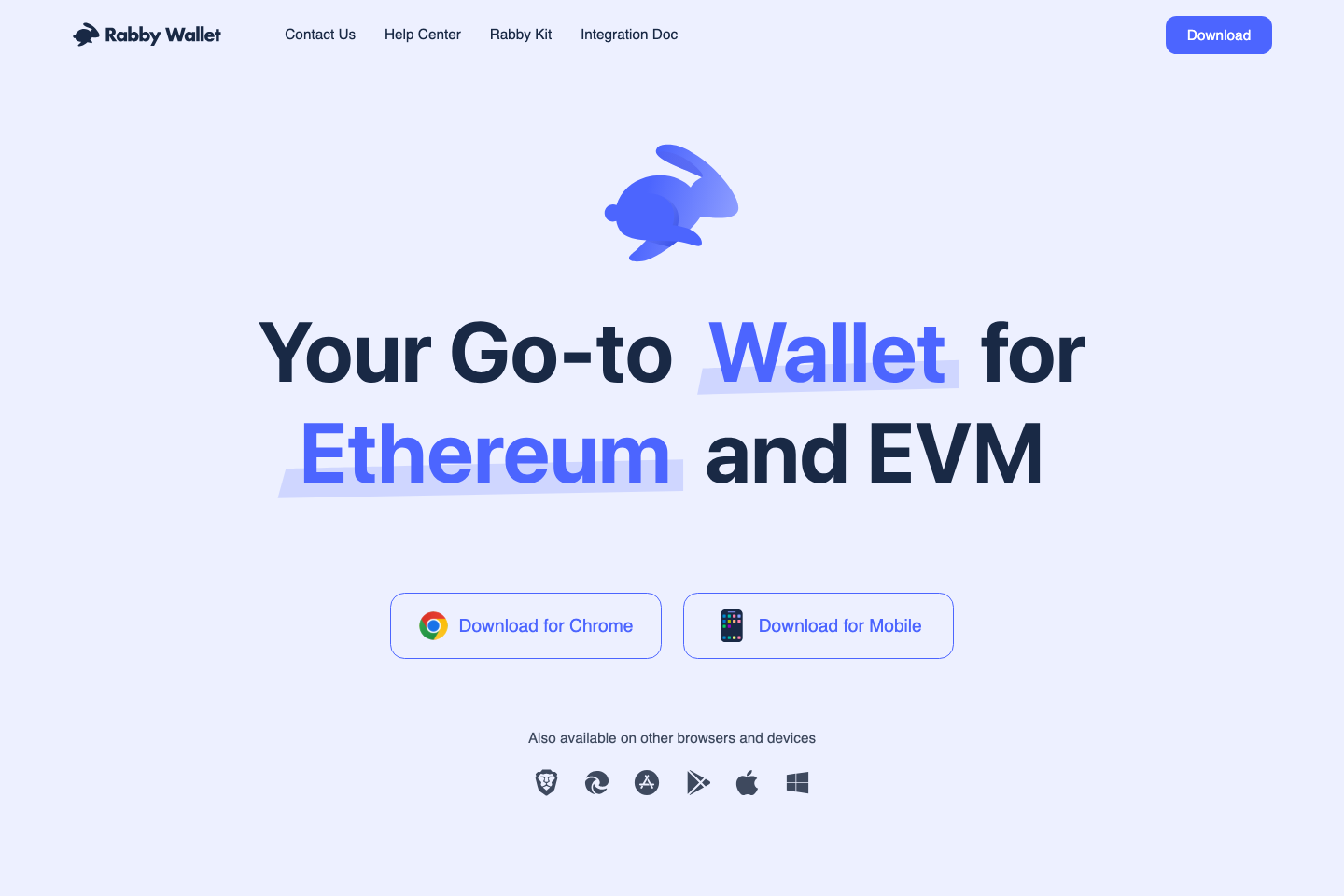
🖥️ Ease of Use & The User Interface
For an established EVM user, the main usability advantage of Rabby is reducing context changes. Instead of maintaining a separate notion of which chain contains which balance and where a site intends to interact, the interface attempts to bring network information and expected effects together. The user still needs to know the intended destination and chain.
The Rabby extension and mobile app have their own interaction patterns. Browser users also need to consider competing wallet extensions and which application handles a connection. Phone users need to confirm supported signing-device connectivity before relying on a desktop workflow to transfer across devices. Neither convenience nor familiar branding should be confused with proof that a request is genuine.
🧭 How to Use Rabby Wallet for Beginners
The following workflow is based on official Rabby documentation. It is an evaluation and safety checklist, not a request to move funds, import private credentials or sign live transactions. Confirm each action independently before using any wallet.
1. Identify your actual network requirements
List the chains on which you have positions and the applications you expect to use. Check whether they are EVM-compatible and whether Rabby includes them in its integrated networks. A token symbol alone does not identify a network or token contract. If you have native assets on a non-EVM chain, plan a different compatible tool for that purpose instead of assuming that every cryptocurrency can be managed here.
2. Use the official download route
The official Rabby Wallet download page is at rabby.io. Start there: search advertisements and lookalike store listings can lead elsewhere. The extension listing should match the publisher and extension identifier supplied by the official website. Do not use a sponsored search result merely because it resembles the brand.
Review the permissions requested by the application and the distribution platform's publisher information. For the Rabby Wallet Chrome extension, follow the official store link rather than installing an archive from an unknown site. The same rule applies to the Rabby Wallet mobile app and future updates. We captured the public listing but did not install or initialize a funded wallet.
3. Choose a signing arrangement before connecting applications
An existing secure arrangement should not be dismantled merely to try a new interface. Rabby documents compatible hardware connections, watched public addresses and local credential-based wallet options. Read-only observation is different from signing access; a watched public address does not grant control over assets. If the purpose is only to assess the portfolio presentation, consider the least-privileged option that serves that purpose.
Never enter recovery words or private keys into a website, a support conversation or an unfamiliar form. Keep backups private and offline where appropriate. Losing the ability to authorize transactions is a separate risk from someone else obtaining that authority. Rabby cannot reverse either problem through a conventional account recovery process.
4. Review requests before granting authority
Before any interaction, identify the expected operation, its network and the destination or contract. Rabby provides documented transaction simulation and security information on integrated networks. Examine the expected changes and any approvals separately. If the preview reports a different asset, amount or action than you intended, reject the request and investigate the discrepancy.
A good routine does not include overriding a risk warning simply to complete a tutorial. A warning is information about something the application detected; the absence of a warning is not a promise of safety. Confirm the legitimacy of the decentralized application through a trusted independent route rather than relying on a link supplied by an unsolicited message.
5. Maintain an inventory of permissions and expenses
Wallet maintenance continues after the initial connection. Review which contracts retain authority to spend tokens, particularly after you stop using an application. Disconnecting its website session is not equivalent to removing an on-chain permission. Rabby documents approval management; a separate specialized approval service may also be relevant.
🛠️ Key Features That Actually Matter
The following features are documented by the vendor. We assess the problem each is intended to solve and the conditions that limit its usefulness.
Network-aware portfolio and application access
Rabby's integrated-network approach combines balance and decentralized-finance views across supported EVM chains. This addresses a common problem: a person may hold positions on several chains while a single-chain balance view gives an incomplete picture. The wallet can help identify where activity is recorded without requiring a separate manual token list for every integrated address.
Portfolio views still require interpretation. A displayed token may be illiquid, an unfamiliar contract may use a familiar ticker, and a third-party valuation may not represent the amount obtainable in an actual sale. A custom network is also not equivalent to an integrated network. Rabby documents limited features for custom networks, including basic token operations and application connectivity. Treat richer portfolio and security services as specific integration capabilities rather than universal properties of all EVM chains.
Pre-signing transaction simulation
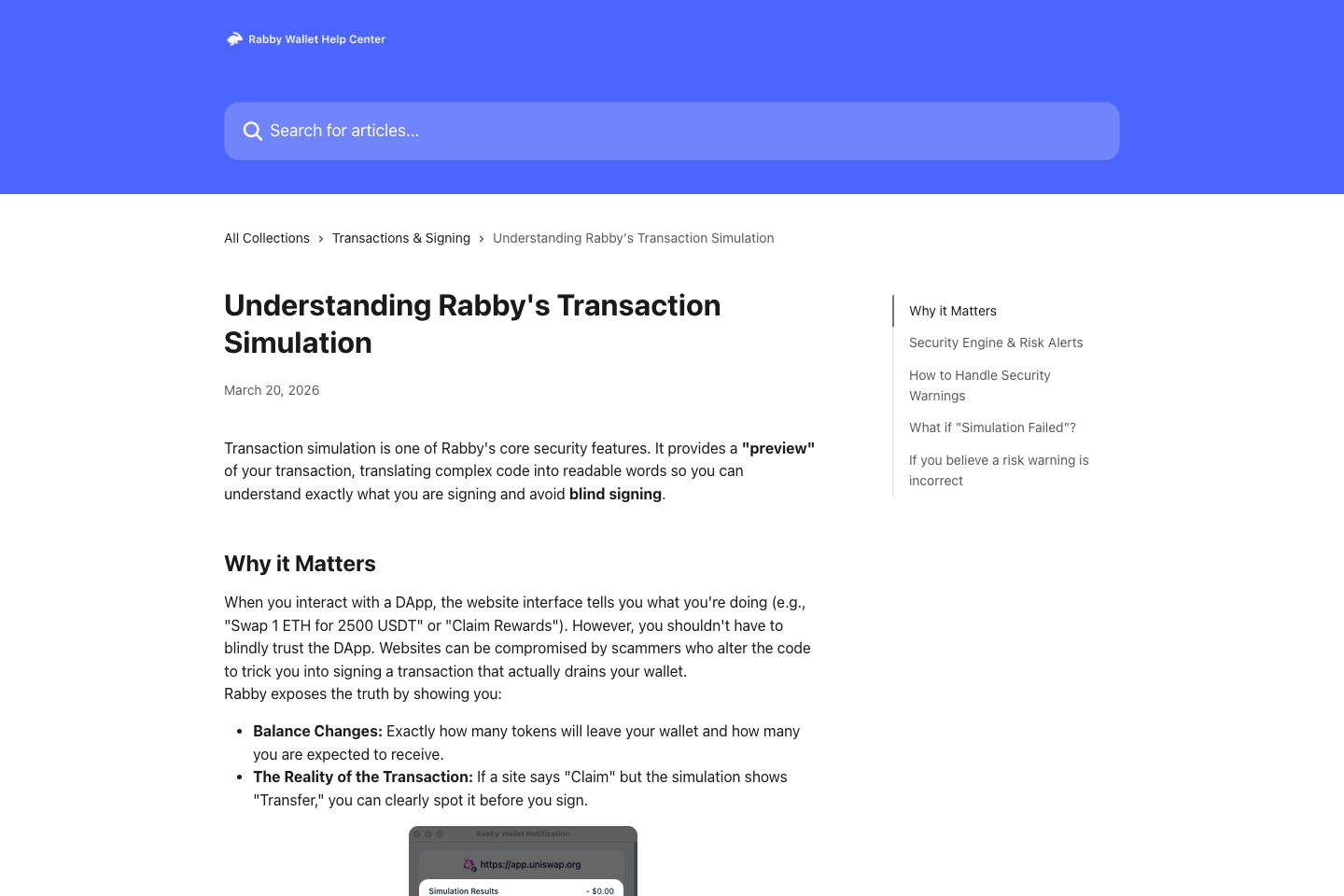
Rabby attempts to translate a transaction request into expected asset effects. This is useful precisely because application interfaces are not authoritative descriptions of what a contract will do. If a page suggests an inbound reward but a pending request appears to transfer assets out, that contradiction warrants rejection and further investigation.
Simulation is an analysis of an expected result, not the result itself. State can change, quotes can become stale and assumptions may not match the final executed transaction. Some interactions grant permission rather than moving assets immediately. A user should therefore examine both the anticipated balance change and the scope of the authorization being requested. A request that moves nothing today can still have consequences later. Rabby provides another opportunity to catch such mismatches, not a substitute for verifying the request.
Risk alerts for approvals and signatures
The documented security engine identifies examples of risky spending addresses, newly created contracts, suspicious tokens, large price impact and certain signature-based permissions. These are practical signals because users often face technical details that a website does not explain. In particular, a risk notice about a spender should prompt a check of who will hold the authority after the request is accepted.
There are limits to any classification. A recent contract is not necessarily malicious, an established contract is not necessarily trustworthy, and a dangerous request can use mechanisms that a detector does not recognize. Rabby describes warnings that may prevent immediate signing unless the user chooses to proceed. For an unfamiliar request, stopping is preferable to treating the warning as an obstacle to remove. We did not test the detection engine against a malicious contract corpus.
Allowance visibility and revocation
Token allowances allow a contract or designated spender to transfer assets within the scope of a granted permission. Rabby documents a way to examine and revoke such permissions. It also explains that decentralized applications determine the requested allowance, which may be larger than the immediate operation requires.
An approval screen does not tell the user whether granting authority is commercially beneficial. It only helps expose the decision. A smaller appropriate allowance may limit exposure, while a broad approval can reduce the number of future confirmation requests at the expense of greater standing authority. Revocation changes an on-chain permission and may require a network transaction. Cancelling a connection in the browser does not do the same thing. A permission review is most useful when it is connected to an inventory of applications you still intend to use.
Hardware device integration
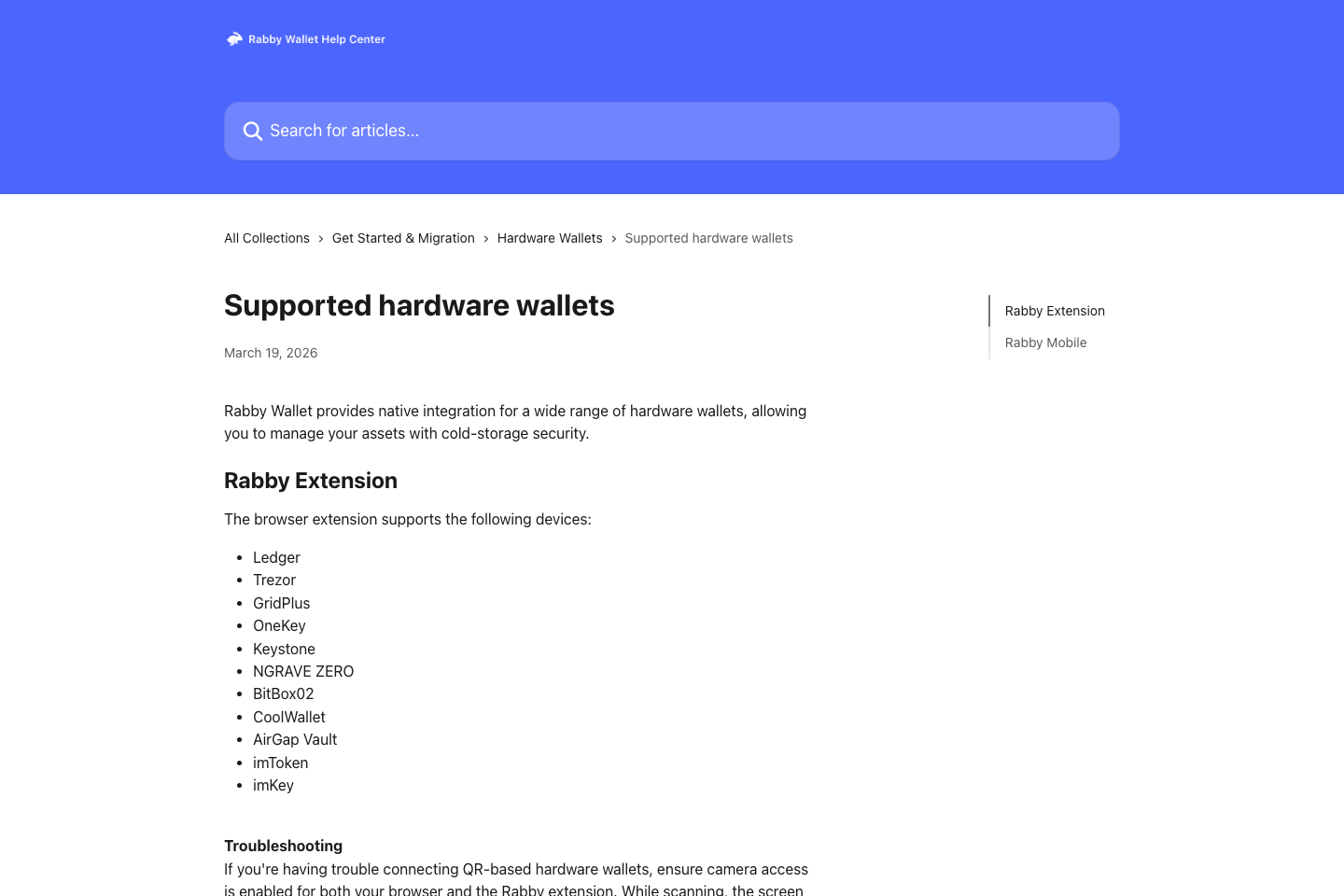
Rabby documents support for several hardware signing devices on the extension, including Ledger, Trezor, Keystone and other manufacturers. The mobile list is narrower and includes different connectivity options. The consumer decision is consequently device- and platform-specific. Check the exact model and connection method rather than reading a list of manufacturers as a compatibility guarantee.
Hardware signing can create separation between a browsing environment and key material when configured appropriately. It does not make the transaction described by an untrusted application safe. The user must compare the action, device display and intended authorization to the extent supported by the device. Moving a hardware-protected secret into a normal browser wallet would remove the benefit of keeping that secret isolated. We verified the documented compatibility lists, not a live pairing or recovery procedure.
Integrated swap and bridge quotes
Rabby documents aggregation of same-network exchanges and cross-network transfers. The swap route helps select between quoted sources of liquidity; the bridge route concerns delivery on another network. The two activities differ in settlement conditions, costs and operational risk. A cross-network transfer may remain incomplete after the initial transaction is confirmed.
A displayed receive amount is a more useful comparison than the headline service charge alone. Two interfaces may produce different routes, liquidity sources and total execution outcomes. Compare asset contract, destination network, estimated receipt, network cost and route conditions before accepting a quote. A token that appears under the expected symbol is not sufficient verification of the destination asset. The vendor's documented standard fee is discussed below; neither the availability of an aggregator nor a lower service rate guarantees a better final price.
✅ Pros & Cons of Rabby Wallet
Pros
- Readable expected transaction effects on supported networks
- Documented approval and signature risk warnings
- Consolidated integrated EVM network views
- Hardware device compatibility documented by platform
- Open-source extension and mobile repositories
- No published recurring installation subscription in checked sources
Cons
- Not a native Bitcoin, Solana or Tron wallet
- Custom networks have limited enriched features
- Warnings and simulation cannot guarantee safe outcomes
- User remains responsible for secrets, signing and recovery
- Swap, bridge, network and other execution expenses remain
- Hardware compatibility differs between extension and mobile
👾 Limitations & Reality Check
Rabby is not an independent custodian or insurance service. Its software does not make the consequences of a signed authorization disappear. Even a well-designed preview can omit risks that require different contextual information, and a compromised device can expose the user to threats outside the scope of a wallet's transaction analysis.
The public source repositories and security assessments provide transparency, but open source is not proof of a vulnerability-free implementation. Least Authority announced final reports for the Rabby extension and mobile application on October 9, 2026. We verified the announcements and their dates. We did not perform our own code audit or read every finding and remediation detail in those full reports for this evaluation. Therefore we do not characterize the applications as having passed every possible security test.
💰 Pricing Plans & Real Costs
There is no normal subscription tier listed in the official installation and usage material we reviewed. That does not mean all operations are free. Rabby's support documentation states a standard 0.25% service fee for swaps and a standard 0.25% fee for bridges, incorporated into their quotes. Its separate fee-waiver documentation lists eligible same-chain token pairs for which the swap service fee is waived. Pair membership and contract addresses matter; an arbitrary stablecoin or an asset with a similar name should not be considered eligible by default.
For an illustrative $1,000 eligible-for-standard-pricing swap, a fee of 0.25% corresponds to $2.50 before considering other cost components. This arithmetic illustration is not a live quote or proof of the amount received. A user may also pay gas, experience price impact or encounter separate route costs. A fee waiver removes a specified provider fee, not every cost of a blockchain transaction.
Compare the expected amount delivered by the complete route rather than subtracting service percentages alone. Rabby Wallet can be used simply as an interface to decentralized applications without routing every exchange through its integrated swap feature. The software cost and the expense of the user's activity should therefore remain separate in a budgeting tool. Hardware devices, where used, are purchased separately.
| Plan | Cost / billing model | Region / billing period | Vendor source checked |
| Wallet software | No recurring subscription quoted; network costs separate | US reference; variable network fees; Free installation | https://support.rabby.io/en/articles/14120234-getting-started-with-rabby-extension (2026-11-21) |
| Standard swap | 0.25% service fee included in vendor quote | US reference; variable network fees; Usage-based | https://support.rabby.io/en/articles/14134156-how-to-use-rabby-swap (2026-11-21) |
| Eligible same-chain swap waiver | 0% wallet swap fee for listed pairs; other costs may apply | US reference; variable network fees; Conditional usage | https://support.rabby.io/en/articles/15956135-0-swap-fee-token-pairs (2026-11-21) |
| Standard bridge | 0.25% service fee; other route costs may apply | US reference; variable network fees; Usage-based | https://support.rabby.io/en/articles/14134280-how-to-use-rabby-bridge (2026-11-21) |
🎯 Who Should Use Rabby Wallet?
Rabby is most relevant for Ethereum and EVM users who have a recurring need to review application interactions. It is particularly worth evaluating when the user maintains several compatible networks or needs to remember which permissions remain active. A supported hardware-wallet owner may also value a different interface without giving up the hardware signing arrangement.
It is less suitable as a single solution for someone who needs native assets on many incompatible chain families. It may also be unnecessary for someone who has a satisfactory custody arrangement and seldom interacts with decentralized applications. The decision to enable another signer or install another extension should be justified by a real need.
⚖️ Rabby Wallet Alternatives
A Rabby vs MetaMask comparison is useful because both products can serve as EVM wallet interfaces, while their exact features, supported platforms and workflows differ. Searching for a MetaMask alternative should begin with the job you cannot already complete comfortably. The best MetaMask alternatives for an individual are the ones that meet that person's network and signing requirements, not necessarily the ones with the most advertised safety tools.
Revoke.cash is a different type of product: it specializes in handling existing permissions rather than replacing the full wallet. Hardware devices form another layer in the system. An alternative to MetaMask is not automatically an alternative to a hardware device or a permission review service. Different tools can complement one another without being direct substitutes.
MetaMask vs Rabby Wallet
MetaMask provides wallet and application connectivity and also documents transaction security alerts. It would be misleading to imply that Rabby is the only wallet capable of presenting risk information. The meaningful comparison is how each interface displays a particular authorization, which platforms and networks support those checks and how the user can confirm a transaction. Compare current quotes without assuming either provider is cheaper. For a fair comparison, use the same network, asset amount and time window. Rabby Wallet vs MetaMask should also include compatibility with your existing signing method.
Revoke.cash vs Rabby Wallet
Revoke.cash helps users identify and manage existing permissions. This can complement Rabby's built-in authorization tools, particularly for users who want a separate interface focused on exposure from prior approvals. Revoke.cash documents free basic approval inspection and individual revocation, subject to network costs; optional premium functionality has separate conditions. The products do not replace each other in every workflow. A person might use a wallet for signing and a dedicated service for periodic review. Verify the official domain for each service and remember that an approval-management tool cannot make stolen signing credentials private again.
Ledger Wallet (formerly Ledger Live) vs Rabby Wallet
Ledger Wallet is the desktop and mobile companion application for Ledger signing devices. The vendor describes a division between the software interface and the hardware that authorizes a transaction. Rabby also documents compatible Ledger connections; compare the exact device, connection method, supported networks and application access rather than treating one interface as a universal replacement. Ledger Wallet has no installation subscription, but the signer is bought separately and transaction costs remain. We did not pair either product with a device. A hardware-protected key does not make an authorized malicious request harmless.
Comparison: Rabby Wallet vs Alternatives
This table compares roles and documented capabilities rather than security rankings. No head-to-head funded-wallet test or execution-price benchmark is claimed.
| Consideration | Rabby Wallet | Alternatives |
| Core task | EVM wallet signing and portfolio | MetaMask: wallet; Revoke.cash: approvals |
| Security signals | Documented simulation and risk alerts | MetaMask also documents alerts |
| Native non-EVM assets | Not supported | Check each alternative separately |
| Hardware support | Documented models vary by platform | Dedicated device interfaces have their own compatibility |
| Provider fees | Fee-free installation; standard 0.25% integrated swap or bridge | MetaMask has separately quoted swap costs; compare the full quote |
| Permission management | Documented built-in revocation | Revoke.cash specializes in permission review |
📌 Why an approval is not the same as a payment
One useful mental model is the difference between making a payment now and authorizing another party to make payments within a certain scope later. Token approvals can create standing authority over a particular asset. That authority may remain after the user closes the wallet window or leaves the application. The relevant data is the existing permission recorded on the network, rather than whether the corresponding website is open.
This also explains why switching interfaces does not repair all historical risks. A migration to Rabby Wallet might change the way requests are displayed, but it does not erase the authority previously granted from the same address. A sensible evaluation includes the existing permission state rather than considering only screenshots of a fresh wallet. The purpose of reviewing prior authorizations is to understand exposure, not to repeatedly submit unnecessary transactions.
🔍 How to interpret a simulation without blind trust
The value of pre-signing simulation lies in comparison. First identify what the user intended to happen; then compare the expected effect presented by the wallet. If the two differ, the mismatch is meaningful even if the application does not show a prominent warning. If they agree, the user still needs to know that the identified contract and destination correspond to the intended application.
The conservative interpretation of an alert is to ask which assumption triggered it. A high price impact warning is different from a suspicious spender warning. Both can justify stopping, but they describe different potential failures. Do not turn warning severity into a universal numerical probability of loss. The sources do not supply an independently measured detection rate that would justify such a calculation.
🛡️ Security audits, source code and privacy
Public source code enables inspection, and the vendor's repositories make that inspection possible for researchers. Actual assurance depends on the code reviewed, build and release processes, the scope of each assessment and the current installed version. It is not enough to see the word audited on a product page.
The October 2026 Least Authority announcements identify separate extension and mobile assessments. This provides evidence that the products have been reviewed, not that all present and future versions are free from vulnerabilities. We link the announcements so a reader can examine their scope and references.
Privacy requires similar care. The vendor describes a self-custodial, locally stored wallet arrangement. Blockchain activity itself is generally observable on public networks, and network access or external services may involve additional data flows. This review does not independently measure telemetry or assert that Rabby provides anonymous activity. A user with specific privacy requirements should examine the applicable privacy terms, network providers and application connections instead of equating self-custody with anonymity.
📱 Choosing browser, mobile or an existing hardware routine
The Rabby Wallet extension is a practical starting point for evaluating supported browser workflows, while the mobile product serves people who need compatible on-the-go access. The same address may appear in different interfaces, but convenience does not require copying secret material to every device. Before expanding an existing setup, decide which devices actually need signing ability and which only need observation.
A reader comparing MetaMask alternatives should make a list of the features used today and test the information presentation without committing real funds or changing recovery arrangements. The product with the lower cognitive burden during an unfamiliar request may be more useful than the product with the longest list of supported chains.
💵 Comparing total cost rather than a fee headline
An integrated swap tool should be evaluated as one possible route to an outcome. The relevant receipt is the estimated asset amount on the correct destination network, after the relevant components of cost. The wallet's own fee is only one row in that calculation. A zero provider fee for an eligible pair can coexist with gas or other execution expenses.
Cross-network movement adds settlement dependencies, so check the destination asset and route conditions rather than assuming instant delivery.
🧪 How We Evaluated Rabby Wallet
DigiOffly evaluated Rabby Wallet using public vendor documentation, open-source repository listings, auditor announcements, competitor documentation and our own screenshots of public pages. We did not import wallet secrets, connect a funded address, pair a real hardware device, execute a swap or bridge, perform a private transaction simulation, conduct a code audit or evaluate exploit detection rates. Feature availability and fees are described from the cited sources as of November 21, 2026. The screenshots show public documentation and distribution pages, not successful transactions with a funded account. Cryptocurrency activity and self-custody involve the potential for irreversible loss. This review is software research, not financial or investment advice.
Method: documentation-based analysis of published vendor sources; no independent product access or benchmark is claimed.
🏆 Final Verdict: Rabby Wallet Review
Rabby Wallet is most compelling as an information-rich interface at the point where an EVM user is about to authorize a request. Its documented portfolio integrations, balance previews and permission warnings address real usability problems. Its open-source repositories and links to security assessments improve the availability of information a prospective user can examine.
The limitation is equally important. A user remains responsible for the authority granted, the security of the signing environment and the integrity of recovery information. The software's native EVM scope, custom-network limits and platform-specific hardware compatibility mean it cannot be recommended as a universal replacement for every wallet.

Frequently Asked Questions
Is Rabby Wallet safe?
No wallet can guarantee safety. Rabby documents transaction previews, risk warnings, open-source repositories and regular audits. These features can help a user assess a request, but they do not eliminate malicious approvals, compromised devices, lost secrets or unsupported interactions. We did not independently benchmark its security.
Is Rabby Wallet free?
There is no recurring installation subscription in the documentation we reviewed. Network costs, integrated swap or bridge fees and hardware devices are separate expenses.
What does Rabby Wallet support?
Rabby supports Ethereum and EVM-compatible networks. Its integrated networks offer richer services than custom chains. Native Bitcoin, Solana and Tron are excluded in its official network guide; consult the current integrated-chains list before use.
What is the Rabby Wallet extension?
It is the browser interface for supported EVM wallet operations. Obtain the Rabby extension through the official website and linked browser store. Confirm publisher details before installation.
Does Rabby have a mobile app?
Yes. The vendor documents a mobile application. The supported hardware device and connection list differs from the browser extension. Verify those requirements before changing your existing setup.
How does Rabby compare with MetaMask?
Both products provide wallet and application workflows. Rabby emphasizes network-aware presentation, expected transaction effects and approval visibility; MetaMask also documents security alerts. Compare current support for the specific network, signing method and action you need.
Does Rabby charge swap fees?
The documented standard wallet swap charge is 0.25% of the routed value, with certain eligible same-chain pairs exempt from that service fee. Gas, price impact and other expenses can still apply. Check the displayed quote and eligibility.
How much does Rabby Bridge cost?
The documentation lists a standard service charge of 0.25% included in the bridge quote. Other costs and settlement conditions depend on the route. We did not test a live bridge or verify a final execution price.
Can I use Rabby with a hardware wallet?
Yes, for documented compatible devices and connection methods. The extension supports more device types than the mobile app. Keep hardware-protected credentials isolated; verify the actual device and platform support before use.
Does disconnecting a site revoke its approvals?
No. Disconnecting the application session does not remove standing on-chain spending permission. Rabby provides approval management, and changing an on-chain allowance may require a network transaction and fee.
Can Rabby recover lost keys or reverse a transaction?
Self-custody is not a conventional recoverable bank login. Rabby cannot promise to recover lost signing secrets or undo a confirmed blockchain transaction. Never share recovery words or private keys with a website or support agent.
EXPLORE NEXT ON DIGIOFFLY
🔍 Explore More on DigiOffly
Dune review
Research public on-chain datasets without confusing them with wallet control
Read Dune ReviewPrimary sources and verification dates
- Identity — official documentation or auditor announcement — verified 2026-11-21
- Networks — official documentation or auditor announcement — verified 2026-11-21
- Hardware — official documentation or auditor announcement — verified 2026-11-21
- Simulation — official documentation or auditor announcement — verified 2026-11-21
- Swap — official documentation or auditor announcement — verified 2026-11-21
- Bridge — official documentation or auditor announcement — verified 2026-11-21
- Security — official documentation or auditor announcement — verified 2026-11-21
- Approvals — official documentation or auditor announcement — verified 2026-11-21
- Waivers — official documentation or auditor announcement — verified 2026-11-21
- Install — official documentation or auditor announcement — verified 2026-11-21
- Migration — official documentation or auditor announcement — verified 2026-11-21
- Chrome Store — official documentation or auditor announcement — verified 2026-11-21
- Audit Extension — official documentation or auditor announcement — verified 2026-11-21
- Audit Mobile — official documentation or auditor announcement — verified 2026-11-21
- Metamask Fees — official documentation or auditor announcement — verified 2026-11-21
- Metamask Alerts — official documentation or auditor announcement — verified 2026-11-21
- Revoke Faq — official documentation or auditor announcement — verified 2026-11-21
- Ledger Wallet — official documentation or auditor announcement — verified 2026-11-21