

Reviewed October 20, 2026. This Stripe review examines published US payment-processing fees, the practical scope of Checkout and Payment Links, subscriptions, marketplace payouts, disputes, tax tools and the work that remains with a merchant. We reviewed current public Stripe documentation and pricing; we did not open a live merchant account, accept customer payments, process cardholder data or benchmark approval rates. Screenshots are sourced from publicly accessible vendor pages, not a logged-in merchant dashboard. Prices and examples are in US dollars for a hypothetical US-based business unless explicitly stated otherwise. Merchants elsewhere must check local pricing.
A founder launches a $12 digital download and celebrates the first thousand orders. Revenue reaches $12,000, but the accounting export is not a simple $12,000 bank deposit. Card-processing fees are deducted, some orders may have been made with international cards, subscription or tax services might add separate costs, and refunds and disputes can change the balance after the sale. A processor should make this workflow manageable; it does not remove the need to understand the money.
Stripe is a payments infrastructure platform. A small merchant can accept payments through a hosted checkout or no-code payment link. A software team can integrate Payment Intents, customer records and webhooks. A subscription company may use Stripe Billing, while a marketplace can onboard sellers and route funds with Connect. These product families share an ecosystem but carry different operational obligations and, in some cases, extra fees.
The most important decision is not whether Stripe has a polished API. It is whether the full transaction journey fits the company’s risk profile, finance controls and economics. The effective cost changes with average order size, customers’ payment methods, international exposure, subscription volume, dispute rates and who owns seller balances. Below we calculate those trade-offs with explicit assumptions instead of pretending one headline fee covers every business.
📊 Stripe Review Summary 2026
What Stripe does well
Payments and hosted checkout, detailed APIs, subscriptions, marketplace tooling and transaction-level financial records.
Where to be careful
Low-value purchases incur meaningful fixed processing fees; international transactions, Billing, disputes and Connect can add costs.
Best for: US-based online merchants that want prebuilt hosted payments now but may later need programmatic checkout, subscriptions, multi-currency acceptance or platform payments. Teams with developers and strong finance operations can make use of Stripe’s deeper API and reporting environment.
Standard US online card rate: The public standard figure is 2.9% + 30¢ per successful domestic card transaction. Stripe lists +1.5% for international cards and +1% if currency conversion is required. Manually entered card data can add 0.5%. These adjustments apply according to the payment circumstances and merchant’s price schedule, not automatically to every order. Stripe’s US pricing page is the appropriate source; it should not be used as a quote for a Romanian or UK account.
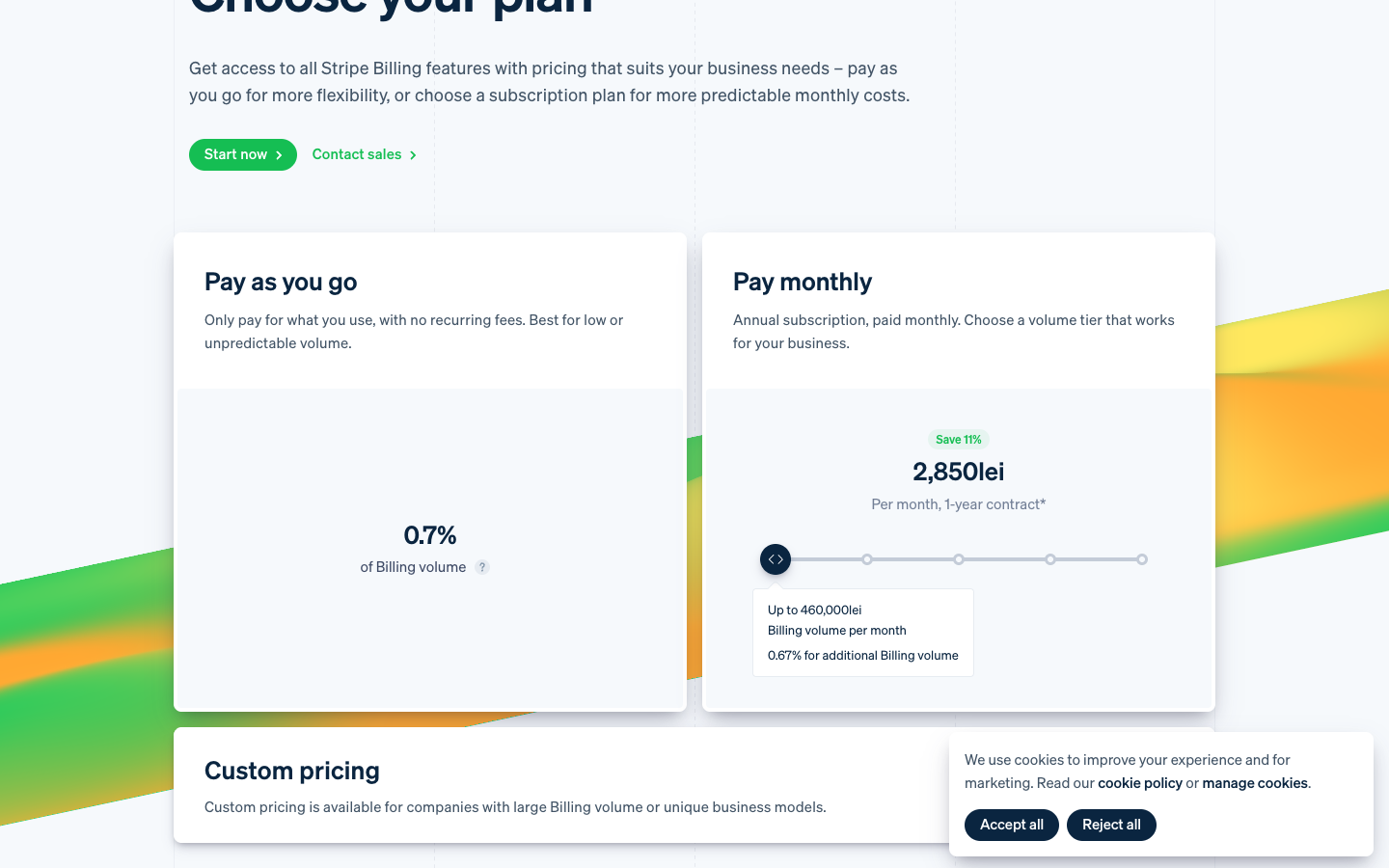
Other products: Checkout and Payment Links are included with standard Payments pricing for eligible use cases. Billing pay-as-you-go is 0.7% of Billing volume, excluding one-off invoices, on the public US Billing page. Invoicing Starter is 0.4% per paid one-time invoice and Plus 0.5%, normally separate from payment processing. Tax Basic has its own calculation charges. Connect pricing depends on whether Stripe or the platform sets connected-account payment fees.
Where Stripe performs well: Broad integration options, hosted pages that reduce how much card-data handling a merchant needs to build, reporting APIs, configurable billing models and an extensive developer documentation ecosystem.
Where to be cautious: A small-ticket business pays a meaningful effective percentage because of the fixed 30¢ fee. Disputes can trigger separate received and countered fees. Cross-border payments, tax automation, revenue recognition and marketplace routing can be separate cost centers. Account underwriting, reserves and payout timing are business risks, not just software settings.
DigiOffly verdict: Stripe is a strong payments shortlist for a growing internet business, particularly one that wants to graduate from no-code payment links to deeper integrations without changing its processor. It deserves a spreadsheet-level cost review before adoption, not an assumption that a common brand is necessarily the lowest-cost choice.
⚡ Quick Verdict: Is Stripe Worth It in 2026?
For a merchant accepting ordinary US-issued cards in dollars, the headline math is straightforward. A $100 successful payment at 2.9% plus 30¢ costs $3.20 in standard processing fees, leaving $96.80 before product costs, taxes, refunds and other Stripe products. The same $3.20 fee consumes a much larger proportion of a $10 sale than a $1,000 sale. The actual blended rate can change as the customer mix changes.
Stripe pricing is attractive for testing a store because the standard Payments model has no monthly platform subscription just to begin processing domestic card payments. However, pay-as-you-go does not mean costless operation. Each successful transaction incurs processing charges, and a business needs to budget the people, software and compliance work around payouts and reconciliation.
The operational advantage is choice. A solo seller can create a Payment Link. A storefront can use Stripe Checkout, and an engineering team can build a custom user journey. Neither should begin with card-number collection on its own server when a hosted solution meets the use case; unnecessary scope increases security and maintenance work.
Stripe also suits merchants whose product model changes. A team could sell one-off licenses, introduce subscriptions, then open a partner marketplace. The platform has products for all three, although adding Billing and Connect changes both integration design and the fee structure. There is a meaningful difference between remaining on one provider and retaining the same commercial terms.
An ideal buyer has basic financial discipline before launch: a chart of accounts, a refund policy, a dispute-evidence owner and a process for checking settlements against orders. Stripe can supply detailed data, but it will not decide which invoice should be recognized as revenue or how a disputed payment should affect inventory.
🧠 What Is Stripe and How Does a Payment Travel Through It?

Think of the merchant’s payment as a lifecycle rather than a button click. The customer sees a checkout form, submits a payment method, potentially authenticates through a bank challenge, and receives success or failure feedback. Underneath, a payment object moves through authorization, capture, settlement and eventually payout. A developer should not infer that money has reached the merchant’s bank account merely because the customer’s browser displays a confirmation.
Stripe’s Payments product supplies payment processing and tools for supporting cards, wallets and other methods. Checkout is a prebuilt hosted or embedded payment experience. Payment Links allows a merchant to distribute a hosted payment URL without building a full website checkout. For API integrations, Stripe uses objects and asynchronous events so an application can react to a successful payment, failed renewal or refund.
The crucial architecture detail is event reliability. A payment confirmation screen can be closed before the merchant’s server receives the final status. Redirect parameters are not a substitute for securely verified webhook events. Store an order identifier, enforce idempotency in fulfillment and make duplicate delivery impossible even when events are retried. That is a business control, not a Stripe-specific trick.
Hosted checkout versus a custom payment form
Stripe Checkout reduces the amount of interface and payment-data handling the merchant must build. It can be configured for products, payment methods and certain customer information flows. For many startups, this is preferable to commissioning a bespoke credit-card UI whose maintenance burden becomes invisible until a wallet or authentication method changes.
A custom integration may still be justified when the product requires a highly specialized multi-step booking, complex payment-method choice or deeply embedded purchase experience. The trade-off is responsibility for testing a larger surface: failure states, localization, delayed methods, fraud decisions, accessibility and unexpected API behavior. An engineering team should cost that work, not assume the ability to customize guarantees a higher conversion rate.
As part of Stripe payment processing fees evaluation, merchants should check whether the chosen integration adds any separate product charges. Stripe lists Checkout as included at standard Payments pricing, but optional post-payment invoices, custom domains and Billing functionality can create other line items. The sales plan and monthly statement must match the features actually enabled.
Why Payment Links appeal to small merchants
Payment Links lets someone accept a payment by sharing a URL in a message, social profile or landing page. It is often the fastest way to validate demand for a workshop, digital item or service deposit. Stripe’s US pricing page says links are included with standard Payments pricing, while an optional custom domain is advertised at $10 monthly. An invoice generated after a one-time payment can carry a separate 0.4% fee capped at $2 in the relevant setup.
A link is a payment collection method, not an inventory, tax or customer-service strategy. A merchant still needs a reliable fulfillment record, refund instructions, privacy notice and customer contact process. If the same link sells limited seats, check how availability and overselling are managed before sending it to a large audience.
Stripe’s broad catalog can tempt a founder to buy features before the first transaction. For a simple sale, define the minimum successful outcome: a customer sees the final price, pays in an eligible method and receives exactly one receipt and one entitlement. Add recurring billing and more complex automation only when those processes have an accountable owner.
💰 Stripe Pricing 2026: Cards, Billing, Tax and Marketplace Payments
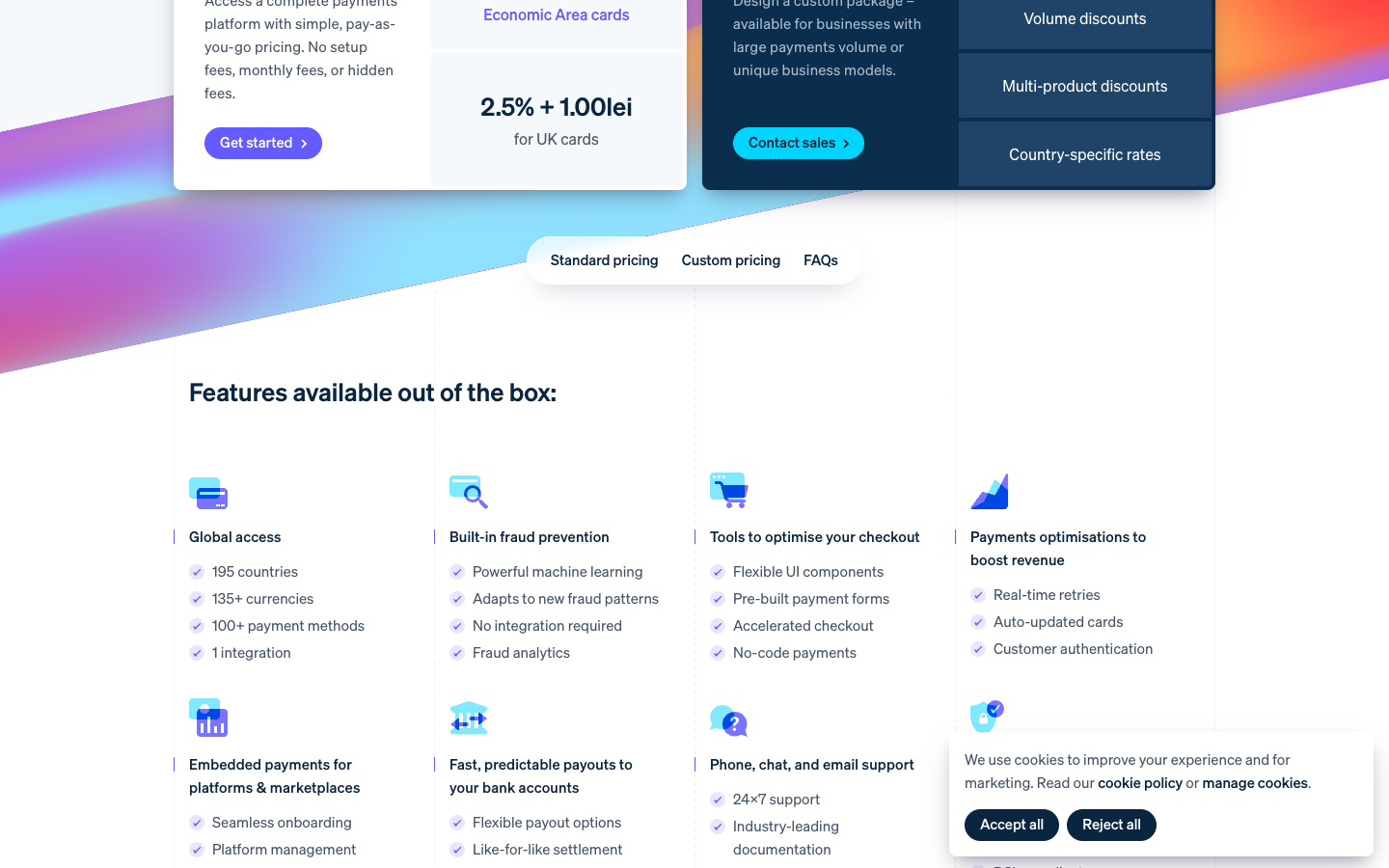
The figures below use published US Stripe pricing in USD, checked October 20, 2026. They are not promises of universal rates. Local Stripe entities, negotiated pricing, account eligibility and specific payment methods can produce materially different fee schedules.
| Product or fee | US published reference | When it applies | Buyer should verify |
|---|---|---|---|
| Domestic online cards | 2.9% + $0.30 per successful transaction | Standard US card processing | Domestic definition, contract and accepted method |
| International-card adjustment | Additional 1.5% | Eligible international card charges | Card origin and other fees |
| Currency conversion adjustment | Additional 1% | Conversion required for the payment | Customer currency and settlement currency |
| Manually entered card adjustment | Additional 0.5% | Eligible manually entered transactions | Which collection flow triggers it |
| Stripe Checkout / Payment Links | Included with standard Payments pricing | Standard hosted collection | Optional products and custom domains |
| Stripe Billing pay as you go | 0.7% of Billing volume | Recurring subscription and billed usage | Whether volume includes off-Stripe invoices |
| Invoicing Starter | 0.4% per paid one-time invoice | Separate one-time invoice product | Payment processing also applies |
| Tax Basic no-code | 0.5% on eligible calculated transactions | Tax collection where registered | Tax setup and local obligations |
| Connect, platform-controlled pricing | $2 per monthly active account, plus 0.25% + 25¢ per payout | Platform handles pricing for sellers | Responsibility for account and payout fees |
Sources: Payments pricing, Billing pricing, Invoicing pricing, Tax pricing and Connect pricing. These amounts belong to distinct products and should not be summed blindly on transactions where the products are not used.
Stripe credit card processing rate and small tickets
The Stripe credit card processing rate combines a percentage with a fixed amount. That fixed component becomes disproportionately expensive as order value drops. A $5 transaction at the standard domestic rate costs 44.5¢ in processing, or 8.9% of the sale. A $500 transaction costs $14.80, or 2.96%. Neither figure accounts for refunds, premium methods, foreign-issued cards or additional products.
| Illustrative US domestic card payment | Processing fee at 2.9% + 30¢ | Fee as share of payment | Remainder before other costs |
|---|---|---|---|
| $5 | $0.45 after cent rounding | About 9.0% | $4.55 |
| $10 | $0.59 | 5.9% | $9.41 |
| $50 | $1.75 | 3.5% | $48.25 |
| $100 | $3.20 | 3.2% | $96.80 |
| $500 | $14.80 | 2.96% | $485.20 |
Illustrative card-processing arithmetic; the $5 result is 44.5¢ mathematically and is shown to the nearest cent. Actual per-transaction rounding and account pricing may differ. The table excludes every other expense.
This example does not make Stripe a poor choice for inexpensive goods by itself. The relevant alternatives may impose monthly subscriptions, minimum charges or extra setup work. The right metric is the effective cost per successful order over a realistic month, including the transactions that failed or were reversed. A business can sometimes improve the economics by bundling several small purchases into one larger basket rather than optimizing the processor alone.
Stripe international card and currency conversion fees
The Stripe international card fee on the standard US reference page is an additional 1.5% for relevant international cards. The extra 1% applies if currency conversion is required. They are separate pricing conditions: a foreign-issued card does not necessarily mean the currency must change, and a business should not apply the FX adjustment to every purchase made by an overseas visitor.
Take an illustrative $100 card charge with both conditions applying to an eligible US Stripe merchant. A simplified fee calculation is $2.90 + $0.30 domestic processing, $1.50 international adjustment, plus $1.00 conversion adjustment, totaling $5.70. This is not a quote for all cross-border payment methods or a promise about a customer’s bank exchange rate.
For Stripe currency conversion charges, report the difference between the amount billed to the customer, the presentment currency, Stripe’s payment fee and the amount settled to the merchant. Some merchants price in multiple currencies to avoid customer friction; that choice may create conversion and accounting complexity elsewhere. Test the transaction path for each major selling region rather than choosing a single global percentage assumption.
Stripe Billing subscription fees and the double layer
Stripe Billing automates plans, subscription schedules, invoices, payment collection and certain revenue-recovery workflows. The US pay-as-you-go page shows 0.7% of Billing volume, including relevant Billing transactions processed on and off Stripe, and excluding one-off invoices. Stripe also advertises annual subscription tiers paid monthly for businesses with predictable volume. Those tiers are not the same as ordinary pay-as-you-go.
The most common misunderstanding is that the 0.7% replaces card processing. It does not. With Stripe Payments collecting a successful US domestic card subscription, the merchant may owe the card charge fee plus Billing’s usage fee. For a simplified $100 monthly subscription, that could be $3.20 in standard card fees plus $0.70 Billing fee, or $3.90 before Tax and other costs, assuming the published rates and eligible treatment.
This is why Stripe Billing pricing for SaaS needs a separate line in a forecast. Many SaaS founders measure monthly recurring revenue rather than the cash actually collected; a failed renewal, prorated upgrade, annual prepayment or credit note can alter the applicable volume and revenue-recognition period. Model both expected invoice volume and successful settlements, and ask which events produce product fees.
Stripe’s public Billing page offers contracted tiers such as $620 monthly for a volume band up to $100,000 per month, with a stated one-year contract and an overage rate. Buyers near that band should compare total annual commitments, overage fees and the cost of unused capacity against 0.7% pay-as-you-go, rather than comparing $620 only with one unusually high month.
Stripe invoicing and one-time professional services
A consultancy selling one-off projects may prefer a formal invoice with line items, terms, collection reminders and a record of what the customer owes. Stripe Invoicing Starter is listed at 0.4% per paid one-time invoice and Plus at 0.5%, with payment processing charged separately. The exact service and account setup determine the billable scope and any cap or negotiated conditions.
For Stripe invoicing fees versus Billing, separate an invoice that bills a one-off service from a recurring subscription invoice. An ordinary monthly subscription generally belongs to the Billing model, and applying both product percentages indiscriminately would double-count the product fee. Ask how credits, partial payments and offline settlements are reflected in reports before choosing invoice automation.
A high-ticket business should also inspect the effect of capped charges and the payment method. A customer willing to pay an invoice by eligible bank transfer may change the fee structure compared with a commercial card; the operational cost of tracing funds and handling failed transfers matters too.
Stripe Tax pricing for digital products
Sales tax, VAT and GST obligations depend on business location, customer location, what is being sold, thresholds and registration status. Stripe Tax can calculate applicable amounts and provide workflow assistance; using it does not make the merchant automatically registered in every jurisdiction or relieve the business of legal responsibility for filings and remittances.
The US Tax Basic no-code price is 0.5% of applicable transaction volume in jurisdictions where the merchant is registered to collect tax. The API mode lists $0.50 per applicable transaction with a bundle of calculation calls. Tax Complete begins at a $90 monthly subscription with a one-year contract and stated included quotas for registrations, transactions and filings. Out-of-quota and foreign registration costs need review.
For Stripe Tax pricing for digital goods, take care with what is taxable, which customer evidence is required and whether the tax calculation is based on a tax-inclusive price. If a founder sells a $10 digital download to customers in different states or countries, do not infer a universal tax rate from Stripe’s pricing page. Use a professional nexus review and actual product classifications before configuring automated tax.
Marketplace costs and the Stripe Connect pricing models
Connect is not an ordinary checkout setting. It manages relationships among a platform, connected accounts and transactions that may require split charges, transferred balances, seller verification and payouts. Stripe advertises a model where Stripe sets and collects processing fees from connected accounts, and a model where the platform sets its own charges.
On the US Connect pricing page, a platform choosing its own payment pricing has a published $2 per monthly active connected account and 0.25% + 25¢ per payout, with some additional funds-routing charges depending on the capability used. An account becomes active when payouts occur to its bank or debit card in that month. The Stripe-handled-fees model can remove those additional platform fees for the specified capabilities, but platform monetization and liability differ.
For Stripe Connect payout fees, count payouts as events, not as the same thing as customer transactions. A marketplace that pays each freelancer every Friday generates a different payout count from one that pays monthly. The decision affects seller expectations, cash controls and reconciliation as well as the per-payout charge. Never apply a published Connect fee to unrelated standalone Stripe Payments accounts.
🛡️ Disputes, Refunds, Fraud and Payout Delays
A checkout provider’s best features tend to receive attention during a successful sale. Finance teams discover its harder edges when a customer files a card dispute, an issuer reverses a charge or the merchant cannot fund a refund from available balance. These events are normal payment-system risks, not evidence that a particular processor is uniquely unreliable.
On the US Stripe pricing page, a dispute received fee of $15 applies to each received card dispute, with a separate $15 dispute countered fee when the merchant manually contests an eligible dispute. Stripe says the countered fee is returned if the dispute is won, but the received fee is not generally refunded. Network fees can also arise in specific cases. Stripe’s dispute fee documentation explains the distinction.
Stripe chargeback fees and evidence strategy
The phrase Stripe chargeback fees for merchants should prompt more than a fee lookup. A chargeback can temporarily or permanently remove the disputed transaction amount from the merchant’s funds, while the business may already have delivered its product. If the merchant contests, it must submit admissible evidence within the network’s deadline and spend staff time preparing it. A win is not guaranteed.
For a digital service, useful evidence may include a clearly presented cancellation policy, invoice details, device or session records with lawful collection, customer communications and proof that a requested service was made available. For physical goods, delivery confirmation and item description may matter. Avoid creating exaggerated evidence: provide accurate, relevant records, not a large dump of unrelated customer data.
Stripe offers fraud tools such as Radar and dispute-management automation. The base Payments experience can include Radar Lite, while extra fraud rules and premium workflows may cost more. No automated scoring system makes every risky transaction disappear. A seller must decide whether to reject some legitimate buyers, require additional authentication or absorb higher expected loss.
Refunds are not simply negative sales
Imagine a $100 payment that is captured, settled and refunded later. A product team may show zero net revenue, but the accounting treatment can still include payment-processing fees, a refund, inventory effects and tax adjustments. The refund policy should explain whether the product can be returned and how long settlement may take. Before implementing a refund API call, verify what portion of the original processing fees is or is not returned under the applicable contract.
A business that sells annual subscriptions should model refunds separately from cancellations. A cancellation may stop future invoices without refunding an already consumed service period; a refund moves money. Disputes are different again because card-network procedures can override the merchant’s preferred timing.
For finance, build a reconciliation report with separate columns for gross charges, processing fees, refunds, disputes, network assessments, product-specific fees and bank payouts. The word “sales” alone is too ambiguous for a daily dashboard that drives cash planning.
Stripe payout schedule and rolling reserves
Funds shown in a processor balance are not always eligible for immediate payout. Stripe’s account settings and country rules determine ordinary payout timing, and a new or higher-risk merchant can face additional verification, rolling reserves or adjustments. A sudden rise in disputes, prohibited activity or mismatched business information can interrupt the cash cycle.
For Stripe payout schedule for new businesses, ask what funds become available when, whether the first payout uses an extended waiting period and what conditions could pause payouts. Do not treat a card authorization as money in the bank. Merchant finance should keep enough cash outside the processor to cover suppliers, taxes and returns if a settlement is delayed.
A reserve is especially consequential for a business with expensive fulfillment. A merchant that receives $50,000 in orders may owe inventory suppliers before receiving all settlement funds. That is a working-capital issue that a dashboard cannot solve. When comparing processors, read the merchant agreement’s rights to hold balances rather than assuming the fastest advertised payout applies to all accounts.
🛠️ Integration Workflows and Security Responsibilities
Stripe publishes comprehensive APIs, libraries, events and testing tools, which make it appealing to product teams. The engineering challenge is that money workflows are stateful and must survive partial failure. Building a payment page is usually easier than handling a double-click, delayed bank confirmation, failed webhook, expired card, interrupted subscription or mid-cycle upgrade correctly.
A robust design gives each customer order a stable internal identifier and records its payment status independently of any browser redirect. It validates the authenticity of Stripe events and processes each event idempotently. If a fulfillment service is temporarily offline, it queues work and retries safely. These controls protect the customer from duplicate licenses and the company from shipping an unpaid order.
Payment Intents, Checkout sessions and webhooks
Stripe’s API exposes payment lifecycle objects, but a merchant should not copy identifiers from untrusted client input without validation. For a hosted Checkout implementation, the application creates a session using prices and products it has authorized server-side. After a successful event, a background worker delivers the entitlement and marks the internal order as complete.
A buyer inspecting Stripe Checkout integration for SaaS should request a written failure-state matrix. What happens if the payment succeeds but the callback times out? If the buyer refreshes the receipt page, is another license issued? If the card requires additional authentication, does the app preserve the cart? Can support staff see an understandable audit trail without privileged API access?
The best first integration is deliberately small. Test one-time payments and refunds, then recurring payments and invoices, then webhooks and failed payments. A product that can safely stop and resume work during outages is a stronger foundation than one that demonstrates an elaborate checkout animation but depends on every network request succeeding instantly.
Subscriptions and revenue recovery
SaaS companies have a more complicated revenue story than retail merchants. A subscription can have a trial, promotional price, metered usage, a tax calculation, a mid-cycle seat increase and a renewal failure. Stripe Billing provides subscription and invoice automation for these patterns, including tools intended to recover failed payments. The software team still needs to decide when service access is granted, restricted or removed.
For usage-based models, define a reliable event source, the idempotency key of each billable event and the cutoff at which late usage is accepted. Metering disputes are customer trust problems: two systems counting the same API requests differently can create billing confusion even if the payment is successful. Keep reproducible usage logs without unnecessarily retaining sensitive payloads.
A subscription migration from another provider should start with an inventory of plans, customer identifiers, trial states, discounts, open invoices, balances and payment tokens. Some payment methods cannot be moved between processors in the same way; account and network rules apply. Parallel reconciliation is safer than assuming the new dashboard’s MRR figure matches the old system’s recognized revenue.
Accounting exports and financial controls
Stripe offers transaction data, balance movements and reporting capabilities; finance should decide how these map to the general ledger. One bank payout can represent hundreds of gross charges minus fees and refunds. Posting the payout as sales understates gross revenue and hides the economics of payment acceptance.
The accounting integration needs identifiers that join each payment with an order, invoice, customer, refund and settlement. Map different fee categories to appropriate expense accounts and maintain a reconciliation checkpoint: total gross charges plus and minus all balance movements must explain the bank transfer. Exception queues should highlight orphan payments rather than silently dropping them.
A merchant considering Stripe accounting reconciliation tools should ask whether the existing QuickBooks Online or Xero workflow imports gross sales and fee detail or just net deposits. A direct integration may save time, but its handling of disputed amounts, multiple currencies and deferred revenue requires testing. Our QuickBooks Online review and Xero review explain why accounting system choice matters beyond the payment processor.
PCI scope and customer information
Hosted Stripe components can reduce the amount of card data that passes through the merchant’s systems. They do not eliminate all security or regulatory duties. Businesses still handle names, addresses, receipts, device information and sometimes sensitive billing relationships. Limit access to production keys, separate sandbox from live environments and use role-based permissions for support staff.
The strongest security model does not grant every employee the ability to issue refunds or export customer data. Use distinct roles, approval workflows for exceptional refunds, audit logs and a documented process for revoking access when someone leaves. Review retention policies and cross-border data-transfer requirements relevant to the merchant’s jurisdiction.
Stripe’s documentation supports versioned APIs and integration testing. That can reduce avoidable breakages, but the company must actively maintain its own dependencies, verify webhook signing secrets and monitor background-job health. Payment infrastructure may be outsourced; accountability for the checkout experience is not.
📋 Total Cost Scenarios for Three Business Models
All calculations below are illustrative US domestic card scenarios based on the standard public fees. They assume successful payments, no discounts, no refunds, no international charges and no chargebacks unless stated. These are not forecasts of Stripe profitability and do not estimate tax liability or Stripe fee rounding for every possible edge case.
Scenario A: Digital downloads. A creator sells 1,000 items at $12 each. Gross sales are $12,000. At 2.9% plus $0.30 per transaction, processing costs would be $348 + $300, or $648, leaving $11,352 before product expenses and other Stripe services. The effective processing rate is 5.4%. If 20% of those orders were eligible international-card purchases with the 1.5% adjustment, that would add an illustrative $36, assuming each such order still costs $12 and no currency conversion is needed.
Scenario B: Subscription software. A SaaS company collects 400 identical $40 monthly subscriptions through US domestic cards. Gross monthly collections are $16,000. Standard card processing would be $464 in percentage fees plus $120 in fixed charges, or $584. Stripe Billing pay-as-you-go at 0.7% of the eligible $16,000 volume adds $112, for an illustrative $696 combined total. This excludes tax, disputes, discounts and other add-ons. A finance team should compare the $696 with the cost of subscription software and a separate gateway, not with the $584 card fee alone.
Scenario C: A small two-sided marketplace. The platform has 20 connected sellers receiving one eligible payout each in a month. Under a platform-controlled Connect pricing model, 20 active accounts at $2 represent $40. If those 20 payouts total $10,000, the listed 0.25% payout-volume charge is $25, plus 20 × $0.25 = $5, yielding $70 in the illustrated Connect account and payout fees. Card processing and any extra funds routing, instant or cross-border transfers, tax reporting and other costs are excluded. If the platform uses the Stripe-billed-connected-account model, that specific additional platform fee structure may not apply; do not mix the models.
| Example business | Assumed gross activity | Calculated Stripe fee components | Important omissions |
|---|---|---|---|
| Digital downloads | 1,000 × $12 sales = $12,000 | $648 standard card fees | Refunds, fraud, foreign cards |
| SaaS subscriptions | 400 × $40 subscriptions = $16,000 | $584 card + $112 Billing = $696 | Tax, failures, chargebacks |
| Marketplace platform | 20 monthly active seller accounts, $10,000 in 20 payouts | $40 active-account + $30 payout = $70 | Card processing and routing |
A company should not choose a provider simply because the first row looks tolerable. A creator whose average order is $5 has a different unit economy from one selling $100 courses. A platform sending dozens of micro-payouts has a different cost structure from one sending consolidated seller balances weekly. A seller with high chargeback frequency must model both direct fees and potential disruption.
The useful approach is to run three scenarios: expected volume, slow month and rapid growth. For each, vary the card mix, payment count, subscription share, FX exposure, disputes and refund rate. Ask where a change in one assumption crosses a profitability threshold. The result can guide product packaging, payment-method selection and whether to negotiate with Stripe.
⚖️ Stripe vs PayPal, Square and Adyen
The question Stripe vs PayPal for online business is often framed as a debate over which checkout brand is more familiar. A more practical test compares the customer’s payment method preferences, geographic exposure, conversion funnel, dispute operations, payout timing and the cost of maintaining each integration. PayPal-branded checkout can be useful to merchants whose buyers prefer that wallet; Stripe offers its own broad card, wallet and local method coverage. Many stores make more sense supporting both rather than forcing an exclusive choice.
Stripe vs Square for ecommerce depends on the role of physical retail. Square has strengths for merchants that need a point-of-sale environment alongside online ordering, while Stripe’s developer tooling and API-based product range are attractive for deeply integrated online products. A coffee shop that sells gift cards online and manages in-store staff may value an integrated POS more than a flexible payment API. A SaaS startup has almost the reverse set of needs.
Adyen is another contender for businesses that handle complex international payments and have the engineering resources to negotiate and manage enterprise-grade processing. Its commercial structure and interchange-based pricing may suit some high-volume merchants, but a smaller business should not assume it qualifies for the same terms. Request actual proposals with the same payment mix rather than inventing a definitive winner.
| Provider or approach | Where to investigate it | Questions that determine the choice |
|---|---|---|
| Stripe | Online-first startups, SaaS, API-driven platforms | Blended fees, Billing/Tax/Connect charges, funding and disputes |
| PayPal checkout | Sites whose customers ask for a familiar PayPal wallet | Wallet conversion, merchant fee mix, dispute experience |
| Square | Retail and hospitality needing POS plus ecommerce | Hardware, store operations, online pricing and inventory |
| Adyen | Larger international or omnichannel merchants | Minimum requirements, payment-method coverage and quoted economics |
| Bank transfer / ACH | Suitable B2B invoices or recurring payments | Eligibility, processing time, return risk and reconciliation |
We deliberately do not display a universal competitor fee ranking in this table. Providers have country-specific pricing, optional products and negotiated rates, and the same company may use several payment methods. A useful procurement exercise is to provide all vendors an anonymized twelve-month payments mix and compare the quoted effective cost, support model and documented data portability.
When Stripe may be the wrong choice
A merchant with few online transactions and no technical resources may find a simpler storefront-and-payments bundle sufficient. A regulated or high-risk business may be ineligible for particular categories or subject to additional underwriting; do not build around an assumption of approval. A business with unusually large payments and low transaction counts should obtain tailored quotes and bank-method alternatives rather than extrapolating a mass-market card rate.
Some teams overinvest in features. They build custom checkout and Billing integrations before validating product demand, then discover that maintenance and reconciliation take more time than marketing. Others underinvest, relying on a single no-code link even as their order states, refunds and entitlements become complex. Choose the least complicated arrangement that can be monitored and audited reliably.
👍 Stripe Pros and Cons
Pros
Clear domestic card rates, hosted checkout, developer APIs and options for recurring billing or platforms.
Cons
Small-ticket fixed fees, dispute exposure and extra Billing, Tax, Connect or international transaction charges.
Strengths: Clear standard US online-card reference pricing; multiple routes from Payment Links to Checkout and full APIs; mature developer resources; products for subscriptions, tax calculations and platforms; many supported payment methods; transaction-level data that can support detailed finance reconciliation when configured thoughtfully.
Limitations: Card fees can be costly on very small orders; international-card and conversion adjustments increase blended expense; Billing, Invoicing, Tax, Connect and advanced fraud features can produce additional charges; merchant verification and risk controls may affect payouts; payment integration still requires engineering ownership; and dispute outcomes are not under the merchant’s full control.
These advantages and drawbacks are drawn from published product documentation and payment-system realities, not firsthand acceptance-rate experiments. We have not tested Stripe’s internal fraud scoring, compared real authorization uplift or measured the timing of a specific company’s payouts. Any vendor conversion or uptime claims should be evaluated through the buyer’s own monitoring and a properly designed test before being treated as operational expectations.
🎯 Who Should Use Stripe?
Strong fit: an online software company selling subscriptions. The combination of Checkout, payment APIs and Billing can support a product that changes its plans frequently and needs automated recurring collections. Finance and engineering still have to align invoice events with customer entitlements and revenue recognition, and Billing’s 0.7% usage fee belongs in the margin forecast.
Strong fit: a marketplace with a capable product team. Connect provides building blocks for onboarding sellers and routing payouts, but the platform must understand the chosen account model and contract responsibility. Seller verification, customer support, dispute liability and payout economics should be designed before launch, not patched after volume increases.
Potential fit: a freelancer or small seller validating demand. Payment Links and hosted Checkout can shorten the path to the first order. The founder should focus on a trustworthy sales page, clear refund policy and a way to reconcile orders to received funds. A complete custom payment integration is rarely necessary at that stage.
Weak fit: a merchant treating payment processing as a substitute for accounting or tax advice. Stripe can produce detailed money flows, not the business decisions needed to recognize income, register for sales taxes or file returns. Teams with primarily in-store activity, unusually high-risk products or special regional payment requirements should compare dedicated alternatives and account eligibility.
🧪 How We Reviewed Stripe
We inspected the official US payments pricing, Stripe Payments, Billing prices and volume tiers, Connect charges and platform-account models, Tax Basic and Tax Complete, Invoicing, and dispute-fee explanations. Public product imagery was captured on October 20, 2026, and the article uses exact product distinctions rather than estimating unavailable private account settings.
These sources document fee schedules and product descriptions, not the merchant’s individual economics. Calculations use clearly stated domestic-card assumptions and exclude items that vary by business. We have not opened a merchant account, sent a test payment, verified a business identity, run a refund, filed a dispute or experienced settlement under a particular legal entity.
For independent verification, the next stage for a buyer would be a carefully controlled sandbox build and, with approval, a low-risk real payment test. That work would evaluate event processing, receipt delivery, ledger export, refund workflow and integration behavior, not merely whether a button can accept a card number. The findings would be specific to that merchant and should not be represented as universal measurements.
A buyer operating in Romania, elsewhere in the European Union or outside the US should not use the numerical US examples as local pricing. Compare the localized Stripe pricing page, settlement currencies, regional payment options, taxes, dispute fees and eligibility rules. Negotiated accounts may also have a different fee schedule, and product terms can change after our inspection date.
🏆 Final Verdict: Is Stripe Worth the Cost in 2026?
This Stripe review concludes that Stripe is a strong option when the company needs a payment system that can support both a simple initial checkout and more complex sales models later. The real benefit is an ecosystem of hosted UI, payment APIs, billing tools and data that a serious team can turn into reliable operational workflows. The platform does not guarantee that every payment will succeed or every dispute will be won.
The standard Stripe pricing headline is a starting point. Domestic cards at 2.9% plus 30¢ are easy to explain, but order size matters, and international charges, Billing volume, Tax, Connect or disputes can add material costs. A company that forecasts its margin from one percentage alone will miss obvious sources of variance.
Our preference would be to start with Stripe Checkout or Payment Links where the merchant model permits it, build idempotent event handling and proper ledger reconciliation, and add advanced products only for explicit business needs. A finance owner should be able to explain a customer charge all the way through to the bank payout, including every processing and product fee.
Stripe is worth considering for an online-first business with ambitions beyond a one-page store. It is less obviously the best choice for every shop, payment geography or risk category. Compare actual proposals, the buyer’s payment mix and the support and compliance commitments that matter before signing. A disciplined pilot is more informative than a list of impressive product names.
Stripe Review 2026: Frequently Asked Questions
How much does Stripe charge per card transaction in 2026?
The standard US online domestic-card reference is 2.9% plus 30 cents per successful transaction. International cards, currency conversion, manual entry and other products can add fees.
Is Stripe Checkout free?
Checkout is included with standard Stripe Payments pricing for eligible flows, but processing charges remain. Optional custom domains, invoicing and subscriptions may have separate fees.
Does Stripe charge a monthly fee?
Standard US Payments is pay as you go rather than a mandatory monthly software subscription. Certain other services, including Billing tiers, Tax Complete and custom domains, can have monthly or annual commitments.
How much does Stripe Billing cost for subscriptions?
US Billing pay-as-you-go is listed at 0.7% of eligible Billing volume on top of any payment processing charges; contracted monthly tiers are also offered.
What extra fees apply to international cards?
The standard US pricing page lists an additional 1.5% for eligible international cards and another 1% where currency conversion is required. Region and payment method may change the schedule.
What is the Stripe dispute fee in the United States?
Stripe lists a $15 dispute received fee and a separate $15 countered fee for eligible manual dispute responses, with the countered fee refunded on a win. Region-specific rules apply.
Is Stripe Payment Links suitable for a small shop?
It can be useful for simple no-code payments, but the seller remains responsible for product delivery, refunds, inventory controls and correct tax treatment.
Does Stripe Tax file my sales tax returns automatically?
Tax Basic primarily calculates and collects applicable tax; registration and filing obligations depend on your setup. Tax Complete offers broader services under its contract and eligible quotas.
What is the difference between Stripe Payments and Connect?
Payments accepts customer payments for a merchant. Connect helps platforms manage connected businesses, onboarding and payout routing; its fees and risk responsibilities vary by account model.
Did DigiOffly test Stripe with real card transactions?
No. This independent editorial review analyzes publicly available product pages, fee schedules and use cases; no live merchant account or real transaction was used.
EXPLORE NEXT ON DIGIOFFLY
What to explore after Stripe
Compare payment processing, subscription billing and business finance tools using total cost rather than headline percentages.
Finance comparisons
- Explore our Finance software hub — Review banking, accounting, payroll and expense platforms.
- Browse the full software directory — See the wider catalog and existing reviews.
- Chargebee review — Compare subscription billing with payment processing.
- Wise Business review — Research international receipts and supplier payouts.
Compare total ownership costs
- Estimate recurring software costs — Separate monthly fees from annual commitments and transaction charges.
- Compare software side by side — Check capabilities and the unknowns before subscribing.
Keep researching
- Find software for your workflow — Shortlist tools by concrete business needs.
- Read our research methodology — See how public vendor documentation is interpreted.