

Robbyant: Robbyant, an embodied AI company within Ant Group, announced LingBot-Map 2.0 and LingBot-Navi on November 27, 2026. The two research models tackle different problems in robotics AI: constructing a consistent three-dimensional representation of an environment and using observations from earlier tasks to guide later movement. The announcement follows the release of technical materials in the preceding days. For engineers working on spatial intelligence, the important question is not simply whether a robot can find its way once, but whether its knowledge of a place can remain useful on the next assignment.
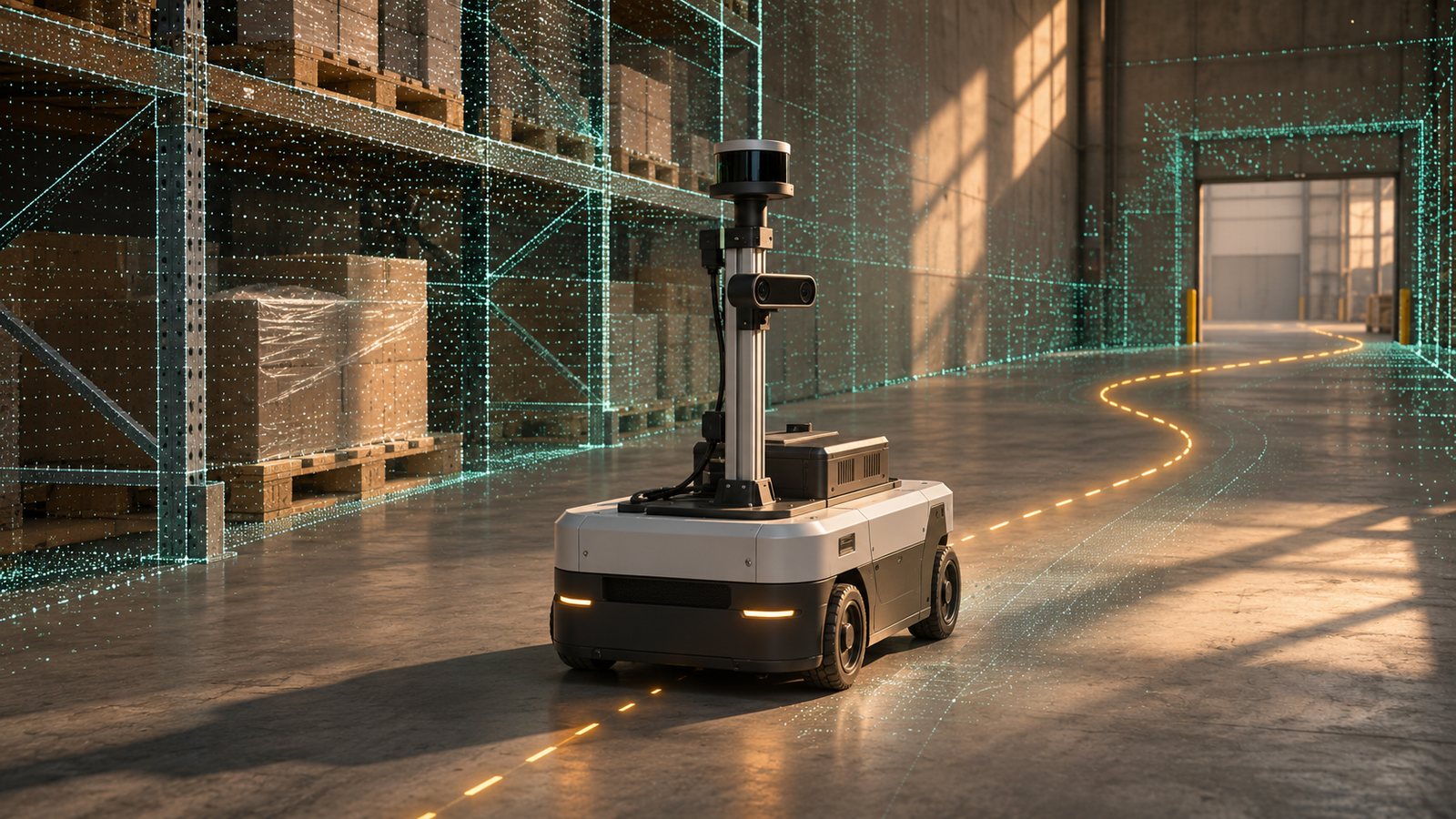
Why a robot's memory of space matters
The scene illustrates the relationship between a physical environment, geometry reconstruction and retained navigation context. It is an editorial visualization rather than an actual robot or benchmark result.
What Happened
Robbyant describes LingBot-Map 2.0 as a streaming 3D reconstruction system. Its research architecture includes a way to revisit and refine previously accumulated geometric context. LingBot-Navi addresses the complementary task of using stored visual and geometric evidence to interpret instructions and predict routes. The company reports nearly 85% lower long-trajectory mapping error in its VBR benchmark comparison. That is a vendor-reported research result, not a measured improvement for every robot or the public base checkpoint. The two models should not be confused with a complete commercial autonomous vehicle or fleet management system.
Who Is Affected & When
The announcement is most relevant to robotics researchers, computer vision engineers and teams investigating autonomous navigation. Robbyant has provided repositories and model cards for developers outside China to consult, with different terms for different components. The Map 2.0 base streaming checkpoint is distinct from the full reconsolidation research configuration. The Navi repository documents its first public release on November 26, with inference code, model weights and a dataset. The Robbyant dataset repository may require access approval. A company considering deployment should review both the model licenses and the underlying components before committing engineering resources.
What Changes in Practice
What Robbyant changes in 3D scene reconstruction
A robot that moves through a building needs to estimate its own position while collecting evidence about the surroundings. Small errors in camera pose estimation can accumulate over successive observations. In the Map 2.0 research architecture, geometric context can be revised as additional evidence becomes available. The released base model instead provides causal streaming reconstruction from RGB images. For teams comparing visual SLAM and learned approaches to robot localization, this distinction is crucial: the research paper describes capabilities beyond those delivered by the specific downloadable checkpoint. Evaluate that checkpoint on representative routes rather than assuming every reported feature is included.
LingBot-Navi: spatial memory and visual navigation
Robbyant organizes earlier observations into spatial memory blocks so a navigation model can refer to a scene that is not currently visible. Its published examples cover object grounding, visual localization and coordinate navigation. In a hypothetical warehouse, a robot sent back to a previously observed loading area could use its earlier map evidence rather than treating every instruction as a completely new environment. The model still needs current observations and appropriate local execution. A successful demonstration of robot path planning does not establish that the same system will avoid moving obstacles or reliably execute a route in every unfamiliar building.
Checkpoints, datasets and hardware requirements
The Robbyant Map 2.0 model card identifies the available checkpoint as the geometric streaming base model, rather than the mixed-mode reconsolidation checkpoint. It lists a BF16-capable CUDA GPU, PyTorch 2.8 or later and FlashInfer among the runtime requirements. Navi provides separate navigation transformer and local planner weights. Its repository describes a robot navigation dataset covering 511 reconstructed scenes, including a 36-scene test subset. The documentation provides examples of building memory and using it for subsequent tasks. These assets can help investigate depth estimation, trajectory estimation and robot perception, but developers must check access, dependencies and hardware compatibility for the actual workload.
Licensing and commercial use
Robbyant's Map 2.0 original code and base weights carry CC BY-NC 4.0, which restricts commercial use. The Navi model card specifies Apache 2.0 for its two sets of weights, while the repository documentation separately identifies the code license and third-party notices. The more permissive Navi terms do not automatically make every mapping dependency or dataset available for commercial deployment. In particular, the Navi examples refer to a separate LingBot-Map package and checkpoint. A robotics business should document the licenses of each component, confirm the applicable dataset terms and obtain additional rights where required. No commercial support agreement or subscription price is established by this research announcement.
| Aspect | LingBot-Map 2.0 | LingBot-Navi |
|---|---|---|
| Primary role | Streaming geometry reconstruction | Scene-aware navigation |
| Public materials | Causal streaming code and base checkpoint | Inference code and model weights; dataset access conditions apply |
| Research focus | Long-route consistency and geometric context | Using earlier observations across tasks |
| License | Original code and base weights: CC BY-NC 4.0 | Model weights: Apache 2.0; check dependencies |
Why It Matters
For robotics software developers, the practical challenge is transferring research results into repeatable systems. A robot mapping a corridor in controlled conditions faces different requirements from one operating around workers, carts and changing shelves. Embodied intelligence depends on sensing, localization, planning and reliable execution, not just a single model. The Robbyant announcement highlights a useful research direction: treating earlier observations as an asset rather than discarding them at each new task. A meaningful evaluation would compare route completion, relocalization errors, repeated exploration, memory consumption and recovery after a scene changes. These robotics benchmarks should be evaluated separately from operational safety requirements.
Our Take
Robbyant's announcement is worth following for teams studying persistent maps and autonomous robot navigation. Start by reproducing a documented example using the exact checkpoint and software versions, then compare the results with an existing robot mapping baseline on the same recorded inputs. Test scene understanding when the requested target is outside the camera view, when a familiar layout has changed and when the system has incomplete information. Record failures as well as successes. Keep a conventional safety and control layer during research trials. Most importantly, do not budget a production rollout based on the 85% headline alone: verify which checkpoint produced the figure, which evaluation protocol was used and whether your intended components are commercially licensed. DigiOffly has not independently run these models.
Frequently Asked Questions
What did Robbyant announce on November 27?
Robbyant announced LingBot-Map 2.0 for streaming geometry reconstruction and LingBot-Navi for navigation using earlier spatial observations. The associated public technical releases began before the press announcement.
Is LingBot-Map 2.0 free for commercial use?
Its original code and published base weights are licensed under CC BY-NC 4.0, which restricts commercial use. Check third-party terms and obtain suitable permissions before deploying commercially.
Does the downloadable Map 2.0 model include all research features?
No. The released checkpoint is identified as the causal geometric streaming base model, not the mixed-mode Geometric Context Reconsolidation checkpoint.
Can LingBot-Navi replace a complete robot navigation stack?
It supplies research components for navigation and local planning. A deployed robot still needs compatible hardware, integration, safety controls and environment-specific validation.
Official Sources & Dates
Announcement: 2026-11-27. Robbyant issued its press announcement on November 27, 2026. Technical materials appeared earlier: the Map repository dates its inference code to November 21 and benchmarks to November 23; the Navi repository dates its first public release to November 26. Check official updates before purchasing or changing production settings.
- Robbyant press announcement, November 27, 2026 (Business Wire)
- Robbyant LingBot-Map 2.0 research project
- LingBot-Map 2.0 code and dated release notes
- LingBot-Map 2.0 Base Streaming model card
- LingBot-Navi code, release notes and dataset
- LingBot-Navi model card and license
- LingBot-Navi dataset access
Editorial note: DigiOffly verified dated primary sources. This is not a claim of hands-on testing unless independently documented. Prices and access conditions may change.