

Reviewed October 20, 2026. This Remote review examines the published hiring and payroll products, the difference between annual and monthly EOR prices, the obligations that remain with the customer, and the practical questions to settle before signing. We reviewed Remote’s public pricing, product pages and August 2026 service terms alongside third-party user feedback. We did not open a paid Remote account, employ a person through its entities or run a live payroll. Any budgets below are labeled illustrations, not quotes or legal advice.
Consider a product company with one new employee in Portugal, two permanent hires in Germany and six freelance specialists spread across Europe and Latin America. Its HR manager wants all nine people in one dashboard. The finance team needs to know who is the legal employer, which funds must be advanced before payday, what happens if a contractor becomes an employee and how the company retrieves its records if it moves providers. A neat interface helps; it does not answer those questions by itself.
Remote sells distinct services for distinct employment relationships. Employer of Record, or EOR, hires an employee through a Remote group entity in an eligible country. Global Payroll processes payroll for staff employed by a company that already owns the appropriate local entity. Contractor Management helps a business administer people it contracts with directly. Contractor of Record creates a different contractual chain in which Remote engages the contractor. A US professional employer organization, or PEO, addresses yet another situation: domestic co-employment and benefits administration.
The essential purchasing mistake is to treat these as interchangeable payment buttons. A contractor invoice cannot lawfully replace an employment agreement merely because the $29 software fee is cheaper than an EOR subscription. And a $29 payroll line is not a substitute for an employer in a country where the buyer has no legal entity. Determine the worker relationship first, then calculate the cost of the matching service.
📊 Remote Review Summary 2026
What Remote does well
Owned-entity EOR employment in supported countries, separate Global Payroll, contractor administration and localized expertise.
Where to be careful
Annual versus monthly EOR pricing, worker employment costs, contract commitments and possible FX or reserve costs need scrutiny.
Best suited to: Companies hiring employees in several countries without establishing local subsidiaries, and teams that value the vendor’s stated owned-entity model and locally administered payroll. Organizations with foreign employing entities can consider the distinct Global Payroll product.
Published pricing in US dollars: Remote’s main pricing page now lists EOR from $599 per employee monthly, while some localized EOR FAQs still describe $599 with annual payment or $699 with monthly payment. Confirm the current billing terms in writing; Contractor Management at $29 per active contractor monthly; Contractor Management Plus at $99; Contractor of Record from $325; and Global Payroll from $29 per employee monthly. Remote PEO for US teams starts at $99 per employee monthly. Verify currency, discounts, country coverage and all order-form amounts before committing.
What stands out: Remote says its EOR network uses wholly owned employing entities in 90-plus countries, rather than relying on local EOR resellers. Its administration covers employment contracts, local payroll, core benefits coordination and onboarding through the same software environment.
What deserves scrutiny: The $599 advertised EOR figure depends on annual payment. Employer taxes, salary, benefits, termination liabilities and any required reserve can change total cash outlay. Remote’s service terms also allow payment charges and an exchange-rate margin, despite simplified marketing about transparent pricing.
Editorial conclusion: A credible option for a multi-country hiring shortlist, especially where owned legal entities and predictable responsibilities matter. A buyer with only straightforward contractor invoices or one domestic payroll should compare narrower, cheaper tools before choosing a global workforce platform.
⚡ Quick Verdict: Is Remote Worth It in 2026?
The strongest case for Remote is operational rather than cosmetic. If an employer in London recruits a specialist in another jurisdiction, Remote can serve as the local employing entity, handle payroll and assist with country employment requirements while the client directs ordinary work. That is a meaningful service beyond SaaS account access. The trade-off is a recurring per-worker charge and a contractual dependency on the provider when the employment relationship changes.
Remote pricing deserves two readings. The current central pricing page shows EOR from $599 per employee per month without specifying an annual-billing condition. Some localized EOR FAQs still describe $599 with annual payment and $699 when paid monthly. Because these presentations differ, obtain a written quote stating the fee, billing commitment, prepayment, early exit and any negotiated terms before treating either figure as guaranteed. Remote pricing and the EOR billing explanation are the primary references.
A second reading focuses on total cost. The advertised starting EOR service fee does not include the worker’s gross salary or all statutory employer contributions. A worker paid $60,000 a year can generate sizable additional costs depending on the country, pension, taxes, mandated benefits and termination rights. A company should model all these separately instead of displaying the platform fee as its labor budget.
Remote employer of record arrangements are more useful than standard payroll when the buyer cannot legally employ a person locally. Conversely, businesses with an existing employing entity may find the $29 starting Global Payroll service substantially more economical, provided they are comfortable retaining the legal employer’s obligations and local administration. Moving between the two models involves contracts, registrations and payroll migration; it is not a simple plan downgrade.
A fair Remote review therefore asks a purchasing question: Does owned-entity employment reduce enough legal and administrative complexity to justify the fee for each country? If the answer is yes, Remote is worth detailed due diligence. If the answer is no, the broad product menu can become expensive complexity rather than efficiency.
🧠 What Is Remote, and Who Legally Employs the Worker?

An EOR becomes the legal employer in a jurisdiction where the client normally does not have its own entity. Remote’s EOR website describes coverage in more than 90 countries through owned entities with in-house HR, payroll, benefits and legal specialists. The client company still decides day-to-day responsibilities, performance targets, and the work the employee performs. Authority over hiring arrangements, permitted contract terms, dismissal and legal filings must follow local law and the signed agreement.
This difference is especially relevant to fast-growing software companies. Suppose a business has a promising applicant in Portugal and a product launch in eight weeks. It may be unattractive to incorporate and maintain a Portuguese subsidiary for one employee. An EOR quote may let the team consider a lawful local employment contract, onboarding steps and benefits administration without creating its own company. But the candidate’s actual start date remains subject to document checks, country rules and contract execution.
Remote’s marketing describes an average onboarding timeline of a few days. Treat averages as vendor-reported context, not a guaranteed hiring date. A work permit, missing identification or atypical benefits package can change the timeline. Ask for a country-specific written timetable and responsibility matrix before promising a start date to a prospective employee.
Why owned legal entities matter
Remote presents ownership as a core distinction: it says that EOR employment is handled through group-owned entities, without third-party local employment providers. This can simplify the question of whom to contact during a payroll correction or termination, because the legal employer is inside the Remote group. It does not eliminate every intermediary in payment rails, insurance, banking or software integration. Nor does ownership alone prove service quality in every country.
For a high-stakes hire, request the registered name of the employing company, a draft agreement, the local benefits schedule and the applicable dispute channel. Confirm whether a professional employee representative or outside counsel becomes involved in an unusual employment matter. These details matter more than a map colored to show theoretical coverage.
A sensible test of Remote employer of record support is to give the sales team a realistic exception: an employee asks to change hours, relocate to a new country, take extended protected leave or end employment after a conflict. Ask who may authorize the change, which fees apply and how many working days the process normally needs. Written answers are more reliable than a generic promise of compliance.
Worked example: a French employee versus an independent consultant
Imagine an illustrative French employee on €72,000 annual gross salary. The business should ask for French employer social contributions, supplemental benefits, paid leave obligations, the relevant collective agreement, any payroll reserve and any exchange conversion. Adding twelve $699 platform invoices to €72,000 would mix currencies and omit material costs. A meaningful employer budget needs one reporting currency and a dated exchange assumption.
Now imagine a genuine independent consultant in Poland who invoices agreed project milestones and decides how to deliver them. Contractor Management might be appropriate if the arrangement meets local classification requirements. The client signs with the freelancer and remains responsible for the relationship. Paying a $29 management fee does not transfer the legal and tax analysis to Remote.
Remote contractor management can streamline documentation, invoice approvals and payouts, but the distinction remains legal as well as technical. Before switching a person from contractor to employee, check whether the scope, control, exclusivity or working schedule already looks like employment. Reclassification risks exist regardless of how neat the onboarding workflow appears.
💰 Remote Pricing 2026: EOR, Contractors and Global Payroll
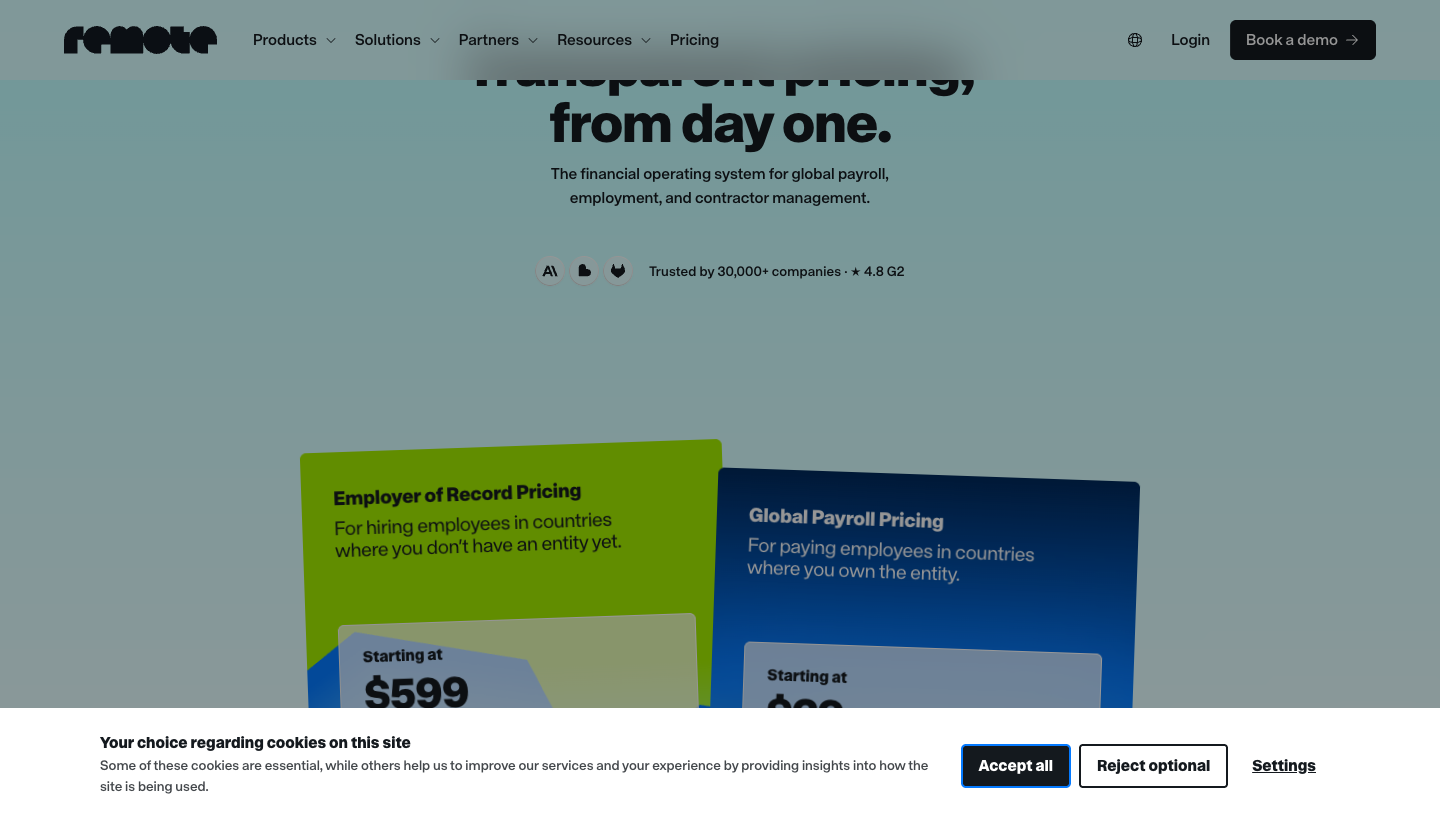
Remote publishes multiple starting figures in USD. Product prices should not be compared as if each tier performs the same job. Source: Remote pricing, EOR billing explanation, Contractor Management, Global Payroll and US PEO, checked October 19, 2026.
| Remote product | USD reference price — confirm quote | Legal or operational relationship | Watch for |
|---|---|---|---|
| Employer of Record — annual-payment reference | $599 / employee / month | Remote entity employs worker | Verify billed term, salary and country-specific taxes |
| Employer of Record — monthly-payment reference | $699 / employee / month | Same employment model | Verify whether higher rate applies, exit and payment terms |
| Global Payroll | $29 / employee / month | Customer already employs worker locally | Country rollout, integration and processing scope |
| Contractor Management | $29 / active contractor / month | Customer contracts with contractor | Classification responsibility, transaction fees |
| Contractor Management Plus | $99 / contractor / month | Customer contracts with contractor | Eligibility and scope of indemnity |
| Contractor of Record | From $325 / contractor / month | Remote contracts with contractor | Deposit or payment funding, terms and territory |
| US PEO | From $99 / employee / month | US co-employment model | Employer eligibility, benefits and US bank setup |
Remote EOR pricing per employee: annual versus monthly
If a written quote offers $599 rather than $699 per employee per month, the difference is $100 per person monthly, or $1,200 over twelve months. For five stable employees, the illustrative service-fee difference is $6,000 annually. This does not prove that an annual agreement is always cheaper after changes in headcount, negotiated offers or exit clauses. Ask whether unused periods can be credited or refunded.
The wording Remote annual EOR billing should trigger a close look at the order form. A marketing price that says “per employee per month” can still be contingent on an annual payment arrangement. Verify whether the invoice is paid annually up front or invoiced in installments under an annual term; these are not necessarily identical cash-flow schedules.
| Illustrative team | Illustrative $699 monthly EOR rate | Twelve months at monthly rate | Twelve months at illustrative $599 rate |
|---|---|---|---|
| 1 employee | $699 | $8,388 | $7,188 |
| 3 employees | $2,097 | $25,164 | $21,564 |
| 5 employees | $3,495 | $41,940 | $35,940 |
| 10 employees | $6,990 | $83,880 | $71,880 |
Illustrative arithmetic using public base service rates, with unchanged employee counts for twelve months. Salary, employer taxes, benefits, reserve payments, FX, discounts and country variations are excluded. Annual-rate figures are not a representation of actual billing dates or refundable terms.
Remote contractor management fees and plan differences
At $29 per active contractor each month, eight active contractors represent $232 in platform fees before compensation and payment charges. Remote says the service is billed for active contractors rather than every contact saved in the database. Confirm what activity triggers a bill during the relevant calendar month and whether a contractor with a late invoice counts as active.
Plus raises the headline fee to $99 for a different risk proposition. Remote advertises indemnification up to $100,000 per contractor for qualifying penalties, with company-wide limits and specific plan conditions. That is not a general insurance promise covering every classification dispute. Buyers need the exact eligible territories, exclusions, notification duties and applicable contract version.
The phrase Remote Contractor Management Plus coverage describes that defined contractual protection, not automatic immunity. If a regulator challenges a relationship, the practical outcome will depend on the worker’s real circumstances, applicable law, evidence and compliance with the indemnity terms.
Contractor of Record is another product. Instead of the customer directly engaging the freelancer, Remote undertakes the contractor engagement and payment under its own arrangement. The published Remote Contractor of Record cost starts at $325 per contractor monthly. Ask how the work statement, intellectual property transfers, funding deposits and end-of-contract process operate before assuming the higher fee transfers every possible liability.
Remote global payroll pricing and service boundaries
Global Payroll starts at $29 per employee monthly on Remote’s official product page, but the legal employer remains the customer entity. Local gross-to-net calculation, deductions, payroll reporting and the ability to export records are the service claims to validate. The employer must still own proper registrations, payroll controls, bank funding and employee agreements.
For Remote global payroll pricing, obtain a quote for each entity and payroll country. The service description says self-serve and fully managed models can be available, so do not assume a single public figure includes complex migrations, prior-period corrections or the same level of specialist support in every market.
A practical pilot is to ask for a parallel payroll run against one recent closed period. Agree in advance how gross-to-net differences will be reconciled, which payslip language will be produced, how benefit deductions are mapped and what triggers a manual intervention. A dashboard demo without an exception-handling walkthrough tells little about real payroll reliability.
Employee equity, US PEO and extras
Remote also advertises an Equity service at $39 per applicable EOR employee per month on its EOR information page. Local tax handling for grants and vesting varies substantially, so the presence of an integration should not be treated as a promise that every equity structure is supported. Request the exact instrument eligibility and payroll withholding workflow.
The US PEO begins at $99 per employee monthly and is designed for domestic co-employment administration, including US payroll and benefits. A PEO is not an international EOR. Pricing and eligibility may depend on the employing company, states, headcount and benefit plans. A small business with entirely US staff should compare PEO and ordinary domestic payroll products before using an international employment arrangement.
Remote’s August 2026 terms allow charges for certain payment methods, FX fees or margins, and separately priced AI-enabled usage. Such clauses make it essential to examine the actual order form rather than extrapolate from a headline per-person price. A sound finance approval requires both a cost schedule and a description of what is excluded.
⚖️ Contracts, Reserves, FX and the Costs That Surprise Teams
A pricing page cannot answer how much an employer may have to pay when a relationship ends. Remote’s service terms updated August 3, 2026 distinguish general terms, service-specific terms and order forms. Their precedence matters: a negotiated order form can override a more general description. The buyer should save the precise documents accepted at signature, not just the sales presentation.
Remote EOR security deposit and working capital
Remote’s public pricing FAQ says reserve payments are collected in unusual higher-risk cases; it does not offer a single reserve percentage for all countries. That is a materially different statement from “a deposit will never be necessary.” The general terms explicitly include possible reserves among fees. A company funding three new hires needs to ask whether any advance is required, what determines its amount and how quickly an unused balance returns after employment ends.
A Remote EOR security deposit may be refundable in principle while still imposing a meaningful liquidity cost. Even a short delay in returning a reserve can affect the ability to fund a replacement employee, pay a severance installment or start an entity migration. Finance should record cash reserves separately from ordinary payroll expense and monitor them until reconciled.
If Remote says a reserve is waived, ask whether the waiver applies to the specific customer, country and proposed salary, and whether it can change after a deterioration in credit conditions or a change in the worker arrangement. A dated email or order-form provision is more useful than a generic assurance.
Remote FX conversion rate and funding deadlines
International payroll moves across currency pairs and funding cutoffs. Remote’s pricing FAQ says that invoice amounts in a currency different from the employment agreement are converted at its own FX rate. The general terms allow an additional transaction fee or margin where foreign exchange applies. Neither statement guarantees the mid-market rate.
For the Remote FX conversion rate, request a worked example in the real currencies the team will use: for instance, a USD-funded employer paying EUR salaries. Ask when the rate is locked, whether a spread is included, when funds must arrive and how a late or rejected payment is handled. A small percentage difference becomes relevant when applied to salary, taxes and benefits rather than the $29 software fee alone.
Finance should keep the invoice currency, payroll currency, conversion date, nominal exchange rate and resulting local gross-to-net transfer in its reconciliation records. If the accounting system receives only a USD platform-fee total, management may underestimate the local employment cost and have difficulty explaining currency movements.
Remote EOR termination notice and renewal conditions
Remote’s general terms describe a twelve-month initial term with automatic renewal for further twelve-month periods, while also providing a right to terminate with at least thirty days’ written notice. Separate order-form clauses and minimum-value commitments may affect the practical financial consequence of an early exit. A thirty-day notice right is not the same thing as a promise that every employment obligation ends in thirty days without additional cost.
The Remote EOR termination notice should therefore be examined at two levels. First, what notice must the customer give Remote for a service or order form? Second, what notice, consultation, final wages, unused leave and severance must the legal employer provide to the individual under local labor rules? These periods may be different, and the worker’s legal rights do not disappear when the software subscription ends.
Request an offboarding estimate for a plausible scenario: an employee with 18 months’ service, protected leave considerations, earned but unused vacation and an upcoming bonus. Ask which party bears each amount, who signs the employee-facing documents and how long the final payslip and tax certificates remain accessible. Avoid comparing vendors solely on their best-case onboarding claims.
Contract documents to review before payment
| Document or answer | Reason it matters | Who should sign off |
|---|---|---|
| EOR order form and country schedule | Confirms service fee, billing period, entity, discounts and other line items | Finance and legal |
| Employment-cost calculation | Separates gross pay, statutory charges, benefits and assumptions | Payroll and finance |
| Reserve or guarantee policy | Clarifies advance cash and refund triggers | Treasury |
| FX and funding methodology | Controls conversion margin and due dates | Treasury and accounting |
| Termination and renewal terms | Establishes notice, commitments, offboarding and liability | Legal and HR |
| Security and data export plan | Helps retain records and ensure transition continuity | Security and IT |
Use the table as a procurement checklist, not a claim that every customer receives identical paperwork. A particularly important line is the order of precedence among contracts. If the sales email offers one promise and the signed order form says another, rely on the signed terms and seek written amendment before paying.
🛠️ Remote Product Workflows: EOR, Contractors and Payroll

A fair product review must describe what people actually need to accomplish, not merely count menu items. The value of workforce software lies in transactions that finish correctly: a worker is classified, the right agreement is signed, data reaches payroll before cutoff, obligations are funded, and the employee receives the right documents.
A new international EOR hire
In a typical onboarding scenario, the hiring business selects a country and employment type, submits worker details and compensation, reviews the provider’s cost estimate and coordinates local contractual documentation. The prospective employee may need to supply identity, residence, tax and banking information. Remote’s EOR services aim to coordinate these elements through the local legal employer.
Questions worth asking during a demo are specific: Can a hiring manager see which data is outstanding without viewing sensitive tax documents? Can legal review a proposed nonstandard clause? What happens if the start date moves across payroll cutoff? Who corrects an incorrectly entered salary before the first payslip? The answers determine administrative time more reliably than an onboarding-progress graphic.
Country compliance requires human judgment. Holiday rules, probation periods, mandatory insurance and protected leave can differ by employment category as well as country. An employment form that accepts an input is not evidence that the input is lawful. Remote’s in-house team is a selling point, but buyers should still ask which compliance checks are automated and which require a specialist’s approval.
Contractor intake and classification
For a directly engaged consultant, Remote contractor management supports localized contracts, invoice collection, approvals and international payments, according to Remote’s product description. The customer’s purchasing and compliance teams still need to know which project is authorized, whether deliverables were accepted and which person can approve a payment.
The danger appears when an individual looks independent on paper but works like a full-time controlled employee in practice. Assignment length, exclusivity, equipment, supervision and ability to hire substitutes may all matter. Independent contractor status is a question of facts and jurisdiction, not whether the service was purchased from a contractor dashboard.
Remote advertises a more protective Plus tier and a separate Contractor of Record arrangement. Before upgrading, ask which events invoke the stated indemnity, whether ordinary contractual disputes are covered and how quickly classification advice can be escalated. A $99 or $325 product should be evaluated for actual scope of risk and administrative responsibility, not simply the highest figure in a comparison chart.
Global payroll for established entities
A company with its own registered employing entity in Spain, the Netherlands or another supported market may keep legal employment directly and use Remote Global Payroll as infrastructure. The work then includes collecting changes, validating local gross-to-net, remitting relevant deductions, generating payslips and reconciling journals across countries.
Request a demo using anonymized but realistic data with backdated salary changes, bonuses, absence and an employee leaving during a pay period. Verify how corrections are labeled in general-ledger exports and whether reviewers can inspect approval history. A platform that renders attractive multi-country totals but cannot reconcile a statutory adjustment would impose work elsewhere.
A responsible Remote global payroll implementation starts with a named owner for each jurisdiction, a mapping of employee and entity identifiers, comparison of historical balances and a signed parallel-run acceptance criterion. “Go live in one week” should never substitute for these controls when payroll taxes and employee wages are involved.
Integration, reporting and privacy questions
Remote advertises a workforce platform combining EOR, contractor management, HR data and payroll. Integration value depends on whether the buyer needs data flowing to an HRIS, identity provider or accounting system and what fields actually move. A simple roster export is not equivalent to a bidirectional payroll integration, and a logo on an integration page should not be treated as proof that every module and country is supported.
Ask for a field-level flow diagram showing where salary, bank details, contract status and paid leave records live. For a European business, determine which organization is controller or processor for each workflow, where employee documents are held, and how transfer and retention obligations will be handled. For financial statements, confirm the currency and period used in the journal export.
The correct demo is two-way: create a harmless test change in the proposed source of truth, observe the destination, then reject or reverse it and confirm that the system logs the reconciliation. This can expose errors earlier than a polished sales presentation. It also makes clear when manual checks are still necessary.
📋 Illustrative Procurement Scenarios
Consider three businesses that might encounter Remote with very different needs. These are hypothetical purchasing cases using advertised service rates as arithmetic inputs; actual country employment costs and discounts are not modeled.
Scenario A: Three EOR employees in different countries. Using a $699 monthly reference rate, the recurring service component would be $2,097 each month before gross salaries, local employer contributions and any additional terms. At the $599 illustrative rate, the twelve-month service expense for a stable three-person group would be $21,564 versus $25,164 at monthly pricing. The decision depends on the flexibility lost by committing to the lower rate, not only on the $3,600 difference.
Scenario B: Fifteen independent contractors. Fifteen active contractor profiles at $29 each amount to $435 per month in management fees. These fees should be justified by reduced manual invoice handling, stronger recordkeeping and payment visibility, not by an assumption that contractor status becomes safer automatically. For a team with one simple invoice run and an existing finance process, a new platform may not deliver enough incremental value.
Scenario C: A foreign subsidiary with forty employees. Forty employees under Global Payroll at the public starting figure of $29 would represent $1,160 monthly in base service fees. This is not comparable to 40 EOR arrangements, because the company already bears local employer responsibility and must fund labor obligations through its own entity. Ask the payroll vendor for an implementation proposal before treating $1,160 as the all-in budget.
The common lesson is to maintain separate columns for provider service fees, workers’ gross pay, employment taxes, payment conversion, retained cash reserves, one-time migration cost and staff time. A comparison that collapses every amount into “per employee/month” removes the details that determine affordability.
⚖️ Remote vs Deel and Other International Hiring Alternatives
Remote vs Deel is a sensible shortlist for a business with hires across several countries, but choosing based on one advertised price can be misleading. The competitors offer EOR, contractor and payroll services with overlapping product names, while contract detail and country coverage can vary. Remote states it uses owned EOR entities across more than 90 countries. Deel advertises broad international coverage and its own employer services; buyers should request the exact legal employer in each target country for either platform.
Deel advertises EOR from $599 monthly. Remote’s current main page also advertises from $599, while localized EOR descriptions still mention a $699 monthly and $599 annual-payment distinction. Compare actual written quotes before treating those figures as comparable. Remote’s directly managed contractor fee is $29 versus Deel’s $49 public entry price. A meaningful comparison must account for whether the vendors offer the same hiring model, supported country and billing commitment at those prices. This is not an endorsement based on fees alone.
A proper Remote vs Deel EOR comparison should use the same worker salary, exact jurisdiction, benefits, local employing entity, payroll funding date, deposit rules, contract notice and human support commitments. Ask both providers to return written proposals with a common template; a sales table listing software features cannot determine which arrangement will be easier during a country-specific termination.
| Provider or route | Where it may fit | Confirm before choosing |
|---|---|---|
| Remote EOR | Employer wants a provider-owned legal employer in a supported country | $599 annual versus $699 monthly rate, employing entity, reserves, country coverage |
| Deel EOR | Employer needs broad global hiring options with related payroll and contractor products | Country entity model, $599 starting service fee, cash reserves and support |
| Oyster or another EOR | Buyer needs a country-specific competing employer quote | Benefits, entity model, local contract terms and complete employer budget |
| Rippling with EOR | HR and IT workflows are already centered on an integrated system | Which employment services are included and whether add-ons are needed |
| Local entity plus payroll provider | Many permanent employees in one market | Incorporation, local professional fees, payroll costs and ongoing legal liability |
Remote versus Deel: onboarding and support
A buyer should compare the exception path, not only the happy path. Ask each vendor how an incorrectly paid bonus is investigated, whether a local payroll specialist is reachable during a same-day issue, and how delays are reported to affected employees. Remote emphasizes in-house specialists and owned entities; Deel offers its own operating model. Neither product guarantees perfect payroll in every circumstance.
Set up a scorecard that can be defended to stakeholders. Give weight to hiring legality and contract clarity, financial predictability, support escalation, employee experience and quality of reporting. Ask the sales representatives to show real sample deliverables with sensitive details removed. Without a standardized case, a vendor can win simply by demonstrating its strongest country or simplest worker type.
When another approach may be better
A global platform may be overkill for a company hiring domestically only. A business with enough permanent workers in one country may instead compare establishing its own entity and purchasing payroll services. A firm paying three independent consultants may already have a compliant contract and low-friction bank transfer workflow. In those cases, Remote’s broad coverage is not automatically economical.
Conversely, a mixed international workforce can benefit from one administrative environment: separate worker records, aligned approvals and fewer disconnected payment processes. The advantage is real when it reduces errors and staff time, but it should be demonstrated through the buyer’s own workflows and a pilot before purchase.
👍 Remote Pros and Cons
Pros
Owned legal entities, localized employment support, public plan prices and tools for multiple international worker arrangements.
Cons
The EOR fee is separate from salary and statutory costs; annual commitments, reserves, FX and termination terms require evaluation.
What we like: Clear differentiation between the legal-employer product and the customer’s own payroll; public starting prices for several distinct services; the stated owned-entity EOR model; localized specialists and onboarding support; and enough contract and pricing documentation to ask substantive procurement questions. The platform’s range can be especially useful when a business manages employee and contractor populations side by side.
Where it falls short: EOR service fees add up quickly across a permanent team; annual and monthly price displays need careful reading; gross pay and country liabilities remain significant; reserves and FX costs are not captured by the simplified headline; and country-specific exceptions still call for specialist review. Broad feature claims also require verification against the actual service tier, integrations and implementation commitments.
Remote’s public user feedback includes praise for finding payslips, arranging leave and onboarding international staff, as well as complaints about rigid administration and delayed resolution in some complex cases. G2 reviews vary by user role and whether a reviewer is an employee or a paying business administrator. We did not independently resolve those cases and would not turn a handful of anecdotes into a reliability statistic.
A mature procurement decision assumes that human payroll errors remain possible. Ask how Remote finds, communicates and corrects mistakes and what evidence the buyer can retain. The right provider is not necessarily the one whose marketing claims there will be no mistakes; it is the one whose written process handles exceptions acceptably.
🎯 Who Should Use Remote?
Likely fit: a venture-backed team hiring a few employees in several new countries. Establishing local entities for each first hire may be disproportionate. Remote’s EOR service warrants consideration if it supports the actual countries, can produce acceptable employment agreements and supplies a complete country-specific cost estimate. The service fee is part of the hiring decision, not a substitute for it.
Likely fit: an established multinational seeking consolidated global payroll. Where the company already employs staff through its own entities, a payroll vendor can reduce fragmented local processes. The $29 starting Global Payroll rate is worth examining alongside the provider’s implementation, compliance coverage, historical data migration and accounting export capabilities.
Possible fit: a company with many international consultants. Contractor Management can centralize contracts and invoices. However, worker classification must be checked separately, and an upgrade to Plus or Contractor of Record should be evaluated against the specific risk and contract scope. Some businesses may need a legal classification opinion more urgently than another software license.
Weak fit: a business with one domestic payroll, a few simple vendor invoices, or a single large overseas operation where entity ownership is already economic. In those circumstances the relevant comparison may be local payroll, accounting software or specialist legal advice, not another global HR subscription.
🧪 How We Reviewed Remote
We checked Remote’s US-dollar pricing page, the EOR product explanation, the localized annual-versus-monthly pricing clarification, Contractor Management, Contractor of Record, Global Payroll, the US PEO product page, and Remote’s August 2026 service terms. The pages were inspected on October 19 and rechecked on October 20, 2026.
For outside context we consulted G2 Remote user reviews and Trustpilot’s Remote review page. User experiences are self-reported and may reflect a worker’s perspective rather than the customer’s procurement, payroll or legal responsibilities. The article does not treat an unverified comment as proof of a platform-wide issue.
The arithmetic scenarios assume unchanged headcounts and the listed public USD service rates. They deliberately do not estimate country-level statutory burdens without a specified country, salary profile and reliable local calculation. This review is an editorial assessment of documented product terms, not the result of processing real salaries or managing authenticated employee records.
Prices, EOR jurisdictions, currency methods, contractual terms and available features can change. Local labor and tax rules are consequential, and the article does not replace a binding country-specific quote or legal and accounting advice. No first-hand performance benchmark, service uptime result, implementation timing guarantee or undisclosed affiliate discount is asserted.
🏆 Final Verdict: Is Remote Worth the Cost in 2026?
Our Remote review finds a defensible offering for employers whose main problem is legal, not simply transactional: hiring people internationally without opening an entity in every location. The model of owned employing entities and related local support makes Remote a serious contender when compliance responsibilities and contract management are important to the buyer.
The decision should start with the employment relationship. Use EOR only where an EOR is the appropriate legal structure. Use Global Payroll where the company already operates an employing entity. For truly independent contractors, review the difference between $29 management, $99 Plus and the $325 Contractor of Record option instead of interpreting those figures as three levels of the same legal protection.
Price is not only the number printed on the subscription page. Remote now lists EOR from $599, but older localized descriptions still mention $699; a buyer needs written billing and offboarding terms rather than assuming the older rate distinction applies. A team paying salaries in a currency different from its funding account needs to understand the applicable FX rate. All employers need a plan for statutory costs, benefits, payroll mistakes and employment termination.
We would put Remote on a shortlist alongside Deel and at least one alternative tailored to the hiring country, then request equivalent written quotes. If Remote can identify the legal employer, support the employee’s actual terms, disclose the total cash commitment and demonstrate a clear escalation path, the fee may be justified. If those answers are vague, a polished dashboard and a 90-plus-country claim should not close the deal.
Remote Review 2026: Frequently Asked Questions
How much does Remote EOR cost in 2026?
Remote’s central pricing page currently starts at $599 per employee monthly. Some localized pages still mention $599 with annual payment and $699 with monthly payment, so buyers should confirm their current quote and billing commitment. These are platform service prices before salary, employer taxes, benefits or applicable extras.
Does Remote own its employer of record entities?
Remote says its EOR services operate through owned entities in more than 90 countries. Verify the exact employing entity and supported arrangement for the country in your quote.
What does Remote contractor management cost?
The standard plan starts at $29 per active contractor monthly. Plus is advertised at $99, while the separate Contractor of Record service starts at $325 per contractor monthly.
Is Remote Global Payroll the same as Remote EOR?
No. Global Payroll is for workers employed by your own legal entity and starts at $29 per employee monthly. An EOR provides the local legal employing entity instead.
Does Remote charge a deposit for EOR?
Remote says reserves are collected in rare higher-risk circumstances, while its terms allow reserves. Request a written country-specific funding and refund schedule before signing.
How do currency exchange fees work at Remote?
Remote uses a vendor-defined FX rate when required, and its service terms allow a transaction fee or margin. Request a real currency-pair example and the funding schedule.
Can Remote help with employee stock options?
Remote describes an equity administration option from $39 per eligible EOR employee monthly. Availability, taxation and the supported award structures depend on country and contract.
What are Remote EOR termination rules?
The commercial contract and the employee employment agreement have different obligations. Remote general terms describe notice rights, while local labor law governs employee notice, severance and final payroll.
Is Remote cheaper than Deel for international hiring?
Remote lists a lower starting direct contractor-management fee, while published EOR rates depend on billing periods. Compare identical worker countries, arrangements, deposits and support before deciding.
Has DigiOffly tested Remote payroll with real employees?
No. This independent editorial review analyzes published documentation, public product pages and user feedback; no paid Remote client account or live payroll transaction was used.
EXPLORE NEXT ON DIGIOFFLY
What to explore after Remote
Compare EOR hiring, international payroll and software operating costs using the right legal and financial assumptions.
Finance comparisons
- Explore our Finance software hub — Review banking, accounting, payroll and expense platforms.
- Browse the full software directory — See the wider catalog and existing reviews.
- Deel review — Compare employer-of-record terms and payroll.
- Gusto review — Consider domestic payroll for eligible teams.
Compare total ownership costs
- Estimate recurring software costs — Separate monthly fees from annual commitments and transaction charges.
- Compare software side by side — Check capabilities and the unknowns before subscribing.
Keep researching
- Find software for your workflow — Shortlist tools by concrete business needs.
- Read our research methodology — See how public vendor documentation is interpreted.