

Reviewed October 20, 2026. This Chargebee review is an independent editorial analysis of the current public pricing page, billing documentation, subscription lifecycle controls and finance integrations. We did not log into a paid billing workspace, run real customer invoices or obtain private negotiated quotes. Published USD figures below are reference prices from the vendor, not universal prices for every country or implementation. Calculations are explicitly illustrative and exclude payment-gateway fees, tax and separate modules unless stated.
Picture a subscription software business with three ways to buy. Individual developers pay $19 per month, workgroups buy an annual plan with seat changes throughout the year, and enterprise customers negotiate a minimum commitment plus overage charges for AI agent runs. A spreadsheet can initially track those arrangements, but it gets unwieldy when a customer upgrades mid-period, a payment fails, credits are applied and a finance manager needs to explain why recognized revenue differs from cash received. That is the type of operational problem Chargebee is designed to address.
Chargebee offers subscription and usage-based billing infrastructure, including product catalogs, invoicing, checkout, customer self-service, payment-gateway integrations, dunning and reporting. Additional products support sales quoting (CPQ), revenue recognition (RevRec) and customer growth workflows. The suite is broad, but purchasing all modules is not automatically justified. The billing record should become more accurate and easier to audit, not merely more elaborate.
The purchasing decision depends on what is causing friction today. A small business with a single fixed-price monthly product may be able to use its payment processor’s built-in subscription features. A mid-market SaaS team with contract amendments, usage allowances, multi-currency invoices and a complex close may be better served by a specialized billing layer. Fees alone cannot answer which group you belong to; implementation workload and responsibility for payment collection matter.
📊 Chargebee Review Summary 2026
What Chargebee does well
Adaptable subscription catalogs, usage metering, invoice management, gateway options and finance integrations.
Where to be careful
Invoice-volume fees are separate from payment processing; migration, reporting and extra modules can introduce costs.
Most relevant to: Subscription businesses and software vendors combining seats, recurring platform subscriptions, prepaid credits or consumption charges. Finance and RevOps teams looking for more control over invoicing rules, catalog changes and reconciliations should consider it alongside the software they already run.
Public Billing price structure: Chargebee currently displays a Flow pricing calculator with $0 plus 0.80% or $99 plus 0.65% based on monthly invoicing volume, plus custom Enterprise pricing. The pricing page marks $66K as the approximate break-even invoice volume between the two formulas. These percentages describe a billing-platform fee model, not the card-processing percentage a payment gateway might deduct.
Key capabilities: Recurring and usage-based plans, metering and included allowances, customer portal, adjustments and credit notes, multiple gateway integrations, billing analytics and integrations with finance systems. Chargebee advertises 100 million usage events per month included with Flow and support for 40-plus payment gateways. Actual throughput, access, limits and eligibility should be checked against the signed contract.
Cautions: Billable invoicing volume can differ from money successfully collected; a failed payment does not make gateway and billing costs disappear automatically. Enterprise features, custom integrations, implementation services and separate RevRec or CPQ products may require a proposal. A migration can introduce financial risk if legacy subscriptions and credit balances are not reconstructed accurately.
Bottom line: Chargebee is a credible shortlist for companies with genuine subscription complexity. The clearest economic comparison is the all-in billing stack—billing-platform fees, gateway charges, tax integrations, implementation cost and finance labor—versus a simpler approach such as Stripe Billing. The vendor’s broad feature set creates opportunity, but not a guarantee of cost savings.
⚡ Quick Verdict: Is Chargebee Worth It in 2026?
A strong case for Chargebee begins with a recurring problem that persists after a payment succeeds. For example, suppose an enterprise customer signed a $24,000 annual subscription with quarterly seat adjustments, a special discount and a usage overage charged monthly. The processor can collect the card or bank payment, but the company also needs to maintain the commercial agreement, create correct invoices, calculate credits, enforce entitlements and provide accounting data. Its value lies in coordinating that logic.
Chargebee pricing is not a single flat subscription. The current Flow calculator shows two published fee formulas and encourages prospective customers to model their monthly invoicing volume. This makes it important to distinguish invoice amount from successful payment amount, subscription MRR and recognized accounting revenue. They are different metrics and may differ by thousands of dollars in a month with annual prepayments or unsuccessful collections.
The best feature is configurability, not magic automation. A pricing owner may set plan rules, a finance owner may approve invoices and a developer may connect usage events or payment status. When these responsibilities are carefully assigned, Chargebee can reduce manual handoffs. When no one owns the underlying financial definitions, the system can generate the wrong invoice consistently and at scale.
We would not recommend purchasing an advanced subscription platform solely to send a few identical monthly bills. The fixed administrative work to migrate customer records, reconcile prior invoices and validate event flows might exceed the savings. By contrast, a fast-growing business shifting from seat-only to hybrid AI-usage packages may need an adaptable catalog and usage ledger before it can safely sell those plans.
Our judgment is therefore conditional: Chargebee is potentially worthwhile when subscription logic, pricing changes and financial reporting are strategically important, provided the implementation is controlled. The actual benefits should be demonstrated in the customer’s workflow, using a sandbox and representative billing examples rather than a vendor revenue-growth claim.
🧠 What Is Chargebee? Billing Platform Versus Payment Gateway
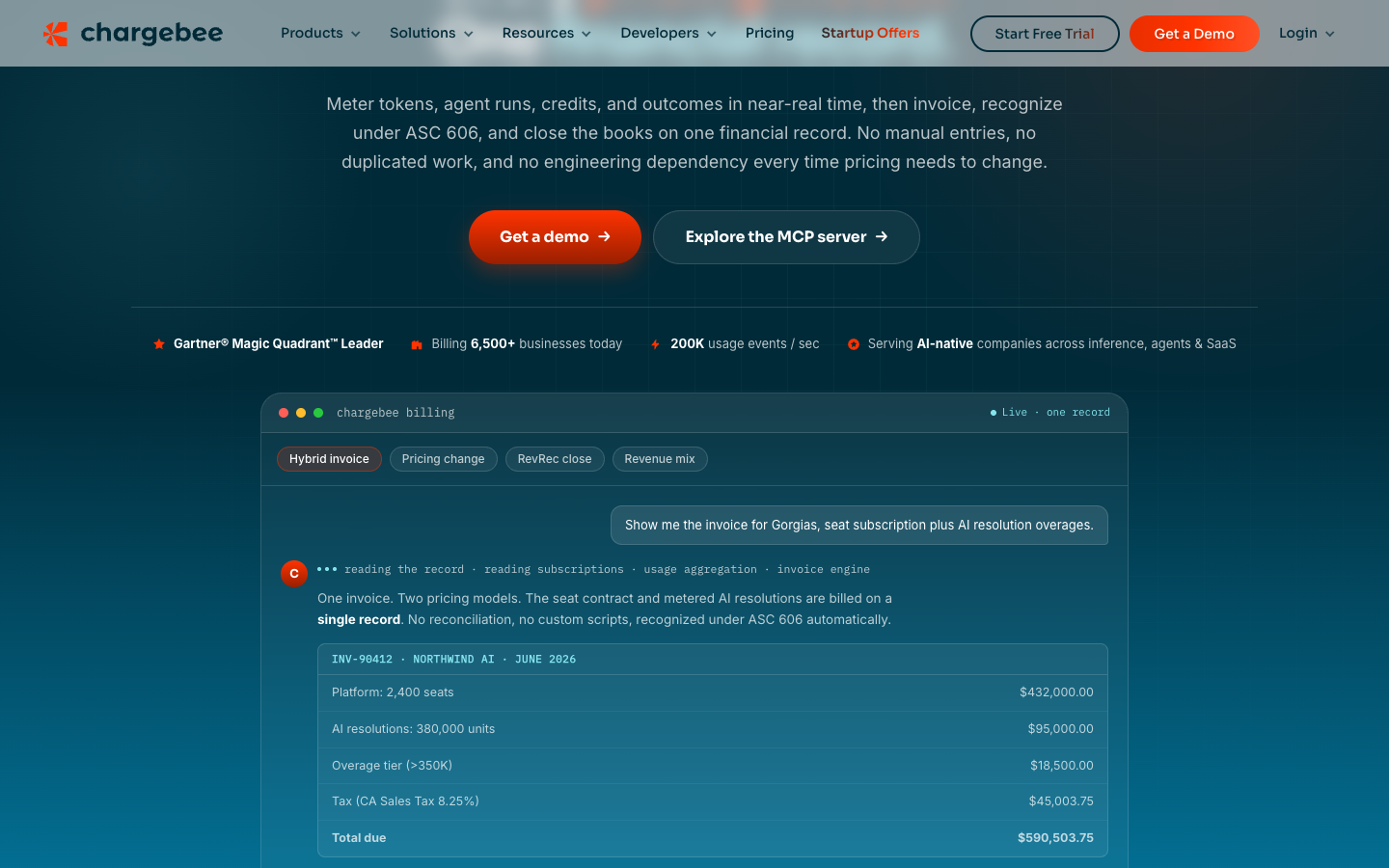
Chargebee is principally a subscription billing and monetization platform, not simply a bank account or card acquiring service. Its documentation describes integration with external payment gateways to accept money, and its current catalog includes payments-related capabilities. The distinction matters because a recurring invoice and a settled payment are separate events: one expresses what the customer owes, the other records how collection progressed.
In a straightforward architecture, a subscription record contains a customer, plan, currency, billing schedule, tax context and payment method reference. At renewal, the billing system computes the invoice amount. A connected gateway attempts collection. A successful result should update the invoice and entitlement status; a failure may trigger dunning or a service-access decision. Accounting then reconciles billed amounts, collected cash and any deferred revenue.
A product team should know which system owns each piece of information. Chargebee can govern prices and subscription state while Stripe, Adyen or another compatible gateway processes a payment. An accounting platform such as Xero may be the general-ledger destination. If three tools independently modify the customer’s renewal date, the result is not an integrated workflow—it is an expensive synchronization problem.
Chargebee subscription management software
Chargebee subscription management software supports plans, trial periods, coupons, term changes, invoices and other lifecycle events. These are valuable when subscriptions depart from a simple monthly renewal. A university customer might need a fixed annual billing date; an enterprise software contract might contain a delayed start, one-time onboarding charge and a ramped seat count.
The distinction between an invoice and the underlying entitlement should be explicit. An unpaid invoice does not automatically tell the application whether to lock a critical service. Businesses can choose grace periods or partial access, but the choice must be consistent with contract terms. Chargebee can provide signals and configuration; the product should interpret them safely.
A customer’s billing profile should also remain understandable to human support. If a support agent sees a credit note, a partial payment and a scheduled downgrade, they need a timeline explaining what happened rather than three disconnected records. During vendor evaluation, ask to see an amendment with a backdated contract change and a corrected invoice.
Hosted checkout and self-service portal
Chargebee’s documentation describes hosted payment pages and a customer portal for payment methods and subscription management. Hosted checkout can limit the amount of payment information a merchant must process directly, but the merchant still owns product messaging, privacy obligations and security configuration. The portal’s ability to cancel or change a plan must align with the real contract.
A practical Chargebee customer portal setup should test more than visual styling. Can customers change their payment card without accidentally creating a new subscription? Do annual-contract clients see a permissible downgrade date? Does a member who cancels receive confirmation and retain access until the correct term end? These questions are more meaningful than whether a button looks modern.
Cancellation controls can also affect customer trust. If the product makes it easy to subscribe but hides contract conditions or places barriers around cancellation, compliance and complaints can follow. Design the portal to present accurate dates, unpaid balances and any consequences of a plan change.
Chargebee payment gateway integrations
Chargebee advertises 40-plus payment gateway integrations. The availability of a gateway in its catalog does not mean that every method, region, saved-payment token or transaction feature is portable without effort. Verify supported gateways for the legal merchant entity and which payment methods remain usable during an actual migration.
In a Chargebee multiple payment gateways scenario, a global company could route subscriptions differently by geography, local entity or customer payment preference. That can offer operational flexibility, but it also creates more reconciliation pathways. Failed payments and settlement timing must be tied back to the exact invoice and gateway transaction.
A buyer using Stripe today should ask how much of its existing billing logic can remain untouched. A new billing layer might take over pricing and invoice generation while Stripe continues card acceptance. Yet the payment-processing contract, fraud policies and disputes still require separate attention; Chargebee does not cancel an existing processor agreement by being configured as a new invoicing authority.
💰 Chargebee Pricing 2026: Flow, Enterprise and Extra Products
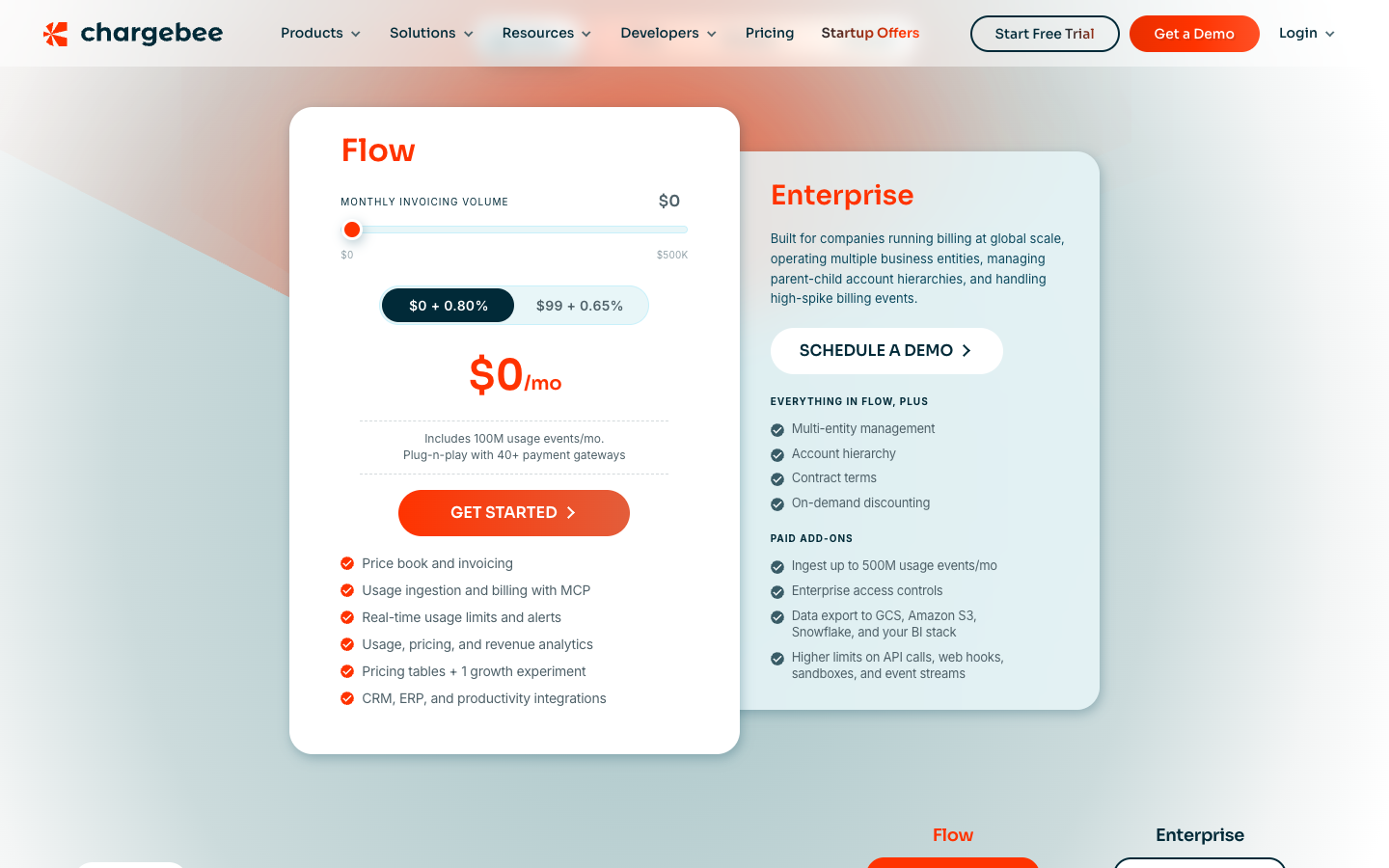
Chargebee’s current public pricing calculator shows two Flow formulas rather than the legacy Starter and Performance billing tiers still seen on older indexed pages. This review uses the October 20, 2026 public page as the higher-priority reference. It also lists Enterprise arrangements on request and distinct modules for quoting, revenue recognition and growth tools. The calculations below are examples, not formal invoices.
| Product or pricing approach | Public October 2026 reference | How it should be understood | Confirm before contract |
|---|---|---|---|
| Billing Flow, first option | $0 fixed fee + 0.80% of monthly invoicing volume | Usage-linked billing-platform fee | Eligible invoicing volume and minimums |
| Billing Flow, second option | $99 fixed fee + 0.65% of monthly invoicing volume | Lower percentage plus monthly fixed charge | Contract term and chargeable volume |
| Billing Enterprise | Custom sales proposal | Larger and complex business requirements | Entity, data and feature limits |
| CPQ Lite | Free for first 50 quotes, for Billing customers | Entry-level assisted sales quoting | What happens after quote allowance |
| CPQ full product | Contact sales | Multi-product and multi-year sales workflows | Implementation and add-on pricing |
| RevRec Performance | Request pricing | Billing-linked revenue recognition | License scope and accounting rules |
| Growth Starter | $0 for qualifying Billing customers | Hosted pricing and growth features | Subscriber and brand limits |
| Growth Enterprise | Custom pricing | Higher-scale lifecycle experiments | Active-subscriber metric |
Some Chargebee pages still display older pricing structures with cumulative billing thresholds and a $599 Performance fee. Treat them as historical or context-dependent until the provider confirms applicability. Do not insert an outdated free allowance into a 2026 forecast without a signed offer that actually grants it.
Chargebee Flow pricing calculator: 0.80% versus 0.65%
The two published Flow formulas are 0.80% × monthly invoicing volume and $99 + 0.65% × monthly invoicing volume. At $20,000 of illustrative eligible invoices, they result in $160 and $229 respectively. At $100,000, they result in $800 and $749. The lower-percent option costs more at smaller volumes because of the $99 fixed component.
A useful Chargebee Flow pricing calculation solves the break-even point. The difference between percentages is 0.15 percentage points, or 0.0015. Divide $99 by 0.0015 to obtain $66,000. Below that level, the 0.80% option has a smaller mathematical charge; above it, the $99 + 0.65% option is cheaper, before considering any pricing restrictions or negotiated terms.
| Illustrative monthly invoicing volume | Flow $0 + 0.80% | Flow $99 + 0.65% | Lower simple formula |
|---|---|---|---|
| $5,000 | $40.00 | $131.50 | 0.80% |
| $20,000 | $160.00 | $229.00 | 0.80% |
| $50,000 | $400.00 | $424.00 | 0.80% |
| $66,000 | $528.00 | $528.00 | Equal |
| $100,000 | $800.00 | $749.00 | $99 + 0.65% |
| $250,000 | $2,000.00 | $1,724.00 | $99 + 0.65% |
Illustrative arithmetic based solely on the currently visible pricing formulas. It does not establish who qualifies for each option, billing commitments, payment-gateway charges, tax, additional modules or how invoices are adjusted. Confirm the actual billable volume definition with Chargebee.
The phrase Chargebee billing fees by invoicing volume deserves close attention. A merchant might invoice $100,000 while collecting $92,000 due to unpaid bills, credits or payment delays. The public percentage is framed around invoicing volume, not necessarily cleared cash. Ask whether voided invoices, taxes, credits, refunds and failed collections affect the denominator, and secure a worked invoice from sales for your own business model.
Are Chargebee and payment processing the same fee?
No. Chargebee’s billing price does not automatically include the fee charged by the gateway that accepts a customer’s card or bank transfer. A US merchant using an eligible Stripe domestic card could incur Stripe’s card-processing fee on the payment plus a separate billing-platform fee on the relevant invoicing volume, and other products could add fees. The respective services are billed for different work.
Consider a hypothetical SaaS business that sends 1,000 identical $50 invoices in a month, with all payments successfully collected on US domestic cards and eligible billing volume of $50,000. Chargebee’s $0 + 0.80% formula gives a $400 billing-platform fee. Using Stripe’s published US 2.9% + $0.30 card fee, 1,000 collected payments generate $1,450 in variable card fees plus $300 fixed charges, for $1,750 processing. The illustrative combined amount is $2,150, excluding taxes, disputes, gateway contract terms and other modules.
If the same company chooses the $99 + 0.65% Chargebee formula, its illustrative billing-platform charge is $424, and the combined charge becomes $2,174 under those same assumptions. This is not a recommendation to choose a tier based on a single month; the expected future mix and contract requirements matter.
For Chargebee pricing with Stripe gateway, create separate forecast lines: billable invoice volume, actual successful transaction count, gateway percentage, per-transaction fee, refunds, chargebacks, currency conversion and any fraud or tax service costs. Bundling all of these into one invented ‘all-inclusive transaction fee’ would mislead a buyer.
What is included in 100 million usage events?
The public Flow page advertises an inclusion of 100 million usage events per month. That can be relevant to AI products or metered platforms, but an event is not always the same as an invoice, API request or customer. A service might create one event per processed document, per token batch or per agent run. Its event ingestion pattern can be many times larger than the number of paid customers.
For Chargebee usage event limits, distinguish the included monthly event count from throughput, permitted backdating, development-test allowances and any enterprise burst handling. The vendor’s usage documentation provides indicative ingestion limits and says some may be raised through support. Check the actual contract and deployment design rather than interpreting a high event count as proof that every workload will run without tuning.
A startup ingesting ten usage events for each of 100,000 monthly automated jobs generates one million events; logging hundreds of tiny fragments for the same job could multiply that number. Choosing the correct aggregation unit can matter more than the headline plan limit. Finance must still be able to reproduce charges from the event ledger.
RevRec, CPQ and Growth are not automatically one bundle
Chargebee RevRec addresses a different question than collecting payment: how much revenue the business has earned during an accounting period under its applicable policy. Its pricing page lists Performance and Enterprise options by quotation. Do not invent a fixed monthly price from an outdated landing page or assume the Billing Flow price purchases full revenue-recognition automation.
CPQ connects quoting and approved commercial terms to billing. Its public Lite offer covers the first 50 quotes for Billing customers, while the advanced offering is sold through the sales team. A company with no sales-assisted contracting may have no need for CPQ. A B2B enterprise team negotiating ramps, multiyear discounts and amendments might need it badly.
Growth Starter is displayed as free for eligible Billing customers, but advanced growth experimentation and subscriber-scale capabilities are sold separately. ‘Free’ applies to that identified product entry; it does not mean all Chargebee modules or subscriptions are free. Ask the vendor to identify every enabled product in the signed order.
🛠️ Usage-Based Billing, Proration and Enterprise Agreements
The area where a specialized platform can become indispensable is the intersection of plans, usage allowances and contract amendments. A software company might promise 100,000 monthly workflow runs included in a $500 platform subscription, charge per additional 1,000 runs, and offer larger enterprise customers a prepaid credit pool. Each clause affects the final bill differently, and customers rightly expect to understand why their invoice changed.
Chargebee’s usage-based billing documentation describes consumption-based, entitlement and hybrid approaches. Users can collect events and apply pricing linked to metered features. This can support an AI service with variable usage, a developer API billed by calls, or a membership product with overage allowances, subject to the enabled product and contract.
Chargebee usage-based billing for SaaS and AI
A reliable Chargebee usage-based billing for SaaS implementation starts by defining the billable unit in plain English. ‘Request’ might mean one externally authenticated API invocation, one successful result, one hour of compute or one agent run. Those definitions produce different invoices. Product, sales and finance must agree on the commercial event before engineers build a meter.
Consider a fictitious automation service with a $300 monthly platform subscription, 10,000 included jobs and a $0.02 overage charge. A customer processes 14,500 jobs during a month. The illustrative overage is 4,500 × $0.02 = $90, so the invoice before tax is $390. The billing implementation should be able to show the precise event count, which jobs were included and the contract version used to calculate the charge.
This is straightforward arithmetic but difficult operationally. What if 200 events arrive late? What if an ingestion retry sends the same event twice? What if one customer switches plans on the 15th? A correct metering system needs immutable source identifiers, defined event timestamps, deduplication rules, reproducible aggregation and a process for reconciling exceptions before closing invoices.
A common mistake is counting every telemetry signal as money. An AI model may generate ten logs for one customer-visible answer, but a contract may say the unit is one completed task. The billing system should consume an intentionally designed chargeable event rather than raw observability noise. More sophisticated software cannot rescue a contradictory unit definition.
Chargebee prepaid credits and usage overages
Chargebee prepaid credits and usage overages can support a product where a buyer prepays a balance and draws it down as an AI model or workflow runs. The platform’s pricing documentation describes prepaid credits and hybrid pricing models, but the exact rollover, expiry, refund and negative-balance rules depend on implementation and contract.
One illustrative plan might sell a $1,000 credit pack, value each completed workflow at $0.50 and permit balances to roll into the next calendar month. Another might allow overages beyond a fixed allowance while the original subscription remains in force. The customer-facing portal should show what credits remain, which events consumed them and how expiry is determined.
The finance issue is not limited to consumption. Prepaid balances may represent liabilities until the underlying service is delivered, subject to applicable accounting rules. A team should not automatically book a $1,000 purchase as $1,000 of earned revenue merely because cash arrived. Consult the finance policy and revenue-recognition product separately.
An appropriate pilot uses adversarial cases: a duplicate event, an event arriving after an invoice closes, a customer switching from annual to monthly billing and a credit balance that expires during a contract amendment. Those cases reveal the real operational fit more effectively than a screenshot of an evenly growing usage chart.
Chargebee subscription proration settings
Chargebee subscription proration settings govern credits and charges when a subscriber changes plan or quantity partway through a term. The vendor documents day-based and millisecond-based calculation modes. This distinction is especially important because the documentation notes that sites created before May 19, 2026 can use older day-based behavior than newer sites. It would be inaccurate to assume all long-lived accounts calculate partial periods in exactly the same way.
Take a customer with a $120 monthly plan who upgrades to $240 halfway through a 30-day billing period. Under a simplified equal-day example with no taxes, a merchant might credit $60 from the old plan and charge $120 for the unused half of the new plan, producing a net $60 charge. A real implementation needs to account for the exact timestamp, prior invoice status, calendar convention, billing term and treatment of a refundable versus future credit.
A predictable invoice policy matters to trust. If support quotes a ‘midmonth’ upgrade but the system’s millisecond calculation includes a different number of hours than the human example, explain the actual formula. Testing calendar boundaries and daylight-saving changes is prudent for businesses operating across time zones.
A buyer should also test how a refund interacts with a credit note and an unpaid invoice. Credits that automatically apply to a future charge are not necessarily cash refunds. A clear account history is essential for the customer and the auditor.
🔁 Dunning, Revenue Recovery and Customer Retention
A failed payment can be an ordinary consequence of an expired card, insufficient funds, changed authentication requirements or bank downtime. A business that immediately cancels access after one failed attempt may create avoidable churn. A business that retries without limits or sends confusing emails may frustrate customers and generate support complaints. Dunning is the policy between those extremes.
Chargebee supports configurable payment retries and customer notifications. Its documentation distinguishes online collection attempts from offline invoice reminders, and describes final actions such as marking invoices unpaid or canceling subscriptions. However, it explicitly notes differences by payment method, including limitations for certain direct-debit scenarios. Do not assume every card-retry feature applies to bank transfers or manually paid invoices.
Chargebee dunning automation and failed payments
For Chargebee dunning automation and failed payments, design a policy based on payment method, customer type and contractual obligations. A small self-service subscription might receive an immediate reminder, a few retry attempts over a defined grace period and a final notice before suspension. An enterprise client paying by invoice may require an accounts-receivable owner and a different timeline.
Suppose an illustrative product has 1,000 active monthly subscribers, and 40 renewals fail on the first attempt. If 25 of those 40 are subsequently collected, the recovery proportion for that failed-payment group would be 62.5%. This is merely an example of how to calculate a result, not a claim that Chargebee—or any provider—achieves such a rate.
Record the denominator honestly. Some failed charges cannot be recovered because the customer has canceled, the cardholder disputes authorization or a bank has blocked the payment. Recovery dashboards that report only successful retries without showing the original eligible cohort can be misleading.
Configure communications with restraint. A notice should explain what failed, whether access is affected, how to update the method and what the customer can do if the charge is incorrect. When an invoice has multiple failed attempts, support staff should see the sequence and avoid instructing the customer to pay a second time after the charge has already settled.
Cancellation, retention and compliant offers
Chargebee Growth products offer pricing tables, cancellation experiences and subscription-lifecycle experiments. These tools can help a team present a more suitable plan or save a customer who would otherwise churn. But not every cancellation is an invitation to bargain, and retaining an unhappy subscriber through confusion damages trust.
For a Chargebee cancellation flow for subscriptions, measure whether people understood their next renewal and access expiration. If a customer accepts a discount, store the exact new amount and discount duration with the subscription record. If they decline, complete the cancellation under the agreed policy rather than sending them through a loop.
A sensible experiment measures customer outcomes as well as retained revenue. Examine complaints, refund requests and the proportion of users who contact support after cancellation. An A/B test that superficially increases retention but raises accidental renewals is not a long-term improvement.
Growth Starter is advertised as $0 for eligible Billing customers; that is not evidence that advanced, enterprise lifecycle features are part of every Billing Flow agreement. Verify active-subscriber quotas, branding limitations and the commercial terms for additional experimentation.
📚 Revenue Recognition, Accounting and Financial Reporting
Cash movement, invoice creation and revenue recognition can happen at different times. Suppose a customer pays $12,000 on January 1 for a one-year software subscription. The processor may transfer the net cash soon after payment, while under a simple evenly delivered service assumption, finance could recognize $1,000 of revenue in each month rather than the full $12,000 immediately. Real arrangements with setup work, usage fees or deliverable milestones can be more complicated.
Chargebee RevRec is aimed at automating revenue-recognition calculations under accounting frameworks such as ASC 606 and IFRS 15. The public product page lists performance and enterprise offerings on quotation. It should not be confused with a promise that merely purchasing the Billing module automatically creates audit-ready accounting under every company’s policies.
Chargebee revenue recognition ASC 606 workflows
A credible Chargebee revenue recognition ASC 606 evaluation uses specific contract examples, not a generic dashboard tour. Request a revenue schedule for an annual license, a usage-based overage, a separately priced onboarding service and a midterm amendment. Confirm how the system identifies performance obligations, maps line items and handles credit notes.
For multiple-element contracts, finance may need standalone selling-price analysis and allocation across obligations. Some specialized RevRec features appear in higher-tier offerings. Get a list of the exact rules available in the proposed tier and ask whether accounting adjustments can be traced back to original contract events.
The general ledger is the authoritative financial record for many companies. A revenue schedule that cannot be reconciled to invoices, payment fees and a journal entry is difficult to defend. If Chargebee exports journals into Xero, QuickBooks or NetSuite, confirm account codes, entity and currency mappings as well as the reconciliation process.
Chargebee QuickBooks and Xero integration
The purpose of a Chargebee QuickBooks integration should be precise. Do you need summarized monthly sales, invoice detail, accounts receivable, revenue deferrals or a full settlement tie-out? Exporting a net payment does not explain gross invoice value, tax, processor fees and returns. Accounting can look balanced while individual invoices remain unmatched.
A Chargebee Xero accounting sync deserves similar scrutiny. Test multi-currency invoices, customer merges, partial credits and an invoice paid outside the automatic collection system. Verify which platform becomes the source of truth for customer details and what happens if an accountant edits a transaction directly in the ledger.
Our Xero review and QuickBooks Online review cover the accounting tools separately. In a well-governed stack, subscription logic should not compete with bookkeeping for ownership of the same invoice; every downstream correction needs a documented direction of synchronization.
Reports that a CFO should demand
Useful recurring revenue metrics include active subscriptions, paid and unpaid invoices, monthly recurring revenue, expansion, contraction, involuntary churn and renewal cohorts. None should be treated as interchangeable with cash receipts. The finance team must agree which cancellations count as churn and when a future-dated plan change takes effect.
| Metric or record | What it helps explain | Frequent interpretation mistake |
|---|---|---|
| Monthly recurring revenue | Normalized recurring contract value | Calling annual prepayment current-month revenue |
| Invoiced amount | Customer’s formal billed obligation | Treating every issued invoice as collected cash |
| Successful collections | Cash captured by payment providers | Ignoring fees, refunds and payout timing |
| Deferred revenue | Services contracted but not yet recognized | Assuming payment equals earned revenue |
| Net revenue retention | Existing-customer expansion and contraction | Excluding churn while reporting a universal growth claim |
| Failed-payment recovery | Performance of retry and reminder policy | Claiming a win rate without eligible failure cohort |
A useful financial-system demo should produce these measures for the same illustrative customer and reconcile them. If the subscription dashboard and general ledger disagree about what was sold or earned, the operating process is unfinished irrespective of feature count.
🧪 Implementation Plan, Migration and Risk Controls
A company migrating subscription billing is moving obligations, not simply customer names. An existing account can have accumulated credits, a prepaid term, a grandfathered price, a pending cancellation, an overdue invoice, a missing payment token or a tax status that varies by jurisdiction. Losing that history is expensive in customer goodwill and finance corrections.
Before importing anything, classify which records will remain in the old system and which become authoritative in Chargebee. Define a cutover date, freeze or dual-write policy, rollback conditions and reconciliation owner. Some payment-method tokens may be subject to gateway-specific migration rules and cannot be exported in the form engineers expect.
Chargebee migration from Stripe Billing
A Chargebee migration from Stripe Billing should begin by extracting a representative inventory of subscriptions and invoices without exposing private payment information in planning documents. Compare plan identifiers, prices, customer tax treatment, proration method, coupons, renewal timestamps, outstanding credit balances and payment collection status.
Stripe can remain the payment gateway in some Chargebee-based stacks; whether a specific token or existing subscription workflow can be reused depends on the supported integration and migration process. Never assert that an account can move every saved payment method with one API call. Ask both vendors what customer reauthentication or token-transfer steps are permitted.
Run a parallel test against a closed historical billing period and reconcile every invoice to the previous platform. For forward-looking tests, construct scenarios for a first renewal, an annual term, a plan upgrade, a failed payment, an issued credit and a canceled trial. A migration passes when the relevant amounts and access outcomes are correctly explained, not merely when a batch import job reports success.
Chargebee implementation costs and timeline
For Chargebee implementation costs for SaaS, consider software fees, gateway fees, external consultants, internal engineering and finance labor, reconciliation tools, privacy assessments, contract review and testing. A third-party integrator’s proposal may be more important than the first monthly software invoice. Keep one-time costs separate from ongoing subscriptions.
A realistic implementation timetable depends on existing systems. A new company launching its first fixed-price plan is not equivalent to migrating tens of thousands of subscriptions with multiple payment methods and a complex deferred-revenue schedule. Do not accept a generic ‘one-day integration’ as a guarantee for the second case.
A pilot should have success criteria agreed before vendor selection. For example, all sample invoice lines must match the contract, usage events must be deduplicated, refunds and credits must post to correct accounts, and the customer portal must respect cancellation dates. Set thresholds for unacceptable invoice discrepancies and a documented way to pause go-live.
Permissions, APIs and data governance
Chargebee exposes web APIs and webhooks that connect to business applications. Any system that controls subscription state and invoice amounts deserves strict access controls. Separate test and production credentials, restrict the ability to alter historical invoices, log administrative changes and review which integrations can write to the product catalog.
The webhooks and event-processing system should tolerate duplicates, out-of-order delivery and temporary network outages. A renewal event sent twice must not provision two entitlements. A refund arriving before a related ledger sync must not silently disappear. Idempotent processing and a reconciliation queue are basic safeguards.
Review data residency, international customer personal information, contract retention and deletion requirements relevant to the business. A vendor’s security documentation can be useful, but the merchant remains responsible for the permissions it grants and the accuracy of customer notices. Do not store full card details in an internal support tool just because a billing integration offers metadata fields.
⚖️ Chargebee vs Stripe Billing, Recurly and Zuora
The question Chargebee vs Stripe Billing often arises because a SaaS company already uses Stripe Payments and sees a relatively straightforward route to activating Stripe’s recurring-billing features. The platform can sit alongside a payment gateway and provide a separate billing-control layer, while Stripe Billing integrates closely into Stripe’s own payment ecosystem. The right choice depends on how complex the product catalog, customer contracts and operational reporting have become.
Stripe Billing’s public US pay-as-you-go figure in our Stripe review is 0.7% of eligible Billing volume, with processor fees charged separately. Chargebee Flow currently advertises 0.80% or $99 + 0.65% of monthly invoicing volume. The two vendors may define their invoicing or Billing volume differently and have different product inclusions. A superficial comparison of 0.65% and 0.7% without checking the denominator or feature scope would be misleading.
A business that plans to use only Stripe Payments may prefer a simpler vendor relationship. A company switching gateways by country, managing hybrid seat-and-usage contracts or sending negotiated quotes through a sales team may have good reasons to evaluate Chargebee. Those reasons are functional, not proof of lower total fees.
Chargebee vs Stripe Billing pricing and total cost
For a fair Chargebee vs Stripe Billing pricing comparison, build one financial model with the same set of customers and actual invoicing behavior. Include subscription charges, failed collections, credits, annual invoices, gateway transaction costs, other modules and labor required to maintain each integration. If one supplier’s model uses successfully processed payments and the other’s model uses invoices issued, calculate both based on the actual contract wording.
The most useful comparison test is an existing customer’s mid-cycle enterprise contract change. Ask both vendors to produce the amended invoice, a credit note, the corresponding payment collection steps and the financial export. Observe which workflows can be configured by finance staff, which require code and whether the resulting history is understandable to auditors.
Recurly is another specialist in recurring billing, retention and subscription management. It belongs on a shortlist when the company places particular importance on subscriber lifecycle automation, renewals and recoveries. Zuora is commonly evaluated by organizations with elaborate enterprise pricing, accounting and quote-to-cash requirements. Rather than claiming these competitors are interchangeable, ask for a demonstration of the same business case and a quote specific to your scale.
| Platform | Good reason to evaluate it | Questions to ask before deciding |
|---|---|---|
| Chargebee | Complex SaaS subscription, invoicing and usage models across gateways | Volume definition, Flow formula, integration scope, RevRec and CPQ extras |
| Stripe Billing | Payments already run on Stripe and recurring billing needs are manageable | Billing volume fee, payment processing, tax and implementation |
| Recurly | Lifecycle automation, subscriber operations and retention are priorities | Plan coverage, gateway flexibility, reporting and contract terms |
| Zuora | Sophisticated quote-to-cash and enterprise monetization workflows | Implementation effort, modules, financial reporting and total contract value |
| Custom billing + gateway | Highly specialized requirements with engineering capacity | Maintenance, auditability, compliance exposure and long-term staff cost |
This table intentionally does not display invented competitor prices. A real buyer should provide a common request for proposal describing headcount, invoice count, annualized invoice volume, usage event rate, legal entities, accounting platform and required support. Then compare vendor terms on a like-for-like basis.
👍 Chargebee Pros and Cons
Pros
Flexible pricing catalogs, billing automation, usage metering and connections to accounting and payment gateways.
Cons
Pricing based on invoices needs contract clarity; additional gateway, RevRec and implementation costs can matter.
What we like: Published Flow formulas make the entry-level billing model relatively straightforward to estimate; a rich product catalog accommodates subscriptions and consumption; dunning and lifecycle controls can reduce manual exception handling; the company emphasizes multi-gateway connectivity; and billing, quoting and revenue recognition can be considered within one broader operating architecture.
Where it falls short: Multiple fee models and add-on products complicate procurement; the percentage may be based on invoicing volume rather than successful collections; a company still pays gateway processing charges; migration and financial reconciliation demand careful work; some specialized modules require custom quotes; and a large feature menu can overwhelm a small business that needs only basic renewals.
We have not measured real customer onboarding times, actual payment recovery, tax accuracy or an authenticated Chargebee account’s dashboard performance. These strengths and limitations reflect documented capabilities and the operational implications of the billing architecture. Claims of guaranteed conversion uplift or zero invoice errors would not be supported by this research.
🎯 Who Should Use Chargebee?
Good fit: A B2B SaaS company with annual contracts and changing seat counts. It needs rules for amendments, invoicing, tax handling and finance exports that are consistent across sales and product teams. Chargebee warrants investigation when those rules have become expensive to implement directly in an application.
Good fit: A software company selling mixed recurring and metered usage. It offers a platform fee with included AI processing and overage consumption, and wants a durable ledger of chargeable events. The business should validate deduplication, cutoff times and pricing-plan changes in a sandbox before production rollout.
Possible fit: A multi-country subscription business using more than one gateway. The ability to control subscription logic separately from collection can be strategically useful, but regional eligibility, payment-method portability, integration coverage and settlement reporting must be demonstrated.
Weak fit: A small operator with one fixed-price plan and little finance complexity. A native recurring-payment product may meet the need with less configuration and fewer vendors. Chargebee’s additional flexibility should not be purchased without a problem it demonstrably solves.
🧪 How We Reviewed Chargebee
We inspected the official Chargebee pricing page, Billing product description, usage-based billing documentation, proration settings, dunning documentation, tax settings, and general billing overview. Public pages were inspected October 20, 2026.
The public pricing is displayed in USD, but the page alone does not supply a binding offer for a specific legal entity or deployment. We distinguish the current Flow pricing calculator from older archived subscription-plan figures. No promotions, historical discounts or account-specific plans were inserted as active offers.
Our examples use simple assumptions so readers can audit each calculation. They do not estimate payment failure ratios, churn improvements, tax or professional-service pricing from undocumented data. The analysis is independent editorial research rather than a hands-on performance benchmark, legal advice or an accountant’s revenue-recognition policy.
If a business is seriously considering Chargebee, we recommend a documented procurement exercise: gather twelve months of normalized billing activity, define the required customer scenarios, request a complete written quote and run a nonproduction integration against historical invoices. That produces much stronger evidence than relying on a marketing checklist.
🏆 Final Verdict: Is Chargebee Worth the Cost in 2026?
Our Chargebee review finds a compelling billing-management option for companies whose commercial terms have outgrown basic monthly renewals. The strongest value proposition is a more coherent system for complex subscription plans, metered consumption, credits, quotes and downstream finance data—not a promise that recurring billing becomes entirely hands-free.
The published Chargebee pricing formulas are useful because a buyer can calculate their approximate platform fee before contacting sales. Still, invoicing volume, gateway charges and add-ons must be assessed separately. At around $66,000 in illustrative eligible monthly invoices, the two current Flow formulas produce the same amount; below and above that level their relative cost changes. That mathematical comparison does not replace negotiated contract terms.
Chargebee also imposes a serious implementation obligation. Customers should not lose credits, subscription dates, entitlements or invoice history during migration. Finance should own the ledger reconciliation, while engineering owns the reliable delivery of usage events and customer-state updates. Success means fewer unexplained invoices, not merely more automated actions.
We would shortlist this option alongside Stripe Billing, and Recurly or Zuora where appropriate, then run the same representative cases on each. If the solution handles the company’s special pricing structures, produces defensible invoices and clarifies the complete cost, the platform merits consideration. If the business sells one uncomplicated plan, its simpler existing stack may be the better choice.
Chargebee Review 2026: Frequently Asked Questions
How much does Chargebee cost in 2026?
The public Billing Flow calculator shows $0 plus 0.80% or $99 plus 0.65% of monthly invoicing volume; Enterprise is quoted. Check eligibility and volume definitions before purchase.
Is Chargebee free for startups?
The current zero-fixed-fee Flow option still charges a percentage of eligible monthly invoicing volume. A Growth Starter offer also lists $0 for eligible Billing customers; neither means every Chargebee product is free.
What is the Chargebee Flow break-even point?
At equal billable volume, $99 divided by the 0.15-percentage-point difference gives a mathematical cross-over at $66,000 of monthly invoices, excluding add-ons and contract requirements.
Does Chargebee include card payment processing fees?
Not necessarily. Chargebee integrates with payment gateways. Billing-platform charges and gateway fees can be separate, so model them independently.
Can Chargebee bill for AI usage and prepaid credits?
The documented usage billing system supports included allowances, metered consumption and hybrid models. Validate event aggregation, entitlement rules and required plan access.
Does Chargebee connect to Stripe?
Chargebee supports Stripe as a gateway in relevant configurations. Migration of existing billing data or saved payment methods depends on the specific integration and provider rules.
What is Chargebee dunning?
Dunning is a configurable set of reminders and collection retries when a payment fails. Behavior and eligibility vary by payment method and configuration.
Is Chargebee RevRec part of Billing Flow?
Do not assume so. The current pricing page lists RevRec Performance and Enterprise by sales quotation; confirm exactly which modules are in the order form.
How does Chargebee compare with Stripe Billing?
Chargebee is a specialized billing layer with multiple payment-gateway integrations, while Stripe Billing belongs to the Stripe payments ecosystem. Compare invoice-volume rules, total gateway charges and required workflows.
Did DigiOffly test Chargebee with a paid billing account?
No. This independent research reviews official pricing, technical documentation and illustrative billing scenarios. No live subscription, invoice or payment was processed.
EXPLORE NEXT ON DIGIOFFLY
What to explore after Chargebee
Compare subscription billing, payment gateways and finance systems using real invoices and total operating cost.
Finance comparisons
- Explore our Finance software hub — Review banking, accounting, payroll and expense platforms.
- Browse the full software directory — See the wider catalog and existing reviews.
- Stripe review — Compare the underlying payment-processing fees.
- Xero review — Explore revenue and invoice reconciliation.
Compare total ownership costs
- Estimate recurring software costs — Separate monthly fees from annual commitments and transaction charges.
- Compare software side by side — Check capabilities and the unknowns before subscribing.
Keep researching
- Find software for your workflow — Shortlist tools by concrete business needs.
- Read our research methodology — See how public vendor documentation is interpreted.