

Pricing and product documentation checked on October 29, 2026. This Firebase review uses published vendor material and publicly accessible screenshots, not an authenticated customer account. Features, service quotas and billing terms can change. See the official Firebase pricing source before buying.
Firebase offers a flexible Google-backed set of application services, especially for mobile and web teams; the key risks are service-by-service quotas, security rules and the unpredictability of consumption-based billing. The Firebase review separates no-cost onboarding from the behavior of a growing production app. Data access patterns, security rules, functions, hosting and billing meters must be considered together.
This Firebase review looks at the collection of services behind the brand, including Firestore, Authentication, Hosting and functions. A team needs to choose service boundaries and usage safeguards before describing the whole backend as a single product.
Some DigiOffly links may earn a commission at no added cost to readers. Published vendor features and price terms are examined independently of those links.
📊 Firebase Review Summary
Firebase offers several app services rather than one universal backend. Firestore, Authentication and Hosting behave differently under load, so developers should model data reads, access rules and peak demand individually before choosing the no-cost or usage-metered route.
💰 Firebase plans at a glance
| Plan | Official entry price | What to verify |
|---|---|---|
| Spark | $0 | No-cost plan with product-specific allowances |
| Blaze | Pay as you go | Usage-based charges and eligible no-cost quotas |
⚡ Verdict & App Strategy
Firebase can let a small mobile app team assemble authentication, document data, messaging and app diagnostics quickly. The value proposition changes when different Google Cloud services begin charging on independent usage meters.
A collection rather than one database
Firebase includes authentication, Firestore, Cloud Messaging and several development and operational products. Buying the name alone does not define a technical architecture. Firebase App Hosting is one service in a broader app platform; it does not share one universal quota with every other Firebase product.
Evaluating Firebase requires recognizing that it functions as a sprawling collection of disparate cloud services rather than a single unified database product. Relying on the brand name alone masks critical architectural distinctions between document storage, real-time messaging, and serverless execution environments. When architecting an application, teams trade away traditional relational constraints for speed of integration, but this introduces friction if a project outgrows managed primitives and requires custom backend infrastructure. Problems arise when developers assume all components scale uniformly under sudden traffic spikes, only to discover that Cloud Functions and Firestore have separate concurrency limits and independent billing meters. A small team can combine Firestore, Auth and Hosting without running its own servers. Each service still has different free allowances and usage charges. Prospective buyers must audit the specific SDK footprints and operational dependencies of every individual service bundled into their project plan rather than assuming uniform platform behavior.
Mobile and web fit
Mobile app teams can benefit from integrated SDKs and operational utilities, but each service has different quota and residency implications.
Mobile and web development teams gain substantial engineering velocity from tightly integrated client SDKs and built-in operational utilities like crash reporting and analytics. However, adopting these client-side conveniences introduces distinct trade-offs regarding data residency, payload sizes, and individualized service quotas that vary across deployment regions. For instance, configuring multi-region redundancy for global users can inadvertently double document operation costs while complicating compliance mandates if data crosses international boundaries unexpectedly. A frequent operational failure arises when background synchronization routines trigger excessive read-write loops on client devices, quickly exhausting free-tier allowances or inflating pay-as-you-go bills. These integrated client tools prove most useful for cross-platform applications requiring immediate offline persistence and real-time state synchronization across iOS and Android clients. Technical evaluators should verify regional data governance options and monitor how offline cache configurations interact with server-side rate limits before production release.
When not to use it automatically
If your core data is highly relational, query and transaction requirements should be tested against alternatives before choosing Firestore.
Applications built around deeply interconnected data structures face significant friction when adopting a document-oriented database like Firestore without prior benchmarking. Choosing a NoSQL paradigm for highly relational domains often requires heavy schema denormalization, forcing developers to duplicate data across multiple documents to maintain acceptable read performance. One risk involves executing complex multi-document transactions or multi-level filtering that triggers pagination errors and transactional rollbacks under high concurrency. This managed document approach is useful primarily for hierarchical, object-oriented data models where records can be retrieved cleanly by direct keys or shallow collections. Before committing to this stack, development teams must rigorously test their most demanding reporting queries and atomic write operations against relational database alternatives to ensure index limitations do not cripple future feature expansion or slow down critical business workflows.
🗄️ Firestore & Data Modeling
Firestore rewards modeling around how a screen reads its documents. A design based on habitual SQL joins can create surprising extra reads, duplicate data or difficult transactions when transferred without reconsideration.
Document queries and indexes
Firestore favors particular document access patterns. A data shape that requires frequent complex joins may need denormalization or a different database approach. Firebase Firestore security rules deserve testing alongside the indexes needed for common document queries.
Firestore is fundamentally optimized for straightforward key-value lookups and shallow collection queries rather than ad-hoc relational joins or dynamic aggregations. When data shapes demand frequent cross-referencing between disparate collections, developers must either embrace widespread data duplication or construct secondary composite indexes that consume extra storage overhead. A typical failure pattern occurs when an unindexed query hits production under heavy load, resulting in immediate execution errors and degraded client response times. This document model shines brightest when data is organized into self-contained hierarchical objects where subcollections mirror the exact UI navigation paths of the application. Engineering leads must audit all intended query parameters and index definitions early in the design phase to prevent costly performance bottlenecks and ensure that anticipated data growth does not invalidate core retrieval strategies.
Security Rules enforcement
Client-facing permissions depend on correctly written and tested rules. Never assume that hiding a UI button secures a document. Before using Firebase deploy Firestore rules in CI, test that a denied cross-account request stays denied.
Enforcing robust data access control in client-facing applications relies entirely on meticulously authored security rules rather than superficial frontend interface restrictions. A dangerous security misconfiguration occurs when developers hide administrative buttons in the user interface while leaving underlying document paths completely readable or writeable by unauthenticated clients. Because clients interact directly with the database SDKs, malicious actors can easily bypass client-side routing to query protected endpoints unless server-side rules explicitly validate every incoming request. This declarative rule engine is exceptionally useful for enforcing granular, user-specific ownership boundaries without maintaining a separate middleware authorization layer. Security reviewers must systematically test rules using automated test suites, verifying that edge cases like partial document updates, missing fields, and anonymous user sessions are correctly rejected before deploying to production environments.
Read/write economics
Document reads, writes, deletes and network movement can become cost drivers. Estimate busy screens and live listeners, not just stored record counts. Cloud Firestore pricing is sensitive to repeated document reads, so estimate the behavior of live dashboards rather than only page loads.
Managing operational expenses in consumption-based database environments requires looking far beyond static record counts to account for active read, write, delete, and network egress metrics. A persistent Firestore listener may trigger new billable reads as documents change. Estimate the read pattern for a busy dashboard, not just its first load. These runaway consumption patterns can quickly convert an inexpensive prototype into an unexpectedly expensive monthly utility bill. Metered database economics are particularly useful for applications with highly spiky, unpredictable user engagement where provisioning fixed server capacity would lead to massive waste. Financial stakeholders and technical leads must calculate worst-case usage scenarios for every active view, incorporating listener churn and data transfer volumes into thorough budget projections before scaling user acquisition campaigns globally.

🔐 Authentication & App Services
A Cloud Function can react to a document change, but a retry loop may multiply function calls and data writes. A production design must make the trigger safe when a request is delivered twice.
Identity providers and tokens
Firebase Authentication simplifies common login flows but still requires sound authorization and recovery policies in the application. Firebase phone authentication changes the sign-in flow, but phone-number verification does not replace application access controls.
Integrating managed authentication services significantly accelerates initial product onboarding by standardizing multi-provider sign-in flows, credential federation, and secure token exchanges, but it does not replace the absolute need for robust internal authorization logic. A critical administrative failure occurs when engineering teams rely exclusively on basic token validity for access control, failing to implement secure account recovery workflows, mandatory email verification enforcement, or granular role-based permissions within the core application layer. This prebuilt authentication utility is especially useful for consumer-facing software where minimizing friction during user registration directly impacts long-term user retention metrics and overall platform growth. Security architects must carefully verify custom token claims, session expiration policies, and administrative revocation mechanisms to ensure compromised user credentials do not grant unauthorized access to sensitive backend database resources and critical user records.
Storage and media
Cloud Storage may be convenient for user files, yet upload sizes, object access and outbound traffic are separate cost and security decisions.
Cloud Storage provides a robust mechanism for handling user-generated content, yet application teams must treat upload sizes, object access paths, and outbound traffic as distinct cost and security parameters. Storing large media files without strict path validation or size caps can quickly inflate operational costs, particularly when files are frequently downloaded across high-latency networks. One risk involves deploying loose bucket security rules that allow public read access to sensitive user uploads, exposing private documents or media to unauthorized scrapers. This feature is particularly useful for mobile and web applications requiring reliable media persistence tied directly to user authentication contexts. When evaluating this service, a buyer should verify that bucket lifecycle policies are configured to purge temporary uploads and that appropriate file type validation is enforced on the client and server sides to prevent malicious binary injections.
Analytics and Crashlytics
App analytics and crash reporting provide different signals. Events still need privacy review and a defined response to discovered errors. React Native Crashlytics may surface client crashes, while infrastructure latency requires a different monitoring signal.
App analytics and crash reporting serve fundamentally different operational purposes, supplying distinct telemetry signals regarding user behavior and application stability. While tracking user event streams helps product teams understand engagement patterns, these metrics require careful privacy reviews to ensure compliance with data collection policies and to prevent the unintentional logging of personally identifiable information. Similarly, unhandled exceptions captured by crash reporting tools demand a structured internal triage workflow so that recurring software bugs are addressed systematically rather than ignored. This telemetry combination is invaluable for production environments where maintaining high software reliability and monitoring feature adoption are critical to retention. Prospective buyers should verify that data retention windows align with internal governance policies and that data masking rules are actively filtering out sensitive strings before crash payloads leave user devices.
Workflow roles compared
| Capability | What Firebase contributes | What the team must own |
|---|---|---|
| Identity providers and tokens | Firebase Authentication simplifies common login flows but still requires sound authorization and recovery policies in the application. | Roles, test data, validation and escalation |
| Storage and media | Cloud Storage may be convenient for user files, yet upload sizes, object access and outbound traffic are separate cost and security decisions. | Configuration review and failure handling |
| Analytics and Crashlytics | App analytics and crash reporting provide different signals. Events still need privacy review and a defined response to discovered errors. | Access, recovery and documentation |
🚀 Deployment & Functions
Firebase Security Rules deserve their own test suite. A screen hidden behind a login is not evidence that an unauthenticated client cannot retrieve the same document or object through an API.
App Hosting and Cloud Run charges
Firebase App Hosting integrates Google Cloud products and has specific included and metered usage; the billing rules are not a single Firebase seat price. Firebase Hosting pricing has separate allowances from the compute services behind App Hosting or Cloud Functions.
Firebase App Hosting bridges modern application delivery with underlying Google Cloud infrastructure, yet its inclusion of specific free allowances and metered usage means the billing structure extends far beyond a flat user seat price. Managing full-stack web applications through this ecosystem requires careful monitoring of container build minutes, hosting storage consumption, and outbound bandwidth thresholds. One risk involves neglecting to set up granular budget alerts, allowing unexpected traffic spikes or inefficient asset delivery to generate surprise consumption fees. This integration is exceptionally useful for development teams seeking automated CI/CD pipelines tightly coupled with backend services without managing raw virtual machines. A diligent buyer must verify how container scaling limits are configured and examine the underlying metered rates for data transfer to ensure predictable monthly operational expenditure.
Cloud Functions triggers
Background functions need idempotence and retry handling. An accidental event loop can multiply resource usage quickly. Firebase Cloud Functions pricing depends on executions and related resource usage, including unexpected retried events.
Background cloud functions provide powerful event-driven automation, but they require strict adherence to idempotence principles and robust retry logic to prevent cascading failures. When an unhandled exception causes a background trigger to fail repeatedly, the platform’s automatic retry mechanism can initiate an event loop that rapidly multiplies resource consumption and exhausts billing quotas. A typical implementation risk involves writing triggers that call external webhooks without timeouts, causing execution threads to hang and accumulate unnecessary compute charges. This feature is indispensable for asynchronous workflows such as processing database updates, sending transactional emails, or synchronizing third-party APIs. Before shipping to production, engineering buyers should verify concurrency limits, configure appropriate execution timeouts, and ensure that retry policies are explicitly handled within the application code.
Local emulators and testing
Emulators support development, but differences from the production cloud must be documented, especially for authentication and rules. A Firebase deploy only Firestore rules command can release access changes independently of the application code.
Local emulators offer a convenient environment for rapid feature development and offline debugging, but subtle behavioral differences between local mock services and the production cloud can introduce hidden production risks. Relying entirely on local environments without validating security rules or authentication flows against remote instances frequently results in broken access controls upon deployment. Problems arise when local token validation bypasses complex custom claims, allowing improperly secured endpoints to pass local checks while failing in live production. This tooling setup is vital for accelerating development velocity and enabling comprehensive unit and integration testing without incurring continuous cloud costs. Buyers should mandate that CI pipelines execute integration tests against staging cloud environments rather than relying exclusively on local emulator parity.
💰 Spark & Blaze
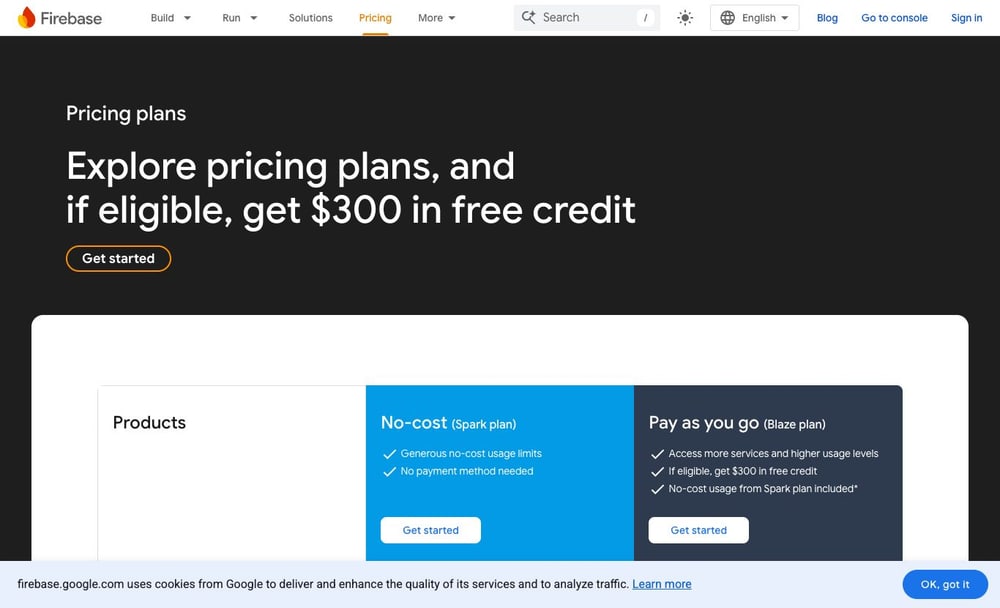
Spark and Blaze are not interchangeable fixed-price subscriptions. The team should model reads, function execution, storage, egress and App Hosting services with expected peak traffic rather than extrapolating from idle use.
Spark no-cost boundaries
Spark offers a no-cost starting point without a payment method for supported services. Some offerings require Blaze and eligible workloads vary.
The Spark tier provides a valuable no-cost starting point for early-stage development, allowing teams to build and test applications without entering a credit card or incurring fixed subscription fees. However, this plan enforces strict product-specific quotas and completely excludes certain advanced backend capabilities, meaning growing applications will eventually hit hard ceilings where operations are refused. A common pitfall is building an application architecture around features that are entirely unavailable on Spark, forcing an unexpected architectural migration once user traffic scales past initial boundaries. This tier is ideally suited for hobby projects, student prototypes, and early proof-of-concept phases where predictable zero-dollar costs are paramount. A prospective adopter should verify the exact daily operation limits and storage caps for each intended product to ensure the project scope fits comfortably within the no-cost allowances.
Blaze usage-based pricing
Blaze charges per applicable service usage, with documented no-cost thresholds. App Hosting and associated Google Cloud resources can have separate meters. Firebase Hosting Free allowances should be evaluated by service, while Blaze meters eligible overage usage.
The Blaze plan shifts project accounting to a consumption-based model, charging for actual resource utilization across supported services while maintaining standard product allowances where applicable. Because billing is tied directly to volume metrics such as document reads, function invocations, and network egress, costs can scale non-linearly if application queries are poorly optimized. One risk involves deploying inefficient database queries that perform unnecessary document reads on every client connection, turning a minor feature update into a major billing spike. This pricing model is essential for production applications with active, unpredictable user traffic that require elastic scalability without artificial service caps. Evaluators must verify that project-level budget alerts and strict programmatic quotas are implemented within the cloud console to maintain active oversight of consumption velocities.
Budget alarms and limits
A budget alert does not necessarily stop resource usage. Verify project spending controls and protection against accidental traffic spikes.
Relying solely on Firebase budget alerts can leave cloud architectures vulnerable to runaway consumption, because native alerts dispatch notification hooks rather than enforcing hard billing cutoff switches on active projects. When an unexpected traffic surge or infinite client-side retry loop hits Firestore or Cloud Functions, billing continues to accrue past the designated threshold until manual intervention or pre-configured cloud billing automations step in. Teams migrating to the Blaze pay-as-go plan must implement programmatic safeguards, such as tying billing Pub/Sub topics to Cloud Functions that disable billing or scale down service instances when spending spikes. Buyers should verify whether project administrators have established granular budget notifications alongside automated budget caps via Google Cloud billing tools. This verification step prevents surprise invoices caused by orphaned test scripts or distributed denial-of-service attempts targeting serverless endpoints.
⚖️ Alternatives & Integration
Supabase can be preferable for SQL-centered relationships, while Firebase may be easier to adopt alongside Google-oriented mobile tooling. Compare query patterns and security rules before assigning an abstract winner.
Firebase versus Supabase
Supabase is PostgreSQL-centric while Firebase includes Firestore and other app services. Compare query and auth rules against your actual application.
Choosing between Firebase and Supabase requires evaluating relational versus document-oriented data models against your team’s querying requirements and schema complexity. While Firebase relies on Firestore and Realtime Database for flexible JSON document storage and client-side SDK integration, Supabase centers on PostgreSQL, offering robust relational querying, foreign-key joins, and standard SQL extensions out of the box. Teams building applications with deep relational dependencies often find Supabase’s SQL capabilities more maintainable than duplicating data across Firestore collections, whereas applications requiring rapid prototyping with offline-first client SDKs benefit from Firebase. Evaluating authentication rules involves contrasting Firebase Authentication’s managed identity providers with Supabase’s Row Level Security policies enforced directly inside PostgreSQL. Buyers should audit their data access patterns, query complexity, and relational integrity needs before committing to either ecosystem.
Crash monitoring via Sentry
Sentry can complement Firebase’s app diagnostic services when a team needs richer release correlation or error triage across platforms.
Integrating Sentry alongside Firebase Crashlytics offers mobile and web development teams enhanced error triage, deeper release correlation, and advanced stack trace parsing across heterogeneous frontend frameworks. Although Firebase Crashlytics provides built-in stability reporting and basic crash logs for iOS and Android, Sentry excels when engineering organizations require granular breadcrumbs, performance tracing, and cross-platform error grouping that spans serverless functions and client codebases. Problems arise when teams rely exclusively on default mobile crash dashboards without correlating client-side exceptions with backend Cloud Function failures or unhandled promise rejections. Sentry fills this gap by capturing structured context and user session metadata during active error states, helping engineers isolate root causes faster. Buyers should verify whether their current error tracking workflows benefit from Sentry’s advanced alerting integrations and release health metrics before duplicating telemetry tooling.
Source controls and CI
Use GitHub or GitLab to review security rules, functions, migrations and deployment settings; avoid treating a console edit as permanent documentation.
Managing Firebase infrastructure through manual Firebase Console edits introduces configuration drift and eliminates audit trails for security rules, Cloud Functions, and deployment settings. Relying on console changes instead of version-controlled infrastructure as code prevents teams from reviewing pull requests for Firestore security rules or database indexes prior to production deployment. Implementing a robust CI/CD pipeline using GitHub Actions or GitLab CI ensures that all security rule modifications, environment variables, and migration scripts undergo automated validation and peer review. One risk involves deploying unverified security rules directly from a local machine, bypassing automated testing and exposing sensitive database collections. Buyers should verify that their engineering workflows mandate version control for all configuration artifacts and block direct console modifications in production environments.
Alternatives and complements
| Software | Relationship to Firebase | Key question |
|---|---|---|
| Supabase | Alternative or complementary tool | Which exact workflow changes? |
| Railway | Alternative or complementary tool | Would this duplicate a paid function? |
| Sentry | Complementary part of stack | How are permissions and failures handed off? |
🧪 Pilot & Verdict
For a pilot, create two users and a small dataset, then introduce a burst of reads and a rejected rule. Investigate whether the reported spending and permission behavior match the design assumptions.
Simulate a traffic spike
Exercise a busy screen, uploads, queued jobs and repeated listeners with a realistic request distribution to estimate cost.
Estimating production cloud costs requires simulating realistic traffic patterns, high-frequency uploads, queued background jobs, and repeated client-side listeners rather than relying on low-traffic development metrics. Because Firebase services bill based on granular consumption units such as document reads, writes, function invocations, and network egress, unoptimized client listeners can quietly multiply database read operations during idle states. A frequent pitfall involves failing to account for background synchronization traffic and redundant snapshot listeners during peak load scenarios, leading to unexpected billing spikes upon launch. Engineering teams should execute load tests using realistic request distributions to measure how Firestore query patterns and Cloud Function execution times scale under pressure. Buyers must verify that pre-launch pilots incorporate stress testing on data access layers to establish reliable baseline consumption forecasts.
Prove rules with adversarial tests
Try accessing other accounts’ documents and buckets from an unprivileged test client. Security claims should be tested at API level.
Verifying Firebase security rules through adversarial testing at the API level is essential for uncovering privilege escalation vulnerabilities before malicious actors exploit them. Relying on unit tests within the console or assuming client SDK safeguards are sufficient often hides critical flaws that allow unprivileged test clients to read or write restricted documents and storage buckets. One risk involves writing overly broad wildcard rules during early development and failing to restrict field-level updates or collection queries in production. Security verification should include automated script tests that attempt unauthorized data access across multiple user roles using custom authentication tokens. Buyers should require independent security audits of all database and storage rules to ensure that data isolation boundaries hold firm under direct API scrutiny.
Decide with a meter map
Firebase is valuable when its app services fit. Before production, record every active billable service, monitoring owner and exit strategy.
Adopting Firebase as a core application backend provides rapid development velocity for mobile and web teams, but long-term sustainability depends on maintaining a clear meter map across every active billable service. Because consumption-based pricing can scale unpredictably as user adoption grows, engineering leaders must catalog every active database, function, and authentication method alongside its designated monitoring owner. A frequent risk involves accumulating orphaned cloud resources and unmonitored background triggers that continue generating costs long after feature deprecation. Before committing to production deployment, teams should document their exit strategy and data migration pathways to prevent vendor lock-in if scaling costs eventually outgrow Firebase’s economic model. Buyers must verify that architectural governance includes continuous meter tracking, designated cost owners, and a viable contingency plan for data portability.
🏆 Final Verdict: Is Firebase Worth It?
Firebase can be productive for mobile and web apps with access patterns suited to its managed services. The main boundary is between a successful prototype and usage-based production bills. Test Firestore rules with separate identities, estimate request patterns and make sure alarms do not get mistaken for spending caps.
For Firebase, test two identities, a burst of Firestore reads and a rejected Security Rule. Record the associated service meters and whether budget notifications would prevent, or only report, a surprising bill. Expand the app once the model is credible.

Frequently Asked Questions
What is Firebase used for?
Firebase supports document queries and indexes and related developer workflows. Firebase offers a flexible Google-backed set of application services, especially for mobile and web teams; the key risks are service-by-service quotas, security rules and the unpredictability of consumption-based billing. Compare its role in a complete software stack before choosing an annual plan.
Is there a Firebase free plan?
Firebase publishes the following plan starting points: Spark $0, Blaze Pay as you go. Free access and included services vary by workload; confirm the current official pricing page before relying on an allowance.
How much does Firebase cost in 2026?
Firebase pricing depends on the plan and service unit. Spark $0, Blaze Pay as you go. Additional usage, add-ons, seat count or infrastructure charges can change the total invoice. The vendor pricing page is linked in this review.
What are the key Firebase features?
Firebase focuses on identity providers and tokens, storage and media, analytics and crashlytics. Availability and limits depend on the active offering, and not every advertised add-on is included in a standard plan.
Who should consider Firebase?
Firebase offers a flexible Google-backed set of application services, especially for mobile and web teams; the key risks are service-by-service quotas, security rules and the unpredictability of consumption-based billing. A buyer should validate role permissions, a realistic workload and who maintains the connection after the initial setup.
How should a team evaluate Firebase security?
For Firebase, review Firestore and Storage Rules alongside Auth providers. Test denied operations with two fictional users; administrator access or an emulator success is not proof of isolation.
What are Firebase alternatives?
Supabase suits teams that want PostgreSQL and SQL queries. Railway supplies deployment infrastructure without Firebase’s integrated client SDK model. Compare access patterns before planning a switch.
Does Firebase integrate with other developer tools?
Firebase services interact through client SDKs, Cloud Functions and Google Cloud permissions. Identify privileged service accounts and test what an untrusted client can and cannot request.
What are the limitations of Firebase?
Firestore operations, data transfer and functions have separate quotas and costs. Budget alerts can inform teams without automatically stopping charges, so model demand spikes explicitly.
How can a team migrate to Firebase?
Export Firestore and Storage data, map document structures to the new model and rewrite security rules. Rehearse authentication changes, SDK migration and rollback before switching users.
How was this Firebase review researched?
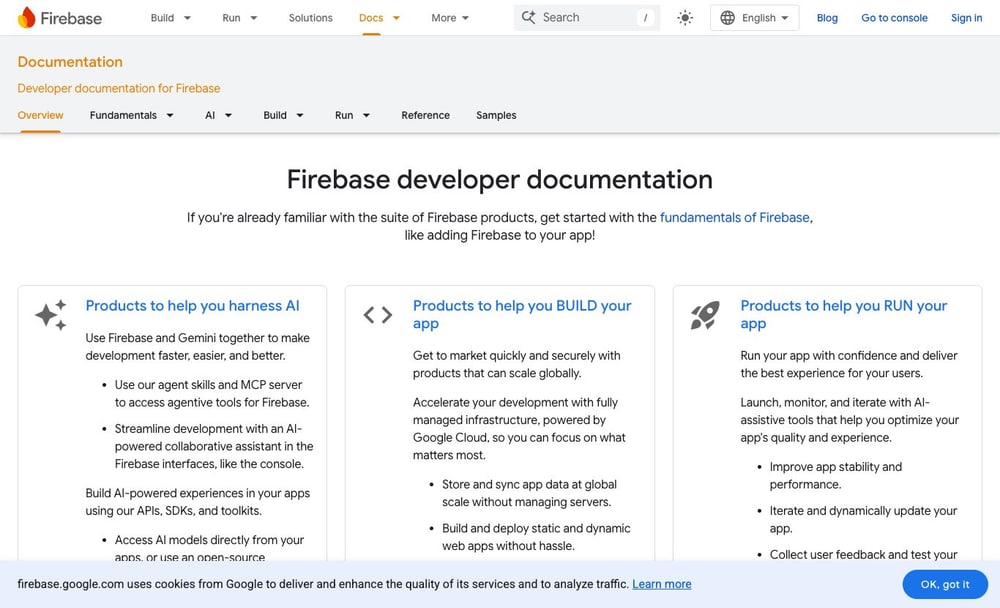
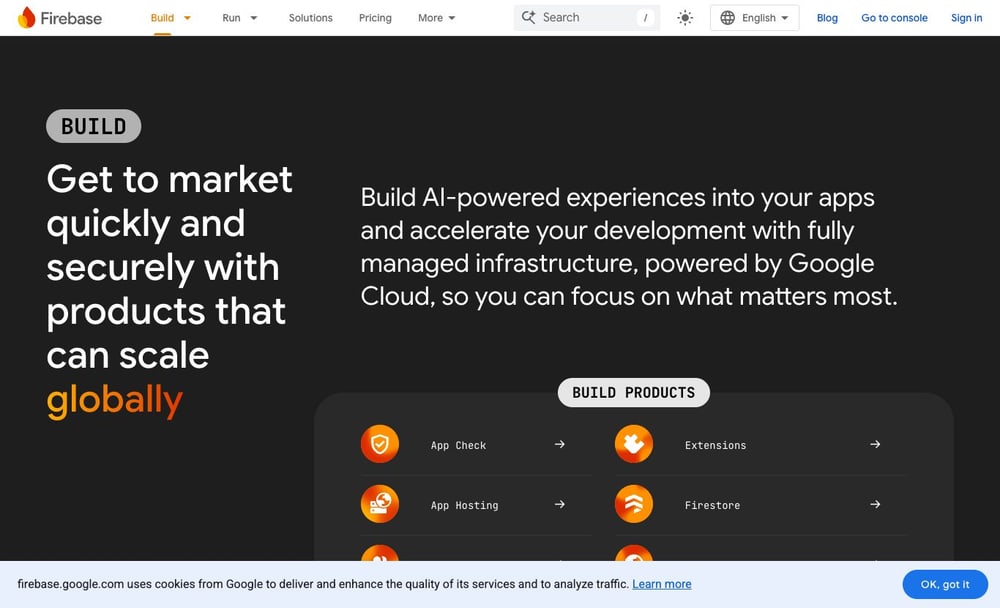
DigiOffly checked public Firebase pricing and product documentation on October 29, 2026. Screenshots show official publicly accessible pages. This article does not claim an authenticated company implementation or independently measured uptime.
EXPLORE NEXT ON DIGIOFFLY
🔍 Explore More on DigiOffly
Compare related developer platforms, estimate software costs and navigate DigiOffly guides before adding Firebase to a production stack.
Explore related software
- Development & DevOps — Explore all eight developer software categories and reviews.
- Hosting & Websites — Review hosting and infrastructure choices.
- Automation & No-Code — Find integration and workflow alternatives.
- Supabase review — Managed PostgreSQL and authentication
- Sentry review — Developer error monitoring
Compare your shortlist
- Software Directory — Browse reviewed tools by software category.
- Compare Software — Compare capabilities, billing and compatibility.
- AI Software Finder — Narrow options by your exact engineering workflow.
Plan costs and updates
- Software Cost Calculator — Estimate known license and usage costs.
- Best Value Advisor — Compare products against a practical requirement.
- Deal Alerts — Receive relevant software offers and updates.
- Vercel — Next.js deployment previews and commercial hosting costs
- Netlify — Git deploys, credit-based pricing and web functions