

Vercel review — October 2026. Next.js deployments, preview access, and usage-based production bills are the practical questions. Alex Wright evaluated the company’s public terms and deployment documentation, not an authenticated Pro workspace or paid workload.
Vercel review 2026: push a branch to Git, open a preview URL, get the change approved and deploy. That is the attractive part of Vercel. The financial question starts afterward: does the application render on each request, transform many images, or call functions every time a customer loads a page? Those workload details determine whether the $20 Pro starting fee is a useful budget estimate.
A pull-request preview can save a team a round of manual deployment work. Whether Vercel is economical in production depends on something else: the number of routes rendered on demand, how many images are transformed, and the team’s need for paid seats.
🔎 Review Summary and Editorial Fit
Vercel’s Git-to-preview workflow removes a lot of manual release work for a frontend team. Pro becomes relevant when the project is commercial, requires team collaboration or cannot fit the applicable Hobby restrictions. Its base price is still only part of the invoice.
Inspect the application rather than starting with a tier name. List server-rendered routes, cache rules, external databases, image transformations and any job that must survive a restarted function. That inventory reveals which Vercel services will be used, and which responsibilities remain in a backend or queue owned by the company.
🧭 Contents and Navigation
Jump to pricing, technical constraints, practical scenarios, comparisons and official sources.
🔎 Quick Verdict: Strong Developer Workflow, Metered Production
Vercel is attractive to a frontend team that needs automatic production deployments, review links for pull requests and a managed application runtime. Its default workflow can reduce work compared with a manually maintained server. The trade-off is that platform resource usage, additional seats and integrations can affect total cost as traffic and code complexity grow. Vercel’s personal-use Hobby terms should not be treated as authorization to host a paid product. A fair evaluation tracks the exact framework features and requests an estimate from realistic usage metrics.
This Vercel review 2026 focuses on implementation cost, deployment control and account eligibility instead of speculative speed rankings.
🔎 What Vercel Is and How the Deployment Model Works
A typical Vercel flow connects a Git repository, produces a preview deployment for a branch or pull request and promotes an approved build to production. Developers can review builds without manually copying release files onto a server. Application functions, routing, caches, images and edge services may still involve platform-specific resource rules. A developer should check the build output of the chosen framework: a purely static export and a server-rendered application have different runtime requirements. Good release automation does not remove the need for tests and rollback ownership.
\n
🔎 Vercel Pricing 2026: Hobby, Pro and Enterprise
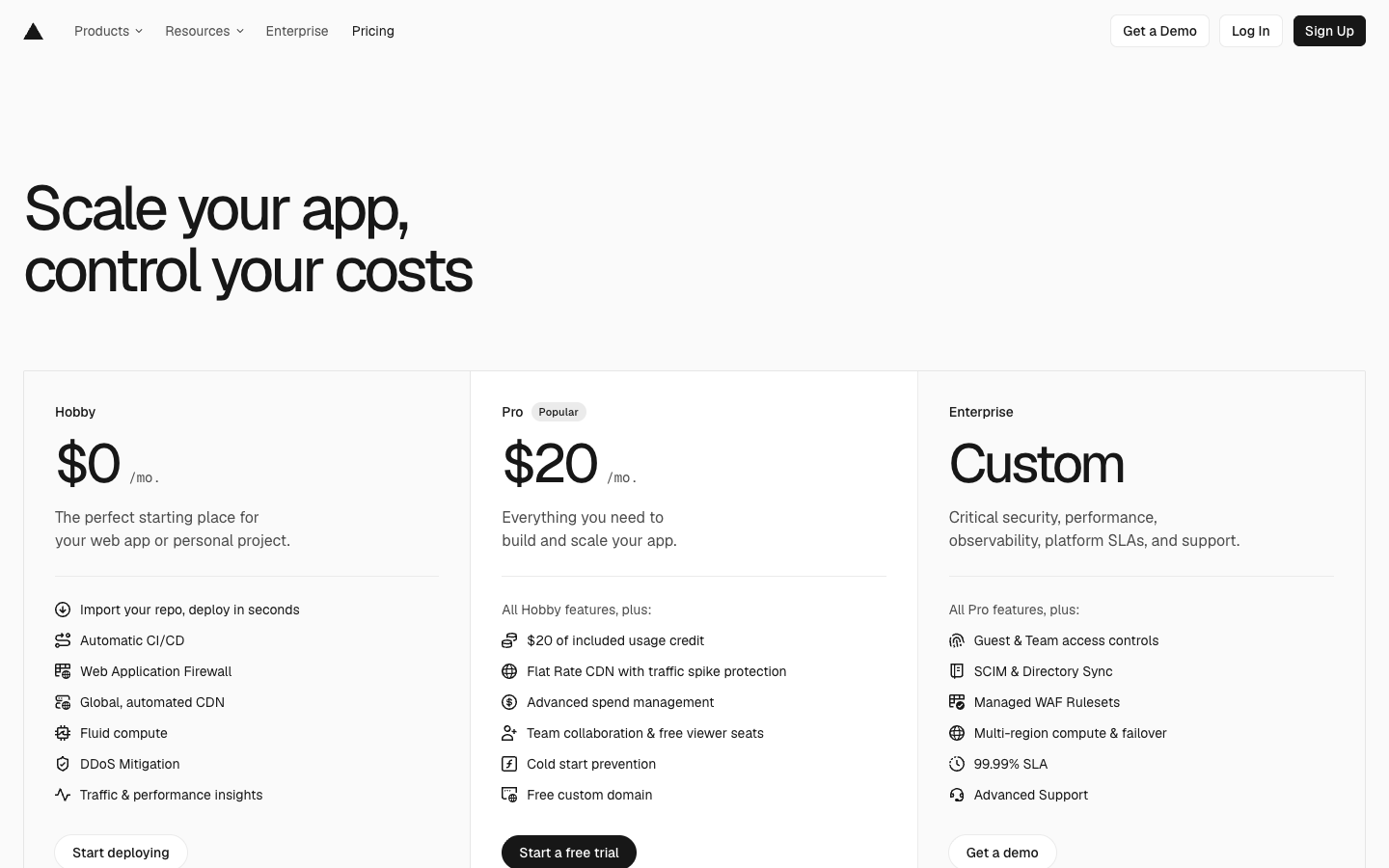
Vercel’s official pricing page currently shows Hobby at $0, Pro at $20 per month and Enterprise at custom pricing, with tax and usage caveats. Pro is presented with $20 of included usage credit and advanced spend controls; additional paid seats and usage can change the actual invoice. The $20 Pro starting price is not a cap on usage charges. Before recommending a plan, inspect compute duration, data transfer, image optimization, builds, log retention, add-ons and geographic requirements using the current vendor calculator or usage dashboard.
Vercel pricing 2026 combines a published Pro starting fee with usage, so the cost of requests and team membership must be modeled.
Before selecting Hobby, establish whether the site is commercial and check the governing use restrictions. A $0 price does not justify ignoring the licence conditions applicable to a customer-facing service.
| Plan | Advertised entry | Renewal or usage model | Important boundary |
|---|---|---|---|
| Hobby | $0/month | Personal/non-commercial restriction | Resource limits; no commercial-use assumption |
| Pro | $20/month | Includes $20 usage credit; more usage/paid seats may cost extra | Commercial apps and teams |
| Enterprise | Custom | Quote and agreement required | Custom security, SLA and control |
🔎 Hobby Is Not a General-Purpose Free Business Plan
The official terms restrict Hobby to personal or non-commercial use. This matters more than a simple free-versus-paid feature chart: a monetized production site should verify eligibility and normally plan around a commercial tier. The free tier has operational quotas that may be reasonable for a personal project or learning exercise. It should not be recommended as a cost avoidance route for commercial customers. Keep development experiments and customer-facing properties properly separated, and revisit the current terms before relying on a plan for an ongoing service.
A Vercel Hobby vs Pro decision must begin with the permitted use of Hobby, not simply the apparent similarity of deployment tools.
🔎 Vercel Pro: Seats, Included Credit and Spend Management
Pro provides team collaboration and a budgeted base from which to scale. The official page describes $20 included usage credit, but credit should not be mistaken for unlimited compute or universally applicable discounts across add-ons. A company that adds collaborators or enables premium analytics can increase its fixed and variable obligations. Configure spending alerts and limits, confirm whether the account allows pausing excess usage and ensure financial owners can see actual consumption. A reliable cost model separates recurring platform or seat costs from request-driven runtime charges.
Vercel Next.js hosting works best when framework integration solves a real release or runtime problem for the application being deployed.
Test the data-transfer and image transformation profile of a real application build. The CDN can reduce latency but not remove all usage charges or fix an API call that prevents caching.
| Area | Question to answer | Evidence to collect |
|---|---|---|
| Access and ownership | Who holds the domain and billing account? | Offboarding, login protection and recovery tested |
| Migration | What must survive the move? | Redirects, forms, DNS, database, assets and rollback |
| Performance | Which workload creates peak cost or errors? | Measure with consistent test conditions |
| Data and security | Which services hold customer or business data? | Permissions, backups and retention verified |
🔎 Next.js Integration: Useful, Not Mandatory
Vercel aligns closely with Next.js deployment conventions, including server-rendered routes and route handlers. That familiarity may streamline preview workflows, cache rules and framework upgrades. Other frameworks can also be deployed, but each one may produce a different combination of static files, server functions and build dependencies. Check platform adapters and supported versions rather than assuming all features are portable. An application whose business logic runs primarily on a separate backend should compare whether Vercel’s incremental frontend conveniences justify a second infrastructure billing account.
🔎 Functions, Timeouts and Background Work
Function runtimes should be evaluated for startup behavior, permitted execution time, memory, concurrent requests and external service calls. Vercel’s limits page publishes build and function-related quotas, but those details can change with architecture and plan. A request handler that responds quickly is a different workload from a durable background queue, video encoding job or continuous socket server. Do not promise that switching to a paid plan converts short-lived functions into a fully managed persistent worker. Separate long-running jobs into an appropriate queue and worker runtime where needed.
🔎 Deploy Previews, CI/CD and Branch Protections
Preview URLs help product managers and designers review work before it reaches customers. That benefit depends on access control and realistic data sanitization. A preview deployment containing internal feature flags or sensitive sample records is still a published environment unless explicitly protected. Tie deployment permissions to repository protections and review approvals. For a business app, audit environment-variable scopes, confirm that secrets are not injected into client bundles and make the rollback steps known to people other than the lead developer.
| Situation | What changes the requirement | A useful validation |
|---|---|---|
| A founder deploys a public SaaS landing page | The marketing site is on Next.js and supports paid signups, so the team would prefer to… | Review the non-commercial Hobby restriction and plan a compliant commercial subscription; account for run… |
| An e-commerce frontend calls an external API | Checkout is handled by another service, but the frontend uses SSR and image optimizatio… | Measure uncached requests, data transfer and transformed images. Estimate high-water billing with traffic… |
| A team shares deployment secrets | Several contractors need preview access but should not see production environment crede… | Scope variables to appropriate environments, rotate exposures and verify repository permissions; test tha… |
| A startup evaluates a migration to Netlify | The team thinks it can save money by moving a repository without testing application-sp… | Build a minimal parity prototype, compare function and caching semantics and model credit usage on Netlif… |
🔎 Bandwidth, CDN and Image Optimization
A global CDN improves the path for static assets and cacheable responses, but a site can still incur high bills when requests bypass caches, images are repeatedly transformed or functions perform unnecessary work. Measure cache-hit ratios and source image behavior with the actual application rather than treating CDN presence as proof of low cost. Vercel documents data-transfer and image-related allowances separately from compute. Configure sane asset sizes, caching headers and image-loader behavior before attempting to solve a financial problem by moving to an entirely different platform.
Evaluate whether functions provide enough execution time for planned tasks. Batch media encoding and durable queues are architecture choices, not simply features unlocked by paying a higher Vercel subscription.
\n
🔎 Logs, Observability and Incident Response
A small site may only need application error reporting and a few reliable alerts. A paid product also needs a way to correlate a request failure with a deployment, the affected route and its dependency calls. Check how long runtime logs remain available under the chosen plan and whether deeper observability is an additional subscription. Logs can identify a broken route, but someone still needs to decide whether to roll back the deployment. Keep deployment IDs, release notes, error-rate thresholds and a rollback process accessible to the whole operations team, not just the person who pushed the last commit.
🔎 Authentication, Domains and Secrets
Automatic HTTPS and custom domains can simplify release, but they do not secure application authorization logic. Review environment-variable access, preview URL exposure, repository permissions and accidental indexing of staging domains. If customer data flows to third-party APIs, document the processing and retention responsibilities of each service. DNS changes and certificate validation deserve their own release checklist. Domain configuration is best managed through ownership records, not remembered as a collection of one-off clicks made under an individual employee’s account.
🔎 Vercel vs Netlify vs Traditional Hosting
Vercel and Netlify both support Git-connected deployments and modern frontend work, but they meter usage differently and have distinct functions, build and collaboration limits. Netlify’s new credit-based plans should not be compared to Vercel simply by reading the headline Pro price. A traditional host such as DreamHost is more appropriate for some PHP/WordPress workloads; it does not provide the same branch-preview workflow by default. Compare the codebase, release cadence, runtime profile and likely operational skills rather than declaring one provider universally faster or cheaper.
Vercel Functions limits should be checked against actual execution and background workload requirements before choosing a plan.
Against Netlify, compare identical deployment outputs and a complete team workflow. Headline plan fees cannot normalize credits, runtime usage and custom integration effort without a representative project.
| Provider | Primary model | Cost caveat | Best-fit evaluation |
|---|---|---|---|
| Vercel | Framework-oriented app hosting; Next.js workflow | Pro base + usage | Server-rendered frontend teams |
| Netlify | Git deployment with credits | Credit budget per tier | Static and hybrid web apps |
| DreamHost | Shared/managed WordPress and VPS | Term + renewal + add-ons | Traditional CMS sites |
| Railway | General app and service deployment | Resource-based billing | Backend services and worker applications |
🔎 Migration, Vendor Lock-in and Portability
A Git export does not carry every Vercel-specific function, cache rule or middleware behavior to another host. A project may depend on framework-specific caching, middleware, edge semantics, managed data products or authentication integrations. Before choosing the platform, document which parts are standard code and which depend on vendor APIs. Test a second environment using a minimal production-like configuration; estimate how long domain, secrets and build settings would take to move. A second working deployment exposes which integrations would need rewriting during a migration.
🔎 Editorial Methodology and Limits of This Review
This Vercel review is based on publicly available product documentation, legal terms, price schedules and workflow analysis reviewed in October 2026. It does not represent a controlled benchmark of live sites or a paid Vercel Pro trial. Screenshots show accessible vendor pages rather than private analytics. Pricing, permitted uses, function quotas and billing models are subject to change, so a purchase recommendation must be checked against the current account invoice and official documentation. Any performance result requires a reproducible load test on the actual application.
🔎 Real-World Decision Scenarios
The following Vercel cases explore SaaS release engineering rather than routine cPanel administration. They are invented test scenarios covering commercial-plan eligibility, preview security, request-triggered workloads and dependency-heavy migrations. No production incident or successful client outcome is presented as a firsthand DigiOffly result.
1. A founder deploys a public SaaS landing page
A Next.js signup site collects payments, but the founder hopes to run it on Vercel Hobby indefinitely. The immediate question is permitted commercial use, not request volume. Verify the current terms and model Pro’s base fee, seats and usage before sending paying customers to production.
A paid signup page is commercial even when the deployment contains only a handful of static files. The team should read Hobby’s permitted-use terms before putting production traffic on it, then model a Pro invoice using realistic campaign volume. Keep the payment flow on its intended service and verify that staging deployments cannot capture genuine customer credentials. A zero-dollar development build and a compliant business deployment are different procurement decisions.
2. A product team approves preview URLs
A product designer approves changes using links created for each pull request. Vercel previews speed up that process, but a generated URL is not proof that the contents are private. Use synthetic customer records, review access controls and ensure only approved commits reach the production deployment.
Preview deployments are valuable only when the approval chain reflects the work. A designer should be able to view a sanitized page without accessing release secrets, while a developer should know which commit created it. Test access from a signed-out browser and inspect any preview indexing settings. If a customer can reach sensitive content through a guessed URL, the review process is not properly isolated.
3. An e-commerce frontend calls an external API
A shop delegates payments to a third party while its Vercel frontend renders product pages dynamically. During promotions, repeated server rendering and image transformations may grow the bill even if the checkout service absorbs the transaction work. Count uncached requests, image operations and transfer under realistic browsing patterns.
An external checkout does not remove Vercel-side costs if the frontend regenerates expensive server responses on every product view. Use a representative shopping journey to separate cacheable content from cart state and API calls. Watch image transformation and transfer metrics during a staged burst. The right optimization may be a caching change rather than a larger package or a complete platform migration.
4. An application sends background emails
A developer tries to send a large email batch inside a Vercel function triggered by a customer request. Once the response ends, an unfinished batch may be lost or retried twice. Use the function to enqueue a durable job, then handle delivery with an independently monitored worker, retry limits and an idempotency key.
Sending many emails after a user action needs delivery guarantees beyond the lifetime of the HTTP response. Put the work on a queue with idempotency keys, deliberate retry limits and a dead-letter recovery path. The Vercel function can validate the request and submit a job. This division avoids losing half a mailing batch when a function ends or a downstream provider becomes temporarily unavailable.
5. A site gets a viral social post
The marketing site goes viral overnight. On Vercel, a budget alert helps the owner respond to growing consumption, but a hard spending stop can interrupt the very signup page the campaign is meant to promote. Agree beforehand which features may degrade and who can approve more spend during a traffic event.
During a viral campaign, lower origin load is helpful only if the cache serves the right content. Identify which route is generating cost before applying new platform limits. Prepare an escalation rule for who can approve more spending and what should degrade gracefully. A hard budget cap could protect the invoice while interrupting a signup funnel, so that trade-off needs an explicit business owner.
6. A team shares deployment secrets
External contractors need Vercel preview links without gaining access to the production database. Check each project’s environment-variable scope and repository permissions, then open the preview from a signed-out browser. If secret material was exposed to a former contractor, rotate it after removing access.
Contractors reviewing a pull request should not inherit production database credentials through a shared environment variable. Audit the variable scopes and the repository’s role permissions, then load previews with synthetic records. Use client bundle inspection to catch accidental exposure of server-only values. On departure, revoke access and rotate keys that might have been visible, even when the deployment itself remained private.
7. A developer compares Next.js and Astro
The app serves thousands of static pages and just one dynamic route. Vercel’s price cannot be inferred from page count alone. Inspect the generated build output and measure how often the API route executes; a small uncached endpoint may use more compute than the public marketing pages.
A static Astro export and a Next.js app with dynamic routes generate different bills and operational duties even if their homepages look identical. Build a minimal copy of the real app using the intended rendering mode. Capture which routes execute server functions and which are simply served from the CDN. The measured invocation pattern should determine whether Vercel’s framework conveniences are worth using.
8. An agency manages ten customer frontends
An agency manages several clients whose domains, deployment approvals and billing must remain separate. On Vercel, choose project and team ownership before the first handover. Test a project transfer with nonproduction settings so a departing contractor cannot become the only person able to ship the next release.
Ten client frontends in one organization produce complicated access and billing decisions. Map each project’s domain owner, production approvers and environment variables, then decide where separate teams are justified. Create a repeatable client handoff with deployment settings and rollback instructions. The agency should be able to transfer a project without making a former contractor indispensable to its continued operation.
9. A production issue follows a bad release
The build completes successfully but a new Vercel deployment returns errors on one route. CI/CD cannot test every integration automatically. Identify the failing deployment and its runtime logs; check database migration compatibility before rolling back to an earlier build, and keep the incident message separate from the technical diagnosis.
Successful deployment is not proof that the app works. During an incident, inspect the specific failed route, recent runtime errors and the commit associated with the affected deployment. Roll back only after checking whether database changes remain compatible with the previous version. Document the customer-facing status message and the criteria for reopening traffic. CI/CD reduces mechanical deployment errors, not all regressions.
10. A startup evaluates a migration to Netlify
A team expects to save money by moving its Git repository from Vercel to Netlify. The repository may be portable while middleware, image handling and server functions are not. Build one representative route on both platforms, verify caching and secret handling, and compare observed usage rather than converting unlike billing units.
Before promising a cheaper Netlify bill, deploy the same representative routes with identical API dependencies and caching. Compare the build, requests, image handling and functions under a reproducible load. A test deployment should exercise middleware and edge routes before anyone commits to the migration. Reserve time for secrets, custom domains and a DNS rollback; savings need to exceed the engineering cost of migration.
🔎 Practical Evaluation: What to Verify Before Checkout
The legal boundary of Hobby is an eligibility question, not a performance variable. Read Vercel’s current permitted-use terms before operating a business website there. A development experiment that does not earn revenue may have different constraints from a paid customer portal hosted from the same repository.
Pro billing should be modeled as recurring access plus actual consumption. The $20 entry line and usage credit do not guarantee a flat invoice, particularly when team seats, analytics or compute grow. Use a deployment’s usage dashboard and account limits to estimate the bill under ordinary and peak demand.
Measure Next.js routes with the intended rendering configuration rather than attributing all latency to hosting. A static asset, an ISR update and an uncached server function require different resources. If a performance comparison is made, hold framework version, region and load pattern constant. This review has not performed such a comparative test.
Preview environments need their own data and secrets policy. Branch deployments should be accessible only to appropriate reviewers, with test data that cannot reveal live customer records. Repository controls and environment-variable scope matter as much as the convenience of generating a URL for every pull request.
🔎 Vendor Sources, Research Limits and Next Steps
The linked Vercel documents contain the current tier description, limits and legal terms. This article does not claim that DigiOffly has performed a commercial deployment or measured a function’s production costs. Teams should verify their project’s eligibility and expected usage before signing up.
- Vercel official source 1
- Vercel official source 2
- Vercel official source 3
- Vercel official source 4
- Vercel official source 5

Frequently Asked Questions
Is Vercel Hobby free?
Hobby is advertised at $0 but has resource limits and is restricted to personal or non-commercial use under official terms. Do not assume that a revenue-generating production project qualifies for this tier.
How much is Vercel Pro in 2026?
The official pricing page lists Pro at $20 per month with $20 of included usage credit. Extra resource consumption, paid seats, taxes and selected add-ons may increase the invoice.
Can I use Vercel Hobby for a business website?
The current terms reserve Hobby for personal or non-commercial use. Commercial projects should assess Pro or an appropriate agreement instead of depending on a free tier whose conditions prohibit their activity.
Is Vercel only for Next.js?
No. It supports other supported frontend frameworks and static workflows, though individual features and runtime behavior vary. Inspect actual build output and deployment requirements rather than assuming identical integrations.
Do Vercel preview deployments expose private information?
They can if access protection is missing or production data and secrets are used in previews. Restrict preview access, scope environment variables and test that sensitive records do not appear in client bundles.
Does the $20 Pro price cap usage expenses?
No. The listed amount is a starting plan cost, and additional usage or paid services can be billed. Establish monitoring and spending controls based on real runtime and data-transfer patterns.
Can Vercel Functions run unlimited background workers?
Functions are bounded execution environments with plan- and technology-specific restrictions. A persistent worker or long video-processing task may need a queue and separate server or job service.
Is Vercel faster than shared web hosting?
The deployment and CDN architecture differs, but no universal benchmark follows from that. Test the same site, region, caching state and runtime behavior before drawing speed or reliability conclusions.
How does Vercel compare to Netlify?
Both offer Git deployment, preview workflows and managed runtime features. Their billing models and limits differ: Vercel Pro combines a base fee with usage, while newer Netlify accounts use credits.
Can I migrate away from Vercel easily?
A static repository may be straightforward to redeploy, but platform-specific functions, caching and edge integrations introduce migration effort. Maintain an inventory of dependencies and test a second target environment early.
Did DigiOffly run production Vercel benchmarks for this article?
No. The evaluation is based on documented plans, product limits and workflow considerations. It does not claim an authenticated enterprise account, paid Pro trial or controlled speed results.
EXPLORE NEXT ON DIGIOFFLY
🔍 Explore More on DigiOffly
Compare hosting, platform operations, deployment needs and total cost before choosing a provider.
Hosting and website software
- Hosting & Websites — Check requirements, alternatives and pricing considerations
- Software Directory — Check requirements, alternatives and pricing considerations
- Ready-Made Software Stacks — Check requirements, alternatives and pricing considerations
Decision tools
- Compare Software — Check requirements, alternatives and pricing considerations
- AI Software Finder — Check requirements, alternatives and pricing considerations
- Software Cost Calculator — Check requirements, alternatives and pricing considerations
Related hosting reviews
- WP Engine — Check requirements, alternatives and pricing considerations
- Bluehost — Check requirements, alternatives and pricing considerations
- WordPress.com — Check requirements, alternatives and pricing considerations
- DigitalOcean — Check requirements, alternatives and pricing considerations
- Netlify — Git deploys, credit-based pricing and web functions
- DreamHost — WordPress shared hosting, DreamPress and renewal-price comparison
Pricing and feature eligibility can change; confirm directly before purchase.