

Pricing and specifications checked 2026-11-20 against vendor primary sources. Conditions, billing cycles and regions may change.
Revoke.cash is a security-focused application for checking the permissions that crypto wallets have granted to smart contracts. When someone swaps tokens, deposits assets into a DeFi protocol, lists an NFT, or uses another decentralized application, the interaction may require an allowance or approval. That permission can remain after the person closes the page or stops using the service. Revoke.cash makes these standing permissions easier to review and, where the relevant network supports it, revoke.
DigiOffly currently uses direct non-affiliate product links. Vendor claims are distinguished from independently observed tests. No investment or trading advice is provided.
📊 Revoke.cash Review Summary
That job is distinct from storing cryptocurrency, screening investment ideas, detecting every form of malware, or tracing funds after theft. Revoke.cash can reduce one specific type of exposure: an authorized spender retaining the ability to move certain tokens or NFTs under an existing contract permission. It cannot recover tokens already transferred, recreate a lost seed phrase, reverse a blockchain transaction, or guarantee that a malicious contract will be identified in time.
⚡ Quick Verdict: Is Revoke.cash Worth It?
The service's publicly documented scope has expanded beyond the original single-network checker. The free tier includes checking and individual revocations, while Premium offers a unified multichain workflow and Ultimate introduces automated revoking for a narrower set of compatible wallets and chains. As of November 20, 2026, the official pricing page lists Free at $0, Premium at $99 per year, and Ultimate at $199 per year. Users still need to understand network transaction fees and the distinction between the number of networks a dashboard can display and the smaller number that supports automatic action.
🏆 VERIFIED PRODUCT OVERVIEW — Revoke.cash
Wallet token approval security: free checker, Premium, Ultimate and real limitations
Best for: DeFi wallet owners and NFT collectors reviewing smart-contract allowances across EVM networks
🧠 What Is Revoke.cash?
A wallet address represents more than a balance. Its history may also include permissions granted to smart contracts. In common ERC-20 designs, a token contract records an allowance that specifies how much a particular spender may transfer on behalf of a token holder. Other standards govern NFT approvals, where a spender may be permitted to move one individual NFT or an entire collection. Wallet dashboards frequently emphasize balances and transfers, leaving these permissions less visible than they deserve.
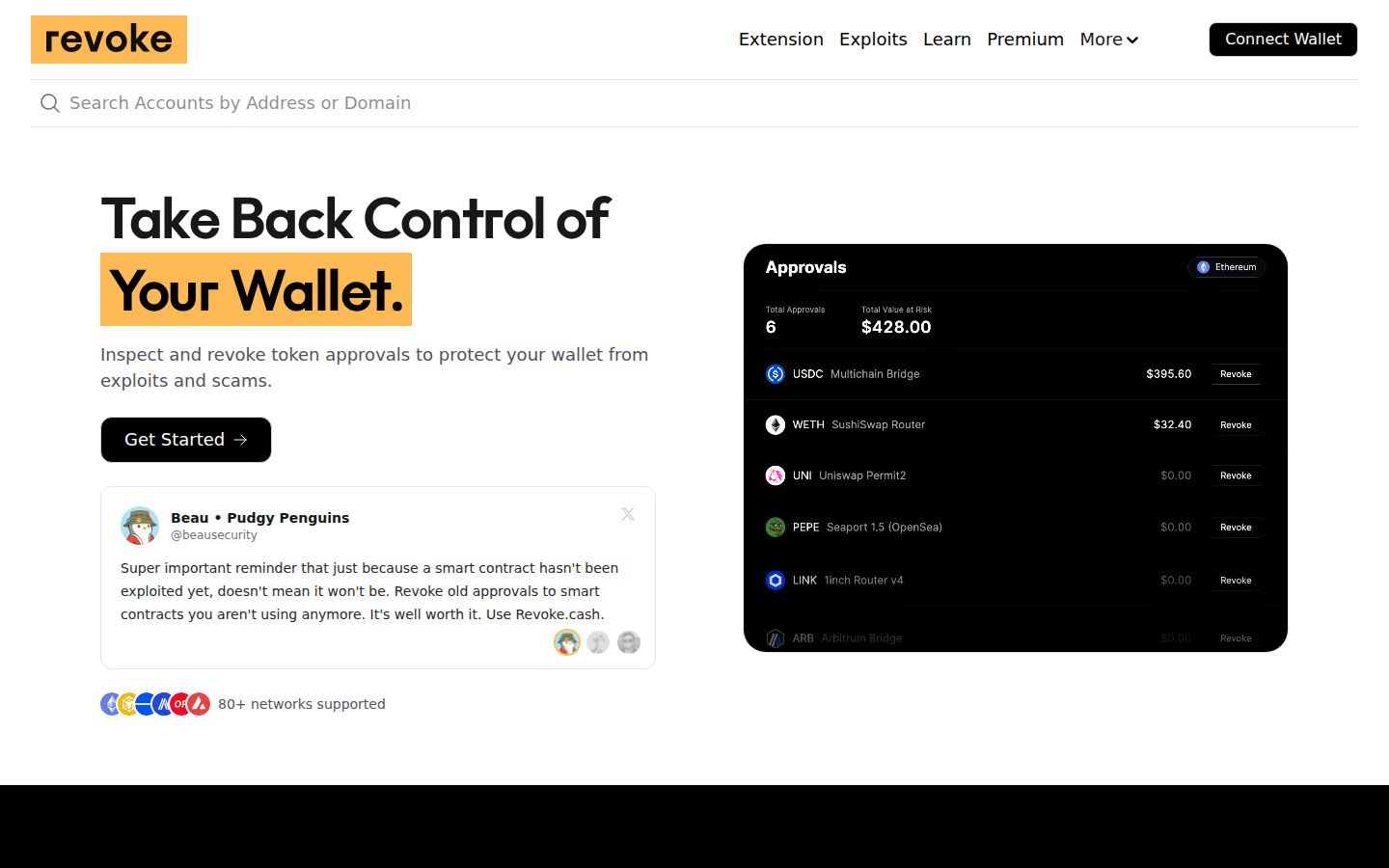
Revoke.cash addresses this visibility gap. You can enter a public address to inspect recorded approvals, or use a compatible wallet connection for interactive actions. The interface groups permissions and exposes details such as the relevant network, token or collection, spender and permission amount. It also provides tools to revoke a permission or adjust its scope. Those activities are fundamentally administrative. They do not require you to predict the market, choose a cryptocurrency or trust the app with a recovery phrase.
The distinction matters because people often misunderstand what disconnecting a wallet accomplishes. Closing a browser tab or disconnecting a decentralized application generally changes the website's ability to interact with the wallet interface; it does not erase previously recorded smart-contract approvals. When a standing allowance remains valid, the authorized spender may still have transfer power under the relevant token contract. The Revoke.cash FAQ explicitly highlights this difference.
🖥️ Ease of Use & The User Interface
Revoke.cash supports a large collection of EVM networks; its site currently advertises more than 80. It also offers an exploit checker that compares active approvals to its information about known incidents. A useful research question is not simply whether the vendor lists a particular chain, but whether the exact asset standard and contract behavior you use can be indexed correctly. Revoke.cash itself documents that some non-standard NFT approvals do not generate the events on which an indexer relies, so those permissions may be absent from the interface. If an unfamiliar site advertises a Revoke.cash browser extension, verify the publisher and the link through the official product documentation before installing anything.
🧭 How to Use Revoke.cash for Beginners
A useful Revoke.cash workflow begins without signing anything. Start by typing the verified official domain directly in your browser. Avoid advertisement links or help-desk messages that ask for an urgent wallet recovery action, because impersonation pages can imitate security utilities. Bookmark the legitimate address if you expect to revisit it.
1. Start on the authentic website and review a public address
Enter the public wallet address or use the supported connection process. A public-address lookup is suitable for an initial inventory, whereas submitting a revocation transaction requires control of the relevant signing account. Never provide a seed phrase, recovery words or a private key to a website. No legitimate approval-checking step requires a person to paste those secrets into a web form. For Revoke.cash MetaMask users, selecting the intended account and chain is essential before inspecting any allowances.
2. Inspect wallet approvals, networks and spender contracts
Select the network and study the recorded approvals. Use sorting or filtering to isolate recent or unlimited permissions. Cross-check the spender against a block explorer and the genuine protocol's documentation. When the approval is unfamiliar, try to identify when it was granted and what application was being used at that time. If you cannot establish its purpose, consider the security trade-off and seek appropriate verification rather than signing impulsively.
3. Decide whether the permission still serves a purpose
Next, decide whether a revocation is necessary. An old allowance attached to a service you no longer use is a reasonable candidate. An approval actively required by a marketplace or lending application needs more care because revoking it may temporarily interrupt a legitimate activity. If the application supports adjusting the amount instead of removing permission entirely, consider whether that provides the needed restriction.
4. Confirm transaction details and verify the on-chain result
When ready to proceed, read the transaction in the wallet carefully. Verify the target network, spender, requested change and gas estimate. The wallet's text can be confusing because revocation calls the same token contract functions used for approval. A legitimate transaction should reflect the intended allowance change rather than granting new, unrelated spending rights. If the details are unclear, stop; this review does not recommend signing a specific transaction.
After a transaction confirms, revisit the approval inventory and, when possible, check the on-chain event or permission state using an independent explorer. A pending or failed transaction is not a completed revocation. Keep the transaction hash with your records if you are documenting a security review.
🛠️ Key Features That Actually Matter
These features are checked against the official product documentation.
Approval Dashboard for Single-Chain Review
The starting point is the approval dashboard. Revoke.cash describes a workflow in which the user enters a wallet address or connects a wallet, chooses a network, and inspects allowances. Sorting, filtering and search features help when an address has years of interactions. The public educational guide recommends using recent-first ordering when investigating a suspicious event, because recent permission changes may be relevant to a new incident.
An address is already public blockchain information; an interactive revoke requires a transaction from a controlled wallet. This distinction helps users perform an initial check without exposing credentials or signing blindly.
The free tier is enough for inspecting one chain at a time. That may suit a person who mostly uses Ethereum or Base, while someone who rotates among dozens of networks may value a more unified view. A single-chain limitation is an inconvenience rather than proof that a security scan is unreliable. Revoke.cash NFT approvals can involve operator permissions that cover ERC-721 or ERC-1155 assets rather than just ERC-20 token allowances.
Official source: Revoke.cash documentation: Approval Dashboard for Single-Chain Review.
Exploit Checker and Risk Indicators
Revoke.cash can flag permissions associated with known exploited contracts. This is a helpful research layer because an old contract does not need to have been suspicious at the moment of approval to become dangerous after an exploit. However, an exploit database is by definition dependent on detection, reporting, coverage and updates.
A clean result should not be interpreted as a universal safety certificate. It does not prove that an unflagged spender is audited or benign. It also does not establish that a user's device or seed phrase remains uncompromised. An incident may become publicly known after attackers act, and a transaction may happen before a protective revocation could confirm.
Treat alerts as leads for verification. Check the spender address, compare it with official protocol resources, and consider revocation when a permission is obsolete or suspicious. For a high-value wallet, independent review of the relevant contract or professional incident-response guidance may be appropriate; no web dashboard should be the only protection.
Official source: Revoke.cash documentation: Exploit Checker and Risk Indicators.
Approval History and Approved Transfers
Approval history can help reconstruct earlier interactions, especially when the owner does not remember which application originally requested access. Premium and Ultimate add a combined multichain view, reducing manual switching across supported networks. According to the provider's September 2026 release notes, paid subscribers also gained Approved Transfer Detection for identifying transfers carried out through existing approvals on most supported networks.
This is a meaningful investigative distinction. A normal outgoing wallet transfer, a transfer executed under a pre-existing token approval and a transfer caused by compromised signing credentials can imply different threat models. Connecting a specific transfer to an approved spender may help explain an event, but it does not restore the transferred asset.
Official source: Revoke.cash documentation: Approval History and Approved Transfers.
Manual Revoking and Permission Adjustment
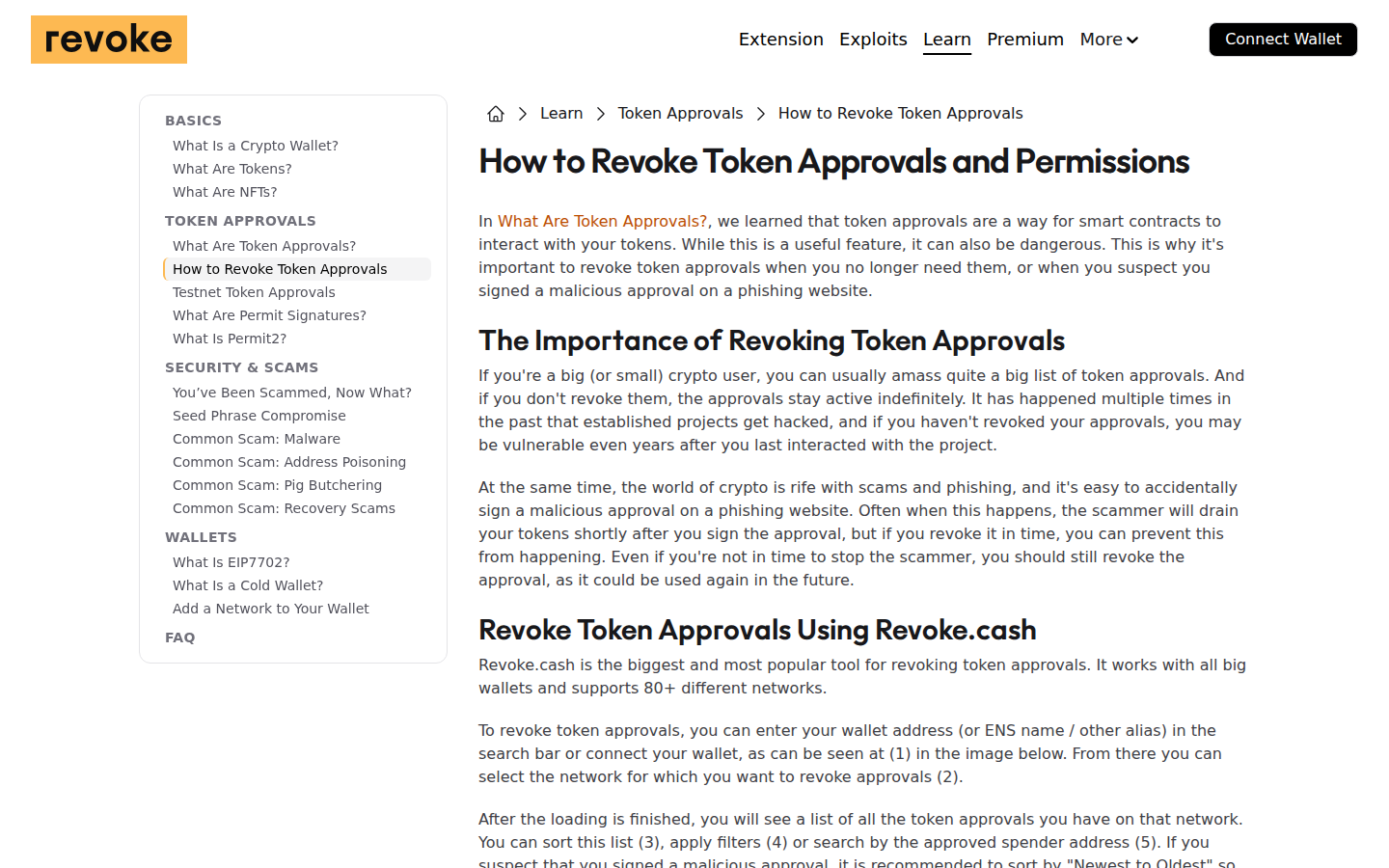
The operational heart of Revoke.cash is the ability to submit a transaction that removes or changes an allowance. A user can inspect a contract and choose whether the remaining permission still serves a purpose. On supported standard token contracts, this is often a matter of setting a token allowance to zero or disabling collection-wide authorization.
There is a usability trade-off. Removing a legitimate approval can interrupt an existing workflow or require a new approval transaction when the person next interacts with that decentralized application. For example, funds deposited in a protocol generally remain deposited when an external spending permission is revoked, but adding to a position later may require approval again. Likewise, some marketplace listings may need standing permissions in order to function as designed.
A cautious user therefore asks three questions before confirming: Is this the correct spender contract? Is the permission still required? What will the application ask for if I revoke it? The answer need not always be immediate revocation. A reduced allowance, where supported, may better balance security and convenience.
The exact wallet confirmation screen matters. Revoke.cash explains why some wallets use confusing labels involving approval when the user intends to revoke: grant and revoke operations may call the same underlying token function with different parameters. Users should read the transaction data or the wallet's permission details rather than react only to a generic button label.
Official source: Revoke.cash documentation: Manual Revoking and Permission Adjustment.
Batch Revoke: Convenience Versus Transaction Costs
Some owners discover dozens of obsolete approvals on the same chain. Selecting and processing each individually is laborious, especially when they have interacted with many decentralized protocols. Revoke.cash therefore offers batch revocation, but the commercial terms deserve attention.
On the official 2026 pricing page, Free includes batch revoke with a $1.50 platform fee per batch; some sponsored networks may cover that fee. Premium and Ultimate remove the batch platform fee. Gas and execution costs are separate considerations. The provider describes batch transactions as a convenience for working through multiple permissions, not an assurance that every chain or contract implements the same execution path.
A person with three approvals to revoke once a year may be better served by the free tools. Paying an annual subscription merely to avoid one small batch fee is unlikely to make financial sense. Conversely, a frequent multi-wallet operator could save time and avoid recurring batch charges with a paid plan, depending on how often the service is genuinely used.
Official source: Revoke.cash documentation: Batch Revoke: Convenience Versus Transaction Costs.
✅ Pros & Cons of Revoke.cash
Pros
- Public wallet address lookup and free individual permission revocations
- Exploit checker plus documented approval history and permission changes
- Optional paid multichain management for multiple wallets
Cons
- On-chain gas and potential batch platform fee are additional costs
- Automated revoking operates on fewer networks and account types than the general checker
- No recovery of already stolen assets and no guaranteed exploit prevention
👾 Limitations & Reality Check
Trade-offs: Network gas still matters. Paid subscriptions are annual commitments, not inexpensive monthly trials. Automatic revoking is supported on fewer networks than the broad dashboard, requires compatible wallet capabilities, and cannot promise that it will outrun an attacker. Non-standard assets or contracts may be missed by event-based indexing. The app cannot restore stolen cryptocurrency.
💰 Pricing Plans & Real Costs
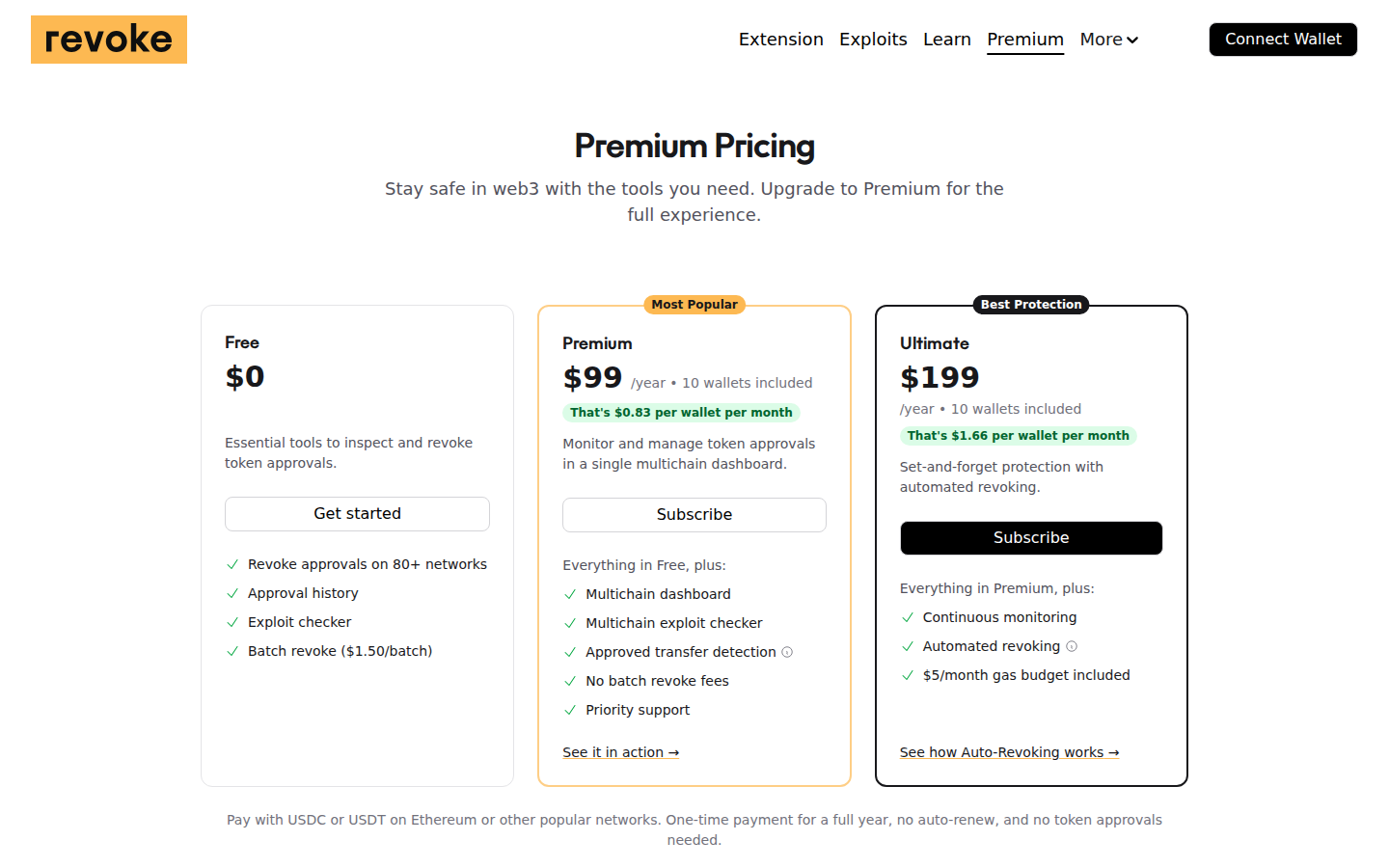
Revoke.cash's official published pricing as checked on November 20, 2026 is specific enough for a meaningful comparison, but it can change. The paid subscriptions are quoted as annual commitments. The provider's current checkout information says payment may be made using USDC or USDT on supported networks, for a full year upfront, without automatic renewal. That is different from the effective monthly equivalents displayed next to annual prices; users should not mistake those equivalents for monthly billing offers.
Official source: Revoke.cash Premium Pricing, checked November 20, 2026.
| Plan | Cost / billing model | Region / billing period | Vendor source checked |
| Free | $0 subscription; manual revoke gas; published $1.50/batch fee on eligible non-sponsored networks | United States (USD reference); Free | https://revoke.cash/premium (2026-11-20) |
| Premium | $99 annually; up to 10 wallet addresses; multi-chain dashboard, no platform batch fees | United States (USD reference); Annual, prepaid | https://revoke.cash/premium (2026-11-20) |
| Ultimate | $199 annually; up to 10 wallet addresses; compatible auto revocation, $5/month gas allowance | United States (USD reference); Annual, prepaid | https://revoke.cash/premium (2026-11-20) |
🎯 Who Should Use Revoke.cash?
Ultimate adds functionality, not necessarily certainty. Its automated revoking uses delegated permissions for supported smart accounts. The technical documentation says the delegation is limited to revocations rather than arbitrary transfers, but accepting any delegation should be a deliberate security decision. Users must understand the wallet upgrade and authorization prompts, the conditions that activate rules, and the circumstances in which a malicious spender may act before the software can respond.
An effective per-wallet-per-month figure is shown on the vendor site: Premium $0.83 and Ultimate $1.66 when spreading the annual subscription over ten included wallet slots. This assumes those slots are actually used. One person with one wallet has a very different per-wallet cost than an operator using all ten. The annual amount remains $99 or $199 regardless of whether only one wallet is registered.
⚖️ Revoke.cash Alternatives
Choosing among security utilities requires clarity about the job. Revoke.cash and Etherscan can both assist with identifying and revoking on-chain permissions. Rabby is primarily a wallet with transaction-related protections. Pocket Universe is primarily a transaction simulation and warning extension. These products can complement each other rather than compete as interchangeable approval managers.
Etherscan Token Approval Checker vs Revoke.cash
Etherscan is a sensible second opinion for Ethereum approvals. The Revoke.cash tutorial itself points readers to the explorer's token approval checker and explains how to use the ERC-20, ERC-721 and ERC-1155 views. An explorer can also help verify spender addresses and transaction histories directly. The trade-off is that a person working across multiple networks may need to navigate different explorer sites.
Rabby Wallet vs Revoke.cash
Rabby Wallet belongs in a broader comparison because its own wallet interface can help users understand transaction risks. This can reduce friction for people who already use it. However, the primary choice is between full wallet products and independent permission-checking tools, not simply two websites with the same feature set. Account safety still depends on what the signer authorizes.
Pocket Universe vs Revoke.cash
Pocket Universe is useful for a different moment of risk: before a potentially malicious transaction is approved. Its official site describes simulated transaction information and scam warnings. Such a preventive warning system may be valuable alongside Revoke.cash, which helps examine permissions already granted. Neither is a substitute for seed phrase security or correct device hygiene.
Comparison: Revoke.cash vs Alternatives
The different security workflows are complementary rather than interchangeable.
| Consideration | Revoke.cash | Alternatives |
| Primary purpose | Identify and revoke standing approvals | Explorer checks, wallet signing safety or transaction simulation |
| Free core tool | Public-address approval dashboard and manual revokes | Basic explorer and some wallet checks |
| Paid features | Multichain monitoring and compatible auto-revoking | Different features and commercial terms by vendor |
| Underlying risk addressed | Unnecessary smart-contract allowances | Explorer investigation, wallet security or suspicious signing |
| Independent caveat | Detection, indexing, gas and compatibility limits | Risk alerts and simulations also have incomplete coverage |
How Token Approvals Actually Work
Imagine using a token swap service. You have tokens in a wallet and want a decentralized application to exchange them. To complete that workflow, the application may ask you to approve a contract as a spender. In a standard ERC-20 approval, the token contract records an amount associated with that spender and your address. The spender can later use the allowed transfer mechanism within the approved limit.
A narrowly sized approval limits what may be spent. A very large or effectively unlimited approval may remain useful for repeat transactions, but it can also increase exposure if an approved spender becomes compromised or operates maliciously. The important questions are which contract received the allowance, what token it covers, on which network the approval exists, and whether continued authorization is necessary.
Revoking an ERC-20 approval usually means sending a new transaction that sets the previous allowance to zero. For NFT collection-wide permissions, revocation commonly changes an approval-for-all value from true to false. Those actions modify an on-chain record and generally require a network transaction with a gas fee. They are not equivalent to deleting a connection from a browser settings panel.
The exact gas fee is not fixed. It varies with the network and conditions at execution. An inexpensive chain may offer lower typical transaction costs than a congested Ethereum mainnet, but the correct amount must be shown by the wallet when the user considers a specific transaction. A review that labels a service universally free without mentioning network gas is misleading.
Revoke.cash Premium: Is the Annual Plan Worth It?
The purchasing decision is not only price. It is whether the product's specific network and data coverage matches the user's real workflow. A wallet owner concentrated on a network with unusual contract standards should verify compatibility before subscribing. The 10-wallet entitlement should not be interpreted as 10 separately insured wallets or a guarantee of financial reimbursement after an exploit; the product offers software features, not blanket asset protection.
For occasional activity, a disciplined manual review may be enough. For frequent activity, paid convenience may be useful, but it does not eliminate the need for careful signing or wallet segmentation.
Ultimate Automated Revoking: Risks and Compatibility
Ultimate appeals to people who want the platform to monitor approved spenders continually and respond according to configured rules. The official documentation states that its automation depends on ERC-7715 permission support and an ERC-7702 smart account upgrade. Known supported wallet options include MetaMask and WalletChan, and the current detailed list names 14 networks for automated revoking.
Do not confuse the 80-plus supported networks advertised for the regular checker with the 14 networks documented for automatic revoking. The headline network figure describes broad product coverage; auto-revoking is a narrower feature with its own compatibility requirements. Hardware wallet accounts such as Ledger and Trezor are specifically excluded from this automatic setup in the current vendor documentation, even when connected through a supported wallet.
Ultimate's $5 monthly gas budget is also conditional. The provider describes limits on individual revocations and says some routine actions can be deferred when the budget is used or gas becomes expensive. It says exploit-triggered revocations continue even after the regular monthly allowance is used, subject to its operating rules. A prospective subscriber should review the current terms rather than infer an unlimited gas reimbursement from the marketing summary.
Most important, automated protection is expressly best-effort. Detection may lag an exploit; blockchain networks can be congested; attackers can act quickly. If a private key or recovery phrase is compromised, automatically revoking an approval does not solve the underlying account compromise. Paying for Ultimate should never replace secure wallet management, independent transaction review and prudent authorization limits.
Revoke.cash: How to Use the Approval Checker Safely
First select the correct network and look up the address you intend to review. An approval list identifies the token and spender, but its mere presence does not determine whether a transaction is safe. For NFTs, check both collection approvals and individual-token permissions where the interface and contract standard support that distinction.
A Revoke.cash crypto wallet check should be treated as a permissions audit, not a promise that every spender is safe. An independent block explorer can help verify the contract address before you spend gas to change an allowance. If a wallet or recovery phrase has already been compromised, revoking a permission may not be sufficient to stop further loss.
Is Revoke.cash legit? The genuine service has published documentation and explains its limits, but you must still verify the domain, the active chain and the exact on-chain transaction request yourself.
Security Review Method: Verify Rather Than Guess
Finally, remember that the process is ongoing. New dApp interactions can create new approvals later. A routine schedule for reviewing standing permissions may be more useful than a one-time cleanup, particularly for wallets interacting with many contracts.
The vendor's step-by-step explanation and images can be found in its official revocation guide. DigiOffly has captured the public interface, but it has not executed a live transaction in the course of this review.
🧪 How We Evaluated Revoke.cash
How this review was researched: DigiOffly checked eight publicly accessible first-party pages on November 20, 2026, archived their HTML and captured five browser screenshots at desktop and mobile widths. We independently verified the public pricing display and documentation navigation but did not connect a wallet, sign permissions, perform an on-chain revoke, or test the product against a live exploit. Vendor claims about protection, user counts and automatic monitoring have not been independently benchmarked. A complete hands-on security certification is outside this review's evidence.
Method: documentation-based analysis of published vendor sources; no independent product access or benchmark is claimed.
🏆 Final Verdict: Revoke.cash Review
Revoke.cash solves an important but specific problem: understanding who retains smart-contract spending permissions on assets associated with a wallet and providing a workflow for reducing unnecessary allowances. The accessible free core is its strongest general-purpose feature; many users can learn the basic permission model and manage occasional allowances without an annual subscription.
Premium makes more sense for sustained multichain administration. Ultimate adds an automated response mechanism that deserves close scrutiny of wallet compatibility, data quality and security assumptions. The extra features are not a reason to let routine transaction scrutiny lapse, and no published marketing claim can replace independent evidence of how a particular contract behaves.
For DigiOffly readers, the recommendation is to evaluate the free version against a public address first, read the official limitations, and pay only if the exact advanced functionality is relevant. Use official URLs, maintain good key hygiene, and never sign an unexplained permission request. This is a software-review conclusion, not an endorsement of any token, trading strategy or financial outcome.

Frequently Asked Questions
Is Revoke.cash free in 2026?
The basic checker and individual revoking interface are free, but a blockchain transaction may require network gas. The provider lists a $1.50 fee for free-tier batch revocation except where a network sponsor covers it. Paid subscriptions offer additional monitoring and convenience.
Is Revoke.cash safe to connect to my wallet?
Review the official domain, connection permissions and any transaction request carefully. A public-address lookup can be used for initial research without signing. No third-party website should receive a recovery phrase or private key. The service’s existence does not make every transaction presented by a browser safe.
Can Revoke.cash recover cryptocurrency that has already been stolen?
No. Revoke.cash explicitly describes revoking approvals as prevention against additional misuse of existing permissions. It cannot reverse confirmed transfers or recover lost assets. If the seed phrase was compromised, the threat extends beyond approvals and may require abandoning the affected wallet.
Does disconnecting a wallet remove approvals?
No. Disconnecting a wallet from a website generally affects the current website connection, not the approvals already stored by token contracts. A blockchain permission must be checked and, where appropriate, revoked or adjusted separately.
What happens to staked tokens if I revoke an approval?
The provider says existing deposited or staked assets remain in their protocol. However, a later deposit or other new transaction may require approval again. Check the exact protocol and permissions before making changes, especially when active listings or automated DeFi workflows are involved.
How many networks does Revoke.cash support?
For general permission checks, the public Revoke.cash homepage advertises more than 80 networks. Choose the actual chain you used and verify that your specific token contract appears there; coverage of one chain does not imply identical support for every token. Automated revoking in Ultimate is a separate feature with a shorter supported-network list, so confirm that list independently before subscribing.
Can I use Revoke.cash with Ledger or Trezor?
Revoke.cash Ledger owners should first verify that their hardware wallet has a supported manual connection method for viewing and changing allowances. The vendor specifically excludes hardware-wallet accounts such as Ledger and Trezor from its automated-revoking feature. Never assume the public dashboard network list guarantees compatibility with a particular wallet or transaction flow.
Is Revoke.cash Premium worth $99 per year?
Premium can be useful when you regularly review several chains and up to ten wallet addresses. For a single wallet checked occasionally, the free tier may be sufficient. Compare the real annual cost with how often you need multichain history and batch convenience.
What does Revoke.cash Ultimate add for $199 per year?
Ultimate adds rule-based continuous monitoring and automated revocation where supported, along with a published $5 monthly automated-revocation gas budget. It still has compatible-wallet requirements, per-transaction limits and potential detection delays. It cannot guarantee that a theft is prevented.
Is Revoke.cash better than Etherscan’s approval checker?
Both can help manage permissions, but the experience differs. Etherscan is closely tied to Ethereum explorer data; Revoke.cash emphasizes a dedicated approval workflow and paid multichain conveniences. The best choice depends on your networks and whether you want to cross-check data independently.
How often should I check token approvals?
There is no universal safe interval. Frequency depends on the number of wallets, networks, applications and new interactions. Checking after unfamiliar dApp use and during periodic wallet hygiene is sensible. If there is evidence of an active attack, routine scheduled reviews are not a substitute for urgent incident response.
EXPLORE NEXT ON DIGIOFFLY
🔍 Explore More on DigiOffly
Trading & Market Analysis Software
DigiOffly trading software reviews, not trade signals
Explore the related guideRabby Wallet Review
Compare wallet transaction previews with dedicated permission checks.
Read Rabby Wallet reviewSoftware Finder
Find wallet-security and approval-audit tools by your actual research needs.
Open Software FinderPrimary sources and verification dates
- Revoke.cash official homepage — verified 2026-11-20
- Revoke.cash public pricing — verified 2026-11-20
- Revoke.cash Frequently Asked Questions — verified 2026-11-20
- Token approvals explained — verified 2026-11-20
- How to revoke token approvals — verified 2026-11-20
- Automatic revoking restrictions — verified 2026-11-20
- Revoke.cash product update Q3 2026 — verified 2026-11-20
- What to do after an on-chain scam — verified 2026-11-20
- Etherscan Token Approval Checker — verified 2026-11-20
- Rabby Wallet official site — verified 2026-11-20
- Pocket Universe official site — verified 2026-11-20