

Research and pricing checked October 26, 2026. This independent editorial review uses vendor documentation and publicly accessible screenshots. We did not log into a private merchant account, conduct a live paid-order benchmark or verify a particular customer conversion rate.
For BigCommerce, the practical question is who will manage catalog changes, payment failures and fulfillment as sales grow. The analysis separates published features from workflows a merchant still needs to test.
📊 BigCommerce Review 2026: Summary
A hosted, multi-channel commerce platform whose 2026 economics depend on GMV thresholds and payment-provider classification.
🏆 EDITORIAL FIT: GROWING MULTI-CHANNEL RETAIL
Best for: Retailers prepared to model GMV bands, payment gateway routes and integration needs. Plan changes, payment-provider classifications and storefront charges affect the real bill.
| Decision question | Editorial assessment |
|---|---|
| Best fit | A growing multi-channel retailer with a clear payment-provider strategy and margin model |
| Poor fit | A store that cannot forecast trailing revenue bands or whose required gateway triggers additional fees |
| Ownership trade-off | Centralized hosted commerce, API flexibility and GMV-linked plan economics |
| Research basis | BigCommerce 2026 pricing and payment provider policy; public sources only |
Pros
- Documented multi-storefront and API capabilities
- Core, Growth, Scale plans for different selling volumes
- Embedded Payment Providers avoid the extra Open Provider fee
Cons / Caveats
- Sales volume can trigger plan upgrades and overages
- Open Payment Provider fee requires gateway-level analysis
- Multi-storefront expansion may add monthly charges
⚡ Quick Verdict: Is BigCommerce Worth It in 2026?
BigCommerce deserves to be evaluated as a complete commerce operating model, not just a subscription that produces an attractive store. Its 2026 self-service offering now revolves around Core, Growth and Scale, with Performance intended for more demanding contracted businesses. That distinction matters because plan thresholds, qualifying sales volume and the type of payment provider processing each order can affect the economics of a growing store. A merchant who compares the platform against Shopify using only $29-versus-$29 annual headline prices is missing information that may become important during the first strong sales quarter.
The main appeal is an established hosted ecommerce environment that can support a rich catalog, several sales channels and an integration architecture without the merchant managing WordPress servers or updating individual commerce plugins. The harder question is how your particular operational workflow maps onto the hosted platform. Does the warehouse own inventory? How are orders allocated when products are listed on multiple storefronts? Will an accounting or ERP integration be responsible for prices, or will the ecommerce admin remain the authoritative source? These questions determine implementation work more reliably than a feature checklist.
🎯 Who Should Use BigCommerce?
It can be a poor choice for a merchant who is unwilling to model sales forecasts or determine exactly which gateways process transactions. Under the current published plan framework, some transactions processed through Open Payment Providers may attract a BigCommerce fee in addition to processor charges. Merchants using the listed Embedded Payment Providers are in a different position for those orders. A platform is not automatically expensive because a fee exists, but a merchant who ignores the definition may forecast misleading margins. A BigCommerce B2B ecommerce evaluation needs a wholesale-specific workflow: buyer account, negotiated price, approval path and order reconciliation.
The strongest buying brief identifies the country in which the legal merchant operates, the stores and sales channels involved, the selected payment gateway for each order type, any B2B purchasing requirements, the number of staff and the responsibilities of external systems. For a home-goods retailer, delivery surcharges and product dimensions may be more important than an extra marketing widget. For a fast-moving consumables brand, recurring purchases and inventory turnover may deserve priority. Neither buyer should treat a generic demo as a reliable prediction of daily administrative work. Compare its outcome with the hosted alternatives instead of assuming that a platform marketed to growing businesses automatically fits each distributor.

Official public webpage screenshot, captured October 26, 2026. This is not a merchant account or a checkout test.
▸ A buyer-fit decision, not a universal ranking
A small store with ten products may find a simpler solution more economical in the early months. An organization already operating a developer-supported WordPress property might value WooCommerce's control over its existing content and infrastructure. A larger multi-brand merchant should examine whether BigCommerce's multi-storefront management and API ecosystem reduce the coordination overhead that currently requires spreadsheets and manual imports. These are different purchasing problems, so a single 'best ecommerce platform' label would hide the most consequential details.
🧱 Storefront Setup & Product Catalog
A product catalog is not merely a grid of photos. A furniture store needs variants, lead times, oversize shipping rules, bundles and clear naming across search and category pages. Before considering themes, construct a small but difficult sample catalog: a sofa with several fabrics, a lamp with a restricted shipping destination, a pre-order item and a clearance item that must not be oversold. Import that sample into a trial or test environment and document each field that must survive the process. The ability to represent your actual merchandising data is a better test than the speed of importing a hundred identical demonstration products. BigCommerce multi-storefront costs depends on tier-specific additional-store charges, so multiplying the base subscription by brand count is not an accurate forecast.
▸ What a catalog migration should preserve
Start with identifiers, not screenshots. Record SKUs, barcodes, variant combinations, categories, canonical URLs, taxes, product-level shipping overrides and the images attached to each record. Then repeat an import and export on a small sample to inspect the resulting data. A merchant who can reproduce the source catalog and spot missing fields in a spreadsheet is much safer than a merchant who discovers broken variants only after redirecting advertising traffic to a new domain.
Product image processing deserves a separate check. Test tall and wide photography, accessibility labels and image placement on small screens. For large objects such as furniture, visual content can materially influence returns and support volume. The storefront should not trade away useful detail for an untested claim of fast-loading pages. Look for measured image sizes, not an invented performance benchmark.
💳 Checkout, Payments & Customer Experience
The most important 2026 BigCommerce pricing nuance sits inside the payment workflow. The official documentation distinguishes Embedded Payment Providers from Open Payment Providers. Orders actually processed through a provider on the embedded list are not subject to the additional Open Payment Provider fee. Orders going through an Open provider can attract a tier-specific percentage charged by BigCommerce itself. This is separate from normal payment processing, interchange, currency conversion or chargeback charges. Which option appears at checkout is not by itself proof of who processes the eventual transaction. To estimate BigCommerce Open Payment Provider fees, identify which gateway actually processes each order and apply the rate for your plan.
On the published self-service plan rules, the Open Provider rates are 2.0% on Core, 1.0% on Growth and 0.6% on Scale. Performance is subject to contracted terms. The vendor includes Stripe and several other major providers on its current Embedded Payment Provider list, but partner classifications can change. The relevant question is not just 'Does BigCommerce support our gateway?' It is 'Which of our actual orders will this gateway process, and which fee category will BigCommerce assign to those orders?' That distinction belongs in the same spreadsheet as card processing costs and refund assumptions. The BigCommerce Embedded Payment Providers list can change the economics because eligible embedded transactions avoid the extra Open Provider platform charge.
Consider an explicitly illustrative month in which a merchant produces $40,000 in gross orders. If twenty percent of the relevant qualifying order volume is attributed to an Open Payment Provider, that would be $8,000 before considering the vendor's Inclusive GMV method; under an assumption that $8,000 is already fee-eligible Inclusive GMV, a 0.6% Scale fee would equal $48. This is not a forecast, a quote or proof of actual eligibility. It demonstrates why the accounting team must separate payment processing from the platform's additional invoice line rather than combine every charge into an unexplained payment percentage. BigCommerce payment provider fees are not the same as processing fees.
A checkout test should contain more than a successful credit-card purchase. Include a declined payment, a full refund, a partial refund, a discount combined with shipping, an international card and a customer who makes a change after submitting an order. Observe which team receives notifications and how the resulting order is represented in finance exports. A discrepancy between settlement and order reports often creates more recurring work than the store's original implementation. Never infer that a feature is supported in your exact country solely because it appears on a global marketing page.

Official public webpage screenshot, captured October 26, 2026. This is not a merchant account or a checkout test.
📦 Inventory, Shipping & Fulfillment
An ecommerce platform becomes business-critical when it accepts orders while other systems are still changing stock. In the hypothetical home-goods company, a dining table may be available in the physical showroom, reserved for a wholesale buyer and listed online at the same time. Define whether BigCommerce, the warehouse system or the point-of-sale tool is the authoritative inventory source. If two systems both overwrite stock, a seemingly successful integration can create overselling that appears only under pressure.
Test a cycle that involves receiving inventory, transferring it between locations, cancelling an order and restocking a return. Check whether each change is reflected in the customer-facing availability message before checkout. Warehouses may need rules for bulky items, multiple parcels, pickup windows and delivery quotations. Your chosen plan or extension must support the real route, not merely offer a field labelled 'shipping.' Ask whether staff can identify the order that caused a negative inventory balance without reading raw API logs.
Fulfillment integrations also need an explicit failure path. What happens if a label provider is unavailable after the customer has paid? Can staff hold fulfillment without cancelling the financial transaction? Are shipping updates pushed once, or can a retry create duplicate notifications? These questions can be tested with a controlled order before deployment. BigCommerce's ecosystem may connect the necessary systems, but the merchant remains responsible for documenting behavior across organizational boundaries.
▸ Customer care and returns
Returns become expensive when customer service cannot distinguish an exchange, an item not delivered and a product damaged in transit. Map the status changes that staff can make, the refund rights assigned to each role and the evidence retained for disputes. A catalog may require different policies for made-to-order goods and ordinary stocked products. The operational test is whether a representative can follow a single order through these branches without manual updates in three different tools.
🌍 SEO, Content & International Selling
Organic search cannot be evaluated by a screenshot of a pretty homepage. Catalog SEO depends on product URLs, duplicate variants, canonical handling, redirects, structured product information, indexable category pages and the clarity of editorial content surrounding products. Before migration, export the site's highest-value landing pages and known redirects. Compare which URL patterns BigCommerce will create by default and which customizations require a technical implementation. A store may retain all products and still lose search traffic if old page addresses are not mapped precisely. BigCommerce international selling features matter only once you have validated real localized orders across your destination markets.
International commerce adds another layer of operational definitions. A translated category title is not enough: price display, settlement currency, tax responsibility, shipping eligibility, product restrictions and return addresses must work for each target market. A merchant selling furniture to two countries may have different carriers and VAT handling. Test two complete sample orders with different addresses and payment methods, documenting where localization is native, where an integration is needed, and which country-specific legal advice is outside the platform's role.
Marketplace connections deserve equal scrutiny. A SKU may be renamed or repriced by a channel, returns may be initiated somewhere other than your own checkout, and advertising attribution may split across systems. Pick three products and follow every update from the catalog source to the live listing and back. The time required to fix mismatches is part of total ownership cost. A claimed integration should be treated as the start of testing, not the end of it.
▸ Editorial content versus product merchandising
Some retailers choose BigCommerce primarily for transaction management while keeping a separate content platform for educational articles and campaigns. Others prefer a single store architecture. The decision should account for how editors publish, who owns redirects and whether product embeds can be updated without developer involvement. A company that wins sales through long-form buying guides should protect that content strategy instead of selecting a platform solely around checkout design.
💰 BigCommerce Pricing Plans & Real Ownership Cost
A BigCommerce buyer in October 2026 should begin with the new plan names: Core, Growth, Scale and Performance. The old Standard, Plus and Pro names no longer describe the published self-service product correctly. Core lists $39 per month on monthly billing or $29 per month when billed annually; Growth lists $105 or $79; Scale lists $399 or $299. Performance begins with custom pricing, advertised from $1,499 per month on annual terms, and requires a negotiated agreement. These US reference figures exclude taxes and cannot replace a region-specific checkout quote. BigCommerce pricing for Core, Growth and Scale follows the June 2026 plan update; older articles may still refer to Standard, Plus and Pro.
Plan price is only the first input. The 2026 self-service rules use Inclusive GMV for plan placement and some fee calculations. Under the vendor's definition, the relevant gross order value is reduced by ten percent for those measurements. A business that sees $120,000 of raw gross order value in its own reports should not automatically use that number as the BigCommerce dashboard metric. The published dashboard, exclusion rules and lookback period have to be reconciled before budgeting. For Core, the current trailing-12-month Inclusive GMV threshold is $30,000; for Growth, $100,000. Exceeding thresholds can lead to an automatic plan change. The BigCommerce 2026 plan changes make sales volume a billing variable.
Scale introduces a different problem. The published reference includes $33,333 per month of Inclusive GMV before a 0.9% overage applies above that level. At sufficiently high trailing volume, contracted Performance can become the relevant plan. A merchant should model a soft month, an average month and an unusually successful campaign month, because a forecast based solely on a smooth annual total can conceal short-term overages. Record both the sales period used for plan assignment and the period used for fee calculation; they are not necessarily identical. A BigCommerce Inclusive GMV calculation uses a vendor-defined adjustment to gross order value and is not the same as bank settlement or accounting revenue.
Here is a purely illustrative exercise, not a customer quote. Suppose a retailer has $12,000 in monthly gross order value and the relevant vendor calculation reduces that value by ten percent. Inclusive GMV would be $10,800 monthly, or $129,600 across twelve months at a constant run rate. This is above the published Growth threshold of $100,000, so the merchant should investigate Scale placement rather than assume that Growth's headline price applies indefinitely. A seasonal business may see very different trailing numbers even when its current month's orders are small. Ask finance to reconcile each measure against a sample month.
Now add payment-provider classification. The published Open Provider fees are 2.0% of eligible Inclusive GMV on Core, 1.0% on Growth and 0.6% on Scale; orders processed by listed Embedded Payment Providers do not incur this BigCommerce platform fee. Normal processor charges remain separate. If the store takes payments through several services, record actual order attribution by gateway. Do not assume that displaying a branded wallet makes every order eligible for the wallet's provider classification. A BigCommerce Scale monthly GMV overage model is especially important for fast-growing stores, because the 0.9% overage rule is applied to eligible volume above the published cap.
Finally include paid integrations, additional storefronts, custom development, data synchronization, tax services, design changes and any advanced support contract. The relevant metric is monthly contribution after those operating costs, not the theoretical saving between two annual plan prices. An implementation with one less subscription but twice as much manual fulfillment work can lose money despite a cheaper checkout invoice. Request itemized assumptions before approving a migration. The BigCommerce Performance enterprise plan conversations should include contractual thresholds, support needs and exit terms. BigCommerce pricing 2026 has Core, Growth, Scale and Performance tiers, rather than the older self-service names.
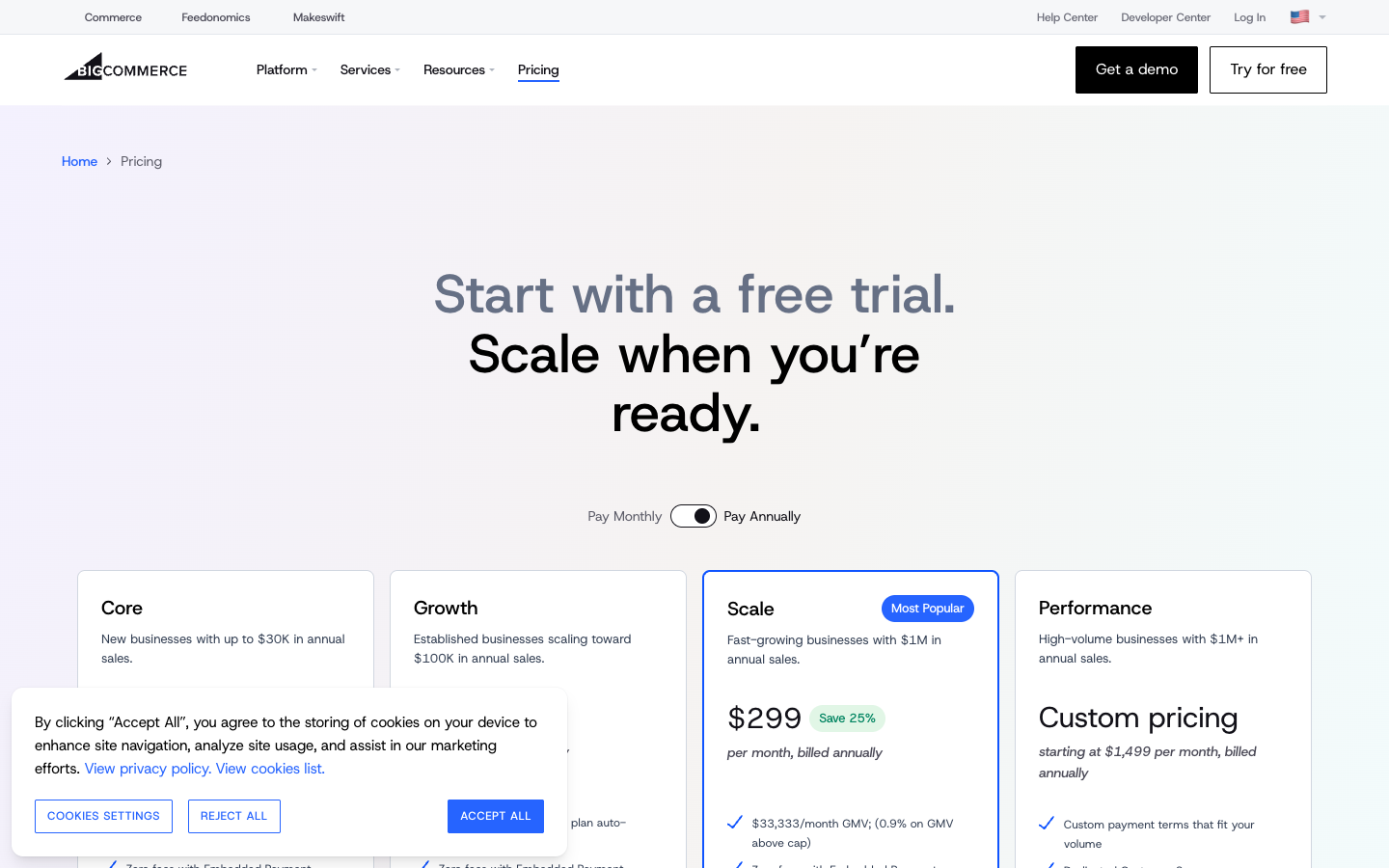
Official public webpage screenshot, captured October 26, 2026. This is not a merchant account or a checkout test.
🔐 Security, Reliability & Staff Permissions
A hosted platform reduces exposure to some server-maintenance tasks, but business security does not become automatic. Staff accounts, payment gateway credentials, tax integrations, domain access and support privileges still require controls. Create role definitions for merchandising editors, warehouse staff, support representatives, accountants and technical administrators. Ask who can create refunds, change bank details, export customer records or add a new payment integration. A broad shared administrator account is operationally convenient but hard to audit.
Access to a customer's personal information also depends on legal context. BigCommerce and its app partners can provide technical controls, but the merchant must determine retention periods, processing agreements, privacy notice obligations and consent requirements for analytics and marketing. An ecommerce platform should not be described as making a store 'fully GDPR compliant' merely because it offers settings or a security page. International businesses should have their legal advisers evaluate the complete data flow and any cross-border processors.
In an evaluation environment, attempt a staff offboarding exercise: remove an employee's access, rotate a test integration credential and inspect whether abandoned sessions can still make privileged changes. Review authentication options and logs available on the plan under consideration. The exercise establishes whether your own operating policy can be implemented, not just whether the vendor has a security certification. For high-volume stores, include incident contacts and communication procedures in the procurement agreement.
Reliability deserves the same precision. Public uptime claims are not a substitute for testing your chosen theme, payment processor and order webhook behavior together. A platform may remain online while a stock integration silently fails. Build monitoring around failed payment callbacks, unsent fulfillment updates, inventory mismatches and order export queues. Determine who receives alerts during a weekend campaign and what action can be taken without waiting for a developer.
🔄 Migrating to or Leaving BigCommerce
A migration begins with a list of dependencies: catalog fields, product assets, customer accounts, historical orders, loyalty data, reviews, discount rules, subscriptions, shipping calculations, tax records, URLs and redirect mappings. Some fields can be exported neatly, while others live in third-party services or platform-specific structures. The discovery phase should establish which system currently owns each dataset. If a warehouse tool controls stock and the ecommerce platform only displays it, move that relationship explicitly rather than copying stale stock numbers during launch. A BigCommerce store migration checklist should capture redirects, product options, subscriptions, taxes and payment ownership.
Preserve the search and analytics baseline. Export the top organic landing pages and the existing sitemap, map canonical redirects, identify indexed category pages and document how revenue attribution is measured. During the transition, avoid changing unrelated branding, content structure and analytics identifiers at the same time. Too many simultaneous changes make it difficult to identify whether a traffic drop came from SEO redirects, a checkout issue or a campaign tracking error.
Rehearse the cutover in stages. Import a representative catalog, configure payment and tax settings, route test orders to a nonproduction workflow, verify support visibility and confirm that the previous store remains recoverable. The reversal plan is especially important for stores with open orders: do not assume that switching DNS back also reverses data already written to the new system. Decide how you will reconcile orders captured between the last export and the launch checkpoint.
Leaving a hosted platform should be considered during procurement, not only after the relationship fails. Document which data is exportable, which app integrations must be rebuilt and who controls the domain. The practical question is whether you can produce a complete and lawful customer handoff without relying indefinitely on your previous subscription. Budget for the exit test even when the chosen vendor looks like a long-term fit.
⚖️ BigCommerce Alternatives & Trade-Offs
Shopify is the obvious hosted-platform comparison for many merchants. Both provide a managed commerce environment, themes and an ecosystem of apps or integrations. The difference is not simply whether one is 'more powerful': the merchant must model two sets of plan thresholds, payment-provider fees, checkout capabilities, POS requirements and support arrangements using the same product catalog. Shopify's own third-party payment terms and app costs require a separate review. A fair comparison should apply one identical sample month of orders to both pricing structures. A BigCommerce vs Shopify comparison requires a matching order sample, including payment routing and volume-related charges.
WooCommerce offers a different bargain. Its WordPress plugin is free and open source, with infrastructure, extensions and maintenance purchased or administered separately. Merchants with a skilled WordPress team may value control over server configuration, URLs and custom business logic. Others may underestimate the time required for backups, staging, plugin compatibility and performance. Do not compare a hosted plan against WooCommerce's $0 core price while omitting hosting and developer work.
▸ Comparing the same basket across platforms
Prepare a thirty-product sample with variations, two shipping regions, a returned item, one restricted destination and representative taxes. Configure the basket in competing trial environments. Then record setup time, subscription commitments, gateway fees, stock handoffs and the work required to maintain the integration. The exercise gives stakeholders a shared definition of 'easier' and exposes hidden assumptions that general comparison articles usually miss.
🧪 How to Evaluate BigCommerce in 30 Days
During days one through five, document the current state: order volume, contribution margin, payment-provider mix, inventory systems, number of storefronts, support roles and the top twenty revenue-generating landing pages. Collect actual invoice and settlement data instead of estimates when possible. Ask the vendor to confirm which 2026 pricing rules apply to the legal entity and billing country. The expected result is a signed-off requirements list, not a selection based on who gave the best sales presentation.
In the second week, build the difficult portion of your catalog in a trial environment. Test product variants, dimensions, shipping restrictions, promotion overlap and inventory import/export. Have someone who does not normally administer ecommerce attempt routine tasks such as correcting a price and processing a return. Record tasks that require outside assistance. Where documentation appears ambiguous, ask for an official product reference rather than accepting a verbal assumption.
In the third week, connect a controlled version of your preferred payment and fulfillment workflow. Categorize every test order by processing provider and simulate partial refunds, cancellations, multiple parcels and failed order notifications. The platform fee must be calculated independently from the payment processor charge. Inspect the logs and admin reports available to staff. Stop if the environment cannot demonstrate a reliable order-to-settlement trace.
During the fourth week, run an export and recovery rehearsal. Produce a product export, verify customer data rules, test redirect mapping, confirm data access for departing staff and create a cost projection for three sales scenarios. Include any extra storefront fees and contract support terms. The final decision should show what the store can do, what work remains outside BigCommerce and why the expected operational benefit justifies the full cost.
✅ BigCommerce Pros & Cons
BigCommerce can reduce the burden of managing a custom ecommerce server and provide a cohesive environment for complex catalog and multi-channel operations. Its published pricing and provider documentation offer useful starting points for diligence. The company may especially appreciate a platform where separate teams can coordinate product merchandising and order workflows without assembling an entirely new commerce engine. For some merchants, API and multi-storefront options can also lower the effort involved in scaling into additional brands.
The drawbacks are economic and operational, not merely aesthetic. New 2026 GMV definitions, automatic plan movements and Open Payment Provider charges mean the subscription cannot be evaluated in isolation. Multi-storefront additions, specialist apps and integration maintenance can introduce extra costs, while a hosted architecture places boundaries around deep customization. Merchants with simpler needs may prefer a platform with fewer moving parts, and organizations dependent on unusual gateways should validate fees early.
🏆 Final Verdict: Is BigCommerce Worth It in 2026?
BigCommerce is a credible candidate for a growing online retailer that wants hosted operations, multiple channels and a serious commerce integration layer. It is not a universal recommendation for the smallest store, nor should its suitability be judged from outdated Standard, Plus and Pro pricing. Build an Inclusive GMV forecast, then map every payment gateway that will process orders. Without those two inputs, the cost comparison is incomplete.
For the illustrative home-goods retailer, I would put BigCommerce on a shortlist alongside Shopify and at least one alternative aligned with the existing website architecture. I would not sign off until the catalog, returns workflow, payment-provider classification, fee projection and export rehearsal produce an acceptable result. That is a more useful definition of 'worth it' than a numerical rating built from an untested demonstration.
💰 BigCommerce Pricing & Plan Comparison (October 2026)
The following figures are vendor-published reference prices, not a quote for your location. Taxes, currency, feature tiers, gateway charges, annual-term obligations and negotiated contracts can affect a merchant’s checkout cost. Follow the official pricing source to confirm the amount you will actually pay.
| 2026 tier | Monthly USD | Annual effective USD/month | Published rule |
|---|---|---|---|
| Core | $39 | $29 | $30K trailing-12-month Inclusive GMV threshold; 2.0% open provider fee |
| Growth | $105 | $79 | $100K trailing-12-month Inclusive GMV; 1.0% open provider fee |
| Scale | $399 | $299 | $33,333 monthly Inclusive GMV before 0.9% overage; 0.6% open provider fee |
| Performance | Custom | From $1,499/month billed annually | Contracted pricing and GMV rules; see vendor terms |
🧭 Buyer Checklist: Questions Before Subscribing
Before committing, verify how the selected plan handles the whole order journey, including failures and refunds.
- Test a purchase and refund.
- Validate shipping, taxes and permissions.
- Reconcile all recurring costs.
- Plan exports and rollback.
⚖️ BigCommerce vs. Competing Store Platforms
| Platform | Operating model | Typical cost drivers | Buyer fit |
|---|---|---|---|
| BigCommerce | Hosted, API-focused, multi-channel commerce | Plan + Inclusive GMV + payment-provider classification | Useful when payment routes are documented |
| Shopify | Managed store, app and POS ecosystem | Plan + apps + gateway + optional POS | Useful for broad DTC use cases |
| WooCommerce | Open WordPress commerce and extensions | Hosting + maintenance + specialist support | Useful for customizable self-hosting |
| Ecwid | Store embed and lightweight start | Plan + product cap + payment fees | Useful for incremental commerce |
This is a qualitative operating-model comparison, not a performance benchmark or a substitute for a quote from each vendor.
🔎 Sources, Fact-Checking & Research Boundaries
Vendor pages reviewed on October 26, 2026. A public website screenshot shows the information available to visitors; it cannot establish the behavior of an authenticated production store or performance of a test purchase. We recommend a controlled pilot before procurement.
bigcommerce.com — plan pricing updates 2026
bigcommerce.com — embedded payment providers
Frequently Asked Questions
What replaced BigCommerce Standard and Plus plans in 2026?
The 2026 self-service lineup is Core, Growth and Scale, with Performance for larger contracted businesses. Using old Standard, Plus and Pro descriptions would omit important new GMV and payment-provider fee rules.
What does BigCommerce Core cost?
The US reference is $39 per month monthly or $29 per month effective with annual billing. Core uses a published trailing-twelve-month Inclusive GMV threshold and can apply a 2% Open Payment Provider fee.
How is BigCommerce Inclusive GMV calculated?
The vendor describes Inclusive GMV as gross order value after a 10% reduction for relevant account thresholds and fee calculations. That number is not identical to accounting revenue or settled payment proceeds.
What is the BigCommerce Open Payment Provider fee?
Eligible orders through providers classified as Open can trigger an additional platform fee: 2% on Core, 1% on Growth and 0.6% on Scale under the published 2026 rules. Processing charges remain separate.
Are orders using Stripe subject to that extra fee?
Stripe appears on the current Embedded Payment Provider list, so transactions processed through that integration are not subject to the Open Provider fee under the published policy. Verify actual provider classification and future changes.
Can BigCommerce upgrade my plan based on sales?
The 2026 policy includes auto-upgrades linked to trailing GMV thresholds and overage arrangements on Scale. Inspect current contract and dashboard measurements before forecasting the full-year bill.
Does BigCommerce support multiple storefronts?
Multi-storefront options are available, often with extra storefront charges and plan limits. Account for each brand, locale, inventory pool and distinct checkout instead of assuming unlimited storefronts are bundled.
Is BigCommerce suitable for B2B?
It can serve B2B workflows with the right plan and integrations, but buyer-specific pricing, purchasing terms and approval paths must be checked against vendor documentation and contract.
How does BigCommerce compare with Shopify?
Both provide hosted commerce with substantial ecosystems. BigCommerce pricing is sensitive to GMV thresholds and payment-provider categories, while Shopify has its own plan, gateway and app economics. Compare the same merchant order sample.
Can I leave BigCommerce and take my data?
Catalog and other data exports are possible, but promotions, customer accounts, redirects, subscriptions and multi-storefront configurations may need migration work. Map data ownership and exit support before launch.
How can I prevent surprises in BigCommerce fees?
Model twelve months of sales using vendor Inclusive GMV definitions; identify every gateway processing orders; estimate platform fees separately from processing. Run the model under a high-growth and conservative case.
Browse our E-commerce & Online Selling category for related guidance on storefront setup, payment methods and store operations.
EXPLORE NEXT ON DIGIOFFLY
Explore Your Online Selling Stack
Use related DigiOffly categories and tools to plan a storefront, payments and business operations. Product-specific e-commerce reviews have not been published here yet.
▸ Plan the storefront
- Hosting & Websites — Plan infrastructure, domains and performance.
- Software Directory — Browse currently published software information.
- Growth software — Explore acquisition, email and conversion workflows.
- E-commerce & Online Selling — Explore eight storefront and digital-selling platforms.
- Gorgias review — Evaluate customer-service tools for online orders.
- Klaviyo — Ecommerce email and order-triggered retention
▸ Price the entire operation
- Software Cost Calculator — Model subscription commitments and team costs.
- Compare Software — Test overlapping tools side by side.
- Best Value Advisor — Match documented capabilities to your requirements.
▸ Explore related software
- Finance Software — Understand accounting and payment operations.
- Automation & No-Code — Connect order handling and repetitive tasks.
- Software Deals — Check documented plans without assuming discounts.
- Shopify review — Assess hosted-store plan and integration trade-offs.
- Paddle — Merchant of Record, software checkout and SaaS billing