

Klaviyo research update, October 30, 2026: Vendor pricing and product references were consulted for this article about Klaviyo. The illustrated public pages are not evidence of private-account testing. Check the current vendor documentation for Klaviyo before making a purchase.
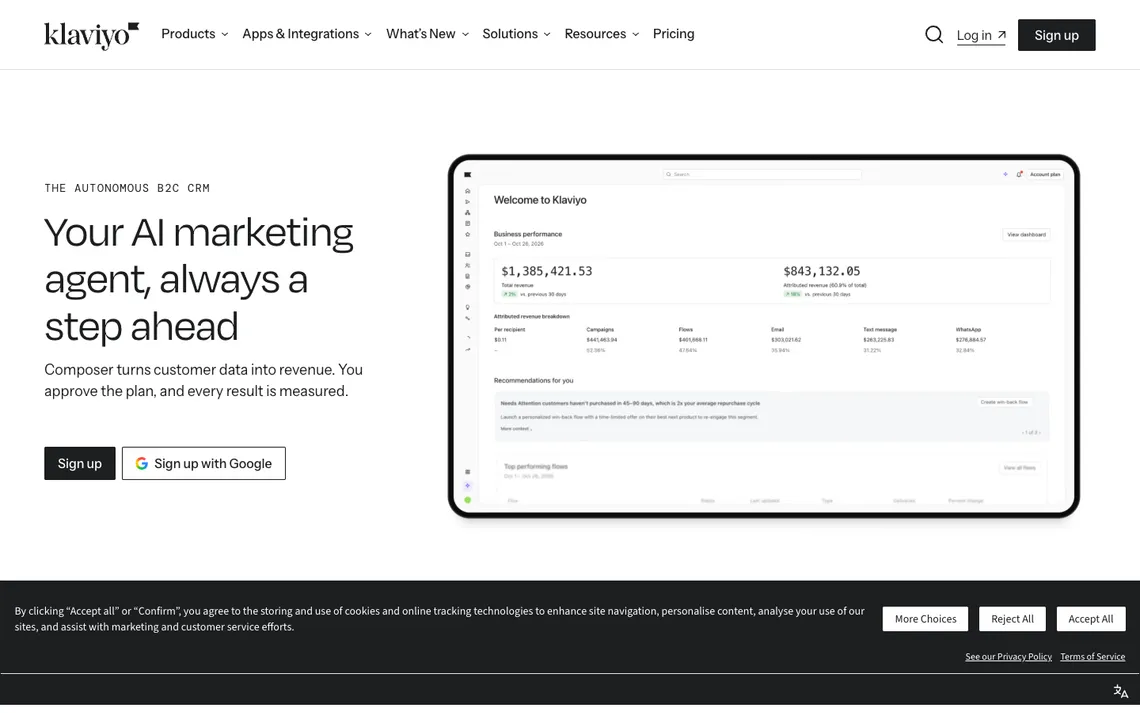
Klaviyo’s central question is whether a retailer can turn reliable customer events into relevant messages. The service is closer to an ecommerce customer-data and marketing workflow than to a simple newsletter sender. That sophistication can be valuable when checkout, product and lifecycle data are trustworthy—and costly when large active profiles and multiple channels expand the bill.
Klaviyo is built around the customer events an online store can reliably supply. A useful evaluation begins with profiles, checkout data and order updates rather than design templates. In this Klaviyo review, we examine how the Free limits, active-profile billing, email and SMS flows, and storefront integrations affect a merchant’s operating costs. The examples explain checks to perform with your own store; they are not measured revenue or campaign results.
DigiOffly may earn a commission from qualifying links about Klaviyo, at no additional cost to the reader. Confirm all current vendor terms before buying.
📊 Klaviyo Review Summary
Klaviyo is most relevant to stores with dependable order, product and checkout events. Its price is affected by active profiles and message volume. Verify the 250-profile and 500-send Free limits against real customer data, then test whether the store supplies enough events for cart recovery and retention flows.
- Best fit: Ecommerce merchants using purchase events to personalize retention campaigns and manage active-profile costs.
- Budget: Verify the applicable usage and seat tier in the detailed pricing section
- Strength: Designed around commerce events and profiles
- Trade-off: Active profile growth drives email costs
- Evidence: Pricing and product claims checked against official sources, not a private account benchmark.
⚡ Quick Verdict: Is Klaviyo Worth It?
A free Klaviyo account can demonstrate an integration, but the decisive question is whether order events reach the right profile and stop a cart reminder once a purchase is complete. Evaluate email and SMS separately, including active-profile billing and geography-dependent message usage. If the catalogue is incomplete or the consent data is unreliable, clean that data before buying a higher plan.
🧭 Contents and Navigation
🧠 What Is Klaviyo?
🛠️ Features, Workflows and Practical Limits
Active profiles rather than raw list size
Before importing ten thousand historical buyers, ask how many of them are eligible for marketing today. Klaviyo’s active-profile model makes that distinction financially significant. An old customer who has unsubscribed should not be treated in the same way as someone who just opted into a promotion. Review suppression and consent status at the source, then reconcile the number of active profiles against the tier shown at checkout.
Klaviyo billing starts to make more sense when a store separates its whole customer history from its active marketing audience. A merchant might have 25,000 lifetime orders but far fewer eligible, non-suppressed profiles. That gap matters because profile eligibility influences the email plan tier. An import should therefore carry consent and suppression states, not merely names and addresses. Before migrating, compare the count in the source platform with the expected active-profile count in Klaviyo; investigate large differences instead of paying for them without explanation. When comparing Klaviyo pricing plans, confirm how a suppressed historic record affects the current bill.
Before hitting the import button on your previous email service provider export, take time to inspect eligibility and suppression status thoroughly. Filtering out old contacts who have consistently ignored past campaigns or bounced indefinitely will protect your sending reputation and your budget simultaneously. Run a preliminary audit on your CSV files to weed out inactive addresses long before they sync into your new workspace.
Free-plan reality
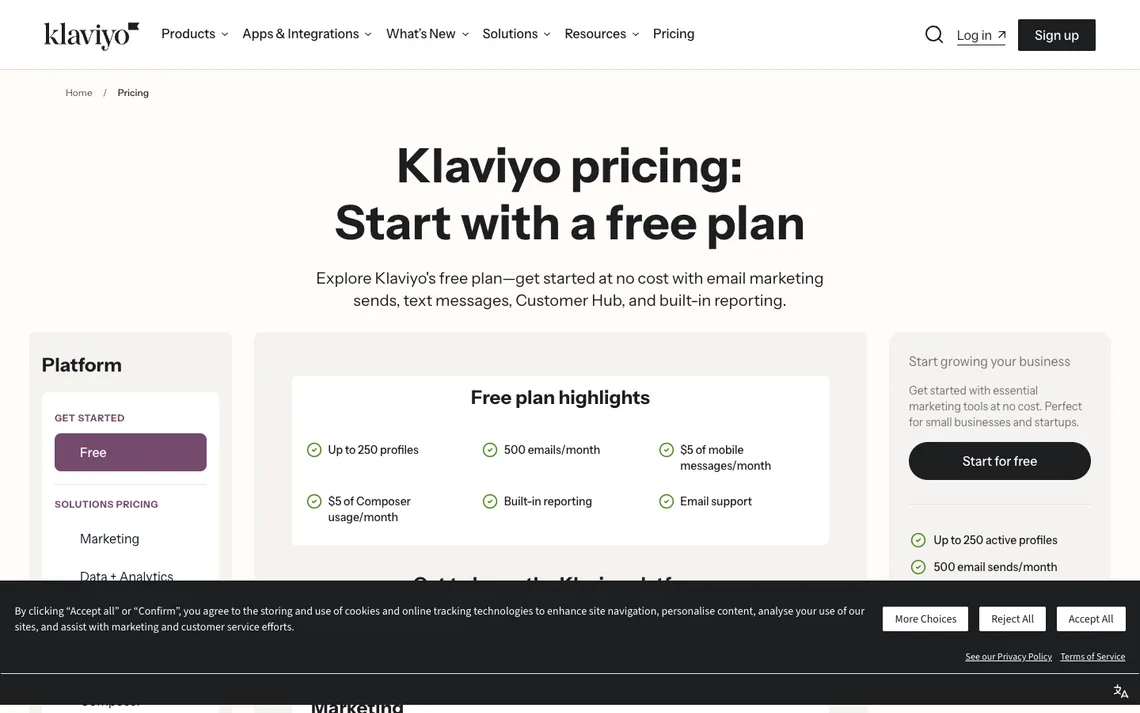
Evaluating the platform through its entry-level tier allows operators of a small store to test core features without committing to a paid subscription immediately. The vendor specifies 250 active profiles and 500 monthly email sends on this tier, creating a constrained sandbox for early experimentation. While these thresholds are modest, they offer enough breathing room to configure basic templates and understand how events flow through the system.
The advertised Klaviyo Free allowance combines two separate ceilings: 250 profiles and 500 email sends per month. A store with 200 eligible people could still exceed the email allowance if a welcome series and weekly promotions both run. Conversely, a large historical archive might exceed the profile limit before any campaign is built. Model one normal month by listing each flow, the approximate entries into it and the number of messages per entry. This makes the paid-tier conversation concrete without predicting any unobserved delivery failures. A Klaviyo Free plan is best treated as a controlled setup environment rather than evidence that a growing store will stay within the caps.
To avoid sudden delivery failures, map both your current profile count and projected monthly flow sends directly against the stated caps before launching any campaigns. Calculating your expected velocity ahead of time reveals whether your store will outgrow the entry tier during its very first week of operation. Keeping a close eye on your usage dashboard ensures you can upgrade smoothly before automated sequences start dropping messages.
Shopify and WooCommerce events
Connecting your storefront via native integrations with platforms like Shopify and WooCommerce bridges the gap between raw web traffic and actionable customer data. This deep integration brings purchase, browse, and order events directly into your flows, enabling you to trigger messages based on exact shopper actions. Instead of sending generic blasts, you can respond dynamically to what people view, add to cart, or purchase in real time.
An ecommerce integration deserves a boring reconciliation test. Create a test order with two different SKUs, pay for it and confirm that the Klaviyo profile shows the relevant order event with the expected item identifiers and totals. Then cancel or refund another test order and see which downstream events appear. If the store’s product catalogue maps an old SKU to a new item, a personalised recommendation may look plausible but be wrong. The article’s screenshots are of vendor material; no such connected test store was operated for this review. The Klaviyo Shopify integration should be evaluated using actual shop event fields rather than a static screenshot of the connector.
Verifying the setup requires you to trace a test order manually from checkout through the profile timeline to confirm every event logs correctly. Check whether the purchase event populates the right item properties, customer tags, and monetary values before letting real shoppers interact with your automations. A single end-to-end test run catches synchronization errors early and guarantees your messaging reflects actual store activity.
Abandoned checkout workflows
An abandoned checkout reminder can be helpful when a shopper genuinely leaves without buying. It becomes a problem when the customer pays a few minutes later and still receives a discount offer. Klaviyo uses checkout and order events in automated flows, so the practical test is to create both journeys in a test store. Inspect whether a purchase exits the recovery sequence and whether guest and logged-in checkouts are treated consistently.
Despite their revenue-generating potential, poor execution in these automated sequences can backfire through discount abuse and missing suppression logic. If your flow fails to suppress customers who already completed their purchase elsewhere, you risk annoying recent buyers with irrelevant reminders to finish checking out. Careful condition filtering protects your margins and maintains a polite, professional brand experience. A Klaviyo abandoned cart flow should stop when an order completes, rather than keep offering incentives to a buyer.
Cart recovery can become an accidental discount programme if a Klaviyo flow never checks whether a purchase happened. A shopper who abandons on a phone and pays on a laptop should not receive an ‘unfinished checkout’ incentive the next morning. Create that cross-device scenario in a test environment, then add one guest checkout and one logged-in checkout. Check the identity and purchase events used as filters. The acceptance criterion is that a paid order exits the recovery path, not that the flow sent a reminder successfully.
Customer segmentation
Separating high-value repeat buyers from first-time subscribers through targeted customer segmentation allows you to tailor your marketing message to specific audience tiers. Behavioral rules can reference deep order history and past engagement metrics, grouping people by lifetime value, purchase frequency, or product category preference. This granularity transforms generic newsletters into relevant recommendations that speak directly to a customer’s shopping habits.
Building these divisions requires vigilance because segments become misleading when order refunds and cancellations are accidentally excluded from the criteria. If a customer returns their entire order but remains grouped inside your VIP repeat-buyer segment due to faulty logic, your VIP messaging will miss the mark entirely. Accounting for financial adjustments keeps your audience groupings honest and actionable. The Klaviyo Shopify app may expose store events, but marketers still need to check which events their actual shop sends.
A VIP segment based on total historic spend can be misleading when refunds are omitted. For a Klaviyo proof of concept, pick five store records: first-time buyer, repeat buyer, fully refunded order, partial refund and a customer with two email addresses. Decide which should belong to the segment before building its rule. Then compare the segment’s result against the order ledger. If the definitions disagree, repair the rule or event feed. There is no benefit in writing premium-customer copy for a group that includes people who were misclassified.
Email builder and dynamic products
Personalizing merchandising content becomes significantly easier when using the built-in email builder alongside catalog-aware blocks that pull dynamic product data automatically. These tools and template editing features reduce manual composition time by populating grid layouts with real-time inventory details straight from your store database. Instead of hardcoding product images and links by hand, you can let dynamic tags handle the heavy lifting during newsletter production.
Dynamic content relies heavily on backend accuracy, meaning an empty or outdated catalog can produce broken product cards that display missing images or weird placeholder text. If a promoted item goes out of stock or changes its URL structure while an email is scheduled, your subscribers might open a message containing dead links. Ensuring data integrity prevents these embarrassing rendering errors from slipping past your editorial team. Klaviyo email flows require sensible fallback content when a product catalog lacks an image, price or variant.
Dynamic Klaviyo product blocks deserve an empty-data test. Try a product with no image, an item that has gone out of stock and an old SKU with a changed URL. A template that looks polished with the demo catalogue may expose broken image icons or inaccurate prices with the live feed. Define a fallback that makes sense without the recommended product. Review the actual email in at least one mobile and one desktop client, including accessibility text, rather than evaluating only the in-editor preview.
SMS channel economics
Integrating mobile messages for opted-in customers introduces a distinct financial layer, as Klaviyo prices SMS through a separate credit and geographic cost structure. Because mobile marketing involves per-message carrier fees alongside platform expenses, scaling text outreach requires careful audience segmentation. Marketers must weigh the immediacy of SMS against its higher delivery costs, ensuring that high-intent campaigns justify the additional overhead rather than depleting margins on low-value transactions.
Crucially, an SMS opt-in is not interchangeable with email consent, meaning brands cannot legally or effectively migrate email lists directly into text messaging queues without explicit secondary permission. Maintaining separate consent records prevents regulatory penalties and consumer friction. Retailers need to approach SMS acquisition as a dedicated channel initiative, honoring distinct subscriber journeys that respect individual privacy preferences from the initial point of capture. Treat Klaviyo SMS pricing separately from email subscriptions because message credits and destinations affect the final expense.
Adding Klaviyo SMS to an existing email flow changes both billing and consent. A phone number collected during checkout for delivery updates is not automatically permission for promotional campaigns. Store the permission source and timestamp, check how the platform distinguishes email and mobile preferences, and test opt-out handling in the relevant market. Price message credits for the countries in the actual audience. A campaign that fits the email subscription can still be uneconomic once recurring SMS costs are counted.
Predictive analytics
Predictive scores sound useful, but the input data determines whether they mean anything. Klaviyo’s forecasts draw on historical customer activity; a newly launched store or a shop with inconsistent purchase records should be cautious about using them as automatic campaign triggers. Compare predicted repeat buyers with a simple cohort based on actual order frequency. A model that cannot outperform a transparent rule may not justify additional workflow complexity.
However, predictive insights depend heavily on having sufficient historical customer records to feed the algorithmic models accurately. A prediction generated without adequate data history functions as an unreliable marketing rule, potentially leading to misdirected segmentation. Brands operating with sparse transaction histories or newly imported profiles should exercise caution before automating critical flows based solely on immature machine learning projections. A Klaviyo sunset flow can reduce repeated messaging to chronically inactive recipients; keep those rules separate from predictive-value calculations.
Klaviyo predictive metrics should be compared with an uncomplicated rule before they drive expensive campaigns. For a store with twelve months of order data, a repeat-purchase indicator built from past purchases may already be useful. Record its accuracy on a held-out group and compare it with the platform’s available prediction. If several months of orders are missing, neither figure deserves a confident conclusion. The same caution applies to lifetime-value forecasts: they are estimates conditioned on the quality of the underlying events.
| Operational checkpoint | Evidence to request | What could go wrong |
|---|---|---|
| Input | predictive insights depend on sufficient historical customer records | Unreliable or incomplete inputs |
| Control | compare recommendations to simple cohort baselines | No tested exception process |
| Owner | Named account or project administrator | No one can repair an unexpected change |
| Outcome | Repeatable result and documented limits | a prediction without history is an unreliable marketing rule |
Deliverability and suppression
Protecting sender reputation during aggressive campaigns requires rigorous attention to domain authentication, bounce handling, and ongoing subscriber engagement metrics. As high-volume promotional periods scale up, internet service providers closely scrutinize outgoing traffic patterns for signs of list fatigue or improper configuration. Maintaining strict infrastructure standards ensures that commercial messages consistently reach primary inboxes rather than getting trapped in spam filters.
A common pitfall during rapid scaling is that click growth can sometimes hide a dangerous rise in complaints or blocked recipients. While aggregate engagement numbers may look healthy on the surface, underlying spikes in spam reports can quietly degrade sender standing across major mailbox providers. Marketers must look past top-line click metrics to evaluate the true health of their recipient base and identify early warning signs of disengagement. Evaluate Klaviyo email marketing for Shopify using consented audience behavior, reliable product data and downstream purchases rather than email open rates alone.
A rising click rate does not settle whether Klaviyo mail is healthy. Segment the bounce, complaint and unsubscribe counts by acquisition source, especially after a giveaway or affiliate promotion brings in unfamiliar addresses. A large campaign can appear successful because a handful of active customers click repeatedly while many others stop engaging. Monitor domain authentication and suppression behaviour alongside actual purchases. Decisions about list cleaning should account for consent and business relevance, not simply a universal inactivity threshold.
Revenue attribution
Revenue attribution gives Klaviyo an advantage over a newsletter report that only counts opens, but the attributed number is not the same as incremental revenue. A repeat customer could have bought after several other interactions. Check the configured attribution window, refunds and the order value recorded in the commerce platform. Where possible, compare comparable audience groups before treating the report as proof that one email caused a sale.
Commerce conversion attribution relies heavily on configured windows that define the exact timeframe a customer has to purchase after interacting with a message. Properly setting these parameters dictates how credit is assigned across touchpoints, bridging the gap between initial browsing behavior and final checkout confirmation. Because attribution models can sometimes credit sales that would have happened organically anyway, operators must document their chosen windows carefully and utilize holdout test cohorts to measure true incremental lift. Klaviyo transactional emails have different service and consent expectations than promotional retention campaigns.
An attributed-revenue chart and a genuine uplift experiment answer different questions. Klaviyo can associate orders with a marketing interaction under its configured reporting window, but that does not show what the same customers would have bought without the message. A merchant with sufficient audience size can consider a comparable holdout group; a smaller store can at least report revenue and order count separately from attribution. Keep returns and shipping charges consistent across the store ledger and the marketing report.
Multi-brand stores
Managing multi-brand stores demands a deliberate data structure to cleanly separate distinct regional storefronts and disparate product catalogs without cross-contaminating user data. Establishing distinct organizational boundaries prevents inventory mix-ups and ensures localized messaging reaches the correct target demographic. Retailers operating across borders must architect their database schema thoughtfully to maintain clean boundaries between diverse operational entities while supporting centralized oversight.
Consolidating customer identities under a single unified profile can inadvertently obscure crucial legal permissions and consent statuses gathered across different jurisdictions. Because regional privacy regulations vary significantly, a shared database record might falsely assume global opt-in consent where strict local compliance is mandated. Operators must audit country-specific customer profiles and sending requirements continuously to prevent severe regulatory infractions and protect brand reputation.
Ensuring compliance across diverse international markets requires rigorous auditing of local data protection laws and explicit subscriber opt-in records. Automated synchronization tools must honor regional unsubscribe preferences instantly, safeguarding subscriber trust and adhering strictly to legal mandates. Implementing robust permission frameworks guarantees that cross-border expansion remains legally sound and respectful of individual consumer privacy rights.
Platform migration
Transitioning from generic email broadcasting to commerce-specific targeting unlocks advanced lifecycle automation driven by actual buyer behavior rather than basic broadcast schedules. Shifting platforms demands a strategic overhaul of existing customer segmentation to leverage deep purchase histories, browsing patterns, and cart abandonment triggers effectively. This transition turns routine newsletters into dynamic, revenue-generating touchpoints that respond intelligently to individual shopper actions in real time.
Migrating historical data involves distinct mapping steps for subscriber lists, design templates, and event tracking that go far beyond a simple contact upload. Relying solely on a quick CSV import omits the crucial behavioral event history that sophisticated automated workflows require to function properly. Consequently, technical teams must map custom metadata structures meticulously to preserve purchase trajectories and maintain seamless lifecycle messaging continuity during the transition phase.
De-risking the platform migration process involves piloting a single storefront journey before committing to a full-scale transfer of all historical data and automated flows. Testing a localized customer segment validates event tracking accuracy and ensures template rendering functions correctly under live conditions. A controlled rollout minimizes operational downtime and provides valuable feedback to refine remaining automation rules prior to complete enterprise-wide deployment.
💰 Klaviyo Pricing, Plans and Real Cost
Klaviyo currently describes a free email plan covering up to 250 active profiles and 500 email sends monthly. Paid Email and Email + SMS plans depend on active profiles, sends and messaging components; extra services can be priced independently. The vendor’s pricing calculator should be checked with the store’s real active-profile count.
Klaviyo has two distinct planning dimensions: the number of active marketing profiles and the messages generated by campaigns and event-triggered flows. A store with many past buyers should establish how profiles are suppressed, when a profile becomes active and whether its monthly email volume matches the intended program. Before adding SMS, model geographic message costs separately from email billing. For an accurate budget, examine both a quiet month and a busy seasonal promotion; abandoned checkout, welcome messages and retention campaigns can all affect actual consumption even if the headline subscriber count stays stable.
| Decision item | Current evidence | Procurement check |
|---|---|---|
| Official pricing basis | Current official plan documentation linked in this review | Verify selected tier, country, billing and seat count |
| Free plan or trial | Refer to the vendor source; eligibility and quotas differ | Confirm sender, recipient, profile, crawl or credit limits |
| Operational add-ons | Some functions, usage or seats may be charged separately | List every required function before checkout |
| Migration and support | Data export, support and permissions vary | Test a sample import and rollback |
⚖️ Klaviyo vs Alternatives
| Product | Primary comparison angle | Important question |
|---|---|---|
| Klaviyo | Ecommerce merchants using purchase events to personalize retention campaigns and manage active-profile costs. | inspect eligibility and suppression status before migration |
| Omnisend | Alternative scope and integration fit | Can Omnisend use the required checkout and order events with comparable message pricing? |
| Brevo | Alternative scope and integration fit | Would Brevo be simpler if the store mainly sends newsletters and transactional mail? |
| ActiveCampaign | Alternative scope and integration fit | Does ActiveCampaign offer enough ecommerce event context for the intended automation? |
✅ Pros, Cons and Who Should Choose It
- Advantage: Designed around commerce events and profiles
- Advantage: Flows for retention and cart recovery
- Advantage: Email and mobile messaging in one customer view
- Limitation: Active profile growth drives email costs
- Limitation: SMS cost depends on destination and message type
- Limitation: Event quality controls campaign relevance
For a small ecommerce pilot, connect one test storefront and follow two purchase journeys into Klaviyo: an abandoned checkout and a successful order. The important question is whether the order event stops the recovery sequence, not whether a flow looks polished in the builder. Inspect the active-profile count, suppressed contacts and monthly email sends before importing the store’s entire history. If SMS is planned, check consent records and country-level message costs separately. A higher tier becomes reasonable only when its profile, send or channel allowances match the verified retention workflow.
🧪 Evaluation Method and Evidence Boundaries
Klaviyo’s published free-profile and send allowances, Shopify integration documentation and product materials underpin the comparisons here. The screenshots show a public presentation of ecommerce marketing, not access to a customer’s storefront. Predictions about customer lifetime value, recovered carts and revenue attribution have not been experimentally verified by this research. Merchants should validate those claims with their own order events and consent records before buying.
A useful Klaviyo proof of concept begins with a test checkout in a connected store, including an abandoned attempt and a completed purchase. Confirm that each event reaches the appropriate customer profile and that the abandoned-cart flow stops after a legitimate order. Repeat with an unsubscribed address and an unavailable product. Only the actual store and messaging logs can establish whether the automation works.
🏆 Final Verdict
Klaviyo fits merchants who can maintain reliable purchase events and want to coordinate customer segmentation with email or SMS campaigns. Its billing depends on active profiles and relevant message usage, so an uncontrolled import can materially change expected cost. A store with weak event data should repair the integration before paying for sophisticated automated recommendations; simpler email software may otherwise deliver comparable value.

Frequently Asked Questions
What is Klaviyo best suited for?
Ecommerce merchants using purchase events to personalize retention campaigns and manage active-profile costs.
Does Klaviyo offer a free plan?
Klaviyo Free covers up to 250 active profiles and 500 monthly email sends. More contacts, messages or channels may require a paid plan.
How does Klaviyo pricing work in 2026?
Budget the specific activity described under deliverability and suppression, including relevant seats, usage and add-ons. See the pricing section for the plan structure checked for this review; verify current checkout currency, allowances and renewal terms with the provider.
Can small teams use Klaviyo?
Yes, for a focused first project. Start by checking whether your team can understand the difference between billed contacts and suppressed records, then confirm that the chosen plan covers the actions, permissions and expected volume.
Which Klaviyo features should I check first?
Prioritize free-plan reality, abandoned checkout workflows and email builder and dynamic products. Test whether the features operate as expected together rather than reading a feature grid as a promise of results.
What is the biggest limitation of Klaviyo?
The practical risk is that discount abuse and missing suppression can erode margins. A second concern is that attribution can count sales that would have happened anyway. Those are reasons for explicit safeguards, not proof the product always fails.
How should I migrate data into Klaviyo?
Begin with a small, reversible sample. Preserve identifiers, consent or access records, and a rollback path. As a practical check, pilot one storefront journey before migrating every automation. Keep the original workflow available until the new system handles both normal and exceptional cases.
What should I compare against Klaviyo?
Compare Omnisend, Brevo, ActiveCampaign for the same specific job. Price, product scope, deployment effort and data ownership matter more than a broad generic feature count.
Is Klaviyo suitable for agencies?
It depends on whether separate client accounts, permission boundaries, exports and billing match the agency model. An agency should prototype a representative client instead of assuming that a single-workspace trial covers multi-client work.
How can I evaluate Klaviyo without a misleading test?
Choose one workflow, document its starting state and verify the expected output. For example, watch complaint and bounce metrics by acquisition source. Record what you can independently confirm and what is a vendor-documented claim.
Where can I verify the latest Klaviyo limits?
Use the official pricing page and vendor documentation. Screenshots in this review are dated and may not match a later checkout.
Primary sources: Official pricing · Product / plan documentation. Screenshots in this review are dated October 30, 2026.
EXPLORE NEXT ON DIGIOFFLY
🔍 Explore More on DigiOffly
Continue exploring published Growth software reviews and choose complementary tools for your workflow.
Explore categories
- Growth & Marketing — Browse email, SEO, outreach and retention tools
- Software Directory — Find related published software reviews
- Software Stacks — Choose a minimal set of complementary tools
- Brevo — Email sends, contacts and marketing automation
- ActiveCampaign — Lifecycle email workflows and CRM-connected automation
- beehiiv — Newsletter publishing, growth and subscriptions
Compare your shortlist
- Compare Software — Compare documented features and plan differences
- AI Software Finder — Build a task-specific shortlist
- Cost Calculator — Separate per-seat and usage-based costs