

Pricing and specifications checked 2026-11-21 against vendor primary sources. Conditions, billing cycles and regions may change.
When a lending protocol’s dollar TVL rises by 20%, deposits may not have increased at all. Its collateral may simply have appreciated. DefiLlama gives researchers separate measurements for those questions: protocol deposits, net asset flows, exchange volume, stablecoin supply and more. The distinction matters when comparing lending markets or writing a weekly network report.
This DefiLlama review compares Open, Pro and developer API access against those research tasks. Our evidence consists of the public metric definitions, documented prices and adapter descriptions. The live dashboard returned an access challenge during our automated capture. No paid account or transaction benchmark forms part of the evaluation.
DigiOffly currently uses direct non-affiliate product links. Vendor claims are distinguished from independently observed tests. No investment or trading advice is provided.
📊 DefiLlama Review Summary
The strongest reason to start here is the ability to inspect how protocol measurements are constructed. Open covers the initial research question; Pro targets recurring spreadsheet work and custom views; the API subscription targets automated collection. Subscription access does not remove the need to reconcile timestamps, asset prices or accounting definitions.
⚡ Quick Verdict: Is DefiLlama Worth It?
Start with the open plan. It is difficult to justify a subscription merely because a dashboard has a large number of charts. Upgrade only after identifying an actual recurring bottleneck, such as manually reconstructing a report every Monday or needing an endpoint that the free API does not provide. The platform's data definitions are a compelling reason to evaluate it, but an impressive protocol ranking does not establish that a contract is secure or that a token is attractively valued.
🏆 VERIFIED PRODUCT OVERVIEW — DefiLlama
Open DeFi market data, protocol comparisons and optional research subscriptions.
Best for: DeFi researchers, analysts and developers
🧠 What Is DefiLlama?
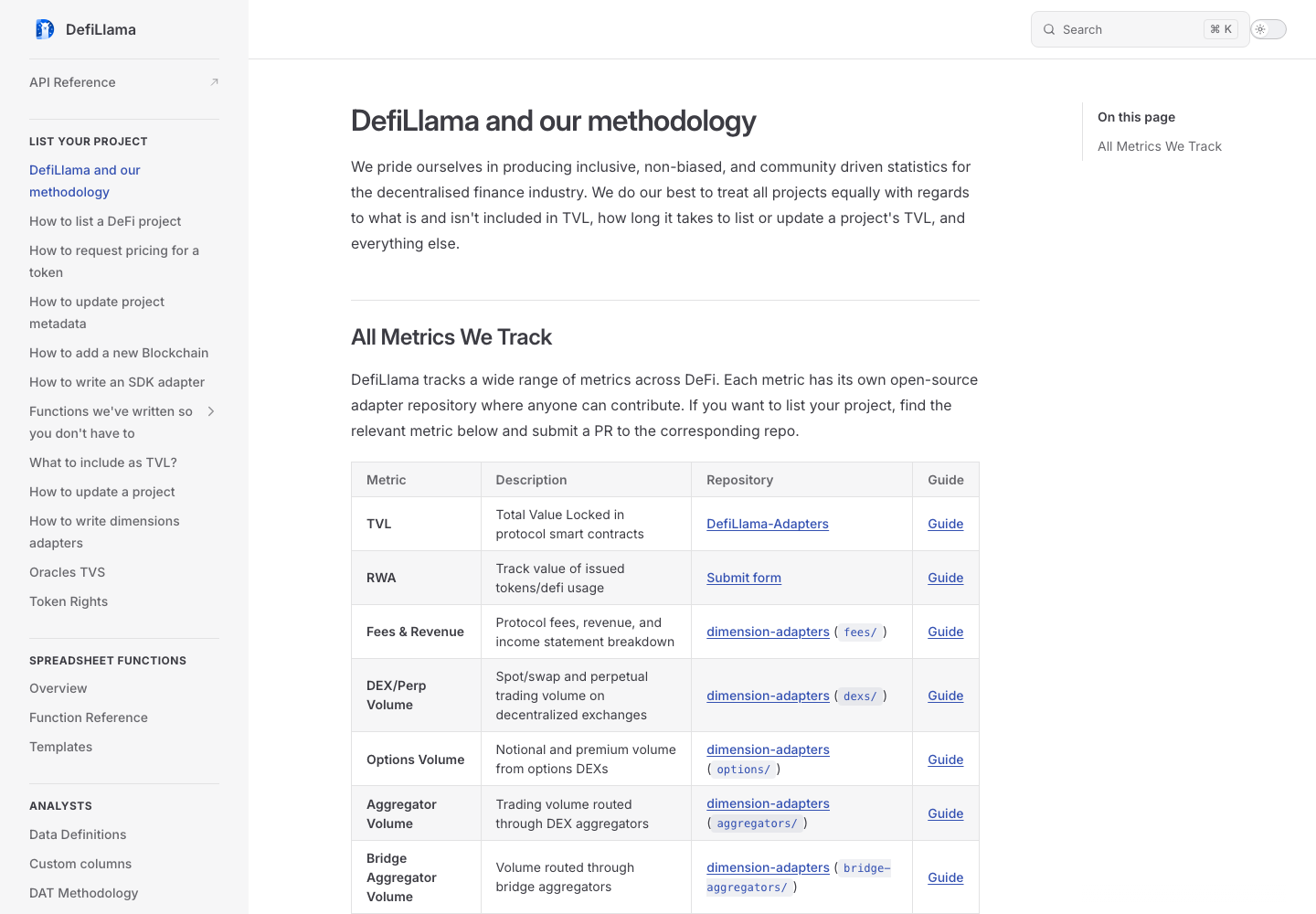
The name DefiLlama (also searched as DeFi Llama) refers to a research platform for decentralized finance and related blockchain data. Its methodology is built around adapters that gather information about protocols and chains. Public code and definitions make it possible to examine the assumptions behind many metrics. This is a different proposition from a market-price website that concentrates primarily on token quotes.
Suppose a lending protocol reports deposits increasing from $100 million to $120 million. The first question is not whether it has become a better investment; it is whether twenty million dollars of new assets arrived, whether the price of the existing assets increased, or whether both happened. DefiLlama provides a framework for separating these observations. For a journalist, the distinction can prevent a misleading growth headline. For an analyst, it can change the questions asked of the protocol's financial data.
The service also covers multiple categories of activity beyond deposits. Some represent point-in-time quantities, while others represent accumulated transactions over an interval. This is why combining two attractive charts into a single percentage without checking their time bases is a poor research technique. The relevant definitions should travel with the numbers in any report.
🖥️ Ease of Use & The User Interface
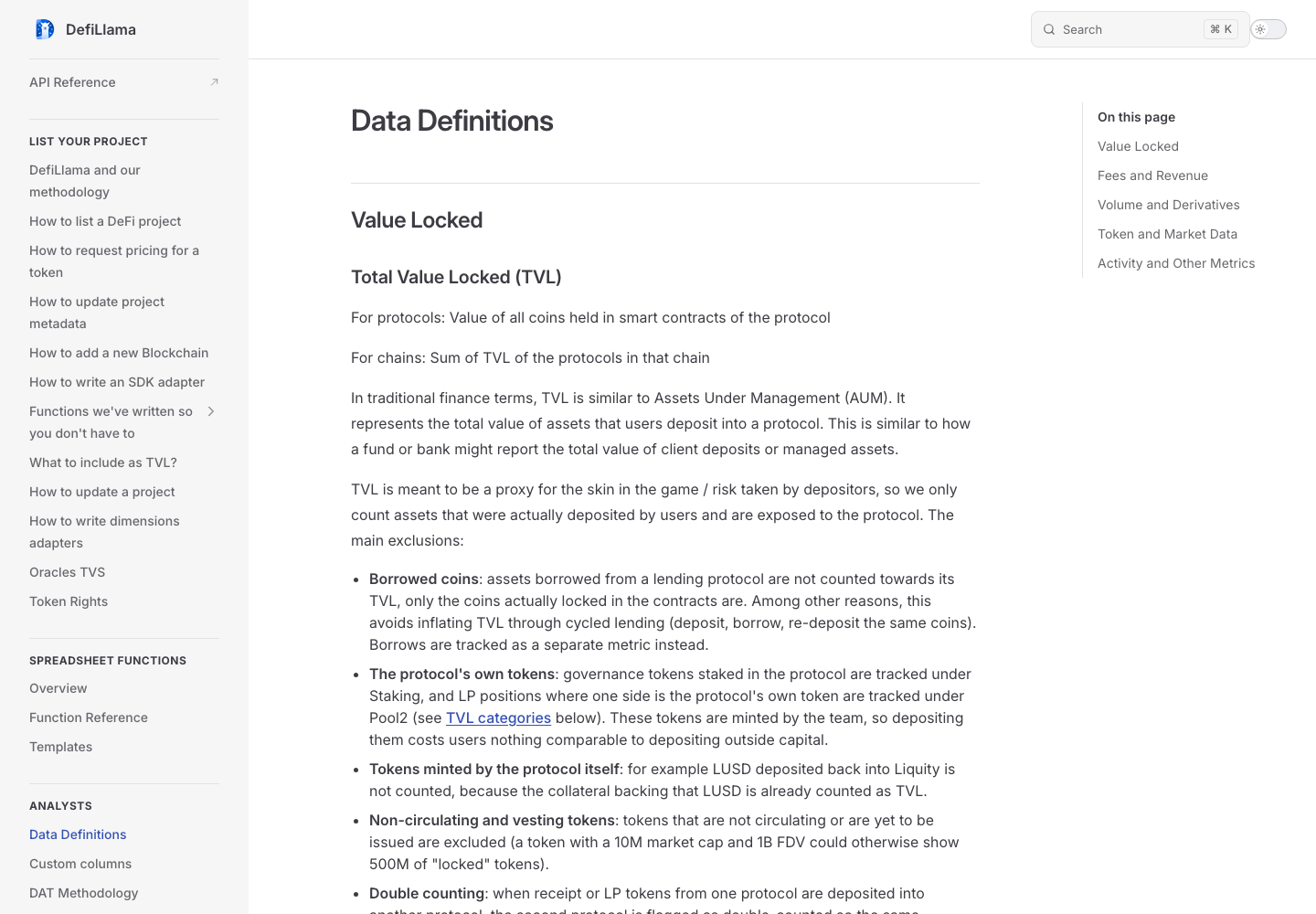
We could inspect the public DefiLlama documentation, including its navigation, metric definitions and subscription explanation. The actual analytics dashboard was inaccessible to our automated capture environment, so we cannot responsibly score its responsiveness or describe an authenticated workspace as if we had used one. The images here show the documentation pages we actually accessed.
A reasonable evaluation of the DefiLlama app starts with a single research question. An analyst who wants to compare lending protocols should concentrate on a common group of metrics before opening additional sections. A second question can then be added, such as whether growth is accompanied by fees. It is generally faster to work with a small, consistent observation set than to maintain a huge dashboard whose indicators have no established use.
🧭 How to Use DefiLlama for Beginners
The following workflow is a proposed research process based on documented features, not a claim that we completed authenticated tasks.
1. Establish a measurable question
Write down what you expect to learn from DefiLlama before collecting any figures. For example, a question about lending activity has a different evidence requirement from a question about trading turnover. Specify the protocol category, the networks under consideration and the observation period. Keep the question descriptive rather than predictive: the software can help examine measured activity, not determine the future price of an investment.
2. Read the metric definitions
Open the vendor's definition of total value locked before using the DefiLlama TVL number. Note which assets the definition excludes and whether optional categories are included. If two sources have different numbers, a scope disagreement may explain the difference without either source being wrong. Record that scope beside the value, rather than in a separate notebook that will be forgotten when the chart is reused.
For a quick check, compare the reference definition with the specific adapter where available. A discrepancy may identify a change in implementation, a delayed listing or a misunderstanding of which metric was selected.
3. Compare the same dates across protocols
Choose a fixed time window and a consistent snapshot time. For a weekly review, one date at each end of the interval is a starting point, but daily observations can reveal temporary spikes that the endpoints hide. DefiLlama documents different update schedules for snapshot balances and flow metrics, so record the most recent usable timestamp rather than assuming that every dataset is perfectly synchronized.
Do not replace missing values with zeros automatically. Missing can indicate an unsupported metric, an interrupted data source or an observation that has not yet been collected. A true zero is itself a finding.
4. Cross-check surprising results
When something looks unusually large, locate the protocol's own public explanation and the relevant adapter. A second data provider with a compatible definition can help, but agreement between two services using the same underlying input does not establish independent verification. Review whether price changes, reclassifications or new deployments explain the difference.
5. Determine whether paid access solves a real need
Use the official plan information to distinguish ordinary browsing from paid exports, custom dashboards and API access. If your task consists of occasional research, DefiLlama may already be sufficient without a subscription. If it involves frequent data collection, first estimate the time you spend on that task and whether a machine-readable export would reduce it. A trial can help assess the interface, but the official terms exclude CSV export during that trial. Do not interpret a feature you could not test as independently confirmed performance.
🛠️ Key Features That Actually Matter
Six practical questions help distinguish deposited capital, trading activity, reported income, and the cost of retrieving those measurements.
Total value locked and capital flows
TVL describes the value of assets exposed to protocol contracts under the vendor's measurement rules. A chart of DefiLlama TVL can therefore help describe the size of a protocol, but it is not a deposit receipt or a solvency statement. The value can change when asset prices change, even with no new deposits. The separate inflow metric attempts to isolate changes in balances from price movements.
Consider a hypothetical protocol holding 1,000 units of one asset valued at $100 each. If the asset falls to $80 and balances do not change, dollar TVL falls from $100,000 to $80,000 even though nobody withdrew money. That is a twenty percent difference in the valuation, not a twenty percent withdrawal. A research summary that attributes the entire change to user behavior is wrong. This simple distinction is an important reason to consult both measurements.
DefiLlama excludes or separately categorizes certain assets, including native chain staking and borrowed balances. Before ranking two lending protocols, check whether both totals exclude borrowed balances and whether either includes staking or Pool2.
Network comparisons and measurement scope
The DefiLlama chains data supports comparisons of DeFi deposits across networks. A DefiLlama chain observation should be understood in relation to the protocol-level measurements that contribute to that aggregate. It should not be equated with a network's market capitalization or the amount of tokens secured by its validators.
For example, a search for DefiLlama Base or DefiLlama Sui might lead a researcher to focus on a particular network. Comparing Base and Sui requires a consistent date, metric and currency; their architectures and application ecosystems are not identical. If a search for “Sui DefiLlama” brings you to its network page, check the underlying adapter coverage. Investigate the available protocol adapters when making a claim about a particular deployment.
Pair the network total with the five largest contributing applications. A total driven by a single large contributor can have a different interpretation from a similar total spread across many independent applications. Neither distribution guarantees resilience.
Fees, revenue and trading volume
DefiLlama distinguishes fees from revenue and from the portion distributed to liquidity providers or other suppliers. A protocol facilitating high trading turnover does not necessarily retain a large share of the fees generated by those transactions. Changes in fee schedules and accounting scope can materially affect comparisons.
Imagine two decentralized exchanges with identical daily traded volume. One charges lower fees to attract activity, while another charges more but returns most of the proceeds to liquidity providers. Their volume rankings alone do not tell you which protocol retains more revenue. Before comparing the business models, trace the fee split between liquidity suppliers, the treasury and token holders, which deductions are represented by the source and whether the observations cover the same interval.
Also avoid treating the ratio of fees to volume as an exact quoted transaction fee. Aggregated data can combine pools with different schedules, fee types and incentives. The ratio can be useful as a descriptive estimate when the numerator and denominator are compatible, but it does not replace checking the actual product or pool documentation.
Stablecoins and cross-chain flows
DefiLlama stablecoins research concerns supply and peg information, while DefiLlama bridges data describes cross-chain activity using separate measurements. These are not interchangeable with DeFi TVL. Stablecoins circulating on a network may be held in ordinary wallets rather than deposited into protocols. Some asset representations depend on bridges and collateral elsewhere.
When assembling a comparison, record whether you are discussing the supply of an asset, assets attributed to a chain, or transfers over an interval. A rise in bridge volume does not automatically mean that all transferred funds remained on the destination. Likewise, a stablecoin supply figure is not evidence that the issuer could meet every redemption request.
An analyst researching a peg deviation should consult factors outside the dashboard, including the asset's backing structure, redemption terms and current market depth. These are separate due-diligence questions. DefiLlama can guide the initial search, but the aggregate chart cannot answer them all.
Yield research without confusing APY and suitability
The platform documents yield measurements for decentralized finance pools. The useful research task is to identify where a quoted rate comes from and what obligations accompany it. A lending yield, a liquidity incentive and a token reward may carry substantially different risks despite being displayed as annualized percentages.
A short-lived reward campaign can make an annualized number look remarkable without implying that the same rate persists for a year. When comparing pools with DefiLlama, collect the relevant historical observations and investigate the underlying assets. Changes in reward token prices, borrowing demand, withdrawal restrictions and contract design can change the realized outcome. Never treat the displayed yield as a guaranteed return or an instruction to deposit.
This is also where a reader should separate software utility from asset selection. A data tool can organize available information without assuming responsibility for the underlying protocol. That boundary should remain explicit in any review of DeFi analytics software.
Developer access, custom dashboards and reporting
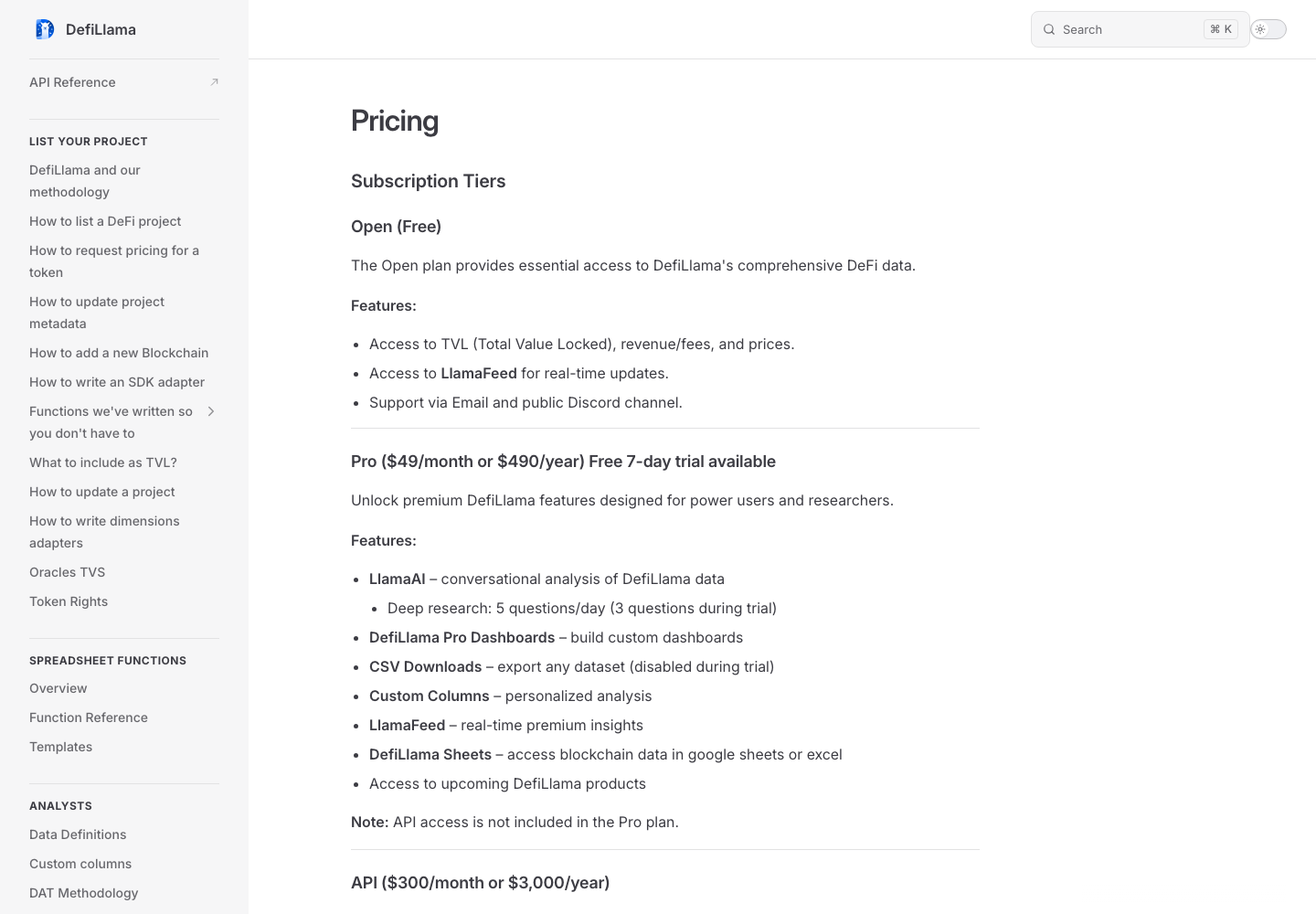
The DefiLlama API is a distinct access route for software developers who need structured data. Pro adds saved dashboards, spreadsheet access and CSV downloads; those are analyst tools rather than premium endpoint access. A user searching for DeFi Llama API access should check which endpoints belong to public access and which require the separately priced API subscription. An API key should stay on a server or in a secure local environment, never in a public spreadsheet or client-side website bundle.
For a project with a recurring reporting job, define an expected call count before selecting a plan. A scheduled job for a few series is different from a public application receiving many simultaneous requests. Cache repeated calls where licensing and data freshness requirements permit, and monitor failures explicitly. Store observation times and schemas alongside the data so that a change in API response formats can be detected rather than silently breaking a downstream chart.
Pro may be useful for a human analyst who works in spreadsheets; the paid API may be useful for a developer. Although the latter includes Pro features according to the vendor, access to the Pro plan alone does not include the premium API.
✅ Pros & Cons of DefiLlama
Pros
- Published metric definitions and inspectable adapter repositories
- Separate categories for deposits, flows, fees, yields and other activity
- Public documentation explains important exclusions and data update timing
- Distinct subscription options for human research and developer access
- Free research route before deciding whether recurring work merits an upgrade
Cons
- Metrics can be misread if their definitions and timestamps differ
- Premium API access is not included in Pro
- Trial does not include CSV exports according to official pricing
- Data coverage and update intervals differ by metric and protocol
- No substitute for contract auditing, investment advice or settlement records
👾 Limitations & Reality Check
DefiLlama is a secondary research interface even when an adapter obtains information directly from a blockchain. Correct calculations depend on how contracts and assets are identified, which valuation method is applied, whether the definitions still fit a changed protocol, and how the data pipeline handles incomplete records. Open source makes this easier to scrutinize but does not guarantee that all errors have been identified.
The vendor's FAQ describes hourly refreshes for several snapshot metrics and variable hourly or daily schedules for some flows. The website may display cached observations after the API has been updated. That is a reason to record the time basis, not a guarantee that the newest available observation is final in every circumstance. If an adapter still references an obsolete contract after a migration, compare the address list with the protocol’s deployment record.
There is also a practical distinction between research and execution. A reader looking for DefiLlama swap information should verify the current LlamaSwap workflow and its separate routing and execution terms before considering any transaction. This review does not test swaps, quotes, bridges or a wallet connection. A historical analytics number cannot confirm the transaction a wallet is about to sign. Use an appropriate dedicated security workflow for that separate job.
Finally, DefiLlama does not make a contract safe by listing it. A large total value can coexist with risks from administrative controls, oracle dependencies, economic incentives or concentrated liquidity. A chart can be a signal for more investigation, not a substitute for it.
💰 Pricing Plans & Real Costs
The official pricing documentation checked for this review lists Open at no charge, Pro at $49 per month or $490 per year, and API at $300 per month or $3,000 per year. Enterprise is a quote-based plan. These are published USD prices, not verified checkout totals in any particular state or country. Tax, payment and renewal details should be checked at purchase. The Pro plan has a documented seven-day trial; the pricing page states that CSV downloads are unavailable during the trial and that the trial has a lower deep-research question limit.
Paying for twelve months of monthly Pro access at the reference price would cost $588. The annual option costs $490, a difference of $98, equivalent to about $40.83 per month if spread over a year. Do not confuse that equivalent with a monthly payment; an annual subscription requires the annual commitment. Twelve monthly API payments would amount to $3,600 before extra calls, whereas the annual listed price is $3,000.
The API plan documents an allowance of one million calls per month and a limit of 1,000 requests per minute. The stated overage is $0.60 for each additional thousand calls. For a hypothetical month with 1.25 million billable requests, the additional 250,000 calls would cost $150 at that published rate. This illustrates why developers should monitor usage instead of treating the base subscription as the full possible operating cost. Actual billing rules, licensing and eligibility must be confirmed directly. DefiLlama data for a public product can also raise redistribution and licensing questions; a paid subscription is not necessarily permission for unlimited reuse.
| Plan | Cost / billing model | Region / billing period | Vendor source checked |
| Open | Free | US reference; taxes and checkout unverified; Ongoing free access | https://docs.llama.fi/pro-api (2026-11-21) |
| Pro | $49 monthly or $490 annually | US reference; taxes and checkout unverified; Monthly or annual | https://docs.llama.fi/pro-api (2026-11-21) |
| API | $300 monthly or $3,000 annually; $0.60 per 1,000 extra calls after 1M/month | US reference; taxes and checkout unverified; Monthly or annual plus usage | https://docs.llama.fi/pro-api (2026-11-21) |
| Enterprise | Custom quote | US reference; taxes and checkout unverified; Vendor agreement | https://docs.llama.fi/pro-api (2026-11-21) |
🎯 Who Should Use DefiLlama?
The strongest use case is a research team that regularly compares protocol categories and needs public definitions to support its reporting. DefiLlama is also relevant to writers describing changes in network activity, software developers exploring data integrations, and independent readers learning the difference between market prices and deposited assets.
For a small editorial team, the free service is often the natural place to begin. A team with substantial recurring spreadsheet work might benefit from investigating Pro. A developer building an internal reporting application should instead compare the required DefiLlama API endpoints, usage limits and licensing conditions with the project's architecture.
⚖️ DefiLlama Alternatives
The relevant comparison is between research methods, not merely subscription prices.
Dune vs DefiLlama
Dune emphasizes query-based blockchain research and custom dashboards. It is a sensible alternative when an analyst needs to express a novel data question rather than rely on an already defined metric. DefiLlama may be more convenient for initial cross-protocol comparisons because its categories have established definitions. An organization with SQL expertise might use Dune to investigate a surprising observation discovered in DefiLlama. Conversely, a reader with limited time to create queries may prefer a documented aggregation as a starting point. Custom queries also have assumptions; query authors should document their logic.
Glassnode vs DefiLlama
Glassnode's documentation focuses on curated on-chain and market metrics. Its analytical emphasis may suit a researcher concerned with network behavior and market structure, while DefiLlama places substantial attention on decentralized applications and their economic activity. The products are not interchangeable merely because both show blockchain charts. Determine whether your main unit of analysis is a protocol, an asset, a network or a market cycle. A useful buying decision is based on which definitions and historical series are available for that unit rather than an arbitrary score.
Token Terminal vs DefiLlama
Token Terminal focuses on standardized financial and operating metrics for blockchain projects. The overlap with DefiLlama is particularly relevant for researchers comparing protocol revenue or fees. Evaluate the treatment of incentives, supplier payouts and the attribution of revenue before treating figures from different services as direct equivalents. If a standardized reporting format is a priority, Token Terminal is an alternative worth evaluating; if diverse DeFi activity measurements are the main requirement, DefiLlama deserves a place in the initial comparison. We have not benchmarked paid account features or data completeness between these services.
Comparison: DefiLlama vs Alternatives
The table separates the main research tasks and the evidence available.
| Consideration | DefiLlama | Alternatives |
| Protocol deposits and capital movements | Defined TVL and separate inflows | Dune custom queries; check definitions |
| Custom blockchain queries | Predefined metrics and optional custom research views | Dune emphasizes query-based analytics |
| Financial protocol reporting | Fees, revenue and related definitions | Token Terminal standardized financial metrics |
| Network and market analysis | Chain-level DeFi and other documented metrics | Glassnode curated on-chain series |
| Automated access | Public access and separately priced premium API | Check endpoint coverage and licensing for each service |
🗂️ Build a reproducible weekly research report
A weekly report is a good way to find out whether DefiLlama fits an actual research process. Establish a set of perhaps five protocols within the same category and collect comparable observations over an identical window. Give each row a source, metric definition, timestamp and status. Do not write conclusions until these fields are complete. The table is the evidence; the chart is one way of presenting it.
Next, use the documented inflows concept to distinguish changing valuations from changes in deposited balances. Add a volume or fee observation only if it is relevant to the protocol's operation. For a lending example, a separate borrowing measurement can be more revealing than a trading volume metric intended for exchanges. Where a figure is absent, mark it as unavailable and note the research needed to resolve it.
In a second pass, explain a small number of unusual observations rather than describing every row. A protocol might have added a new network, changed an adapter or experienced a temporary revaluation. Such explanations should be checked against public evidence. A repeatable DefiLlama report preserves both the source observation and the analyst's interpretation so that another person can reproduce the work.
📐 A sensible way to evaluate data quality
For DefiLlama, the useful starting point is the published methodology. Pick a metric and inspect its constraints. Then identify the relevant source adapter and note whether the observation is based on direct contract queries, a subgraph or another source. If a protocol appears to be missing, check whether its adapter is supported, whether its category is appropriate and whether the date is relevant. Absence from a dashboard does not prove absence of real activity.
A second source can be helpful, but reconcile definitions first. Two figures can diverge legitimately because one includes liquidity receipts or staking balances and another does not. A comparison should state these limitations before making a claim of error.
🧾 Keep the costs of research and execution separate
The monthly budget for analytics software is not the same thing as the cost of a blockchain transaction. A subscription to DefiLlama may provide access to research features without paying gas or other transaction charges. Any decision to execute a swap, bridge assets or use a lending pool entails separate costs and risks. The review makes no recommendation to undertake those actions.
For an editorial operation, begin with recurring staff tasks: how much time is spent finding the same data, producing exports, checking definitions and updating charts? Estimate the time cost and compare it with the published subscription. A $49 monthly plan would need to create sufficient value for the organization, but the calculation depends on the actual staff costs and how much work it eliminates. A developer has another cost structure: hosting, monitoring, request volume, integration maintenance and data rights. Do not count a saved manual task twice when assessing both Pro and API.
🔍 Choose the right research question
Start by deciding which observation would answer your research question. For someone asking “what is DeFi Llama?”, the methodology is a good first stop. The query “TVL DefiLlama” instead signals a narrower question about deposited assets. For that task, identify the protocol or network, confirm the definition, and record the observation date.
Someone looking for the DefiLlama app might be asking about the public web interface, not necessarily a native mobile application. We did not verify a native application or attempt a mobile download. Use the official site and inspect the linked documentation rather than assuming that a similarly named download belongs to the vendor. The same care applies to browser extensions and requests to connect a wallet. This review considers public research, which does not require sharing a seed phrase.
A reader searching for the API should identify whether the intended task is a one-off export or automated collection. A reader searching for chain data should distinguish the valuation of underlying assets from the movement of balances. Clear questions prevent a research tool from becoming a source of unexamined assumptions.
🧪 How We Evaluated DefiLlama
Our evaluation is based on official public methodology, data definitions, pricing, FAQs and developer documentation, supplemented by competitor documentation. We captured three real screenshots of the vendor's public documentation and kept their source addresses. We could not capture the main dashboard in the automated browser because it returned an access challenge. No paid account, private API credential, wallet connection, live transaction, trading result or performance benchmark was tested. The hypothetical numbers in the article are explanatory examples, not claims about current protocol values. The article is software research, not financial advice or an assurance of security.
Method: documentation-based analysis of published vendor sources; no independent product access or benchmark is claimed.
🏆 Final Verdict: DefiLlama Review
DefiLlama is worth evaluating for researchers who need a structured overview of protocol activity and a way to investigate how the measurements are defined. Start with free access and learn the difference between TVL, inflows, fees and revenue before deciding which charts belong in a report. If repeated custom research work or a specific API requirement creates a concrete need for paid access, compare the subscription against that workload and its alternatives. The most valuable outcome is a more reproducible research process, not a prediction of which asset will make money.

Frequently Asked Questions
What is DefiLlama used for?
It is a blockchain and DeFi research service providing documented metrics such as protocol TVL, fees, revenue, volume, yields and stablecoin supply. Its figures support research rather than investment recommendations.
Is DefiLlama free to use?
The vendor lists a free Open plan for core research. Some custom research, exports and premium API capabilities require subscriptions. Check current plan restrictions before paying.
What does DefiLlama Pro cost?
The official reference is $49 monthly or $490 annually. The vendor lists a seven-day trial with restrictions. We did not verify a paid checkout.
Does DefiLlama Pro include premium API access?
No. The official pricing documentation separates Pro from the API plan, which is listed at $300 a month or $3,000 annually.
How is TVL different from inflows?
TVL values deposited assets under a particular scope. Inflows seek to represent changes in balances separately from changes in asset prices. A rise in TVL is not necessarily new deposits.
How often does DefiLlama update its data?
The vendor FAQ describes hourly updates for several balance and yield metrics, while some flow series update daily. Website caching may also delay the display relative to the API.
Can DefiLlama identify safe protocols?
No. Its data can inform a research process, but a listing or high TVL does not certify a contract’s safety, governance or liquidity.
Is DefiLlama better than Dune?
They serve different research methods. DefiLlama aggregates defined metrics; Dune emphasizes querying blockchain datasets to create custom analyses. The appropriate tool depends on the task.
Can I export DefiLlama data?
The Pro plan describes broad CSV download functionality, excluded during its trial. Some public data access is available; check the current endpoint and export rules for your specific dataset.
Does DefiLlama trade or manage my assets?
The analytics service is separate from a wallet or custody workflow. The vendor also documents swap-related services, but this review does not test their execution. Never share private keys to access research.
Can I use DefiLlama data in a commercial app?
Check the actual API access, request limits and data licensing terms. A subscription provides defined access but does not automatically grant unrestricted redistribution rights.
EXPLORE NEXT ON DIGIOFFLY
🔍 Explore More on DigiOffly
Primary sources and verification dates
- Methodology — official documentation — verified 2026-11-21
- Definitions — official documentation — verified 2026-11-21
- Pricing — official documentation — verified 2026-11-21
- Faq — official documentation — verified 2026-11-21
- Api — official documentation — verified 2026-11-21
- Dune — official documentation — verified 2026-11-21
- Glassnode — official documentation — verified 2026-11-21
- Token Terminal — official documentation — verified 2026-11-21