

Pricing and specifications checked 2026-11-22 against vendor primary sources. Conditions, billing cycles and regions may change.
A profitable wallet on a leaderboard can be an interesting research lead, but it is not a trading system. The wallet may have accumulated its position months earlier, the displayed results may exclude costs, and following the address after a visible trade may mean buying into a completely different market. Nansen provides a way to ask better questions about those movements rather than assuming that public wallet activity predicts future returns. This Nansen review examines the current Nansen AI experience from the perspective of a researcher deciding whether wallet labels, Smart Money leaderboards, Nansen portfolio views, and Nansen API access can justify a subscription. It contrasts the free tier with Pro, looks at real workflow constraints, and explains where Dune, DefiLlama, and Glassnode are more appropriate. Facts come from official documentation inspected in November 2026.
DigiOffly currently uses direct non-affiliate product links. Vendor claims are distinguished from independently observed tests. No investment or trading advice is provided.
📊 Nansen Review Summary
Nansen AI links transaction and wallet information to labels, historical activity, token screening, and research questions. The main advantage is the ability to move from an unexplained token movement to the wallets involved and then examine those wallets in context. It is stronger as a workflow for investigation than as a shortcut to buying what somebody else bought.
The free tier offers a starting point for Nansen crypto research; Pro adds expanded analytics, additional AI credits, and unlimited alerts. Whether these benefits save enough time depends on how often the same research work is repeated and whether the supported chains contain the assets you investigate.
⚡ Quick Verdict: Is Nansen Worth It?
Nansen is worth shortlisting when your recurring task is identifying wallets, checking capital flows, or monitoring labeled market participants. Start with the free account and write down what you cannot complete before paying. Do not subscribe only to copy a leaderboard, and do not regard a Nansen smart money tag as proof of professional skill.
For someone primarily comparing decentralized-finance protocol revenue, DefiLlama may answer the first question faster. For building a custom chain dataset, Dune may be the better fit. A Nansen pricing decision should be based on actual workflow needs, not a broad claim that any analytics platform offers an automatic market edge.
🏆 VERIFIED PRODUCT OVERVIEW — Nansen
Nansen AI onchain intelligence: Smart Money analytics, wallet research and a single Pro subscription.
Best for: Onchain analysts, wallet researchers and teams monitoring labeled capital flows
🧠 What Is Nansen?
Nansen is a blockchain analytics and onchain trading platform that connects wallet-level behavior with interpreted labels and market context. The company describes data covering hundreds of millions of labeled addresses and offers research experiences such as Smart Money dashboards, wallet profiling, token screening, AI-assisted questions, and developer access. Nansen AI also connects research to supported trading flows, but analysis and execution must be evaluated separately. On a public blockchain, a transaction may show that one address transferred tokens to another, yet not explain who controls either address or why the transfer occurred. A useful analytics service helps structure those observations. Wallet labels can group known exchanges, funds, smart-money participants or other entity types. A profiler can show counterparties, holdings and transaction patterns, while a token view can help an analyst understand whether flows are concentrated or widespread. These conveniences can reduce manual investigation, but labels are not infallible identities, ownership is not always clear, and several wallets may be controlled by one actor. The Nansen crypto experience is therefore best treated as evidence assembly. Start with a precise hypothesis, such as whether a set of labeled wallets increased net exposure to a token over a chosen period. Then compare the observation against time, liquidity, token supply, other known addresses and independent sources.

🖥️ Ease of Use & The User Interface
The public Nansen site emphasizes fast access to onchain questions, mobile research and a combined analytics-and-execution experience. The official Academy documentation provides more concrete navigation: a Smart Money leaderboard, token tabs, a Profiler for specific addresses, and an AI Agent that answers questions in plain language. Those descriptions are useful for planning a workflow, but they cannot establish that the current logged-in interface will suit every screen or that every chain has equal coverage. Our screenshots in this review come from official public pages and the Nansen Academy. They are not fabricated account screenshots. We did not authenticate to a paid workspace, and we cannot responsibly claim to have measured latency, accuracy, notification delivery or subscription upgrade behavior. For a first evaluation, the sensible usability test is whether you can answer one small question without switching between unrelated dashboards.
🧭 How to Use Nansen for Beginners
The following is a proposed research workflow based on the vendor's published instructions, not a claim that our team completed these steps within a paid Nansen account.
1. Define an observation instead of a trade
Choose a token, address, ecosystem or market behavior and specify a time window. For example, ask whether a set of labeled Smart Money wallets increased holdings during the previous seven days. Keep the question descriptive. Deciding whether an asset should be purchased would require additional information about valuation, portfolio constraints and execution risk. Record the exact timestamp at which your question was asked, because blockchain data and prices evolve quickly. If you already have a Nansen portfolio, keep that monitoring objective separate from market discovery. The first is about understanding your holdings; the second is about other participants.
2. Review Smart Money categories and filters
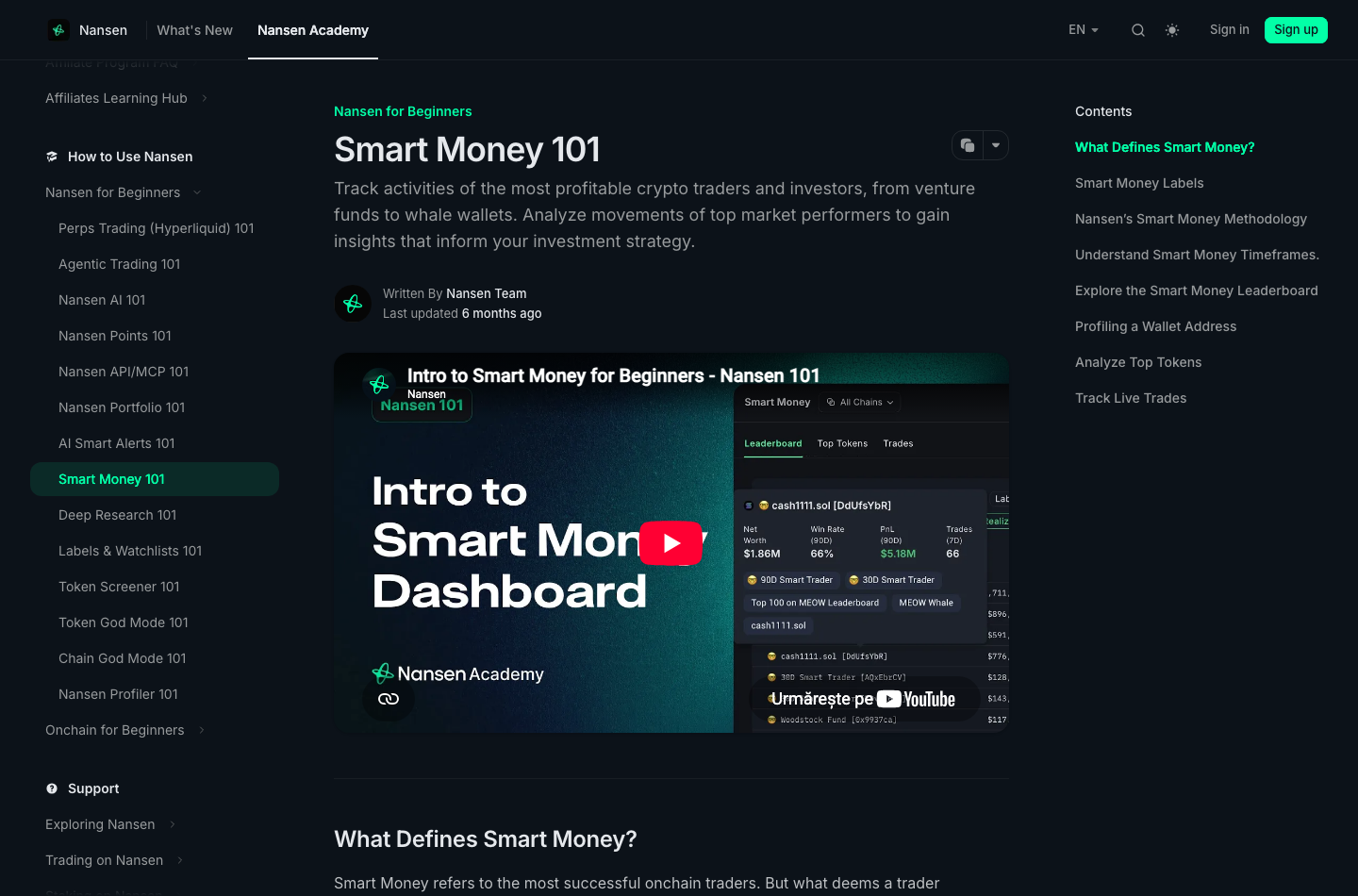
Use the Smart Money documentation to learn what the leaderboard measures: realized and unrealized profit and loss, observation windows, trading activity and network coverage. A profitable address over thirty days may have a very different risk profile from one evaluated over six months. Narrow the view to the relevant chain and compare wallets over a consistent interval before drawing conclusions. Nansen smart money categories are a useful sorting method, not a universal definition of investor skill. Even a correct label cannot reveal every offchain position, hedge or custodial relationship.
3. Open a wallet profile and study its counterparties
Nansen Profiler documentation describes holdings, transaction histories, counterparties, token-specific wallet views and relationships between addresses. Take one wallet from the research question, record its recent activity, and check whether the balance changes reflect real purchases, transfers between controlled addresses or movement to a known service. A large incoming transfer can be a deposit rather than an investment. A small token trade can be a test transaction rather than conviction. Cross-check contract addresses instead of relying on names alone. If an address receives funds from an exchange, that relationship by itself does not identify the beneficial owner.
4. Compare token-level signals with context
After reviewing a wallet, examine the relevant token's holders, netflows and trading activity. Ask how many distinct wallets contribute to a move and whether a small number dominate the result. Compare changes in holdings with supply, liquidity, trading volume and market conditions. A visually striking change can arise from a low-liquidity token where modest capital changes the percentage dramatically. If you use Nansen AI to summarize those observations, inspect the underlying screens or API results before incorporating the answer into an investment decision or published report.
5. Evaluate the free plan before upgrading
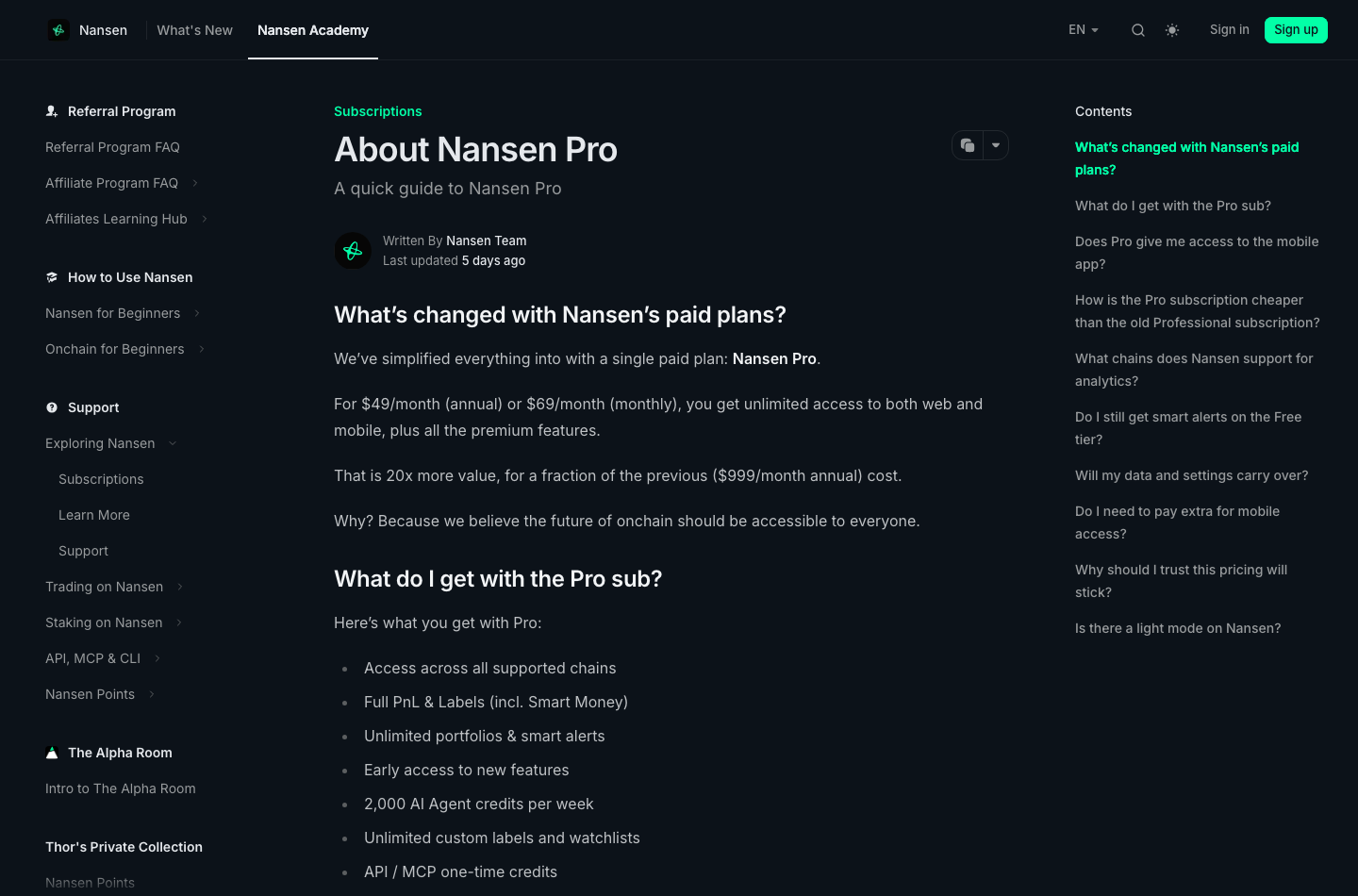
Work through a few real research questions, then write down limitations that actually prevented completion. Official documentation lists free access with a constrained number of active alerts and AI credits, while Pro substantially expands access. Separate the need for unlimited watchlists or alerts from a vague desire to have more features. A research project with one monitored wallet is not automatically a reason to pay a monthly subscription. If paid access looks useful, compare Nansen pricing under monthly and annual billing and check the current checkout details.
🛠️ Key Features That Actually Matter
Nansen combines several layers of onchain research that should be evaluated separately. Some features describe what happened in public transactions, others add labels or estimated performance, and newer functions interpret these observations through an AI agent. The distinction affects both trust and usefulness. Below are the capabilities most relevant to the Nansen crypto researcher and the limitations worth checking before paying.
Smart Money wallet leaderboards and historical activity
The Smart Money interface organizes wallets by historical results and activity. Nansen describes different evaluation periods for short-term and long-term participants, and it distinguishes between realized and unrealized profit and loss. The point of the leaderboard is not the ranking itself; it is that the researcher can narrow a large universe of public addresses to a smaller set worth studying. Its value depends on the definitions used to classify addresses and calculate performance. A wallet that appears consistently profitable may use derivatives or offchain arrangements that are not visible from the public address. Fees, taxes, prior cash flows and ownership of linked wallets also affect interpretation.
Official source: Nansen official documentation.
Wallet Profiler and counterparty intelligence
Wallet Profiler explores balances, transaction histories, counterparties, token-specific holdings and relationships between addresses. Nansen's documentation describes several profiler modes, including individual wallet analysis, wallet-to-token interaction and a comparison of two wallets. For a compliance researcher, analyst or journalist, this structure can make a complicated sequence of public transactions easier to investigate. Its most important limitation is attribution. An address is not necessarily a person. Centralized venues, custody systems, smart contracts and shared service wallets can make a simple funding relationship look more personal than it is. Avoid publishing a claim about ownership solely because the software shows two addresses as connected. Save the transaction hashes or relevant counterparties and seek independent corroboration.
Official source: Nansen official documentation.
Token discovery and netflow research
Token screening and Smart Money netflow data help frame questions about concentration and changing capital exposure. Nansen's API documentation shows a Smart Money netflow endpoint and related token-analytics capabilities. Such tools are valuable when an analyst wants to ask which categories of labeled participants were net buyers or sellers during a defined interval rather than reading isolated social-media posts. A positive net inflow does not mean that the token will rise. The move could already be priced in, liquidity may be thin, or the classification may omit influential addresses. Distinguish a flow measured in token units from one expressed in dollars; price changes can make the latter look larger even when units are unchanged.
Official source: Nansen official documentation.
Nansen AI Agent for research questions
Nansen AI provides a conversational way to explore onchain data and request summaries of wallet behavior, capital flows or market activity. The vendor documents Fast and Expert modes using different numbers of weekly credits. The appeal is obvious for a researcher who knows the question but does not know which dashboard contains the answer. Rather than spend time navigating many menus, the user can ask a specific question and follow up with more context. That convenience should not be mistaken for an independently verified conclusion. A generated summary can hide missing data, omit a time-zone assumption or sound more certain than the evidence allows. Ask what chains, dates and labels were included.
Official source: Nansen official documentation.
Alerts, watchlists and ongoing monitoring
Nansen's official Nansen Pro explanation states that free users can have up to 50 active Smart Alerts, while Pro makes alerts unlimited. The important buyer question is not how large the maximum number sounds but whether the monitoring workflow needs that scale. A person watching two wallets and three ecosystems may have little immediate need for unlimited alerts. A research desk following many addresses and token categories may reach the limit quickly. Alerts can help establish a record of changes after the researcher selects a relevant condition. They cannot guarantee that an event will be delivered before a market responds.
Official source: Nansen official documentation.
Nansen API, MCP and CLI for automation
The Nansen API introduces a different product question: does a team need interactive dashboards, or should a research workflow pull structured records into its own application? The vendor presents REST, MCP and CLI access routes, plus endpoints for Smart Money, token screening and wallet profiling. These interfaces may help an analyst build a reproducible monitoring job without manually exporting the same figures every morning. Before committing to any automated Nansen API workflow, verify the available endpoints, credit consumption, request limits, licensing and commercial redistribution terms. An API key should be kept server-side and not embedded in public JavaScript. Log failures and store the source timestamp with every extracted observation.
Official source: Nansen official documentation.
Research connected to spot and derivatives trading
Nansen has broadened from research to selected trading workflows. According to the vendor, free accounts can also trade, and transaction fees depend on products and reward tiers. For derivatives, the published explanation adds a Nansen builder fee to the underlying Hyperliquid base fee. Spot routes may incur platform, network and execution costs; slippage can make the realized price differ from the initial quote. This is a different service from passive analytics. A wallet connection exposes a user to signing decisions, contract permissions, market risk and potential operational errors. Nansen AI may help explain a proposed action, but it should not be treated as a replacement for examining the destination, amount, token contract and transaction details.
Official source: Nansen official documentation.
✅ Pros & Cons of Nansen
Pros
- Distinct wallet-level research and labeled counterparty context
- Smart Money, token and wallet investigation available in connected workflows
- Free access lets users test a concrete research question before paying
- Published Pro pricing and plan comparisons with a lower annual equivalent
- Official API/MCP/CLI documentation for automated research projects
Cons
- Wallet labels and reported performance require independent interpretation
- Subscription features, AI credit limits and trading charges are different cost categories
- Some networks provide more analytical coverage than others
- Large and busy dashboards can encourage post-hoc pattern selection
- We could not verify paid dashboard performance or notification latency firsthand
👾 Limitations & Reality Check
The central risk of interpreting Nansen is false precision. A label can be based on heuristics, public evidence or a cluster of transactions, and ownership can change. A transfer to a recognized service may be an exchange deposit, an internal movement or part of a custody workflow. The screen can be accurate about an observed transaction while the inference about economic intent is wrong. This is especially important when attributing activity to a public figure or a fund. Treat a label as a research lead, not independently proven identity. Profit-and-loss views have their own limits. A wallet may hold positions on multiple networks or use derivatives that a given display does not include. Realized and unrealized measures can change as market prices and valuation methods update. A wealthy address may be funded by another party. If you publish a ranking, note the time range, dataset scope, available costs and any unanswered ownership questions. Never turn a retrospective leaderboard into an implied guaranteed strategy. Nansen portfolio analytics can also be affected by missing token prices, wrapped assets, unsynced networks and ambiguous transaction classification. A visually complete portfolio may not account for liabilities, borrowed capital or tax basis.
💰 Pricing Plans & Real Costs
The official Nansen pricing documentation identifies a free account and one paid Nansen Pro subscription. As checked in November 2026, Pro is described at $69 per month on monthly billing or $49 per month equivalent when billed annually. Twelve months of the $69 monthly option would total $828 before any relevant taxes. The annual equivalent corresponds to $588 over twelve months, which is $240 lower than twelve monthly payments. That difference describes the published plan options, not a guarantee of final checkout prices. An annual equivalent is not the same as a month-to-month contract. Free access is more than a banner that says 'trial': according to the vendor, it is a standing tier with a cap of 50 active Smart Alerts and 20 weekly AI Agent credits. Pro is described as providing unlimited alerts and 2,000 weekly credits, along with premium data and expanded mobile access. The documentation distinguishes one-credit Fast questions from eight-credit Expert questions, so the practical number of interactions depends on query type. A purchaser should review current quota details before assuming that an AI tool permits unlimited requests. Nansen price searches sometimes mix subscription costs with token prices, rewards or trading charges. Keep these categories separate. The Nansen AI software subscription pays for access to an analytics product. Trading through supported routes may involve builder fees, DEX or derivatives fees, gas and slippage, regardless of whether the user has Pro.
| Plan | Cost / billing model | Region / billing period | Vendor source checked |
| Nansen Free | $0; free-tier limits apply | US reference; ongoing Free | https://academy.nansen.ai/en/articles/9412804-about-nansen-pro (2026-11-22) |
| Nansen Pro monthly | $69 per month, month-to-month | US reference; monthly recurring | https://academy.nansen.ai/en/articles/9412804-about-nansen-pro (2026-11-22) |
| Nansen Pro annual | $49/month equivalent, $588/year reference | US reference; annually billed (monthly equivalent shown) | https://academy.nansen.ai/en/articles/9412804-about-nansen-pro (2026-11-22) |
🎯 Who Should Use Nansen?
Nansen is most relevant to researchers who repeatedly need to move between a token, the wallets trading it, and the context around those wallets. Independent analysts can use that structure to examine capital flows rather than chase social-media alerts. Journalists can use wallet profiles to ask who may be connected to an event while retaining necessary caution about attribution. Research desks can use watchlists and Nansen smart money filters to follow changing exposure over time. A developer may care less about the interface and more about Nansen API coverage, stable schemas and access controls. For that user, a small pilot calling selected endpoints may reveal more than an ordinary subscription trial. The team should define its compliance and redistribution needs, account for API usage, and make sure that a public product does not expose private credentials. A Nansen portfolio user may prioritize tracking holdings and keeping the context of important positions. That is a different task from discovering tokens. If the main issue is personal transaction accounting, a purpose-built portfolio or tax service may be more appropriate.
⚖️ Nansen Alternatives
To compare crypto analytics tools meaningfully, choose software by the question to be answered. The following alternatives overlap in blockchain data, but have different organizing principles. The comparison is based on public documentation and editorial job fit, not a controlled paid-account benchmark.
Dune vs Nansen
Dune emphasizes custom blockchain queries, transformations and reusable dashboards. A researcher with SQL experience can use it to define the precise filters and logic for a new question. Nansen has a different advantage: interpreted wallet labels, packaged Smart Money workflows and address-oriented profiling that can save time when the necessary classification already exists.
Suppose a team wants to inspect behavior around an unusual token transfer. Nansen may help identify related wallets and labeled counterparties. If the team instead needs a custom protocol metric with a very specific accounting definition, Dune may provide more control over the query. Neither service removes the need to inspect the underlying contracts and timestamps. Read our Dune review for the differences between curated research and query-based analysis.
DefiLlama vs Nansen
DefiLlama organizes protocol and network activity around metrics such as total value locked, fees, revenue and related DeFi measurements. Nansen focuses more on wallet behavior, labeled actors and onchain intelligence. Those starting points lead to different research workflows even when both services include token or ecosystem information.
For a question like 'Did lending activity increase across several protocols?', DefiLlama offers a natural starting point. For 'Which labeled participant wallets are accumulating a token?', Nansen analytics may be a better fit. Use both carefully: a rise in a protocol metric and a rise in Smart Money inflows do not necessarily describe the same assets or time window. Comparing them without definitions can produce a polished but misleading chart.
Glassnode vs Nansen
Glassnode's curated onchain and market metrics are often relevant to network-level research and behavior across longer periods. Nansen addresses a different layer by making individual wallets, labels and token flows central to the workflow. One platform might help examine an aggregate market condition while the other identifies a set of observable participants worth studying.
A trader researching broad accumulation trends could value a consistently defined network metric more than a list of individual wallets. An investigator tracing counterparties may prefer the specificity of Nansen Profiler. The correct choice depends on asset coverage, historical availability, methodology and subscription requirements. No one of these analytics tools should be treated as a replacement for legal, tax or cybersecurity advice.
Comparison: Nansen vs Alternatives
The matrix describes different analytical emphases, not an overall winner. Verify current coverage, plans and terms directly before treating any row as a purchasing recommendation.
| Consideration | Nansen | Alternatives |
| Wallet attribution and counterparties | Nansen labels and Profiler for address investigation | Dune custom queries; others vary by available data |
| Smart Money and token flow monitoring | Packaged Nansen smart money views and alert workflows | Custom queries or project-specific analytics |
| Protocol revenue and TVL | Can provide context around users and token positions | DefiLlama focuses on documented protocol metrics |
| Network-level analytical series | Wallet-centric investigation and onchain screening | Glassnode publishes curated onchain indicators |
| Programmatic research | Nansen API, MCP and CLI routes; usage limits to check | Dune and other services offer distinct APIs/data models |
| Subscription decision | Free or $69/month Pro; $49/month annual equivalent | Compare current vendor plan pages and workload |
🧮 A disciplined Nansen research checklist
Create a row for the target address, the token contract, the chain, the observation period and the timestamp. Save an external reference for any label that materially changes your interpretation. Then compare the address to relevant counterparties, position changes and token flows. Without those fields, a screenshot of a Nansen smart money leaderboard can lose meaning within days. Next, write at least two alternative explanations. A large transfer may represent a newly funded trader, movement between controlled wallets, or a deposit to an exchange. Identify evidence that would distinguish these cases. If you cannot distinguish them, keep the claim descriptive. Do not turn uncertainty into a confident trading narrative.
🛡️ Wallet research is not wallet safety
Nansen wallet analysis and contract security are different disciplines. A wallet label tells you something about a potential entity relationship, while contract review asks about authorization, upgrade keys, oracles and malicious token behavior. Neither a profitable address nor a prestigious label guarantees that interacting with the same contract is safe. A practical division of responsibilities helps. Use Nansen to understand activity, independent chain explorers to verify transactions, protocol documentation to understand assets and a dedicated security workflow before signing transactions. Never send a seed phrase to a research service. Treat unexpected wallet-connection requests as an independent security decision even if they appear while following an otherwise legitimate analytics link.
💼 Subscription procurement for a small team
Build a one-page requirements list before paying for Nansen Pro. Include the number of researchers, the chains monitored, the types of wallet profiles required, recurring alert counts, and whether API access is part of the workflow. Distinguish Nansen AI questions from ordinary dashboard browsing, because weekly credit allowances depend on the question mode. Estimate time saved only after observing actual work. If three analysts each rebuild the same monitoring report every week, a shared workflow may justify a paid tool. If the data is needed once per quarter, Free or an alternative may be adequate.
🔎 Validate a surprising wallet alert before acting
A wallet alert in the Nansen platform is a prompt to investigate, not a completed assessment. Start by checking the contract address, the originating transaction and whether the transfer represents a market purchase, a direct transfer, a bridge deposit or an internal movement. The same token symbol may appear on unrelated contracts, and a transfer into a wallet is not necessarily a new position. Next, compare the observed change with the address's earlier activity, the relevant token's available liquidity, and the timestamp at which the analytics data became visible. If the event was associated with a labeled address, look for independent evidence supporting the label.
🧪 How We Evaluated Nansen
Our methodology is documentation-based software analysis. We accessed and archived official Nansen pages for pricing, Smart Money workflows, Profiler, API, AI Agent and trading fees. We captured genuine screenshots of the public website and Academy documentation, with source URLs and hashes. This does not amount to signing in to a Nansen Pro account or measuring its private service performance.
We did not connect any wallet, purchase a subscription, send an API request requiring credentials, execute a transaction, test alert-delivery latency, audit label accuracy or independently verify claimed wallet counts. The numerical scenarios about annual subscription cost are simple illustrations derived from vendor-listed reference prices, not receipts. Any discussion of token or wallet behavior is educational and does not recommend a trade.
Method: documentation-based analysis of published vendor sources; no independent product access or benchmark is claimed.
🏆 Final Verdict: Nansen Review
For researchers who need labels, wallet behavior and capital-flow context, Nansen deserves a structured evaluation. Its strongest potential advantage is reducing the work required to move from an unusual token movement to a coherent set of wallets and counterparties. The same interface can also encourage premature conclusions, so every attractive signal deserves a definition, time window and competing explanation.
Begin with the Free account. Compare the documented limits with a real recurring research task, then consider Nansen Pro only when the extra access solves that problem. Check the live Nansen pricing screen, any API costs, and separate trading charges before committing. Nansen AI can assist an investigation, but neither labels nor AI summaries replace independent verification or risk management.

Frequently Asked Questions
What is Nansen used for?
The Nansen blockchain research platform covers wallet profiling and token analytics. Historical Nansen NFT support should be verified separately because coverage evolves. Nansen is an onchain analytics and trading platform with Smart Money research, wallet profiling, labels, token screening and an AI assistant. Its outputs support investigation, not guaranteed predictions.
Is Nansen AI free?
An official Free tier exists. The vendor documents limits including 50 active Smart Alerts and 20 weekly AI Agent credits. Availability and current terms should be checked on the official Nansen site.
How much does Nansen Pro cost in the US?
Nansen Pro is listed at $69/month on monthly billing or $49/month equivalent with annual billing, before applicable taxes or account-specific checkout terms.
Is Nansen pricing different from trading fees?
Yes. An analytics subscription covers software access, while supported trading routes can incur builder fees, exchange fees, network costs and slippage. API usage can be separate too.
What is Nansen smart money?
It is a labeled-wallet research framework using historical behavior and analytics. A Smart Money category or leaderboard ranking does not mean that copying a wallet will be profitable.
Does Nansen have a portfolio tracker?
Nansen portfolio features provide wallet and holdings context. Check network coverage, missing assets and cost-basis assumptions before treating any balance as a complete accounting record.
What is Nansen API used for?
Nansen API provides programmatic access to supported wallet, Smart Money and token analytics. Verify endpoint availability, credits, usage terms and data rights before an integration.
Can I use Nansen AI on mobile?
People who search for app Nansen AI should use the official Nansen mobile download links, not similarly named third-party apps. Nansen documents web and mobile access for its AI experience. Supported features and region restrictions may differ, and Pro plan terms should be checked before purchasing.
Is Nansen better than Dune or DefiLlama?
They focus on different tasks. Nansen emphasizes wallet intelligence and labeled flows, Dune supports custom query workflows, and DefiLlama concentrates on documented DeFi metrics.
Can Nansen verify a wallet owner’s identity?
Wallet labels and counterparty information can help research attribution, but an address is not automatically a verified person. Independent evidence is needed for ownership claims.
Is this Nansen AI review based on firsthand Pro testing?
No. This nansen.ai review is based on public official sources and genuine page captures. No paid subscription, private API, wallet connection, trade or notification benchmark was tested.
EXPLORE NEXT ON DIGIOFFLY
🔍 Explore More on DigiOffly
Dune Analytics Review
Custom SQL-based blockchain analytics and reports
Compare Dune research workflowsTrading & Market Analysis Software
Browse relevant analytical software by category
Explore trading softwarePrimary sources and verification dates
- Nansen official product — verified 2026-11-22
- Nansen Pro pricing and plan FAQ — verified 2026-11-22
- Nansen Plans and Pricing — verified 2026-11-22
- Nansen Agent and AI credits — verified 2026-11-22
- Smart Money tutorial — verified 2026-11-22
- Nansen Profiler tutorial — verified 2026-11-22
- Nansen API product — verified 2026-11-22
- Nansen trading fees — verified 2026-11-22