

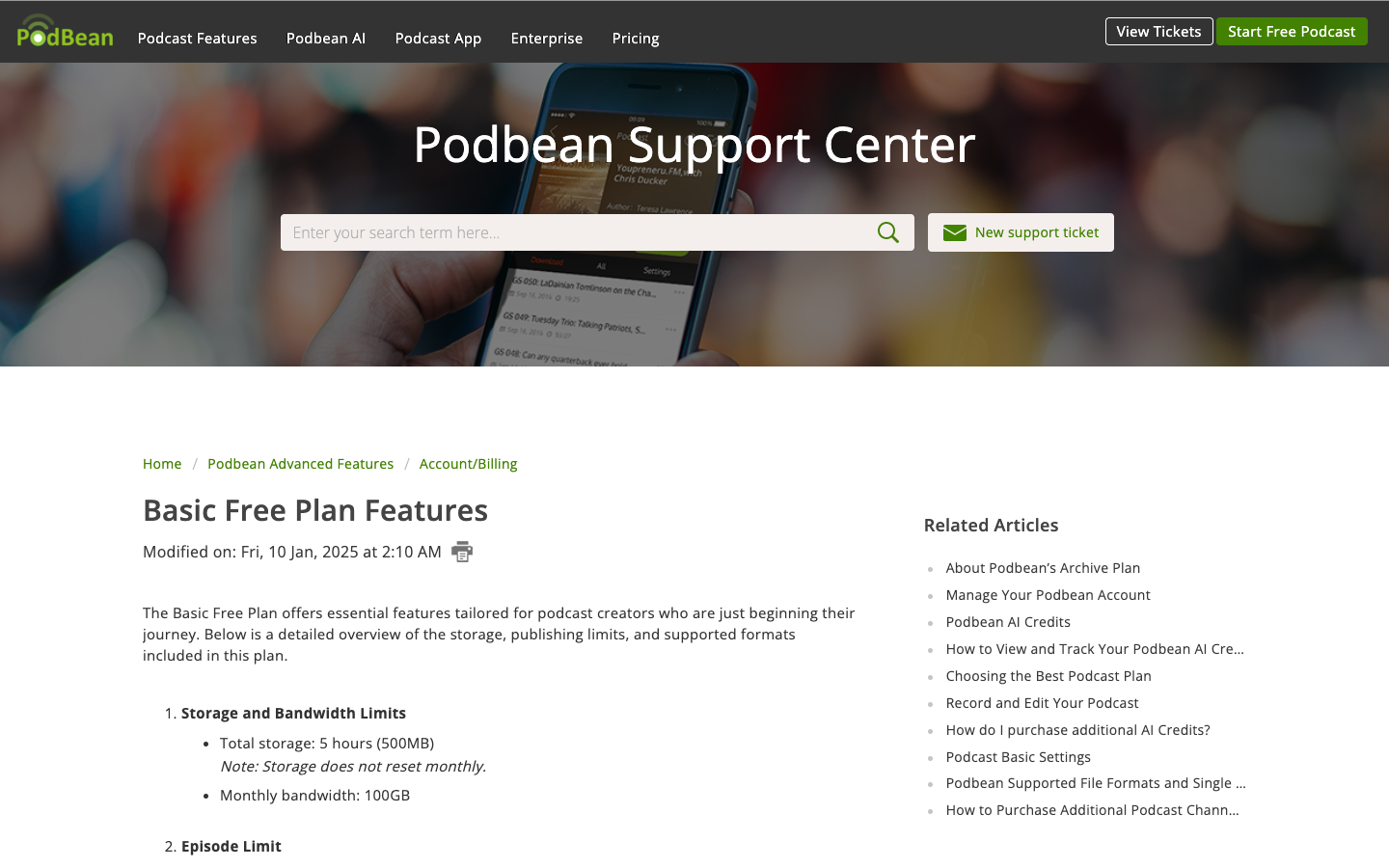
Updated 30 October 2026. Alex Wright assembled this DigiOffly Podbean review from current hosting-plan descriptions, the vendor’s Basic Free support limits and publicly accessible distribution information. These screenshots document published terms; no private subscriber feed, migration or member-access experiment is represented as completed.
Uploading the first MP3 is straightforward. The harder questions appear later: who owns the RSS address when a co-host leaves, what happens to subscribers during a host migration, and why do two analytics dashboards count the same episode differently? Unlimited total storage does not remove monthly upload limits, and private distribution does not guarantee that a downloaded file can be withdrawn. This guide approaches the decision through actual episode size, RSS ownership, directory verification, sponsor reporting and long-term portability rather than the attraction of a single hosting price.
📊 Podbean Review Summary
Podbean is a hosting and distribution service for audio and video podcasts. It stores media, generates RSS feeds, provides an embedded player and helps creators distribute an episode to listening directories. A host must still make recordings listenable, edit mistakes, get permission for music, design episode descriptions and maintain a publishing calendar. This Podbean review 2026 considers the often-overlooked differences between total storage, monthly upload allocations, bandwidth and private-member allowances. On Podbean’s paid audio plan, the total stored archive can be described as unlimited while new uploads still face a 1 GB monthly allowance. Video creators need to inspect the separate 10 GB quota on Unlimited Plus, not treat the word unlimited as a promise about every resource.
⚡ Quick Verdict: Solo Podcasters, Video Hosts and Networks
A solo audio creator can begin with Podbean Basic Free to test the workflow, then consider Unlimited Audio when its lifetime storage cap becomes restrictive. Podbean Unlimited Plus targets creators who need video podcast capability and a larger upload allocation. Network and Business are separate use cases: multiple public feeds and teams versus member-restricted private distribution and organization controls. The correct tier depends on the actual number of feeds, episode file sizes, users and distribution rights, not whether a marketing page calls a plan unlimited.
Before selecting Podbean, export one complete episode and measure its file size. Count planned shows, decide whether video delivery is required and check who will own every RSS and directory account. Basic is suitable for trying a short format but its lifetime storage cap is a real constraint. Paid plans are worth comparing by upload allowances, bandwidth, collaboration and private members. A cost-effective host is one that will not disrupt listeners when a show grows or moves.
🧭 Contents and Navigation
Jump to pricing, practical scenarios, alternatives, methodology and official sources.
🧠 What Podbean Podcast Hosting Includes
Podbean’s job begins after the audio or video file has been produced. The host creates a stable distribution feed, makes media available to listeners and supplies a website or embed player. Listeners may subscribe through compatible apps, while episode metadata and artwork travel through RSS. Ecamm Live can capture an interview, and a separate editor can clean the recording. Podbean takes over when there is an approved audio file, episode metadata and an RSS feed to deliver. Those are distinct failure points and often separate subscription costs. A creator should establish the chain from recording to publishing, distribution verification and measurement before relying on one vendor for the entire operation.
💰 Podbean Pricing 2026: Monthly vs Annual
Podbean pricing 2026 has several clear public tiers. The pricing table lists Unlimited Audio at $12 monthly-equivalent when billed annually versus $17 month-to-month, Unlimited Plus at $29 versus $39, Network at $79 versus $99, and Business at $99 versus $129. These are not four interchangeable products; each changes podcast quantity, monthly upload limits, bandwidth terms, collaboration or private member capacity. An annual equivalent is not a flexible monthly subscription. Confirm currency, tax, renewals and whether the selected tier supports your planned media and access model.
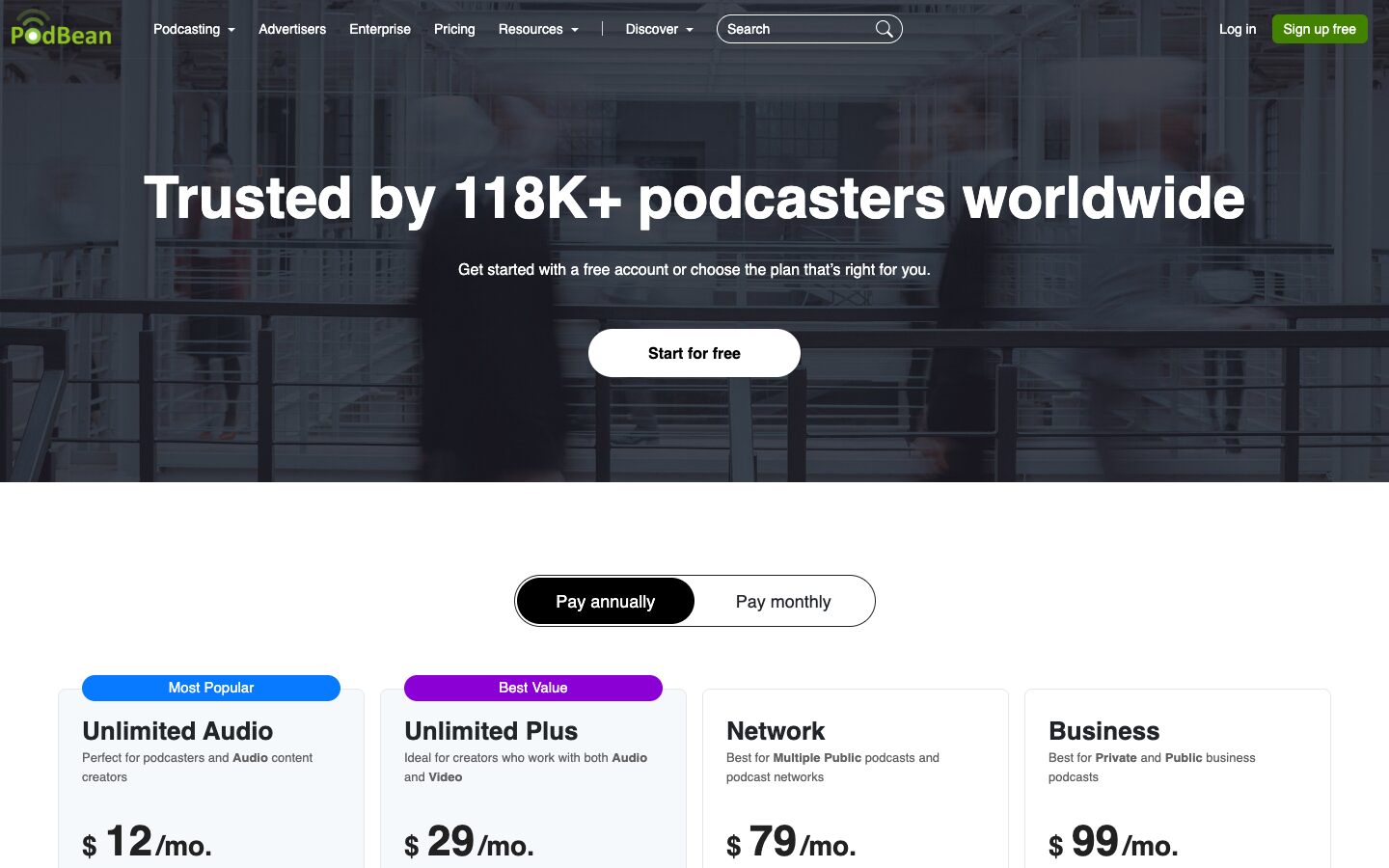
| Plan | Annual-equivalent / mo | Month-to-month | Practical limit |
|---|---|---|---|
| Basic Free | Free | Free | 500 MB lifetime storage |
| Unlimited Audio | $12 | $17 | 1 GB uploads / month |
| Unlimited Plus | $29 | $39 | 10 GB uploads / month, two podcasts |
| Network | $79 | $99 | 40 GB uploads, 3 TB bandwidth |
| Business | $99 | $129 | 40 GB uploads, 100 private members |
💰 Podbean Free Plan: The Critical Lifetime Limit
The Podbean free plan is worth examining because its storage limit does not renew every month. The official support article states a total allowance of five hours or 500 MB, 100 GB of monthly bandwidth, a maximum of three episodes published per day, a maximum file size of 100 MB and only 20 episodes displayed in the RSS feed. Audio is restricted to specified MP3 and M4A formats. Consider a 45-minute weekly interview. Six episodes already use 4.5 hours of the Free plan’s five-hour lifetime allowance; a seventh would exceed it even when the files are far below 500 MB. The producer should plan for whichever limit is reached first. Free is a useful pilot, not unlimited perpetual hosting.
🔎 Podbean Unlimited Audio: One Audio Show
Podbean Unlimited Audio is marketed for audio podcasting, with a 1 GB monthly upload allocation, unlimited total storage and unmetered bandwidth under the plan terms. Podbean estimates about 16 hours of audio within the 1 GB monthly upload allowance. At 128 kbps, one hour of MP3 audio uses roughly 58 MB; a higher bitrate or embedded media changes the calculation. Record the actual exported bytes rather than assuming the marketing hour estimate fits every episode. A solo interviewer releasing four episodes a month should calculate the actual export sizes rather than use the hour estimate blindly. The value of this tier is predictable publishing for one audio show without the Basic plan’s small lifetime storage ceiling.
🔎 Podbean Unlimited Plus: Video and Two Feeds
Podbean Unlimited Plus is positioned for audio and video creators and lists two podcast channels and a 10 GB monthly upload allocation. The official page gives a rough guide of 160 hours of audio or ten hours of video, which is not a guaranteed duration at all bitrates. An HD video episode may occupy several gigabytes by itself. For a creator who publishes audio and a separate video feed, count both against the relevant plan allowances. Check which directories accept video podcasts in the intended format before assuming all subscribers will receive both versions.
🔎 Podbean Network: Public Podcast Portfolio
A network with several shows has different needs from one hobby feed. Podbean Network lists unlimited audio/video podcasts, a 40 GB monthly upload allocation, 3 TB monthly bandwidth, network-level statistics and up to 50 team members. A production company should examine whether its monthly archive release schedule fits the upload quota and whether aggregate traffic could exceed the network bandwidth term. Permissions and show-level ownership matter: the creator of one interview series should not automatically have publishing control over an unrelated client show.
📡 Podbean Business: Private Podcast Distribution
Podbean Business supports private podcast use cases and advertises unlimited private plus two public shows, a 40 GB monthly upload allocation, 100 private members, SSO and organization-oriented security controls. It is aimed at companies distributing training, leadership updates or internal audio beyond the public podcast directory model. The 100-member allowance is a planning limit, not a promise of unrestricted enterprise audience size. Organizations should confirm identity management, content retention, access revocation, bandwidth and whether listeners can download material outside a managed environment.
📡 Podbean RSS Feed and Directory Submission
A Podbean RSS feed carries the episode media URL, title, metadata and podcast identity that listening platforms use to ingest shows. This does not mean the host can force immediate directory approval or perfect synchronization. Each directory may have its own account verification, content policy and update delay. Keep a list of approved feeds and ownership credentials. Before changing artwork or episode titles, allow for caches and verify on at least two listening platforms. RSS ownership is a valuable asset; do not submit a temporary test feed to a public directory without a migration plan.
| Item | Free | Unlimited Audio | Unlimited Plus |
|---|---|---|---|
| Storage | 500 MB total | Unlimited total | Unlimited total |
| Monthly uploads | Lifetime 500 MB | 1 GB | 10 GB |
| Bandwidth | 100 GB / month | Unmetered | Unmetered |
| Video | No guaranteed video podcast | Audio podcast | Audio and video |
| Episodes | Up to 3/day; RSS shows 20 | Subject to terms | Subject to terms |
📡 Podbean Podcast Distribution and One-Click Tools
Podbean podcast distribution tools simplify some directory submissions, but the producer remains accountable for category choices, language, explicit content labels, episode dates and the descriptions listeners read. Publishing one click too soon can send the wrong audio to every subscriber. Build a preflight checklist that includes listening to the beginning and end of the export, checking an accessible transcript and validating artwork dimensions. After publication, inspect the feed and directory entry rather than assuming every third-party service has refreshed.
📈 Podbean Analytics: Downloads and Meaningful Reach
Podbean analytics can provide insight into consumption trends, platform mix and episode performance, but downloaded media does not always equal a unique human listener or a completed listen. Automated downloads, caching and different measurement standards complicate interpretation. Use consistent periods and definitions when comparing seasons. A sponsor report should distinguish host-reported downloads from survey responses, purchases and confirmed conversions. A successful episode may have a smaller listener base that consistently completes a useful technical segment rather than a larger count of disengaged background downloads.
💳 Podbean Podcast Monetization and Sponsorships
Podbean podcast monetization includes vendor-described advertising and other creator revenue options, subject to eligibility and program rules. The existence of a monetization button does not guarantee sponsor demand, a particular ad rate or minimum viable earnings. A creator should document downloads by market, listener geography, content exclusions, brand suitability and the permission to insert advertising into licensed material. Paid supporter models introduce subscription and fulfillment obligations. Evaluate each revenue stream after fees and the administrative effort needed to deliver the promised audience value.
🔎 Podbean Site, Embed Player and Custom Domain
Podbean plans include an episode website and embed player features, with some tiers supporting more flexible branding. A show website can make episodes discoverable outside listening apps and provide accessible notes, links and transcripts. However, the publisher should decide which website is the canonical home for SEO and whether duplicated episode descriptions create weak or competing pages. Test the player on mobile, check loading performance and make sure embedded playback does not block cookie preferences or obscure essential navigation. An expensive theme cannot rescue low-quality audio.
🎬 Podbean AI Credits and Production Assist
The pricing table shows AI credit allocations: Unlimited Audio with 600, Unlimited Plus with 2,400, and Network/Business with 6,000 in their respective tiers. The meaning of an AI credit and which tasks consume it require review of the current vendor policy. Do not equate an allocation with a guaranteed number of fully transcribed episodes or assume every generated summary is factually accurate. Human editors should review names, claims, sponsor language and sensitive remarks. An AI-produced title can accelerate drafting but should not replace listening to the recorded conversation.
📡 Podbean Upload Quotas and Audio Bitrate Math
An audio podcast can appear modest in minutes and still exceed a quota if files use unnecessarily high bitrate or include duplicate exports. Duration estimates on a pricing page depend on compression assumptions. For a sixty-minute MP3 exported at a constant 128 kbps, a rough order of magnitude is about 58 MB, excluding metadata. Four such episodes are around 232 MB, far under a 1 GB monthly limit; an uncompressed WAV can be far larger. Always calculate from the actual export file and include artwork or companion media where applicable.
🔐 Private Podcast Security and Membership Lifecycle
Restricting a private RSS feed does not stop an authorized listener from recording the playback or retaining a previously downloaded file. For employee training, test revocation in the real apps and limit what confidential material is recorded in the first place. An authenticated listener can often record or forward audio outside the player, while RSS link sharing and client behavior depend on the host’s implementation. A company should define membership approval, expiration, offboarding and what happens to downloaded copies. Test a revoked user account on the actual mobile applications rather than assuming a dashboard status removes previously downloaded files. Training podcasts also need accurate versions so outdated policies are not presented as current instructions.
Podbean private podcasts require a documented listener-offboarding plan and realistic expectations about the limits of controlling recordings once a file reaches an authorized device.
| Use case | Likely tier | Must verify |
|---|---|---|
| Short podcast pilot | Basic Free | Lifetime storage and format limits |
| Solo audio show | Unlimited Audio | Monthly export size |
| Video and audio feeds | Unlimited Plus | Feed count and video capacity |
| Public production network | Network | 3 TB traffic and team rights |
| Internal member content | Business | SSO and private-member count |
🔎 Migration from a Previous Podcast Host
Moving from another host requires careful RSS control. The publisher should inventory existing episode GUIDs, media URLs, artwork, analytics history and directory ownership. Where a redirect is supported, check the old host’s instructions and monitor the transition before cancelling service. During migration, changing an existing episode’s GUID can make listening apps treat it as a new episode, while failing to redirect the old RSS feed can leave subscribers behind. Verify both identifiers and redirect behavior before cancelling the previous host. Keep a backup export and check that the new host presents the expected publication dates. The least disruptive move often includes a temporary period of overlap.
⚖️ Podbean vs Buzzsprout and Spotify for Creators
A Podbean vs Buzzsprout comparison should normalize what each provider counts: uploaded hours, storage, download bandwidth, video, team access and monetization conditions. Spotify for Creators may serve a different audience strategy and publishing workflow. A fair test imports one representative episode into each service, checks the resulting RSS metadata, listens through multiple players and verifies migration instructions. Focus on ownership of the feed and operational flexibility rather than a single attractive promotional price.
⚖️ Podbean vs Ecamm and Descript: Different Stages
Podbean, Ecamm Live and Descript do not compete for exactly the same role. Ecamm can capture a live interview, Descript can help edit speech-driven recording, and Podbean hosts the resulting episode and manages distribution. An all-in-one promise deserves scrutiny because the editor, distribution host and live producer handle different failure modes. A show might have perfect hosting but clipped microphone audio. Review equipment, editing tools and hosting as a sequence, then budget each part separately.
🎬 Podcast Production Workflow: From Recording to Publishing
For a recurring show, use a consistent episode folder containing consent notes, original recordings, an edited master, artwork and final MP3. Assign one person to listen to the entire final export and another to verify metadata before release. Schedule an episode only after obtaining rights and checking required disclosures. Once Podbean publishes the media, verify the RSS enclosure URL, the directory entry and playback on a phone without being signed into the publishing account. Maintain a change log for replaced files and corrected claims.
🔎 Editorial Fit: Best Reasons to Upgrade
Podbean becomes compelling when the creator needs dependable hosting beyond the small free allowance, a published RSS feed, useful analytics or multiple media formats. But an upgrade should match a measured limit: the actual upload total, number of channels, need for private episodes or collaboration access. A one-person audio show rarely needs Business simply because it is labeled professional. Verify monthly versus annual commitment and the feasibility of exporting the podcast later. The long-term value of a host includes the ability to leave without losing subscribers.
| Tool | Stage | Key distinction |
|---|---|---|
| Ecamm Live | Recording and live production | Does not replace RSS hosting |
| Descript | Speech-first editing | No automatic guarantee of directory ownership |
| OBS Studio | Capture and streaming | Separate postproduction/host needed |
| Podbean | Hosting and publishing | No substitute for recording quality |
🔎 Real-World Use Cases and Decision Tests
The Podbean scenarios model the choices faced by solo hosts, production agencies and organizations publishing private audio. We did not run a real subscriber migration or test a protected corporate feed. Instead, each situation identifies what should be observed before subscribing: exported media size, podcast count, feed ownership, membership revocation and how the chosen analytics define a download. That checklist gives publishers a way to compare providers without trusting unverifiable reach promises.
1. A weekly thirty-minute interview podcast
Four interviews per month might occupy only a few hundred megabytes at a sensible MP3 export setting. The Basic free lifetime five-hour cap still becomes the limiting factor within a few months. Unlimited Audio may be enough if the creator distributes one audio feed. Before upgrading, inspect real exported file sizes and determine whether the host must also support video clips.
A simple storage worksheet can eliminate the temptation to buy too much hosting. Record one representative MP3 export, calculate the expected number of uploads in three months and compare the result with the lifetime Free limit. A trial that publishes only an introduction and one trailer may appear to have ample space, but the remaining lifetime allowance can disappear quickly once weekly interviews begin. Include the feed’s episode-display limit in the decision.
2. A video show with two versions of each episode
A host wants a public audio feed and a separate video edition. Podbean Unlimited Plus supports two audio/video podcasts and has a larger monthly upload allowance, but ten gigabytes is not infinite video storage throughput. Estimate full-resolution export sizes, avoid uploading duplicate test renders and verify the video format expected by target listeners. Audio subscribers should not be forced to download enormous files unintentionally.
Publish the audio and video feeds with separately verified metadata. Video bitrate, artwork and audience playback preferences matter more than generic hours-equivalent figures. A ten-gigabyte allowance could host many compressed audio recordings but only a few high-resolution video files. Keep an archive outside the hosting account before publishing. If one directory rejects the video format, provide a supported audio version rather than assuming the host can change another platform’s rules.
3. An agency operates six customer podcasts
An agency managing unrelated clients needs feed separation, ownership controls and a consistent publishing process. A network-tier plan may suit multiple public feeds, yet client access, monthly downloads and team-seat policies need explicit review. Provide each client with a documented export and transfer pathway in case the agency relationship ends. No sponsor reporting should mix audience numbers across competing customer shows without permission.
Service providers should agree on who legally owns each feed, directory account and artwork before onboarding a client. A network-level login should not become the single shared password for every project. Create separate publishing responsibilities and prepare an export procedure for departing customers. Check how aggregated analytics are separated so reports cannot disclose another client’s activity. A lower headline rate may be irrelevant if team-level controls create costly manual work.
4. An internal training podcast for a distributed company
The company needs staff-only episodes on onboarding procedures and product changes. Podbean Business presents private-feed and member-management features, but the number of eligible listeners, SSO requirements and controls on downloaded content are crucial. Test a newly added employee, an offboarded employee and a user with an expired invitation. Keep revision dates visible so staff know whether an episode is superseded.
Private audio should be treated as restricted communication, not absolute DRM protection. Review the risk that a listener records material on another device or saves a downloaded copy. The organization should keep confidential data out of the recording unless it has a sound reason to include it. Use a clear revision and takedown policy for changing internal procedures, and test how member expiration behaves in the actual mobile listening application.
5. A show receives a sudden spike from a news mention
A high-profile mention may multiply episode downloads in one day. Verify how the hosting plan handles bandwidth at that scale, including the difference between unmetered and specified monthly limits. Review what the analytics actually count and compare with referral or subscription evidence. Do not promise sponsors a fixed number of listens based only on a spike in downloaded files.
When downloads increase suddenly, check whether the host counts automated requests, app caching and repeated downloads consistently. A marketing spike can temporarily distort averages. Reporting should use clearly defined windows, separate unique subscribers where available and avoid claims about completion rates unsupported by the analytics. If bandwidth caps apply to the selected network tier, track usage against a practical alert threshold rather than discovering the limit at the end of a campaign.
6. Moving five years of episodes to a new host
The publisher should export all original audio, keep historical episode identifiers and confirm directory ownership. Plan redirects from the old RSS feed with the vendor’s documented procedure. Test the oldest, newest and a random middle episode after migration, including embedded players on the publisher’s website. Do not cancel the old account until redirect behavior and expected audience access have been verified.
Subscriber continuity is more important than the aesthetics of the new episode page. Verify the feed title, author information, old GUIDs and redirects while both services are still accessible. A team should check playback for a long-standing subscriber and a newly subscribed listener, because they may rely on different cached feed addresses. Keep written proof of what was migrated and when the old account may safely be closed.
7. A creator evaluates AI episode summaries
An automatic draft can save time on show notes but may invent quotations or misattribute claims. Assign an editor to check proper names, links, dates and whether a guest explicitly approved a sensitive statement. Keep AI credit usage within the selected plan and note any extra tool costs. High-quality written notes can help discoverability, but their accuracy takes priority over publishing speed.
AI-generated descriptions should be a drafting aid with accountable editorial review. A summary can misstate the guest’s opinion, omit a sponsor disclosure or fabricate a resource mentioned in the conversation. Compare every specific claim with the audio before publishing and watch the plan’s AI credit consumption. A useful show note includes timestamps and verified links, not simply a long paraphrase of the transcript.
8. A podcast website already runs on WordPress
The creator may prefer to keep a WordPress site as the public home while Podbean hosts media and RSS. Embed the player without replicating every paragraph into an indexable duplicate; create useful, original episode notes instead. Confirm that analytics and cookie settings respect site policy. Ensure the canonical podcast home and submission URL remain stable even if the site theme changes.
Choose one canonical location for the episode’s valuable explanatory material. A WordPress site may host full transcripts and unique resources, while Podbean provides media delivery and RSS. Ensure embeds load on mobile and that privacy choices are respected. Keep the podcast’s public identity consistent across both domains without publishing identical boilerplate across dozens of URLs. A duplicate page strategy can make analytics and search indexing confusing.
9. A creator launches a limited ten-episode season
A limited run may fit the free plan only if its compressed total length and file sizes stay under the lifetime allowance. Calculate the planned series first, including trailers and corrections. If there is any chance the show will continue for years, evaluate the cost of Unlimited Audio rather than designing its entire release plan around a small pilot limit.
10. A podcast has listeners on several continents
Verify that the CDN and listening directories deliver episodes acceptably in representative regions. A single office speed test does not establish global experience. Ask several listeners to report actual buffering and playback behavior, while checking host statistics for platform mix and transfer demand. Do not infer a specific geographic listenership merely from a few downloaded files.
11. An editor needs to replace an episode after publication
Correcting a factual error may require a fresh upload or revised metadata. The publisher should document what changed, whether the episode’s RSS identifier stays stable and how caches update. A silent replacement can confuse listeners who have downloaded the older version. Where appropriate, add a correction note and communicate the change clearly.
12. A paid private podcast offers professional training
Subscribers expect reliable access to current lessons and a clear privacy policy. Decide how the company handles refunds, expiration, downloads and support when an authentication link fails. Test the listening experience on at least one iOS and one Android client before advertising compatibility. Security controls at the host do not override the company’s contractual obligations to members.
13. A public podcast contains music from a collaborator
Permission to record a musician for an interview does not automatically include rights to publish the performance in a commercial feed. Obtain clear authorization for excerpts, background tracks and future sponsor insertion. Keep that record attached to the episode production folder. Hosting a file successfully is not proof that the publisher owns the underlying audio rights.
🔎 Research Methodology and Limitations
This review is based on public Podbean pricing pages, hosting descriptions and a dated support article for the Basic plan. No authenticated podcast migration, subscriber download test or private-membership security assessment was conducted for this article. The plan figures were checked in October 2026 but may change by region, currency, feature availability or promotion. Described bandwidth and upload limits are vendor-stated policy rather than performance benchmarks. A prospective buyer should validate the actual checkout terms and test an episode before committing a production archive.
📚 Official Sources and Further Reading
Podbean’s public pricing table describes Unlimited Audio, Unlimited Plus, Network and Business; support documentation explains the free storage and publishing restrictions. Producers should refer to current RSS migration and directory guidance before moving a live feed. For listening analytics, compare platform-specific measurement definitions rather than treating different dashboards as interchangeable. When choosing a private podcast platform, obtain documentation about access revocation, data retention and downloaded file behavior from the provider. This article links to the sources used so readers can verify their own requirements.
This Podbean assessment is grounded in the company’s hosting-pricing table and its written Basic Free plan limits. October 2026 prices distinguish annual-equivalent from month-to-month charges. Media formats, member quotas and feed-management procedures must still be checked for the selected account. Public screenshots and support pages can verify stated restrictions; they cannot prove how a real listener’s app behaves after access revocation.
- Podbean official source 1
- Podbean official source 2
- Podbean official source 3
- Podbean official source 4

Frequently Asked Questions
Does Podbean offer a free plan?
Yes. The documented Basic plan has five hours or 500 MB of total lifetime storage, not a fresh allowance every month, plus limits on bandwidth, file size, episode frequency and RSS display. It is appropriate for a short pilot.
How much does Podbean cost in 2026?
The public page lists Unlimited Audio at $12 annual-equivalent or $17 monthly, Unlimited Plus at $29 or $39, Network at $79 or $99, and Business at $99 or $129. Confirm currency and annual commitment.
What is the difference between Unlimited Audio and Unlimited Plus?
Unlimited Audio is oriented toward an audio podcast with a 1 GB monthly upload cap; Unlimited Plus adds audio/video support for two feeds and a 10 GB monthly upload cap. Actual duration depends on encoding.
Is Podbean unlimited storage really unlimited?
Paid plans advertise unlimited total storage, while separate monthly upload allocations and bandwidth terms still apply. Never interpret the word unlimited as the absence of every capacity or fair-use restriction.
Can Podbean host video podcasts?
Unlimited Plus and certain higher tiers include video podcast options. Video delivery and directory compatibility depend on the platform and file format, so confirm requirements before uploading large files.
Does Podbean distribute episodes to Spotify and Apple Podcasts?
Podbean publishes RSS feeds and offers directory submission workflows. Account approval, timing and distribution rules remain under the control of each listening platform.
Does Podbean show podcast analytics?
Paid offerings include various analytics. Downloads and geographic counts need interpretation; they are not guaranteed unique human listeners or complete listening sessions.
Can I monetize a podcast on Podbean?
Podbean advertises creator monetization and advertising-related features, subject to program rules. Revenue and sponsor eligibility are not guaranteed. Review fees, geographic support and disclosure obligations.
Does Podbean support private corporate podcasts?
The Business offering includes private podcast features, membership access and SSO-related controls. Confirm how downloads, membership revocation and archival retention work for your organization.
How do I move an existing podcast to Podbean?
Plan an RSS migration with the old and new hosting providers. Preserve episode identity, inspect the feed, configure any supported redirect and test playback before cancelling the prior account.
Is Podbean better than Buzzsprout?
It depends on monthly upload size, team access, video needs, network scale and migration requirements. Compare a representative episode and the full recurring bill, not just each host’s entry price.
EXPLORE NEXT ON DIGIOFFLY
🔍 Explore More on DigiOffly
Compare production, editing, distribution and creator software based on actual workflow needs, not marketing promises.
Category and editorial
- Creator & Streaming — Compare workflows and practical limits
- Software Directory — Compare workflows and practical limits
- Ready-Made Stacks — Compare workflows and practical limits
Selection tools
- Compare Software — Compare workflows and practical limits
- AI Software Finder — Compare workflows and practical limits
- Software Cost Calculator — Compare workflows and practical limits
Related reviews
- OBS Studio — Compare workflows and practical limits
- VEED — Compare workflows and practical limits
- Loom — Compare workflows and practical limits
- Adobe Premiere Pro — Compare workflows and practical limits
- Ecamm Live — Mac-focused live video, interviews, scenes and isolated recording
- ElevenLabs review — Compare AI voice generation, speech quality and voice-cloning limits for creator workflows.
Prices and feature access can change. Check current vendor terms before buying.