

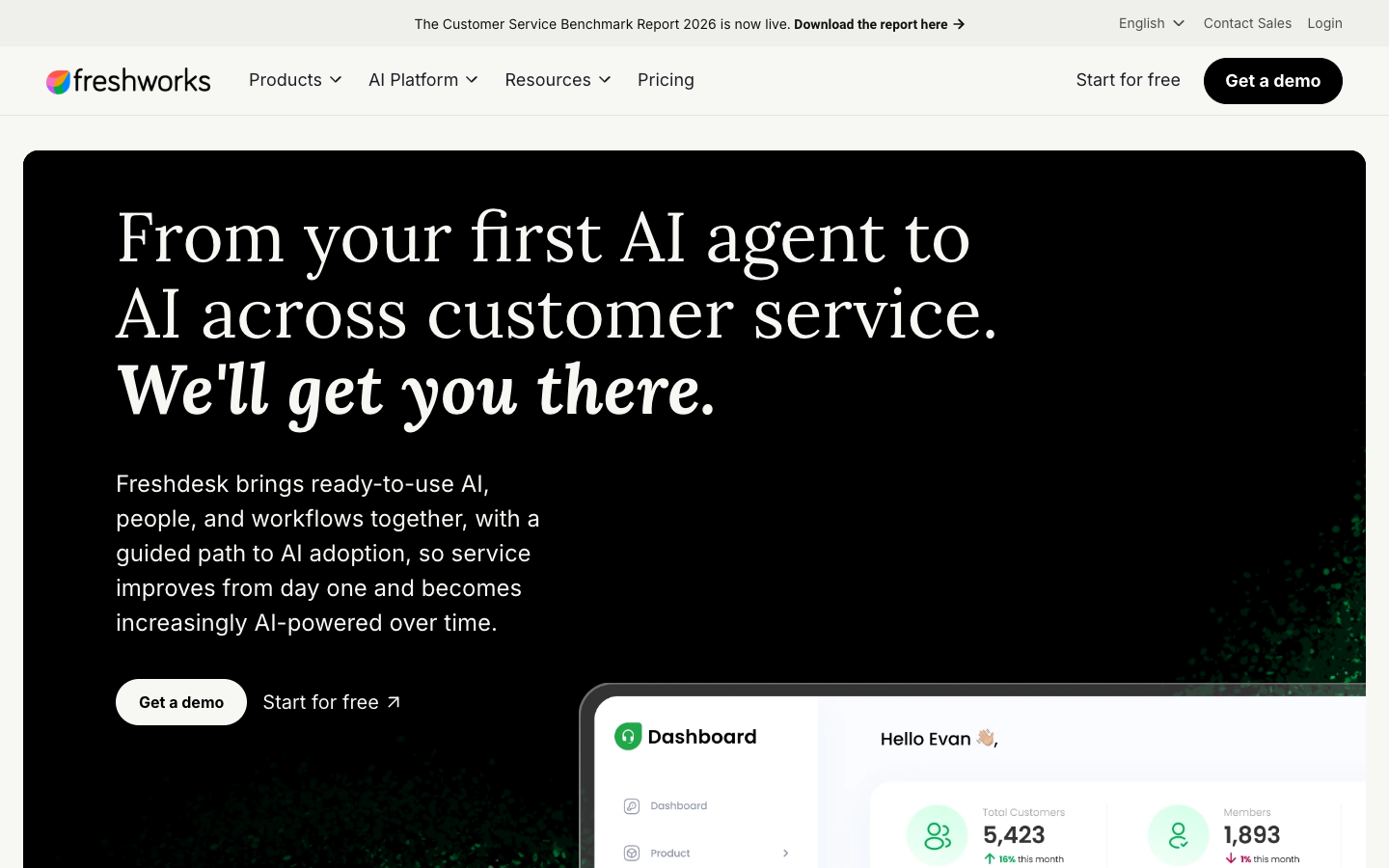
The first procurement decision is whether a team needs basic email tickets or additional channels, not just which entry price looks cheapest. Freshdesk is easy to notice in helpdesk shortlists because its Growth plan has a relatively accessible annual seat price. Beyond its entry price, the key decisions are the support channels you need and which AI or connector usage units a contract would bill separately. This review looks at Freshdesk from the perspective of a support lead who has to staff it, maintain it and explain the bill.
📊 Freshdesk Review 2026: Summary
Verdict: Freshdesk is worth evaluating for organizations that want structured email ticketing and a path to richer automation without immediately buying a broad enterprise suite. The main traps are confusing Freshdesk and Omni, misunderstanding AI allowances and selecting an inexpensive plan that lacks the required routing or SLAs.
Best for: Teams managing several email queues that need clear ownership, searchable help articles and measurable escalation rules.
Less suitable for: A company that assumes one low per-agent fee automatically includes all messaging channels, advanced Freddy AI, unlimited automations and complex SLA features.
💰 Freshdesk Pricing, Plans and Cost Structure
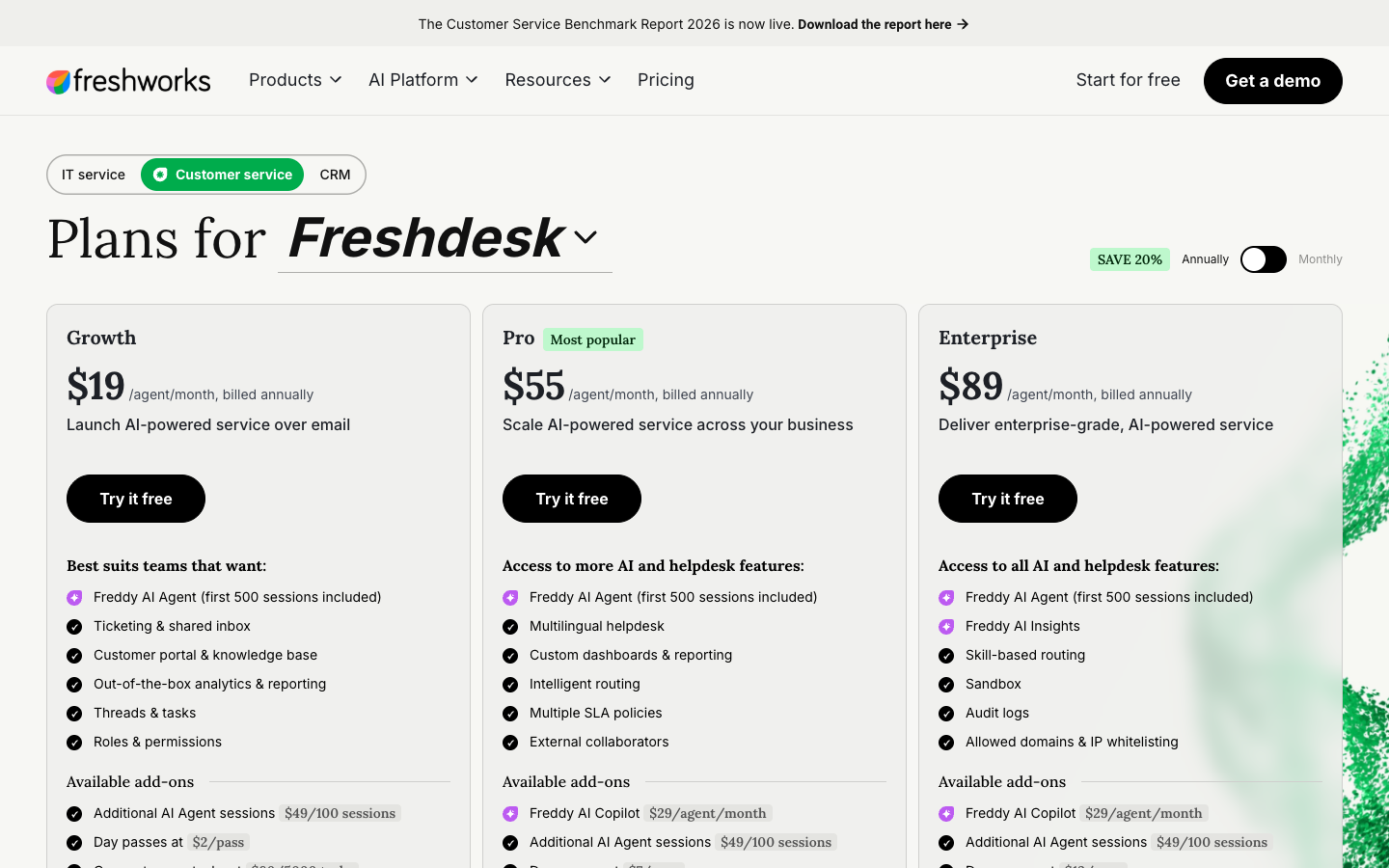
These published US prices apply to the Freshdesk ticketing product, not automatically to Freshdesk Omni. Freddy AI Agent sessions, Copilot seats and connector usage may add separate charges, with annual rates shown as monthly equivalents. Source: official Freshdesk pricing.
| Plan | US pricing reference | Core focus | Important caveat |
|---|---|---|---|
| Growth | $19 / agent / month, annual | Ticketing, shared inbox, portal, articles and reports | Freddy AI session allowances apply |
| Pro | $55 / agent / month, annual | Intelligent routing, multilingual helpdesk, multiple SLAs | Optional Freddy AI Copilot quoted separately |
| Enterprise | $89 / agent / month, annual | Skills-based routing, sandbox, audit logs and stronger security | Request written configuration and overage terms |
| Freshdesk Omni | Separate product and prices | Broader omnichannel support offering | Do not confuse Omni plans with Freshdesk Support Desk |
Freshdesk Growth vs Pro vs Enterprise
| Capability | Growth | Pro | Enterprise |
|---|---|---|---|
| Email ticketing and shared inbox | Included | Included | Included |
| Knowledge base and customer portal | Included | Included | Included |
| Intelligent routing | Core routing | Included | Skills-based options |
| SLA policy configuration | Entry scope | Multiple SLAs | Advanced governance |
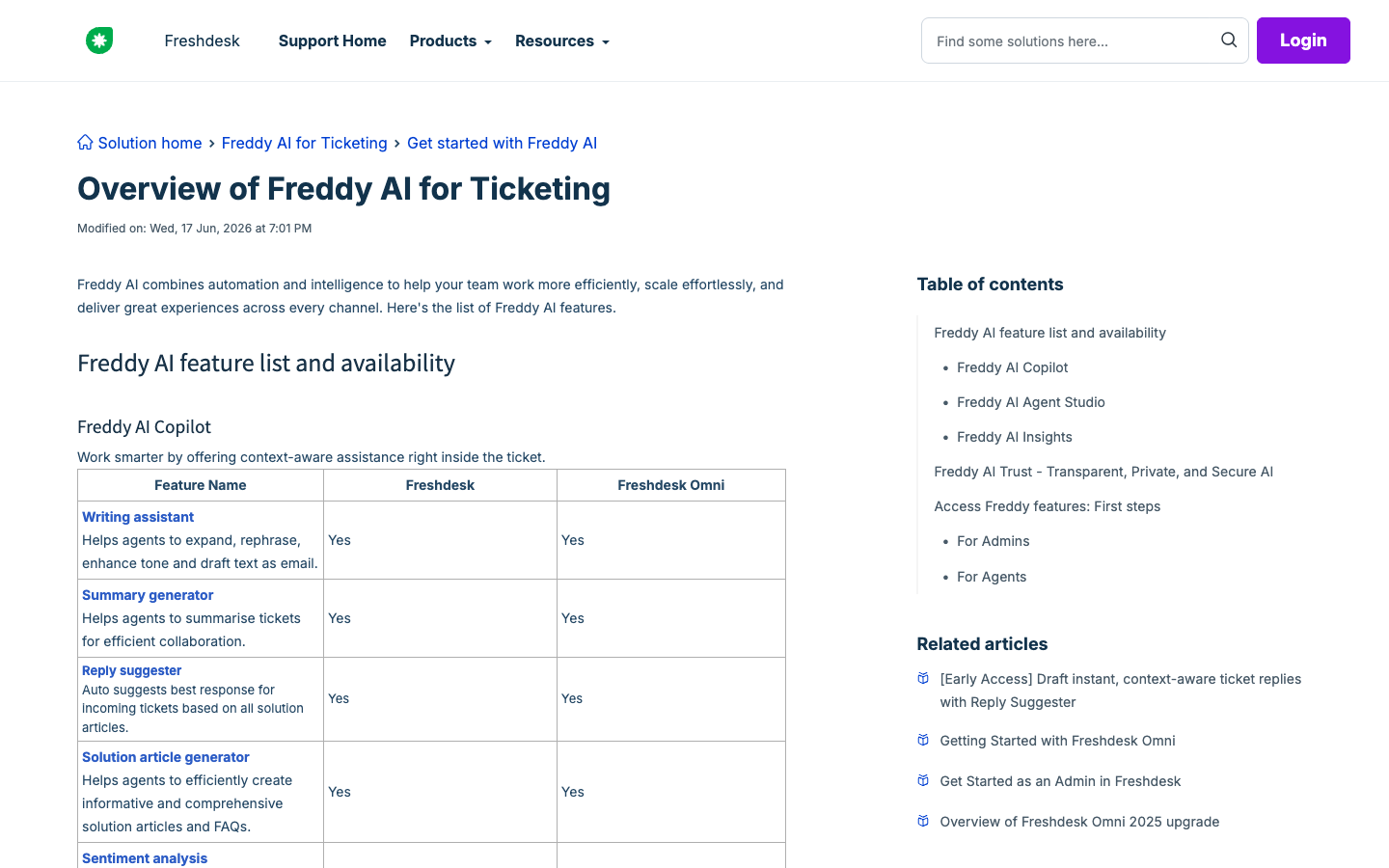
| Freddy AI Agent | First 500 sessions listed | First 500 sessions listed | First 500 sessions listed |
| Freddy AI Copilot | Check eligibility | Paid add-on | Paid add-on |
| Annual USD rate per agent/mo | $19 | $55 | $89 |
⚡ Quick Verdict: When Freshdesk Is Worth Considering
The most sensible Freshdesk starting point is an email team that has outgrown shared mailboxes but does not need every live channel. Growth provides tickets, a customer portal and a knowledge base. Pro becomes more interesting when the queue uses multilingual support, more sophisticated routing or multiple SLA policies. Enterprise is the plan to investigate when skills-based assignments or stronger governance are part of the actual operating model.
The decisive question is whether support employees can use the ticket’s history to resolve a returning customer request without losing context. A straightforward demonstration would assign a billing case, transfer it to a product specialist and then reopen it when the customer replies after two days. If the team also needs messaging, request a separate Freshdesk Omni quote rather than assuming that the Growth seat covers it. A Freshdesk shared inbox migration should also confirm that the primary support address remains recognizable to customers when messages are turned into tickets.
🧭 Freshdesk starts with a persistent ticket record
Freshdesk converts inbound service requests into cases a team can assign, prioritize and resolve. The value is not that a message gets an ID, but that every agent can see the expected next step and preserve a single customer history. A business graduating from a general inbox should first agree on ticket status definitions and ownership so that the new queue does not merely formalize existing delays. A Freshdesk ticketing workflow depends on email threading: a reply to a resolved conversation should return to its existing ticket ID with its attachments and original requester, rather than appearing as a new orphaned ticket.
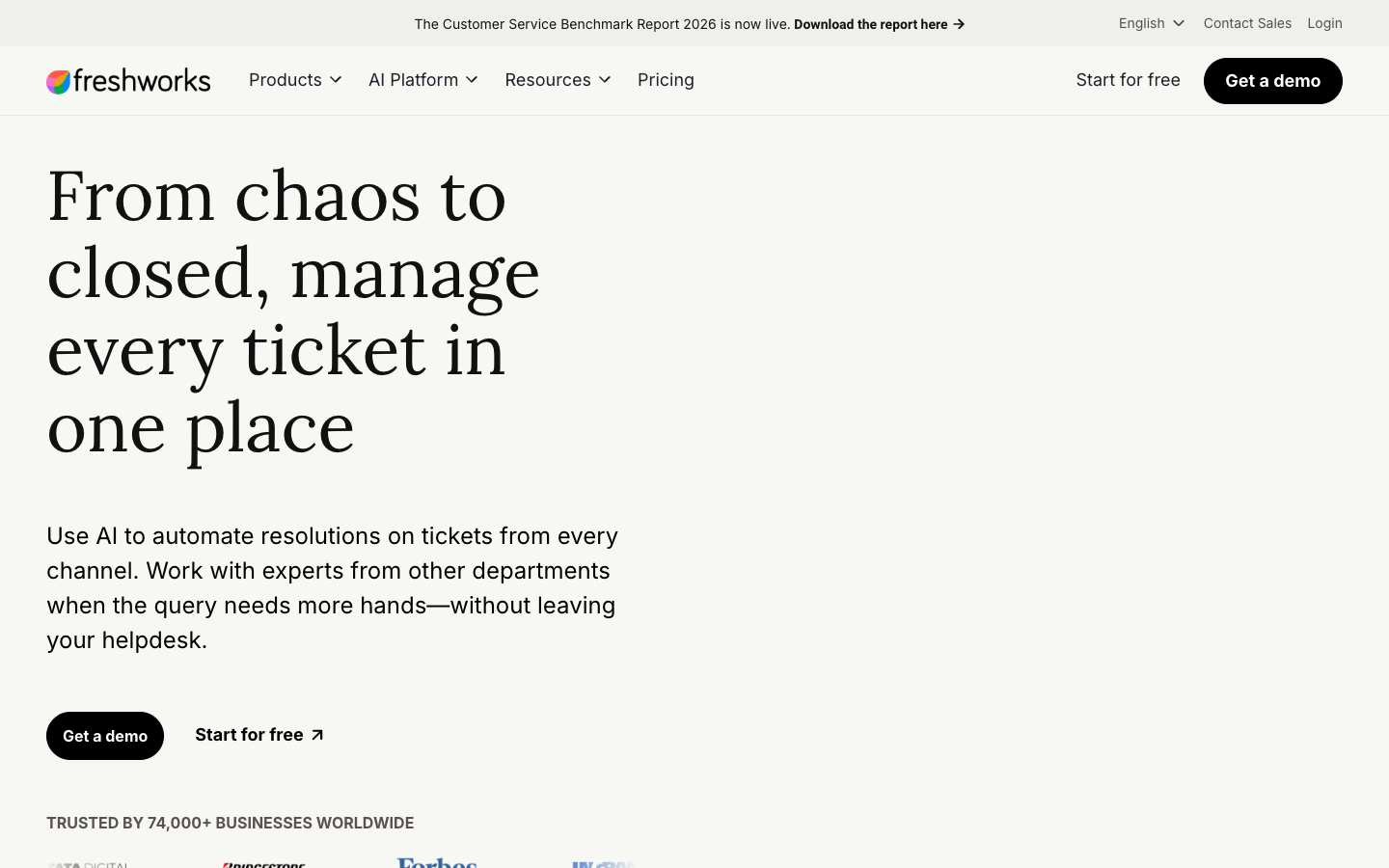
Freshdesk is most useful when a company stops treating each support email as an isolated exchange. Imagine one customer asking about a recurring account error, then replying with another screenshot two days later. The case should return to the right queue with its ownership and earlier context intact. A pilot should trace that lifecycle from first arrival to a confirmed answer, including what happens if the assigned agent is away. This proves more than the presence of an attractive ticket list.
🏷️ Freshdesk and Freshdesk Omni are distinct purchases
Freshworks sells Freshdesk for the ticketing and email-support motion and Freshdesk Omni for broader service channels. Pricing and what counts as a configured channel differ. A buyer who demos WhatsApp conversations or sophisticated live chat should check whether that functionality belongs to Omni rather than the $19 Freshdesk Growth tier; the cheapest published Freshdesk number is not a universal omnichannel quote. Freshdesk Omni pricing should be requested separately if the pilot relies on live messaging rather than email tickets alone.
Concrete routing exercise: Set up an email queue for two regional support groups with different business-hour calendars. Send one test request about an order delay, assign it to a specialist, and send a customer follow-up after hours. Check whether the original email thread remains intact, the service-level clock follows the correct regional policy and a responder can view shipping status without receiving payment-edit permissions. Record each assignment event and timestamp. If the case appears in two groups, inspect the automation conditions rather than altering priority labels merely to make a report look better. Repeat the scenario with the second group offline. This checks the practical behavior of the purchased routing tier and creates a reproducible acceptance test before moving a real support address into production.
Freshdesk Growth is not a promise that every Freshworks channel appears in one low-cost subscription. Standalone Freshdesk focuses on ticketing and email-oriented support, while Freshdesk Omni is a distinct line for a broader set of channels. When writing a comparison sheet, list each channel the business operates and have the seller mark which product is actually required. Otherwise a sales demonstration involving live messaging can quietly become a budget based on an entry ticketing plan that cannot run that workflow.
💰 Growth, Pro and Enterprise seat economics
The pricing table shows the currently advertised annual-billing rates. The larger purchase decision is whether Pro routing and reporting or Enterprise-level controls solve problems that Growth cannot handle. A monthly contract, taxes and AI add-ons will change the invoice. Use actual agents who answer cases as the seat baseline, then price external collaborators, short-term agents and permission-limited stakeholders with the current vendor terms. Freshdesk Growth plan features include a customer portal, shared inbox and knowledge base. Advanced routing and multiple SLA policies belong in the Pro comparison, so the tier choice depends on whether a queue truly needs those capabilities.
Freshdesk’s annual pricing references make the first calculation straightforward: Growth, Pro and Enterprise have separate per-agent amounts. The harder calculation is the real roster, including agents who work shifts, managers needing approval rights and people who collaborate without independently answering customers. Add AI session packs, eligible Copilot seats, connector actions and taxes only after checking the actual contract. A fixed annual seat commitment can create cash and cancellation risk even when the monthly equivalent looks modest.
🔄 The limited free program is not permanent zero cost
Freshdesk has advertised a Free Program for very small teams that lasts a limited period, with eligibility and agent limits. That is different from an unrestricted lifetime free plan. For a two-agent startup, the useful question is which ticket history, routing logic and knowledge assets can be exported if the team does not upgrade after the initial period.
A ticket assignment rule in Freshdesk should be treated as a business procedure that can be tested. For example, a customer may send a complaint about a missing refund but mention a product bug in the same email. A keyword rule that assigns the request to engineering without involving payments could prolong the complaint. Try a mixed-topic message and a case reopened after resolution. Review when multiple automations run and whether the user receives conflicting acknowledgements or duplicate case numbers.
🤖 Freddy AI Agent sessions are a separate meter
On the Freshdesk pricing page, Freddy AI Agent starts with a stated allocation of 500 sessions on the listed paid plans; additional sessions are quoted at $49 per 100. That meter is separate from the number of human-agent seats. If a help center sends the same customer back to the bot several times during an outage, session consumption may behave differently from the number of genuinely solved questions.
Record sessions by request type and review whether the underlying issue was solved. A trial with 100 account-access questions and 100 product-documentation questions can reveal whether the bot is useful where an authenticated action is required. Do not project savings from a session count without establishing the human handoff and outcome quality. Freddy AI Agent session allowances should be reconciled with the provider’s event records when a customer repeats a request after the bot hands over to a human.
📚 Freddy AI Copilot is a different purchase
Freddy AI Copilot is listed as a $29 per agent per month add-on on eligible Pro and Enterprise plans in the annual view. Its agent-assist role differs from customer-facing AI Agent sessions. Before subscribing, show a real ticket that benefits from summaries, drafting or assistance and decide whether Copilot saves enough labor without reducing message accuracy or requiring extra review. A customer portal setup for support should verify that authenticated customers can locate their earlier Freshdesk requests and read the correct language version of an article.
Growth’s customer portal and knowledge-base tools can support self-service, but the useful unit is the customer answer, not the article published. Set ownership for each policy page and give articles a clear update path when the app changes. If Freshdesk suggests help content inside a ticket flow, test whether it surfaces the correct language and access level. A customer following out-of-date steps may create another ticket, increasing the very workload the portal was supposed to reduce.
⏱️ Customer portals and knowledge articles
Freshdesk Growth includes knowledge-base and customer portal capabilities intended to reduce repeated requests. That does not automatically mean customers will find the answer. Article search and portal permissions matter most during a product incident, when customers may arrive with different languages and authorization states and an outdated page can multiply support volume. Assign article ownership just as carefully as ticket ownership. Freshdesk Pro SLA policies become valuable when a team needs separate response targets for different priorities or customers.
Freshdesk routing gains value when service schedules, priority and escalation rules are defined in advance. Pro’s more advanced SLA and reporting scope can be appropriate for a team with multiple service classes, while Enterprise adds still more specialized controls. Test a request that changes urgency after an overnight delay, and another that is paused waiting for a customer. The team should know which clock is active and why. A green compliance chart cannot repair a priority system that agents do not understand.
💬 Ticket routing, agent groups and escalation
Freshdesk Pro brings more sophisticated routing and multiple SLA policies, while Enterprise offers skill-based routing. If a customer describes both a billing issue and an API failure, the helpdesk needs a predictable ownership policy rather than routing based only on first keywords. Mid-lifecycle changes in ticket priority can alter active SLA timers, so this transition belongs in the deployment acceptance criteria.
Email is likely to be the primary entry point for many Freshdesk buyers, but customers may ask for chat or WhatsApp once the business grows. The organization then needs to decide whether Freshdesk Omni is justified or whether a separate channel should feed owned tickets into the current desk. Each approach has trade-offs in threading and customer identity. Try a permitted handoff with an attachment and several replies, checking whether the receiving employee can see enough context without opening a second disconnected inbox.
📈 Automation rules and accidental ticket storms
A frequent Freshdesk setup problem arises when assignment, status and priority rules each react to a customer follow-up. If separate automations tag a ticket and then retrigger another routing step, agents can receive several alerts for one request. Design a small rule table documenting the event, conditions, resulting group and expected notifications. Test it with a customer who replies after the ticket is marked resolved.
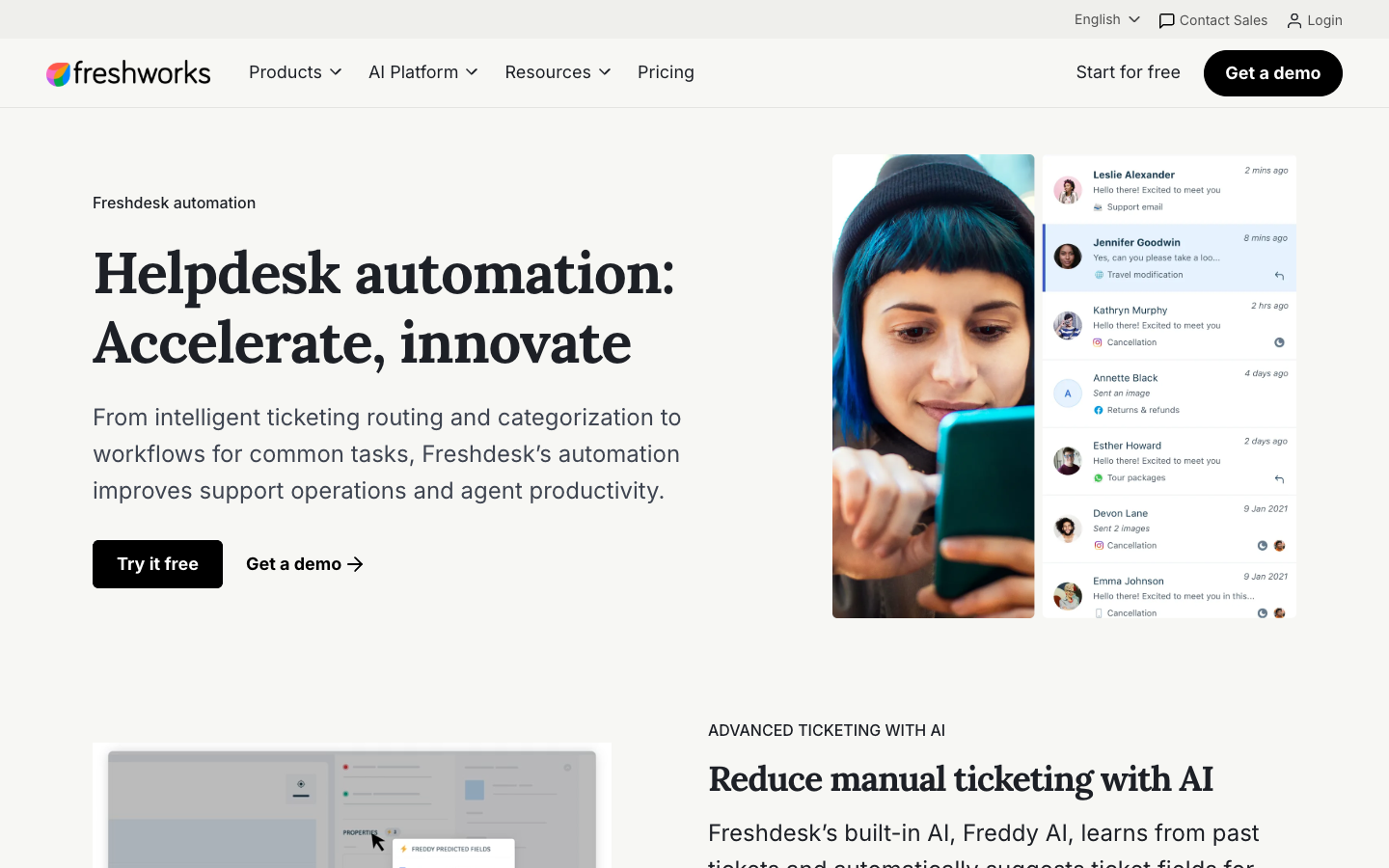
Freshdesk Pro’s more advanced routing is useful if it has clearly defined workgroups. If every ticket is reviewed by the same three people, complexity may produce no measurable benefit. Start with one genuine escalation path; add automation only when the team can name the manual task it eliminates. Helpdesk reporting dashboard metrics should distinguish an automated status update from a substantive reply that solves the underlying issue.
🔐 Reporting and dashboard interpretation
Freshdesk offers standard reporting with deeper custom dashboards higher up. Build one report that reflects actual service quality: first useful response, time to genuine resolution and reopened cases by customer segment. A declining average handle time is not impressive if customers must explain the issue again in a second ticket. Data definitions should be written before rollout. Budget integration task fees for support if automations repeatedly retrieve CRM records or store-order status.
Freshdesk integrations can retrieve customer attributes, CRM information and commerce order data; connector actions may themselves introduce usage charges. Build an inventory of each data connection, its authentication method and the exact request volume expected per ticket. Protect refund and account-recovery actions separately from passive order lookups. When a connector returns an error, agents should see that the data is unavailable rather than an apparently current but stale value. Least-privilege permissions are part of integration quality, not an optional security add-on.
👥 Email support does not solve every live conversation
Freshdesk’s ticket-first strength fits asynchronous requests, but a customer stranded in checkout may want live chat or an immediate callback. The buyer should identify which cases genuinely require a second channel and then compare the cost of Freshdesk Omni or another messaging platform. Duplicating the customer’s timeline across two products can be more damaging than the missing chat widget.
Freshdesk is easier to adopt when staff agree on the meanings of pending, resolved and reopened cases. Teach new agents to handle a reply while a specialist is working, create an internal note without disclosing it and decide when to use an approved canned response. Supervisors can examine a short sample of genuine conversations rather than relying on a training completion badge. If the same case is repeatedly bounced between groups, the queue design needs improvement before more routing features will help.
📤 Freshworks integrations and workflow tasks
Freshdesk’s price sheet lists connector app tasks at $80 per 5,000 tasks and MCP actions at $15 per 1,000 actions in its current public US view. These are distinct meters; they should not be rolled into an unspecified ‘automation included’ allowance. Before automating order lookups, count the number of external requests triggered by one ticket and confirm whether retries consume additional billable actions.
For a merchant, a service agent might use a customer identifier to retrieve a package status and carrier tracking URL. The integration should not have the authority to alter a card charge or edit an unrelated account. When a connector times out, the agent should see an explicit error instead of relying on stale shipping data presented as current.
🧾 A sensible permissions and privacy boundary
Agents should receive enough customer context to solve a case without gaining blanket access to unrelated accounts. Freshdesk can be part of this role design, but downstream integrations need corresponding restrictions and a data-deletion policy. Test which export controls and audit logs are available at the exact level being considered; Enterprise capabilities cannot be assumed on Growth.
Freshdesk Enterprise features such as audit records, sandbox testing and network-related access controls can be useful for larger support organizations. They should not be assumed to exist on the cheaper Growth plan. Document who may change ticket rules, integrate third-party systems or export a full customer history, then verify the available plan controls with those permissions. Even an advanced security feature has little practical value if the business never audits accounts or reviews the owners of service credentials.
🔌 Migration from a shared inbox
Freshdesk adoption often begins by forwarding a live support address into the ticket system. That is easy to describe and harder to execute without duplicates, broken threads or changing reply-from addresses. Keep a documented cutover schedule, map old customer identities to new tickets and test email threading from a customer’s ordinary inbox before moving every address.
Freshdesk can be an effective view into a customer’s order or contract without becoming the source system for that order or contract. For an online store, an agent should be able to identify a shipping exception but not automatically edit payment details because a connected action happens to exist. Record the necessary fields, authorization checks and failure response for each integration. If external commerce data cannot be retrieved, the support workflow must tell the customer what is known and what cannot yet be verified.
📊 An example with six paid agents
What the team actually pays: worked examples
| Illustrative six-agent setup | Monthly equivalent | Annual equivalent | Not included |
|---|---|---|---|
| 6 Growth agents | $114 | $1,368 | Usage overages and taxes |
| 6 Pro agents | $330 | $3,960 | Copilot optional |
| 6 Pro + Copilot for all 6 | $504 | $6,048 | Further AI / connector usage |
| 6 Pro + 500 sessions beyond allowance | $575 | $6,900 | Other add-ons; $49/100 sessions |
At annual billing, six Freshdesk Growth agents correspond to $114 per month or $1,368 over a year. Six Pro agents correspond to $330 per month or $3,960 per year before Copilot, Freddy session overages and taxes. Add Copilot to all six eligible Pro agents at the stated $29 rate and the configured total grows by $174 per month, assuming the same billing cadence. Calculate Freshdesk annual billing costs using real agent counts, Freddy allowances and any paid workflow extensions.
An illustrative six-agent budget helps expose Freshdesk’s tiers. Growth at $19 on annual billing creates a $114 monthly equivalent, whereas Pro at $55 creates $330. These amounts do not include taxes, AI Copilot, overage sessions or channel extensions. A high-volume month could require more Freddy AI Agent sessions than the allowance provides, and connector usage may rise alongside the backlog. Procurement should model a seasonal peak and a normal month, then ask which billing terms can actually be adjusted after the peak.
⚖️ Freshdesk versus Zendesk and simpler options
Freshdesk’s Growth level is useful to compare with Zendesk’s standalone Support product, because both can begin with ticket-based email assistance. Zendesk Suite is a different, broader package. An organization using chat as its primary product channel should also examine Intercom and its Fin outcome pricing, while an email-centric team with low case complexity might prefer Help Scout.
Do the evaluation at the workflow tier rather than comparing promotional prices. A Pro ticket queue that needs several SLA policies cannot automatically be replaced by the cheapest inbox at a competing vendor. On the other hand, paying for skills-based routing before there are distinct specialist groups rarely improves the customer experience.
⚠️ Freshdesk works best with a ticket owner
The product becomes more valuable when someone can curate canned replies, correct automations and review the queue every week. Without a service owner, the status taxonomy accumulates special cases and reports stop matching reality. It is better to keep three clear ticket states that agents use properly than fifteen beautiful categories that no one follows.
Freshdesk can become cluttered if every incident leads to another tag, group or automation. A team may end up relying on one administrator who remembers why fifty special cases exist. Keep a change log, delete rules that no longer match business practice and practice recovery from an incorrectly categorized ticket. Test how the service behaves if a crucial collaborator leaves or an integration stops responding. A well-maintained simple configuration can outperform an elaborate one whose intent is no longer clear.
🧪 Scope and evidence limits for this review
Freshworks presents Freshdesk and Freshdesk Omni as separate products. The public Freshdesk price list shows Growth at $19, Pro at $55 and Enterprise at $89 per agent per month when billed annually, with AI Agent sessions and selected connector actions priced as additional units. These are documented offer terms, not actual invoices from a private account.
This review did not operate a live support desk or run an agent-efficiency experiment. A buyer should put the intended email workflow and any desired messaging channels into separate test cases and ask Freshworks for plan-specific confirmation. The result to measure is a completed service request with an accountable owner, not the mere existence of a dashboard.
⚖️ Freshdesk vs Zendesk, Intercom, Help Scout: Competitor Comparison
Freshdesk vs other support tools
| Platform | Best comparison scenario | Cost structure |
|---|---|---|
| Freshdesk | Ticket queues, customer portal, SLA upgrades | Per-agent + Freddy AI usage |
| Zendesk | Broad Suite channels and formal service operations | Agents + optional modules |
| Intercom | Messenger, Fin and in-product requests | Full seats + outcomes |
| Help Scout | Lower-admin shared email conversations | User licensing + optional AI |
Freshdesk versus Zendesk
Zendesk overlaps most closely in ticketing and increasing service operations depth, but comparable Suite plans may cover different channels. Zendesk Suite has a different channel bundle from standalone Freshdesk; compare both product scopes in writing.
Freshdesk versus Intercom
Intercom emphasizes messaging and Fin AI outcome pricing rather than solely agent-ticket economics. Intercom prices Fin outcomes rather than Freshdesk Freddy AI sessions, creating a different risk under traffic peaks.
Freshdesk versus Help Scout
Help Scout focuses on shared inbox collaboration and a more compact support workflow. Help Scout offers an inbox-led alternative when a strict SLA matrix and elaborate ticket routing are unnecessary.
📌 Why the 500-session detail matters
For an early-stage team with a few hundred help requests, included AI Agent sessions may feel generous. At higher volumes, sessions above the documented allowance can become material. If an extra 600 sessions were charged as six $49 blocks, that would be $294 in addition to the agent seats under those illustrative assumptions. Your real allocation and meter may differ by contract.
🧩 A ticket that moves from sales to engineering
Imagine an integration error reported by a new customer. Freshdesk should preserve the customer’s earlier question, identify the relevant product and allow engineering to contribute without confusing the case owner. Test internal notes and external collaborator permissions, then check whether the customer receives one coherent explanation rather than a chain of departmental replies.
🎯 A simple workflow audit for the first month
Monitor tickets without an owner, automations that fire more than once, articles generating repeat contacts and cases escalated after their service target. Freshdesk can show several useful reports, but only if the team agrees on definitions. Review ten actual resolved requests with an independent supervisor; the human sample often reveals defects the dashboard cannot.
💡 A contract checklist rather than a feature wishlist
Ask for the Freshdesk-only quote and a separate Omni quote if live channels are needed. Add trial length, temporary free-program rules, Freddy Agent session meter, Copilot eligibility, connector-task charges, day passes and export conditions. Make the vendor identify any renewal uplift before declaring that a given tier is the cheapest.
🛠️ How to avoid spending on redundant service apps
If Freshdesk handles the primary ticket timeline, adding another helpdesk inbox can split requester history. Keep chat or bot add-ons only when they have a defined task and send the resulting record back to an owned queue. A minimal integrated support stack often delivers better customer continuity than two unrelated premium support subscriptions.
🔍 When Freshdesk Enterprise earns its price
Skill-based routing, sandbox testing, audit logs and tighter security boundaries are compelling only when a business uses them. An organization dealing with regulated customers or large queues may have clear reasons to invest. A five-person support team can be better served by refining procedures on Pro or Growth rather than buying governance tools it has no one to administer.
✅ An editorial recommendation by company stage
For a small email-centric company, pilot Freshdesk Growth and a straightforward shared inbox alternative using the same tickets. For a team managing multiple routing policies and languages, scrutinize Pro and Freddy usage. For sophisticated incident operations, evaluate Enterprise alongside full governance requirements and a documented escalation schedule.
🔎 Freshdesk Research Methodology, Limitations and Next Steps
DigiOffly inspected publicly available Freshdesk plan information and vendor help materials. No private Freshdesk helpdesk or Freddy AI deployment was used for this analysis. The procurement team should ask which capabilities belong to Support Desk or Omni, exercise a cross-team ticket escalation, and compare its session and connector usage against the written plan terms.
Before moving an entire team to Freshdesk, test email threading, one cross-team escalation and a support article correction. Compare the proposed Support Desk tier and any Omni requirements in separate vendor quotes.

Frequently Asked Questions
What is the Freshdesk starting price in 2026?
Freshdesk Growth starts at $19 per agent per month on annual billing in the current public US pricing view. Monthly pricing and taxes differ.
Is Freshdesk permanently free?
Freshdesk has offered a limited-period Free Program for up to two agents. Do not assume it provides unlimited lifetime service.
What separates Freshdesk from Freshdesk Omni?
Freshdesk centers on ticketing and email support; Omni packages broader service channels. Check their separate plan and pricing pages.
What does Freshdesk Pro add?
Pro includes more advanced routing, multilingual capabilities and multiple SLA policies compared with Growth. Exact features should be confirmed.
How much is Freddy AI Copilot?
Freshdesk quotes $29 per eligible Pro/Enterprise agent per month on annual billing as a separate AI Copilot add-on.
How many Freddy AI Agent sessions are included?
Public pricing lists an initial 500-session allowance on paid plans, with additional session packages. Verify the allocation definition.
Can Freshdesk connect to Shopify?
Integrations exist across ecosystems, but permissions, order access and connector fees depend on implementation. Test them.
Does Freshdesk offer a customer portal?
Current Growth pricing advertises customer portal and knowledge-base capabilities. Confirm customer access and branding options.
Is Freshdesk cheaper than Zendesk?
Compare like-for-like feature tiers, billing period, agent count, AI and needed channels. The first listed number can be deceptive.
Can Freshdesk migrate old support emails?
It can become the support intake system, but historical threading and customer data migration need dedicated testing.
What is the best Freshdesk trial test?
Use a case involving assignment, escalation, repeated customer reply, article suggestion and export; inspect the full agent timeline.
📚 Sources and Related DigiOffly Reviews
Primary vendor source: official Freshdesk pricing and plan information; secondary reading: DigiOffly Customer Support & Help Desk category. To separate fixed agents from metered Freddy usage, see Software Cost Calculator, Compare Software and E-commerce & Online Selling.
EXPLORE NEXT ON DIGIOFFLY
Explore Your Customer Support Stack
Find related customer experience, collaboration and automation tools. DigiOffly links to completed reviews only; unpublished help desk drafts are not displayed as published articles.
Explore related help desk guides
- Customer Support & Help Desk — Compare team workflows and support models.
- Software Directory — Browse currently published product reviews.
- Compare Software — Evaluate comparable documented features.
- Best Software — Choose software by operational scenario.
- Zendesk review — Compare enterprise workflows and ticket handling.
- Zoho Desk review — Explore a different help-desk licensing model.
Plan your customer service budget
- Software Cost Calculator — Model annual seat commitments and subscriptions.
- Best Value Advisor — Explore product capabilities by task.
- Productivity & Collaboration — Coordinate internal service ownership.
- Automation & No-Code — Consider reliable workflow integrations.
Connect related business tools
- E-commerce & Online Selling — Understand customer order and checkout context.
- Growth & Marketing — Join customer acquisition with post-sale support.
- Hosting & Websites — Understand site reliability and customer issues.
- Tools Hub — Explore DigiOffly software tools.
- Tally — Flexible forms, conditional intake and integrations