

Research checked October 27, 2026. Vendor documentation-based review; no merchant-account checkout or conversion benchmark. Official Sellfy pricing and support pricing article differ on one Starter price; verify before purchase.
If you’re a creator choosing where to sell digital files, the first question isn’t which storefront has the prettier theme. It’s whether the tools you buy actually reduce the work of distributing files, answering customer questions and collecting payments while preserving a viable margin. This Sellfy review focuses on those operational decisions, including the sales caps and payment charges that a superficial pricing comparison can miss.
📊 Sellfy Review 2026: Summary
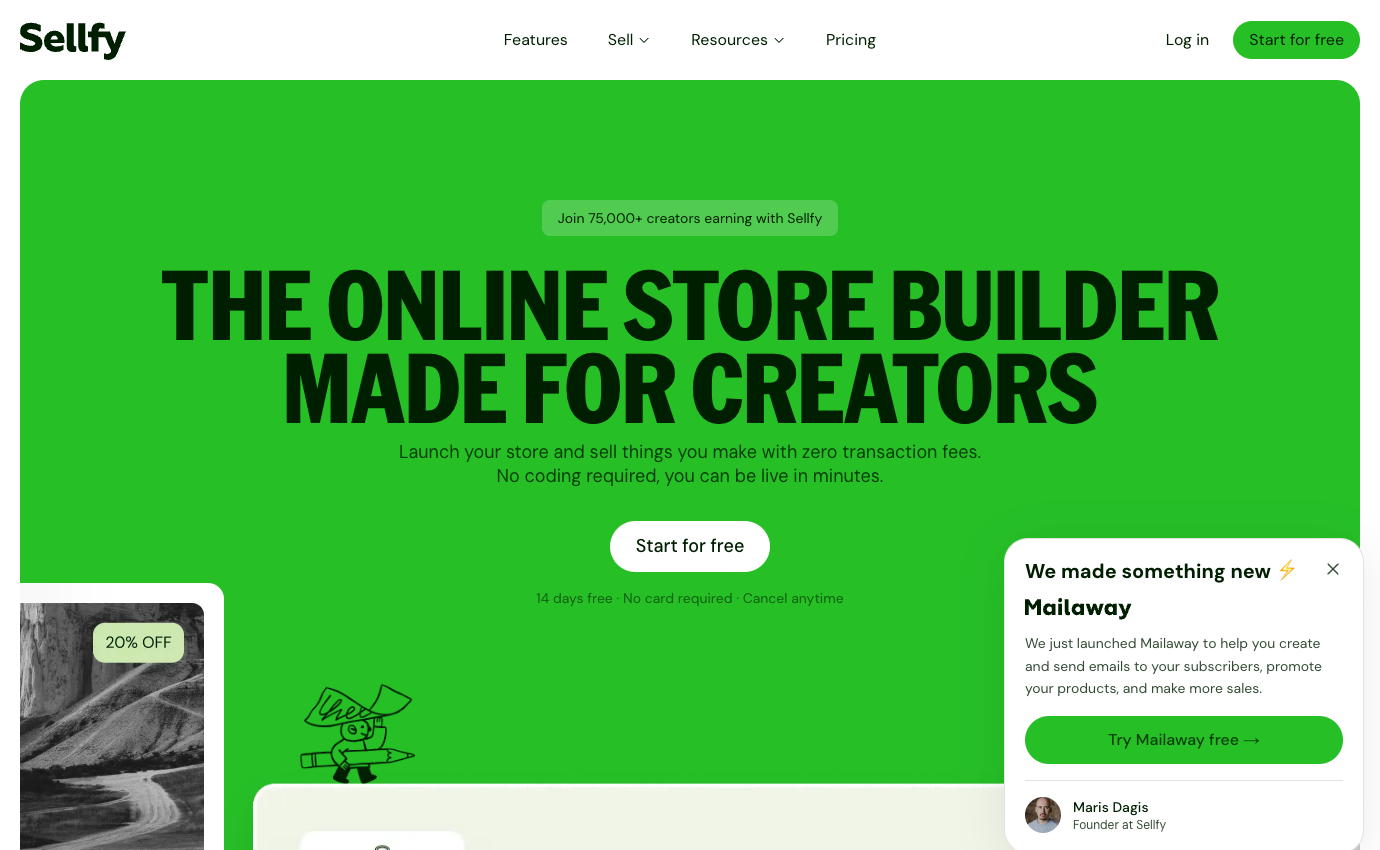
Verdict: A focused creator-commerce storefront that combines digital products, subscriptions, merchandise and email features. It offers zero Sellfy transaction fees but requires a paid subscription and plans are limited by annual sales volume.
🏆 EDITORIAL FIT: BRANDED CREATOR STOREFRONTS
Best for: creators building a compact catalog of digital downloads, subscriptions and merchandise who prefer fixed platform subscriptions to Gumroad-style direct-sale percentages.
| Tier | Published annual sales limit | Important differentiation |
|---|---|---|
| Starter | Up to $10,000 | Digital products, email and storefront basics |
| Business | Up to $50,000 | Upsells, cart recovery, affiliates, branding removal |
| Premium | Up to $200,000 | Higher email and file limits, priority support |
| Higher-volume offer | Contact sales above $200,000 | Custom terms; confirm eligibility and fees |
⚡ Quick Verdict: Is Sellfy Worth It in 2026?
Sellfy deserves consideration when you would otherwise assemble a website, checkout, file-delivery app, campaign tool and product management interface separately. It is not the same as a no-cost selling platform: subscription fees, processor charges and possible volume-driven upgrades belong in the forecast. For a merchant with regular sales and a concise catalog, that commitment can be reasonable. For sporadic launch-only revenue, the fixed bill can be less attractive than pay-per-sale alternatives.
| Pros | Cons and caveats |
|---|---|
| Multiple creator product types in one storefront | Paid subscription required for continued selling |
| No additional Sellfy platform transaction percentage | Stripe/PayPal fees remain |
| Built-in email marketing and paid-tier cart recovery | Sales-volume caps can require an upgrade |
| Custom domain and mobile-friendly presentation | Limited gateway choices and feature gates by plan |
🧭 What Sellfy Is Designed to Solve
Sellfy serves independent creators and small online merchants who would rather maintain a branded storefront than build a complete e-commerce stack from separate hosting, cart, payment and email services. The platform supports digital files, subscriptions, print-on-demand merchandise and physical products within one seller-facing interface. For a photographer distributing presets or a musician selling sample libraries, having those sales formats together can simplify initial operations. For a complex wholesale retailer, the same simplification may narrow what can be customized.
The consequential details are recurring subscription charges, sales-volume ceilings, processor bills, file-delivery rules and which marketing tools require an upgrade. It does not assume that built-in features guarantee profitable sales. A well-designed store still needs qualified traffic, a clear offer and a tested support process. Before debating visual templates, identify who is responsible for issuing refunds, updating products, responding to failed downloads and maintaining the customer list.
The platform’s primary selling point is operational consolidation. Someone who sells a bundle of digital templates, limited merchandise and occasional memberships may prefer one back office to a set of tightly coupled plugins. Yet consolidation creates dependence on a vendor’s plan rules and supported payment methods. That makes the total cost and exit procedure as important as how quickly the first storefront can go live.

💰 Sellfy Pricing in 2026: Subscription and Sales Caps
Sellfy’s subscription model has Starter, Business and Premium tiers. Its official feature comparison associates annual sales ceilings of $10,000, $50,000 and $200,000 respectively, with a custom high-volume option available through sales contact. The company advertises zero additional Sellfy transaction fees; payment processing by Stripe or PayPal is not free. These distinctions deserve prominence because a plan’s sales-volume ceiling can force an upgrade before a merchant reaches the user-count or feature threshold that usually triggers SaaS upgrades.
The published monthly Starter price is not completely consistent across Sellfy’s own pages consulted for this research: a public pricing snapshot lists $29 per month, while one vendor help article describes $39 per month. Business and Premium are shown at $79 and $159 per month in the cited monthly documentation. The live checkout and account country, taxes, promotion and billing frequency therefore control the exact charge. We deliberately do not present a disputed Starter amount as guaranteed current pricing. When purchasing, capture the actual checkout total and renewal terms.
For annual commitments, the vendor help article lists yearly totals of $348 for Starter, $708 for Business and $1,428 for Premium. Those are examples from that documentation, not a promise that every buyer sees the same quote in late 2026. The trial lasts 14 days according to Sellfy. Its help center warns that product checkout is disabled during the trial; a design preview is therefore not equivalent to a complete paid-order trial. Merchants should ask how to perform an authorized transaction test before upgrading.
A useful Sellfy pricing plans comparison starts with the revenue you actually expect, since the annual sales limit can force an upgrade even with very few listed products. If the average item sells for $20 and you anticipate $1,000 a month in revenue, annualized sales would be $12,000, already above the listed Starter threshold. If revenue is seasonal, calculate the full relevant measurement period and confirm how Sellfy defines sales volume and plan upgrades.
🧾 Zero Sellfy Transaction Fees: What That Really Means
‘No transaction fees’ refers to Sellfy’s own platform percentage, not to the payment network. The official pricing FAQ says merchants still cover Stripe or PayPal processing, typically around 2.9% plus $0.30 in the cited example, with actual charges affected by location and payment method. This is a different fee construction from Gumroad, which imposes its own direct-sale percentage and fixed charge in addition to applicable processing. A fair comparison includes subscription payments, merchant eligibility and processing on both sides.
Consider a fictional store with 100 monthly orders at $30 each. With illustrative processing of 2.9% plus $0.30, payment costs are about $117 on the $3,000 gross, before any extra cross-border fees, refunds or disputed sales. Add the Sellfy subscription charge applicable to the merchant’s tier. At $36,000 annualized gross, the store may require Business based on the currently published $50,000 sales cap. A cheaper Starter subscription would be an invalid assumption under that model.
Does Sellfy charge transaction fees? Sellfy advertises no additional platform percentage on its listed plans, but Stripe and PayPal still charge for payments. It also warns that failing to upgrade after exceeding a yearly sales cap can lead to a 2% overage fee on the exceeded amount. The economic model is therefore more nuanced than ‘unlimited selling for a fixed flat price’. Verify the cap, any grace period, and how refunds affect measured sales.
| Model | Revenue or price basis | Watch closely |
|---|---|---|
| Sellfy Business example | $79/month in consulted documentation, plus processor fees | $50,000 published annual sales limit |
| Gumroad direct links | 10% + $0.50, plus applicable card processing | No monthly platform fee; fee grows with sales |
| Sellfy over-cap | Possible 2% overage on exceeded sales if upgrade not made | Confirm exact policy in current terms |
📦 Digital Downloads: File Limits and Product Updates
Sellfy is built for creators who distribute downloadable assets. Its published feature matrix allows unlimited product listings, but individual file-size limits depend on subscription level. The current table lists a maximum digital product file size of 10 GB on Starter, 15 GB on Business and 20 GB on Premium. An additional support page discusses multiple files per product and recommends smaller practical download sizes where customer connections are unreliable. Unlimited listings should never be interpreted as unlimited practical delivery capacity.
For a video creator selling project templates and raw source assets, a 12 GB package may require a higher plan even if annual revenue is modest. Conversely, a seller of ten-page guides may never approach file limits. Prepare a release checklist: file integrity, supported software versions, example previews, license terms and clear update notices. Most support problems after payment come from unclear usage instructions rather than the payment button itself.
Sellfy’s help documentation describes product-update messages that can notify previous customers and include a new download button. That is valuable when templates change because a new software version breaks old presets. It still requires a predictable editorial workflow: keep version numbers, avoid breaking previously promised formats and publish a changelog. When selling digital downloads with Sellfy, those follow-up updates can matter more to customer confidence than the size of the initial catalog.
🔁 Subscriptions and Recurring Content
Sellfy includes subscriptions among its supported product types. That may suit a small community receiving monthly design assets, educational handouts or licensed sound libraries. But recurring revenue creates entitlement questions that are separate from taking a recurring payment. Decide whether customers keep older files after cancellation, what content cadence is guaranteed, how failed billing is communicated and whether access to a private forum is controlled by Sellfy or by another service.
Suppose a creator charges $15 per month for a growing archive. The customer expects each month’s content to be usable, not merely delivered. Content production time, customer questions, refunds and stale-member cleanup can exceed the direct gateway fees. The subscription platform helps with the transaction, but it does not produce creative work or make a third-party community integration reliable by default. Test the cancellation and reactivation path with permission before launching widely.
With Sellfy subscriptions, recurring charges are only part of the decision: the seller must also keep access to any separate community or content platform in sync. If customers need graded courses, per-seat licenses or customized account provisioning, a specialist system might be a better core platform. Sellfy can remain useful for simpler recurring access where the promised product can be fulfilled through digital delivery.
👕 Print-on-Demand and Physical Merchandise
One distinction in the Sellfy vs Gumroad debate is Sellfy’s combined approach to creator merchandise. Its product lineup includes print-on-demand and ordinary physical goods as well as downloads. This can let an illustrator sell printable artwork, a physical poster and branded apparel from one storefront. Still, the existence of a print-on-demand feature does not prove that every garment, destination or production turnaround is equally supported.
Calculate the unit economics separately for physical goods. Retail price minus fulfillment cost, manufacturing charges, shipping subsidies, payment processing, returns and customer service may leave a far thinner margin than a downloadable file. A product that appears profitable before reprints or delivery failures can lose money quickly. Order a physical sample before relying on product photos and investigate which party handles production defects versus merchant-initiated refunds.
A mixed catalog also changes the checkout journey. Some orders contain instant files, while others require addresses and delivery estimates. Verify whether shipping taxes, emails and post-purchase updates communicate these differences accurately. A custom-branded storefront is not useful if a buyer thinks their hoodie should arrive as a download or does not understand a production window. Give each product type its own support explanation.
🎨 Store Design, Domains and Branding
Sellfy offers a store editor, themes and a custom-domain option across the published plan comparison. The design proposition is more substantial than a single checkout link, and creators can put a coherent visual identity around collections. The current feature table, however, identifies branding removal as available on Business and Premium rather than Starter. If a completely white-label appearance matters, the cheapest plan may not satisfy the brief.
Quality of design needs to be judged with actual inventory. A demo using three hero products can look excellent but become difficult to navigate when customers search for seventy presets split across camera systems and software versions. Before selecting a theme, mock up a real catalog, mobile navigation, search expectations, product variations and refund-policy placement. Check whether text stays legible for accessibility and whether the mobile checkout stays focused.
Building a Sellfy branded online store can reduce development work, but it also means accepting platform-specific layout constraints. Determine what you can control through available custom code and what remains managed by the platform. Exporting product data is different from taking a full interactive design elsewhere. Document image originals, copy, customer permissions and domain ownership outside the vendor account from day one.
📣 Email Marketing, Upselling and Abandoned Carts
The current Sellfy comparison grants email marketing to all paid tiers but allocates monthly credits differently: the published feature table shows 2,000 on Starter, 10,000 on Business and 50,000 on Premium. It reserves product upselling, cart-abandonment tools and an affiliate program for Business and Premium. Those differences matter because the missing feature can be more economically important than the apparent subscription gap. If a creator relies on recovering abandoned checkouts, pricing must reflect the tier that actually includes that capability.
Email credits are not the same as reachable opted-in subscribers. Segment existing customers from prospects, honor consent choices and treat purchase notifications differently from promotional campaigns. A simple setup might send product-use instructions immediately and a relevant follow-up later; a complex drip sequence is not automatically valuable. High open rates do not demonstrate incremental profit if shoppers would have bought again without messages.
Sellfy abandoned cart recovery should justify the higher-tier plan cost. Measure recovered gross margin after discounts and the time required to write and maintain the messages. Avoid using the feature as an excuse to pressure buyers with repeated discounts. Likewise, upsells should complement the original product: an advanced template package after a starter template makes sense, whereas an unrelated promotion at checkout may increase confusion and support load.
💳 Payments, Stripe, PayPal and Regional Eligibility
Sellfy’s documented payment options are Stripe and PayPal. The official FAQ makes clear that seller eligibility depends on the availability of those processors in the merchant’s country; a worldwide storefront does not necessarily mean worldwide payout availability. It also says funds go directly to the connected processor account, rather than remaining as a Sellfy-managed balance for routine payouts. The settlement timeline and holds therefore depend on processor rules.
If your team sells in more than one currency, review conversion rates and billing currency before publishing internationally. Cross-border buyers may encounter foreign exchange charges or local payment preferences that the supported gateways do not fully address. Ask which entity appears on customer receipts, who manages disputes and which tax obligations belong to the merchant. Sellfy’s tax settings are not a blanket promise to act as merchant of record.
These details can decide whether the Sellfy store builder is suitable for a specific business. For example, a Romanian creator with a multinational audience must independently verify merchant-country eligibility and local regulatory requirements, rather than using a US payment-rate example as a binding price. Payments are a regional financial service, not simply a software feature.
⚠️ Sales Caps, Upgrades and Unexpected Costs
The most easily missed constraint is annual sales volume. Starter is listed up to $10,000, Business up to $50,000 and Premium up to $200,000; higher-volume businesses are invited to contact the company. That makes forecasting important for a merchant expecting a rapid launch. A single successful promotional month can change the appropriate plan for the entire business even though file storage and subscriber count look unchanged.
Sellfy’s FAQ says an account that exceeds its plan’s sales cap may need to upgrade and could incur a 2% overage fee on the amount above the cap if it does not. Confirm current definitions with support: calendar versus subscription year, gross versus net sales, refund treatment and timing of notifications. A spreadsheet with monthly sales scenarios can reveal whether it is safer to start on a higher tier. Do not intentionally plan to pay overage charges without understanding the agreement.
For Sellfy annual sales limits, a conservative budget includes at least one upgrade scenario. If estimated gross is $45,000 but a second product launch might push revenue to $60,000, the Business label alone does not capture year-end cost. This is one reason the vendor’s ‘0% transaction fee’ claim should not be used as the entire cost assessment.
⚖️ Sellfy vs Gumroad, Shopify and WooCommerce
Sellfy and Gumroad can both sell creator downloads. Their economics are structured differently: Sellfy charges recurring platform subscriptions and external processing, while Gumroad has no recurring subscription but applies direct-link and Discover charges. The correct comparison is a twelve-month projection with sales by channel and ticket value, not a screenshot of monthly prices. If you rarely sell, the flat Sellfy commitment can be wasteful. If you sell steadily and stay within plan caps, a subscription may be easier to budget.
Sellfy vs Shopify for digital products depends on whether you need an end-to-end retail operation. Shopify has a broader managed commerce ecosystem and a large app marketplace, but add-ons can contribute to recurring expenses. Sellfy concentrates on creator products and simpler store management. WooCommerce brings a WordPress-based, open-source path that may be attractive when you want hosting and data control, at the cost of ongoing maintenance.
PrestaShop and BigCommerce belong more naturally in comparisons for complex catalogs, localization and commercial operations. A creator selling twenty illustrations should not overengineer the platform. A retailer processing extensive physical inventory should not assume a creator storefront covers all operational requirements. Choose the smallest solution that satisfies real commitments while leaving an acceptable path to move later.
| Tool | Strongest fit | Cost or control concern |
|---|---|---|
| Sellfy | Digital creators needing a branded store | Subscription, processor fees and caps |
| Gumroad | Low-commitment links and creator checkout | Percentage + fixed fees |
| Shopify | Multi-channel managed retail | Apps, subscriptions and gateways |
| WooCommerce | Self-managed WordPress commerce | Updates, security and hosting |
🔄 Migration, Ownership and Long-Term Independence
Moving products between platforms is not equivalent to moving a business. Files, descriptions and images can often be recreated. Customer permissions, recurring billing agreements, saved tax records and indexed URLs are harder. Sellfy advertises different migration assistance across plans; its detailed pricing table lists higher-level services on paid tiers, and conditions depend on the type of migration. Verify the current entitlement with support before treating assistance as free or comprehensive.
Keep master versions of each file, thumbnails, license documents, customer-support templates and approved marketing copy in a system you control. If you use a custom domain, document DNS access and all redirect targets. If subscribers receive recurring files, define how you would notify them or re-establish access if the platform changes. For a Sellfy to Shopify migration, these administrative details can cost more than the storefront design itself.
An exit plan is not an accusation that a provider is unreliable. It is normal business continuity planning. Once every customer interaction depends on a hosted platform, documenting exports and permissions becomes prudent. Schedule occasional export checks and review whether the available records are sufficient for finance, consent tracking and legitimate customer support.
✅ A Practical Store Launch Checklist
Run a pre-launch rehearsal with realistic products. Start with a small downloadable product, define required fields and examine the mobile product page. Ensure license restrictions appear before purchase and that the download filename makes sense to a nontechnical buyer. Then model a refund, a changed asset and a customer who cannot find their receipt. Resolve each process before traffic grows, rather than discovering gaps during a promotion.
For a mixed catalog, add one physical or print-on-demand product to the test. Inspect shipping address capture, inventory expectations, order notifications and where customers turn for production issues. Send a consent-based email campaign to a small internal test audience, respecting provider rules, and check whether unsubscribe management and list segmentation behave as expected. Do not assume a built-in marketing feature guarantees compliant campaign setup.
Only after operations work should you measure conversion. Distinguish sales from qualified visitors, gross sales from settlement and new customers from repeats. Write down cancellation and upgrade triggers in advance. A structured pilot provides a much stronger basis for choosing Sellfy than a generic rating score.
🎯 Who Should Consider Sellfy—and Who Should Avoid It
Sellfy is most compelling for a creator or small team seeking a branded store for downloadable resources, subscriptions and occasional merchandise, especially when the business values built-in email features and simple product setup. An illustrator managing a coherent catalog may gain more from unified operations than from a deeply customizable engine. The platform can also be a fit when the seller already has audience traffic from video, newsletters or a content site.
Be cautious when you expect large annual revenue relative to plan caps, require local payment methods not supported through the connected processors, or run detailed multi-warehouse fulfillment. Subscription commitments and upgrades may outweigh convenience. Likewise, highly custom B2B sales workflows, complex product configurators and deep database ownership demands point toward more specialized commerce infrastructure.
Ultimately the best choice is determined by product type and operating maturity. Evaluate actual processing quotations, checkout geography and the real support burden. The absence of a Sellfy platform transaction fee is a benefit, not a guarantee that an individual seller’s economics are optimal.
🧪 Research Basis, Disclosures and Limitations
This is an independent documentation-based analysis assembled October 27, 2026 using Sellfy’s public pricing, feature comparison and help documentation. We did not activate a private paid merchant account, place a live payment, inspect actual payout statements or verify customer conversion lift. Some official documents disagree on the exact Starter monthly sticker price, and live pricing text is dynamically displayed. That discrepancy is disclosed rather than concealed behind a false definitive number.
We distinguish sourced features from judgments about business fit. Vendors can update pricing, features, eligibility rules and plan terms at any time. The live checkout and current legal agreement prevail over a static guide. No revenue or SEO performance improvements are promised. Before buying, verify relevant gateways in your country and the precise amount billed to your account.
DigiOffly’s methodology emphasizes ownership cost, a documented pilot, transparent limitations and alternatives. Product claims should be supported by vendor documentation; real usability benchmarks require authenticated user testing that has not been performed for this draft.

Frequently Asked Questions
Does Sellfy have a free plan?
Sellfy documents a 14-day free trial, not a permanently free selling tier. Its support article says checkout is disabled during trial, so a merchant should confirm how to run a permitted test transaction.
How much does Sellfy cost in 2026?
The vendor lists Starter, Business and Premium, but public documentation differs on a Starter monthly price ($29 versus $39 in pages consulted). Verify live checkout, billing frequency, taxes and renewal quotation; the feature and sales-cap differences are more stable.
Does Sellfy charge transaction fees?
Sellfy advertises zero extra Sellfy transaction percentage on its plans. Stripe or PayPal processing still applies, and overage rules may matter if annual sales exceed the subscribed tier.
Can I sell digital downloads on Sellfy?
Yes. Digital downloads are among the core products. Published per-file limits depend on plan, and files should be tested for compatibility, versioning and customer download clarity.
Can I use Sellfy for subscriptions?
Yes. Recurring product offerings are supported. Before launch, determine cancellation access, content schedule, and integration with any external membership community.
Is Sellfy better than Gumroad?
Neither is universally better. Sellfy’s fixed subscription can suit consistent volume, while Gumroad avoids recurring subscription commitment but charges percentage and fixed direct-sale fees. Compare like-for-like volumes and supported features.
Can I sell print-on-demand merchandise?
Yes, Sellfy advertises print-on-demand as a supported product type. Sample products and verify production cost, delivery areas, return responsibility and customer support before selling widely.
What are Sellfy’s annual sales caps?
Current documentation associates Starter with $10,000, Business with $50,000 and Premium with $200,000 in annual sales. An upgrade or potential overage fee may apply; verify current contract rules.
Does Sellfy integrate with WordPress?
Sellfy offers embeddable buy buttons and store widgets, allowing merchants to maintain content on another site. Test the checkout and analytics behavior before treating an embed as equivalent to a native store.
Which payment processors can sellers use?
Sellfy’s published payment options are Stripe and PayPal. Both seller-country eligibility and processor costs must be verified independently, especially for cross-border or non-US accounts.
Who should use Sellfy instead of Shopify?
Creators with straightforward digital catalogs and occasional merchandise may prefer Sellfy’s specialized tools. Retailers needing broader order, inventory, app and shipping infrastructure may find Shopify more suitable.
📚 Sources and Related DigiOffly Reviews
Official evidence: Sellfy pricing and feature comparison, Sellfy pricing help and digital product support. Compare our Gumroad review, Shopify review and WooCommerce review.
EXPLORE NEXT ON DIGIOFFLY
Explore Your Online Selling Stack
Compare live store-platform reviews, model the recurring and transaction costs, and choose supporting tools before committing to a checkout provider.
Compare live storefront reviews
- Shopify Review — See managed-store operations and app costs.
- WooCommerce Review — Compare self-hosted WordPress commerce.
- BigCommerce Review — Review managed catalog and payment trade-offs.
- Gumroad review — Compare transaction-led creator checkout economics.
- beehiiv — Publish a newsletter for a digital-product audience
Plan the cost and workflow
- Software Cost Calculator — Estimate the complete subscription stack.
- Compare Software — Inspect overlapping e-commerce capabilities.
- AI Software Finder — Narrow the shortlist by real requirements.
Continue your commerce research
- Ecwid Review — Add checkout to an existing site.
- E-commerce & Online Selling — Browse the category and its subsections.
- Finance Software — Plan reconciliation and tax reporting.
- Creator & Streaming — Build content products with a lean production workflow.
- Paddle — Merchant of Record, software checkout and SaaS billing