

Editorial note: This independent review analyzes official product documentation, published plan information and decision criteria. Vendor screenshots show public webpages. We do not claim to have completed a private-account hands-on test or guaranteed a particular price.
Instead, consider whether Trello fits your current system of record, staff permissions, procurement terms, administrative resources and ability to leave later. Features and packages change, sometimes within a year, so use the official pricing page as the final authority for your region before checkout.
📊 Trello Review 2026: Editorial Verdict
| Decision question | Editorial assessment |
|---|---|
| Core use case | Visual kanban boards for teams that want a lightweight shared task view with minimal onboarding effort. |
| Team it suits | Small or moderately sized groups that need clear cards, due dates, lists and repeatable handoffs. |
| Potential poor fit | Large portfolio programs requiring advanced native resource planning and complicated dependencies. |
| Billing evidence | Vendor pricing — regional/tax/term details can vary |
| Suggested pilot | Two to four weeks, with sample tasks, real roles and exit criteria |
| Research status | Editorial assessment of public documentation; no private-account testing |
👍 What We Love
- ✅ Boards, lists and cards: Cards provide visible states that nontechnical users understand quickly.
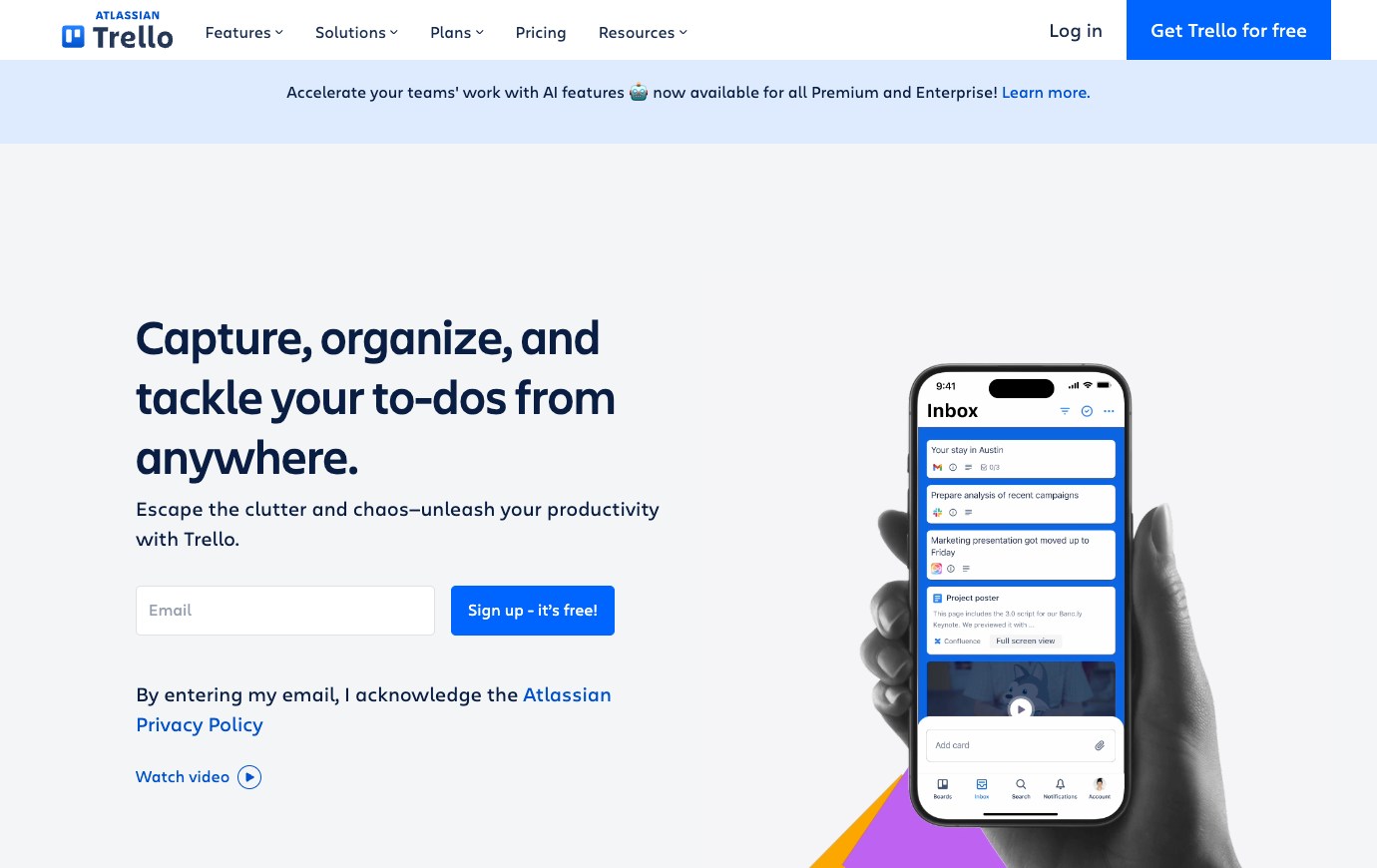
- ✅ Inbox and Planner: Trello has expanded around inbox capture and calendar planning; verify which limits apply on free and paid tiers.
- ✅ Power-Ups: Integrations and plugins extend functionality while increasing the number of external data flows.
- ✅ Premium views: Timeline, table, calendar, dashboard and map are valuable only if cross-board reporting is necessary.
👎 Where It Falls Short
- ❌ Free simplicity can become a limitation for teams needing aggregated reporting.
- ❌ Cards become an archive unless owners and due dates stay current.
- ❌ Add-ons introduce data-permission and paid-billing complexity.
✅ Trello: BUYER FIT AT A GLANCE
Best for: small or moderately sized groups that need clear cards, due dates, lists and repeatable handoffs.
🧠 What Trello Actually Solves
For Trello Kanban project management, first make every list’s exit condition explicit so that Done means accepted work. The everyday Trello editorial content calendar should show who approves a deliverable and where the final source file lives. Cards are useful when a new editor can continue a job without asking for an explanation of the board.
Consider a design studio delivering weekly social assets for three clients. A Trello board could show work moving from brief to concept, feedback, approved and delivered. That is enough for many teams, provided a card has one responsible editor, the client files remain in an approved repository and completed work has a visible sign-off. The temptation is to make one board per minor request and add elaborate Power-Ups to recreate capabilities available in a dedicated project system. Resist that until the studio can say what each extra view or integration would change. A daily visual board should be lighter to maintain than the email chain it replaces.
Trello makes most sense when a team can explain its work as a handful of clear stages. An editorial group might use Ideas, Approved, Writing, Editing and Published, with one person responsible for each card. The appeal is that a newcomer can read the board and grasp the flow without being trained in an elaborate project hierarchy. Yet a card in the right list is not automatically finished work. Define an acceptance checklist for the transition into Published, specify how due dates are changed and decide who closes cards. Simplicity is an advantage only when it produces shared understanding.
🛠️ Trello Features: What Matters in Real Team Work
Test Trello Power-Ups data permissions before connecting a third-party storage or calendar app. Then check Trello automation rules and limits with an overdue item and a duplicate task. A rule that quietly stops running at a quota boundary is a maintenance problem even if the demonstration looked effortless.
A typical mistake is using Trello for a project whose critical dependencies have already exceeded the board’s visual model. If the same launch requires a legal approval, localized assets, software deployment and capacity planning, a single Kanban board can hide genuine sequencing risk. Premium has more views, including timeline and dashboard options, but a paid view does not automatically create trustworthy dependency data. Compare the sophistication needed for your actual portfolio. If the team only needs a weekly content queue, a more complex tool may be worse. If it needs engineering-grade release tracking, Jira or Linear may fit more naturally.
Boards, lists and cards
Cards provide visible states that nontechnical users understand quickly. Name the exit criteria for each list. Ask the employee responsible for small-team hiring pipeline to demonstrate the outcome with synthetic data. When comparing Trello with Asana, remember that Asana offers more structured dependencies, request forms and portfolio views. A different product may be the safer choice if this exact scenario is the team’s dominant work.
Checklists and due dates
When assessing checklists and due dates, check how the final record moves between colleagues. A card can capture subtasks and deadlines without creating an extra project plan document. A useful proof is one weekly maintenance queue example whose requester and approver disagree about the final state. Any unverified permission or plan restriction should appear in the procurement notes.
A second look at checklists and due dates should involve the person who will administer Trello after the original champion leaves. A feature chart cannot show what happens during an unexpected handoff.
Inbox and Planner
Consider inbox and planner before signing a Trello agreement. Trello has expanded around inbox capture and calendar planning; verify which limits apply on free and paid tiers. Before claiming an improvement, walk through agency content handoff from the perspective of the colleague who inherits the task. An external editor reviews only assigned cards instead of being given the full internal workspace. Record which edition was used, whether the external participant could see unrelated work, and whether a departing colleague could leave without losing the underlying content.
For Trello, a buyer should turn inbox and planner into a written acceptance case, not a preference vote. Give an operator a scenario they did not configure beforehand. Free simplicity can become a limitation for teams needing aggregated reporting.
Automation
Rules and commands reduce repetitive card movement but quotas vary across plans. Keep the first experiment small enough to reverse: A content lead moves a draft through legal approval and publication while keeping the approver, source file and deadline on the card. Look for one human owner and one recoverable final artifact. A chat message alone cannot serve as a durable record of a completed action.
Power-Ups
Trello becomes easier to assess when the organization ties power-ups to a specific approval or handoff. Give the Trello card one owner and a completion checklist so moving it to Done is more than an aesthetic event. Use a real business scenario: An editor changes a deadline after legal feedback, and the card still identifies who must approve the final asset.
Custom fields
A team may encounter custom fields first during onboarding, not during a vendor comparison. Structured fields become useful when teams filter by customer, priority or campaign. Populate the pilot with realistic documents, permissions and handoffs. Try this realistic scenario: A facility team drags urgent tickets across actionable statuses and uses automations for overdue work. At review time, compare the resulting artifact with the previous process. Do not award Trello credit for basic good project hygiene that could be achieved with a simpler tool.
A second look at custom fields should involve the person who will administer Trello after the original champion leaves. A feature chart cannot show what happens during an unexpected handoff.
Premium views
Look at how premium views changes the next step in the workflow. Timeline, table, calendar, dashboard and map are valuable only if cross-board reporting is necessary. Find out which step of agency content handoff would have been invisible in the previous system. When premium views cross an organizational boundary, assess the named account, sharing link, retention rule and export path separately.
For Trello, a buyer should turn premium views into a written acceptance case, not a preference vote. Cross-board planning or advanced controls may require Premium.
Atlassian ecosystem
Atlassian ecosystem deserves scrutiny because not every invited colleague has the same rights. Teams already using Jira or Confluence should consider whether Trello adds clarity or another disconnected queue. Set an owner for the artifact created during editorial kanban. The board should flag a missing reviewer before an asset is scheduled. An honest conclusion will depend on the exact user role and deployment, not a marketing claim about unlimited collaboration.
🧭 Four Practical Trello Workflows
Power-Ups and automations deserve a permission review even for a small board. A calendar integration may read card dates; a storage Power-Up may receive file links; an automation can move items or notify outside channels. Ask who approved each connected app and what happens when its owner leaves. Test an expired due date, duplicate task and board export. A supposedly lightweight setup can acquire hidden administrative risk through a long list of extensions. The goal should be a short, explainable integration list rather than a demonstration that every available Power-Up can be installed.
Editorial kanban
Ideas move from brief to drafting, legal review, scheduled and published, each card with one owner and checklist. The next participant should be able to identify the approved version, read the reason for the last change and act under their own account permissions. This is not evidence that Trello was privately benchmarked: it is a repeatable test design for a buyer. Add-ons introduce data-permission and paid-billing complexity.
In the editorial kanban exercise, the test report for Trello should name the outgoing and incoming owner. Check whether an attachment or Power-Up requires an additional service account with access to confidential material. Automation limits differ by tier and may cause silent workflow failures.
Small-team hiring pipeline
Imagine a colleague arrives halfway through small-team hiring pipeline and must finish without asking the original author. A recruiter tracks applicants only after privacy, permissions and retention rules have been checked. To keep the test fair, provide the same sample brief in competing software and time the point where the reviewer can understand ownership. Record not only what looked convenient but also the uncertainty that would block rollout. Automation limits differ by tier and may cause silent workflow failures.
Before declaring the small-team hiring pipeline pilot successful in Trello, ask an unfamiliar colleague to inspect the final work. Check whether your reporting and permission requirements actually justify Premium.
Weekly maintenance queue
Use weekly maintenance queue as a way to test the actual collaboration boundary in Trello. A facility team drags urgent tickets across actionable statuses and uses automations for overdue work. Document what happens when the usual approver is absent, a guest loses access, or a deadline changes. A success condition should be specified before someone chooses their favorite interface.
The weekly maintenance queue scenario offers a chance to check information continuity, not merely the number of features available in Trello. Export a sample board and verify that the project history can be understood outside the original Trello layout. It is easy to duplicate another Jira/Asana task inventory accidentally.
Agency content handoff
For a team using Trello in agency content handoff, a planned interruption is more revealing than a smooth demonstration. Timeline, table, calendar, dashboard and map are valuable only if cross-board reporting is necessary.
💰 Trello Pricing in 2026: Plans and Billing Caveats
A practical Trello Standard vs Premium pricing decision depends on whether cross-board views and automation limits block the team’s real work. Measure Trello Free workspace limits before purchasing an upgrade for a small team. Trello Standard vs Premium is most meaningful when the additional view changes a scheduling decision, not just the color of a dashboard.
Trello Free, Standard and Premium have distinct boundaries. The published annual equivalents have been around $5 per user per month for Standard and $10 for Premium; the vendor may show different regional prices or monthly-billing amounts. The relevant question is whether a particular limit—workspaces, advanced checklists, automation or premium views—actually blocks the team’s work. An eight-person design studio should calculate how many users edit cards versus only read progress, and whether outside contributors need full access. Review guest rules and attachment limits in the exact intended plan.
| Edition / plan | Published reference price | Billing and eligibility notes |
|---|---|---|
| Free | $0 | basic boards, collaborators and file size limitations |
| Standard | $5 | USD/user/month billed annually; review latest checkout |
| Premium | $10 | USD/user/month billed annually; $12.50 month-to-month |
| Enterprise | Custom | seat-based enterprise terms |
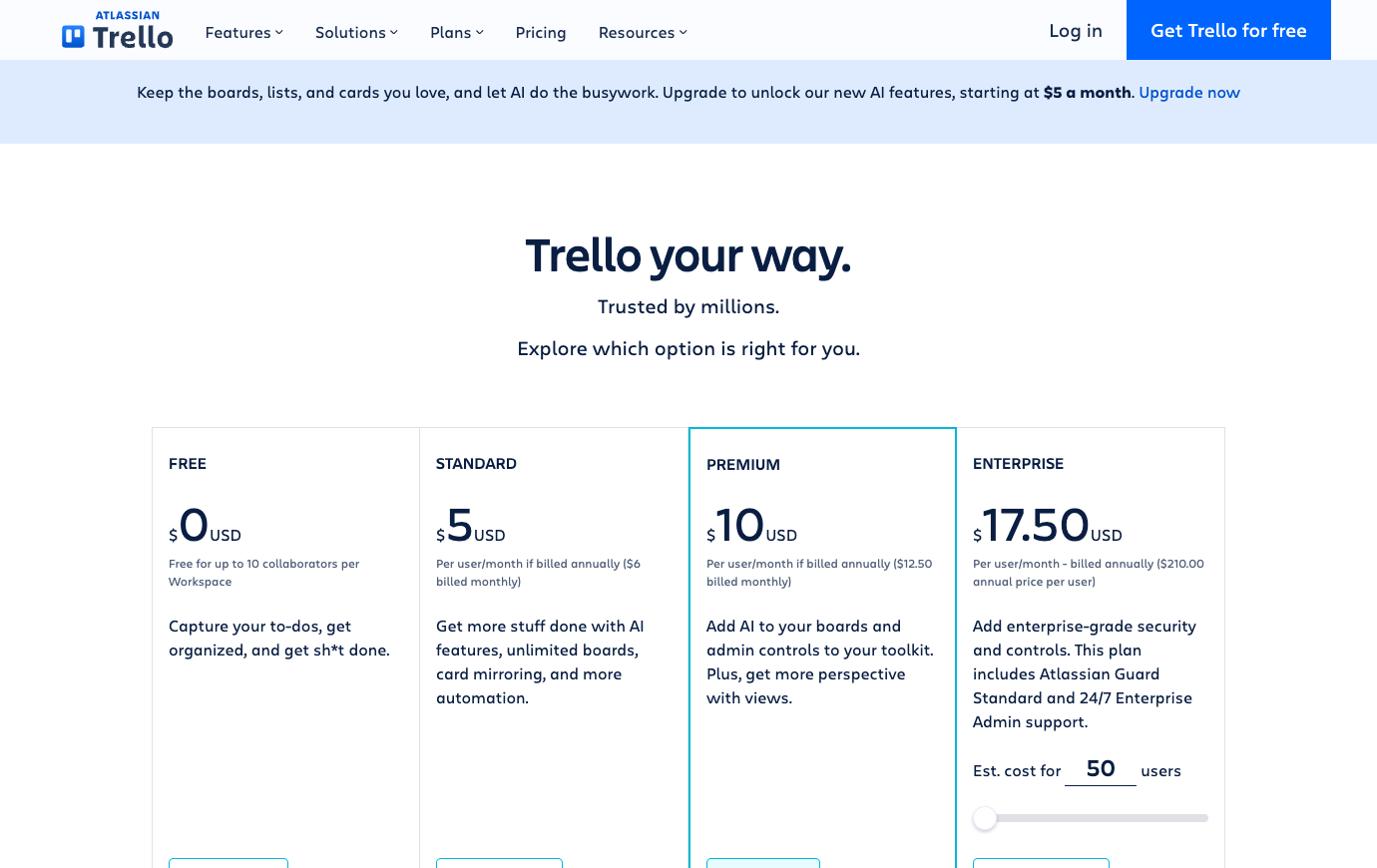
Always consult the official Trello pricing page for the country in which the account will be purchased. Some vendors personalize prices by geography or seat count. Where the public site shows a calculator instead of a fixed amount, we deliberately mark pricing as variable instead of inventing a precise figure. Discounts visible in a screenshot are not promises about your future contract.
🛡️ Security, Governance, Privacy and Exports
For Trello board guest access, invite an outside editor to only one client project and remove the invitation after handoff. A Trello export and backup process should preserve card titles, comments and attachments so completed approvals remain explainable outside the original board. Check where connected Power-Ups store sensitive material.
A useful editorial workflow pilot does not need fictional productivity scores. Create ten sample assignments, deliberately miss one due date and ask a second editor to take over a card while the first is away. Can the replacement find the brief, comments, revisions and final asset? Which state communicates a genuine legal or customer approval? If these answers remain buried in attachments or chat, the board is only a visual front end to confusion. A small set of conventions can often improve the result more than another paid subscription tier.
⚠️ Limitations, Hidden Costs and Failure Modes
The costs of Trello do not stop at its published seat price. Free simplicity can become a limitation for teams needing aggregated reporting. Check these buying risks against the actual edition and your own requirements.
1. Cross-board reporting has limits
Trello’s simplicity can become restrictive when leadership needs a reliable picture across several projects. Before buying Premium for extra views, ask whether the team maintains assignees, due dates and labels consistently. A cross-board chart built on inconsistent card states adds a layer of presentation without improving decisions.
2. Cards without real completion criteria
Cards accumulate quickly when closing criteria are vague. An editorial team should be able to point to the approved draft, scheduled date and owner of a published item; ‘Done’ alone is too weak. Archive completed work deliberately and define when a card is reopened after legal or client feedback.
3. Power-Ups: permissions and paid add-ons
Power-Ups can turn a lightweight board into a series of third-party data flows. Review what each integration can read, whether it stores attachments externally and who pays for its advanced functions. Test removal of one Power-Up so the team knows whether critical context survives without it.
4. Rules that stop at usage caps
Automation can silently stop delivering expected results when plan quotas or rule permissions change. Run an overdue-card case and inspect the activity history rather than assuming an enabled rule is functioning. Every automation should have someone who notices failure; nobody benefits from a perfectly arranged board of unassigned stalled cards.
5. Premium views versus daily needs
Calendar and timeline views appeal to managers, but their usefulness depends on whether a shared schedule is actually necessary. A team working only from one daily Kanban board may not need Premium. Compare the work of updating the card and reporting the same date elsewhere before purchasing another planning surface.
6. Duplicate work across Trello, Jira and Asana
When Trello and Jira or Asana coexist, a customer request may acquire multiple statuses and owners. Define which system is authoritative for engineering work, which is for nontechnical planning, and how the handoff happens. Without that boundary, another board increases copy-and-paste rather than visibility.
⚖️ Trello vs Alternatives
A small editorial team can operate effectively with just lists, cards and an agreed definition of Done. To test whether that remains enough, add a delayed legal review, an external editor and a correction to a previously published article. Each card needs a single owner, a link to its approved asset and a way to see a blocked publication date. If the team begins creating spreadsheets to aggregate those delays, it may need structured dependencies or reporting rather than more Power-Ups on the same board.
Compare Trello vs Asana dependencies on an actual approval-heavy campaign and note which manual steps remain. In Trello vs Jira issue tracking, engineering traceability may be more important than a friendly visual board. Trello alternatives are appropriate when the system requires stronger release controls, aggregated resources or detailed governance than a lightweight Kanban workflow provides.
Compare Trello with Asana or monday.com without assuming every team needs portfolio dashboards. For an agency with three concurrent client calendars, ask whether cross-board reporting is important enough to justify a higher subscription. For a software team already on Jira, determine whether Trello would simply duplicate the same issues in friendlier packaging. The best argument for Trello is the lowest sensible coordination overhead. Reject it when the work cannot be represented without hidden fields, manual copying between boards or missed dependencies.
| Product | Where it may be preferable | Buying question |
|---|---|---|
| Trello | The documented core workflow evaluated in this review | Does it measurably reduce your biggest current bottleneck? |
| Asana | More structured dependencies, forms and portfolios. | Would this replace an existing paid seat or add another system? |
| monday.com | Flexible operational boards and reporting. | Would this replace an existing paid seat or add another system? |
| Jira | Stronger issue workflows for engineering and release management. | Would this replace an existing paid seat or add another system? |
🧪 A Responsible Thirty-Day Evaluation Plan
As the studio grows, cross-client planning becomes a more serious concern. Premium views and automation may help, but only if a producer can answer when a particular designer becomes overloaded and which approval is actually blocking delivery. Simulate a missed deadline, a departed contractor and an exported client board. Check whether the task owner can recover context without the original employee’s private files. If the organization already pays for Jira or Asana, require an explicit explanation for why duplicate Trello cards add value. A low per-seat sticker price does not offset the cognitive cost of maintaining two identical inventories of work.
Days 1–3 — baseline and requirements
Start the Trello evaluation with a baseline of five sample editorial kanban requests. Assign someone to record current completion time, missing information and repeat questions. The baseline matters because a successful pilot must improve an observed handoff, not just create a cleaner workspace.
Days 4–7 — permissions and procurement
Price the actual Standard and Premium plans for your country and planned license count. For Trello, check external access separately. Confirm cancellation, data export and the authorization required for any paid AI usage before inviting more employees.
Week 2 — real but controlled tasks
Run a controlled small-team hiring pipeline scenario in Trello: A recruiter tracks applicants only after privacy, permissions and retention rules have been checked. Create one realistic problem, one correction and one handoff under a non-admin account. A screenshot is not proof of success; ask another person to reconstruct the final decision without private explanations.
Week 3 — integrations and handoff
Use a safe integration case involving automation. In Trello, confirm what happens when two edits conflict, a notification fails, or a collaborator leaves. Document which system holds the authoritative version instead of copying the same status into multiple tools.
Week 4 — decision and exit test
Compare your Trello trial with the old process and Asana. For a multi-team launch, Asana’s dependency and portfolio views may justify the extra complexity. Ask the requester and operator to identify what genuinely improved, then export the sample materials, record the subscription terms and decide whether a limited rollout is warranted.

Frequently Asked Questions
What is Trello best used for?
The strongest use case is visual Kanban boards for teams that want a lightweight shared task view with minimal onboarding effort. Consider it when the team is struggling with that specific outcome, then verify whether existing software already provides enough of the same functionality.
Does Trello offer a free plan?
The current published starting tier is Free ($0). Free versions may limit collaborators, history, functionality or number of workspaces. Check the official feature table for the exact restrictions in your region.
What is the cheapest paid Trello plan?
The first listed paid reference is Standard at $5 per the current vendor page, with these caveats: USD/user/month billed annually; review latest checkout. Confirm regional tax, seat count and renewal before payment.
Can I pay monthly rather than annually for Trello?
Term options vary. The published information notes USD/user/month billed annually; review latest checkout. Do not confuse an annual-commitment monthly equivalent with a month-to-month subscription. Inspect the actual checkout.
Is Trello suitable for a remote team?
It may be a good fit for small or moderately sized groups that need clear cards, due dates, lists and repeatable handoffs. A remote trial should validate access from approved devices, external participants, time-zone handoffs, notifications and the location of durable decisions.
What feature should I evaluate first in Trello?
Start with boards, lists and cards. Cards provide visible states that nontechnical users understand quickly. Name the exit criteria for each list. A useful trial also includes permission and offboarding checks.
What is a common limitation of Trello?
Free simplicity can become a limitation for teams needing aggregated reporting. Treat this as a purchase risk to verify, not as a claim of firsthand failure. The exact impact depends on your team size and chosen edition.
How does Trello compare with Asana?
Asana supports structured dependencies, request forms and portfolio views, while Trello favors simpler boards. Select a representative workflow and evaluate both candidates with the same participant roles, retention expectations and costs.
Can external collaborators work with Trello?
Access policies depend on the selected tier and whether a person is a member, guest or viewer. Test invitation scope, deletion of access and whether external people consume billable seats.
Are AI features included with Trello?
Availability and usage limits are plan-specific. Review premium views; do not assume an unlimited allowance from a marketing label. Check credit or request limits and security policies.
What should we verify before buying Trello?
Confirm official pricing, account roles, data export, required integrations, license minimums, renewals and the real outcome of a small pilot. A written owner should sign off on the decision.
🎯 Final Verdict: Who Should Choose Trello?
Trello is particularly useful for small and midsize teams that need clear cards, due dates, lists and predictable handoffs. It is less suitable for large portfolio programs requiring detailed resource planning and complex task dependencies. Its most convincing benefit would be a documented improvement in the work that currently causes missed handoffs, duplicate effort or avoidable switching.
Use a limited pilot, insist on a written cost estimate and compare one credible alternative. The current vendor plan page should settle any price ambiguity. The objective is not to own the broadest possible software stack; it is to build a workflow where responsibility, documentation and communication are easy to find.
Our methodology: This review is written from public vendor documentation and transparent illustrative decision scenarios. The 2026 price references and both product screenshots were inspected on October 26, 2026. We did not log into a paid account or conduct private first-hand benchmark tests, and nothing here constitutes a guaranteed quote or security certification.
EXPLORE NEXT ON DIGIOFFLY
Build a Smarter Team Software Stack
Use focused reviews and our comparison tools to separate essential collaboration subscriptions from duplicated functionality.
Plan & organize
- Notion review — Compare docs, wikis and linked project databases.
- ClickUp review — Consider tasks, views and team execution.
- Airtable review — Explore connected records and shared workflows.
- Softr review — Build a client-facing portal on structured data.
- Compare workflow automation and no-code tools — See when you need a dedicated workflow builder instead of another task board.
Communicate & decide
- Loom review — Record asynchronous walkthroughs for teammates.
- Otter.ai review — Evaluate meeting transcripts and follow-ups.
- Grammarly review — Improve collaborative writing and editing.
- Microsoft Copilot review — Review productivity AI and licensing limits.
- Explore creator and streaming software — Connect Loom-style async walkthroughs with recording and editing workflows.
- Browse AI & Tech reviews — Evaluate AI writing, transcription and Microsoft Copilot alternatives.
Compare your software stack
- Software Directory — Discover our full software catalog.
- Compare Software — Check tools side by side by actual use case.
- Software Cost Calculator — Estimate monthly versus annual commitments.
- Best Value Advisor — Identify potential overlap before another purchase.
- Explore Growth software — Connect project delivery with CRM, outreach and marketing workflows.
- Productivity & Collaboration reviews — Compare the complete team software shortlist.
- Asana review — See when deadlines, dependencies and approvals justify a fuller project tool.
- monday.com review — Compare dashboard and automation options for growing workflows.