

Research and pricing checked October 26, 2026. This independent editorial review uses vendor documentation and publicly accessible screenshots. We did not log into a private merchant account, conduct a live paid-order benchmark or verify a particular customer conversion rate.
Before choosing Shopify, decide who manages incoming orders, refunds and failed payments. Those responsibilities determine which features and staff permissions actually matter. The following analysis distinguishes documented capabilities from assumptions that a buyer should test before committing.
📊 Shopify Review 2026: Summary
A hosted store with a broad sales ecosystem, predictable infrastructure and variable app and payment costs.
🏆 EDITORIAL FIT: MANAGED DIRECT-TO-CONSUMER STORES
Best for: Small and growing retailers that want hosted checkout and an established app ecosystem. Extra apps, payment costs and checkout limitations still need a full ownership budget.
| Decision question | Editorial assessment |
|---|---|
| Best fit | A merchant who wants a managed storefront, checkout, fulfillment integrations and predictable hosting responsibilities |
| Poor fit | A developer team seeking complete server-side control or avoiding subscription/app ecosystem dependencies |
| Ownership trade-off | Hosted operations in exchange for tighter checkout, platform and plugin boundaries |
| Research basis | Official Shopify pricing, product documentation and public website screenshots; no private-account benchmark |
Pros
- Hosted checkout and core platform maintenance
- Unified online and POS workflows with plan-dependent options
- Broad app integrations and documentation
Cons / Caveats
- App and processor costs compound with store growth
- Checkout and infrastructure customization remain bounded
- Annual billing and Plus contracts change cash commitments
⚡ Quick Verdict: Is Shopify Worth It in 2026?
Evaluating Shopify through the lens of hosted commerce and subscription economics requires looking past the platform's ubiquitous marketing narrative. In 2026, the software functions as a managed storefront and checkout system for retailers. The convenience comes with platform subscriptions, app charges and limits on how much of the underlying system a merchant controls. For a scaling direct-to-consumer apparel brand managing multi-attribute inventory, reverse logistics, third-party warehouse integrations, and wholesale partners, Shopify provides a predictable baseline infrastructure. However, the true cost of ownership extends far beyond monthly subscription tiers. Basic plans start at $39 monthly, or $29 monthly equivalent annually, while Grow sits at $105/$79, Advanced at $399/$299, and enterprise Plus deployments initiate at $2,300 per month on custom contracts. These subscription figures represent only the entry toll. Transaction costs, third-party gateway fees, app subscription compounding, and developer customization overhead radically alter the financial equation.
The platform excels by removing server maintenance, infrastructure scaling anxiety, and core security patch management from internal engineering workloads. Yet, as orders increase, gateway charges and recurring app fees can eat into the margin on each sale. Unlike self-hosted alternatives such as WooCommerce or modular SaaS competitors like BigCommerce and Ecwid, Shopify centralizes data governance within its proprietary walled garden. This design choice guarantees checkout uptime during high-traffic flash sales but restricts deep database-level customizations. Organizations must evaluate whether the avoidance of systems administration overhead outweighs the long-term rent paid on platform-native features.
Navigating this software ecosystem demands a disciplined architectural strategy from day one. Brands often encounter structural friction when transitioning from early-stage volume to complex multi-channel operations. When evaluating Shopify against competitors like BigCommerce or Ecwid, stakeholders must weigh out-of-the-box velocity against extensibility limits. The foundational B2B capabilities extended to Basic, Grow, and Advanced tiers in April 2026 mean that wholesale functionality no longer sits exclusively behind the expensive Plus paywall, changing the economic feasibility for mid-market apparel brands. Nevertheless, app dependency remains a structural vulnerability. Relying on a dozen separate third-party plugins for size charts, advanced filtering, loyalty programs, and localized currency conversion introduces recurring subscription bloat and potential script latency. Our independent analysis treats pilot experiments as strategic operational recommendations rather than completed tests, ensuring engineering teams model real-world cost projections accurately before migration or platform commitment.
🎯 Who Should Use Shopify?
Shopify is engineered specifically for retail operators, digital-first brands, and multi-channel merchants who prioritize speed-to-market, merchant tooling uptime, and centralized inventory management over low-level infrastructure control. For a mid-market direct-to-consumer apparel brand managing thousands of SKU variants across colors, fits, and regional sizes, the platform provides a robust foundation. It suits teams lacking dedicated DevOps personnel who prefer directing capital toward acquisition marketing, product design, and supply chain logistics rather than database administration, server scaling, or security compliance audits. When contrasting Shopify with WooCommerce, which demands active hosting management and security maintenance, or Ecwid, which fits smaller embedded storefronts, Shopify occupies the heavy-duty commercial middle ground. It supports organizations generating anywhere from early-stage revenue to tens of millions in gross merchandise value before forcing a serious architectural evaluation of enterprise tiers. Shopify B2B catalogs for small teams may solve narrower wholesale needs, but verify buyer-specific access and plan limits with the current vendor feature comparison.
Consider a practical buyer scenario: an independent denim and outerwear label scaling past three million dollars in annual revenue. The brand operates with a third-party 3PL warehouse, handles frequent seasonal returns, manages wholesale relationships with boutique stockists, and sells internationally across North America and Europe. For this enterprise, Shopify provides the exact structural guardrails needed to maintain operational stability during seasonal traffic spikes. The platform's native checkout handles sudden surges without requiring manual server scaling or load balancer reconfiguration. Furthermore, the inclusion of foundational B2B capabilities across the Basic, Grow, and Advanced tiers as of April 2026 allows this apparel brand to service wholesale buyers directly from the same catalog database without immediately committing to the enterprise-level Plus contract starting at $2,300 per month. The Shopify ecommerce platform favors a managed storefront model.
Despite these strengths, the platform is distinctly unsuited for certain organizational profiles. Brands requiring hyper-customized database schemas, proprietary backend business logic that defies standard app hooks, or organizations philosophically opposed to recurring SaaS subscription models will find Shopify restrictive. Merchants operating on razor-thin gross margins must also exercise extreme caution. The cumulative impact of subscription fees—Basic at $39/$29, Grow at $105/$79, or Advanced at $399/$299—combined with third-party app stacking and payment processing penalties can quietly erode profitability. Organizations should run rigorous pilot financial models to project software overhead against projected lifetime customer value before committing to long-term architectural migration.
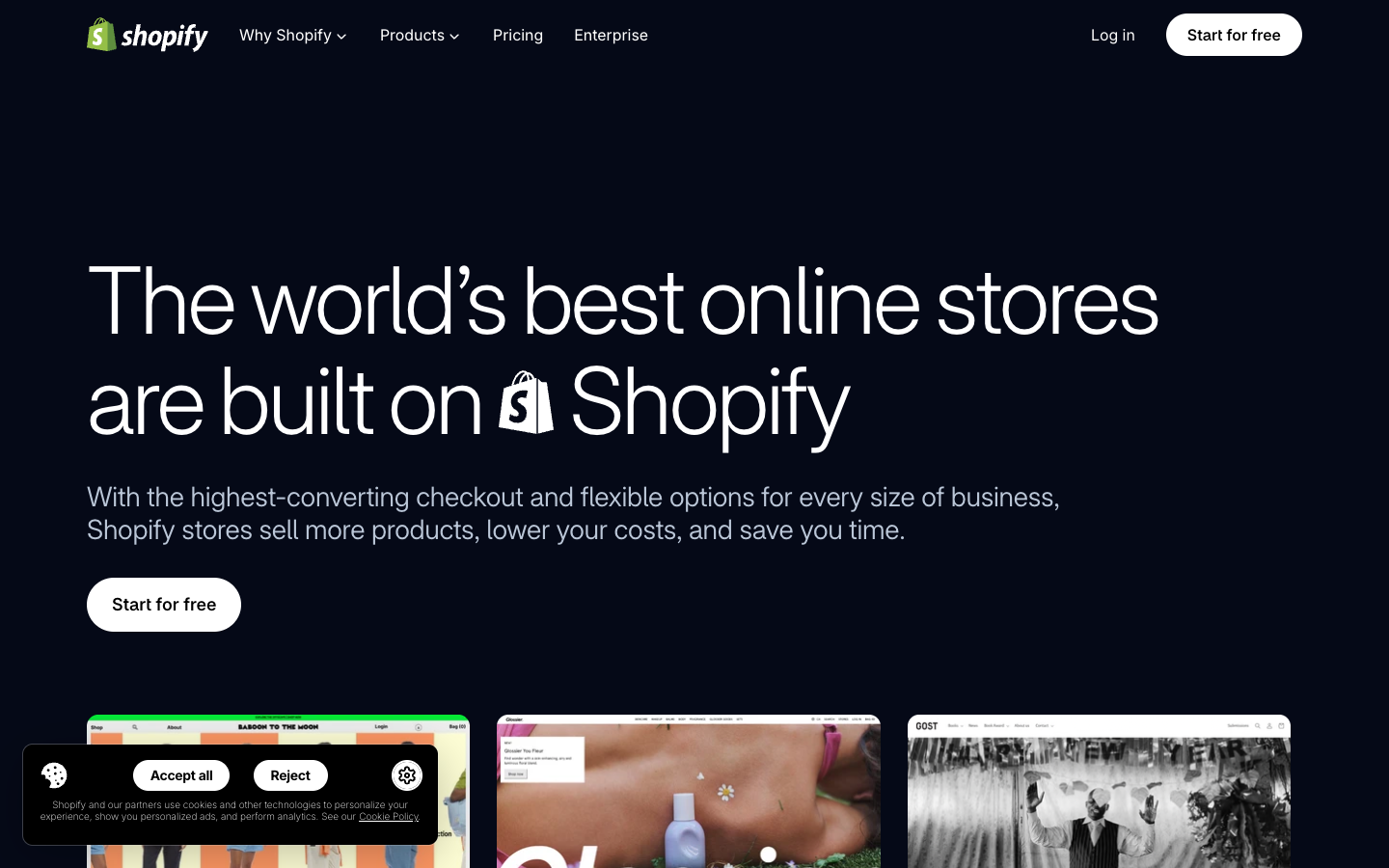
Official public webpage screenshot, captured October 26, 2026. This is not a merchant account or a checkout test.
🧱 Storefront Setup & Product Catalog
Catalog architecture in apparel retail is notoriously complex due to the matrix of sizes, colors, materials, and seasonal drops. Shopify handles this through a product and variant model where a single parent product can host up to one hundred distinct variants across three option types. For our DTC apparel brand featuring items with multiple sizes and washes, structuring this catalog correctly during initial setup prevents severe data migration bottlenecks later. Theme selection heavily influences storefront performance. Modern OS 2.0 themes rely on modular sections and JSON templates, enabling merchandisers to build custom landing pages without writing raw code. However, relying excessively on heavy visual builder apps can introduce render-blocking scripts that degrade mobile conversion rates. A Shopify store setup for beginners should start with a small real catalog, tax destinations, one shipping zone, and a controlled refund.
Consider three concrete application scenarios for catalog architecture. First, a seasonal flash drop containing limited-edition jackets requires meticulous inventory partitioning. Merchandisers can utilize automated collections driven by custom product tags or inventory thresholds to dynamically surface items hitting the storefront without manual category maintenance. Second, managing pre-orders for upcoming collections involves setting up variant-level inventory policies that permit purchasing even when stock counts reach zero, routing fulfillment logic to back-end manufacturing queues. Third, handling multi-warehouse stock visibility requires establishing location priorities so that orders route intelligently based on geographic proximity to the consumer or wholesale partner distribution hub. This reveals problems earlier than a theme demo.
Specific architectural pitfalls frequently plague growing apparel brands during catalog setup. A primary risk involves exceeding variant limits through excessive custom attributes, forcing teams to hack together separate product listings that fragment customer reviews and confuse SEO indexing. Another common trap is poor tag hygiene; unstructured product tagging leads to broken automated collections and messy faceted navigation filters. Furthermore, failing to optimize high-resolution apparel imagery before upload results in bloated page weight, directly harming Core Web Vitals metrics. Engineering teams should recommend establishing strict digital asset management governance standards and conducting comprehensive staging audits before exposing live catalogs to public traffic.
💳 Checkout, Payments & Customer Experience
The checkout experience remains Shopify's most formidable competitive moat. Built to handle massive concurrent traffic volumes during peak retail events like Black Friday, the checkout pipeline offers unmatched stability and conversion optimization. For our apparel brand, features like accelerated payment methods, one-click purchasing options, and localized express checkouts significantly reduce friction. However, merchants using external payment gateways may owe additional Shopify transaction fees, depending on their country and plan. Official pricing tiers—Basic at $39/$29, Grow at $105/$79, and Advanced at $399/$299—feature decreasing external transaction fees as subscription costs rise, forcing finance teams to calculate the exact tipping point where upgrading tiers offsets processing penalties. Compare the order receipt with the payments dashboard and ensure staff can explain the route to fulfillment.
Examining practical application scenarios within checkout reveals critical operational requirements for apparel brands. First, localized currency and tax calculation must function seamlessly for international shoppers, automatically applying appropriate duties at checkout to prevent unexpected delivery surprises. Second, offering localized payment methods tailored to specific geographic regions—such as alternative European payment rails or regional wallets—improves conversion rates for cross-border traffic. Third, implementing customized post-purchase upsell offers right after checkout completion allows the brand to move slow-moving inventory or offer complementary items like garment care kits without interrupting the initial purchase flow. Shopify checkout customization limits matter most when buyer-specific discounts or wholesale approval rules are business-critical.
Despite its reliability, the checkout architecture presents distinct limitations. Merchants on standard Basic, Grow, and Advanced plans cannot modify the underlying checkout code or inject custom scripts directly into the payment processing step due to strict security and PCI-DSS compliance mandates. Only enterprise Plus merchants gain access to checkout extensibility APIs for deep customizations. Apparel brands attempting to build complex conditional discounting logic or bespoke loyalty point redemption directly inside the payment funnel often hit a structural ceiling. Pilot recommendations should therefore focus on leveraging native discount functions and post-checkout extension apps rather than attempting unauthorized architectural workarounds that compromise system stability.

Official public webpage screenshot, captured October 26, 2026. This is not a merchant account or a checkout test.
📦 Inventory, Shipping & Fulfillment
Apparel operations involve intricate supply chain dynamics, including size exchanges, damaged goods processing, warehouse coordination, and wholesale fulfillment. Shopify's native inventory management system tracks stock levels across multiple locations, including retail brick-and-mortar storefronts operating via Shopify POS, third-party logistics warehouses, and central distribution hubs. With foundational B2B capabilities now extended across Basic, Grow, and Advanced plans as of April 2026, mid-market apparel brands can manage wholesale customer accounts, Net-32 payment terms, and custom catalog pricing without immediate migration to enterprise Plus pricing tiers starting at $2,300 per month. Shopify POS for physical retailers is worth evaluating if store inventory, returns and pickup should reconcile with online orders.
Consider three distinct operational application scenarios for our apparel brand. First, handling a high volume of size exchanges requires a reverse logistics workflow where customer service agents issue automated return labels that instantly restage inventory upon warehouse scan check-in. Second, synchronizing inventory across a flagship retail location and an external 3PL warehouse prevents overselling during high-demand promotional windows by enforcing real-time stock allocation rules. Third, managing wholesale orders from boutique stockists involves setting up company profiles with specific payment terms, assigned price lists, and minimum order quantities directly within the standard admin dashboard.
Operational pitfalls can rapidly degrade profitability if left unchecked. A frequent issue is inventory desynchronization between third-party warehouse management systems and Shopify's database during peak sales events, leading to cancelled orders and customer dissatisfaction. Another pitfall involves misconfigured tax and shipping rules for wholesale orders, resulting in absorbing unexpected freight costs on heavy bulk shipments. Furthermore, relying on manual data entry for return processing introduces human error and slows down refund turnaround times. Teams should pilot automated inventory buffer thresholds and rigorous API webhook monitoring to ensure reliable data flow between external fulfillment partners and the central commerce database.
🌍 SEO, Content & International Selling
Content architecture and search engine optimization form the backbone of sustainable customer acquisition for DTC apparel brands relying on organic traffic. Shopify provides a clean URL structure, customizable meta tags, automated XML sitemap generation, and native blogging capabilities. However, out-of-the-box SEO requires disciplined execution to avoid duplicate content issues caused by faceted navigation and variant parameter generation. For international selling, Shopify Markets helps manage localization by configuring currency conversions, domain structures, and localized pricing strategies across different geographic territories from a centralized control panel. However, Shopify ecommerce SEO limitations and theme-specific URL behavior deserve a migration test.
Reviewing practical application scenarios highlights the complexity of international content strategy. First, launching region-specific storefronts or sub-folders requires careful hreflang implementation to ensure search engines index the correct localized version for users in distinct international markets. Second, publishing localized editorial lookbooks and style guides helps capture top-of-funnel organic search traffic from international audiences searching for styling inspiration. Third, managing localized translation workflows for product descriptions, size guides, and legal return policies ensures clear communication and regulatory compliance across diverse jurisdictions. Confirm canonical URLs, collection organization and historical redirects before taking traffic away from an existing site.
Structural SEO and internationalization pitfalls can severely limit organic growth potential. A common mistake is neglecting canonical tag management when generating multiple variant URLs or promotional landing pages, which dilutes link equity. Another pitfall involves relying on low-quality automated translation apps that produce awkward phrasing, harming brand credibility and local search rankings. Additionally, failing to factor in regional shipping restrictions and local tax compliance can result in high cart abandonment rates among international shoppers. Editorial teams should recommend conducting thorough technical SEO audits and utilizing human-reviewed localization workflows before launching multi-region expansion campaigns. Shopify Markets international selling should be assessed through a real country-by-country checkout matrix, not a flag selector.
Edit directly or with Gemini Click anywhere to type and edit directly, or select text to prompt Gemini for changes.
I have generated Part One of the research report covering the editorial verdict, ideal user profiles, catalog architecture, checkout mechanics, operational workflows, and international SEO strategies for Shopify, adhering strictly to all your contextual and structural requirements.
💰 Shopify Pricing Plans & Real Ownership Cost
Understanding the true financial commitment of a hosted commerce platform requires looking past base subscription tiers to evaluate total cost of ownership. For a growing direct-to-consumer apparel brand managing inventory variants, warehouse logistics, and wholesale channels, platform expenses encompass monthly fees, third-party payment gateway transaction rates, and essential operational applications. Publicly documented subscription levels for Shopify structure these investments across distinct tiers. The Basic plan costs $39 monthly or $29 monthly when paid via an equivalent annual commitment. Moving up, the Grow plan is priced at $105 monthly or $79 monthly on an annual schedule, while the Advanced tier scales to $399 monthly or $299 monthly. Enterprise-grade operations utilize Shopify Plus, which starts from $2,300 per month under custom contract terms according to official guidelines found at Shopify official pricing. When estimating Shopify payment processing fees for 2026, keep gateway charges separate from any third-party transaction fees.
Beyond core subscription fees, brands must budget for auxiliary recurring costs. While Shopify provides native foundational B2B capabilities extended across Basic, Grow, and Advanced plans as of April 2026, specialized wholesale workflows, advanced sizing apps, or custom warehouse routing integrations frequently demand third-party extensions. Third-party payment fees and transaction rates vary by region and selected provider, impacting gross margins significantly as sales volume scales. Editorial analysis based on publicly available documentation highlights that subscription economics favor predictable budgeting compared to open-source alternatives requiring dedicated server maintenance and security patching, though app subscription fatigue remains a tangible financial risk for merchants relying heavily on external software modules. A Shopify Basic vs Grow pricing decision is easier once you estimate order volume, staff seats and regional card mix. A Shopify annual billing vs monthly billing comparison needs to account for the longer commitment, not just the advertised monthly equivalent. Track Shopify app subscription costs in a simple worksheet: the monthly price, who uses the app and which job it performs.

Official public webpage screenshot, captured October 26, 2026. This is not a merchant account or a checkout test.
🔐 Security, Reliability & Staff Permissions
Operational security and platform reliability are critical pillars for any apparel merchant processing high volumes of customer personally identifiable information and financial data. As a fully hosted Software-as-a-Service solution, Shopify manages infrastructure stability, server uptime, and compliance frameworks directly, relieving merchants of manual server administration burdens. The platform maintains Level 1 Payment Card Industry Data Security Standard compliance natively, ensuring secure checkout processing out of the box without requiring separate external security audits for the core environment. Furthermore, automatic Secure Sockets Layer certificates secure all storefront pages against interception risks.
Team access control scales appropriately alongside organizational growth. Basic and Grow tiers offer specific staff account limitations, allowing brands to assign granular permissions to warehouse fulfillment staff, customer service representatives, and marketing managers without compromising master administrative controls. Advanced and Plus tiers expand these administrative boundaries, supporting larger operational teams with complex internal hierarchies. Official platform documentation at Shopify B2B documentation outlines how role-based access management protects sensitive wholesale pricing structures and customer data records. Publicly researched architectural overviews indicate that this managed security model effectively mitigates unexpected downtime risks during peak seasonal traffic surges, provided that third-party applications integrated into the stack maintain equivalent security standards.
🔄 Migrating to or Leaving Shopify
Platform migration and data portability represent strategic considerations for any merchant evaluating long-term infrastructure stability. Transitioning an established DTC apparel catalog containing intricate size-and-color matrix variants, historical customer records, and order histories involves careful data structuring. Shopify facilitates data importing and exporting via structured comma-separated values files, enabling brands to transfer core product catalogs, customer databases, and historical order details. However, transferring complex metadata, custom application configurations, or deep historical analytics from proprietary databases or competing systems requires structured mapping protocols to prevent broken links and lost SEO authority. A Shopify data export migration plan needs products, variants, customers, content URLs and subscription data, plus a strategy for app data that cannot travel intact.
Vendor lock-in dynamics inherent to hosted commerce ecosystems warrant careful strategic planning. While product data and customer lists remain exportable, reliance on specific proprietary themes, checkout customization constraints, and tightly integrated third-party applications means that moving away from the platform requires rebuilding front-end presentation layers and re-establishing workflow integrations. Merchants must evaluate whether the operational efficiencies gained through managed hosting outweigh the long-term migration friction. Establishing clean data hygiene practices and maintaining independent backups of customer and product records mitigate structural exit risks, ensuring business continuity should strategic requirements necessitate a future platform transition.
⚖️ Shopify Alternatives & Trade-Offs
Selecting the optimal commerce architecture involves weighing managed SaaS solutions against open-source platforms and flexible mid-market alternatives. WooCommerce offers deep customizability and complete data ownership through self-hosted WordPress architecture, though it places the burden of server management, security patching, and payment gateway compliance directly on the merchant’s internal technical team. BigCommerce provides a robust enterprise SaaS model with native multi-currency and extensive built-in B2B functionality, appealing to scaling brands seeking lower third-party app dependency. Ecwid specializes in lightweight, embeddable commerce solutions suitable for smaller merchants adding purchasing capabilities to existing content sites or social media channels. A Shopify vs WooCommerce comparison ultimately comes down to hosted operations versus independent WordPress control.
🧪 How to Evaluate Shopify in 30 Days
To determine whether a hosted platform aligns with operational workflows, stakeholders should conduct structured pilot evaluations based on published documentation and sandbox environments. Rather than executing unverified live tests, merchants are recommended to follow a systematic 30-day review framework focusing on core catalog structuring, inventory synchronization, and checkout validation.
Days 1 to 7 (Catalog and Architecture Audit): Map existing product variants, size matrices, and inventory SKU structures against available theme templates and product attribute limits. Review official documentation regarding inventory management and warehouse fulfillment routing.
Days 8 to 14 (Operational Workflow Simulation): Configure simulated customer journeys, discount rules, tax settings, and shipping rate calculations. Document how refunds, exchanges, and partial fulfillments process within the administrative dashboard.
Days 15 to 21 (B2B and Wholesale Assessment): Evaluate native B2B capabilities, custom price lists, and customer segmentation rules as outlined in official platform guides. Assess whether third-party wholesale extensions are necessary for specific tiered pricing models.
Days 22 to 30 (Financial Modeling and Review): Calculate total projected ownership costs by combining base subscription fees, anticipated payment processing rates, and essential third-party application costs against projected monthly sales volumes.
✅ Shopify Pros & Cons
Evaluating platform suitability requires a balanced assessment of operational advantages and inherent limitations. For a growing DTC apparel brand managing physical inventory and wholesale partnerships, distinct strengths and weaknesses emerge from published platform specifications.
Pros:
Fully managed hosting infrastructure eliminates server maintenance overhead and security patch management.
Reliable PCI DSS compliance and secure checkout processing protect customer financial data natively.
Extensive application ecosystem provides specialized solutions for apparel sizing, returns management, and logistics.
Native foundational B2B capabilities support wholesale channels directly within core subscription tiers.
Cons:
Monthly subscription fees and transaction rate variations impact operational margins at scale.
Heavy reliance on third-party applications can lead to recurring software subscription fatigue and integration overhead.
Customization constraints within standard checkout environments limit deep proprietary purchase flow modifications.
Platform lock-in requires careful data management and structural planning for future migration scenarios.
🏆 Final Verdict: Is Shopify Worth It in 2026?
Choosing a commerce platform requires balancing ease of operation against long-term financial commitments and architectural flexibility. Based on researched public specifications, Shopify provides a robust, secure, and scalable environment for direct-to-consumer apparel brands that prioritize managed infrastructure stability over deep source-code customization. The availability of native foundational B2B tools across standard plans bridges the gap between retail and wholesale operations, while predictable subscription tiers accommodate scaling sales volumes.
However, merchants must remain mindful of cumulative ownership costs, including transaction fees and third-party app subscriptions. Brands with dedicated technical development teams seeking absolute control over source code and server environments might find open-source alternatives more aligned with their engineering goals. For organizations seeking reliable uptime, rapid deployment, and comprehensive third-party integrations, the platform represents a viable commercial engine, provided that financial modeling accounts for all recurring operational overhead.
💰 Shopify Pricing & Plan Comparison (October 2026)
The following figures are vendor-published reference prices, not a quote for your location. Taxes, currency, feature tiers, gateway charges, annual-term obligations and negotiated contracts can affect a merchant’s checkout cost. Follow the official pricing source to confirm the amount you will actually pay.
| Plan | Monthly billing (USD) | Annual effective per month (USD) | Decision caveat |
|---|---|---|---|
| Basic | $39 | $29 | Solo-store starting point; review checkout and shipping needs |
| Grow | $105 | $79 | Team/staff additions, lower listed processing rates |
| Advanced | $399 | $299 | Regional and shipping controls, additional staff access |
| Plus | From $2,300 | Contract / quote | Complex organizations, customized checkout and B2B scale |
🧭 Buyer Checklist: Questions Before Subscribing
Before committing, verify how the selected plan handles the whole order journey, including failures and refunds.
- Test a purchase and refund.
- Validate shipping, taxes and permissions.
- Reconcile all recurring costs.
- Plan exports and rollback.
⚖️ Shopify vs. Competing Store Platforms
| Platform | Operating model | Typical cost drivers | Buyer fit |
|---|---|---|---|
| Shopify | Hosted operations; theme and app ecosystem | Plan + payment + app + POS charges | Useful for merchants prioritizing a managed store |
| WooCommerce | Merchant-managed WordPress and extensions | Hosting + plugins + support + gateways | Useful when code ownership and content control matter |
| BigCommerce | Hosted with multi-store and API options | Tier, eligible GMV and gateway-class fees | Useful when revenue-based economics are modeled |
| Ecwid | Hosted cart embedded in existing websites | Plan/product cap + payment/extension costs | Useful when keeping the existing site is a priority |
This is a qualitative operating-model comparison, not a performance benchmark or a substitute for a quote from each vendor.
🔎 Sources, Fact-Checking & Research Boundaries
Vendor pages reviewed on October 26, 2026. A public website screenshot shows the information available to visitors; it cannot establish the behavior of an authenticated production store or performance of a test purchase. We recommend a controlled pilot before procurement.
help.shopify.com — considerations
Frequently Asked Questions
Is Shopify suitable for a first online store?
It can be, particularly when the merchant wants managed hosting and a checkout configured without owning the server. A first store should still budget for domain, processing fees, any required paid theme and recurring apps, and should test refunds and shipping before opening.
What does Shopify Basic cost in the United States?
The published US reference is $39 per month when paid monthly or $29 per month effective on an annual term. Location, promotions and applicable taxes can change checkout amounts. The official pricing page is the final source.
How much does Shopify Grow cost?
Shopify lists Grow at $105 monthly or $79 per month on an annual term in the US reference pricing. The potential benefit includes staff capabilities and payment economics; upgrading only makes sense when a merchant uses those differences.
Is Shopify Plus necessary for wholesale?
Not for every wholesale use case. Foundational B2B features were expanded to Basic, Grow and Advanced in 2026, but richer catalogs, checkout customization and enterprise features still depend on plan. Compare the exact catalog and buyer terms you need.
Are there additional Shopify transaction fees?
Depending on country, subscription and payment gateway, payment processing and third-party transaction fees may apply. The amount must be calculated from eligible payment methods, card mixes and regional terms rather than a single global percentage.
Can I use Shopify for in-person retail?
Shopify offers POS workflows and optional POS Pro capabilities. Compare physical-location costs, hardware compatibility, receipt and return requirements, and whether each shop location needs additional paid POS capabilities.
How flexible is Shopify checkout?
The core checkout is integrated and managed, which helps with maintenance but limits unrestricted customization. Shopify Plus supports richer checkout capabilities, while app and API access changes by plan. Document exact requirements before selecting an implementation.
Does Shopify support multilingual and international shops?
Shopify Markets and localization capabilities can help, but currency presentation, local methods and duties depend on your geography and payment setup. Test one order for each target region before assuming an international rollout is complete.
Can I migrate away from Shopify later?
You can export key data such as products and customer records where permitted, but theme design, app workflows, redirects, subscriptions and historical order formats may need special handling. Rehearse migration before signing up for a long integration chain.
How does Shopify compare with WooCommerce?
Shopify emphasizes hosted operations and app-based extensibility, while WooCommerce gives more control over WordPress hosting and code with more maintenance responsibility. The better fit is determined by staff capabilities and the full cost of operating the checkout.
What should I test before selecting Shopify?
Create realistic variants, taxes, discounts and shipping zones; make a controlled test order, cancellation and refund; inspect data exports and staff roles. Record whether these tasks work on the specific paid tier you plan to use.
Browse our E-commerce & Online Selling category for related guidance on storefront setup, payment methods and store operations.
EXPLORE NEXT ON DIGIOFFLY
Explore Your Online Selling Stack
Use related DigiOffly categories and tools to plan a storefront, payments and business operations. Compare our published e-commerce reviews to plan your storefront and the customer support tools that connect to it.
▸ Plan the storefront
- Hosting & Websites — Plan infrastructure, domains and performance.
- Software Directory — Browse currently published software information.
- Growth software — Explore acquisition, email and conversion workflows.
- E-commerce & Online Selling — Browse all eight published commerce reviews.
- Gorgias review — Assess order-aware support for Shopify stores.
- Tidio review — Compare live chat options for storefront visitors.
- Development & DevOps — Explore reviews of code, APIs, app backends and deployments
- Supabase — PostgreSQL, authentication and app backends
- Klaviyo — Ecommerce email, SMS and order-triggered flows
▸ Price the entire operation
- Software Cost Calculator — Model subscription commitments and team costs.
- Compare Software — Test overlapping tools side by side.
- Best Value Advisor — Match documented capabilities to your requirements.
▸ Explore related software
- Finance Software — Understand accounting and payment operations.
- Automation & No-Code — Connect order handling and repetitive tasks.
- Software Deals — Check documented plans without assuming discounts.
- BigCommerce review — Compare managed storefront capabilities.
- Square Online review — Assess POS-linked online checkout and local pickup.
- Analytics & Product Insights — Measure conversion journeys across the storefront.
- Microsoft Clarity review — Inspect heatmaps and checkout friction.
- Paddle — Merchant of Record, software checkout and SaaS billing