

Editorial note: This independent review analyzes official product documentation, published plan information and decision criteria. Vendor screenshots show public webpages. We do not claim to have completed a private-account hands-on test or guaranteed a particular price.
Instead, consider whether Jira fits your current system of record, staff permissions, procurement terms, administrative resources and ability to leave later. Features and packages change, sometimes within a year, so use the official pricing page as the final authority for your region before checkout.
📊 Jira Review 2026: Editorial Verdict
| Decision question | Editorial assessment |
|---|---|
| Core use case | Configurable issue tracking and planning for software teams that require reliable workflow states, ownership, releases and traceability. |
| Team it suits | Engineering organizations coordinating bugs, sprint work, changes and production releases. |
| Potential poor fit | A tiny nontechnical team unwilling to configure workflows or learn an issue model. |
| Billing evidence | Vendor pricing — regional/tax/term details can vary |
| Suggested pilot | Two to four weeks, with sample tasks, real roles and exit criteria |
| Research status | Editorial assessment of public documentation; no private-account testing |
👍 What We Love
- ✅ Issues, projects and fields: A well-designed issue captures severity, reproduction and acceptance criteria; unnecessary custom fields add friction.
- ✅ Backlogs, epics and planning: Epics group related outcomes while the backlog supports prioritization and refinement.
- ✅ Automation and integrations: Automations can connect repositories, Slack and deployment systems; monitor execution usage and security scope.
- ✅ Atlassian ecosystem: Confluence, Bitbucket and marketplace apps can extend Jira yet may add separate costs or vendor dependencies.
👎 Where It Falls Short
- ❌ Plan pricing depends on user count and product choices; fixed per-seat numbers can be misleading.
- ❌ Configuration freedom often becomes workflow sprawl without governance.
- ❌ Marketplace apps can add materially to the full recurring bill.
✅ Jira: BUYER FIT AT A GLANCE
Best for: engineering organizations coordinating bugs, sprint work, changes and production releases.
🧠 What Jira Actually Solves
A Jira bug tracking workflow should preserve reproduction steps, reviewer decisions and the release that fixed the defect. For Jira Scrum and Kanban boards, use the team’s genuine delivery rhythm rather than copying a standard sprint template. The issue record is valuable when support can find the outcome after the original developer leaves.
A software company might use Jira as the authoritative trace from a support escalation to a released fix. A well-formed issue records environment, observed behavior, expected behavior and reproduction steps. Engineers link their code change, reviewers confirm the result, and QA verifies the release that contains it. When the release is deployed, customer support can communicate from the same issue reference. That chain is the genuine advantage over scattered chat messages. It must be designed deliberately: a merge event should not declare the issue ‘done’ if the product is still awaiting validation or distribution to customers.
Jira is not a general workplace chat app that happens to have tasks. It is an issue workflow system shaped by software delivery: bugs, stories, epics, releases and decisions about when something may move from one state to another. The initial design of those states determines whether developers spend time on engineering or ticket maintenance. A concise workflow with a genuine review boundary is better than a twelve-step status chain no one follows. Before migrating an engineering organization, agree what ‘ready,’ ‘in progress,’ ‘review’ and ‘done’ mean, and who is permitted to move an issue past each gate.
🛠️ Jira Features: What Matters in Real Team Work
Test Jira workflow transition permissions using a reporter, developer, reviewer and release approver. For Jira automation with GitHub pull requests, ensure a merge does not mark customer-visible work complete before deployment. Detailed status changes are worthwhile only when they enforce a real quality gate.
Scrum and Kanban boards in Jira support different delivery rhythms. A team with predictable short cycles might benefit from sprint planning, while a support and maintenance group often needs a continuous queue. When choosing among boards, resist using story points as calendar-hour guarantees or treating velocity as a competition between employees. The better measurement asks how long an issue waits for triage, review or release, and whether blockers are clearly recorded. Those measures only become meaningful if engineers update ticket status consistently rather than after the sprint review has already started.
Issues, projects and fields
A well-designed issue captures severity, reproduction and acceptance criteria; unnecessary custom fields add friction. Ask the employee responsible for sprint refinement to demonstrate the outcome with synthetic data. When comparing Jira with Linear, check whether Linear’s opinionated issue flow reduces configuration overhead. A different product may be the safer choice if this exact scenario is the team’s dominant work.
Scrum and Kanban boards
When assessing scrum and kanban boards, check how the final record moves between colleagues. Teams can track sprints or continuous flow, but board configuration should reflect one operating cadence. A useful proof is one incident follow-up example whose requester and approver disagree about the final state. Any unverified permission or plan restriction should appear in the procurement notes. Reports depend on consistent issue hygiene.
Backlogs, epics and planning
Consider backlogs, epics and planning before signing a Jira agreement. Epics group related outcomes while the backlog supports prioritization and refinement. Before claiming an improvement, walk through cross-team dependency from the perspective of the colleague who inherits the task. A blocked issue should reference the upstream team and named owner, making stalled decisions visible to everyone involved. Record which edition was used, whether the external participant could see unrelated work, and whether a departing colleague could leave without losing the underlying content.
Jira becomes easier to assess when the organization ties backlogs, epics and planning to a specific approval or handoff. Give an operator a scenario they did not configure beforehand.
Workflow transitions
Permissioned status changes can enforce quality gates but overly complex transitions slow simple work. Keep the first experiment small enough to reverse: The product owner should see severity and reproducible steps before engineering commits capacity to a fix. Look for one human owner and one recoverable final artifact. A chat message alone cannot serve as a durable record of a completed action.
Automation and integrations
The automation and integrations capability looks simple when viewed in isolation, but it has dependencies. Automations can connect repositories, Slack and deployment systems; monitor execution usage and security scope. During the trial, let a guest perform only the authorized portion of sprint refinement. Set a limit for repeat notifications and automatic actions; the organization should know who can change that limit and where failed actions can be inspected.
Dashboards and reporting
A team may encounter dashboards and reporting first during onboarding, not during a vendor comparison. Cycle time and cumulative flow only tell the truth if every ticket is updated reliably. Populate the pilot with realistic documents, permissions and handoffs. Try this realistic scenario: A production incident creates an action register with owners and links to operational evidence. At review time, compare the resulting artifact with the previous process. Do not award Jira credit for basic good project hygiene that could be achieved with a simpler tool.
Atlassian ecosystem
Look at how the Atlassian ecosystem changes the next step in the workflow. Confluence, Bitbucket and marketplace apps can extend Jira yet may add separate costs or vendor dependencies. Find out which step of cross-team dependency would have been invisible in the previous system. Before release, QA and engineering should agree on one issue key for the blocker and link the upstream dependency directly. When external contractors connect Atlassian apps, assess the named account, sharing link, retention rule and export path separately.
Jira becomes easier to assess when the organization ties the Atlassian ecosystem to a specific approval or handoff. Give an operator a scenario they did not configure beforehand. Reports depend on consistent issue hygiene.
Security and administration
Security and administration deserve scrutiny because not every invited colleague has the same rights. SSO, data residency, audit and governance differ by plan and organization structure. Set an owner for the artifact created during bug intake to release. At release handoff, QA should be able to open the original defect, verification evidence and deployment record. An honest conclusion will depend on the exact user role and deployment, not a marketing claim about unlimited collaboration. Reports depend on consistent issue hygiene.
A second look at security and administration should involve the person who will administer Jira after the original champion leaves. Inspect the output after a correction, a changed owner and an expired invitation. Decide which evidence—permissions, timestamps, exports or an invoice line—would confirm success, and preserve it in a short internal decision memo.
🧭 Four Practical Jira Workflows
The Jira pricing calculator can be more accurate than a copied per-seat figure because charges vary by plan, user count and selected products. Standard, Premium and Enterprise should be compared for the particular organization’s need for governance, automation and support, not for a generic desire to upgrade. Consider the separate costs of Confluence, marketplace extensions and Atlassian Guard features that may appear in a mature deployment. The first-year bill may be substantially different from the headline price for Jira alone. Trial an access configuration with the same user roles the organization expects to license.
Bug intake to release
Support files a reproducible issue, triage assigns severity, engineering works under an owner and QA verifies the linked release. The next participant should be able to identify the approved version, read the reason for the last change and act under their own account permissions. This is not evidence that Jira was privately benchmarked: it is a repeatable test design for a buyer. Marketplace apps can add materially to the full recurring bill.
In the bug intake to release exercise, the test report for Jira should name the outgoing and incoming owner. Use a realistic permissions scheme: an issue reporter may not be authorized to approve a production deployment. Nonengineering participants may find the interface heavy.
Sprint refinement
Imagine a colleague arrives halfway through sprint refinement and must finish without asking the original author. A product owner groups work into epics and estimates effort without treating story points as guaranteed calendar hours. To keep the test fair, provide the same sample brief in competing software and time the point where the reviewer can understand ownership. Permissioned status changes can enforce quality gates but overly complex transitions slow simple work. Record not only what looked convenient but also the uncertainty that would block rollout. Nonengineering participants may find the interface heavy.
Incident follow-up
Use incident follow-up as a way to test the actual collaboration boundary in Jira. A production incident creates an action register with owners and links to operational evidence. Document what happens when the usual approver is absent, a guest loses access, or a deadline changes. Cycle time and cumulative flow only tell the truth if every ticket is updated reliably. A success condition should be specified before someone chooses their favorite interface. Reports depend on consistent issue hygiene.
The incident follow-up scenario offers a chance to check information continuity, not merely the number of features available in Jira. Permission, export and data residency requirements need explicit verification.
Cross-team dependency
A cross-team dependency walkthrough has to be more demanding than moving a sample card across a demo board. Teams use a shared issue key and tracked dependencies instead of relying on email threads for blocking decisions. Check whether the result can be exported and whether the workflow survives removal of the employee who initially created it. SSO, data residency, audit and governance differ by plan and organization structure. The final artifact belongs in the system the organization has declared authoritative, not in a second shadow list. Permission, export and data residency requirements need explicit verification.
💰 Jira Pricing in 2026: Plans and Billing Caveats
A Jira Standard vs Premium pricing comparison should use the vendor’s actual user-count calculator and required capabilities. Include Jira Marketplace app costs when an extension is essential to reporting or administration. Jira Standard vs Premium differs by governance and support needs, not by whether tickets can have a title and assignee.
A reproducible bug ticket is a useful test of product value. Give a tester a problem description with environment, steps, expected behavior, actual behavior and an attachment. Engineering should be able to triage severity, link a code change, route review and record which release resolves the problem. If the process still depends on a private message explaining where the fix went, Jira has not become the dependable record its subscription is meant to fund. The issue should survive staff turnover without losing the reasoning behind a release decision.
| Edition / plan | Published reference price | Billing and eligibility notes |
|---|---|---|
| Free | $0 | eligible small-team tier; published limits vary |
| Standard | Variable | official calculator varies with user count; inspect checkout |
| Premium | Variable | official calculator varies with seats and billing |
| Enterprise | Custom | annual enterprise terms via sales |
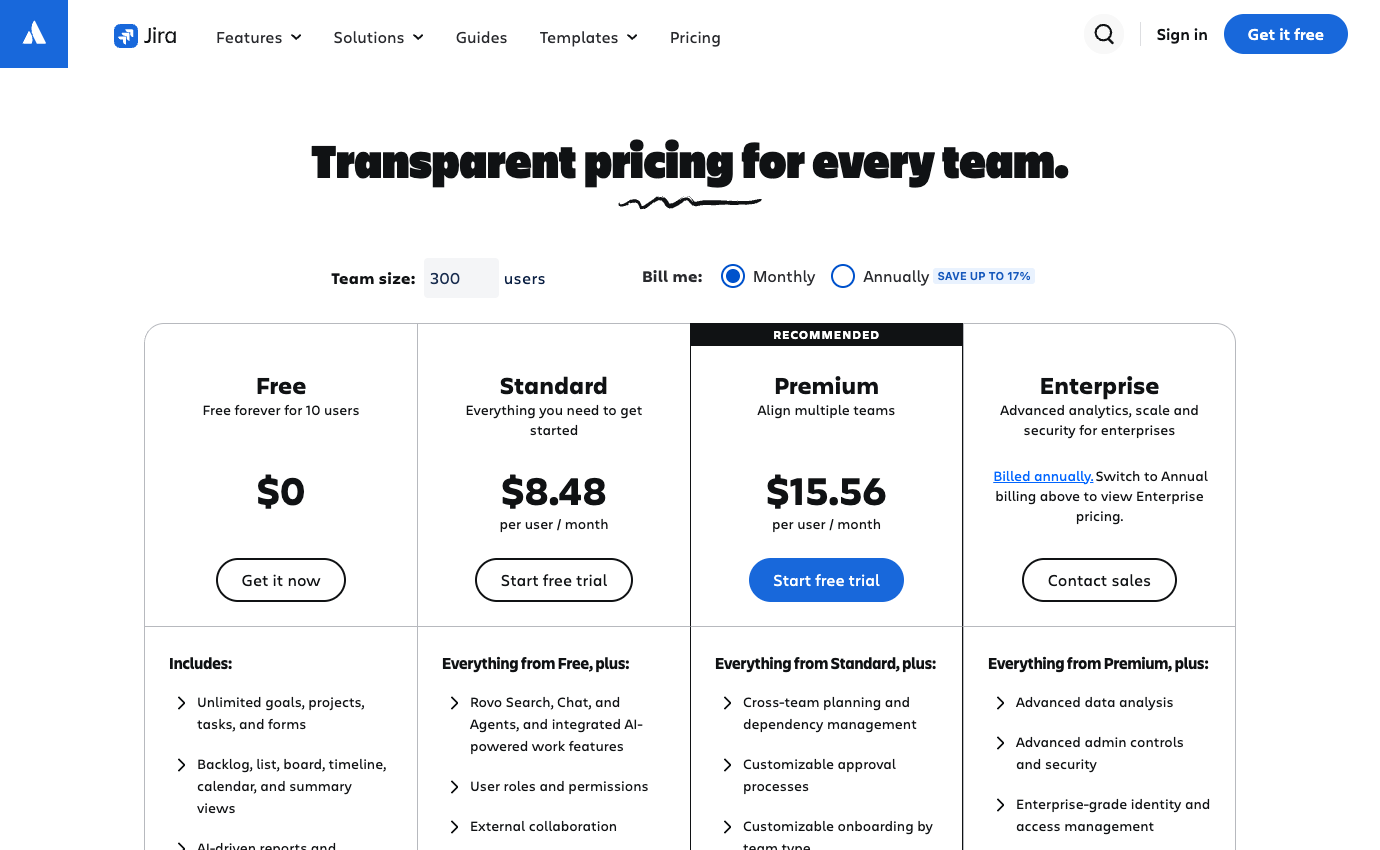
Always consult the official Jira pricing page for the country in which the account will be purchased. Some vendors personalize prices by geography or seat count. Where the public site shows a calculator instead of a fixed amount, we deliberately mark pricing as variable instead of inventing a precise figure. Discounts visible in a screenshot are not promises about your future contract.
🛡️ Security, Governance, Privacy and Exports
Review Jira project access for external contractors and the visibility of sensitive defect information. A Jira audit log and data retention requirement should be documented before teams import historical incidents. Deprovisioning a developer should not remove the code review links or release notes needed by QA and support.
The surrounding Atlassian ecosystem is both a reason to choose Jira and a source of complexity. Confluence can hold design decisions, Bitbucket or GitHub may supply code context, and marketplace apps can add specialized views. Decide which source owns the requirement and which integrations only reference it. An automatic transition after a pull-request merge may be convenient, but it can mark an issue complete before quality assurance or deployment. Automation rules therefore need explicit triggers, failure handling and auditability, especially in regulated delivery processes.
⚠️ Limitations, Hidden Costs and Failure Modes
The costs of Jira do not stop at its published seat price. Plan pricing depends on user count and product choices; fixed per-seat numbers can be misleading. Check these buying risks against the actual edition and your own requirements.
1. Custom-field and workflow overhead
Jira makes it possible to add more issue fields and statuses than a small team should use. A good starting point is the evidence QA actually needs: reproduction steps, severity, environment and acceptance criteria. Do not make every reporter fill in a long form if missing details can be gathered at triage.
2. A sprint board can hide bad data
A sprint board is only trustworthy when tickets represent real work and closure rules are consistent. Cross-check the backlog with deployed fixes, not merely with the number of issues moved to Done. The extra administration of custom workflows is justified only if it enforces a necessary review or release gate.
3. Marketplace cost and integration dependency
Marketplace apps can fill a genuine reporting or test-management gap, but they also affect cost, permissions and migration complexity. Inventory every add-on that appears in a proposed implementation. Ask what breaks if one is disabled or if its vendor stops supporting the current Jira version.
4. Automations before verified release
An automation tied to repository events can create confusing status transitions if code is merged before it reaches production. Specify the actual release condition and check the integration’s permissions. A notification is useful; an automatic ‘resolved’ state that hides an unshipped fix is not.
5. Reporting tiers need reliable inputs
Premium administration and reporting are worth considering when teams have reliable data. Buying them does not produce good cycle-time numbers if tickets sit in the wrong column for days. Trial the exact cross-team dashboard against a known incident history before using analytics to justify another license tier.
6. Security and residency requirements
An established organization may have security and residency obligations that change the appropriate Jira plan or hosting assumptions. Confirm SSO, provisioning, audit and data policy requirements against the product edition, and account for the work of maintaining custom fields and groups. The software price is only one component of that operational burden.
⚖️ Jira vs Alternatives
For an engineering team receiving customer defects, auditability begins with a reproducer, an affected version and evidence of verification after the fix ships. Set up a ticket that is merged into the main branch but not yet deployed. If an automation marks it Resolved at merge, customer support may falsely tell a client that the defect has been fixed. A trustworthy Jira workflow separates merged code from a verified production release, connects the release note and makes the owner of final QA unmistakable.
In a Jira vs Linear agile workflow trial, compare the same bug, cross-team dependency and sprint handoff. A Jira alternative for small development teams could have a lighter setup, but may lack required custom transitions or enterprise controls. Jira agile project management works best when configuration serves traceability rather than replacing engineering work with administration.
Linear and Jira should not be compared by merely counting keyboard shortcuts or fields. Linear favors a streamlined issue model, while Jira allows deeper customization and a broad established ecosystem. Some teams thrive with constraints; others have genuine governance requirements that demand specialized workflows and approvals. Pilot the same real defect, sprint planning session and cross-team dependency in both. Include a new employee and a reviewer without administrator rights. The winning system is the one that makes the engineering record clearer without adding enough bureaucracy to slow delivery.
| Product | Where it may be preferable | Buying question |
|---|---|---|
| Jira | The documented core workflow evaluated in this review | Does it measurably reduce your biggest current bottleneck? |
| Linear | Lighter developer-focused workflow with opinionated defaults. | Would this replace an existing paid seat or add another system? |
| Trello | Simpler board collaboration for nontechnical teams. | Would this replace an existing paid seat or add another system? |
| Asana | Better cross-functional projects outside engineering. | Would this replace an existing paid seat or add another system? |
🧪 A Responsible Thirty-Day Evaluation Plan
A Jira procurement review should separately examine configuration cost. Teams can create many workflows and custom fields, but those require owners and make migrations harder. Standard and Premium price calculators vary with seats and term; Confluence, administrative identity features and marketplace extensions may be additional line items. Give a new engineer a sample bug to process and ask them to identify which statuses are mandatory, which fields are redundant and how to query an old release decision. A lightweight team may prefer Linear; a large organization with genuine audit, approvals and cross-project dependencies may justify Jira’s flexibility. Neither conclusion follows from the raw count of issue types or integrations.
Days 1–3 — baseline and requirements
Start the Jira evaluation with a baseline of five sample bug intake to release requests. Assign someone to record current completion time, missing information and repeat questions. The baseline matters because a successful pilot must improve an observed handoff, not just create a cleaner workspace.
Days 4–7 — permissions and procurement
Price the actual Standard and Premium plans for your country and planned license count. For Jira, check external access separately. Confirm cancellation, data export and the authorization required for any paid AI usage before inviting more employees.
Week 2 — real but controlled tasks
Run a controlled sprint refinement scenario in Jira: A product owner groups work into epics and estimates effort without treating story points as guaranteed calendar hours. Create one realistic problem, one correction and one handoff under a non-admin account. A screenshot is not proof of success; ask another person to reconstruct the final decision without private explanations.
Week 3 — integrations and handoff
Use a safe integration case involving workflow transitions. In Jira, confirm what happens when two edits conflict, a notification fails, or a collaborator leaves. Document which system holds the authoritative version instead of copying the same status into multiple tools.
Week 4 — decision and exit test
Compare your Jira trial with the old process and Linear. Linear can suit a development team that values a lightweight issue workflow. Ask the requester and operator to identify what genuinely improved, then export the sample materials, record the subscription terms and decide whether a limited rollout is warranted.

Frequently Asked Questions
What is Jira best used for?
The strongest use case is configurable issue tracking and planning for software teams that require reliable workflow states, ownership, releases and traceability. Consider it when the team is struggling with that specific outcome, then verify whether existing software already provides enough of the same functionality.
Does Jira offer a free plan?
The current published starting tier is Free ($0). Free versions may limit collaborators, history, functionality or number of workspaces. Check the official feature table for the exact restrictions in your region.
What is the cheapest paid Jira plan?
The first listed paid reference is Standard at Variable per the current vendor page, with these caveats: official calculator varies with user count; inspect checkout. Confirm regional tax, seat count and renewal before payment.
Can I pay monthly rather than annually for Jira?
Term options vary. The published information notes official calculator varies with user count; inspect checkout. Do not confuse an annual-commitment monthly equivalent with a month-to-month subscription. Inspect the actual checkout.
Is Jira suitable for a remote team?
It may be a good fit for engineering organizations coordinating bugs, sprint work, changes and production releases. A remote trial should validate access from approved devices, external participants, time-zone handoffs, notifications and the location of durable decisions.
What feature should I evaluate first in Jira?
Start with issues, projects and fields. A well-designed issue captures severity, reproduction and acceptance criteria; unnecessary custom fields add friction. A useful trial also includes permission and offboarding checks.
What is a common limitation of Jira?
Plan pricing depends on user count and product choices; fixed per-seat numbers can be misleading. Treat this as a purchase risk to verify, not as a claim of firsthand failure. The exact impact depends on your team size and chosen edition.
How does Jira compare with Linear?
Linear offers a lighter development workflow with opinionated defaults, while Jira supports deeper configuration. Select a representative workflow and evaluate both candidates with the same participant roles, retention expectations and costs.
Can external collaborators work with Jira?
Access policies depend on the selected tier and whether a person is a member, guest or viewer. Test invitation scope, deletion of access and whether external people consume billable seats.
Are AI features included with Jira?
Availability and usage limits are plan-specific. Review the Atlassian ecosystem; do not assume an unlimited allowance from a marketing label. Check credit or request limits and security policies.
What should we verify before buying Jira?
Confirm official pricing, account roles, data export, required integrations, license minimums, renewals and the real outcome of a small pilot. A written owner should sign off on the decision.
🎯 Final Verdict: Who Should Choose Jira?
Use a limited pilot, insist on a written cost estimate and compare one credible alternative. The current vendor plan page should settle any price ambiguity. The objective is not to own the broadest possible software stack; it is to build a workflow where responsibility, documentation and communication are easy to find.
Our methodology: This review is written from public vendor documentation and transparent illustrative decision scenarios. The 2026 price references and both product screenshots were inspected on October 26, 2026. We did not log into a paid account or conduct private first-hand benchmark tests, and nothing here constitutes a guaranteed quote or security certification.
EXPLORE NEXT ON DIGIOFFLY
Build a Smarter Team Software Stack
Use focused reviews and our comparison tools to separate essential collaboration subscriptions from duplicated functionality.
Plan & organize
- Notion review — Compare docs, wikis and linked project databases.
- ClickUp review — Consider tasks, views and team execution.
- Airtable review — Explore connected records and shared workflows.
- Softr review — Build a client-facing portal on structured data.
- Compare workflow automation and no-code tools — See when you need a dedicated workflow builder instead of another task board.
- Freshdesk review — Compare customer ticket intake with developer issue tracking.
- Development & DevOps — Explore reviews of code, APIs, app backends and deployments
- GitHub — Source hosting and repository governance
- GitLab — Merge requests and CI/CD workflow
Communicate & decide
- Loom review — Record asynchronous walkthroughs for teammates.
- Otter.ai review — Evaluate meeting transcripts and follow-ups.
- Grammarly review — Improve collaborative writing and editing.
- Microsoft Copilot review — Review productivity AI and licensing limits.
- Explore creator and streaming software — Connect Loom-style async walkthroughs with recording and editing workflows.
- Browse AI & Tech reviews — Evaluate AI writing, transcription and Microsoft Copilot alternatives.
Compare your software stack
- Software Directory — Discover our full software catalog.
- Compare Software — Check tools side by side by actual use case.
- Software Cost Calculator — Estimate monthly versus annual commitments.
- Best Value Advisor — Identify potential overlap before another purchase.
- Explore Growth software — Connect project delivery with CRM, outreach and marketing workflows.
- Productivity & Collaboration reviews — Compare the complete team software shortlist.
- Linear review — Compare engineering issue cycles with Jira backlog and workflow controls.
- Asana review — Consider how non-engineering stakeholders track delivery and approvals.